
Recession has yet to appear
And Janet has signaled, ‘all clear’
But many still worry
She’s in quite a hurry
To help Biden’s prospects this year
One key to this outcome, surprising
Has been oil’s price is not rising
Now, why would that be
If strong ESG
Intentions force drilling downsizing?
This note is a departure from my daily missive as I wanted to address a bigger picture concern regarding the evolution of the US, and global, economy. I would contend that one of the underlying theses that has been part of the market narrative for quite a while is that there is a finite supply of oil and hydrocarbons available beneath the surface and that since all the easy stuff has already been found, the cost of extraction is going to rise and push the oil price higher along with those costs. I’m confident that if you have paid any attention to the discussion, you will have heard about peak oil being forecast (the IEA just claimed it will occur in 2030, although that was pushed back from 2028 in last year’s report) and a theory known as Hubbard’s peak theory, which explains that once an oil field has produced half its reserves, its ability to continue to produce at previous levels is dramatically reduced, thus reducing output.
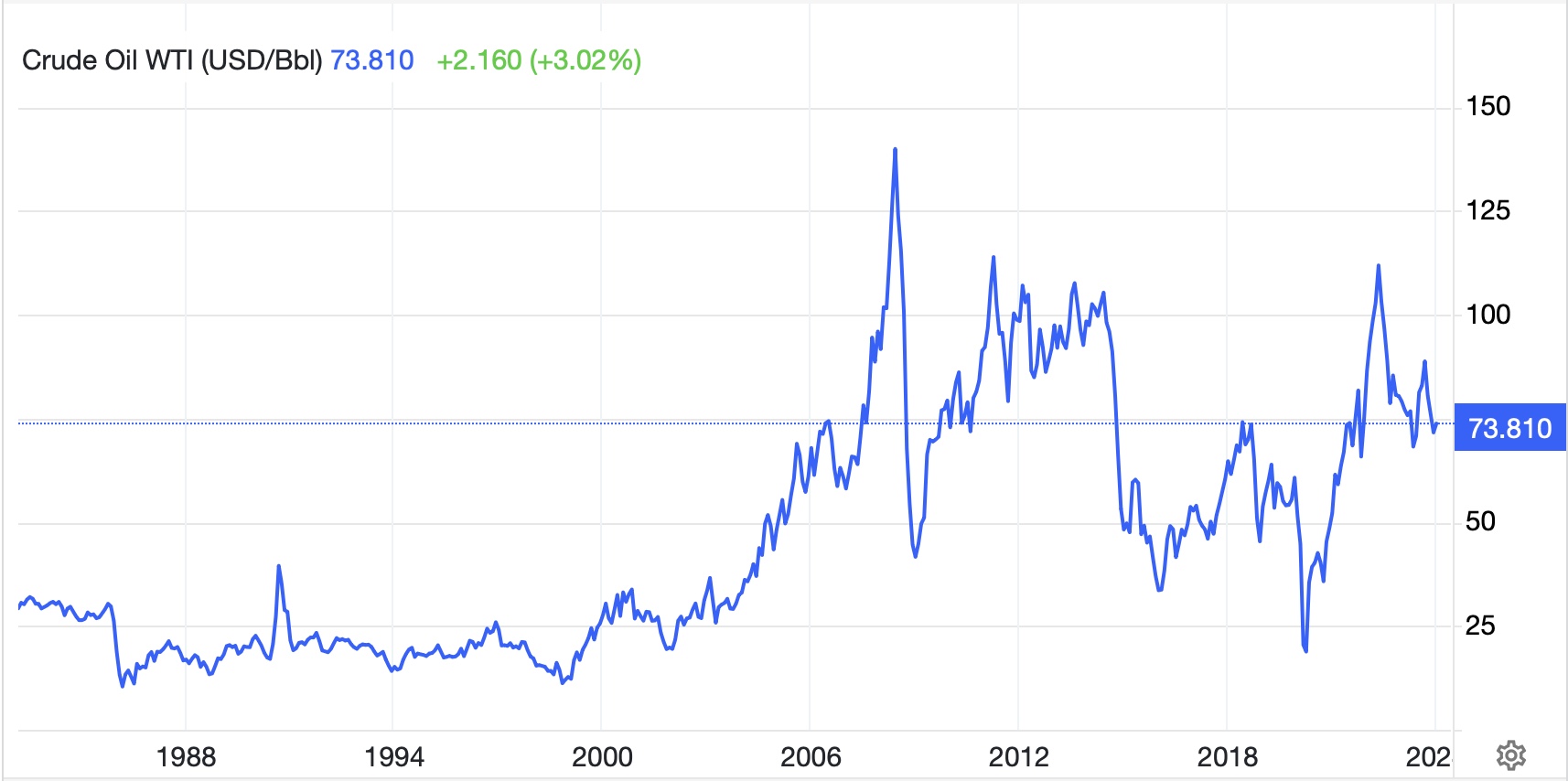
In fact, this was a cornerstone of my mental model regarding inflation and the economy for the past several years. Forgetting for a moment that oil prices are quite volatile as can be seen in the below long-term chart from tradingeconomics.com, one can argue that the broader trend has been for higher oil prices.
As such, if oil prices, and the concurrent price for all types of energy, was going to continue to rise, it seems difficult to believe that inflation would stabilize. After all, energy is an input into virtually every part of the economy and if oil was rising, stable inflation would require deflation in other areas. Now, during the past twenty odd years, with China’s entry into the WTO and the broader global economy, their rapid expansion clearly weighed on the price of manufactured goods. But I believe it is a fair assessment to say that factor is currently dissipating and will continue to do so going forward as evidenced by the significant rise in populist politics around the world. After all, a key part of populism is the inward-looking aspect, supporting domestic activity and shunning imports in an effort to keep jobs in the home country.
With this as a baseline thesis, the question at hand is what can change this view? Well, I recently read a terrific article and listened to a very interesting podcast with an analyst who goes by the name of Doomberg. Doomberg made some really great points about some little-known features of the oil and gas markets which tend to be ignored or glossed over, but which are ultimately very important. Arguably, the most important was to recall that technology improvements are not simply made by Apple and Microsoft, but by energy firms as well, and they have been improving their efficiency in extracting oil and oil products dramatically. Perhaps the number that will really blow your mind is that the US, by itself, is currently producing ~20 million barrels/day of oil and oil-type products (usually described as Natural Gas liquids or NGLs) which makes the US by far the largest producer of energy on the planet, dwarfing Saudi Arabia and Russia. And despite all the efforts by those who are desperate to end oil production completely, these numbers are almost certainly going to continue to grow as cheap energy is the most critical feature to develop a growing economy and improve living standards.
The fact that the US economy continues to plug along and avoid recession, and the fact that despite very real concerns over an escalation of the fighting in the middle east and what that might do to the short-term supply of oil, the price of oil is trading far closer to recent lows than highs, indicates to me that there is a great deal of truth in this view. In fact, I have become persuaded that I need to adjust my world view accordingly. You know what they say about new information and changing your mind.
So, I am going to rough out a new mental model with this new information on the key input to economic activity, the price of energy, and see how I think things may evolve over time.
The first thing to note is that global growth, writ large, is likely to outperform current estimates going forward. After all, if cheap energy becomes more widely available, then the billions of people who live in Africa, Asia and Latin America who subsist on minuscule amounts of energy each day are going to see substantial improvements in their lives. (Of course, I cannot account for the political machinations which may prevent this, but I believe that no matter how inept or corrupt these governments are, some portion will get through to the population.) The upshot of this is emerging market economies are likely to grow at a more rapid clip which will require more resources and feed through to more economic activity around the world. While there will be constraints on this growth eventually, for the next several years at least, and probably for a decade or more, I expect that the story will be a large net positive.
But perhaps more importantly for a more current economic outlook, the availability of relatively cheap energy is going to be a huge boon for the developed world. For instance, the below graph explains a great deal about the current situation in Germany with respect to the fact that it is experiencing a recession and the fact that the populist, right-wing AfD political party is making huge gains in the polls.

Energy intensive industry that had been built on the back of cheap natural gas imported from Russia has been fleeing the country with major companies building facilities in the US to take advantage of the fact that natural gas prices in the US are <$3.00/mmBTU while in Europe they remain above $9.00/mmBTU although they have fallen from their highest levels last year. Consider, though, what will happen if the abundance of cheap energy about which I am hypothesizing becomes reality. Suddenly, many more countries, even those without their own natural supplies of energy, will be able to take advantage of the benefit of cheap energy. If we know one thing it is that all the energy produced will be consumed in some manner, and the cheaper the cost of production, the more widely spread will be its availability.
I highlight Germany as an illustration of what will almost certainly occur worldwide. In other words, reducing the cost of the key input into virtually all economic activity, namely energy, is going to support a very real increase in that activity.
As to the inflation story, here too, much of the blame falls on political efforts to control certain sectors of an economy or to show favor to others, which impedes appropriate price discovery. And that will never change, I fear. However, it becomes much easier to believe that if we eliminate a key plank of the long-term inflation narrative, namely resource constraints driving prices higher, that general price inflation will have far less staying power.
Putting this together leads to a very different, and much more positive, outcome than I had envisioned previously, and than I believe, many had envisioned. For a given level of nominal GDP growth, more will be real growth and less will be price adjustments, a truly beneficial outcome.
The next question then is how might this impact financial markets going forward? This is always a treacherous question given nobody really knows. But, looking at the four main market segments; interest rates, equities, commodities and FX, here are my first thoughts.
Interest Rates – The first thing to consider is that there is an enormous amount of debt currently outstanding around the world, something on the order of $300 trillion to $350 trillion. The two macroeconomic ways to pay back debt are to inflate it away or to generate sufficient economic activity to outstrip the accumulation of that debt. As my contention is inflation will be lower alongside higher productivity, this is a sea change in thinking. While I had always expected inflation to be the likely course, this opens the possibility for growth to do the work. While debtors typically like inflation, especially governments, this new paradigm is likely to be even more effective. Net, I expect that the general level of interest rates will decline somewhat everywhere as higher productivity should help creditworthiness as well as governments. Faster real economic activity should generate more tax revenues and reduce issuance from that perspective thus easing the oversupply problem.
Equity markets – This outcome should be a net long-term benefit for equity markets as the underlying aspect is that economic growth should accelerate. However, while companies may perform well at the bottom line, equity markets are a function of the underlying company and the value multiple that investors place on those companies. Right now, valuations remain far higher than long term historical values. For instance, the current Shiller Cyclically Adjusted PE Ratio (CAPE) is at 31.78. This compares to a mean of 17.07 and median of 15.96 over the past 150 years. While improved productivity on the back of cheaper energy is likely to raise the appropriate level for this statistic, it still appears quite richly valued. For instance, if 20.00 is a more appropriate price multiple in this new world, which would be a 25% increase on the median, the market is still massively overvalued. As such, equity prices might still decline despite this good economic outcome. However, I would say that given emerging market, and even European market pricing is much less robust, cheaper and more abundant energy should help those markets dramatically.
Commodities – Here, the tale will be told by the political machinations going forward. By rights, commodity prices everywhere should decline, at least initially, if energy prices decline, if for no other reason than the cost of producing them will decline. However, the ESG mindset remains widespread and there remain a disturbingly large number of people who want to stop all commodity production activity, oil & gas, metals, and even foodstuffs. If this group is able to maintain political power, they can prevent all the possible benefits. But even if we assume they lose power as people decide that improved living standards are more valuable to them than concerns over global warming, the fact that there may be an extraordinary amount of cheaply available energy does not mean there is an extraordinary amount of copper, nickel or aluminum available. At some point, we could see physical constraints manifest themselves, but at least initially, I expect that other commodity prices will follow energy prices lower.
FX – Since FX is a relative game, this outcome is all about the relative adoption of this new paradigm. The first nations to embrace this view and see improved economic activity are likely to see their currencies strengthen as investment flows in. The fact that they will be able to keep interest rates lower will not necessarily hurt these currencies’ value as investors will be flocking to their equity markets and real investments, not looking for currency arbitrage. Of course, at this time, there is no way to know who will embrace this idea and lead the pack, but the US certainly has a head start given it is the source of much of the cheap energy and the concomitant technology driving it. But you can bet that China will get on this bus quickly, once they recognize its existence, and after that, widespread adoption will drive things. In fact, my biggest concern is that the politics will hold back Europe as they remain enthralled by their climate virtue signaling and it may take far longer to change that view. Either that, or a really cold winter with people running out of energy. So initially, I think this is quite dollar supportive, but over time, we will need to see the evolution of the process.
This is the essence of my evolving view, better real economic activity and increased productivity alongside lower inflation on the back of abundant, and therefore, relatively cheap energy is a growing probability in my mind. If this scenario plays out, it will have very real impacts on financial markets, but more importantly on our everyday lives, and for the latter, I expect quite positive impacts. However, given the current state of politics, this transition will likely take much longer in some parts of the world than others. Keep that in mind as you consider these issues. And remember, these are my first takes. I could well be wrong about the market impacts and welcome comments offering different views.
I apologize for the length of this note, but that is why I put it out on a Sunday rather than a weekday!
Good luck
Adf
 fxpoetry