
A landing that’s soft’s now the bet
By many who poo-poo the debt
But deficit spending
Which seems never-ending
Means prices ain’t coming down yet

So, nominal growth may still rise
Inflation, though, will not downsize
And yields on the bond
Are like to respond
By soaring right up to the skies
Fitch downgraded US government debt one notch to AA+ from its previous AAA. Now, only Moody’s rates the US a AAA credit. As per their announcement, their rationale was threefold: “The rating downgrade of the United States reflects the 1) expected fiscal deterioration over the next three years, 2) a high and growing general government debt burden, and 3) the erosion of governance relative to ‘AA’ and ‘AAA’ rated peers over the last two decades that has manifested in repeated debt limit standoffs and last-minute resolutions.”
Let’s forget the political implications and the commentary from the government as it is completely expected. And I am not here to defend or attack the outcome, but rather hope to try to make sense of what they were thinking and how markets are likely to behave.
Regarding the first issue, expected fiscal deterioration over the next three years, that seems a pretty fair point. After all, fiscal deterioration has been consistently getting worse since the turn of the century, the last time we had a budget surplus. In fact, as per the below Bloomberg chart, absent the Covid drama, the current budget deficit, at -8.5% of GDP, is larger than any time other than the GFC. And this is occurring when, not only is there no recession, but GDP seems to be accelerating. In fact, the Atlanta Fed’s GDPNow forecast has jumped up to 3.86%. It seems fair to ask if part of that ‘growth’ is a direct result of deficit spending.

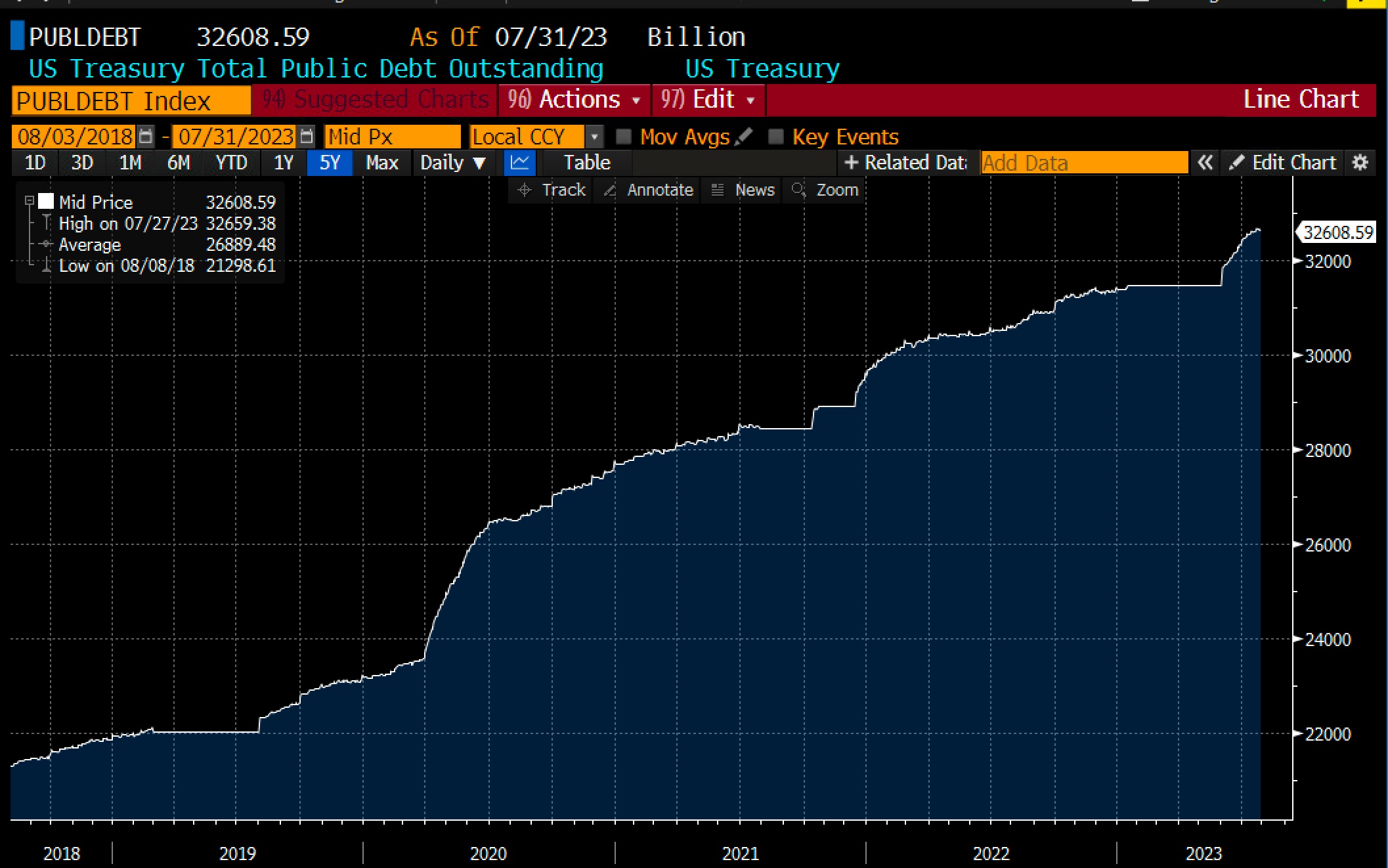
As to point number two, a high and growing government debt burden, that also seems like a fair point. Since the debt ceiling was removed, government debt has grown by ~$1.2 trillion in exactly 2 months’ time (see Bloomberg chart below). At the same time, the Treasury just announced they would be issuing $1.9 trillion in new debt during the rest of 2023. Those are pretty big numbers and based on the legislation that was passed last year, the IRA and CHIPS act, as well as the fact that recent tax revenues have been declining, it is reasonable to expect the government debt burden to continue to grow.
Finally, this poet is in no position to judge the relative erosion of governance compared to other nations, but on an absolute basis, it is not hard to argue that governance in the US has diminished, at least fiscal governance, given the political split between the House of Representatives and the Senate/White House.
Of course, this all begs the question, does it matter for markets? Well, we have seen this movie before in 2011 when S&P downgraded the US government credit rating after the last standoff in Congress regarding the debt ceiling. While it was a big deal politically, it actually had limited impact on the markets. In fact, it may fairly be said that it marked the bottom in the equity market and ignited a massive multi-year rally. Can we expect the same thing this time? I would contend the situation now is quite different than back then, with a much higher debt/GDP ratio as well as a much higher level of interest rates. The point is that the government’s fiscal stance is more tenuous now as interest payments on existing debt either start to crowd out other spending or drive deficits even higher, as per Fitch’s point.
Back then, 10-year yields were also much lower, ~2.5%, and the debt/GDP ratio was ~90% as compared to today’s ~120%. In other words, there was a little more flexibility for the government. In fact, following the move, bond yields fell another 100bps over the ensuing year, bottoming at 1.39%, the pre-Covid low. An optimistic reading of that outcome is that investors looked around the world and decided that despite the flaws in the US, it was still the safest place to be. Of course, that low interest rate coincided with the Eurozone debt crisis, so perhaps investors were simply fleeing the euro (the dollar did rally) given those problems.
So far, the reaction has been a downtick in equity markets and little movement in the bond market. But it is not clear to me that either of those moves are directly related to this news. Rather, it is entirely possible that we are starting to see the effects of what Fitch is describing, rather than the effects of Fitch’s move.
For instance, there is a growing perception that a soft landing is going to be the result of the Fed’s policy moves. While inflation has obviously fallen from its highs of last year, the two things that have been driving that, lower commodity prices and base effects in the calculation, are reversing going forward. For instance, oil prices are higher by nearly 17% in the past month while the monthly comparison for CPI in July is just 0.0%, so any inflation at all is going to result in a rise in the Y/Y figure.
Instead, I would contend that the massive fiscal stimulus from the IRA and CHIPS Act are going to continue to drive demand, as well as debt issuance, and continue to pressure inflation higher. While nominal growth may remain firm, inflation will too, so real growth will decline. Arguably, the government needs this outcome in order to devalue their massive debt pile. However, whether this will be a positive for risk assets is a much tougher question. Certainly, bond yields are likely to rise in this scenario, and if that is the case, I suspect equity markets may start to revalue as well. Government spending is not organic economic growth. Instead, it is far less efficient and debt driven, thus underpinning the Fitch viewpoint. I fear that this time, the ratings downgrade may result in a different result than last time, with risk assets suffering as we go forward.
And that was certainly the case last night as equity markets throughout Asia were all in the red, as are European equities this morning. Notable declines were seen in Japan (-2.3%), Hong Kong (-2.5%) and Spain (-1.2%), but it is universal. As to US futures, they are all in the red as well this morning.
As to the bond market, 10-year Treasury yields are back above 4.0%, although they are little changed this morning. Remember, the last several times the 10-year yield has gone above 4%, there have been problems somewhere in the market, with the UK bond meltdown and Silicon Valley Bank’s implosion the most widely remembered. The curve is steepening (really getting less inverted) because long rates are rising, not because the Fed is cutting. If the yield curve heads back to normal with 10-year yields at 5.5%, consider how that will impact equities. It won’t be pretty.
Away from oil prices, base metals are under pressure this morning as well, potentially because China has yet to offer real support to its economy, or potentially because yields continue to rise thus hurting the investment case.
Finally, the dollar is broadly stronger this morning, certainly against the EMG bloc with KRW (-1.1%) and PHP (-0.75%) the laggards, but weakness widespread. Both of those currencies are reacting to fading data and concerns over China’s actions going forward. Meanwhile, in the G10, NOK (+0.45%) and JPY (+0.4%) are the outliers on the high side, with the former following oil while the yen’s move looks to be a trading bounce given the lack of news or rate activity. However, the rest of the bloc is under pressure led by NZD (-0.6%) and AUD (-0.5%) with both sliding alongside the metals markets.
On the data front, ADP Employment (exp 190K) is coming shortly *Flash, ADP +324K* with most analysts anxiously awaiting not only the headline print, but any revision to last month’s extraordinary 497K rise. As to Fed speakers, there are none on the calendar today. All in all, the market will be keenly focused on the ADP especially after mildly softer than expected JOLTS Jobs data yesterday as well as a soft ISM Employment print. There are certainly still hints of an impending recession, but the situation remains very uncertain. Remember this, though, prior to the GFC, the consensus view was that a soft landing was going to be achieved. The same was true in 2001 and as far back as 1980. The only time the Fed successfully engineered that soft landing was in 1994 and I am not of the mind that they are going to be successful this time. It’s just not clear what is going to break first.
Good luck
Adf
 fxpoetry