
Did they sell?  Or not?
The new Mr Yen, Kanda
Explained, “No comment”
As is clear from the chart below (source tradingeconomics.com), there was a bit of movement in the USDJPY market yesterday morning. The price action certainly had the feel of intervention, with a nearly 2% decline that occurred in seconds, but there has been neither confirmation nor denial of any BOJ trading activity. Kanda-san, who is vice minister of international affairs which is the MOF role that deals with the currency, is the current Mr Yen. His comments were certainly cryptic and as such, not very informative. “We will continue with the existing stance on our response to excessive currency moves,” said Kanda. “While we are basically like a Gulliver in the market, we’re also coming and going as a market player, so usually we won’t say whether or not we’ve intervened each time,” Kanda said.
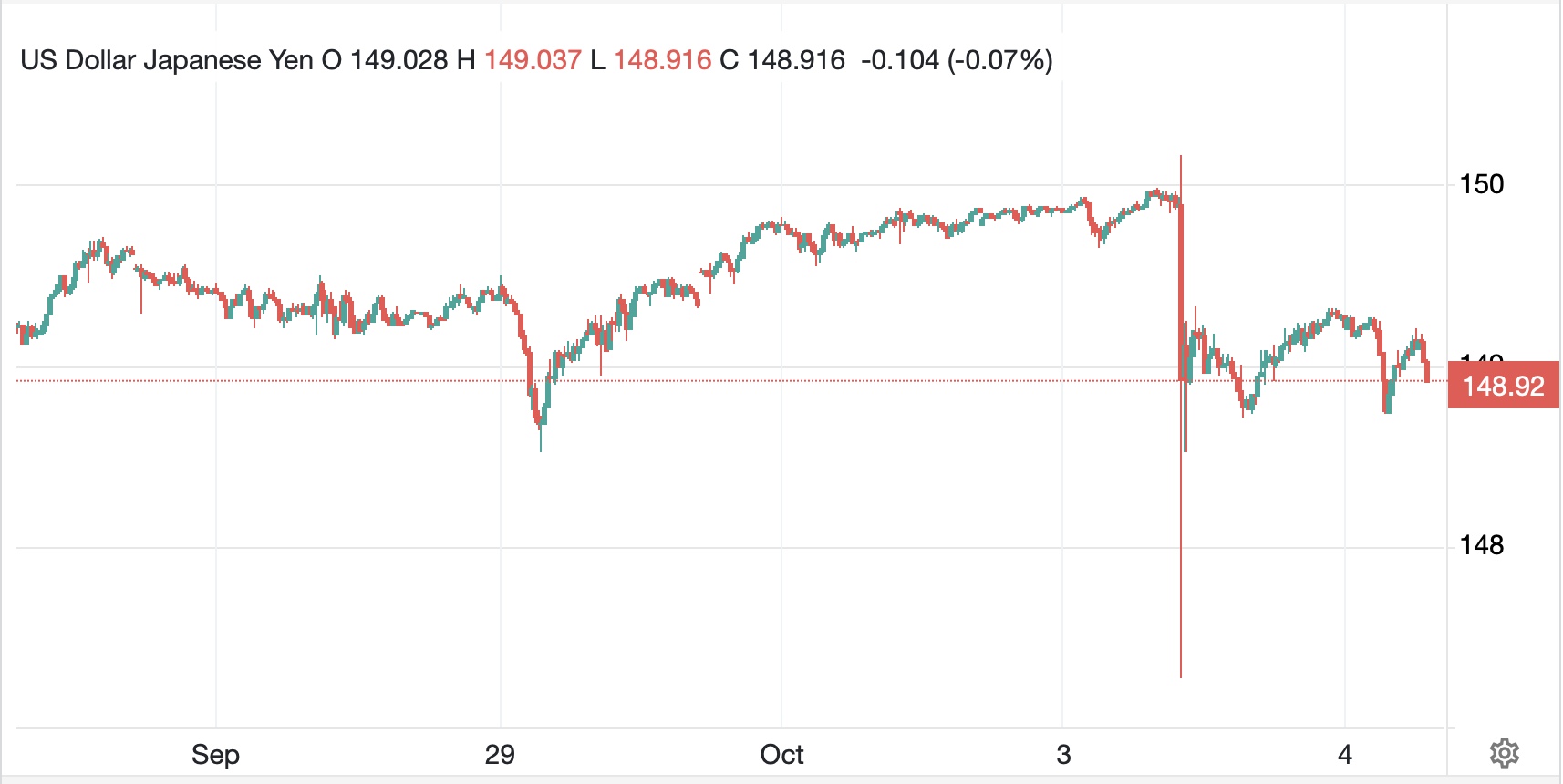
The story that makes the most sense is that the BOJ reached out to the major Japanese banks in NY and London and checked rates. The fact that the move happened minutes after the spot rate finally breeched the 150 level certainly was suspicious and indicated that contrary to yesterday’s comments by Watanabe-san, a former Mr Yen, the level really does matter, not just the speed of the move. Others have tried to explain that breeching 150 triggered selling levels, but if there were exotic option barriers at 150, and I’m sure there were, the more typical move would be an acceleration higher as stop-loss orders by dealers were triggered. The spike down, at least in my experience, is a sign of exogenous activity, not market internals.
Looking ahead, are we likely to see more of this type of activity? You can never rule out currency support from any nation whose currency is weakening sharply, but there are G7 and G20 constructs that are supposed to limit these, and are designed to focus on volatility of movement, not levels. This appeared contrary to those concepts, so we have much yet to learn. At the end of the month, the BOJ will publish any intervention activity as part of their transparency initiative, but that might as well be next year for all the information it will provide. Be wary of further movements like this, but the fundamentals continue to point to a higher USDJPY, especially given the accelerating rise in US Treasury yields.
The bond market rout keeps on going
As we see more folks towel throwing
The question at hand
Is can Powell stand
The pressure that’s certainly growing

Thus far, there’s no sign that the Fed
Is worried when looking ahead
More speakers were heard
To follow the word
That higher for longer’s not dead
Of course, away from the FX market, where the dollar has continued to show remarkable strength overall, the big story is the Treasury market. After yesterday’s sharp move, the 10-year yield is higher by 23bps so far in October and it is only the morning of the third session of the month! The yield curve inversion is down to -32bps and 30-year Treasury yields are pressing 5% now, a level not seen since summer 2007. This sharp move has been the true driver of almost all markets and as long as it continues, there is going to be more pain for risk assets. There has been no change in the fundamentals and yesterday’s move was ascribed to a much higher than expected JOLTS Job Openings number, which printed at 9.61M, far above the forecast 8.8M and a huge jump from last month’s outcome. This seemed to encourage the Fed speakers to maintain their higher for longer attitude with a number still looking for one more rate hike this year. Once again, I will point to Friday’s NFP number and its importance as a key driver of Fed policy. If that number remains strong, and Unemployment remains low, the Fed can maintain this policy stance with limited fallout politically.
The rise in Treasury yields is being copied elsewhere around the world with yields following the US higher. While today is seeing a bit of consolidation, with European sovereign and Treasury yields currently softer by 1bp-2bps, this is a trading effect, not a change of heart. Interestingly, even JGB yields are getting dragged along higher as they closed last night at 0.80%, their highest level since 2012, the beginning of Abenomics. But in the end, this is all about US yields with the rest of the world continuing to follow their lead. I heard some analysts claiming this was a blow-off top in yields and we have seen the end. Alas, I don’t believe that as history shows the yield curve will move back to a normal stance and with the Fed firmly in the higher for longer camp, 10-year yields have further to rise. Yes, something is likely to break at some point, but so far, the few hiccups have been contained.
Not surprisingly, risk assets had a tough time in yesterday’s session with US indices all falling sharply, by -1.3% or more. Yesterday’s European bourses were also under significant pressure and the Asian markets open overnight got hit hard as well with the Nikkei (-2.3%) and Hang Seng (-0.8%) the biggest movers. However, this morning, Europe has a touch of green on the screen, with small gains on the order of 0.3% and US futures are also edging higher, +0.15% at this hour (7:45). I wouldn’t read too much into this modest bounce and fear that there is further, and potentially much further, to go. One of the remarkable things about the equity market is that earnings estimates for 2024 are for a rise of 12% on 2023 earnings. Given the ongoing rise in energy costs and the increasing probability of a recession, those seem quite optimistic. As they are revised lower, that, too, will weigh on equities, and by extension all risk assets.
Lastly, in the energy space, oil (-1.7%) is under further pressure this morning, although the fundamentals wouldn’t indicate that is the right move. Not only did we see a further draw in inventories in the US, notably at the key Cushing, OK storage depot, but we heard from Russia that they are going to continue to restrict production by 300K bbl/day through the end of the year. Meanwhile, the law in the US is set that the government cannot sell oil from the SPR when the inventory level falls below 330 million barrels. Currently, it sits at 327 million, so that supply has ended. Nothing has changed my view that oil has much higher to go, albeit not in a straight line.
Metals prices remain generally under pressure although gold (+0.2%) seems to be bouncing with other risk assets this morning on a technical trading basis. However, both copper and aluminum are still sliding, typically a harbinger of weaker economic activity to come.
As to the dollar broadly, it, too, is a touch softer this morning, pulling back from highs seen yesterday in sync with all the markets. But the same fundamentals driving the bond and stock markets are in play here, higher yields leading to more demand and a higher dollar. Yes, this will end at some point, but we need to see a change in policy for that to happen. The next real chance we have for something like that is on Friday with the payroll report. A weak report, which seems unlikely at this time given the other employment indicators, would almost certainly change the market’s tone. However, until then, look for positioning to continue to favor a stronger dollar, and for more and more dollar short sellers to get stopped out.
On the data front, this morning brings ADP Employment (exp 153K) as well as Factory Orders (-2.1%) and ISM Services (54.5). the PMI Services data from Europe indicated that the worst may be over, but that there is, as yet, no real rebound. We hear from a few more Fed speakers, but thus far they remain consistent, higher for longer is appropriate.
Today could see more consolidation of the recent moves across the board, but I do not believe that we have come to the end. Calling a top or bottom is always impossible but remembering that the trend is your friend is likely to keep your activities in good shape.
Good luck
Adf
 fxpoetry