Pundits and Bores

The fallout from Warsh’s decision
To leave rates without a revision
Has opened the doors
For pundits and bores
With hawks and doves set for collision

For some, Warsh has failed from the start
As they felt a rate hike was smart
But others explain
That under his reign
It’s markets that play the main part

For a no action outcome by the Fed last week, it certainly is interesting how much digital ink has been spilled discussing the outcome of that meeting and, depending on which side of the argument you fall, whether it was the right move or an error.  You know I have been of the belief that there will be zero rate hikes this year and nothing has changed that opinion yet.

There is a great deal of conversation regarding the Fed’s credibility and how despite Warsh’s tough talk about achieving their 2% inflation goal at his first meeting, by doing nothing last week, he has trashed that credibility.  My first thought here is, given the Fed has failed in its key objective for more than 5 straight years on its own terms, it is difficult for me to accept they had a lot of credibility left to trash.  But my second thought is to listen to the Chairman’s words about allowing the market to do its job, and not simply watch the Fed, and I realize there are an awful lot of analysts and pundits who don’t know how to do that and therefore are extremely uncomfortable now.  As I wrote last week, these folks get paid a lot of money by Wall Street and now they have to earn it.  So perhaps that explains the ongoing diatribes.

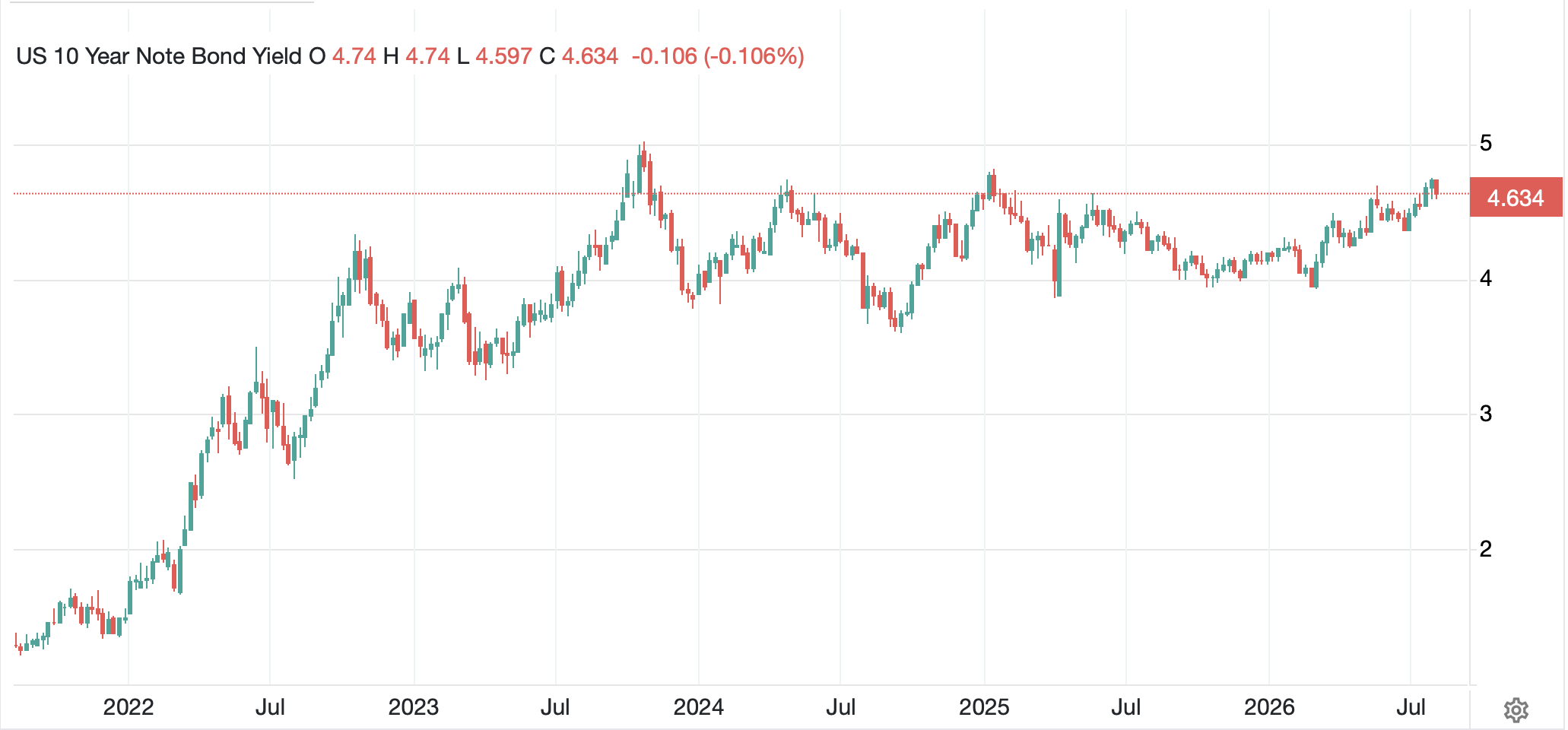
Much has been made of the fact that between the June and July FOMC meetings, US Treasury yields rose substantially as you can see from the below chart.

Source” tradingeconomics.com

At the close on Friday, they had risen 34bps in the 30-year and 28bps in the 10-year), although this morning, with oil prices (-5.6%) falling on the back of a renewed diplomatic initiative in Iran, both of those bonds have seen yields back off by 5bps. 

Now, one of the things that Warsh specifically explained in the press conference was that the market had raised rates already, effectively doing the Fed’s job for them.  And here is the point of departure, I believe, regarding the punditry viewpoint and the Warsh viewpoint.  Warsh has been explicit in saying he wants the Fed’s footprint in the markets to shrink.  He wants market participants to, “play the ball, not the referee”.  However, the pundits claim that the only reason rates rose was in anticipation of the Fed hiking rates.  

So, let’s try a little thought experiment.  Assume there was no Fed, instead that money supply was mechanically increased by 2% per year and that all interest rates were determined by the market.  Do you believe that in this scenario, a government running consistent extremely large deficits would not drive interest rates higher than they otherwise would be, without a central bank to officially do so?  I know I do.  Is that any different than the market pushing yields higher because they are concerned with excess supply of Treasuries and other inflation concerns?  

The Fed has had a major, and in Warsh’s (and my) view, too large impact on markets for a long time, since Black Monday in 1987.  Change is hard and the punditry does not like the fact that they are going to have to actually think and pay attention to many variables in order to have a viable view on things, so they are all crying and claiming Warsh is making a huge mistake.  While not surprising, I think they are completely wrong.  

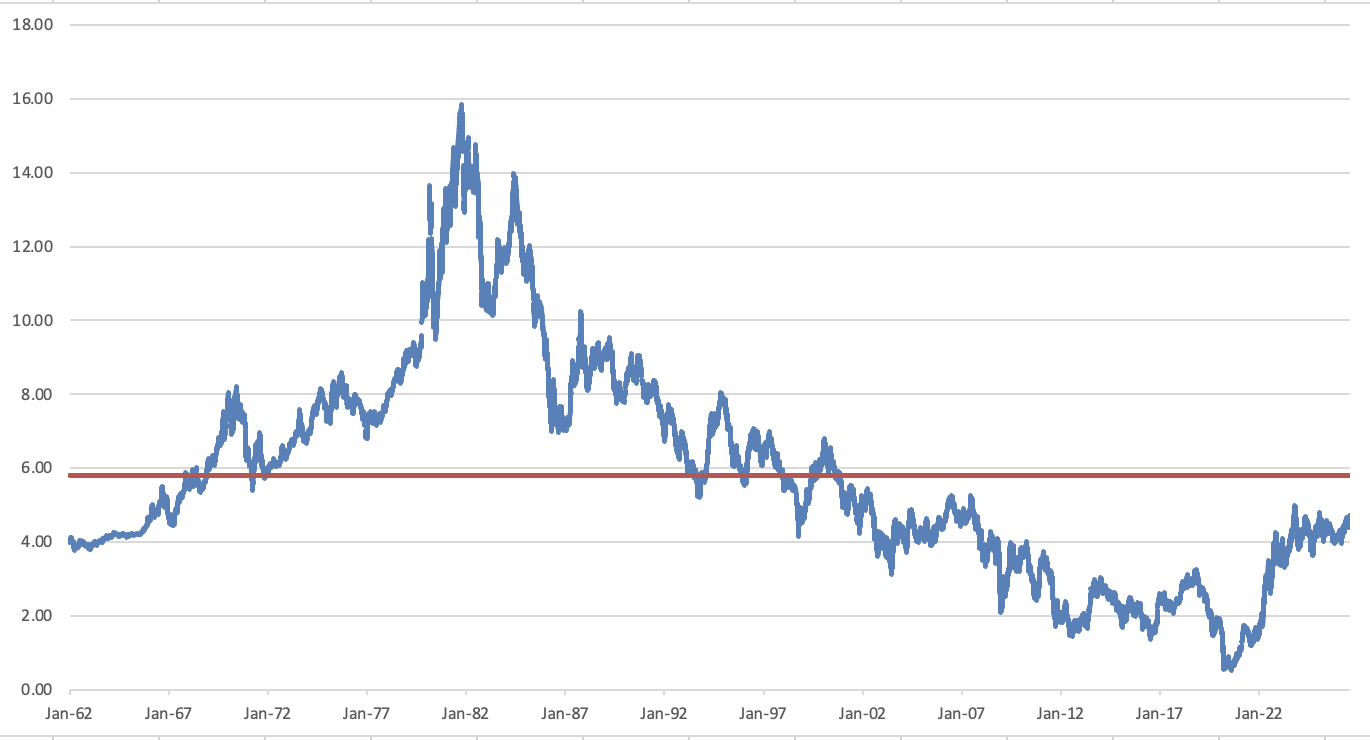
It is also important to understand that the current yields in the bond market are anything but ordinary. Below is a chart I created with FRED data and included the long-term average 10-year yield since 1962, which happens to be 5.81%, more than 100bps above current levels.  For a very long time, a good rule of thumb for the 10-year yield was it should be approximate the nominal GDP growth rate, but we have gone through such a long period of financial repression, that idea faded away.  Perhaps that is coming back into vogue, so at the long-term average, we could see 3.8% GDP growth and 2.0% inflation.  And even today, it could represent 2.7% GDP growth and 2.0% inflation.  I don’t think anybody would be unhappy with that outcome.

My understanding is the task forces will not be reporting until early next year.  At the same time, I am convinced that Mr Warsh is very serious about making significant changes at the Fed going forward, and I applaud that.  But it is going to require him to convince 18 other people who have been inculcated in a process that has proven to be a failure but offers comfort to those people because they know how it works.  Change is very hard, and this will be harder than most.  One last thing, the biggest change is going to be the balance sheet.  The Fed continues to buy T-bills and expand the balance sheet as they continue to seek to maintain “ample” reserves, so banks have liquidity.  I would not be surprised if when we hear from Chairman Warsh at the Jackson Hole meeting at the end of the month, he indicates the Fed will stop buying bills at the next meeting moving further down the path of change.

Surprising comments
Bessent admitted the Fed
Joined the Japanese

The following statement released by Japan’s MOF is quite a surprise, at least the fact that they admitted to the action, something that has rarely been the case in the past.  

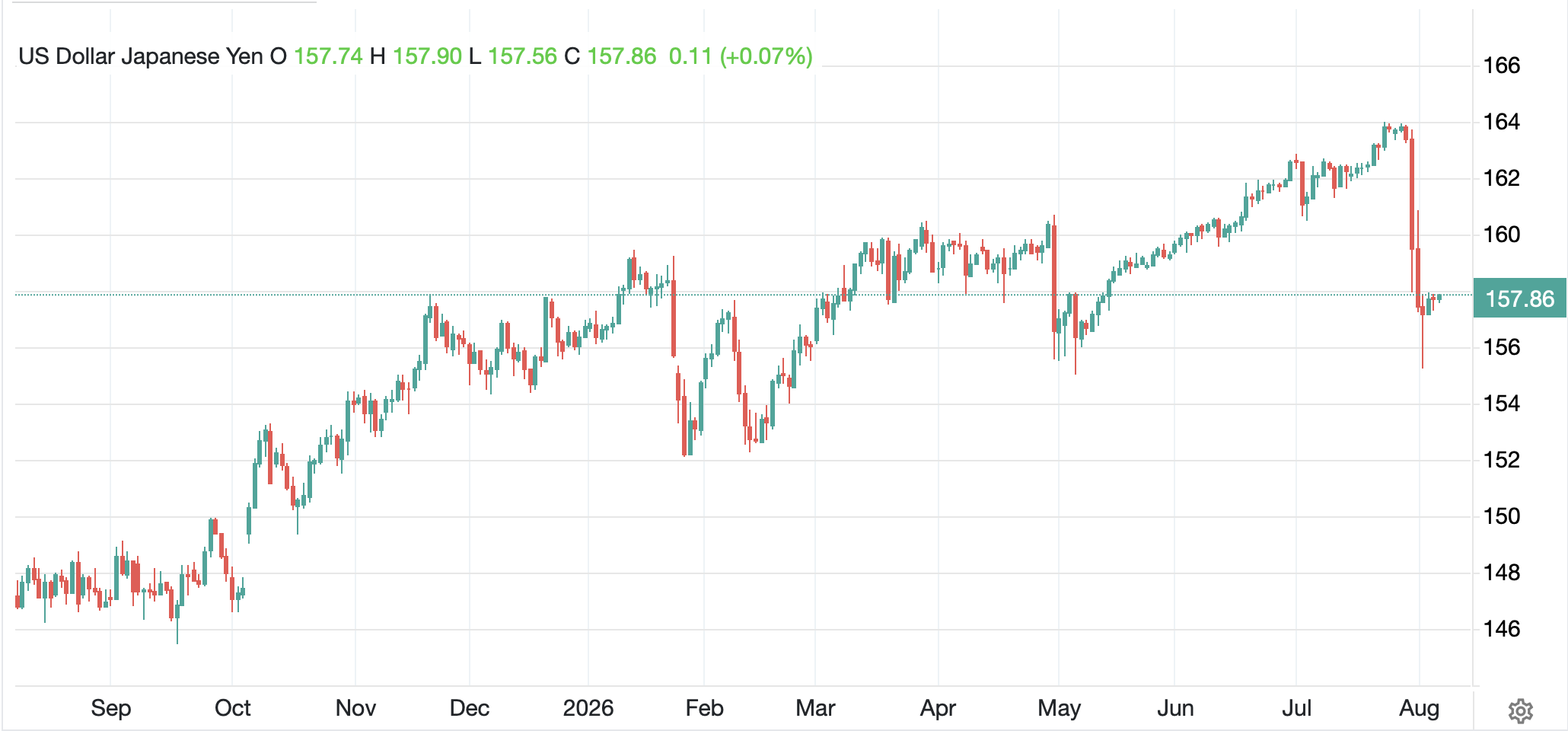
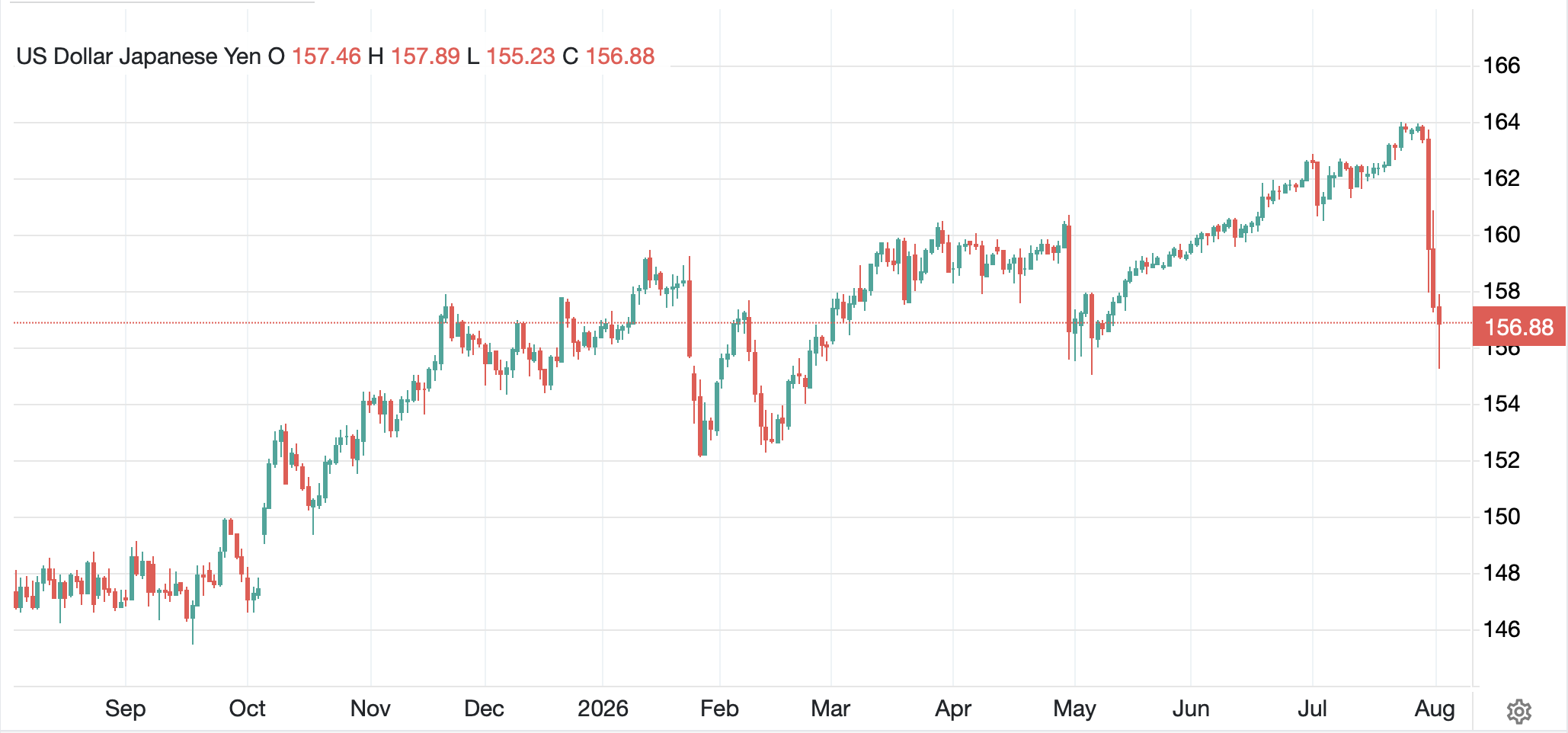
Some have made the point that given Japan is the largest holder of Treasury securities in the world (other than the Fed) and that they would need to sell their Treasuries to fund intervention, this was the driving force.  Certainly, the US is not keen to have holders sell their bonds at this point.  As you can see in the chart below, this intervention has had a larger impact than the previous bouts which were solo Japanese efforts.

Source: tradingeconomics.com

At the dollar’s low, the yen appreciated about 5% in the past two sessions, certainly a very large move.  One of the other things that was interesting was that ostensibly, the Treasury sold EURJPY, not USDJPY.  Perhaps they had extra euros lying around they no longer wanted.  According to BOJ data, it appears the Japanese spent something like $33 billion on the intervention, but I have no indication as to the US effort.

Joint intervention is pretty rare, with the last time being in the wake of the earthquake/tsunami at Fukushima in 2011 when the yen strengthened dramatically.  But it also has a better track record than solo intervention, although absent significant fiscal changes, on both sides of this equation, I suspect that within a few months, the yen will weaken again.

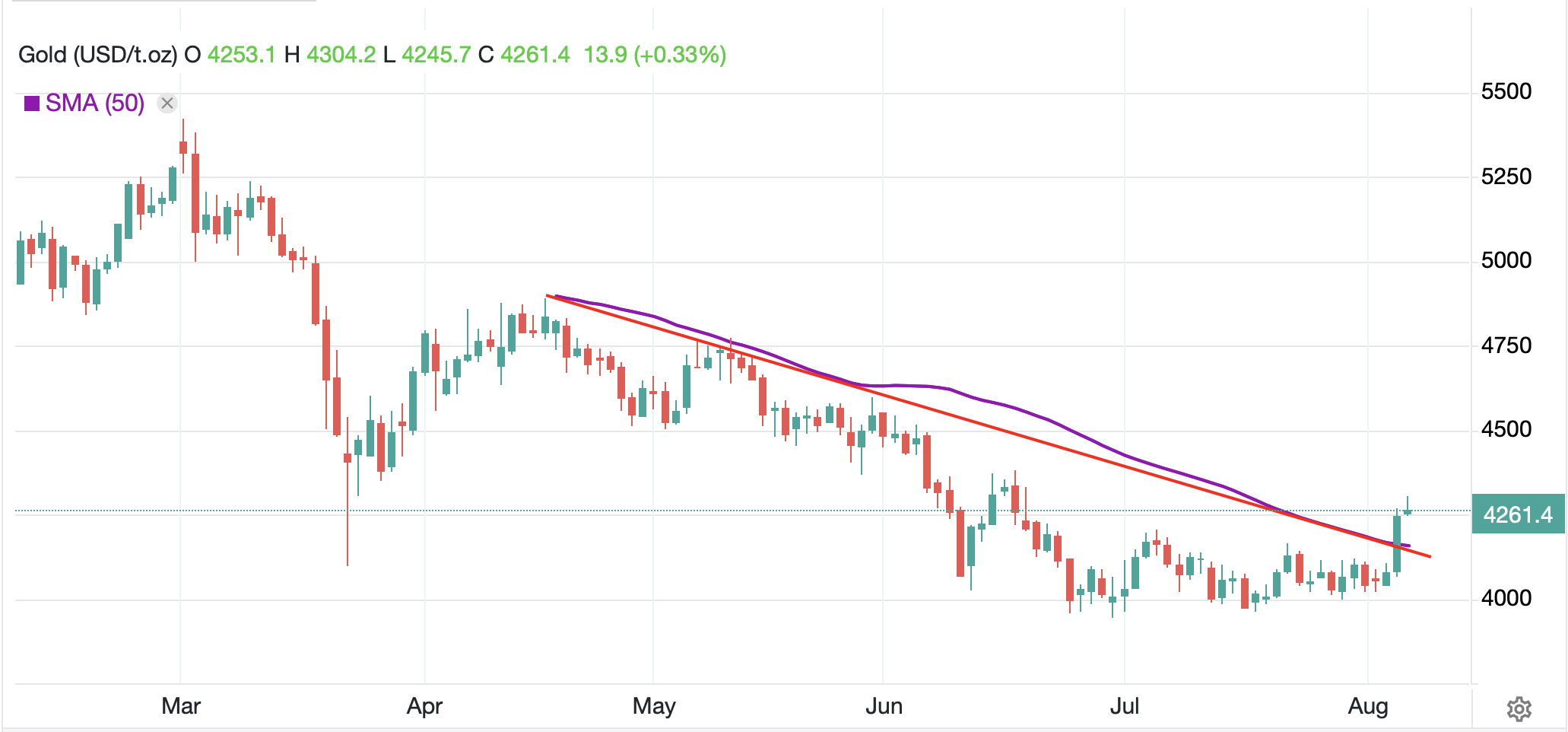
Ok, I feel like that’s enough for one morning.  The oil story, as I mentioned, is that the President has called off the mooted weekend attacks and diplomacy is back on the table.  Interestingly, the metals markets are not as excited by that with gold (+0.15%), silver (+0.6%) and copper (+0.75%) all higher, but not by very much, especially given the size of the decline in crude prices.  And product prices (gasoline -3.4%, heating oil -3.0%) are also sharply lower.

As also mentioned above, bond yields have backed off with European sovereigns sliding far more than Treasuries, between -6bps (Germany, Netherlands) and -9bps (UK, Italy, Greece).  However, JGB yields (+3bps) did not get the memo although I suppose that has more to do with the belief that the BOJ is going to be forced to hike rates as part of the joint US-Japanese currency efforts.

As to the equity markets, after Friday’s US rally, the picture in Asia was mixed, despite the oil price decline, although for Japan, a stronger yen is often a problem for Japanese equities.  The worst performers were Korea (-5.1%), Tokyo (-0.9%) and China (-1.0%) while much of the rest of the region followed the US higher (HK +0.5%, India +0.7%, Taiwan +0.6%, Australia +0.5%) with the smaller exchanges mostly higher as well.

In Europe, things are generally bright with Germany (+1.4%), France (+1.3%) and Spain (+0.75%) all nicely higher despite (because of) modestly weaker PMI data although the UK (0.0%) has not been able to overcome its PMI weakness.  Now, in fairness to the UK, its 51.9 reading, while weaker than last month and forecast, is still about the best in Europe.  As to US futures, they are all in the green, led by the DJIA (+0.8%) at this hour (7:00).

Finally, the dollar is kind of confused overall.  The big winner today is KRW (+1.0%) although that trade has been ongoing for more than a month and is approaching an 8% gain over that period.  The yen (+0.4%) continues to climb, albeit less aggressively, although the other G10 currencies are generally under pressure (GBP -0.15%, AUD -0.3%, CAD -0.2%, NOK -0.6%).

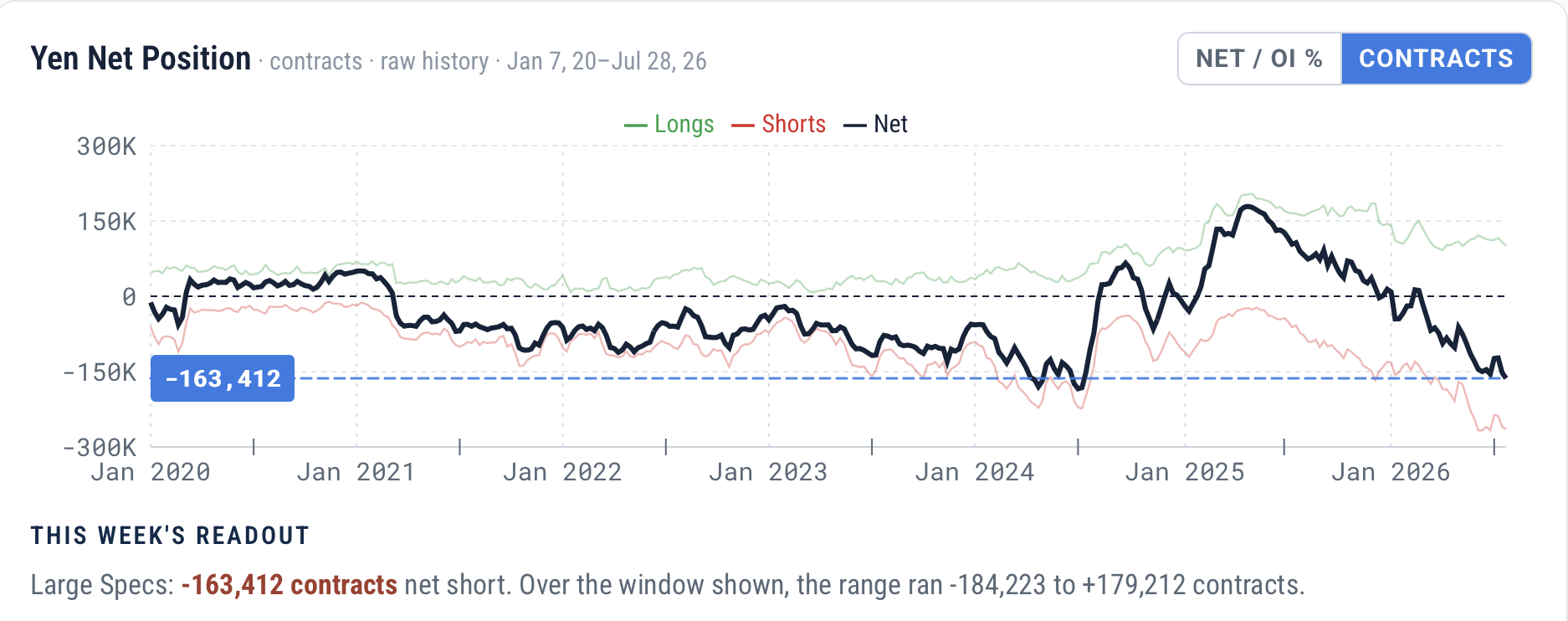
However, I must mention something that Alyosha wrote this morning in Market Vibes that is worth considering; two of the major positions in markets were short bonds and short yen.  Joint intervention by the US and Japan to sell EURJPY has likely forced a lot of covering in both of those markets and it would not be surprising to see more activity like that and further short covering.  Japan is the largest holder of French bonds as well as Treasuries and could easily sell those without a peep from the US.  

Ok, I have gone way over my daily quota this morning, although there were a couple of really big, and complex stories to discuss.  On the data front, today brings ISM Manufacturing (exp 54.0) and I will delve into the rest of the week’s data, including Friday’s payroll report tomorrow.

Good luck

Adf

Dust in the Wind

A line has been drawn
Is it steel reinforced? Or
Just dust in the wind?

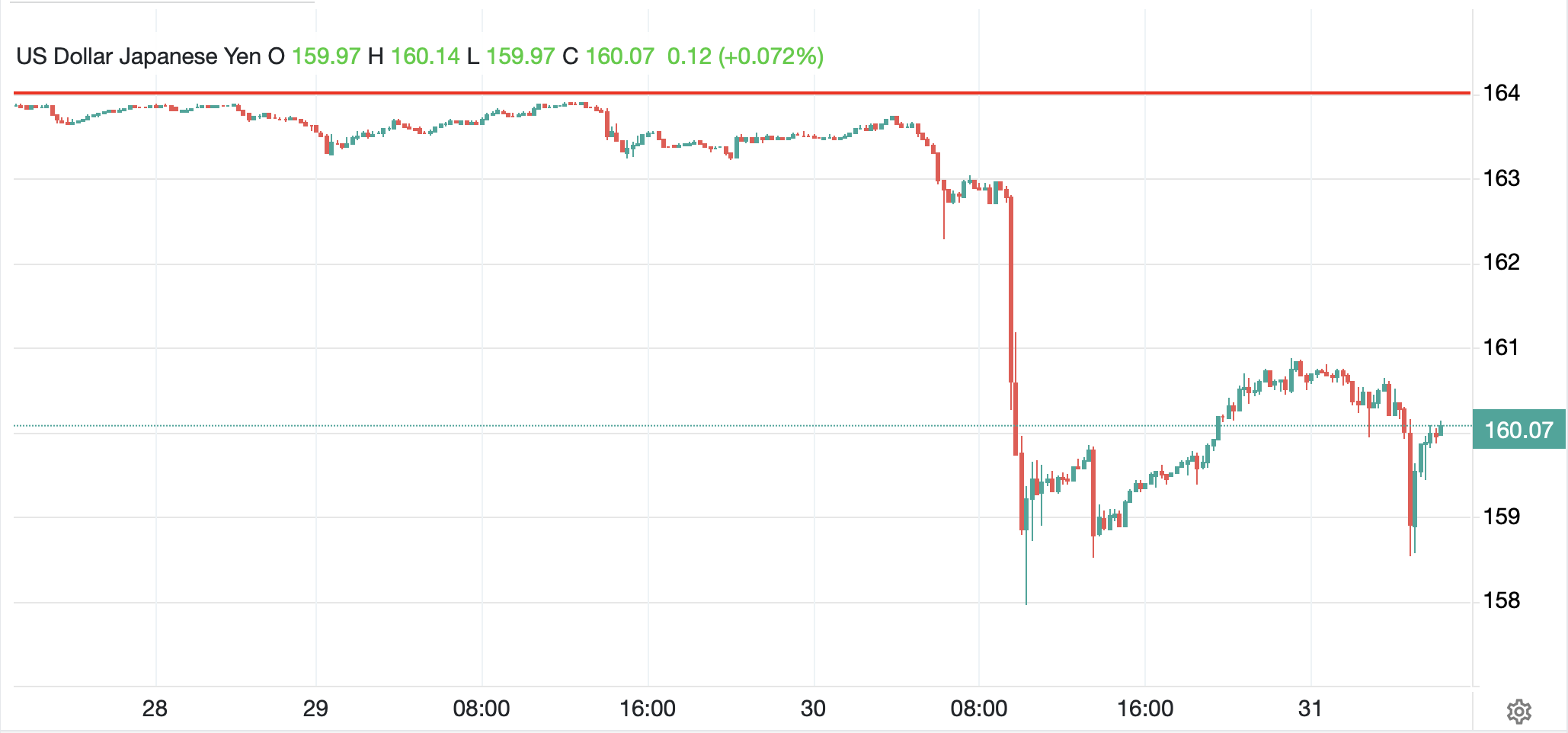
Shortly after 9:30 yesterday morning, the BOJ entered the FX market aggressively selling dollars as you can see in the chart below.  While the amount sold is unknown at this time, it was likely pretty large, ~$10 billion – $15 billion would be my guess.  In addition to the sales, though, apparently the Fed called around the Street “checking rates”, although my understanding is the Treasury didn’t actually sell any dollars.

Source: tradingeconomics.com

Regardless, the signal of an approved, if not joint, intervention is powerful and I expect that the market will take some time before pushing the dollar back higher again.  Now, one of the themes yesterday was that the BOJ would also raise interest rates at their meeting last night in a surprise move as a way to reinforce this action.  I believe if they had done so, it could have been quite effective and we would have seen another sharp leg lower, as well as an overall reduction in pressure on the yen.  But they did nothing with their base rate remaining at 1.0% and, as you can see from the chart, the drift has already begun for the yen to weaken once more.

As I have maintained throughout this process, absent policy changes of substance, and at this point in Japan that includes fiscal as well as monetary, pressure on the yen is very likely going to be the norm.  Of course, if the Fed really does begin to ease policy at some point, that will alter opinions and I imagine soften the dollar universally.  

The pundits are still really pissed
That Warsh, their concerns, has dismissed
Get ready to hear
That Doomsday is near
If Warsh keeps ignoring their gist

Since we seem to be in an interlude in the war in Iran and the Middle East, so oil markets remain quiet and there has been little news from the White House, the punditry has continued its focus on Fed Chair Warsh and all the things they hate that he is doing.  This is well summed up in this morning’s WSJ article titled, ”Kevin Warsh’s Honeymoon with the Bond Market Is Already Over”  interestingly, this was not written by Nick Timiraos, but rather by Sam Goldfarb, their bond market guy.  Personally, I think he is completely wrong, but the punditry is consistent in their desperate desire for Warsh to tell them what the Fed is going to do so they can report it and seem smart.

However, my read on the bond market response is quite different, especially when put in context with other markets, notably inflation markets.  The fact that the 2-year yield has backed off, and we have already seen a modest pull-back in the 10-year tells me that there is limited fear of rampant inflation.  While the pundits, and many other central bankers (see Lagarde, Christine) think that hiking rates into an energy price shock is the right move, it has historically been a key policy error.  And what we have learned from financial history is that it is NEVER different this time.  And the folks who trade inflation have breakevens (the difference between nominal Treasury yields and TIPS yields of the same maturity) trading at very ordinary levels of 2.27% in the 10-year and 2.22% in the 30-year.  I thought that Alexandru Stefan Goghiedid an excellent job of describing the situation in his Substack article this morning.

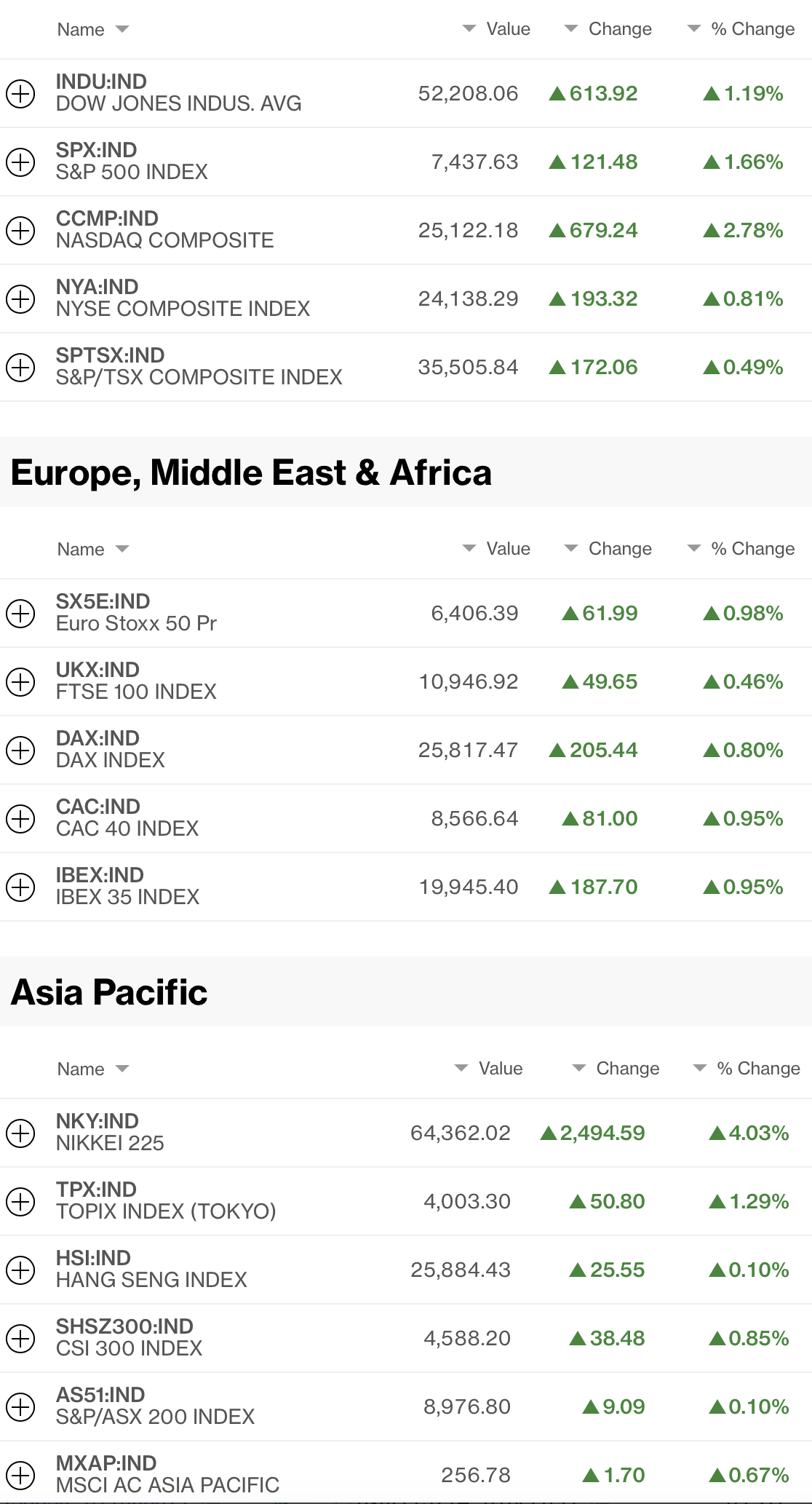
In the meantime, you know who else isn’t really worried about this?  Equity investors.  Broadly speaking, green is today’s color in that asset class, with some of the real movers not even shown in this Bloomberg Screenshot.  

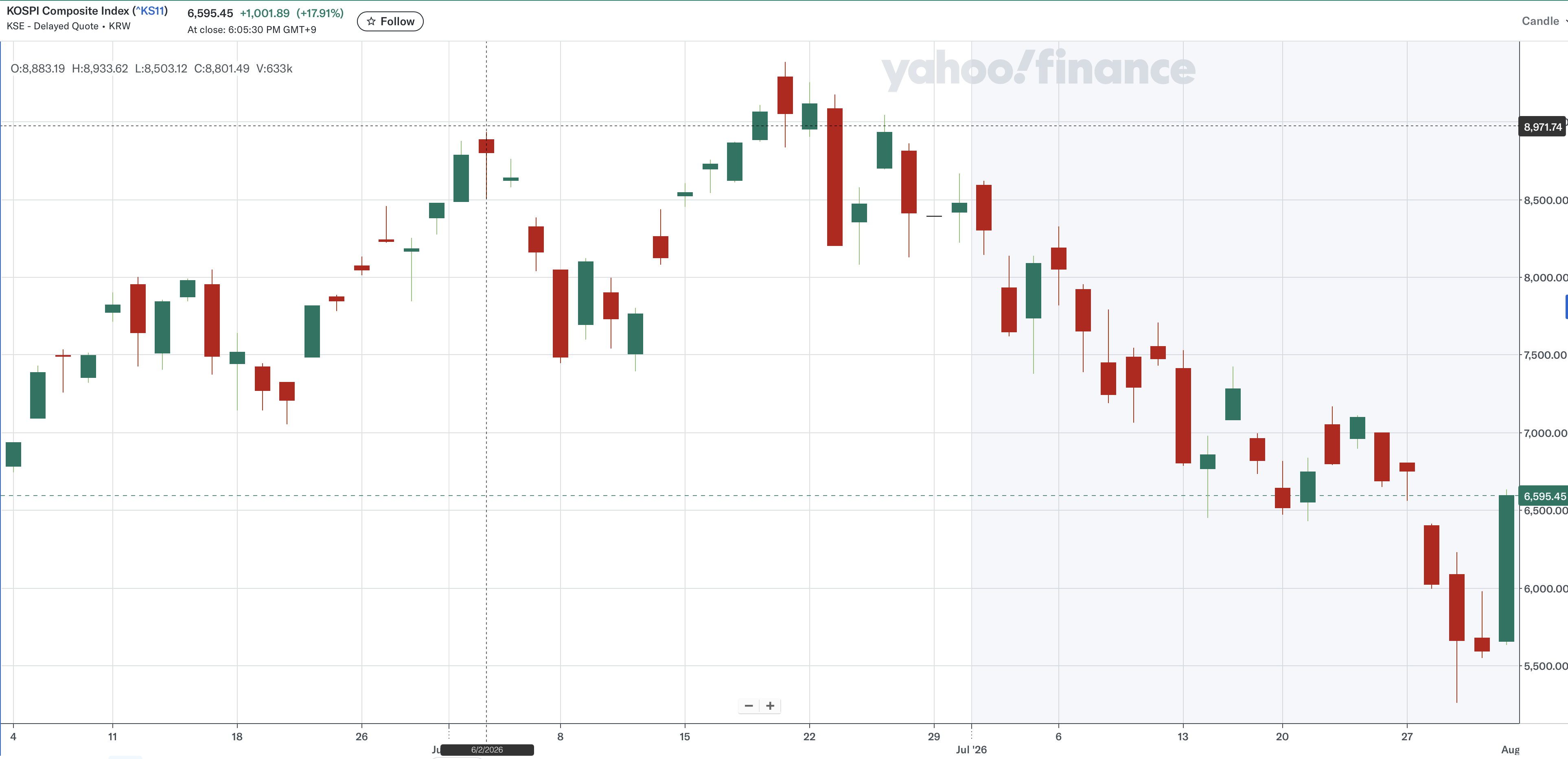
For instance, the KOSPI rallied 17.9% last night after Amazon and Microsoft’s earnings got everybody reconvinced that the AI trade was not over.  This is the market that I had been highlighting as collapsing and it just did a major reversal.  Last night’s candle, on the right-hand side of the chart, is one of the largest you will ever see in a major equity market!

Source: finance.yahoo.com

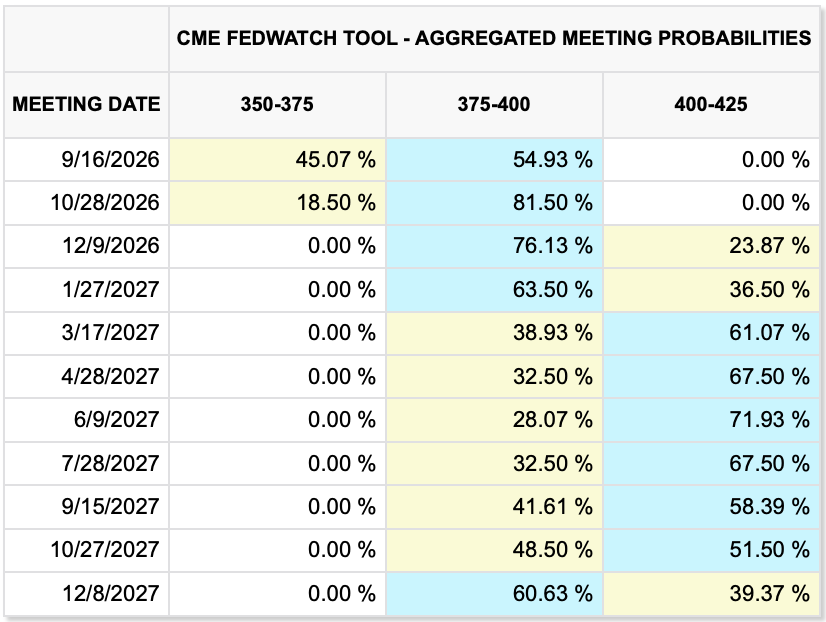
So, we have made it through the major tech earnings releases and spirits are still high.  While the Fed funds futures markets are still pricing a two-thirds probability of a hike in September and the certainty of one by October, the recent cooler than expected CPI and PCE data will continue to give ammunition to remain on hold.  To me the real question is, will Chairman Warsh be able to convince the committee that reducing the balance sheet is the right thing to do (it is) as that will have a much stronger impact on inflation than raising rates into the energy price shock.

In an aside, lately I have been wondering if every Fed governor should be fired for ‘cause’.  After all, according to legal precedent, cause can mean:

  • Inefficiency – persistent inability or incompetence in performing the role’s administrative or official functions
  • Neglect of duty
  • Malfeasance in office

Now, I would not accuse them of the latter two, but let’s face it, they have completely failed in their official functions as evidence by the fact that even on their own terms of stable prices, it has been more than 5 years since they have achieved their goal.  That seems pretty inefficient or incompetent to me!

Ok, let’s run through the other markets.  Bond yields are higher by 1 tick around the world, and we have discussed them already.  JGB yields, have slipped -2bps, so maybe they are not as worried with the yen strength from yesterday.

Commodity markets are dull with oil (+1.5%) having rallied in the past hour but still hanging around the $85/bbl level with no new news on the war.  At the same time both gold (-1.2%) and silver (-2.0%) are under pressure this morning, although that doesn’t make a huge amount of sense to me given the dollar’s broad weakness.  Perhaps the fact that it is month end is driving flows there, but I am not close enough to those markets to know.

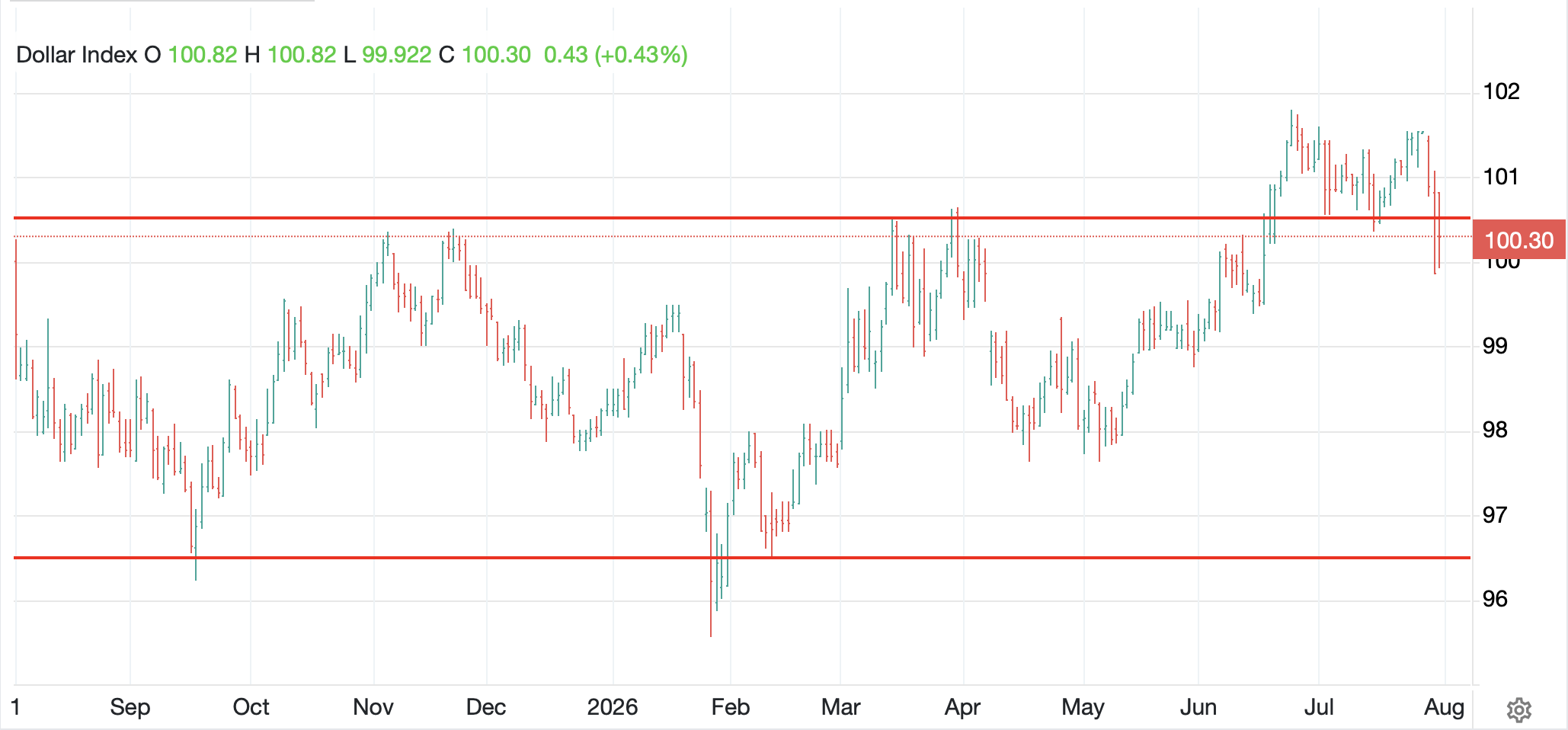
Finally, the dollar is softer, having fallen sharply yesterday although bouncing somewhat this morning.  As you can see in the DXY chart below, we are back within the 96.50/100.50 range that has prevailed for most of the past year and have traded below 100.00 several times yesterday and early this morning.

Source: tradingeconomics.com

To me, this is very interesting as FX traders seem to be taking different signals from the Fed than the short-term interest rate guys.  This does not feel like a market that is anticipating rate hikes in the US.  Now, historically, when it comes to opinion differences across markets, FX traders are the worst of the worst.  And, of course, I am an FX guy at heart, but I have a feeling they are correct here and I still see no rate hikes this year despite the Fed funds futures markets relative certainty.  So, right now, the dollar is broadly firmer by 0.3% across the board with the biggest outlier KRW (-1.35%) seeming to follow the KOSPI.

I think the really important thing to remember here is that the dollar has just not done very much, at least against the G10 currencies, for more than a year.  Certainly, LATAM currencies have performed well this year, but it remains difficult for me to look at the rest of the G10, a group with weak economic activity, and get excited about owning any of them.

On the data front, the PCE data was as expected to softer, but the real key yesterday was the GDP data which showed nominal GDP rose 7.9%, although the inflation adjusted number was just 1.5%.  But this is the very essence of running it hot, high nominal growth, which consisted of significant consumption and investment, while allowing inflation to run as well.  From a debt management perspective for the US, the debt/GDP ratio fell accordingly by about 1%.  While this trend remains higher, I expect we will see more of this type of outcome going forward.

As to today’s releases, Chicago PMI (ep 56.0) and Michigan Sentiment (54.0) are what we see, neither of which seems likely to matter to markets.  The equity bulls are back and that is going to be today’s story.  If those rallies fail, it will portend larger problems I believe, but my take is that is not going to happen.  I guess we shall see.

Good luck and good weekend

Adf

40-Year Nadir

Each day, one more pip
As the yen slides to the next
40-year nadir

The current blame is
The Fed’s recent hawkishness
What if that’s all wrong?

I feel like I must apologize by focusing on the yen again this morning, but quite frankly, there is not that much else to discuss.  And in fairness, it is not as though the yen’s move overnight, edging lower by a further -0.1%, is all that much to write about.  However, the yen has been getting a great deal of press as there is a cadre of analysts who are ‘certain’ that the MOF/BOJ is going to step in and intervene again soon, although I have seen more discussion of how 170 is in the cards as well.

Now, as it is the beginning of the second half of the year, I thought I might look at what I wrote at the beginning of the year regarding the yen to see how it’s going.  And while it is far too early to discern if I was prescient, things are looking pretty good right now.  Below, I have copied my yen discussion from back in January.  You decide if I’m on track.

A turn to the East where the Sun Also Rises
Will teach us that, really, there are no surprises
To date you’ve heard much ‘bout the rise in yen rates
With pundits opining the Carry Trades’ fates
This year, so they say, look for much stronger yen
As local investors buy yen bonds again
Thus, all the hedge funds who’ve been funding their trades
By borrowing yen, and they’ve done so in spades,
Will need to buy back all that Japanese Money
The outcome, for yen shorts, will not be so sunny
But what if this idea of yen heading home
Is wrong? This implies quite a different syndrome

At this point there’s no sign the government there
Is ready, more spending and debt, to forswear
Instead, what seems likely is more of the same
More government spending in all but its name
So, debt will continue to rise without end
And up to One-Eighty the buck will ascend

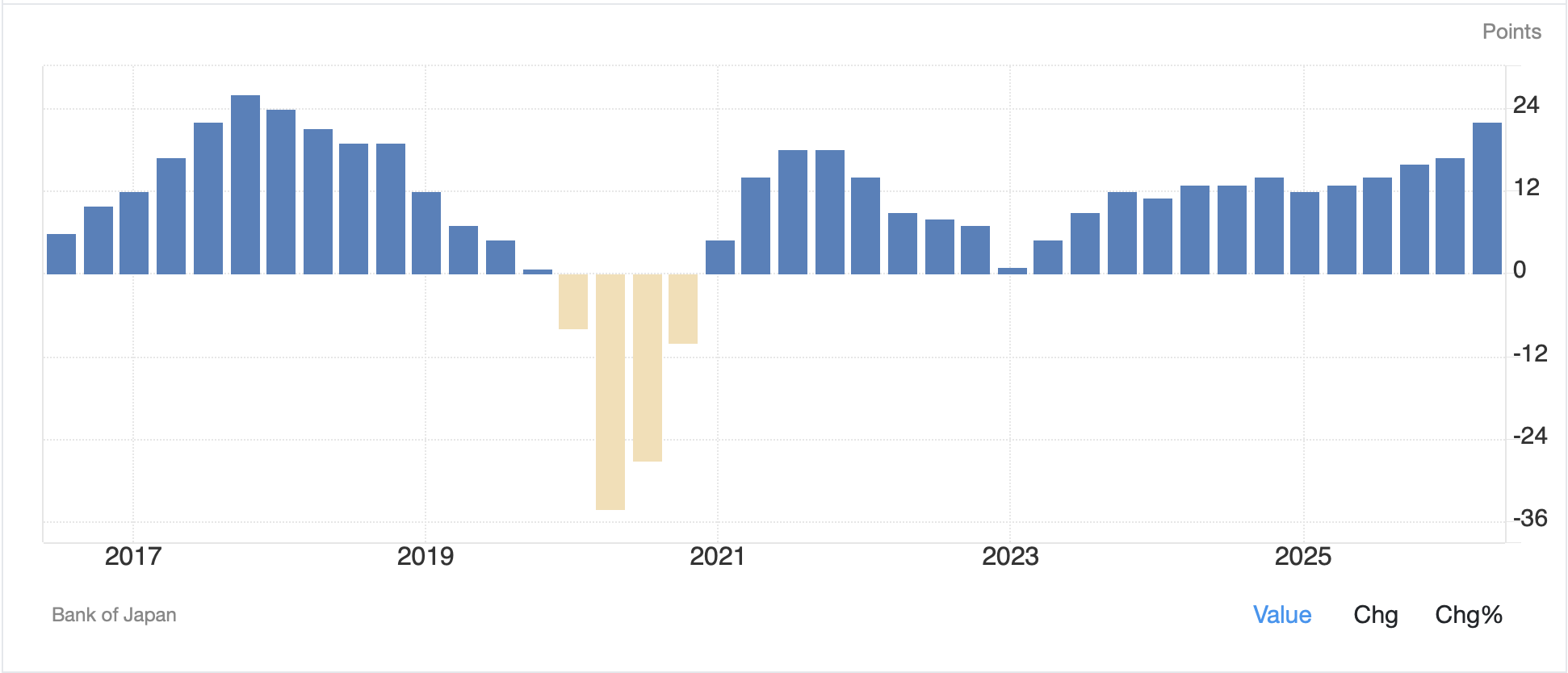
So, with that in mind, let’s see what we learned overnight.  First, Japanese Tankan data was released and the economy, or at least the corporate sector, seems in fine fettle.  The below chart of the Large Manufacturer’s Index shows the strongest reading since 2017.

Source: tradingeconomics.com

Clearly, the corporate set is not unhappy with the yen’s movement.  Now, there was yet another Bloomberg articlediscussing comments from the current Mr Yen, Atsushi Mimura, and reflecting on the fact that the MOF is in regular contact with Secretary Bessent and the Treasury department and there is no obvious concern on then US’s part with the current level of the yen.  

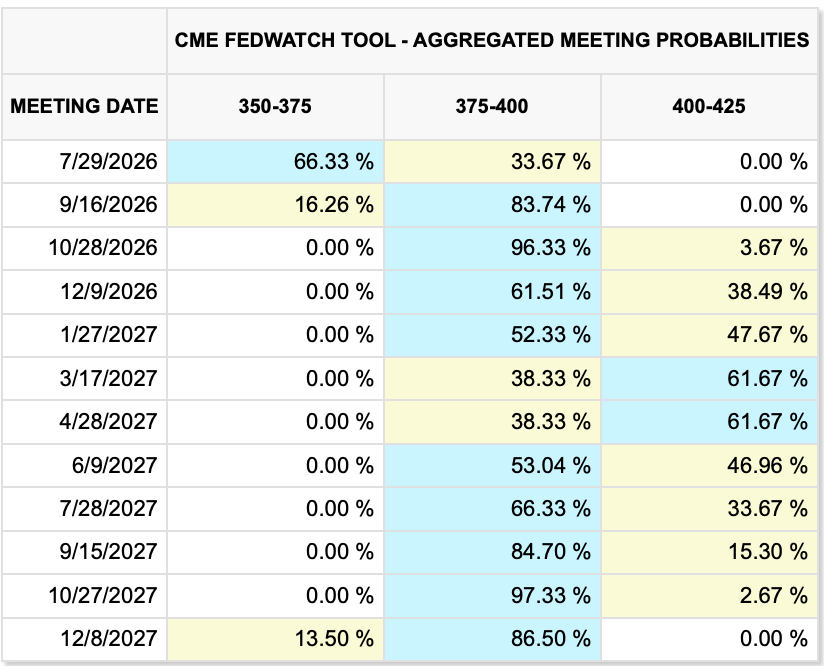
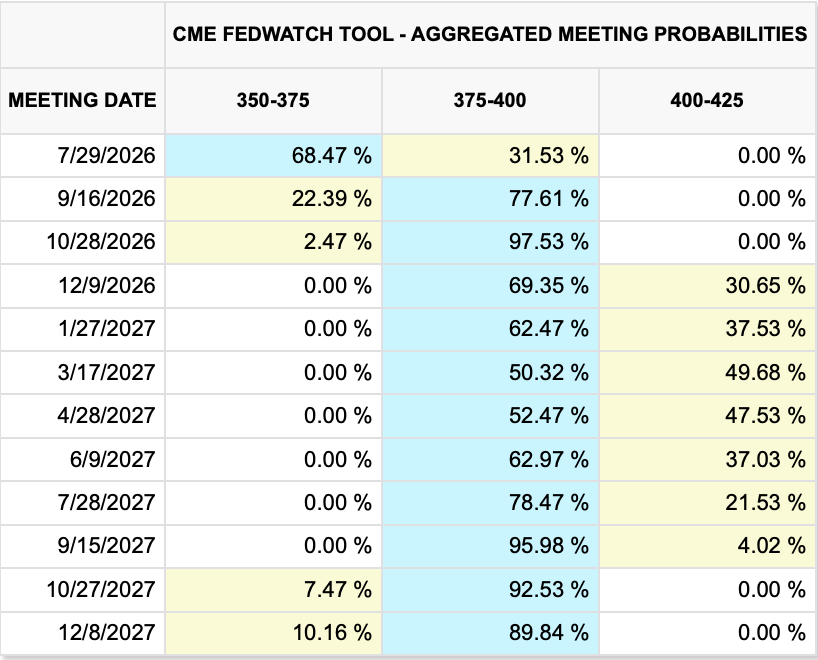
However, the consensus view is that the yen’s recent decline has been driven by the change in attitude regarding the FOMC.  The idea is that while the market was anticipating Fed rate cuts back in January, the comments by Chairman Warsh (more of which we will hear later this morning from Sintra, Portugal) have turned things around dramatically and we are now pricing a one-third chance of a hike at the end of July, a certain hike in October and another 40% probability of a second hike in December as per the below CME table.

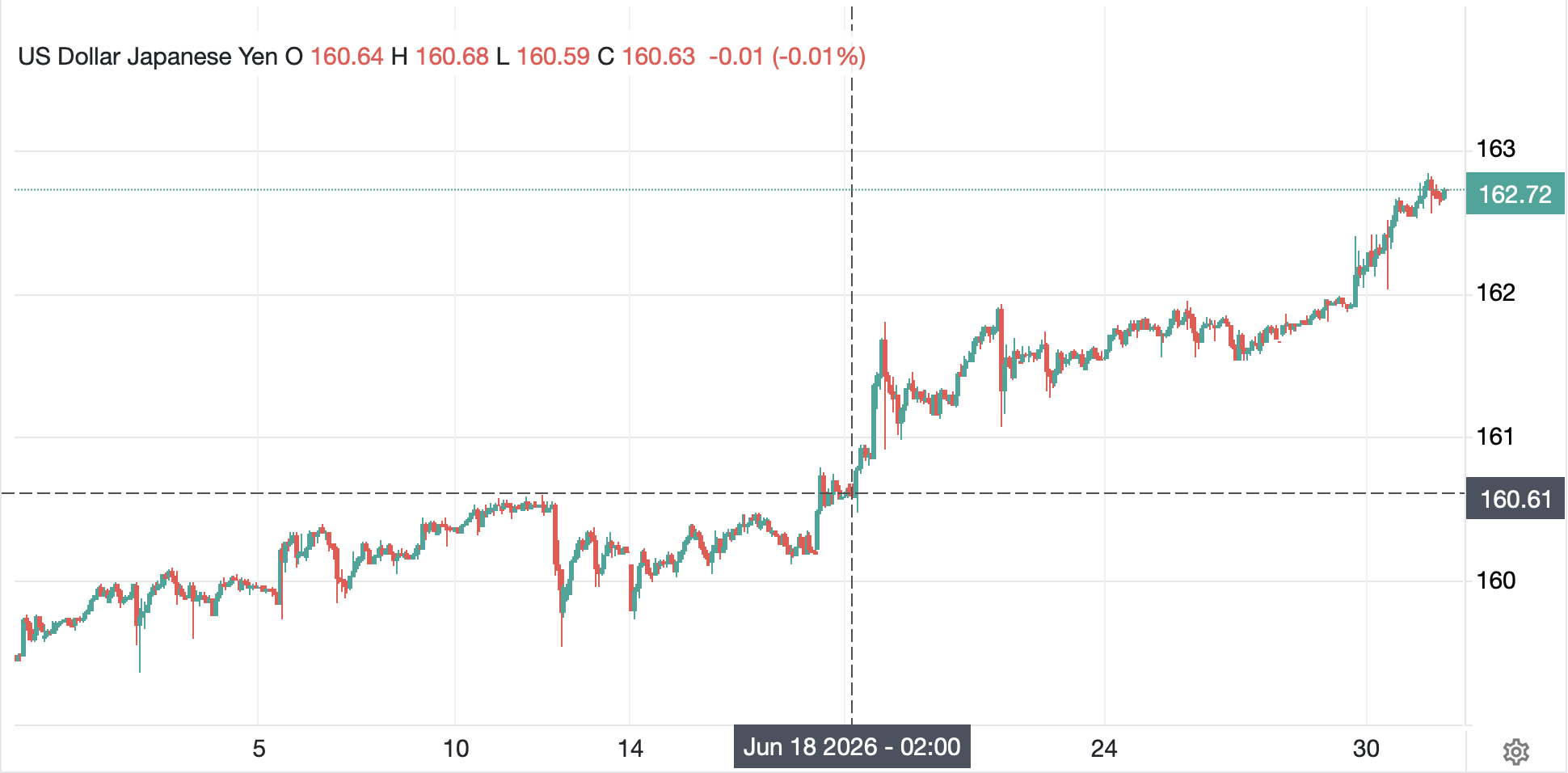
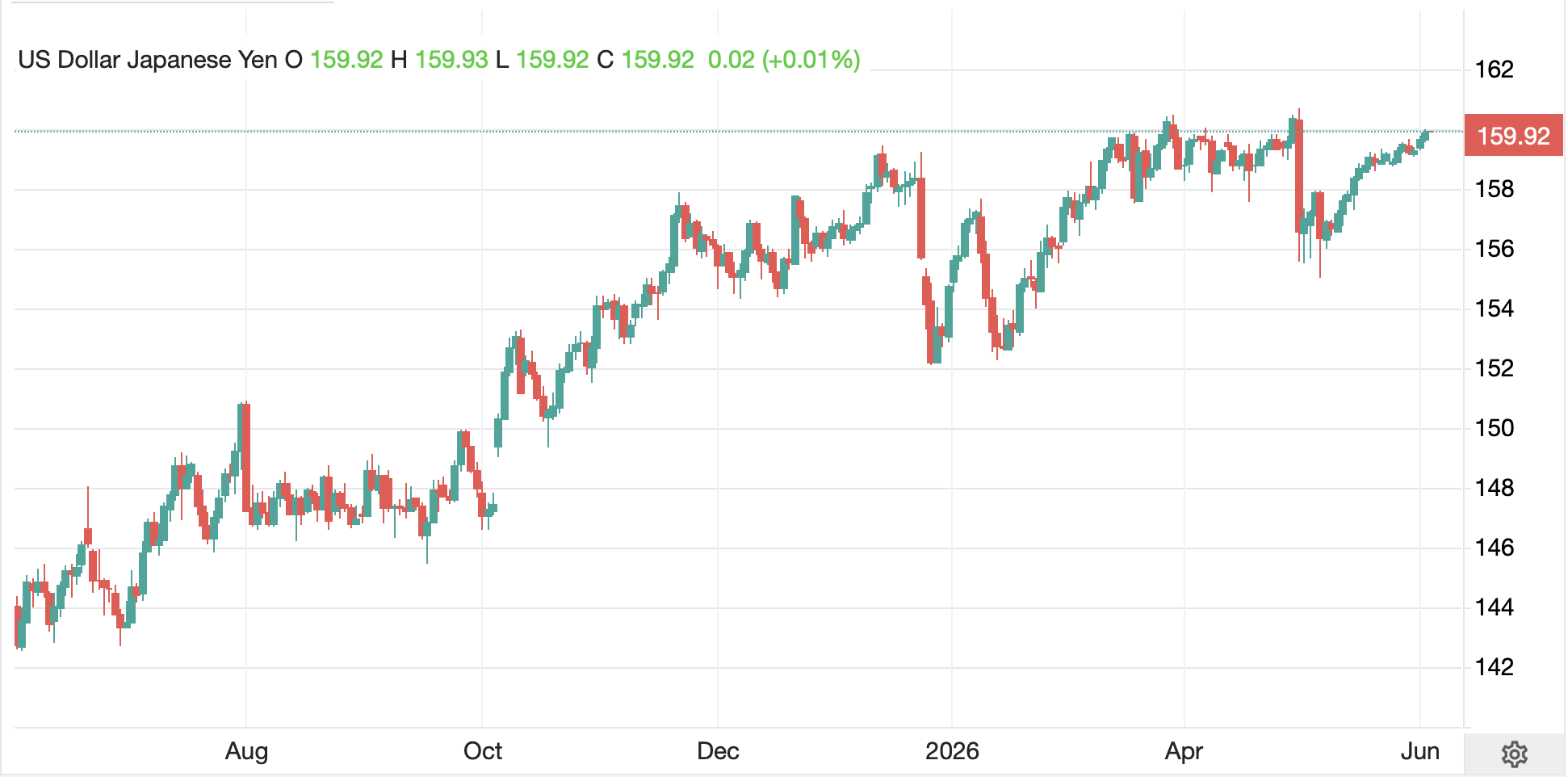
So, if we take this sentiment shift into account, we can look at the last month of trading in USDJPY, which basically encompasses two weeks before the FOMC meeting and two weeks since.

Source: tradingeconomics.com

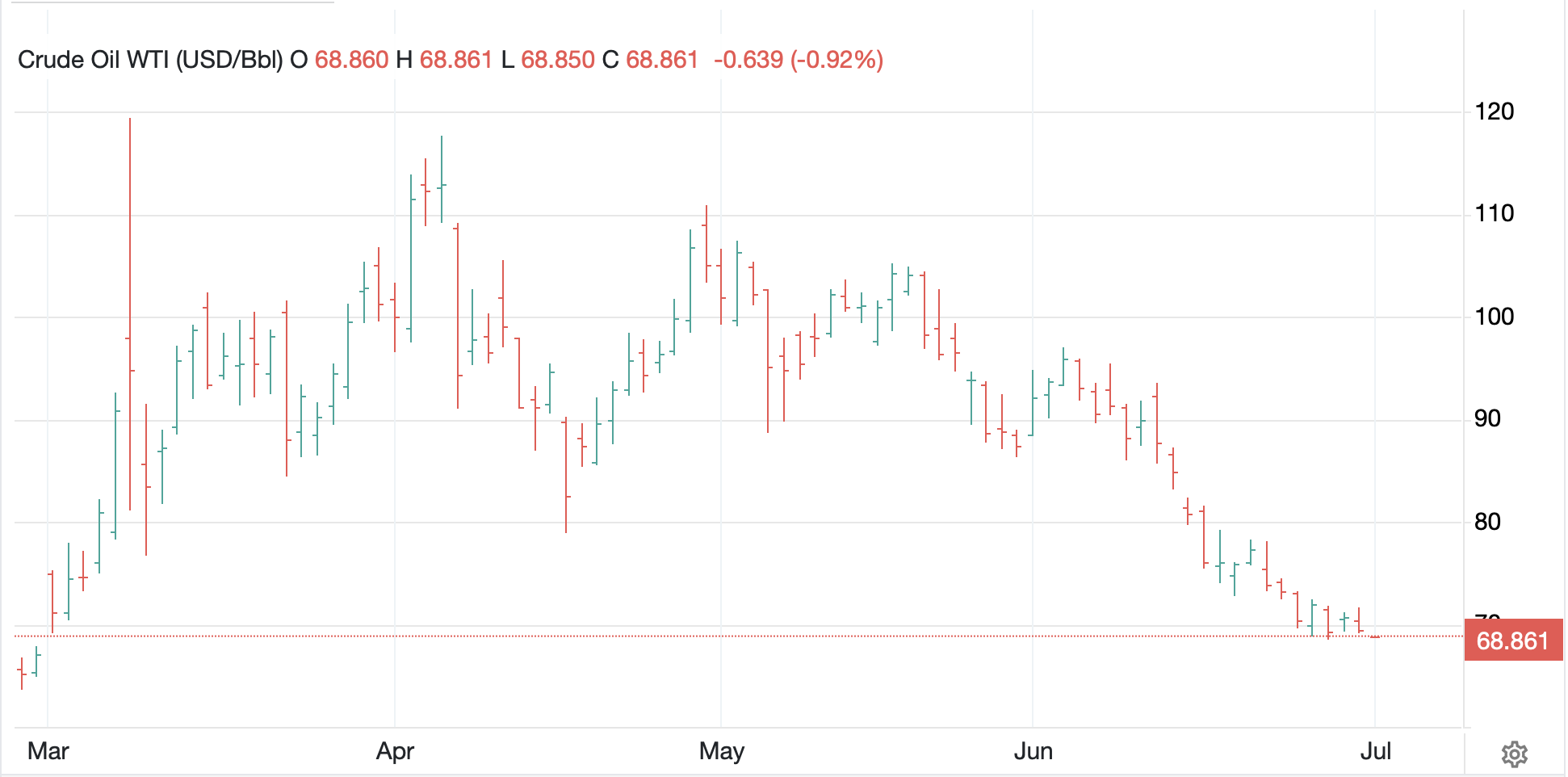
And, if you do the math, it seems that the yen weakened 0.72% (from 159.45 => 160.60) in the first two weeks of June and 1.32% (160.60 => 162.72) since the FOMC meeting.  I completely agree that modest change in trajectory is the result of this newfound belief in Fed hawkishness.  Of course, you all know that I don’t believe that is what the Fed is going to do, and in fact, my 180 call at the beginning of the year had nothing to do with the Fed raising rates, it was all about deterioration of Japan’s fiscal account.  However, as we learned this morning from Europe, where inflation fell to 2.8% headline, 2.4% core, both much lower than last month and forecasts (good thing the ECB hiked into the energy price shock, right?) we can look forward to at least a few months of softening inflation in the US as well based simply on the ongoing decline in oil prices (-1.0% this morning) and continuing to trend lower as per the below chart.

Source: tradingeconomics.com

Softer US inflation numbers are going to undermine the call for rate hikes, and I expect to see those hikes priced out of the markets by the end of July.  That alone should help prevent the yen from collapsing in the short-term, although their long-term problems remain extant.

But one thing to keep in mind is that we are coming up to a holiday weekend in the US with market liquidity impaired.  It would not be surprising to see the MOF step in to markets Friday when liquidity is thin and they will get more bang for their buck.  But the yen is a basket case regardless of US rates.  Like I said, short-term, maybe a dip in USDJPY back toward 155 on the back of intervention, but longer-term, unless they change their fiscal policies, lower the yen will go.

Otherwise, there is not much new to discuss.  Equity markets finished the quarter with their best result in forever, with the NASDAQ rising ~30%.  Seems like it will be hard to repeat that again, and this morning, futures are slightly in the red, about -0.3% or so.  As to the rest of the world (do we really care?) last night saw Tokyo (+0.6%) rally along with India (+0.6%) and Taiwan (+1.9%) but the rest of the region slumped led by Korea (-2.0%) which had been the leader, with China (-0.4%) and HK (-0.6%) also falling and the rest of the regional bourses seeing more red than green.  In Europe, there is more negativity than not with only the DAX (+0.2%) edging higher after their PMI release (50.3) was slightly better than expected, although still weak.  However, the rest of Europe is softer this morning (Spain -0.7%, France -0.65%, UK -0.4%) amid unimpressive PMI results.

In the bond market, yesterday saw US yields pop nearly 10bps in what appeared to be a major futures led move.   Certainly, yesterday’s data releases didn’t indicate dramatic strength in the economy, just that things are still fine.  But things being what they are as the Treasury market drives global bond yields, we did see yields climb everywhere yesterday and have followed on in Europe this morning with sovereign yields higher by between 3bps and 5bps across the board.  JGB yields (+3bps) rose overnight as well, although Treasury yields are little changed this morning.  I feel like this move will be reversed by month end, if not sooner.

In the metals markets, oil’s decline has seen support for both gold (+0.4%) and silver (+0.6%) although copper (-1.6%) is struggling this morning.  Nonetheless, I continue to like the long-term outlook for metals.

Finally, the rest of the dollar story is one of strength for the greenback with the euro (-0.25%) slipping back below 1.1400 and every G10 currency under pressure.  Meanwhile, in the EMG bloc, KRW (-0.7%) is today’s dog, as it approaches its GFC levels as the equity market selling weighed on the currency.  Otherwise, broad dollar strength, but nothing dramatic.

On the data front, ISM Manufacturing (exp 54.0) is coming later this morning as are the EIA oil inventory data. And, of course, Mr Warsh’s speech at 9:00am.  It will be quite interesting to hear what he has to say, as I think it will be the most critical thing for the session, and frankly, I have no idea where he may go.

So, as we head into a holiday weekend, less positioning is better, and choppiness is to be expected.

Good luck

Adf

Just Keeping Up

The yen slid further
Is it accelerating?
Or just keeping up?

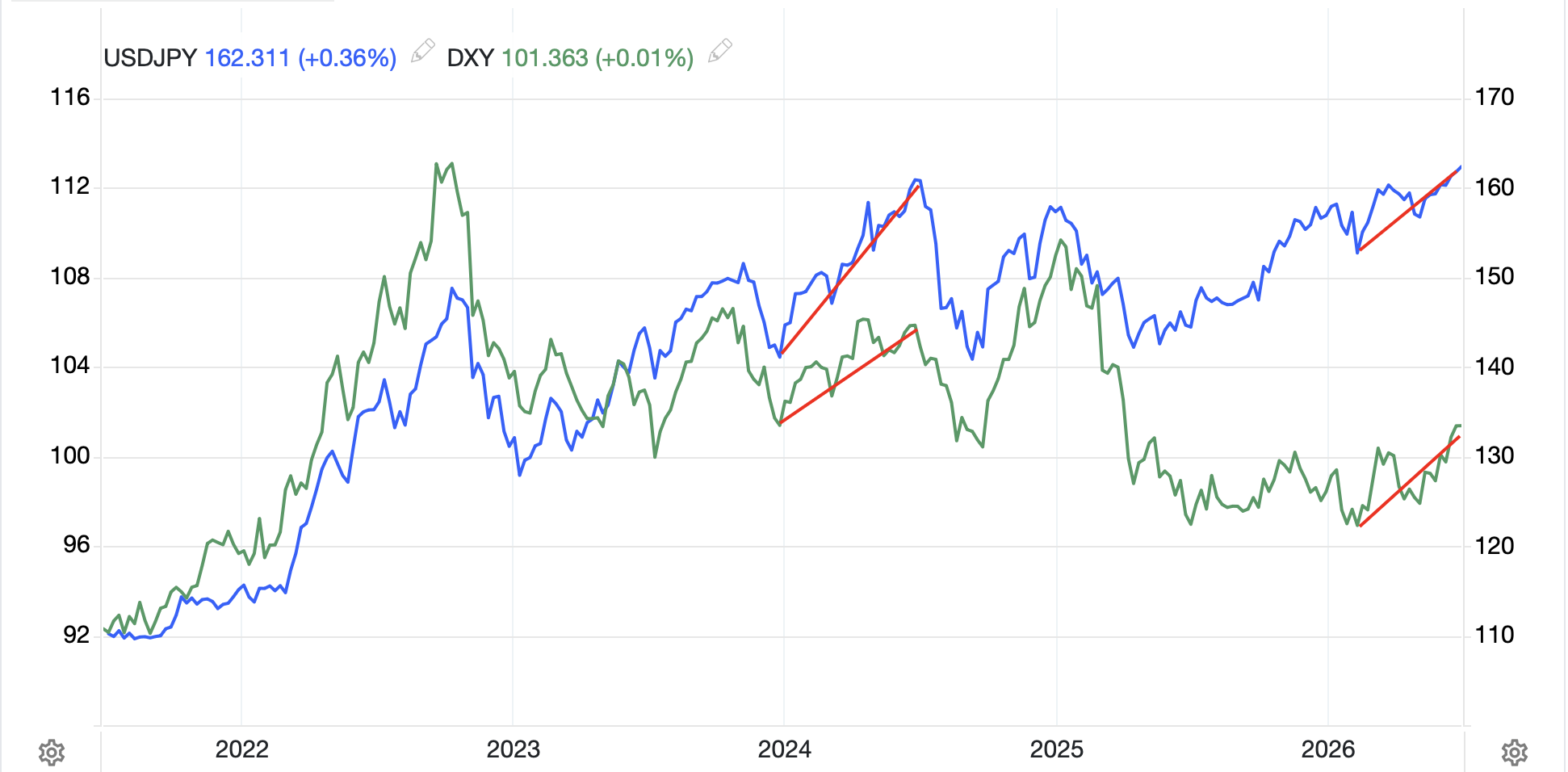
There has been a lot of press this morning regarding the yen (-0.25%) which as you can see has weakened a bit, but hardly an extraordinary move.  Thus, the press is all about the level at which it now trades, 162.30ish which is a new high for the move, although it has yet to break above its 1986 levels.  The nature of the articles has been a question as to when the BOJ is going to be back intervening again which then morphs into a discussion as to whether intervention is effective.  (While I don’t know if they will be back in, I imagine that will be the case at some point, we know it is not effective.)  At any rate, I have created the following chart on tradingeconomics.com so that you can (hopefully) see why they have not yet intervened.

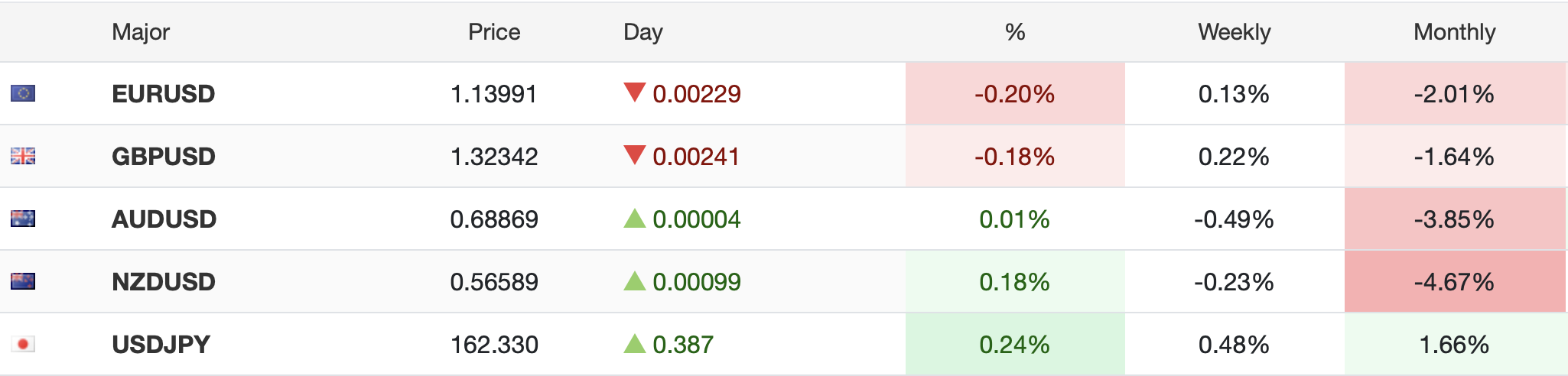
One of the key features of the MOF seven step program to intervention is the pace of the yen’s movement.  A rapid decline is far less tolerable than a gradual movement.  As well, there is the question of whether the yen is declining across the board, or it if is declining specifically, or at least more rapidly, vs. the dollar.  It is no surprise to me that the MOF remains on the sidelines as the dollar is rallying everywhere right now, so yen weakness is really more about dollar strength.  If you look at the chart above, I tried to show the slope of the movement in USDJPY vs. DXY back in the beginning of 2024 which was the previous time the yen started to show serious weakness and the BOJ intervened.  To my eye, the slope of the two lines in 2024 are far different than the slope of the current movement.  In fact, the table below shows that the yen’s weakness over the past week and month is hardly an outlier.  In fact, it has basically held up better than its major counterparts.

My point is much is being made about the yen’s breech of the 162 level, but the movement has been quite gradual, hardly the rapid and volatile movement that has driven intervention decisions in the past.  Frankly, there is little reason to believe that with the dollar strong across the board, the BOJ can do anything other than waste money in an intervention effort.

Which begs the question, why is the dollar performing so well?  The pat answer remains that the market is pricing in a suddenly hawkish FOMC with the Fed funds futures market pricing an October rate hike now, with a one-third chance of a second one in December.  See below from the CME.

But I still don’t understand that pricing.  Despite all the ongoing chatter about the imminent shortage of oil/diesel/gasoline/jet fuel that has yet to appear and has now been delayed to H2 of this year, markets continue to price limited further interruption to energy availability.  In addition, one need only look at today’s raft of Eurozone inflation data where France (1.8%), Italy (3.0%) and every German state (between 2.1% and 2.4%) all printed lower than last month, as well as lower than forecast, and recognize that the significant decline in energy prices over the past month is going to push down measured inflation.  Nothing has changed my view that the Fed is on hold for now, and over the next several months the idea of rate cuts will come back into vogue.  At that point, I assume the dollar will give up its recent gains, although I do not foresee a reason for a substantial decline.  After all, investment flows into the US are going to remain robust.

And with that, let’s look at other markets.  As proof positive that nothing is ongoing, oil is unchanged this morning, just above $70/bbl and there has been precious little new news about the situation in the Gulf.  Metals are edging higher (Au +0.4%, Ag +1.3%, Cu +1.3%) but the precious set remain in downtrends although copper is in demand.

You’ve already seen the dollar movement above, at least vs. the bulk of the G10.  But elsewhere, it is not a very interesting picture either.  Perhaps the fact that ZAR (+0.3%) is firmer this morning on the back of both the modest rise in gold and the fact that their fiscal situation looks a bit better (significantly reduced budget deficit in May) is the outlier of note.

Bond markets continue to drift as 10-year Treasury yields slip -1bp and we see similar price action across most of Europe.  The outlier here is Italy (+3bps) which given the better-than-expected inflation data is confusing and I have seen no other cogent explanation.  As well JGB yields (+4bps) overnight reacted to the yen’s weakness as well as to comments by the newest BOJ member, Ayano Sato, who sounded modestly dovish.

Finally, turning to the equity markets, another record setting day in the US was followed by a mixed picture in Asia with both gainers (Tokyo +0.9%, China +1.1%, Korea +1.0%, Taiwan +2.5%) and laggards (HK -0.6%, Australia -0.5%, India -0.3%, Indonesia -3.1%) with the latter a response to a legal verdict of corruption which the market has taken as a major government intrusion into the economy and frightened investors.

Turning to Europe, though, everybody is happy this morning with gains across the board (Germany +1.5%, UK +1.2%, Spain +0.7%, France +0.6%) as those slipping inflation numbers help the overall sentiment.  As to US futures, you will not be surprised that at this hour (7:25) they are marginally higher.  

One must be impressed with the consistency of equity market gains.  It is enough to make you reconsider your prior ideas as to how markets work.  Arguably, the key feature of the recent equity market performance is that earnings data continues to improve.  Now, if you look at the ongoing growth in money supply, both in the US and around the world, it is no surprise that nominal results continue to rise.  It is also not surprising that people are feeling stressed by inflation regardless of the data that is printed as all that money has to find a home somewhere.  And the Cantillon effect tells us that the first folks who get the newly printed money (banks and institutions) are the ones who benefit the most while the rest of us simply watch our cost of living increase.  This is the entire wealth/income inequality story and, arguably, the reason that the idea of socialism is making a comeback.  And socialism does have a perfect record in its economic outcomes; it has failed 100% of the time it has been tried.  But right now, I fear that record is not going to be a problem.  There is much potential trouble ahead.

Today’s data brings Case-Shiller Home Prices (exp 0.9%) as well as Chicago PMI (58.1), JOLTs Job Openings (7.30M) and Consumer Confidence (94.7).  But with Warsh on the tape tomorrow morning and then NFP on Thursday, I don’t see today’s data having much impact.

While the Iran situation is in the background right now, it remains the issue with the biggest potential impact going forward.  A successful conclusion of a deal and resumption of flows of energy through the SOH will put additional downward pressure on energy prices, and by extension general inflation.  In that scenario, central banks will be quick to turn away from rate hikes.  However, if things collapse there, then we will need to be prepared for another major hiccup, that’s for sure.

Good luck

Adf

One Sixty

The asymptote nears
Will they act at One Sixty?
Can they afford to?

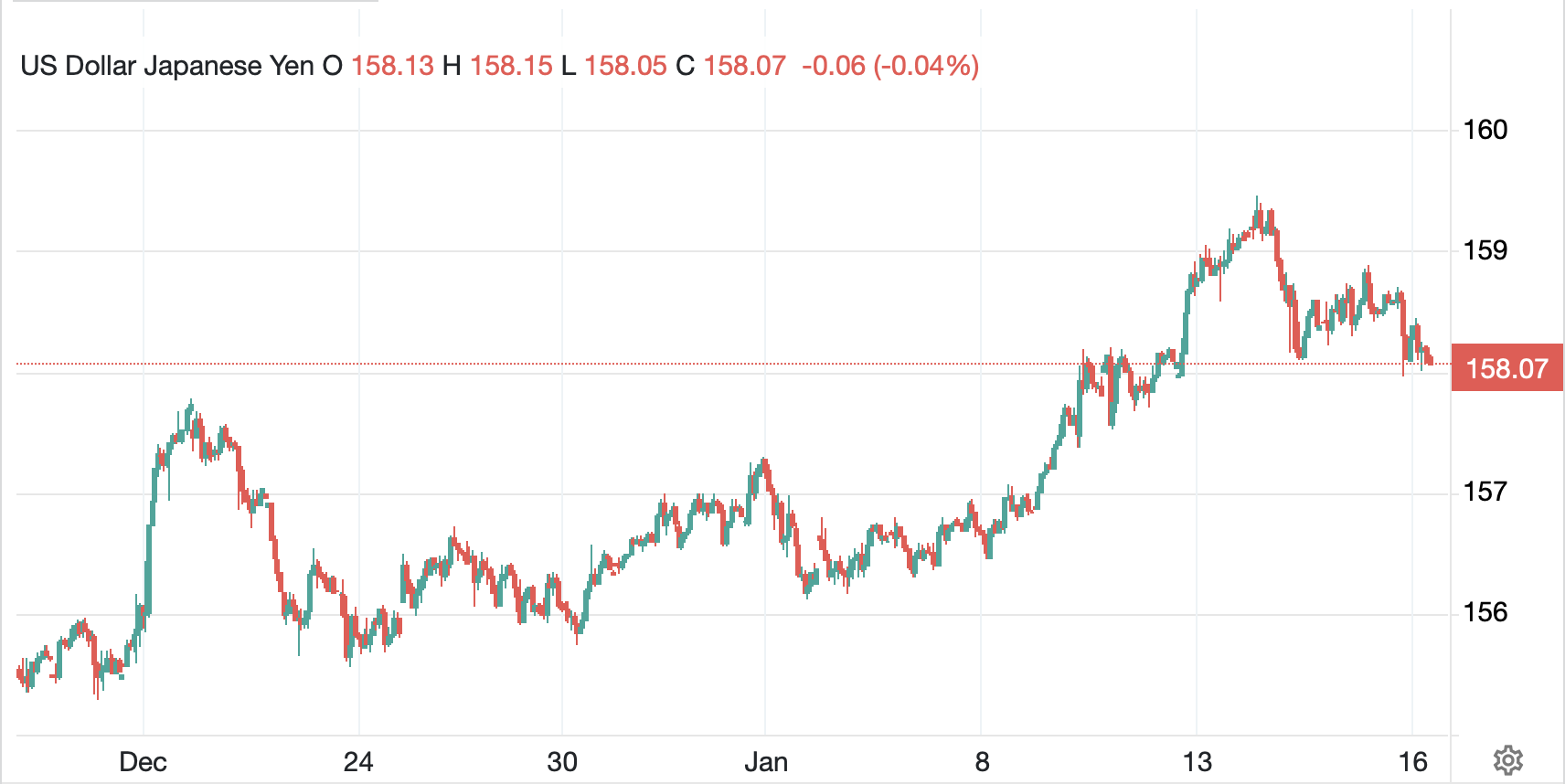
Yesterday saw the yen edge ever closer to the 160 level, the point at which the MOF/BOJ acted in April.  Frankly, looking at the chart, it reminds me of an asymptotic limit from calculus, but the one thing we know is there is no natural limit, only whatever artificial one is imposed (or tried to be imposed) by the Japanese government.

Source: tradingeconomics.com

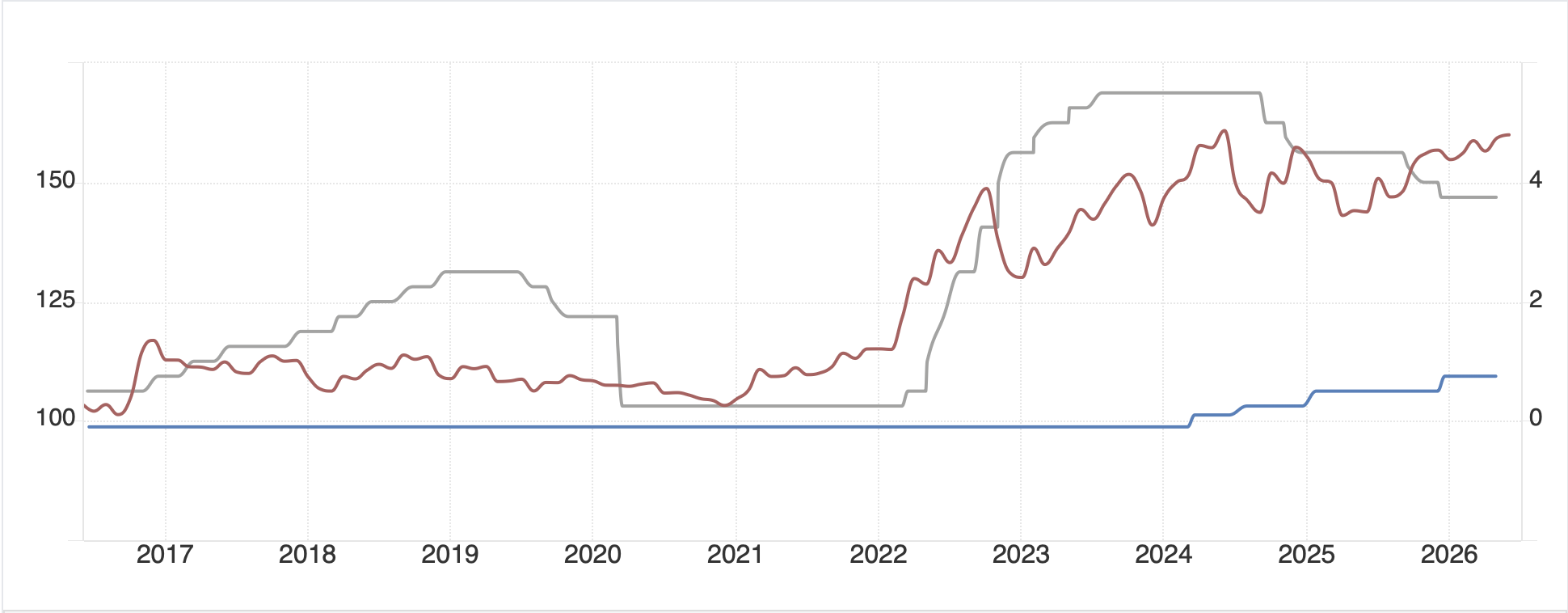
The market continues to price a high probability, ~86% according to the OIS market, of a 25bp hike by the BOJ next week, and I’m confident they will do that.  But to me, the question is, will it matter to the FX markets?  Here’s the thing about FX, typically there are two separate, but related, drivers of the relative value of one currency vs. another.  The most common discussion is about short-term interest rate differentials, typically proxied by central bank base rates.  Below is a chart of the past ten years of data for Fed funds (grey line), BOJ base rate (blue line) and USDJPY (brown line).

Source: tradingeconomics.com

It is abundantly clear that there is a strong relationship here, as US rates shot higher in the post-Covid inflation bout and USDJPY shot higher as well.  Now, since the Fed started cutting rates back in September 2024, while Japanese rates have edged higher over the same time frame, it would be reasonable to assume that USDJPY should retreat somewhat.  However, as you can see in the first chart, that is just not happening.  In fact, the pressures are the other way, with far more weakness than strength.

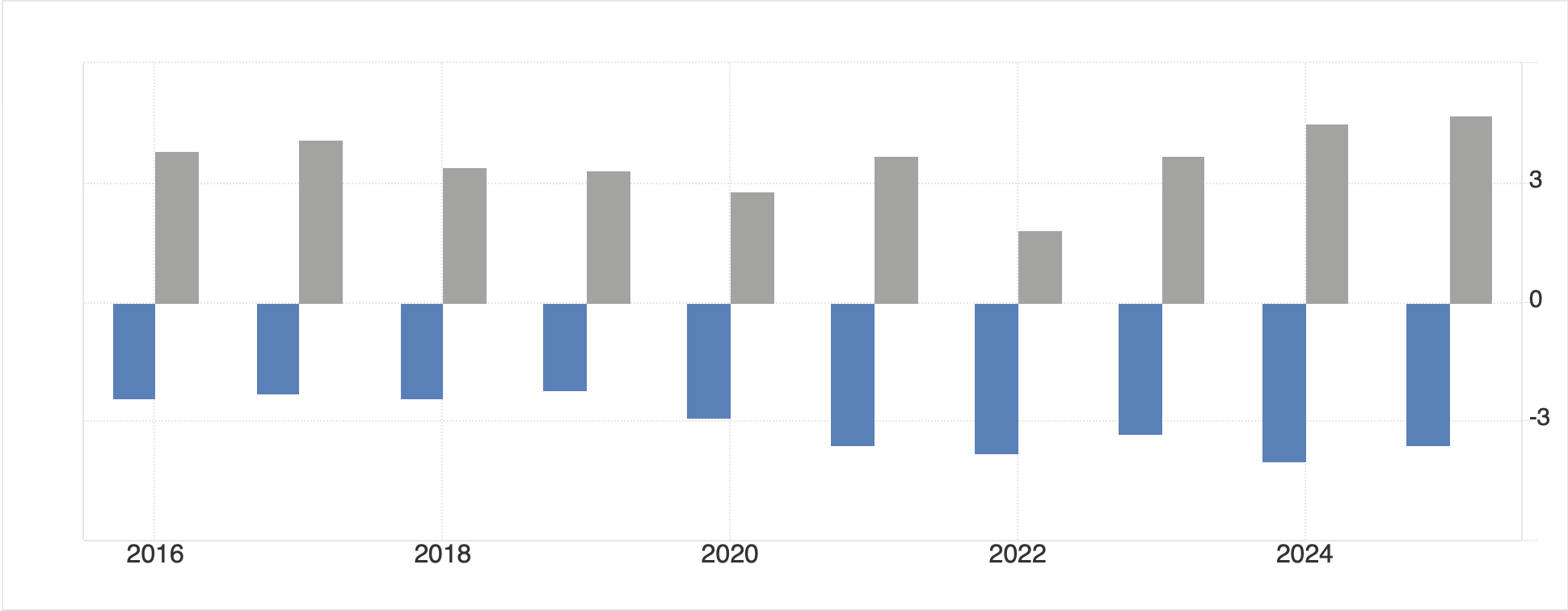
Why, one might ask, is this the case?  This takes us to the other major factor in FX rates, relative capital flows.  Nations that see substantial inflows in capital will typically see their currencies appreciate.  Now, ask yourself, which nation sees the biggest inflows of capital in the world?  Yes, the US, as the capital account surplus is the mirror image of the massive current account deficit that we run.  In fact, if you look at the below chart, it shows the relative current accounts of Japan (grey bars) and the US (blue bars) in percentage of GDP which most recently showed -3.6% for the US and +4.7% for Japan.

Source: tradingeconomics.com

Now, let’s do the math.  US GDP is ~$28.8 trillion while Japanese GDP is ~$4.4 trillion.  3.6% of $28.8 trillion = ~$1.037 trillion of capital inflows.  4.7% of $4.4 trillion = $202 billion of capital outflows.  Of course, we know that everybody in the world is piling into US technology stocks, and that is where the capital is mostly flowing, but in order to do so, they are buying USD.  This is true of Japanese investors as well as others around the world.  

There is a narrative that is developing that claims as the Japanese raise interest rates, the massive, short yen positions that exist to fund many speculative trades will unwind, and with that, the yen will strengthen dramatically as well as we will see many other markets sell off sharply as those positions unwind.  But the NASDAQ is up 21% YTD and 40% in the past year.  If you are an investor and you are funding a speculative position at 0.75% annually that rises to 1.00% while you are returning 40% on the other side, do you really care?

To my eye, for the yen to change course, intervention is irrelevant, and so is a 25bp rate hike.  We need to see a wholesale change in the combination of Japanese fiscal and monetary policies as well as changes in those policies in the US.  Historically, a tight monetary and loose fiscal policy combination will strengthen a currency (something that the US currently has), but can Japan afford to tighten monetary policy that much?  My money is on no, and while 25bps seems pretty certain next week, I would not be looking for USDJPY fall very far, if at all.  And remember, the market is pricing a 50% chance of a Fed hike by the end of the year.  Don’t be taken in by this story in my view.

Away from this issue, it is difficult to find other critical news.  Yes, there was another skirmish in Iran straining the concept of a ceasefire, but all-out war has not resumed.  The elections in California and LA will take several weeks to determine who will be on the ballot in November, which, when you think about it, sums up the incompetence of California governance writ large.  

So, oil is higher along with the dollar and yields, but so are stocks, while metals slip.  Let’s look at the overnight activity.  Another set of equity records in the US was followed in Asia by broad based strength as Tokyo (+2.5%), China (+0.5%), Korea (+0.2%) and Taiwan (+2.0%) all continued to climb. Both HK (-1.6%) and India (-0.4%) were not as robust with the former seeing profit taking after a few strong sessions while the latter felt pressure from those rising oil prices.  One outlier here was Indonesia (-4.5%) which suffered after weaker than expected trade data, higher than expected inflation data, and a weakening rupiah which set another record low (dollar high), touching 18,000.

European bourses, meanwhile, are mostly under pressure after President Trump has devised a new way to impose tariffs on nations that allow “forced labor” which is defined as “all work or service which is exacted from any person under the menace of any penalty for its nonperformance and for which the worker does not offer himself voluntarily.”  One must give the president props for his continuous efforts to impose tariffs, if nothing else.  At any rate, Germany (-0.9%) is leading the way lower, followed by Italy (-0.3%), France (-0.2%) and the UK (-0.2%) although Spain (+0.5%) is bucking that trend on the strength of the earnings for Inditex (Zara clothing parent) which is one of the largest companies in the nation.  US futures, at this hour (6:40) are mixed.

In the bond market, yields are rising again on the back of the oil price rise with Treasury yields (+4bps) gaining alongside the entire European sovereign market, all of which have risen a similar amount.  Last night, JGB yields also rose 6bps, as they respond to the oil market as well as pending rate hikes by the BOJ.

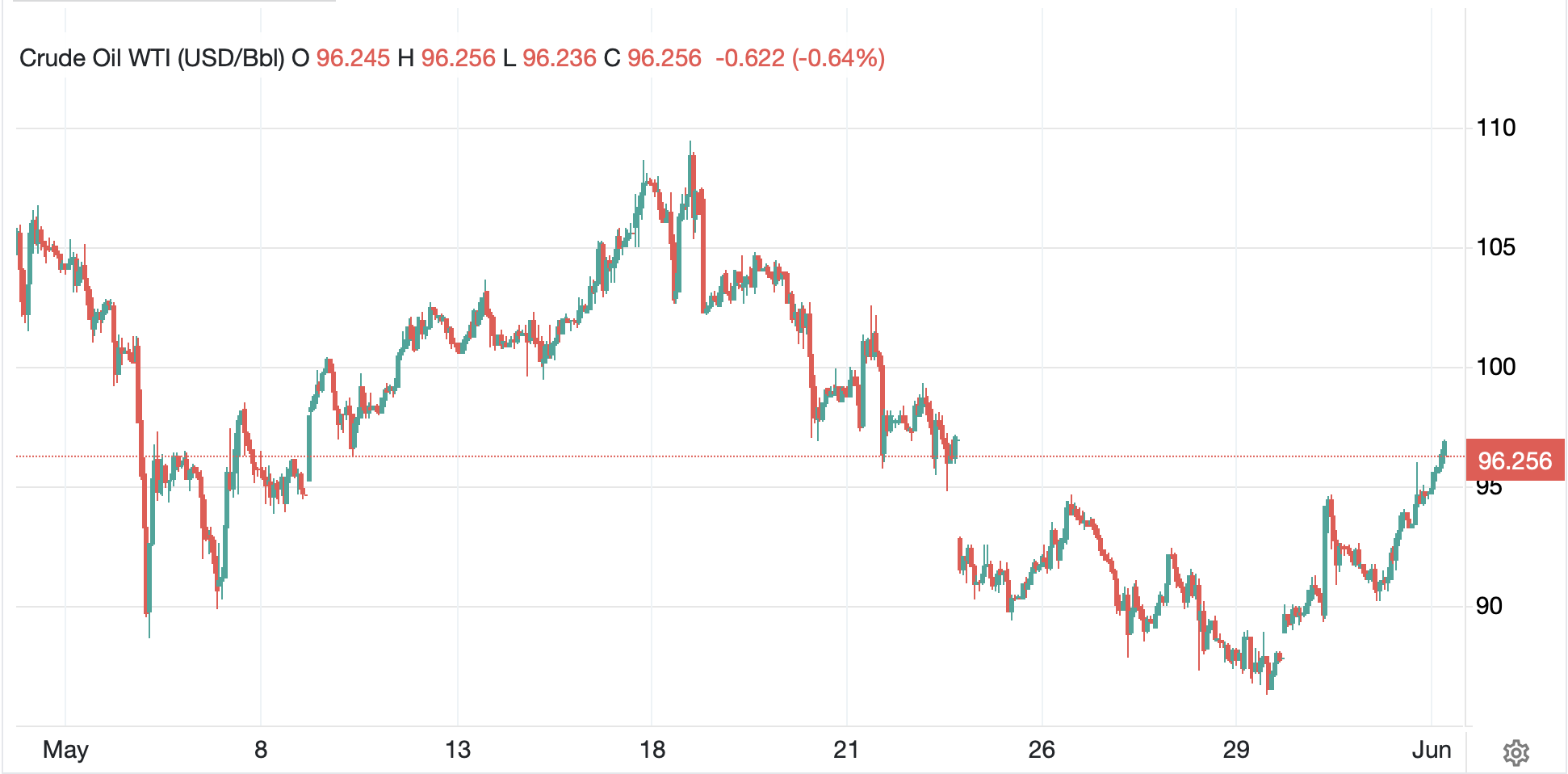
In the commodity market, if you think back to late May, you may recall an announcement that a deal with Iran was close which prompted a gap lower in oil prices as you can see in the chart below.  Well, that gap has now been filled.

Source: tradingeconomics.com

Just as nature abhors a vacuum, markets abhor a gap and seek to fill it whenever possible.  My take here, though, is now that the gap is filled, there is less reason to see oil rally much further and a consolidation before a slow decline is in the cards.  As to metals markets, gold (-0.8%), silver (-1.2%) and copper (-1.1%) are all softer on the day, with their negative correlation to oil intact.

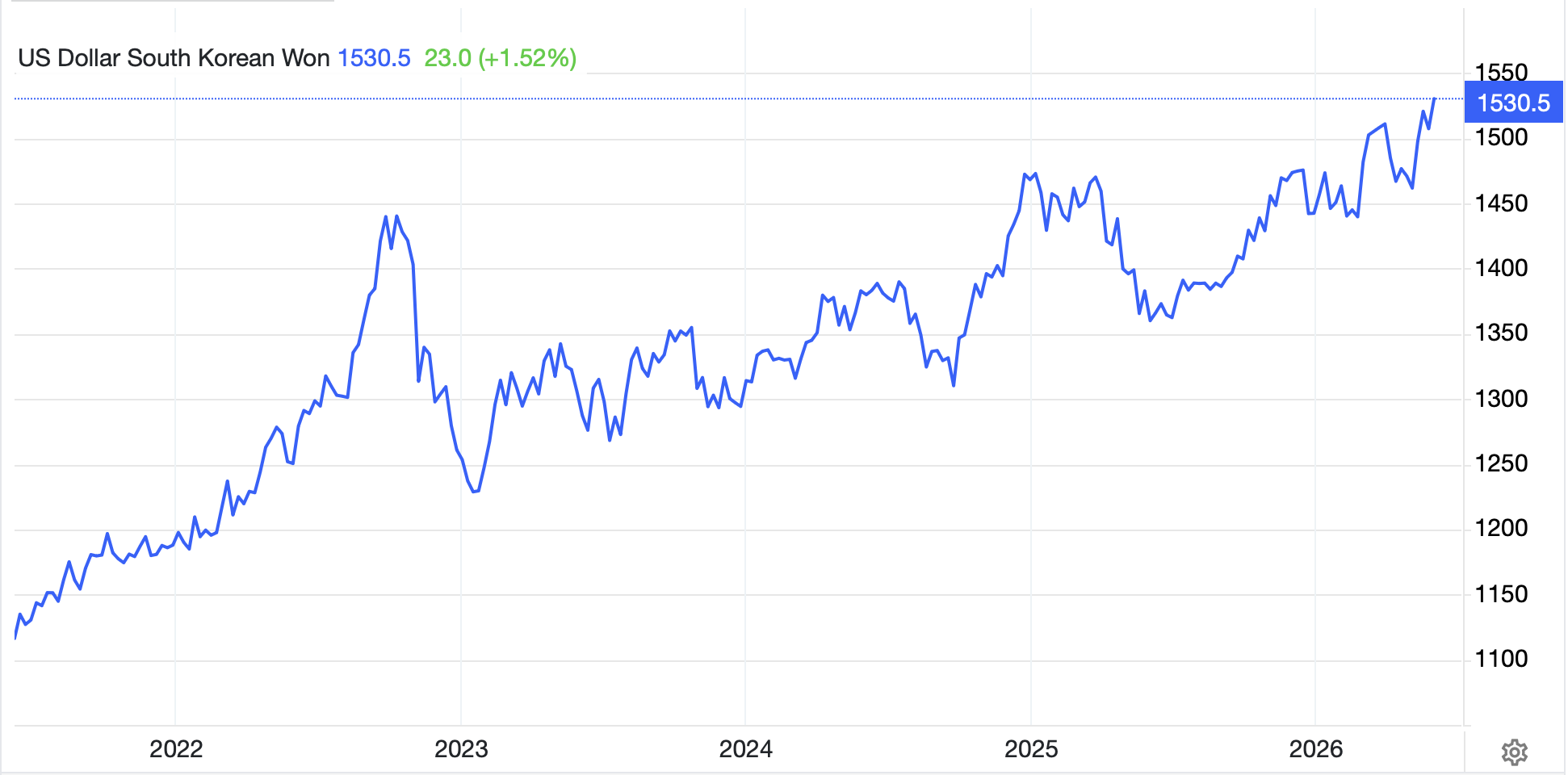
Finally, the dollar is firmer this morning, keeping in line with its recent relationship with other markets.  However, the movement remains relatively muted with most G10 currencies softer by -0.2% or so as only SEK (-0.6%) and NOK (+0.1%) really buck that trend.  NOK is clearly benefitting from the oil price rise while SEK seems to be suffering from a slightly higher beta to the broad dollar move.  In the EMG bloc, KRW (-0.9%) is the laggard as it continues under pressure and trading to its lowest levels (highest dollar) since 2009.

Source: tradingeconomics.com

But otherwise, most of these currencies are slipping a similar amount to the G10 bloc, on the order of -0.2% or so.

On the data front, this morning brings ISM Services (exp 53.8) as well as Factory Orders (4.6%, 0.8% ex-Transport) and then the EIA crude oil inventories with another sizable draw anticipated.  At 2:00, the Fed’s Beige Book is released which should make for some interesting reading.  Yesterday’s JOLTs data was surprising in that it showed a significant jump in job openings, 700K more than expected which does not portray a weakening labor market.

Overall, equity markets seem to be disconnected from the impact of oil prices, something that very few analysts would have forecast in February.  But the dollar remains closely linked to those prices for now.  As we all sit here, waiting for the next headline, I cannot help but look at the US data and consider that the economy continues to tick over pretty well.  Ultimately, I believe that bodes well for the dollar over time, or at least until some other major economy shows it can perform well.

Good luck

Adf

The Specter

On the horizon
The specter of BOJ
Intervention climbs


For those of you who don’t know, the genesis of this note was a daily update during my time covering US corporates for their FX hedging needs.  The poetry was episodic… until it wasn’t.  At any rate, this is the reason I sometimes harp on particular currencies rather than markets more generally.  And right now, while the dollar, writ large, is not that interesting, as I have been explaining for months, the yen (+0.3%) is becoming interesting in its own right as its recent spate of weakness has opened the door to intervention.  Last night, I would say we took a half-step forward on this journey as, while the BOJ did not check rates, FinMin Katayama was more explicit in her discussion about the yen’s weakness, even discussing the fact that the ‘agreement’ that her predecessor made with Treasury Secretary Bessent has no restrictions on intervention if deemed appropriate.

Following are her remarks from last evening, “We can take decisive measures against sudden movements that do not reflect fundamentals. This refers to intervention, and there are no constraints or restrictions on this.  I have repeatedly stated that we will take bold action including all the different measures available.  We shared the view that recent moves have been excessive and do not reflect fundamentals.” Then, she followed that up by referring back to her discussions with Bessent in Washington on Monday. “For many years before I took office, the Treasury secretary has held the personal view that monetary policy has been behind the curve.”

The chart below shows that for now, jawboning is the preferred measure to prevent further yen weakness, but as jawboning is only ever a temporary solution, it seems clear to me that there will be intervention at some point.  In fact, given Monday is a bank holiday in the US, implying less liquidity as banks run skeleton staffs, that may be an ideal time to get the most bang for their buck.

Source: tradingeconomics.com

But remember, even if/when they intervene, the impact will only be temporary.  Perhaps keeping a floor underneath the currency for a month or two.  Ultimately, though, it will follow the fundamentals, and if those are such that the US continues to grow rapidly and receive investment flows, unless the BOJ raises rates dramatically to moderate those flows, the yen will ultimately weaken further.   Now, ask yourself if you think the BOJ can raise rates aggressively given the combination of Japan’s 250% debt/GDP ratio and the fact that Takaichi-san’s policy mix is to borrow more and run things as hot as possible.

Away from the mess in Japan
A story of note is Iran
But tensions have waned
And thus, it’s explained
The oil complex can, down, stand

Looking elsewhere for news of note, there continues to be an enormous amount of energy focused on Minneapolis, which has no market impact.  Remarkably, Venezuela has become an afterthought to the markets as the new narrative is their natural resources are not economically retrievable at current prices.  Iran remains a hot topic in the oil market, but the concerns registered by traders early in the week have ebbed overall, although this morning, Texas tea is higher by 1.5% and back over $60/bbl. 

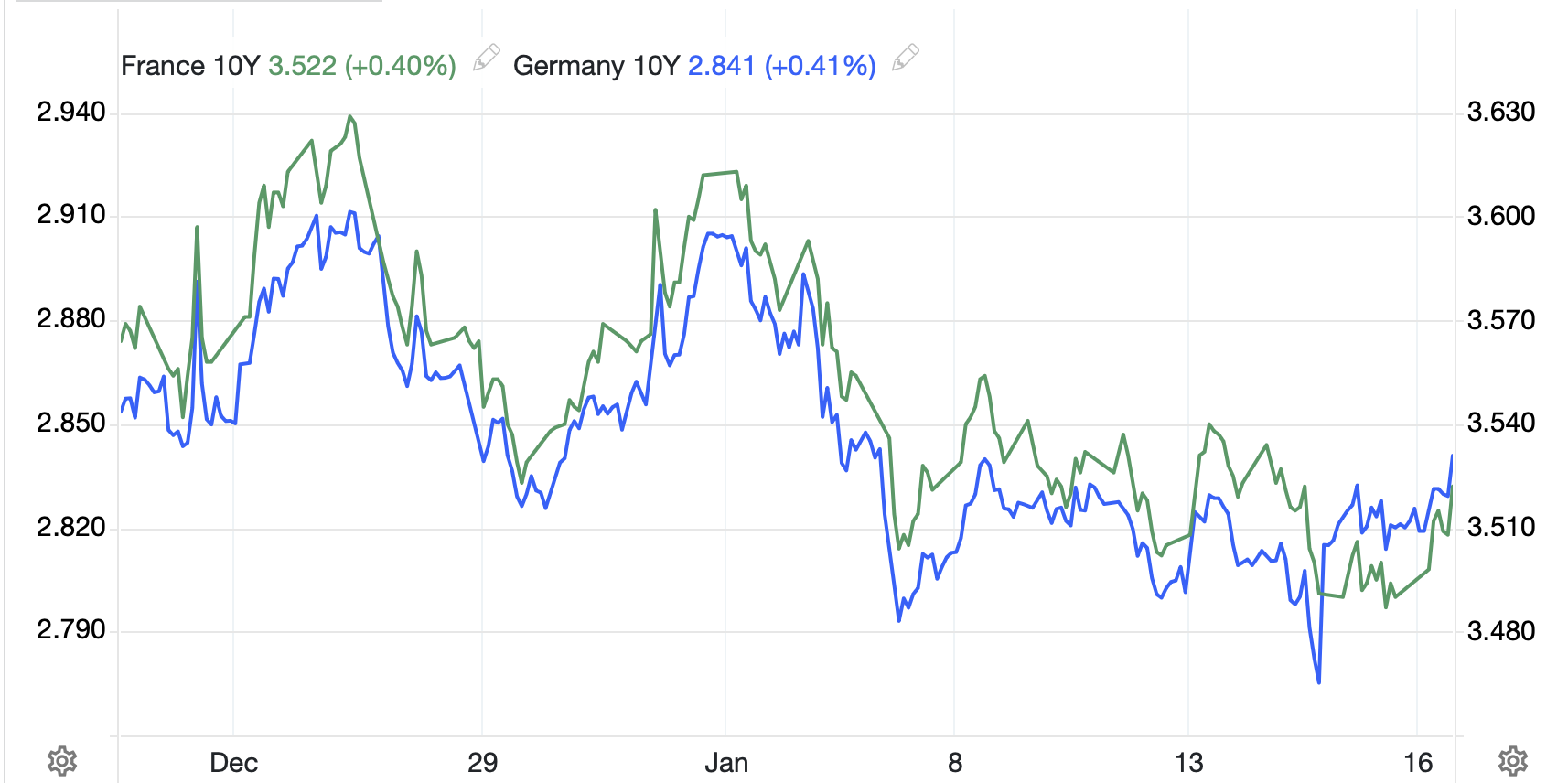
Looking at other markets, bonds remain somnolent, with yields up 1bp this morning, reversing yesterday’s decline of -1bp but still firmly within the 4.00% – 4.20% range.  European sovereign yields have edged higher by 2bps this morning and overnight JGB yields rose 3bps.  However, it remains difficult to see any significant pattern over the past month as evidenced by the chart below of French and German 10-year yields.  Net movement has been a handful of basis points overall.

Source: tradingeconomics.com

Even the metals markets, which have been THE story for the past months, have calmed down a bit as they consolidate their recent remarkable gains.  This morning, gold (-0.25%), silver (-2.1%), copper (-1.5%) and platinum (-3.2%) are all softer, but all remain higher on the week and over the past month, with silver having gained 37% since this time in December, and sitting above $90/oz.

Equity markets in the US rebounded yesterday, seemingly on some decent earnings data, but overnight, there was little love with Japan (-0.3%), China (-0.4%) and HK (-0.3%) all slipping from recent highs.  Elsewhere in the region, though, there was much more positivity as Korea (+0.9%), India (+0.25%), and Taiwan (+1.9%) all rallied with the latter benefitting from the agreement of a trade deal with the US that cut tariffs on Taiwanese exports in exchange for a $250 billion commitment of investment into the US.

In Europe, France (-0.8%) is the laggard du jour as ongoing budget negotiations in the government are no closer to completion and showing signs of breaking down.  As to the rest of the continent, modest declines are the order of the day while the UK is unchanged.  US futures at this hour (7:40) are pointing higher, however, led by the NASDAQ at +0.7%.

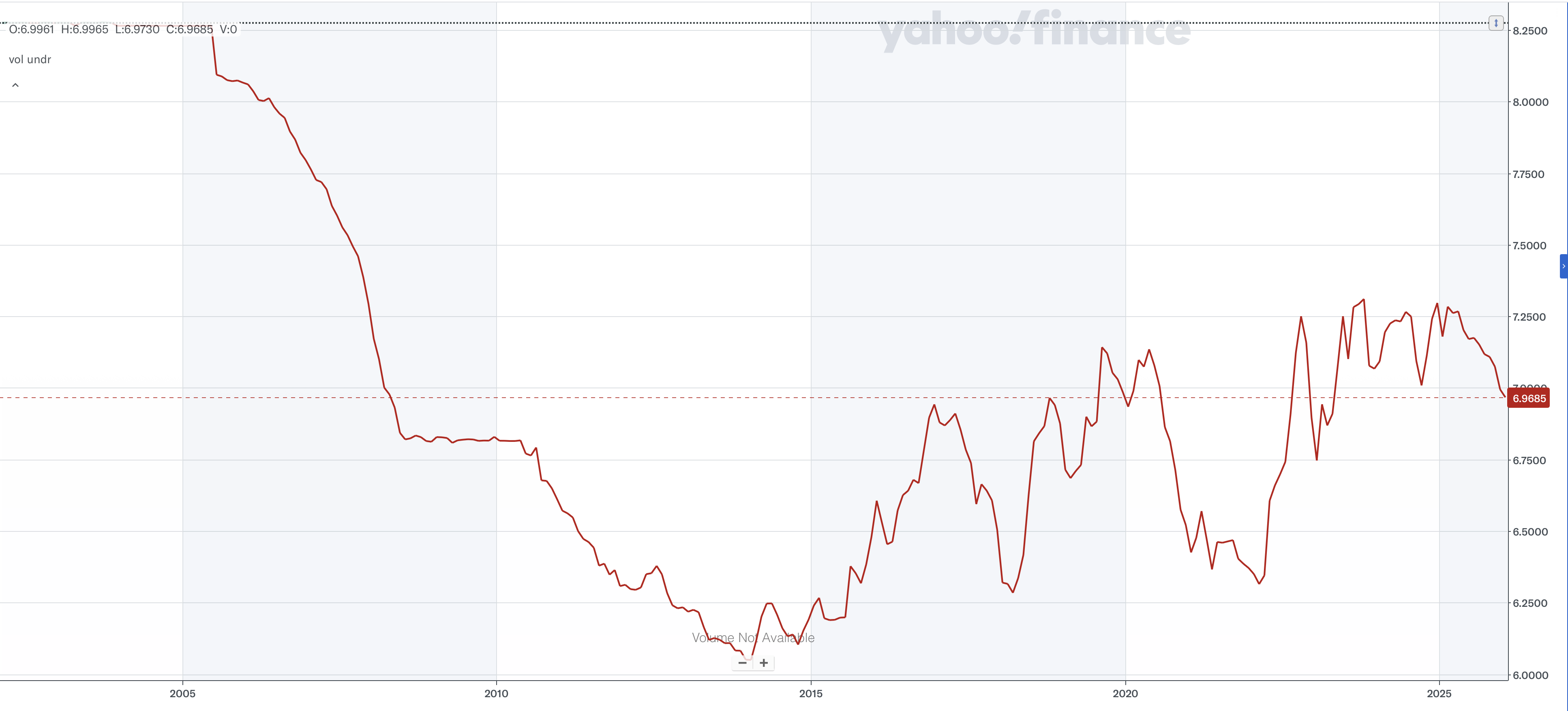
While overall, the dollar remains dull, an underreported story is the CNY (0.0% today) which has been appreciating steadily for the past year and is now at its strongest level since May 2023.  In the beginning of the year my view was if Xi actually got Chinese consumers to raise their spending and back away from the mercantilism that has been the driver of the Chinese economy since the beginning, we would see CNY strength, calling for 6.50 by the end of the year.  Well, a look at the chart below helps keep things in perspective as while CNY has appreciated about 5% in the past year, it remains far below (dollar higher) levels seen post pandemic.  However, I need to see the data indicate Chinese domestic demand is growing before I become a true believer!  Note, too, that the pace of this move is hardly remarkable.

Source: finance.yahoo.com

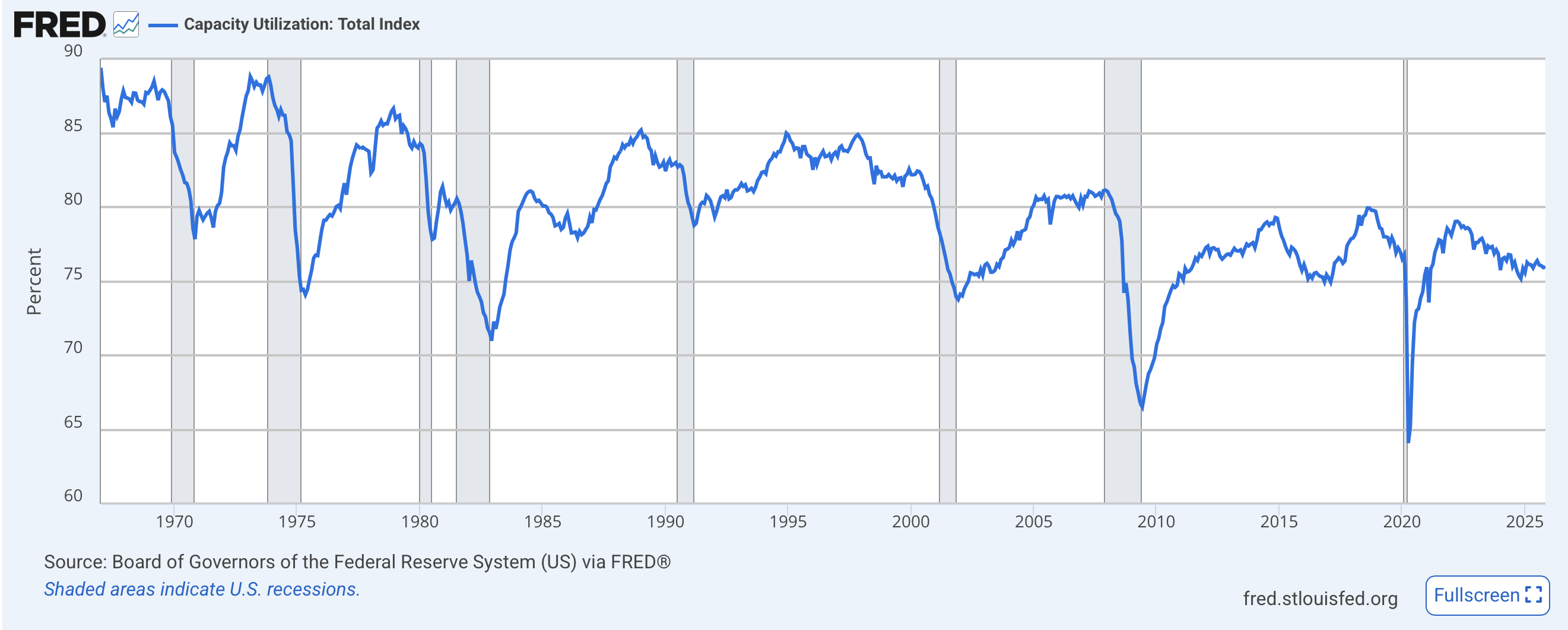
And that’s all I got today.  Today’s data brings IP (exp 0.2%) and Capacity Utilization (76.0%) with a few more Fed speakers as well.  Remarkably, despite the Fed trotting out virtually every member this week, nothing of note has been said given the current focus on defending Chairman Powell regarding the renovations at the Eccles Building.  

One other thing I have been wondering, and this has been for a long time, is the meaning of the Capacity Utilization reading.  On its surface, it tells us that only three-quarters of the US currently available manufacturing, mining and drilling capacity is being utilized.  But that seems like a low count based on the economy and the narrative.  I wonder, how much of what is considered available capacity is actually obsolete?  Undoubtedly, as you can see from the chart below from the FRED database, the trend is falling.  

But do companies really build so much capacity they don’t use and it sits idle?  Seems a tough way to make a living in a highly competitive world.  I understand that globalization undermined US manufacturing ever since China entered the WTO in 2001.  And maybe that is all this reflects.  But given the dramatic buildout in AI infrastructure, as well as growth in LNG and power production of late, if nothing else, I have to believe this trend is set to reverse in the near future.  After all, isn’t that Trump’s goal?

Meanwhile, I feel like we are all awaiting the next headline to determine the next move.  The underlying trend in commodities remains in place, and mostly, bonds and the dollar have no reason to go anywhere.

Good luck and good long weekend

Adf

Step Five?

It takes seven steps
Ere intervention arrives
Was last night step five?


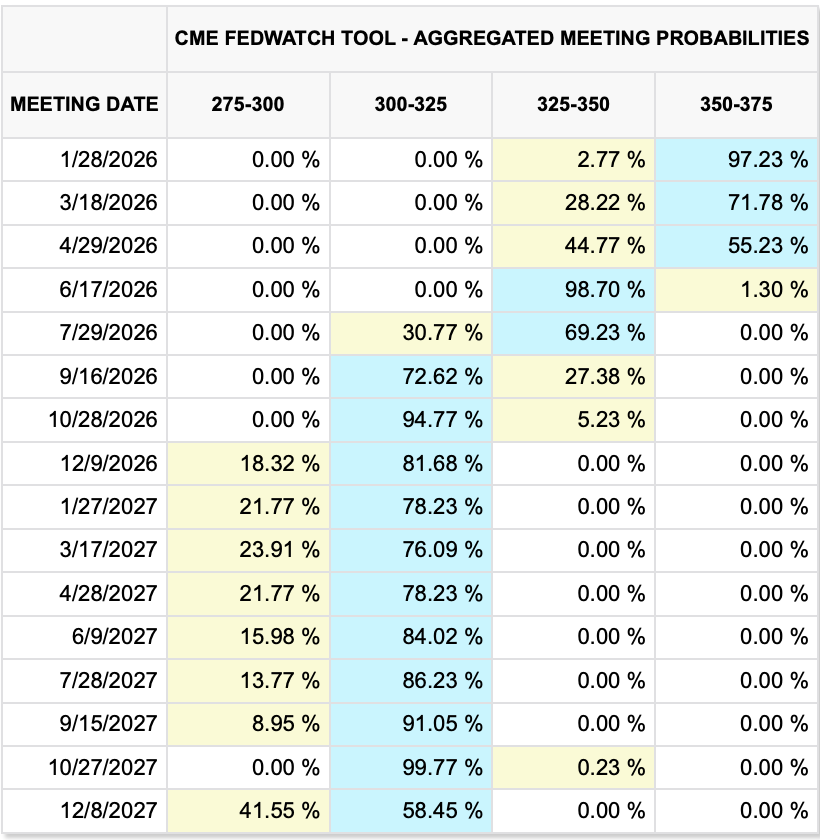
The yen continues to be in the crosshairs of traders as further weakness is anticipated based on several things I believe.  First, there had long been an assumption that the Fed was going to cut rates further, especially with President Trump haranguing Chairman Powell constantly on the subject.  In addition to that, there continues to be an underlying thesis amongst many pundits that the US economy is weakening dramatically to drive that rate decision.  Yet recent data belies those facts, notably the Atlanta Fed’s remarkable GDPNow jump, but also relative stability in other data, including employment.  The upshot is the futures market is now pricing a mere 3% probability of a cut at the end of this month and not pricing the next rate cut until June, after Chairman Powell is gone.  One key leg of the yen strength argument is weakened.

Source: cmegroup.com

Second, there continues to be a belief that the BOJ will continue to hike interest rates, and perhaps they will, but it appears that the pace of those hikes will be far slower than previously anticipated.  Currently, the market is pricing just 50bps of hikes for all of 2026.  At the same time, Takaichi-san is set to “run it hot” in Japan just like in the US, pumping up fiscal stimulus and forcing the BOJ to come along for the ride.  The implication here, which is what we are seeing in the markets right now, is that a larger fiscal deficit will lead to strength in equities but a weaker currency.  The second leg of the yen strength argument is failing here as well.

Which brings us to last night’s commentary from Satsuki Katayama, Japan’s FinMin, who explained, [emphasis added] “We won’t rule out any means and will respond appropriately to moves that are excessive, including those that are speculative. We’ve mentioned this to the prime minister today as well.”  The kind of sudden moves we saw on Jan. 9 have nothing to do with fundamentals, and are deeply concerning,” she added. Her message was soon backed up by Atsushi Mimura, the ministry’s top official in charge of the yen, who reiterated that no options were being ruled out.

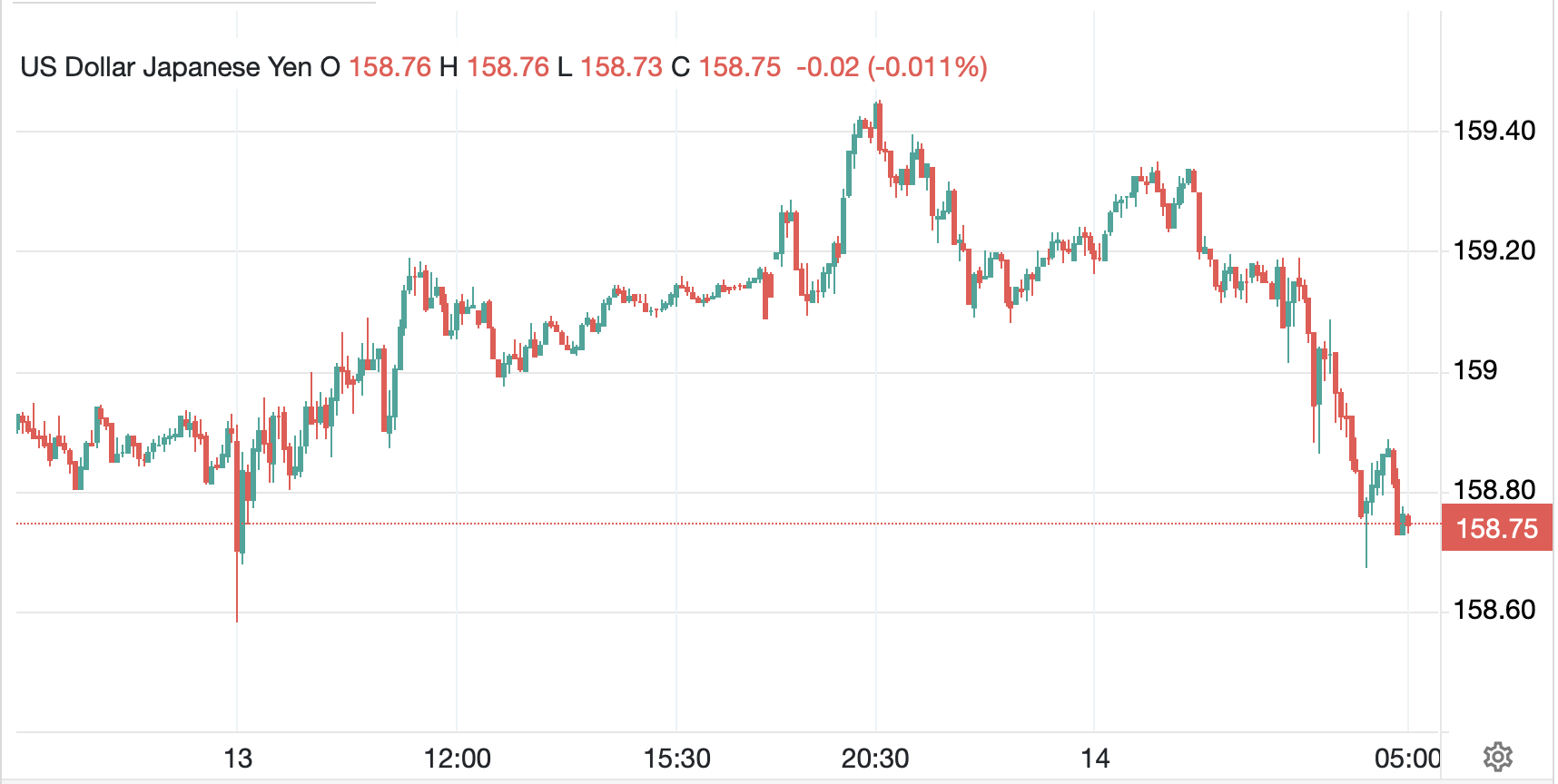
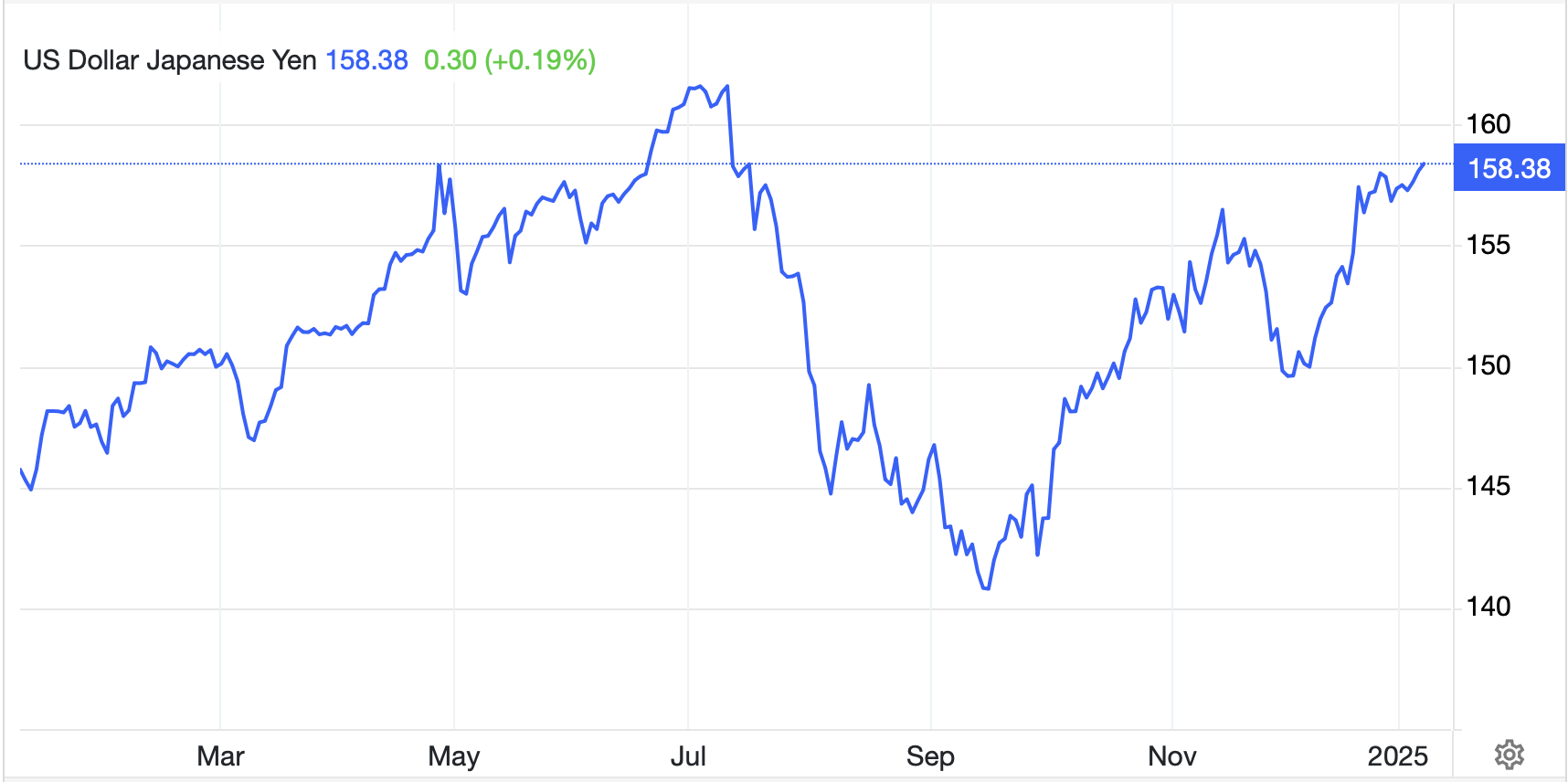
The bolded words are all part of the Japanese seven-step plan toward intervention.  At this point, I feel like we have reached number five.  The market responded predictably, with the yen strengthening vs. the dollar (and all its counterparts), albeit not all that much.  Last night saw the yen trade at 159.45, its highest since July 2024 (the last time the BOJ intervened), before the comments helped bring it back a bit.

Source: tradingeconomics.com

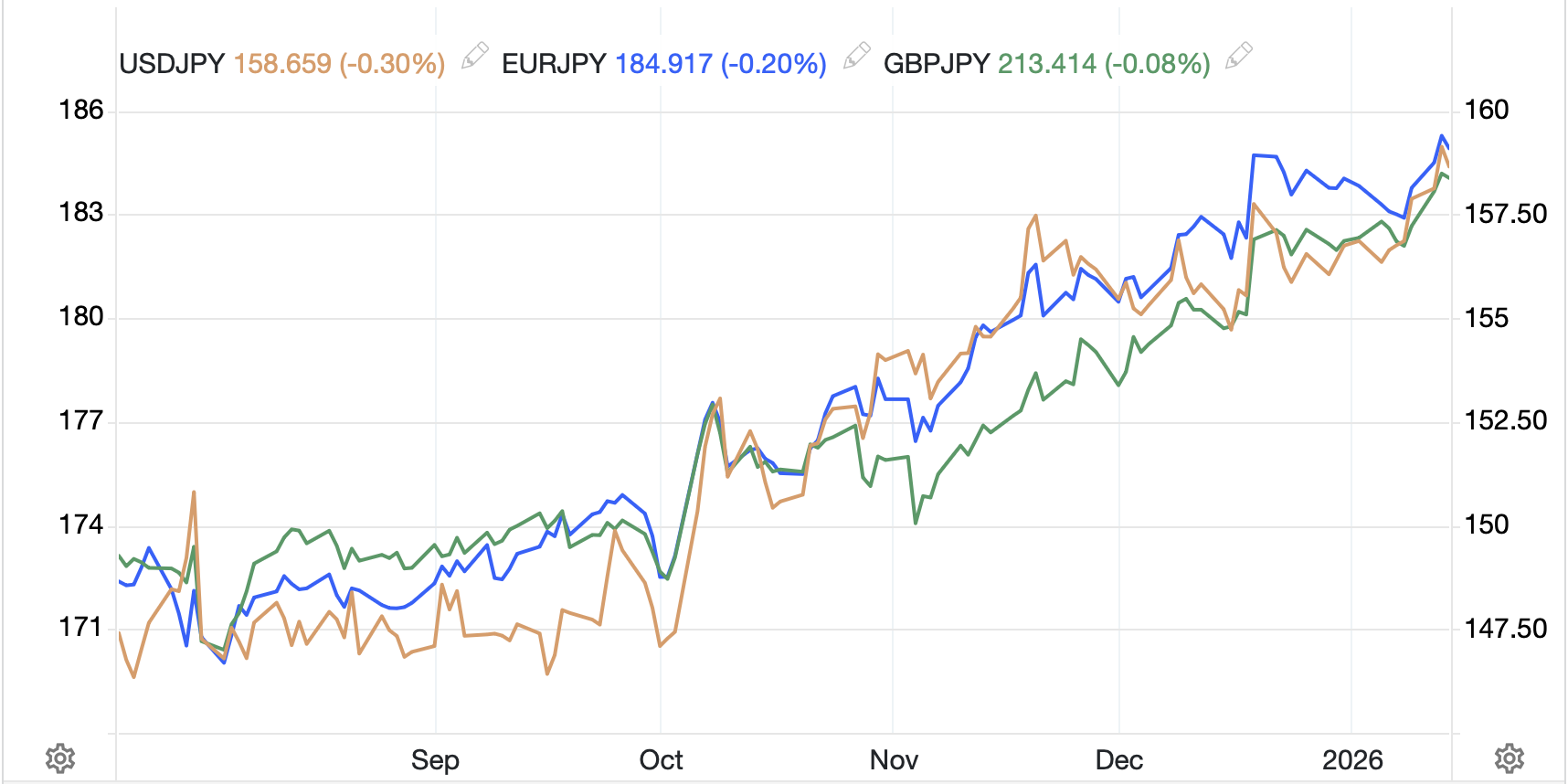
But one other area which the MOF/BOJ follow closely is not just the USDJPY exchange rate, but also the yen’s rate vs. other major currencies.  If, for instance, the yen is only weakening vs. the dollar, that is one thing.  However, a look at the chart below showing USDJPY, EURJPY and GBPJPY shows us that the yen is weakening against all those currencies pretty much in sync.  In fact, this argues that the yen’s current weakness is a yen specific fundamental, not a speculative move, which should argue against intervention, as that will only be a temporary sop.  However, my take is when we get to 160 or 162, which I believe is coming, we will see the BOJ selling aggressively.

Source: tradingeconomics.com

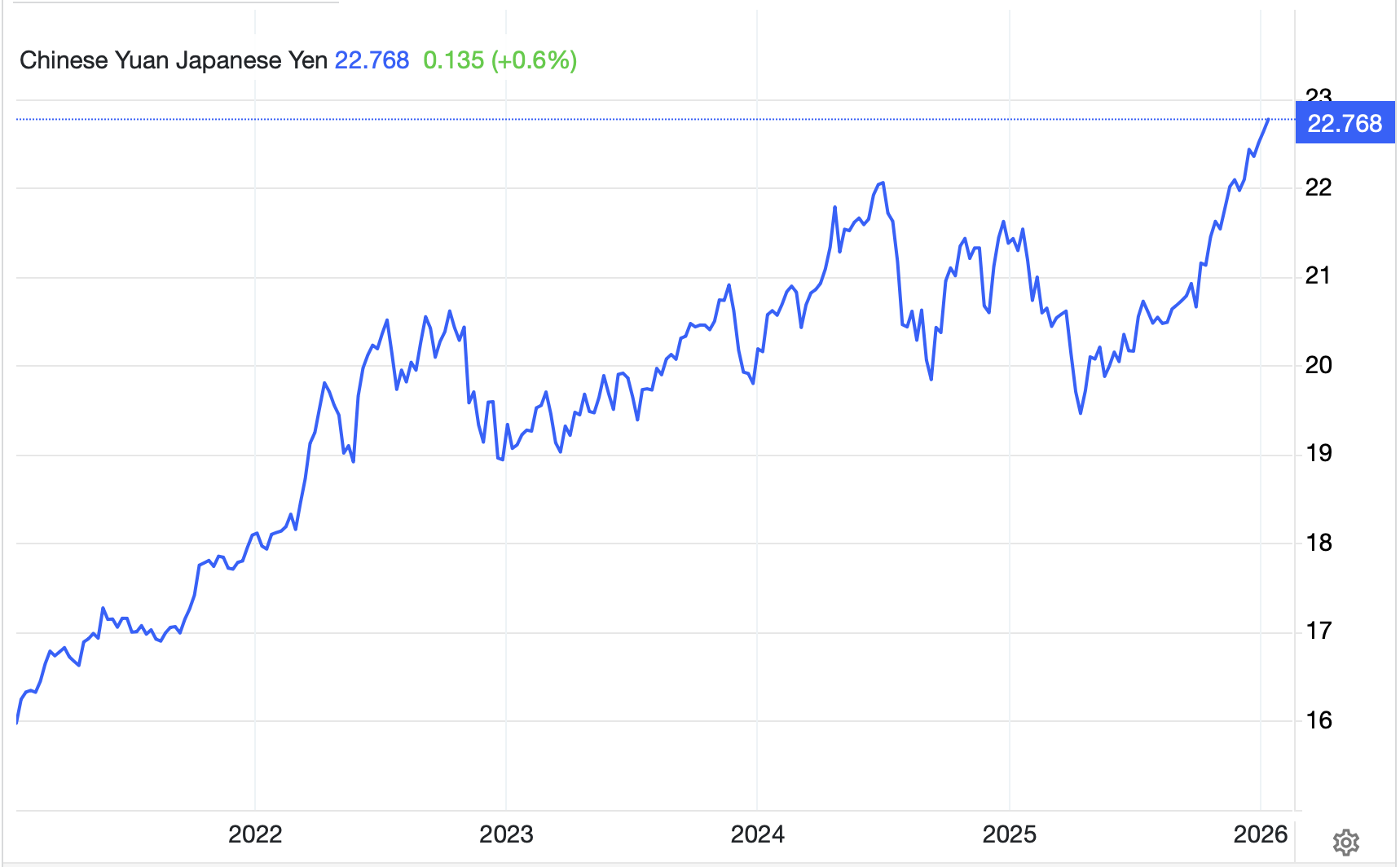
Ironically, the one currency against which the yen has been weakening steadily that I’m sure delights the BOJ/MOF is the Chinese yuan.  Since Liberation Day in the US, the yen has fallen more than 17% and continues to slide vs. the yuan as it has been doing for the past five years.  It is not hard to believe there are voices in the Japanese government that see that move and recognize how much it helps the Japanese export sector and caution against trying to arrest the yen’s weakness too aggressively.

Source: tradingeconomics.com

I look forward to much more dialog on this subject and expect that soon, we will be hearing about the end of the carry trade, yet again.  To my eyes, until Japanese fundamentals change, or at least appear to be moving in the right direction, the yen will struggle.  So, let me know when the fiscal deficit shrinks, or GDP jumps to 4% or inflation slides back to 1%.  Until then, they yen is damaged goods.

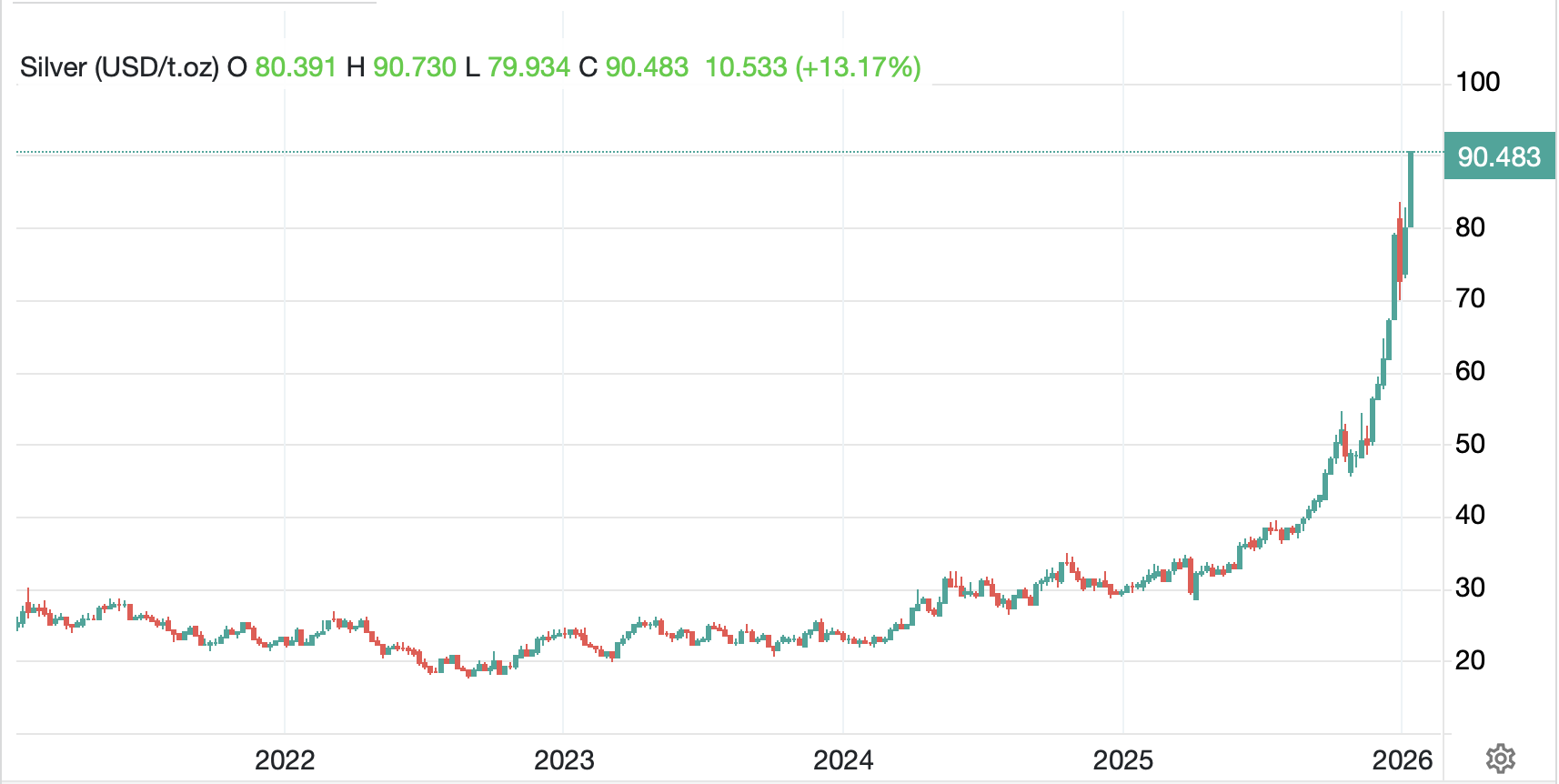
As to the rest of the market, precious metals continue to be the shining stars with the whole sector higher this morning (Au +1.0%, Ag +4.2%, Pt +2.0%) and that move taking copper (+0.4%) along for the ride.  Last night the CME raised its margining requirement and changed its nature by requiring a percentage of the value, rather than a numeric amount per contract.  My friend JJ, who writes the Market Vibes substack wrote a brilliant piece last night explaining how the flows are evolving in the silver market.  To sum it up, at this point, there appears no end in sight for the demand as short positions are covered by new shorts.  Metal for delivery remains scarce and despite the extraordinary shape of the move, it appears to have more steam to drive it forward.  Markets like this are extremely difficult to trade, and history shows that movements in the shape seen below reverse very sharply.  But as Keynes explained 100 years ago, markets can remain wrong longer than you can remain solvent.  I am happy I have been long silver for quite a while but am having a hard time figuring out what to do now!

Source: tradingeconomics.com

Meanwhile, oil (+1.4%) continues to rally on concerns that the Iran situation will lead to one of two outcomes, either a substantial decline in production as the regime collapses, or an effort by the regime to close the Strait of Hormuz which will impede shipping and reduce supply as they try to inflict pain on the US and the rest of the world who are rooting for the uprising.

Heading back to paper markets, yesterday’s weakness in the US was followed by a more mixed picture in Asia with Japan (+1.5%) rallying on continuing hope for more fiscal stimulus.  HK (+0.6%) benefitted from news that China’s trade surplus hit a new record high of $1.2 trillion (remember when they were going to grow domestic demand?) but Chinese shares suffered (-0.4%) after the regulators there raised margin requirements to 100%.  As to the rest of the region, it was far more green than red, although India continues to be a laggard overall.  In Europe, mixed is also the best description with the DAX (-0.35%) lagging while we have seen modest gains in the UK (+0.3%) and France (+0.2%).  Otherwise, it is hard to get excited about activity here today.  There continue to be existential questions about the EU and which nations will enact EU directives given that Poland, Hungary, Italy and the Czech Republic seem to be ignoring the latest issues like the Digital Asset Tax.  As to US futures, at this hour (7:00) they are softer by about -0.25% across the board.

Bond markets (except Japanese ones) remain completely uninteresting.  Treasury yields have slipped -3bps this morning and European sovereign yields are lower by -1bp.  Despite all the sound and fury about specific issues in markets, fixed income investors remain nonplussed by everything for now.  If/when that changes, we will need to watch things carefully.

Finally, aside from the yen (+0.3%) there is little to discuss overall. The DXY is still trading right around 99 and there has been very little movement of note.  Relationships that we would expect (ZAR and Au, NOK and oil) remain intact, but despite the metals dramatic movement, the rand is just gradually appreciating.

On the data front, yesterday’s CPI printed slightly softer than market expectations, but it is hard to get excited that inflation is heading back to target anytime soon.  @inflation_guy, Mike Ashton, had an excellent write-up here explaining what is going on and why much lower inflation is unlikely.  Ultimately, despite a lot of discussion regarding rental rates, those figures are not representative of the rental market as a whole and shelter costs continue to climb.  Absent a serious decline in goods inflation, it will be virtually impossible to get back to 2.0% on any sustainable basis.

As to today, it is a hodge podge of current and old data with Existing Home Sales (exp 4.21M) the only December number.  We see November Retail Sales (0.4%, 0.4% ex-autos) and PPI for both October and November which seem unlikely to impact markets greatly.  We also see EIA oil inventory data where a small draw is expected for crude but a build for gasoline.  Last week saw a massive build in products which likely helped weigh on the price last week.  But this week, things are different.  

We also hear from five more Fed speakers including Steven Miran, who will undoubtedly make his case for aggressive rate cuts again.  Then at 2:00 we get the Fed’s Beige Book.

Drinking from a firehose seems an apt metaphor for market analysts trying to make sense of the current situation.  Stepping back, I have never understood the market pricing for more rate cuts given the economy’s resilience.  The twin stories, in my estimation, are a growing level of fear regarding the debasement of fiat currencies, hence the move in metals, and the fact that the US remains the cleanest dirty shirt in the laundry, hence my preference for the dollar vs. other fiat currencies.  But on any given day, be careful!

Good luck

Adf

Falling Further

Like a stone toward earth
The yen keeps falling further
Beware Kato-san


While we have not discussed the yen much lately, its recent weakness, in concert with the dollar’s broad strength, has begun to cause some discomfort in Japan.  Last night, Japanese FinMin Katsunobu Kato explained, “We will take appropriate action if there are excessive movements in the currency market.”  He went on that he is “deeply concerned” by the recent weakness, especially moves driven by those evil pesky speculators.

The problem, of course, is that all those expectations that the BOJ would be tightening policy to fight domestic inflation while the Fed would continue to ease policy since they “beat” inflation, with the result being the yen would regain its footing, have proven to be false hope.  Instead, as you can see from the below chart, since the Fed first cut rates back in September, the yen has tumbled nearly 13% and very much looks like it is going to test the previous four-decade highs seen last summer.

Source: tradingeconomics.com

Last year, the MOF/BOJ spent about $100 billion in their efforts to stem the yen’s weakness.  They still have ample FX reserves to continue with that process, but ultimately, history has shown that maintaining a cap on a currency that is weakening for fundamental reasons is nigh on impossible.  If a weak yen is truly seen as existential in Tokyo, then Ueda-san needs to be far more aggressive in tightening monetary policy.  This is especially so given the Fed continues to back away from earlier expectations that it would be aggressively loosening policy.  Now, while JGB yields have moved higher over the past several sessions, trading now at 1.18%, which is their highest level since April 2011, that is not going to be enough to stem this tide.  From what I read, inflation is an issue, but not the same as it was in the US in 2022, so Ueda-san is not getting the same pressure to address it as Powell did back then.  My read is the BOJ remains on hold this month and hikes rates in March while the yen continues its decline.  Look for another bout of intervention when we test the 162 level, but that will not stop the rot.  Nothing has changed my view of 170 or higher in USDJPY by year end.

Though Treasury yields have been rising
Most credit spreads have been downsizing
So, corporate supply
Is ever so high
An outcome that’s somewhat surprising

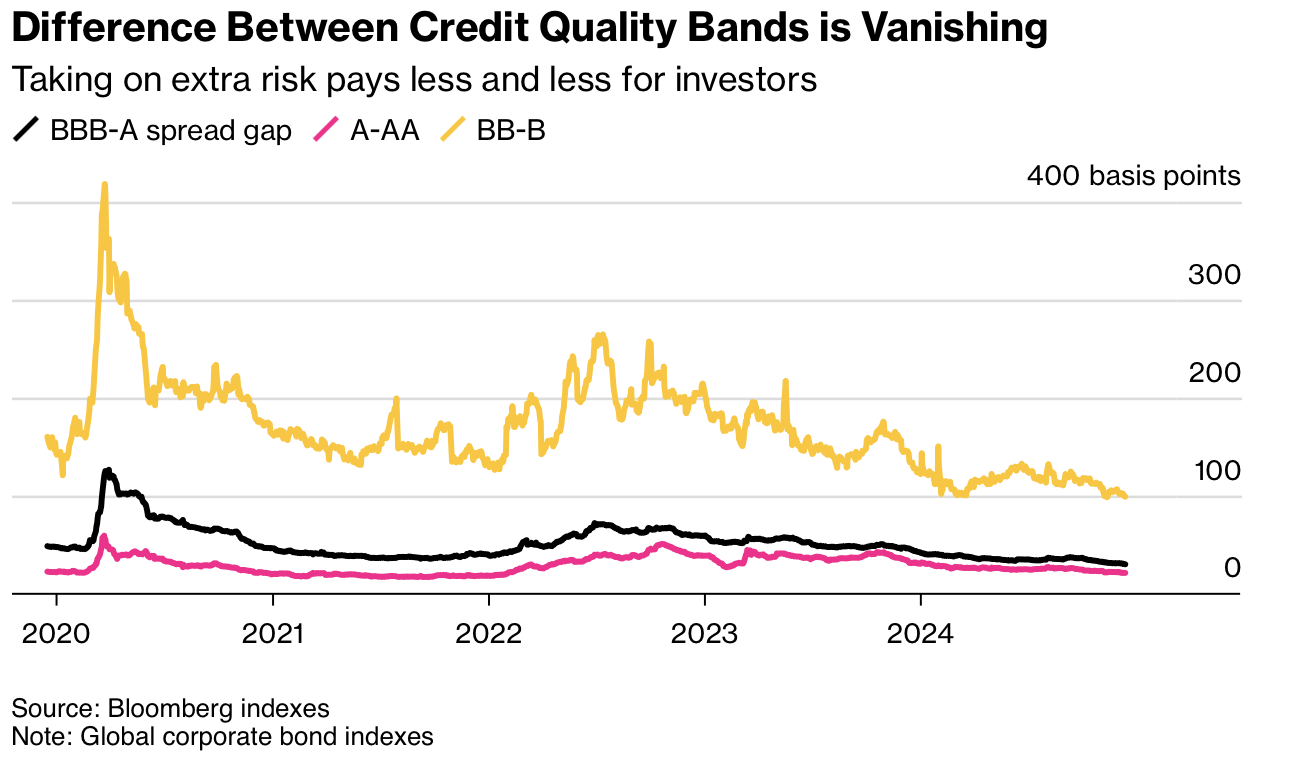
In the bond market, government bond yields continue to rise around the world (China excepted) as investors increase their demands in order to hold the never-ending supply of new bonds.  Ironically, despite this ongoing rout in government bonds across the board, corporate debt issuance looks as though it will set new records this month.  One thing to remember here is that corporates have a lot of debt coming due over the next two years as all that issuance during the ZIRP period needs to be rolled over.  But the other thing to recognize is that corporate credit spreads, the amount of yield investors require to own risky corporate bonds vis-à-vis “safe” government bonds, has fallen to its lowest levels in years, and as can be seen in the chart below, the extra yield available for high-yield investors is shrinking faster than for investment grades.

Potentially, one reason for this is the dramatic increase in the amount of Private Credit, the latest investment fad where weaker credits go directly to funds designed to lend money rather than to their banks, and investors ostensibly remove one of the middlemen from the process.  As such, there is less of this debt around than there otherwise might be, hence increasing demand and reducing that credit spread.  But the other reason is that there continues to be a significant amount of investable assets looking for a home, and with global yields near the highest they have been in a decade or more, and with the equity market dividend yield down to just 1.27% or so, a record low, there are lots of investors who are comfortable with clipping 5% or 5.5% coupons on BBB corporate bonds.

The question I would ask is, if government bond yields continue to climb, and I see no reason for that to stop given the trend in inflation and necessary issuance, at what point are investors going to get scared?  We are likely still a long way from that point, but beware if the new Treasury Secretary, Scott Bessent, follows through with his hinted views of reducing T-bill issuance and increasing coupon issuance, yields could go much higher absent the Fed implementing QE.  That would cause some serious market ructions!

Ok, let’s see how things look around markets this morning after yesterday’s sell-off in the US equity markets.  It seems Japanese stocks were caught between the weaker yen (generally a stock positive) and the tech sell-off (generally a stock negative) with the Nikkei closing lower by -0.25% on the session.  Meanwhile, the Hang Seng (-0.9%) suffered a bit more on the tech move, although Mainland shares (-0.2%) were not as badly affected.  An interesting story here is that the chief economist at state-owned SDIC Securities made comments at an international forum run by the Peterson Institute that really pissed off President Xi.  Gao Shanwen said the quiet part out loud when he claimed that actual GDP growth in China for the past several years has likely been much closer to 2% than the 5% published.  That story has been widespread in the West, although has never been given official credence.  And for Xi, 2% growth is not going to get it done, what with the property bubble still imploding and consumption declining despite promises of more stimulus.  Stay tuned to this story to see if we start to see more Western analysts reduce their expectations.  Elsewhere in Asia, the picture was mixed with gainers (Korea, Australia, Singapore) and laggards (Taiwan, Malaysia, Philippines).

In Europe, red is today’s color, led by the CAC (-1.0%) although we are seeing losses across the board. Eurozone data showed declining Consumer Confidence, Economic Sentiment and Industrial Sentiment all while inflation expectations remain stubbornly high.  That stagflationary hint is typically not an equity market benefit so these declines should be expected.  The story on the continent is not a positive one and I maintain that the ECB is going to have to cut rates more aggressively than their inflation mandate would suggest.  That might support equities a bit, but it will be hell on the euro!  Finally, US futures are a touch softer (-0.2%) at this hour (7:05) although they were higher most of the overnight session before this.

As mentioned above, bond yields are higher with Gilts (+9bps) leading the way as not only is the economy suffering from some very poor policy decisions by the Starmer government, but it seems that the ongoing political crisis regarding grooming gangs has investors shying away.  But yields continue to rise across the board with continental yields up between 3bps and 6bps, Treasury yields higher by another 1bp this morning after a 10bp rise in the previous two sessions, and JGB yields, as mentioned, higher by 5bps.  This trend is very clear!

In the commodity markets, oil (+0.5%) keeps on keeping on, as API data showed a greater than 4mm barrel draw on inventories, far more than expected and indicating a reduced supply around.  Cold temperatures are keeping NatGas (+5.0%) firm as well.  In the metals markets, both precious and base are under a touch of pressure this morning, down less than -0.2%, largely in response to the dollar’s rebound.

Speaking of the dollar, it is higher against all its counterparts this morning with the pound (-1.2%) the G10 laggard although weakness on the order of 0.5% is pretty common this morning.  In the EMG bloc, ZAR (-1.5%) is the worst performer, after weaker than expected PMI data called into question the economic path forward.  But here, too, we are seeing weakness like MXN (-0.9%), CLP (-0.8%), PLN (-0.8%) and KRW (-0.5%).  I would be remiss to ignore CNY (-0.25%), which is trading below (dollar above) 7.3600 in the offshore market, and is now 2.4% weaker than last night’s fixing rate.  This is also the weakest the renminbi has been since it touched this level back in September and then November 2007 prior to that.  Those Chinese problems are coming home to roost for President Xi.

On the data front, ADP Employment (exp 140K) leads the day followed by Initial (218K) and Continuing (1870K) Claims.  These are being released this morning because of tomorrow’s quasi holiday regarding the late President Carter, when US markets will be closed.  This afternoon, the FOMC Minutes arrive and will be scrutinized closely to see just how hawkish they have become.  We also hear from Governor Waller this morning with caution being the watchword from virtually every Fed speaker of late.

It is all playing out like I anticipated, with the ISM data showing strength yesterday, not just in the headline number, but also in the Prices Paid number.  The Fed will have no chance to cut rates again, and I look for the dollar to continue to rise.

Good luck

Adf

No Choice

Data indicates
The BOJ intervened
Did they have no choice?


Last night, Masato Kanda, the Vice Minister of Finance for International Affairs, colloquially known as Mr Yen explained, “I have no choice but to respond appropriately if there are excessive moves caused by speculators.”  He also explained, “We are communicating very closely with the authorities of each country and complying with international agreements, so there has been no criticism from other countries.”  In other words, while he did not actually come out and say that the BOJ intervened on behalf of the MOF, it seems pretty clear that is the case.  Certainly, a look at the price action again last night, as per the below chart, shows that is a viable reality.

Source: tradingeconomics.com

You may recall that USDJPY fell sharply in the wake of the CPI data last week and there was substantial question as to whether there was intervention at the time.  My view was the BOJ would not have been able to act on a timely basis and attributed the move to an overly long dollar positioned market and some algorithmic selling.  However, it appears that data from the BOJ’s accounts have since been released showing approximately ¥6 trillion (~$38.4 billion) was spent at the end of last week.  Now, given the Kanda comments above, the reality is that the MOF is drawing a line in the sand at 162.  

In fairness, this seems a propitious time to do so given the growing certainty that the Fed is finally going to begin its policy easing.  Of course, the main reason that the yen had weakened so much is that, not only had the interest rate differential widened substantially, allowing for, and even encouraging, the growth of the ‘carry trade’ where investors were happy to simply hold long forward USDJPY positions and wait for the time to pass and the profits to roll in.  But as well, there was no indication that the Fed was going to change its stance while the BOJ, though it had threatened to begin tightening policy, was doing so at a glacial pace.  However, that CPI number has dramatically altered opinions, not only of the trading community, but more importantly, of the Fed.  All the Fed comments we have heard since that data point have indicated a much greater willingness to consider easing policy.  Talk about both the goods and labor markets coming into balance are indicators they are ready to roll.  

We still have seven more Fed speakers this week ahead of the quiet period and I would wager that to a (wo)man, they will all say their confidence is growing that price pressures are receding, and they are watching the employment situation carefully.  As I wrote yesterday, the CME Fed funds futures market is pricing a 100% probability of a 25bp cut in September with some folks looking for 50bps.  Given the totality of the recent data where the probability of a recession seems to be growing, I agree a September cut looks likely.  This is not to say every data point is going to be pointing to weaker economic activity (e.g., yesterday’s Retail Sales data was much stronger below the headline number), just that will be the broad trend.

In this situation, with the market starting to believe that higher for longer is truly dead, the initial reaction will be for further dollar weakness.  Of course, once it is clear the Fed has begun to ease policy, we will see other central banks increase their pace of policy ease at which point the dollar’s decline will likely slow or stop.  Remember, FX is a relative game, so if everybody is easing policy at the same time, those interest rate differentials are not going to change very much at all.  However, commodity prices, especially precious metals prices, are likely to be the biggest beneficiaries.  As to stocks and bonds, the former have a much less certain path given the impact of declining inflation on profits, especially for the mega cap names, but bonds should perform well (yields declining) at least as long as inflation remains tame.  Just beware of a slow reversal of the inflation story.  Nothing has changed my view that 3.0% is the new 2.0%.

Aside from the yen news, last night was decidedly lacking in new information.  We saw UK inflation data print at the expected levels showing it has fallen back close to their target of 2%.  We saw final Eurozone inflation also confirming a 2.5% inflation rate.  While the ECB has essentially ruled out a rate cut tomorrow, a September cut seems highly likely at this time, especially if they have confidence the Fed is going to cut then as well.

So, let’s look at the overnight session.  After more record highs in the US, with the DJIA approaching 41K, the tone in Asia was more mixed.  Japanese shares (Nikkei -0.4%) fell as the yen’s strength continues to hamper profit expectations for the many exporters in the index.  Chinese shares, both in Hong Kong and on the mainland, edged higher by less than 0.1% as investors continue to wait to hear the results of the Third Plenum.  As to the rest of the region, gains in Australia and New Zealand were offset by losses in South Korea with most other markets little changed.  however, in Europe this morning, the screens remain red with losses across the board, albeit not as significant as we have seen in the past several sessions.  The DAX (-0.4%) is the laggard although all the major markets are lower.  Finally, at this hour (7:20), US futures are suffering led by the NASDAQ (-1.5%) although they are all under pressure.  It seems that the story about increased tariffs on Chinese goods as well as a ban on selling additional semiconductors to China doesn’t help the prospects of semiconductor companies that rely on China for their sales.

Interestingly, the bond market has seen yields edge higher this morning with Treasuries higher by 2bps and most of Europe up by 1bp.  Given the small size of the movement, I wouldn’t attribute much fundamental thought to today’s price action, and after all, 10-year Treasury yields have fallen 30bps since the first of the month, so a lack of continuation is not that surprising.

In the commodity markets, oil (+0.5%) is rebounding after a rough couple of days.  The weakening economy story is weighing on perceived demand and there is ample supply around.  Gold (+0.1%) is continuing to rally after closing at another all-time high yesterday while silver (-0.9%), which followed gold yesterday, is giving back a bit this morning.  Industrial metals are little changed this morning as they await further confirmation of the economic situation.

Finally, the dollar is under pressure this morning, falling substantially against almost all of its major counterparts, both G10 and EMG.  Aside from the yen (+1.1%) which we discussed above, the pound (+0.5%) is leading the way along with SEK (+0.6%) although the euro (+0.35%) is also firm.  In fact, the pound has risen above 1.30 for the first time in a year while the euro pushes the top of its 1.0650/1.0950 2024 trading range.  The laggard in the G10 space is CAD, which is unchanged on the day as market participants tie its performance directly to the dollar and anticipate the BOC to match the Fed going forward.  In the EMG bloc, though, there are two outliers which have suffered today, despite the dollar’s broad weakness, MXN (-0.6%) and ZAR (-0.7%).  The peso seems to be feeling the effects of weaker than expected economic data lately which has put Banxico into a difficult position as inflation remains above their target.  Will they cut to support the economy and undermine the currency?  That is the question.  As to the rand, aside from its status as the most volatile currency, the market seems to be reacting to a sharp decline in Retail Sales last month, -0.7%.

On the data front, this morning brings Housing Starts (exp 1.3M), Building Permits (1.4M), IP (0.3%) and Capacity Utilization (78.4%) along with the EIA oil inventories.  In addition, we will hear from Richmond’s Thomas Barkin and Governor Waller and then at 2:00 the Fed’s Beige Book will be released.  The current market narrative has quickly shifted to rate cuts, and more tariffs.  The upshot is the dollar is likely to remain under pressure while equities will have a more difficult time going forward.  If inflation remains quiescent, then bonds can do well, but the big winner through it all should be commodities.

Good luck

Adf
Unfair-ish

Well, Jay and the doves got their wish
As CPI data went squish
In fact, it’s not clear
Why cuts aren’t here
Already, it’s just unfair-ish
 
But something surprising occurred
‘Cause rallies in stocks weren’t spurred
But yields and the buck
Got hit by a truck
While gold was both shaken and stirred
 
Chairman Powell must be doing his happy dance this morning as the CPI data was the softest seen since May 2020 during the height of the Covid shutdowns.  Now, after four years of steadily rising prices, the Fed is undoubtedly feeling better.  One look at the chart below, though, shows that the inflation rate since the end of Covid was clearly much higher than that to which the population became accustomed prior to Covid.


Source: tradingeconomics.com

While the annualized data for both core and headline readings remains above 3.0%, there was certainly good news in that shelter and rental costs rose more slowly than they have in nearly three years.  However, for market participants, they are far less concerned over the whys of the soft reading than in the fact that the reading was soft and so they can now anticipate a rate cut even sooner than before.  As of this morning, the Fed funds futures market is now pricing a 92.5% probability that the Fed cuts in September and a total of 61bpsof cuts by the end of the year.  

In truth, I was only partially joking at my surprise they didn’t call an emergency meeting and cut yesterday. While the market is only pricing a 6% chance of a cut at the end of this month, I think that is a pretty good bet. Speaking of bets, the trader(s) who established that big SOFR options position earlier in the week is set to have a really good weekend!

To recap, we’ve had the softest inflation reading in 4 years and the market is anticipating the end of higher for longer.  As I have written consistently, my take is when the Fed starts cutting, the dollar will fall, commodity prices will rise, yields will start to decline, but if (when?) inflation reasserts itself, those yields will head higher.  And finally, stocks are likely to see support, but a very good point was made today that if prices stop rising, then so to do profit margins at companies and profits in concert.  Perhaps, slowing inflation is not so good for the stock market, even if it means that rates can be lowered.  Ultimately, there is still a lot to learn, and this was just one number, but boy, is everyone excited!

Did the BOJ
Take advantage of the news
And sell more dollars?

In the FX markets, the biggest mover, by far, was the yen, which at its high point of the session (dollar’s lows) had risen 4 full yen, or 2.5%.  The move was virtually instantaneous as can be seen in the chart below, and it is for that reason that I do not believe the BOJ/MOF was involved in the market.

Source: tradingeconomics.com

While I understand that the BOJ is pretty good at their jobs, it seems highly unlikely that the MOF made a decision in seconds and was able to convey that decision to Ueda-san’s team to sell dollars.  Rather, my sense is that since the short yen trade is so incredibly widespread as the yen has served as a funding currency for virtually every asset on the planet, the fact that the story about higher for longer may be ending led to instant algorithmic selling by hedge funds everywhere and a massive rally in the yen.  When the MOF was asked about intervention, Kanda-san, the current Mr Yen, gave no hint they were in and said only that people will find out when they release their accounts at the end of the month, by which time this episode will have been forgotten.  Remember, too, the yen has fallen, even after today’s rally, nearly 13% thus far in 2024.  It needs to rally a great deal further before it has any macroeconomic impact on Japan’s economy.  For my money, this was just a market that was caught long dollars and weak hands got stopped out, although Bloomberg is out with an article this morning claiming data showing it was intervention.  One thing in favor of the intervention story, though, is that this morning, USDJPY is higher by 0.6% and pushing 160.00 again.

And lastly, the story in China
Continues to give Xi angina
Domestic demand
Is stuck in quicksand
So, trade is his only lifeline-a
 
The other story that is on market minds this morning is about the Chinese data that was released last night.  The Trade Balance there expanded to $99B, much larger than last month and forecast.  A deeper look also shows that not only did exports grow more than expected but imports actually declined.  Declining imports are a sign of weak domestic demand, a harbinger of weak economic growth.  Later, they released their monetary data showing that loan growth, along with M2 growth, continue to slide as Chinese companies are reluctant to take on debt to expand.  While Xi’s government is pushing some money into the system, it is apparent that the collapsing property market remains a major obstacle to any sense of balanced economic activity in China.
 
Of course, this is a problem because of the international relation problems it continues to raise, notably with respect to charges of Chinese dumping of manufactured goods, and the proposed responses from both the US and EU on the subject.  While my crystal ball is somewhat cloudy, when viewing potential future outcomes of this situation it seems increasingly likely that both the US, regardless of the election outcomes in November, and the EU are going to impose tariffs and other restrictions on Chinese goods, if not outright bans.  Neither of these two can afford the social disruption that comes with domestic companies being forced out of business by subsidized Chinese competition.  While inflation looks better this morning than it did last month, its future is far less certain given this growing political attitude.
 
Ok, let’s see how markets have behaved in the wake of all the new information.  Arguably, the biggest surprise is that the US equity markets did not really have a good day with the NASDAQ tumbling -2.0% although the DJIA eked out a 0.1% gain.  Given the yen’s strength, it is no surprise that the Nikkei (-2.5%) fell sharply, and given the Chinese trade data, it is no surprise that the Hang Seng (+2.6%) rallied sharply.  But mainland shares were lackluster, and the rest of APAC was mixed with some gainers (Australia, India, New Zealand) and some laggards (South Korea, Taiwan, Malaysia).  European bourses, though, are all in the green as traders and investors there look to the increased odds of the US finally cutting rates, therefore allowing the ECB and other central banks to do the same, as distinct positives.  As to US futures, at this hour (7:00), they are unchanged to slightly higher.
 
In the bond market, after US yields fell sharply yesterday, with 10yr yields closing lower by 8bps, although they traded as low as 4.17%, a 12bp decline from the pre-data level, this morning, we are seeing a modest rebound with yields 1bp higher.  European sovereign yields are all firmer this morning as well as markets there closed before the US yields started to creep back up.  So, this morning’s 4bp-5bp moves are simply catching up to the US activity.  Lastly, JGB yields dipped 2bps last night as traders sought comfort in the decline in US yields.
 
In the commodity markets, yesterday saw a sharp rally immediately after the CPI print with gold jumping nearly $40/oz and back above $2400/oz, while oil had a more gradual rise, although is higher by nearly $1/bbl since the release.  This is all perfectly in line with the idea that the Fed is going to start to cut rates soon.  However, gold (-0.4%) is giving back some of those gains today.
 
Finally, the dollar, which fell sharply against all currencies after the CPI print, notably against the yen, but also against the rest of the G10 and most EMG currencies, is slightly softer overall this morning with both the euro (+0.15%) and pound (+0.3%) doing well and offsetting the yen’s weakness this morning.  Elsewhere throughout the G10 and EMG blocs the picture is far less consistent with CE4 currencies all following the euro higher although ZAR is unchanged as it suffers on gold’s weakness this morning. 
 
On the data front, this morning brings PPI (exp 0.1% M/M, 2.3% Y/Y) and its core (0.2% M/M, 2.5% Y/Y) although given yesterday’s surprisingly low CPI data and the ensuing market movements, it doesn’t feel like this number has the potential for much surprise.  After all, a soft reading would already be accounted for by the CPI and a strong one would be ignored.  We also see Michigan Sentiment (exp 68.5) at 10:00, but that, too, seems unlikely to shake things up.  There are no Fed speakers scheduled and really, the big thing today is likely to be the Q2 earnings releases from the big banks.
 
It has been an eventful week with Powell’s testimony being overshadowed by yesterday’s CPI data.  While the market is almost fully priced for a September cut, I think the best risk reward is to expect the Fed to act at the end of July.  Next week we hear from 10 Fed speakers, including Chairman Powell on Monday afternoon.  I would not be surprised to hear them start to guide markets to a July cut which would bring dollar weakness alongside commodity price strength.  As to bonds and equities, the former should do well to start, but as yesterday showed, and history has shown, equities tend to underperform when the Fed starts cutting rates.
 
Good luck and good weekend
Adf