Simply No Need

Said Powell, there’s simply no need
To hike rates, we all have agreed
But likewise, no case
To cut, lest we face
An outcome where, jobs, we impede

Said Trump ‘bout the Strait of Hormuz
Be careful and do not confuse
Our aims in this war
As more than before
Which has been, Iran, to defuse

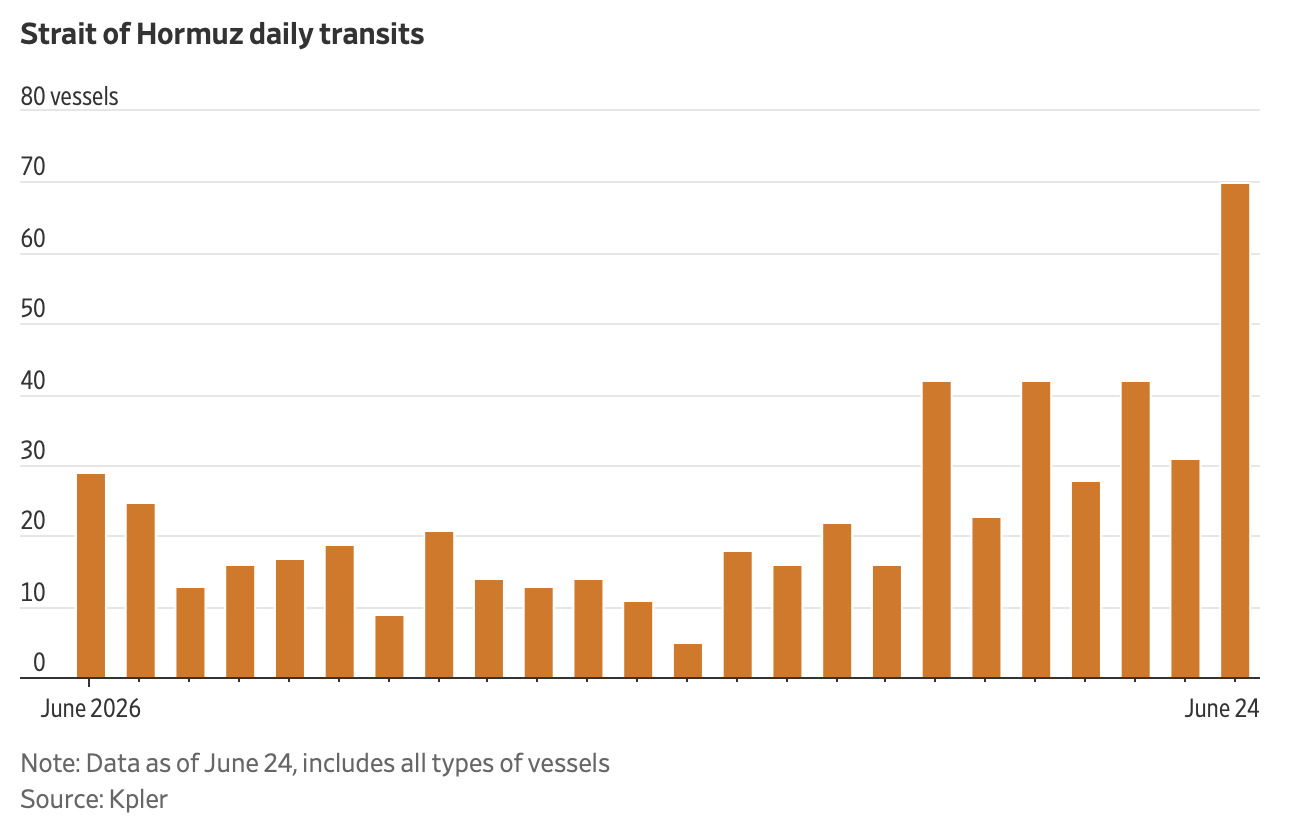
Just like every other day, this morning shows we really have no idea what to believe regarding the war anymore.  The headline in the WSJ is that President Trump may consider the job finished even if the Strait of Hormuz remains closed.  That has certainly gotten the Europeans up in arms as they are the ones relying on its reopening to source much of their oil and LNG.  But consider it from the US perspective, where we source only about 2.5% of our oil related products from nations on the wrong side of the Strait, which means virtually none of our overall import roster (source Grok). 

Now, the one thing I will say about President Trump is that strategic ambiguity is one of his strengths, as he continues to make so many seemingly contradictory statements, nobody knows what he is working to achieve.  Based on the framework that Secretary Rubio laid out again yesterday:

  1. Destruction of Iran’s Navy
  2. Destruction of Iran’s Air Force
  3. Severe diminishment of their missile launching capability
  4. Destruction of their armaments factories

It is not hard to believe the US and Israel are close to their goals.  However, none of this discusses Iran’s nuclear weapons program, which has clearly been a goal, nor the 440Kg of 60% enriched U308 that they retain.  

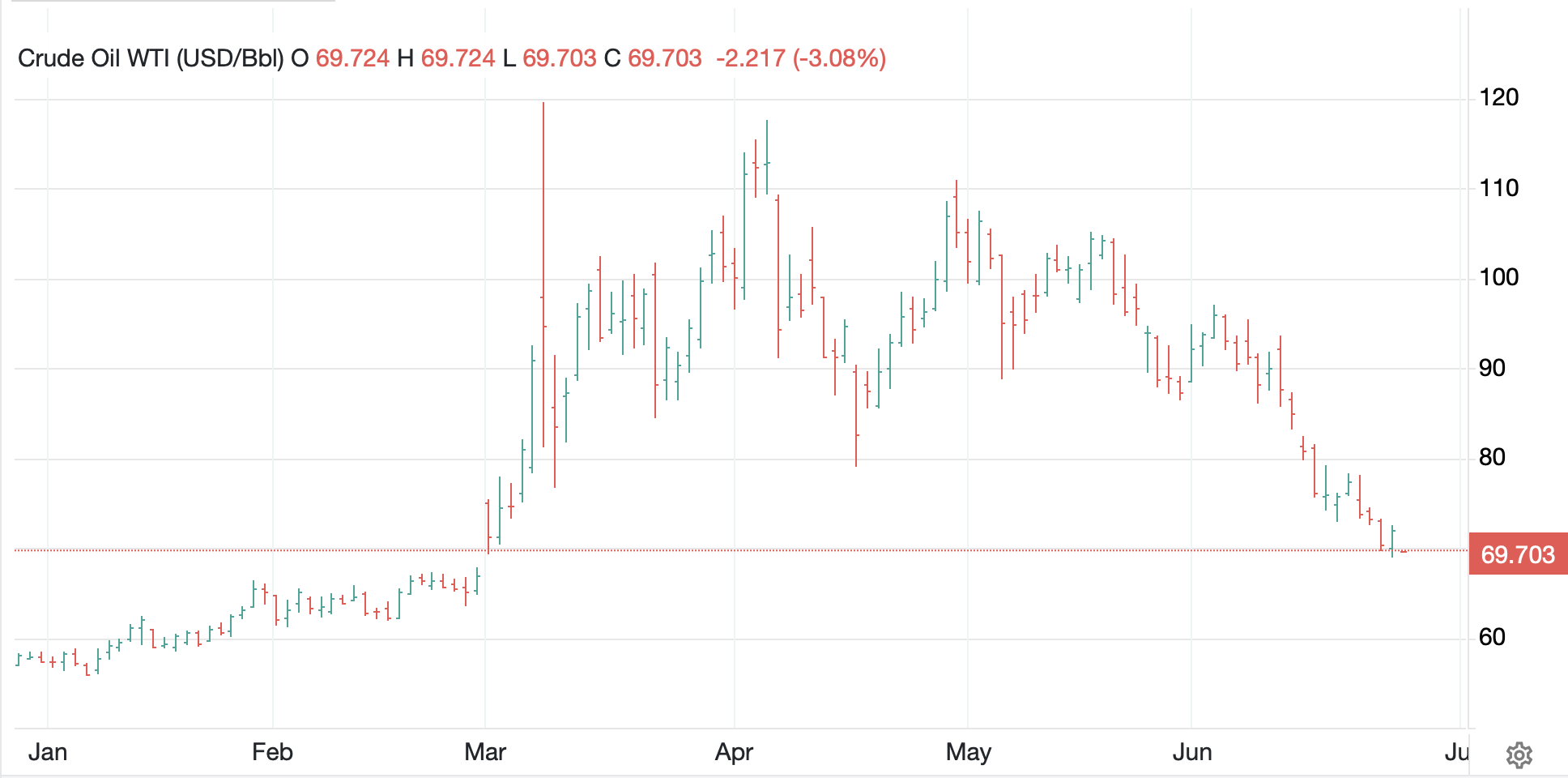
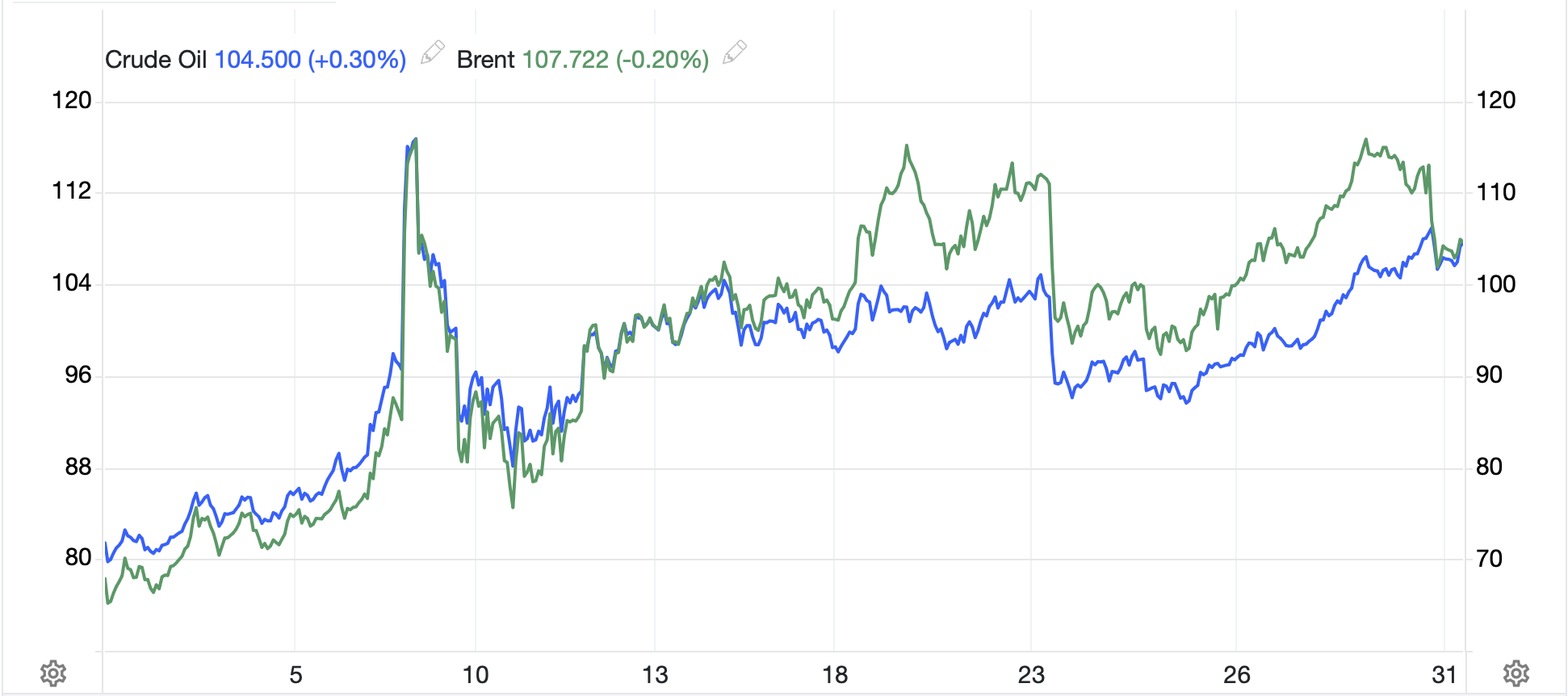
Again, I wouldn’t dare claim to have any idea when this will end, but the political calculus indicates it is unlikely to go on for very much longer.  However, it is not just the political calculus that implies that, but also market pricing of certain things.  For instance, one of the things that initially surprised me was that Brent crude (+0.6% today) did not initially rise more rapidly than WTI (+2.0% today).  After all, zero WTI transits the Strait and it is not a pricing benchmark for anything that happens over there, while Brent is the basis for all Middle Eastern oil.  As the Strait of Hormuz has been effectively closed since March 4th, a look at the below chart shows that Brent did not separate itself from WTI until 2 weeks later.  But last night, that spread collapsed back to its current $3/bbl, similar to the levels that preceded the onset of the war.

Source: tradingeconomics.com

One interpretation of that price action is that there is a growing belief that the Strait will reopen for transit soon.  Of course, it could simply be that neither Brent nor WTI are representative of the oil grades that are impacted, and thus the large premium no longer makes sense, but given the totality of the news, I’m inclined to lean toward the former idea.  Of course, both benchmarks are currently solidly above $100/bbl so still causing great pain.

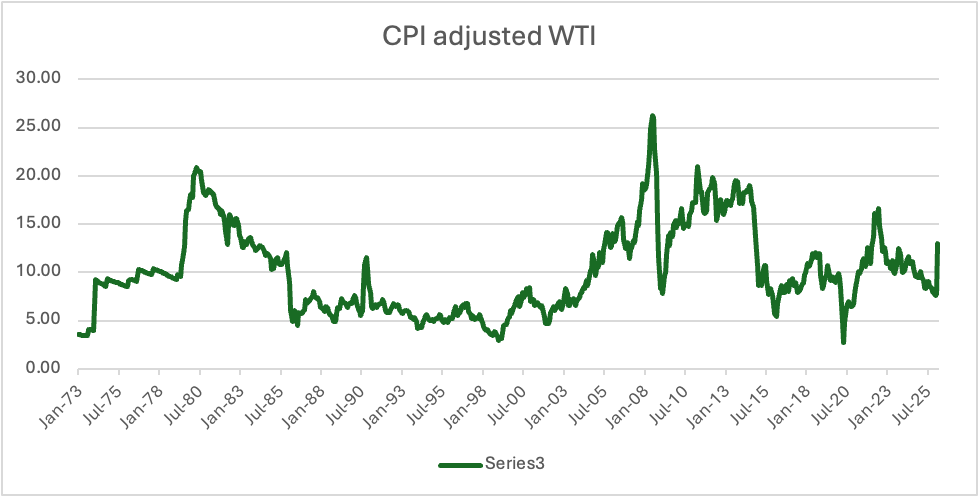
However, on this topic, as most of us live and think in a nominal world, we consider $100/bbl as extremely expensive.  But if we take a moment to consider the real (inflation adjusted) price of oil, we can see in the chart below that energy remains pretty cheap, and well below levels seen ahead of the GFC or even in the wake of the Russian invasion of Ukraine.

Source: data FRED, calculations and chart, @fx_poet

My point is that over time, energy has become less of a cost in the economy, and even with the current situation, my take is the US, and frankly global, economy is quite resilient and will get through this.  I’m not suggesting there won’t be some pain, just that this is not going to lead to economic Armageddon.

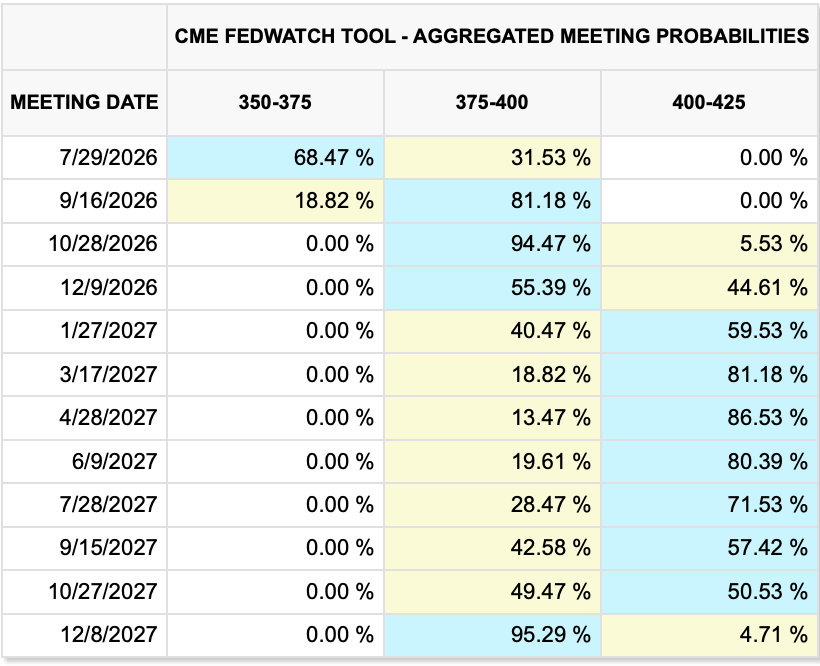
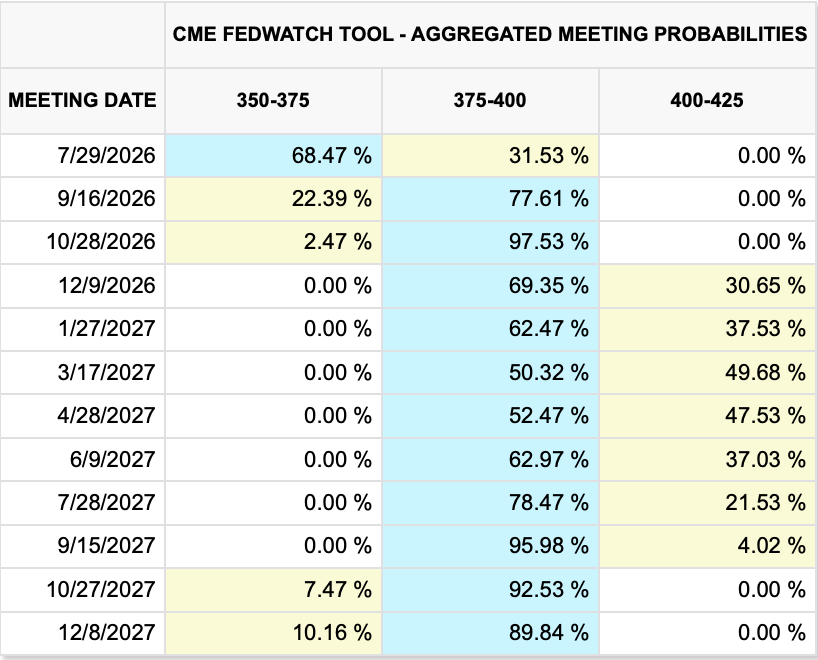
The other interesting story from yesterday came from Chairman Powell, who in a speech at Harvard explained there was a great deal of uncertainty currently, while admitting that the tariffs were likely a one-off modest inflation pressure.  He indicated rate cuts were likely over, although hikes were possible, and then the man who printed $5 trillion to pay for every one of President Biden’s Covid and ESG bills, explained that debt is growing too fast and could be a problem going forward.   And you wonder why there are those who are skeptical of his concerns over politicization of the Fed.

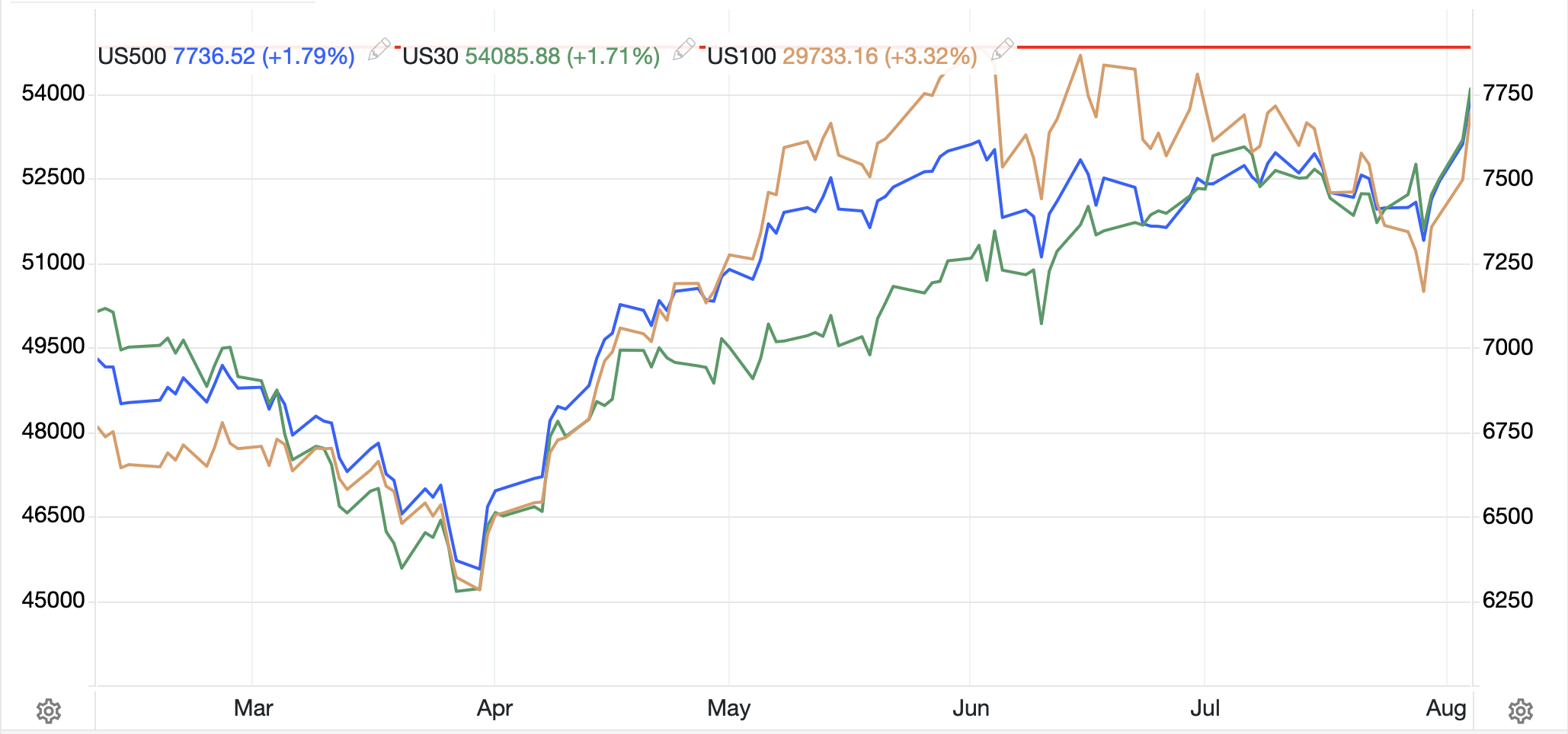
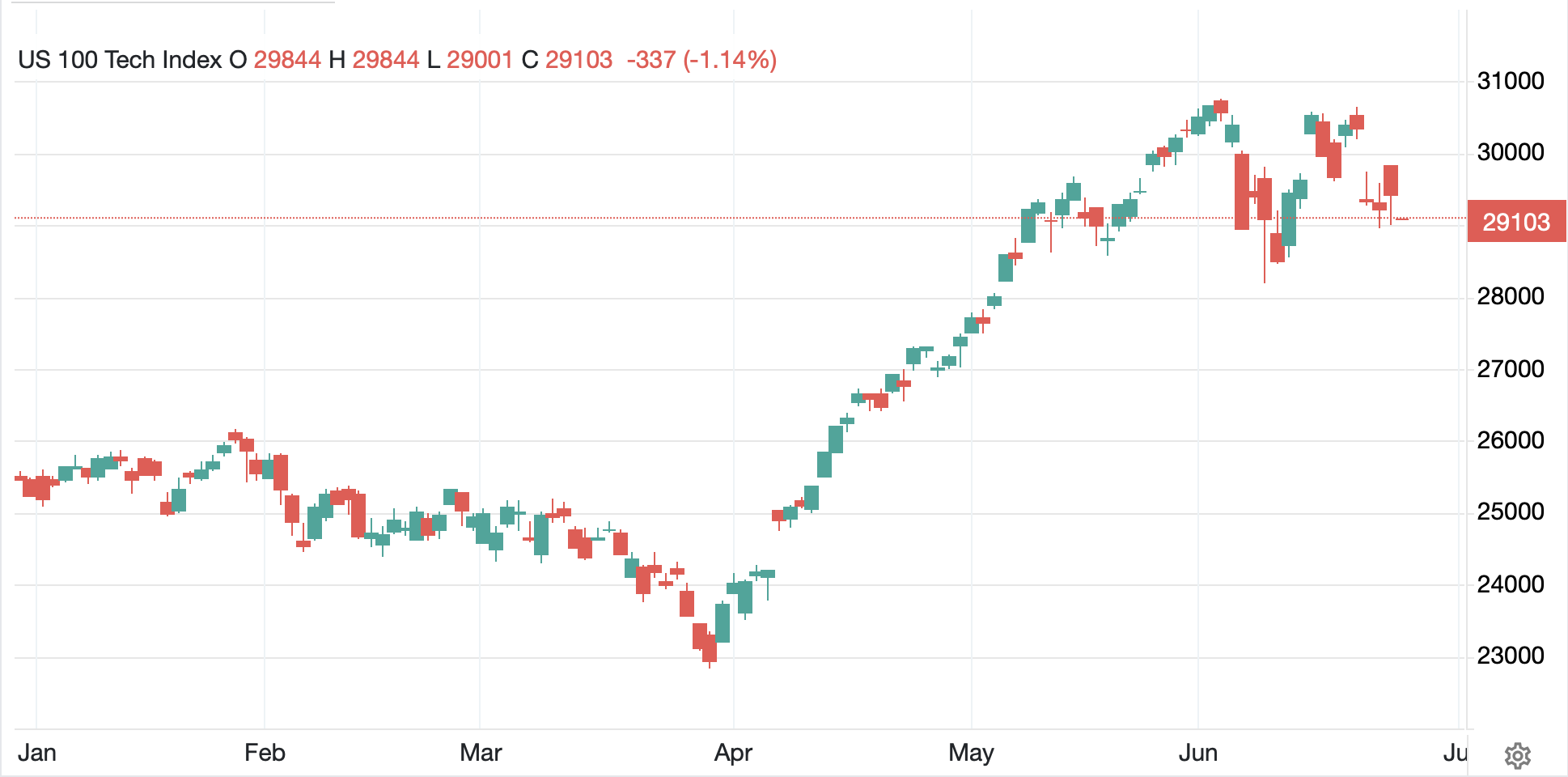
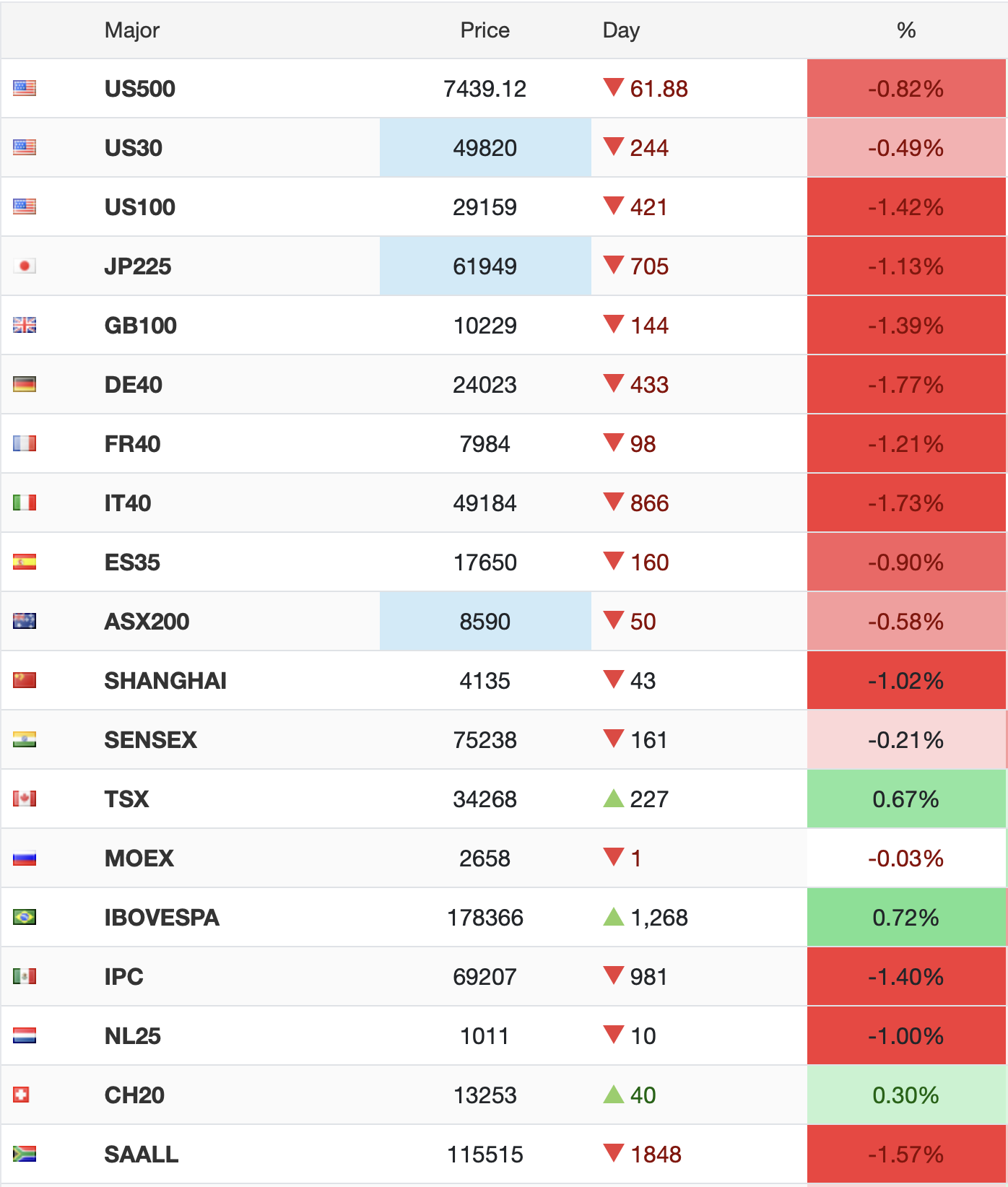
Ok, let’s turn to markets.  Yesterday’s morning positivity faded all day and both the NASDAQ and S&P 500 closed lower on the session.  That mostly followed in Asia with Tokyo (-1.6%), China (-0.9%), Korea (-4.3%) and Taiwan (-2.5%) all under real pressure, although HK (+0.2%) and Australia (+0.25%) managed some gains.  Other regional exchanges were mixed as investors around the world are trying to figure out the next steps.  At this hour (7:00), US futures are pointing solidly higher, +0.8% or so.  Turnaround Tuesday?  Certainly, that is the case in Europe where despite widely expected higher Flash inflation data for March, green is today’s color with gains ranging from 0.2% (CAC) to 0.5% (FTSE 100) with others somewhere in between.

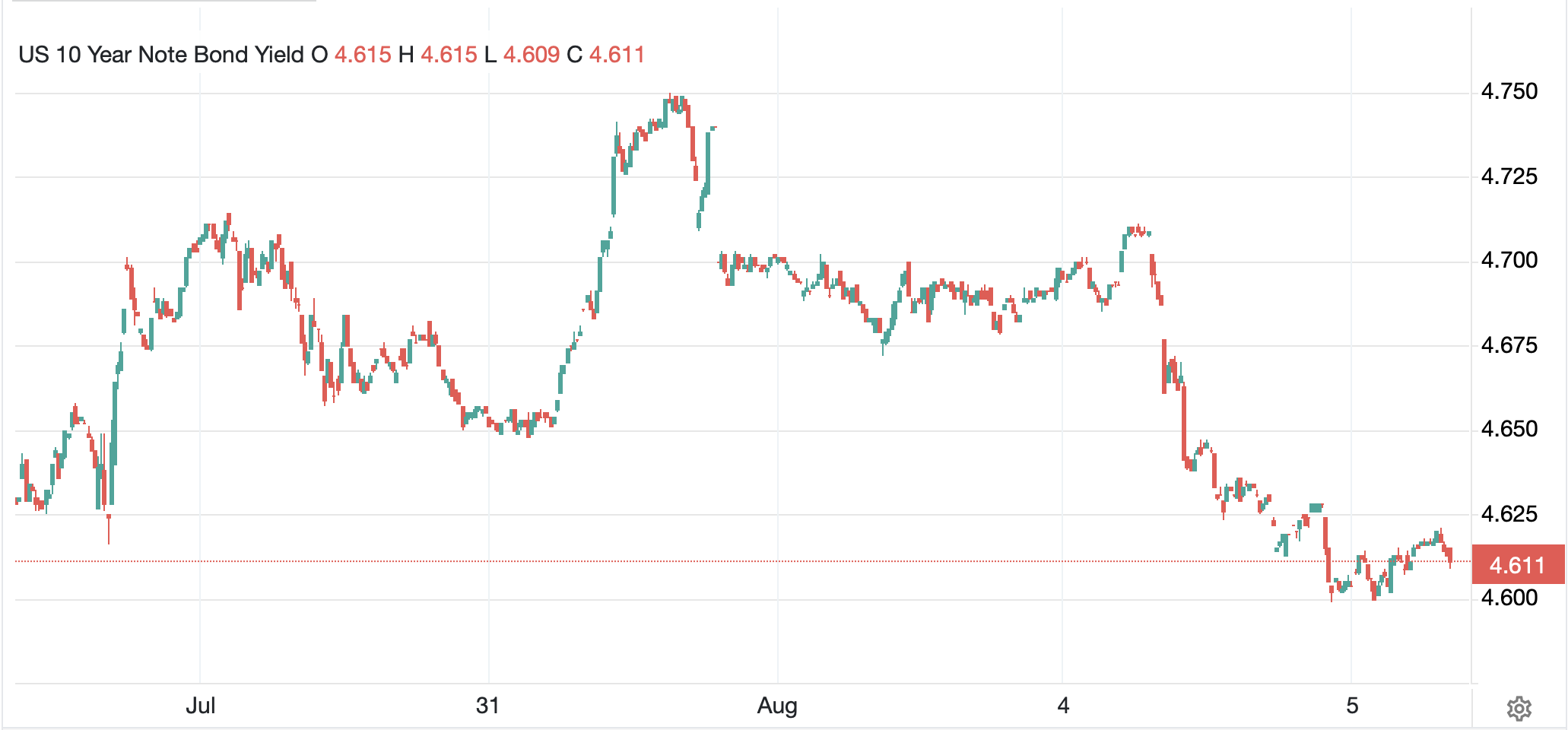
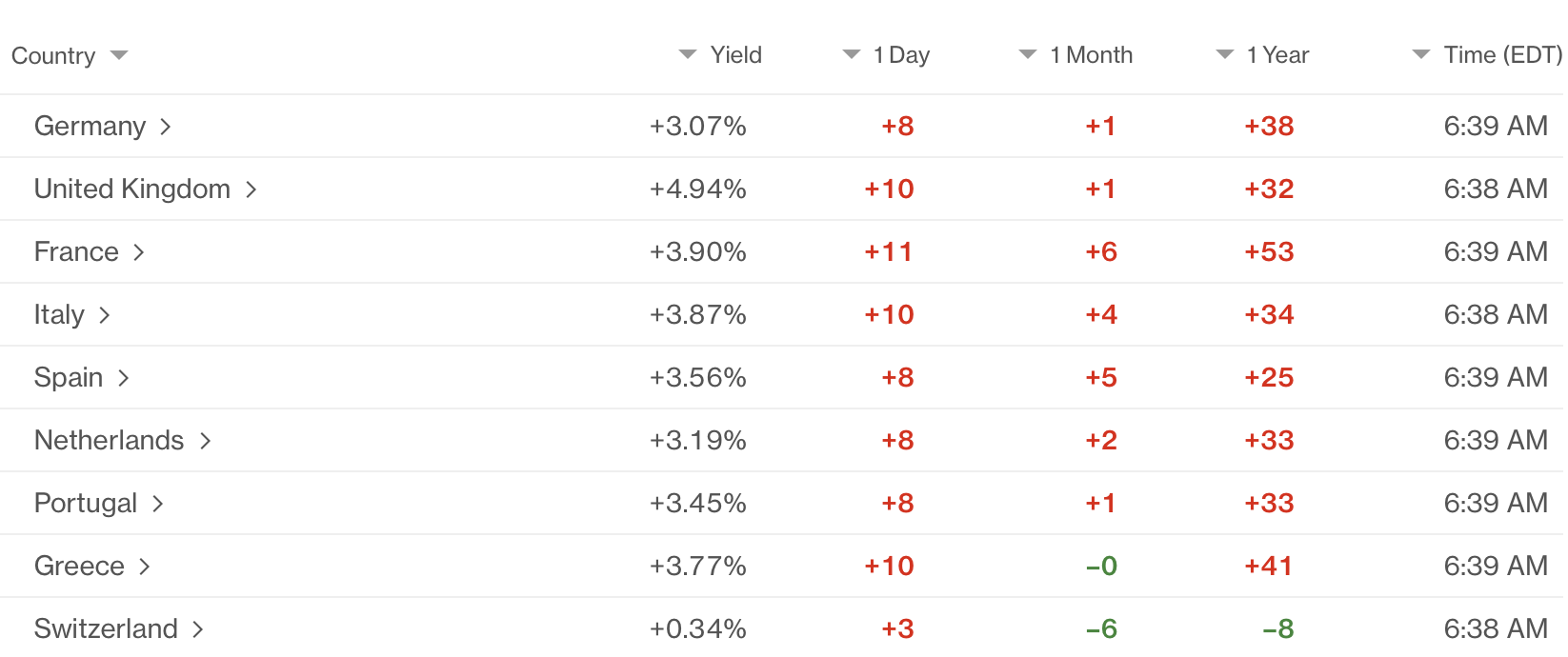
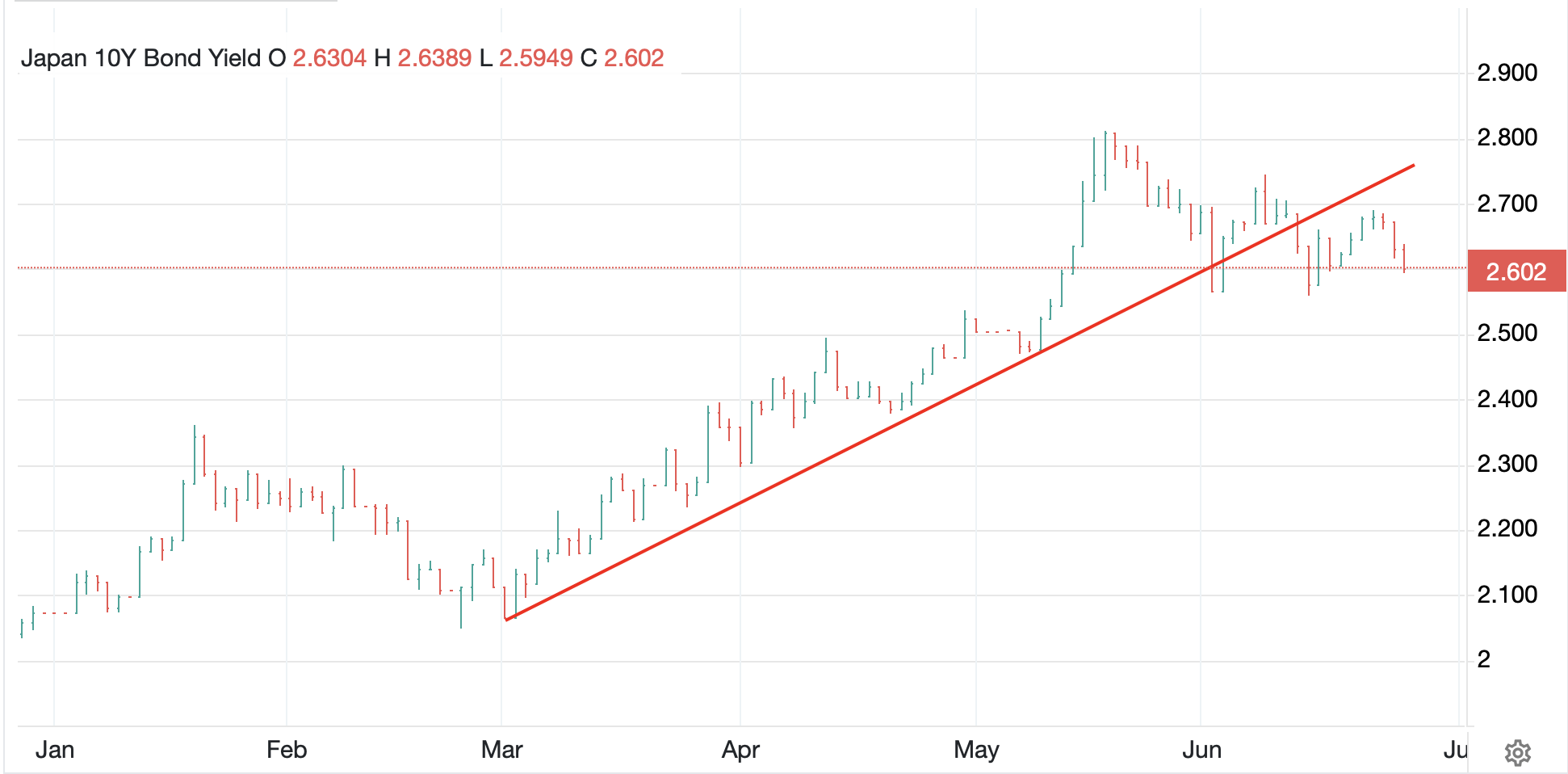
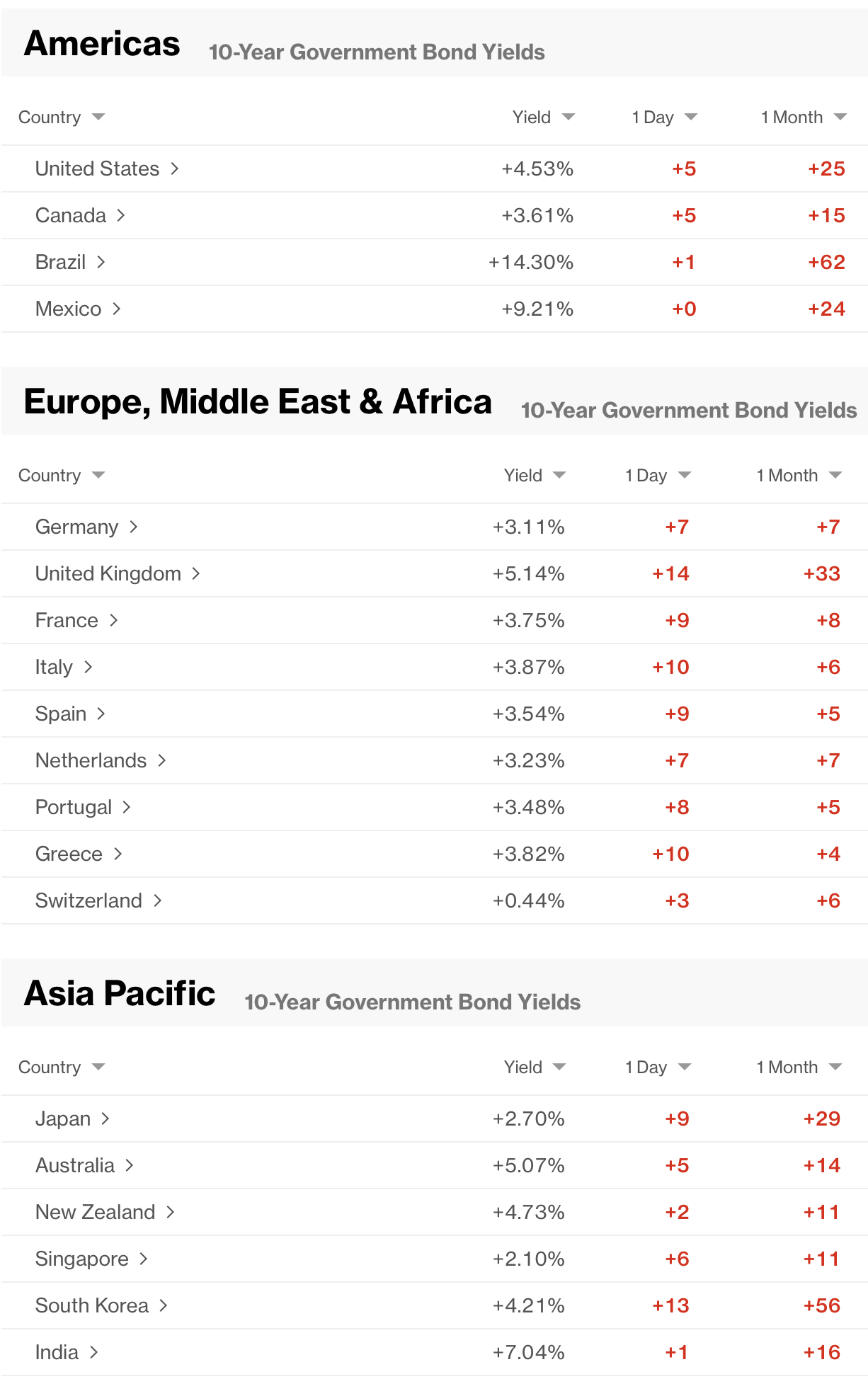
Bond investors have seemingly turned their views from inflation concerns to growth concerns, at least based on the fact that yields around the world are lower this morning than yesterday.  In fact, since Friday morning, 10-year Treasury yields have fallen -14bps, including -2bps this morning.  in Europe, yields did slide somewhat yesterday, about half that in the US, and this morning they are little changed throughout the continent.  But we did see JGB yields slip -2bps overnight as well.

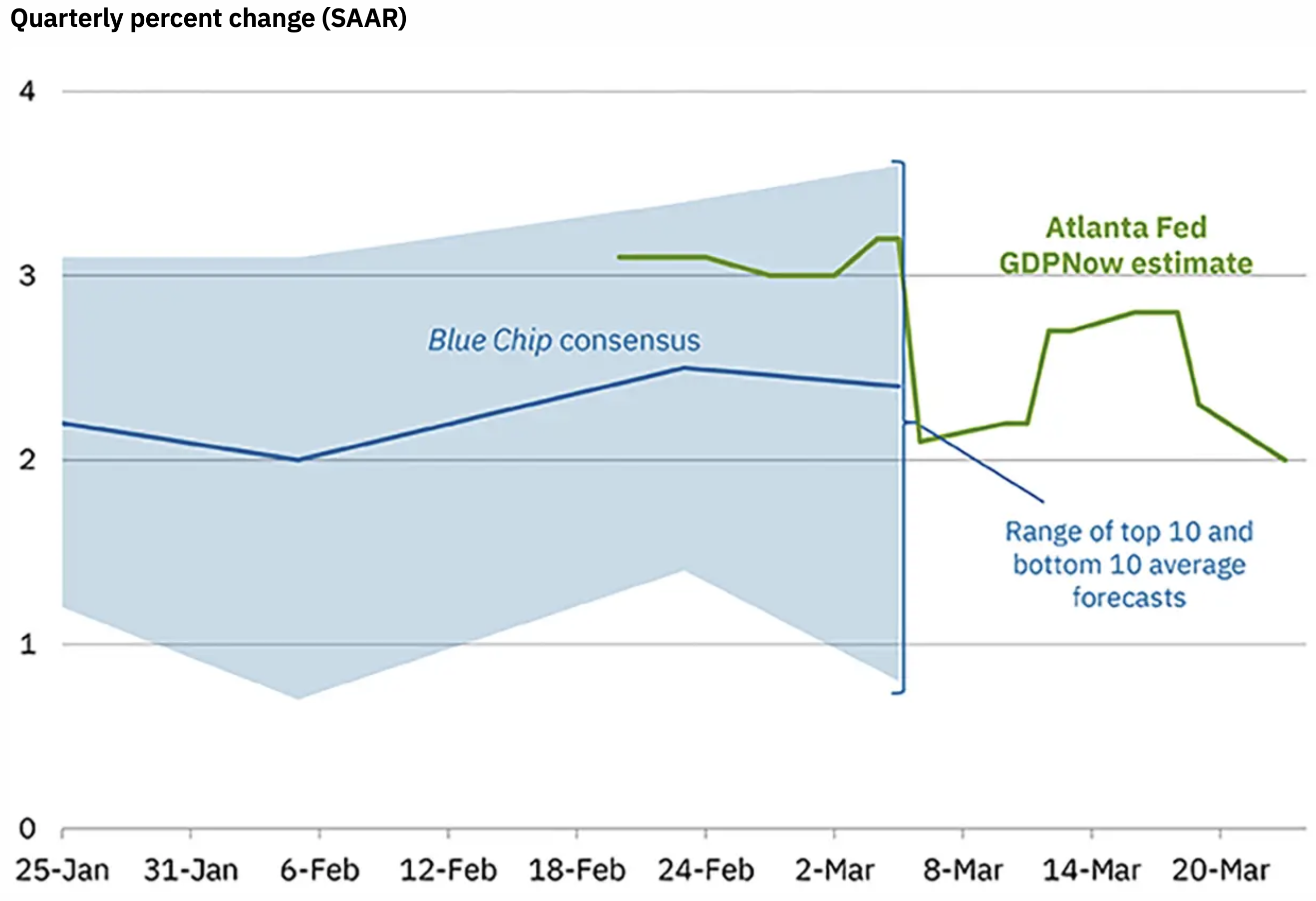
On the growth side, the Atlanta Fed’s GDPNow is running at 2.0% for Q1, well below its first readings from before the Iran activity, although still in decent shape.  The next update comes tomorrow, so will be interesting to see.  And, of course, the payroll report on Friday will be critical for that reading.  It is, though, still well above the Blue Chip Consensus readings.

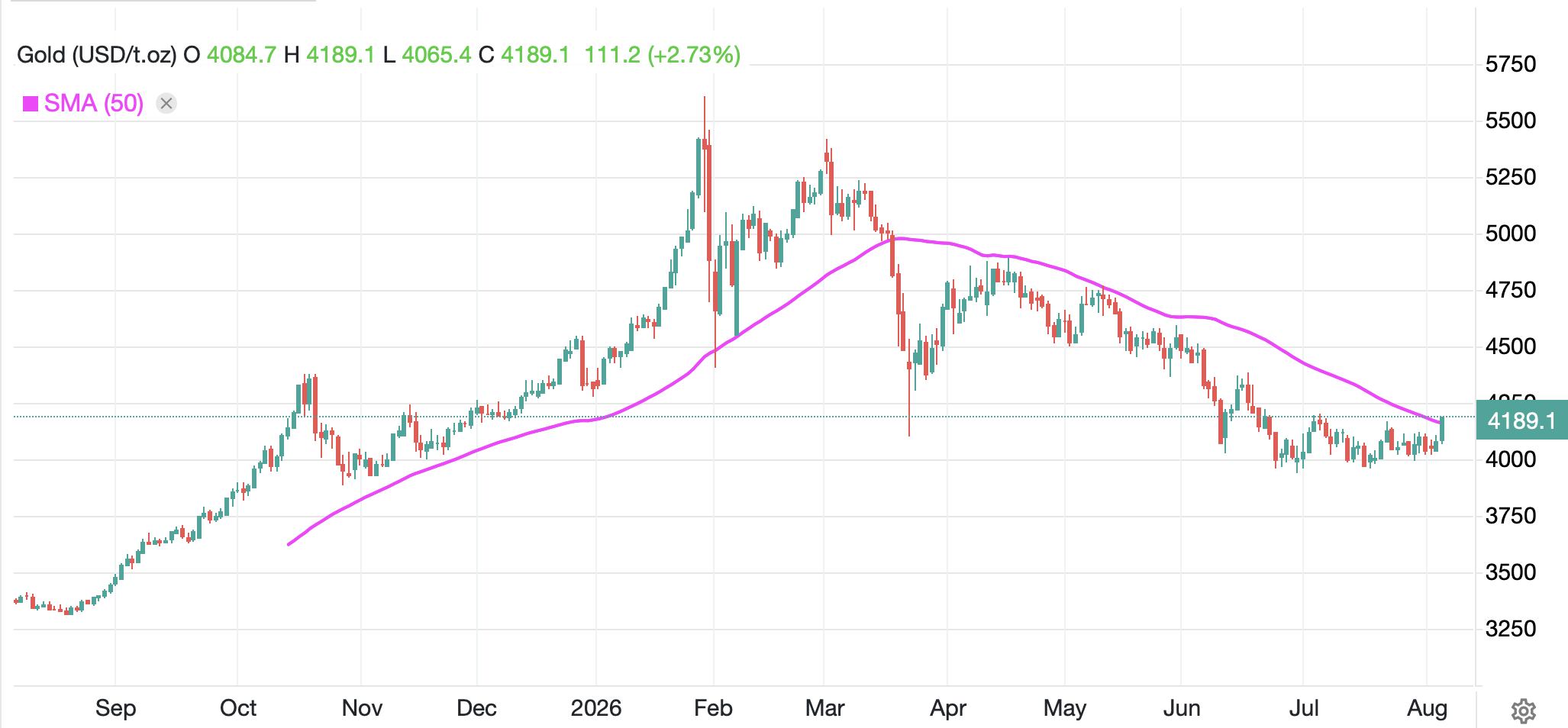
We’ve discussed oil, but a quick peek at precious metals shows they are regaining their luster, with gold (+0.8%) and silver (+3.6%) both nicely higher this morning.  As this price action continues, with the current price more than 10% above the spike low from March 23rd, I believe whatever was driving things during the first part of the war, may now have passed.

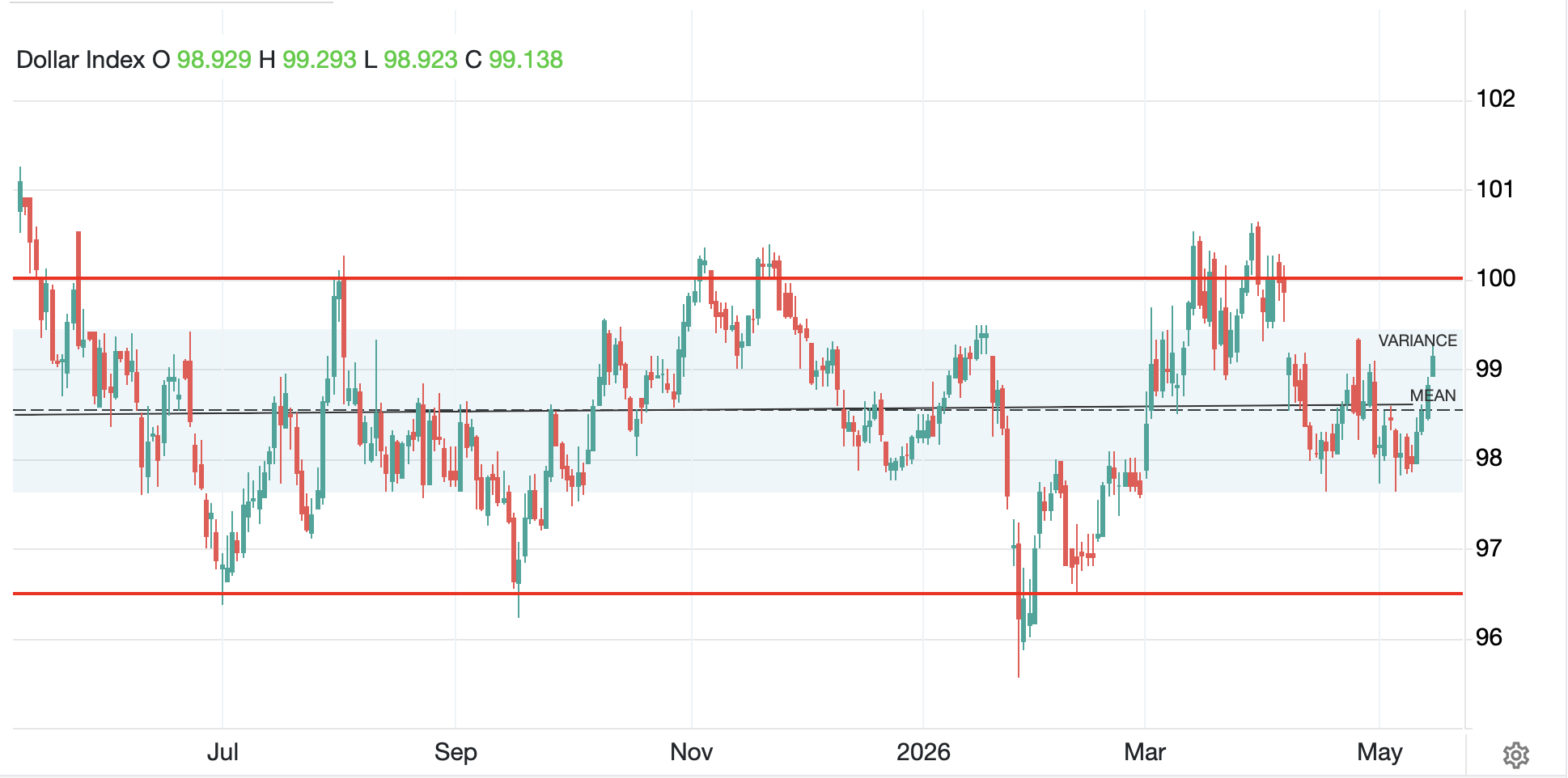
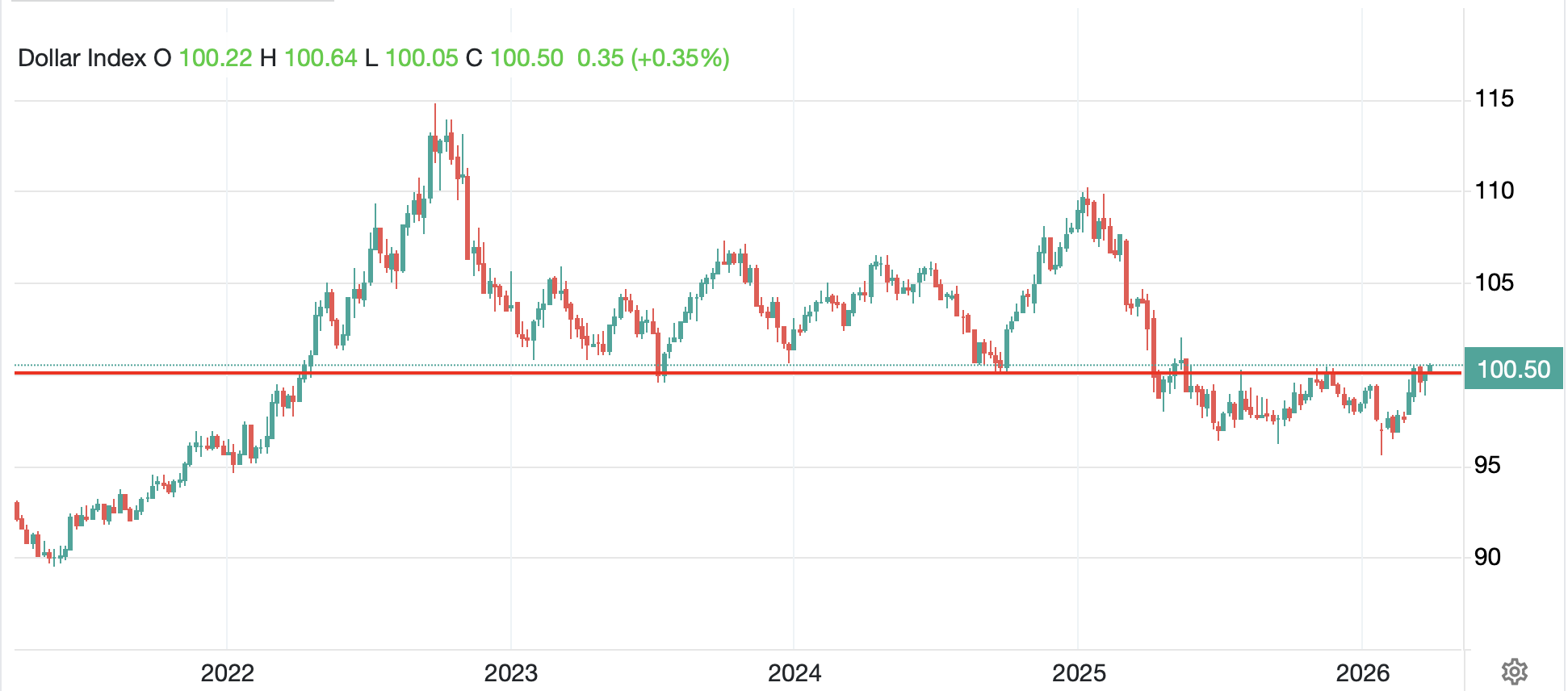
Finally, the dollar is little changed this morning, but sitting on its recent highs with the DXY at 100.53 as I type.  Here’s the thing about the current level.  As you can see from the long-term chart below, while during the first 4 months of 2025, the dollar did decline sharply, about 10%, the longer history shows that the current level has acted as support for a very long time.  As well, if you take the really long view, we are within spitting distance of the DXY’s average since the 1970’s.

Source: tradingeconomics.com

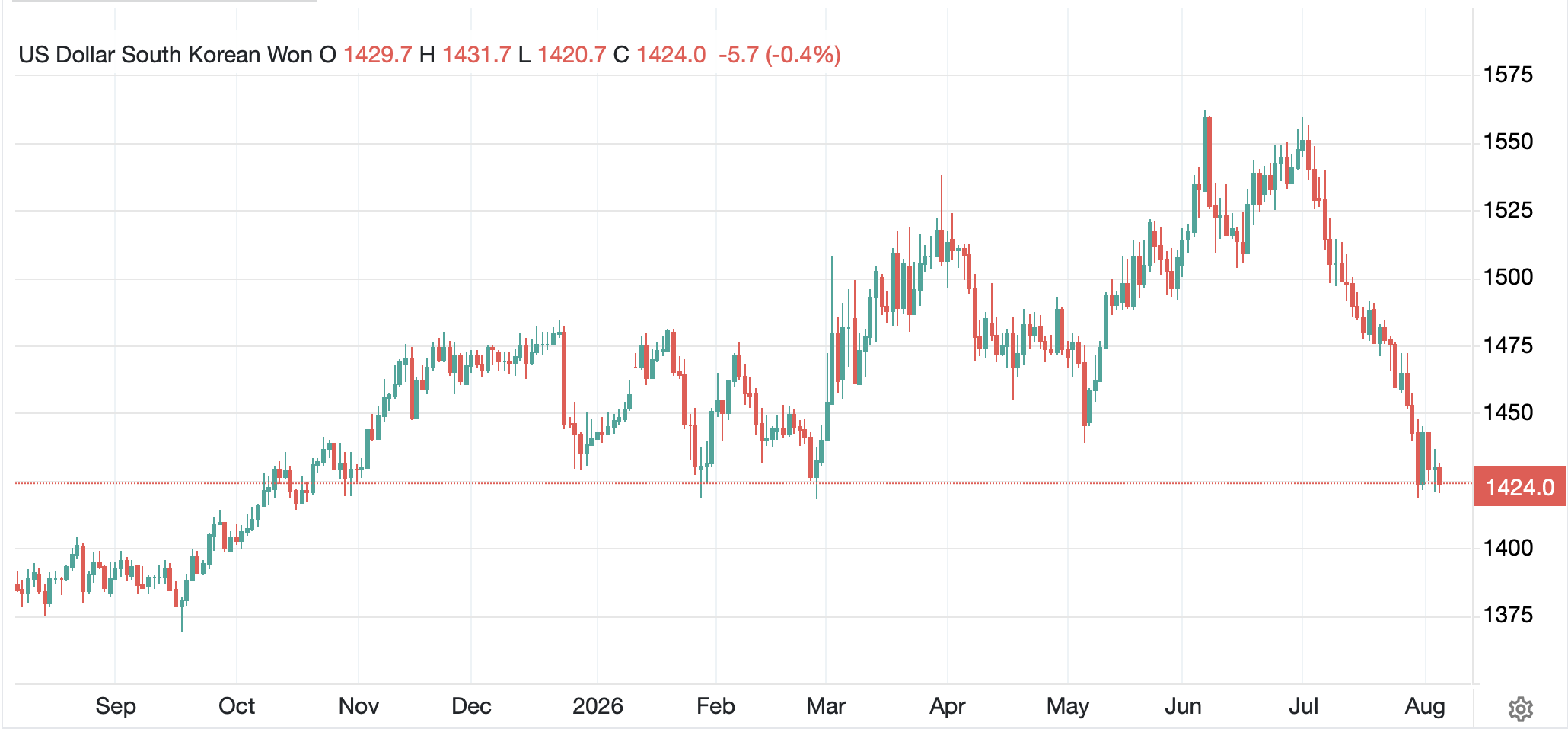
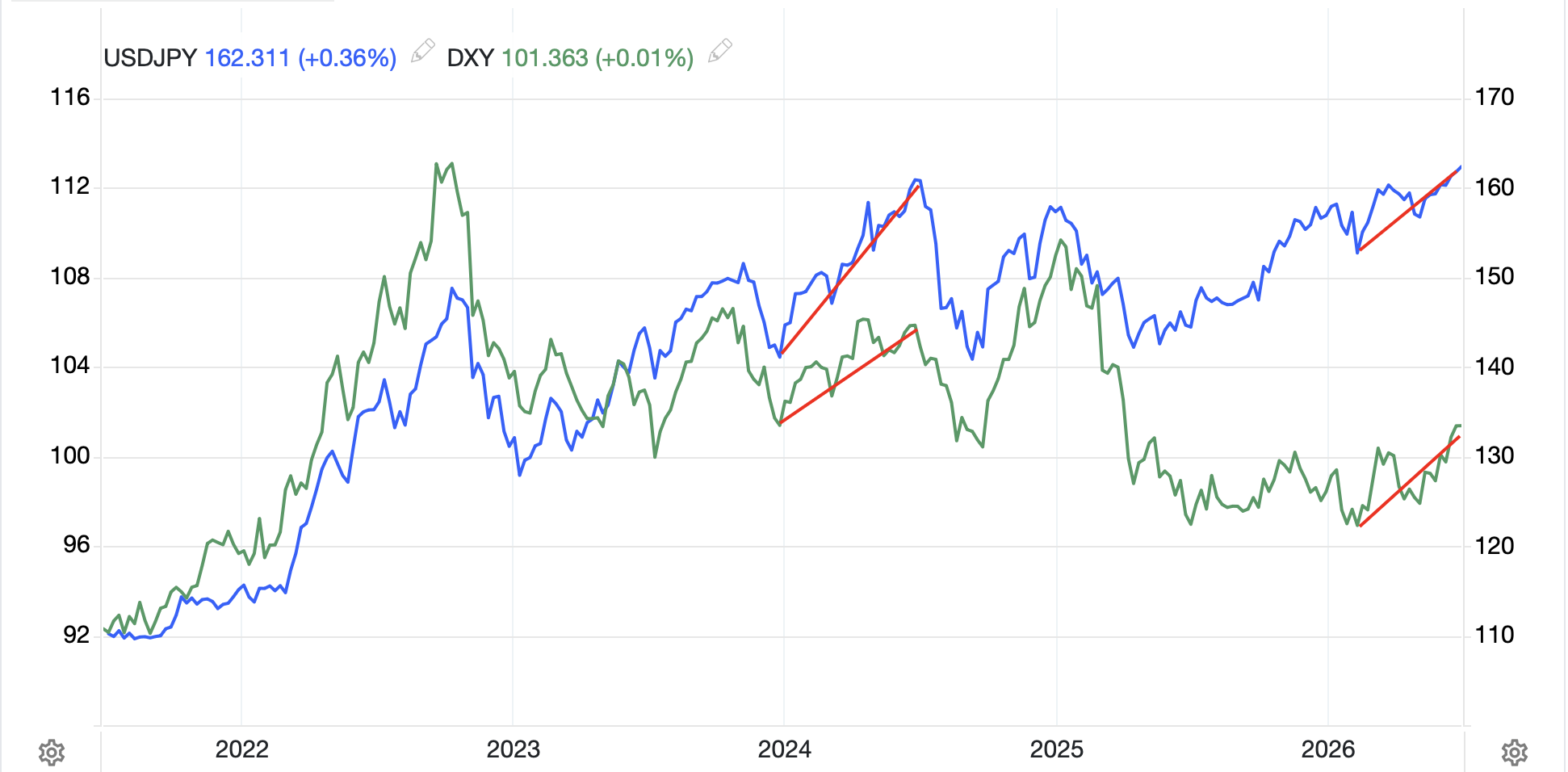
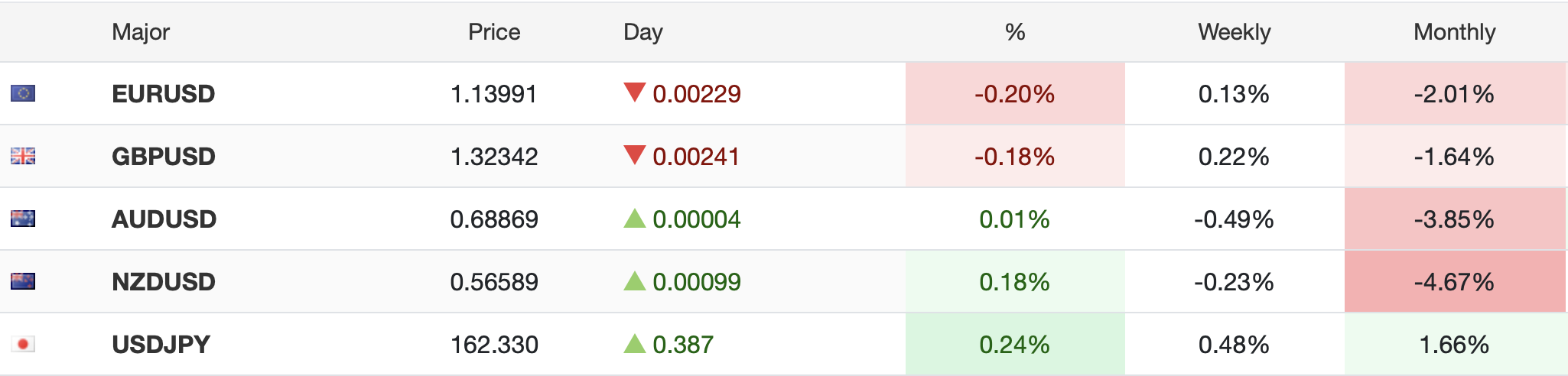
All I’m saying is the dollar is neither strong nor weak right now, it just is.  It is, though, worth looking at the yen (0.0%) which pushed back to just below 160 during yesterday’s session and got more jawboning from Mimura-san, the Vice Finance Minister for International Affairs (aka Mr Yen) who explained they are ready to take “decisive action” against speculative moves.  But otherwise, this morning’s session is unremarkable with only KRW (-0.6%) continuing to suffer from the energy issues there.

On the data front, we get Case Shiller Home Prices (exp +1.3%) and then Chicago PMI (55.0) and perhaps most importantly, the JOLTs Job Openings (6.92M) report at 10:00.  There are two more Fed speakers, Goolsbee and Barr, but with Powell just having confirmed no moves are coming soon, what can they possibly add to the story?

The war and its headlines remain the key drivers and I don’t see anything changing that dynamic for now.  I wonder if markets are prepared for an announcement that it is ending and Iran has come to terms.  I’m not suggesting that is the likely outcome, just that it would be the biggest surprise, I believe.  In the meantime, there are precious few reasons to sell the dollar outright, that’s for sure.

Good luck

Adf

Designed to Ease Nerves

The IEA, last night, proposed
That since, Hormuz Strait, has been closed
Strategic reserves
Designed to ease nerves
Ought be released and not opposed

But so far, it’s not been approved
Despite the fact it is behooved
So, oil is higher
As every supplier
Embraces their, margins, improved

It is somewhat ironic that the biggest story of the evening, the IEA’s recommendation that nations around the world release between 300 million and 400 million barrels of strategic petroleum reserves has not helped mitigate the rise in oil prices.  After falling sharply yesterday, this morning, WTI (+4.5%) is rebounding sharply again.  A look at the chart below reminds me of silver from late January, and certainly, as the following chart demonstrates, daily volatility in that market has made a significant step higher from its pre runup levels.

Source: tradingeconomics.com

One need only look at the size of the daily candles to understand that movement each day has increased substantially since then.

Source: tradingeconomics.com

Of course, the countervailing news that is driving oil higher is that Iran has begun to mine the Strait of Hormuz, which will make resuming transit more difficult when hostilities cease.  In fact, that appears to be the newest front in the war, with the US attacking the small boats Iran is using to try to lay mines.  It seems this is similar to the drug boat attacks the US carried out in the Caribbean late last year prior to the exfiltration of Venezuelan President Maduro.

Again, the interesting thing to me about Iran’s actions is that by closing the Strait, they cut off 90% of their own revenue, and as they are actively fighting a war, that seems a major hindrance.  After all, Iran is nowhere near self-sufficient in anything a nation needs to continue its existence.

But the fog of war is just that, a situation that prevents clear understanding of all that is ongoing in the area.  As we sit, fortunately, thousands of miles away from the action, and everything we read is spun by whoever is writing it, it remains extremely difficult to get a good understanding of the situation in Iran, either tactically or strategically.  All we have is the market price action as an indicator.  

But before we look at markets, it is worth mentioning that CPI is released this morning with the following expectations: Headline (0.3% M/M, 2.4% Y/Y) and Core (0.2% M/M, 2.5% Y/Y).  The problem with this data is twofold.  First, it continues to be polluted by the impact of the government shutdown last autumn, but more importantly, it is for February, and the Iranian action has been entirely in March, so there will be no impact from the dramatic rise in oil prices in the data.  Ultimately, in this case, the data is almost certainly going to be ignored by the Fed, to the extent they even look at CPI rather than PCE.  Of course, the PCE data will have the same problems.

So, let’s turn to markets now.  Yesterday’s nondescript price action in the US was followed by a more positive tone in Asia, arguably on the IEA news.  While there were some laggards (India -1.7%, Indonesia -0.7%, HK -0.25%), the bulk of the region did just fine with Tokyo (+1.4%) and China (+0.6%) both nicely in positive territory, although that was nothing compared to Taiwan (+4.1%).  Otherwise, the rest of the region was positive somewhere between +0.5% and 1.0%.  Europe, however, is having a less positive morning with most major bourses lower on the day (Germany -0.7%, France -0.3%, UK -0.6%, Italy -0.3%) with only Spain (+0.3%) managing a gain in the session.  Energy continues to be the biggest concern here although as I type at 7:25 this morning, we are getting the first word of SPR releases from several nations including Germany and Japan.  Perhaps there won’t be a coordinated release after all.  Meanwhile, US futures at this hour are basically unchanged.

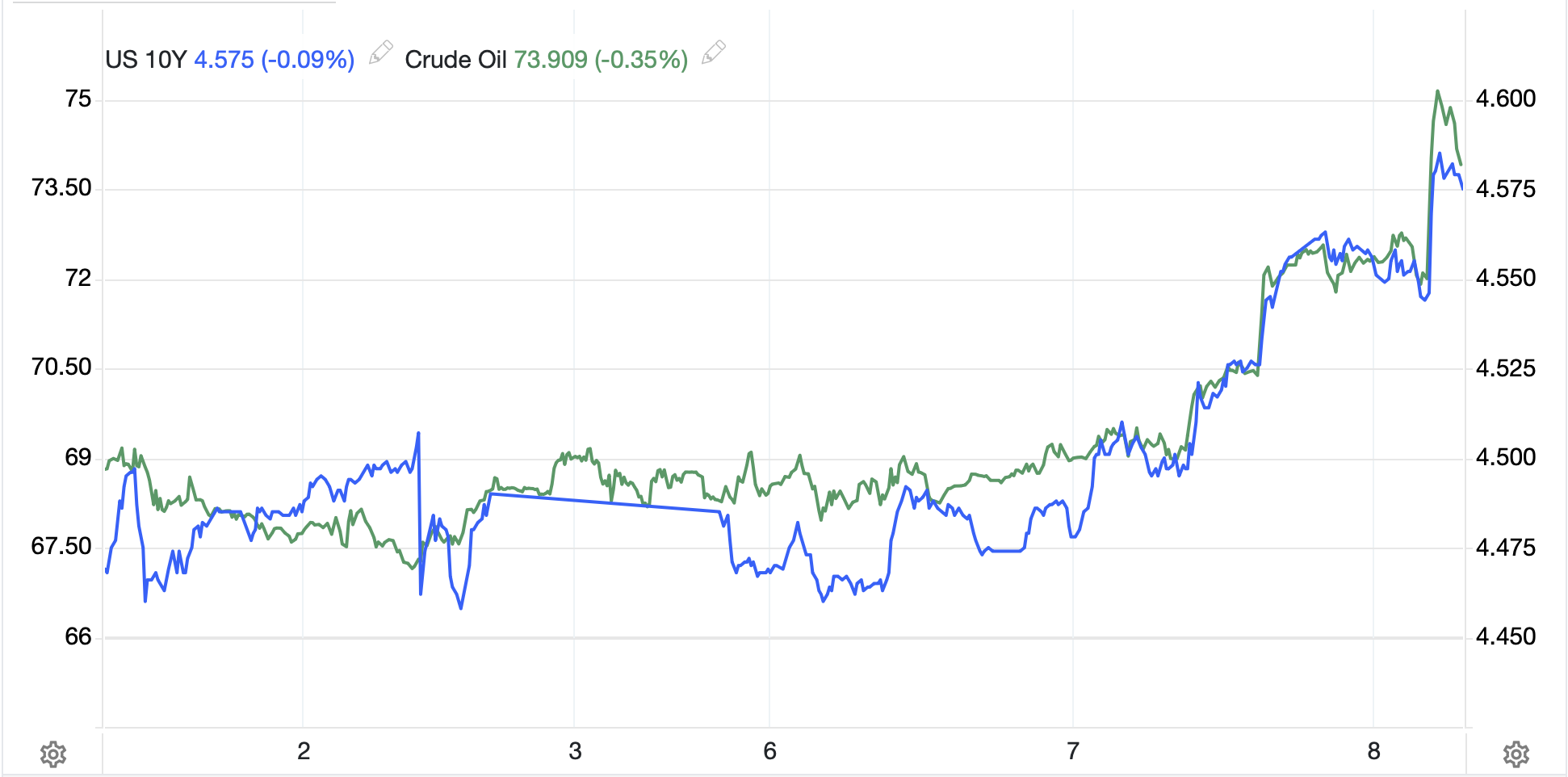
In the bond market, yields rose yesterday afternoon in the US and have edged another 1bp higher this morning while European sovereign yields all catch up to yesterday’s US move with gains of between 5bps and 8bps on the continent.  It is important to remember that there is a strong correlation between oil prices and 10-year yields, as would be expected based on the direct connection between oil prices and inflation.  The chart below shows the past week’s movement in the two markets.  The long-term correlation averages +0.61% with a range of +0.5% to +0.7% according to Grok.

Source: tradingeconomics.com

Again, referring back to today’s CPI, we can expect that CPI next month is going to be higher than this month, even if the war ends today.

In the metals markets, weakness is the order of the day although gold (-0.1%) is just barely so.  However, those metals with industrial uses are faring worse this morning led by platinum (-2.4%) but both silver (-1.75%) and copper (-1.7%) are under pressure.  A potential explanation here is that continued high oil prices will weaken economic activity and therefore demand for these metals.  The counter argument is that war is inflationary at all times, and metals tend to do well in those periods.

Finally, the dollar is slightly firmer across the board, but movement has been de minimis overall.  The noteworthy exception is AUD (+0.6%) which has been rallying recently on concerns (hopes?) that the RBA is getting set to raise rates at their meeting on Monday (Sunday night here).  In fact, the Aussie has traded to its highest level in almost four years, although I have a hard time understanding the attraction given the softened state of economic activity there (recent GDP reading of 0.8% Y/Y) and an energy policy only the Europeans could love as they continue to prohibit nuclear power and shut down coal despite having abundant resources in both.  But, in the FX world, relative interest rates mean a lot, and the perception of a hawkish central bank is apparently enough to overcome bad fiscal and energy policy.

And that’s really all for today.  We do see the EIA oil inventory data, with a small net draw expected and Fed Governor Bowman speaks, although it is at the ABA’s Summit on Regulation, so there will likely be no monetary policy discussion as this is the quiet period.

Where do we go from here?  Your guess is as good as mine.  We are already seeing oil prices slip a bit with the announcement of the SPR releases, although they remain higher on the day.  The war continues to drive all the narratives so if you are trading, keep abreast of that news.  If you are not trading, though, avoid it at all costs, it will make for much happier days!

Good luck

Adf
Sometime Soon Become Miffed

At this point, I think we’d agree
It’s oil that seems to be key
As it keeps on rising
It’s not that surprising
That markets elsewhere lack much glee

So, how might the narrative shift?
One way is a noteworthy rift
Twixt Trump and our friends
Who seek different ends
And might, sometime soon, become miffed

The war continues to be the only story that matters to markets right now, although this morning we will be seeing the payroll report.  And no matter the information we receive from ordinary news sources, all of which have their own biases, the one thing that rings true is market prices.  People can say whatever they like, but when it comes to money, the truth will out.

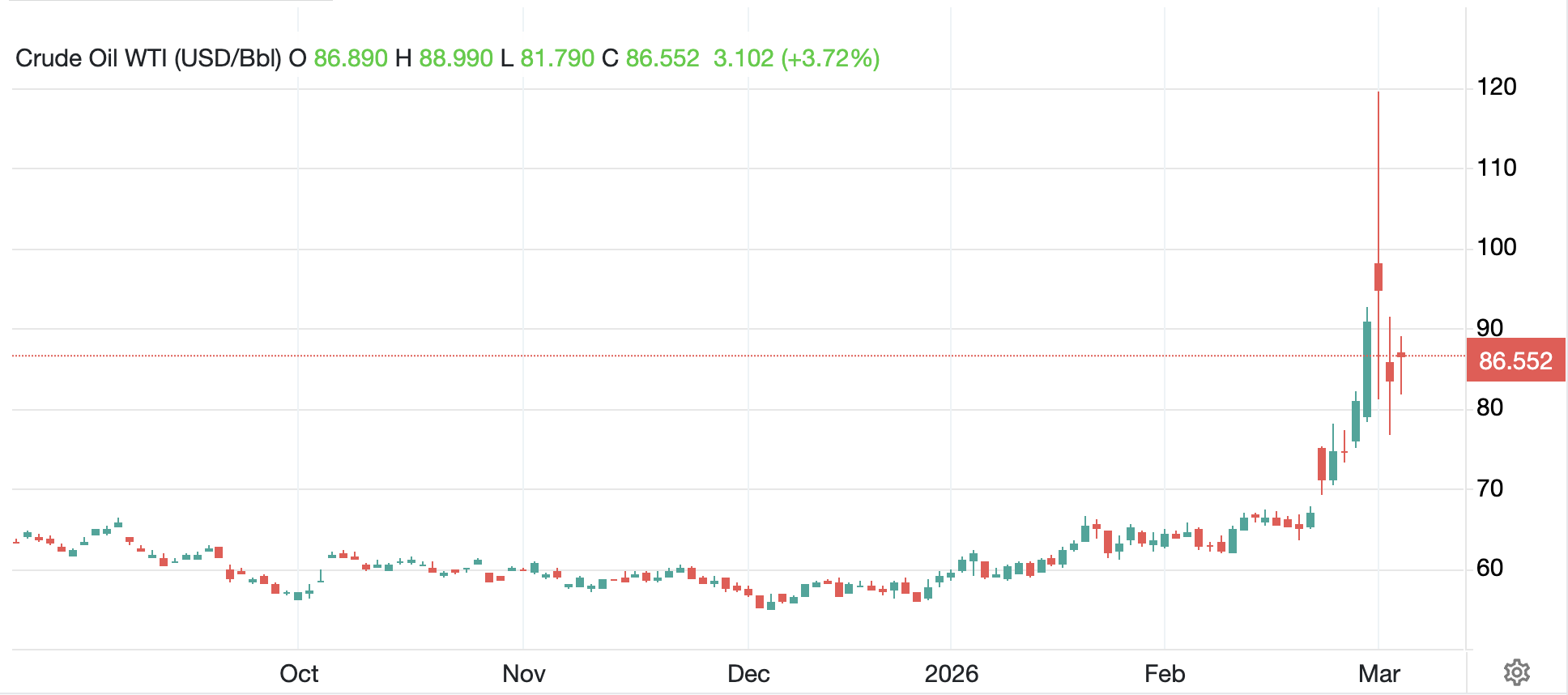
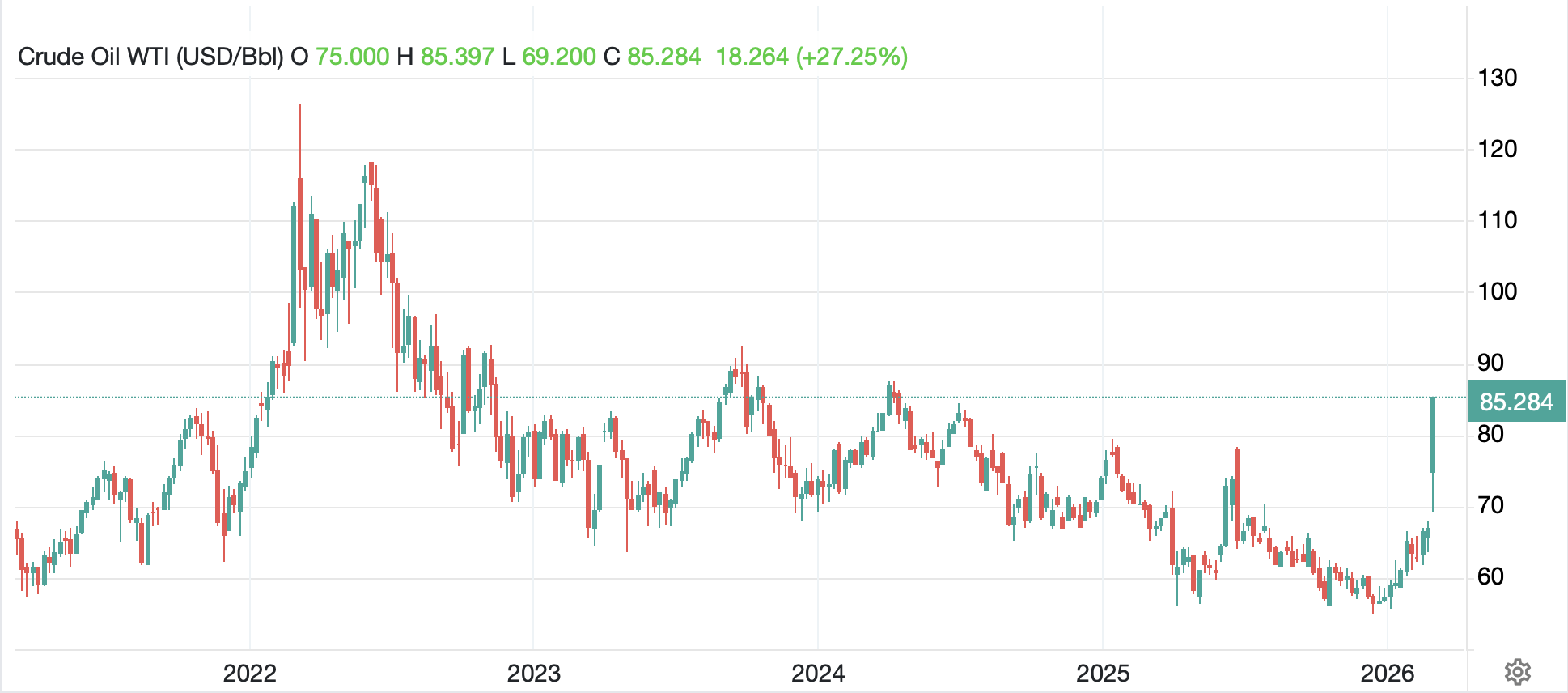
With that in mind, a look at the oil market this morning is not very optimistic as the black, sticky stuff is sharply higher once again, up by 5.25% as I type at 6:45.  I have highlighted this week that thus far, the rise had not been excessive, but as we look at the chart this morning, that claim may no longer be correct.  While we remain far below the levels seen shortly after Russia invaded Ukraine in 2022, the price has risen 25% this week.

Source: tradingeconomics.com

As others have highlighted, while the price of crude gets all the market press, for the man on the street, it is really the price of gasoline that matters, and that has risen some 17% this week.  Arguably, markets are beginning to price the idea that this war will continue longer than initial thoughts, and that the key chokepoint, the Strait of Hormuz, will remain closed for longer than initially expected.  I have seen several models that indicate the impact on measured inflation if gasoline continues to rise in price, which indicate that we should expect CPI to be jumping in the next few months.  The upshot there is that do not be surprised if inflation is suddenly running above the Fed funds rate by the summer, a forecast that I don’t believe was on any bingo card at the beginning of the year.

Remember, though, the narrative prior to the onset of this military action that there was an oil glut.  Remember, too, there is a significant amount of oil in storage around the world, and as I continue to say, the Western Hemisphere is pumping as fast as they can.  (As an aside, I saw this morning that the US is going to restart diplomatic relations with Venezuela, an indication that things there are working far better than the critics implied.)  Clearly, fear is rampant in the oil markets right now, but that is subject to change in a heartbeat.

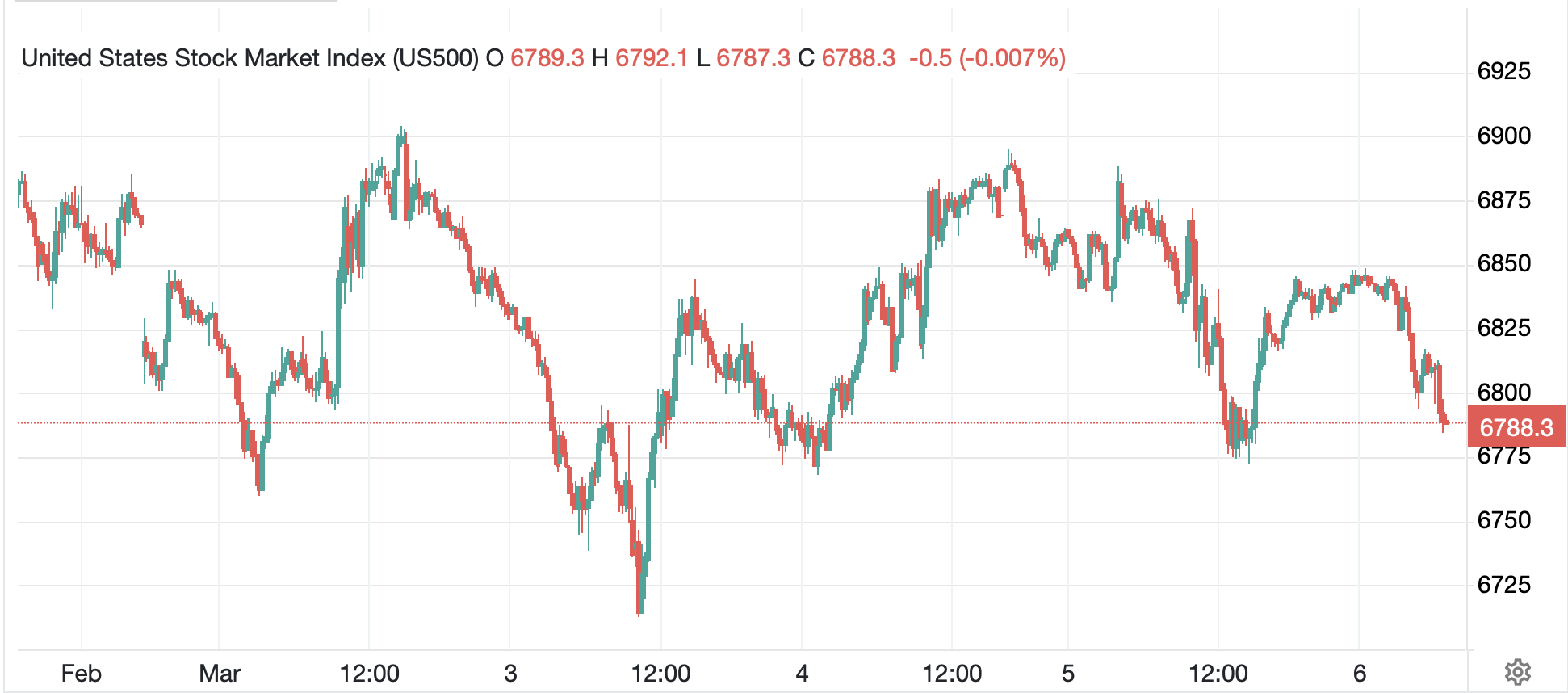
In the meantime, let’s see how markets have responded to the latest rise in oil prices.  Stocks cannot make up their mind, it seems, as the below chart of the S&P 500 shows the price action over the past week, since this started.

Source: tradingeconomics.com

I am hard pressed to discern a trend here, with the movement more akin to a sine wave than anything else.  Interestingly, yesterday’s weakness in the US was followed by a mix of strength and weakness in Asia with Tokyo (+0.6%), China (+0.3%) and HK (+1.7%) all gaining although there were declines in India (-1.4%), Australia (-1.0%) and Indonesia (-1.6%).  Not surprisingly, each nation in Asia is impacted by the war differently, although higher oil prices would seem to me to be quite a negative for the big 3 markets given how reliant each one is on imported oil, and how much of it transits the Strait of Hormuz.

As to Europe, this morning is all red, with losses between -0.1% (UK) and -0.5% (Spain) and everywhere in between.  I read a charming article in Bloomberg about how recent unseasonably mild and sunny weather in Germany has resulted in solar power generating more than 40GW of electricity for the 5th consecutive day this week, helping to keep prices in check despite the rise in energy prices elsewhere.  I hope, for the Germans’ sake, the weather stays more like Phoenix than Frankfurt going forward.  But reality is going to be a problem for them going forward, and high energy prices not only hurt consumers, but they are destroying what’s left of Europe’s industry.  As to US futures, at this hour (7:15) they are lower by -0.6% across the board.

Bonds continue to shun their safe haven role in this conflict with yields continuing to climb.  Treasuries are higher by a further 3bps this morning and approaching the 4.20% level that had been the top of the trading range.  European sovereign yields are all higher by between 3bps and 6bps as inflation concerns percolate amid higher energy prices.  Alas for Europe, this morning they released Eurozone GDP growth for Q4 at a softer than expected 1.2%.  I expect we will begin to hear more about stagflation there if the war continues.

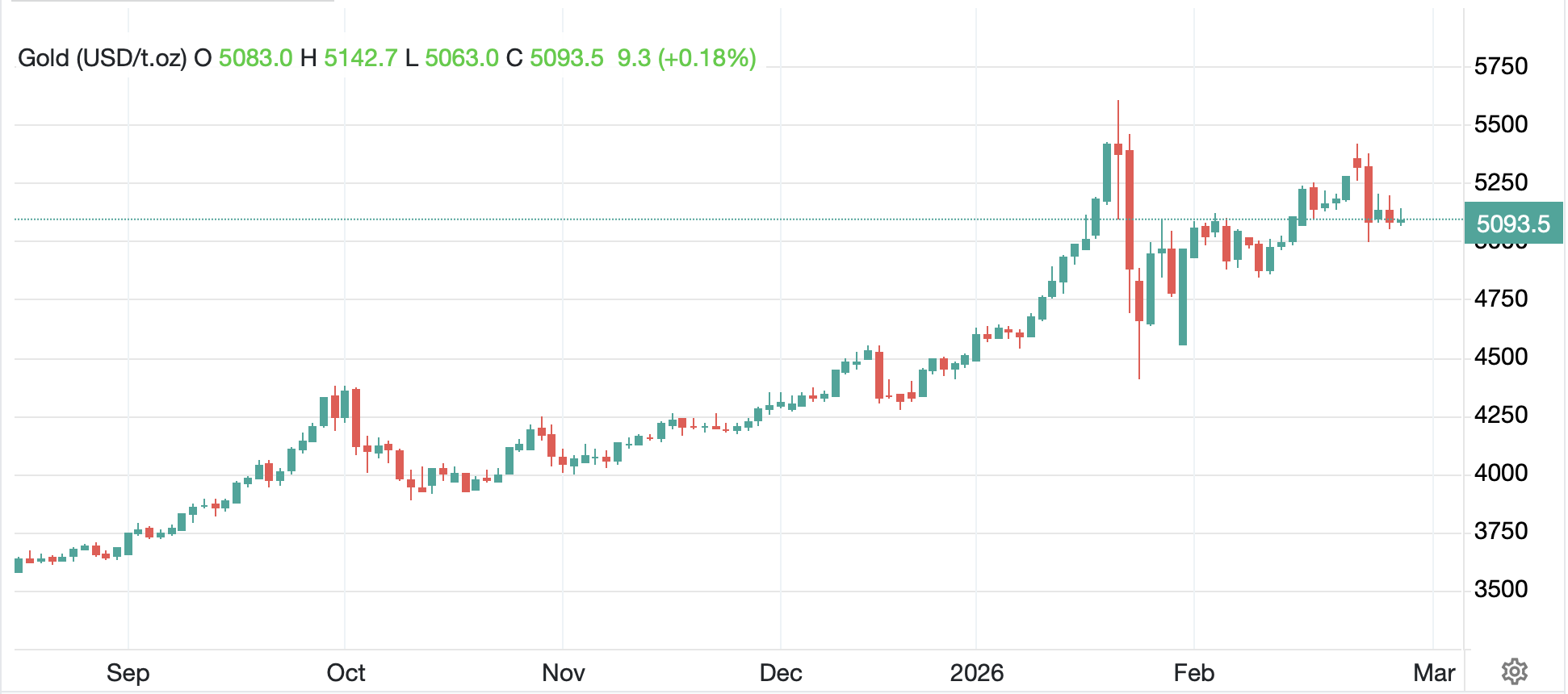
In the metals markets, both gold (+0.1%) and silver (+0.1%) are marginally higher this morning although both suffered yesterday.  My friend JJ who writes the Market Vibes Substack made a very prescient statement last evening, “However, when the shit is hitting the fan, you don’t want safe assets, you want safe prices.”  Thus far, gold has not proven to have safe prices, as evidenced by the daily chop you see below, but my belief remains that it will continue to maintain its value over time, especially in a situation like this.

Source: tradingeconomcis.com

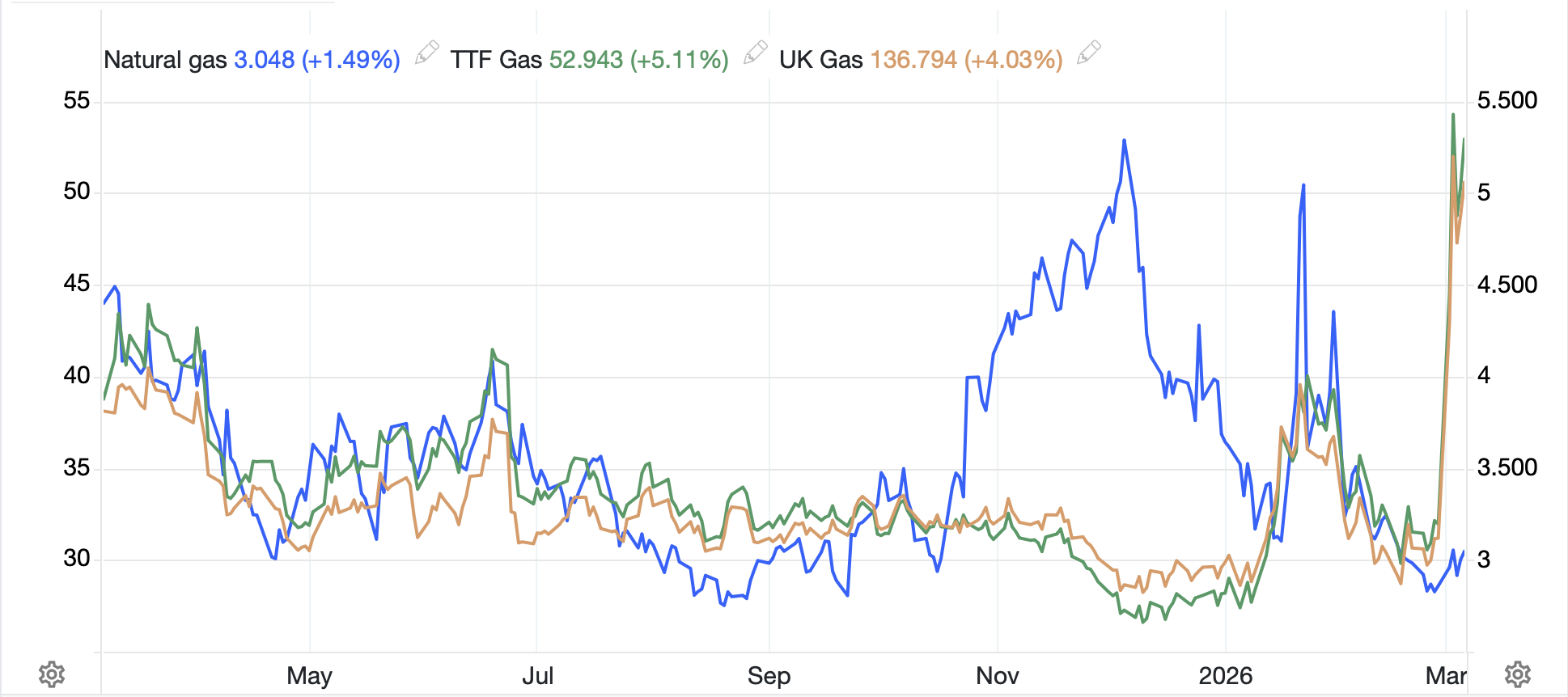
Finally, rumors of the dollar’s death continue to be exaggerated.  This morning, it is stronger vs. virtually all its counterparts in both the G10 and EMG blocs, even the traditional havens of CHF (-0.2%) and JPY (-0.3%).  As I have repeatedly written, I don’t believe you can look at the global energy equation without recognizing that the US combination of extraordinary resources and the willingness to exploit them is an unbeatable combination.  After all, despite 25% of global LNG shipping stopped due to the closure of Hormuz, natural gas prices in the US are just over $3.00/MMBtu, certainly above their levels from two years ago, but incredibly cost competitive on a global basis.  Just look at the chart below with European, UK and US gas prices and see how they have behaved.

Source: tradingeconomics.com

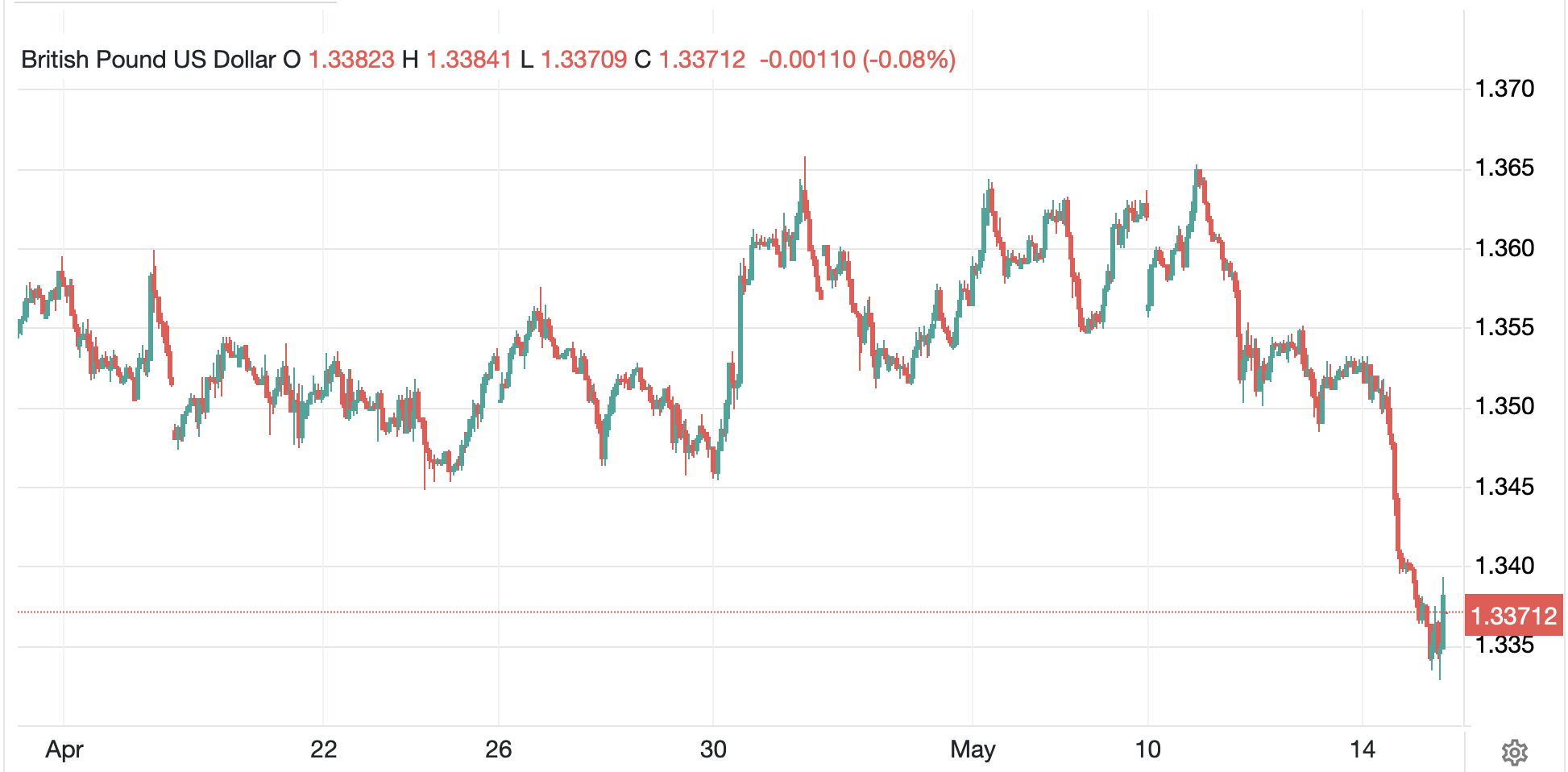
Back to the dollar, both the euro (-0.4%) and the pound (-0.3%) have slipped to their lowest levels vs. the dollar since late November 2025.  I believe that is a combination of both fear and the energy situation as it is aggravated by the war.  There are two currencies holding up this morning, NOK (+0.15%) and CAD (+0.15%) with the similarity that both are major oil exporters.  Oil continues to be the story driving everything.  Quite frankly, as long as the war continues, I find it hard to devise a scenario where the dollar declines in any meaningful way.

On the data front, this morning brings the payroll report with the following expectations:

Nonfarm Payrolls59K
Private Payrolls65K
Manufacturing Payrolls3K
Unemployment Rate4.3%
Average Hourly Earnings0.3% (3.7% Y/Y)
Average Weekly Hours34.3
Participation Rate62.5%
Retail Sales-0.3%
-ex Autos0.0%

Source: tradingeconomics.com

Yesterday’s Initial Claims data was in line and the productivity data was better than expected.  Wednesday’s ADP Employment Data was better than expected.  While there continues to be a lot of discussion about the economy setting to crack, at this point the data does not show that to be the case.  Remember, the tax impacts of the OBBB are starting to be felt, and that is a huge stimulus.  Remember, too, last month’s NFP was much stronger than expected.  A strong number will certainly support the dollar, although it will probably support oil prices as if the economy remains strong, it will encourage President Trump that he can continue in Iran for a longer time.

Good luck and good weekend

Adf