‘Pocalypse Dreams

Though many have preached the buck’s dead
The greenback keeps moving ahead
And right now, it seems
Their ‘pocalypse dreams
Are still all confined to their head(s)

But narrative writers ignore
Whatever they said from before
Right now, it’s the buck
That’s causing bad luck
As rate hike bets all start to soar

In a fairly rare set of circumstances, the dollar has drawn the spotlight in markets for the past few sessions.  While it always matters to some extent, it is rarely seen as the cause of many other market movements, just a coincident one.  But right now, I read more about how the strong dollar is driving equity weakness and commodity weakness as more and more bets get placed on the Fed hiking rates aggressively to address inflation by the end of the year.

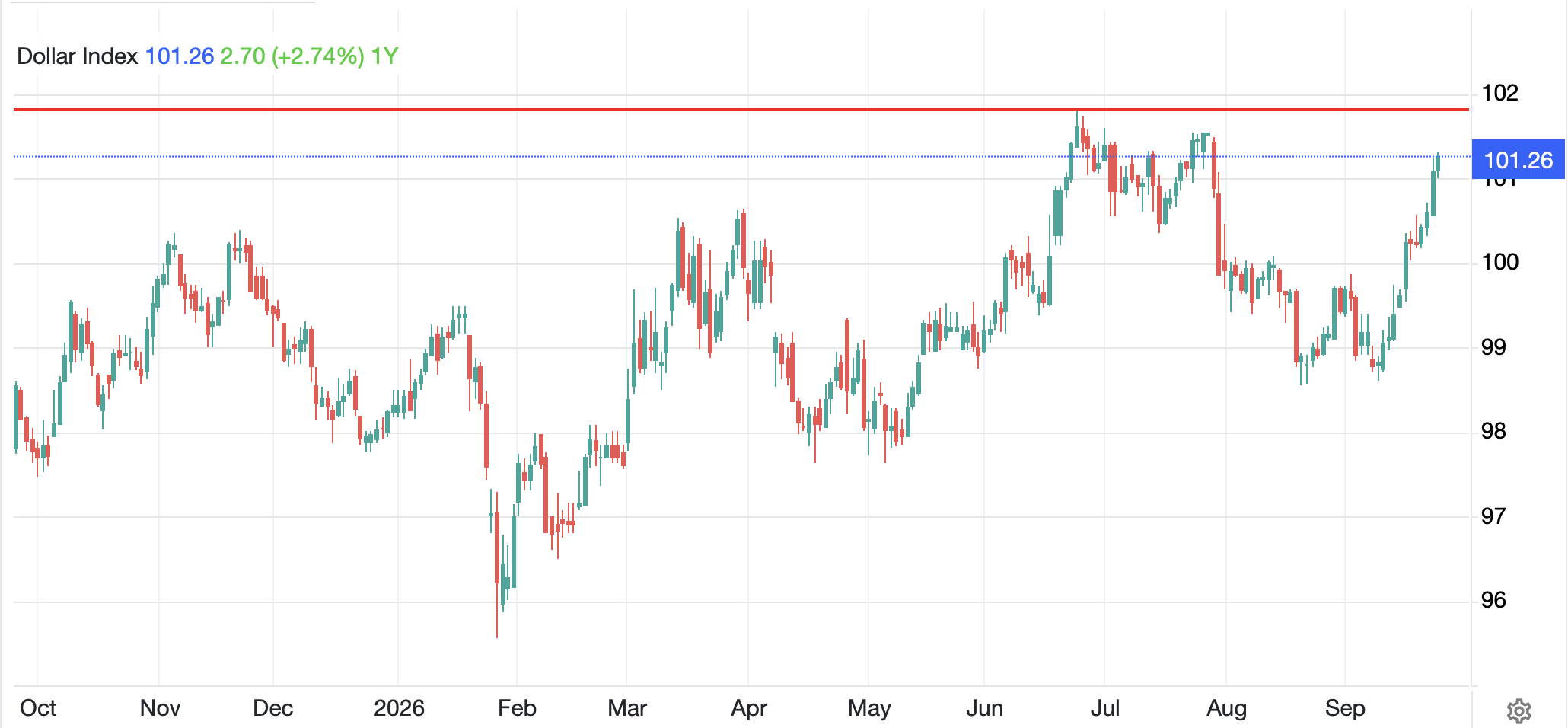
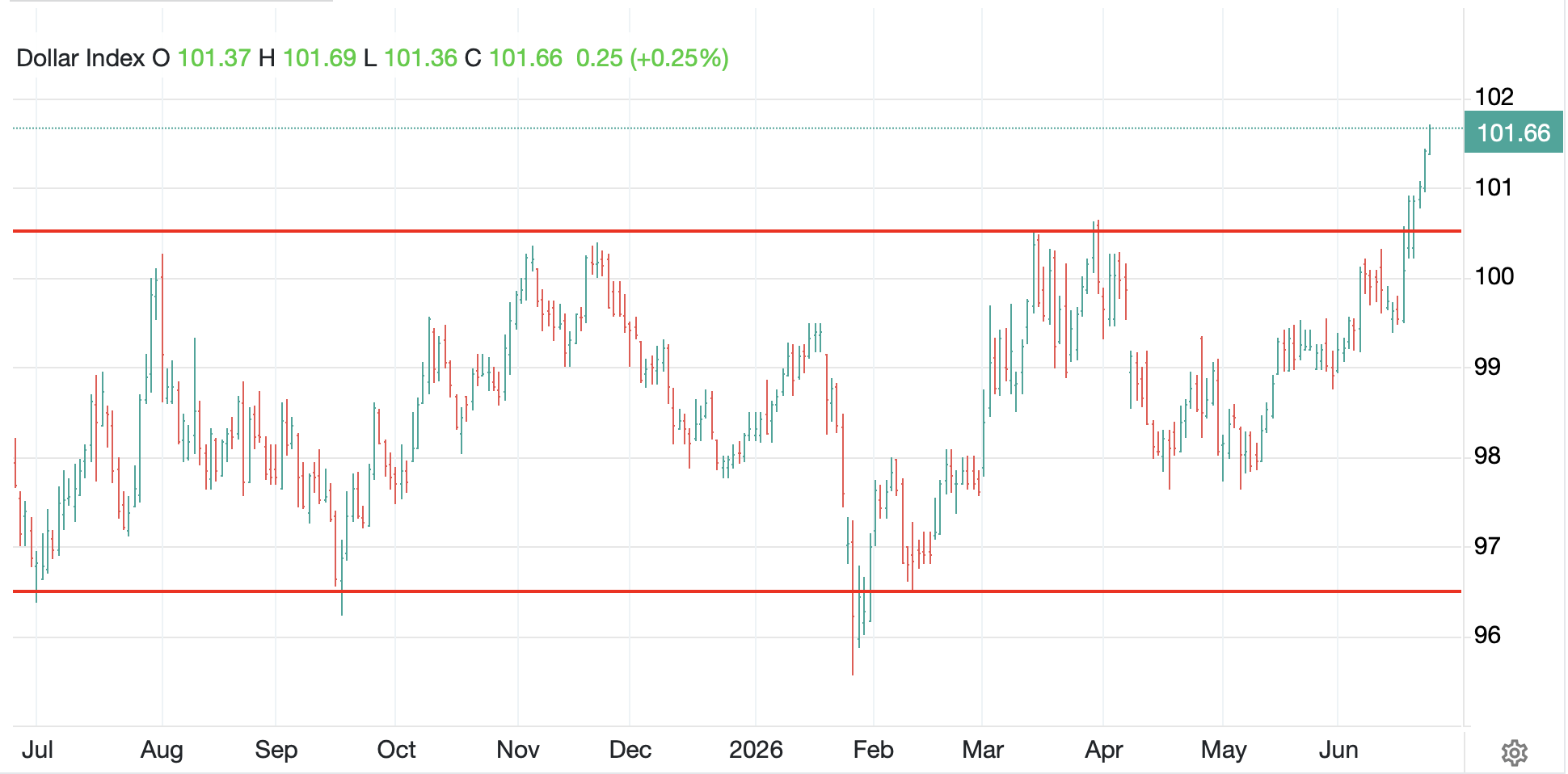
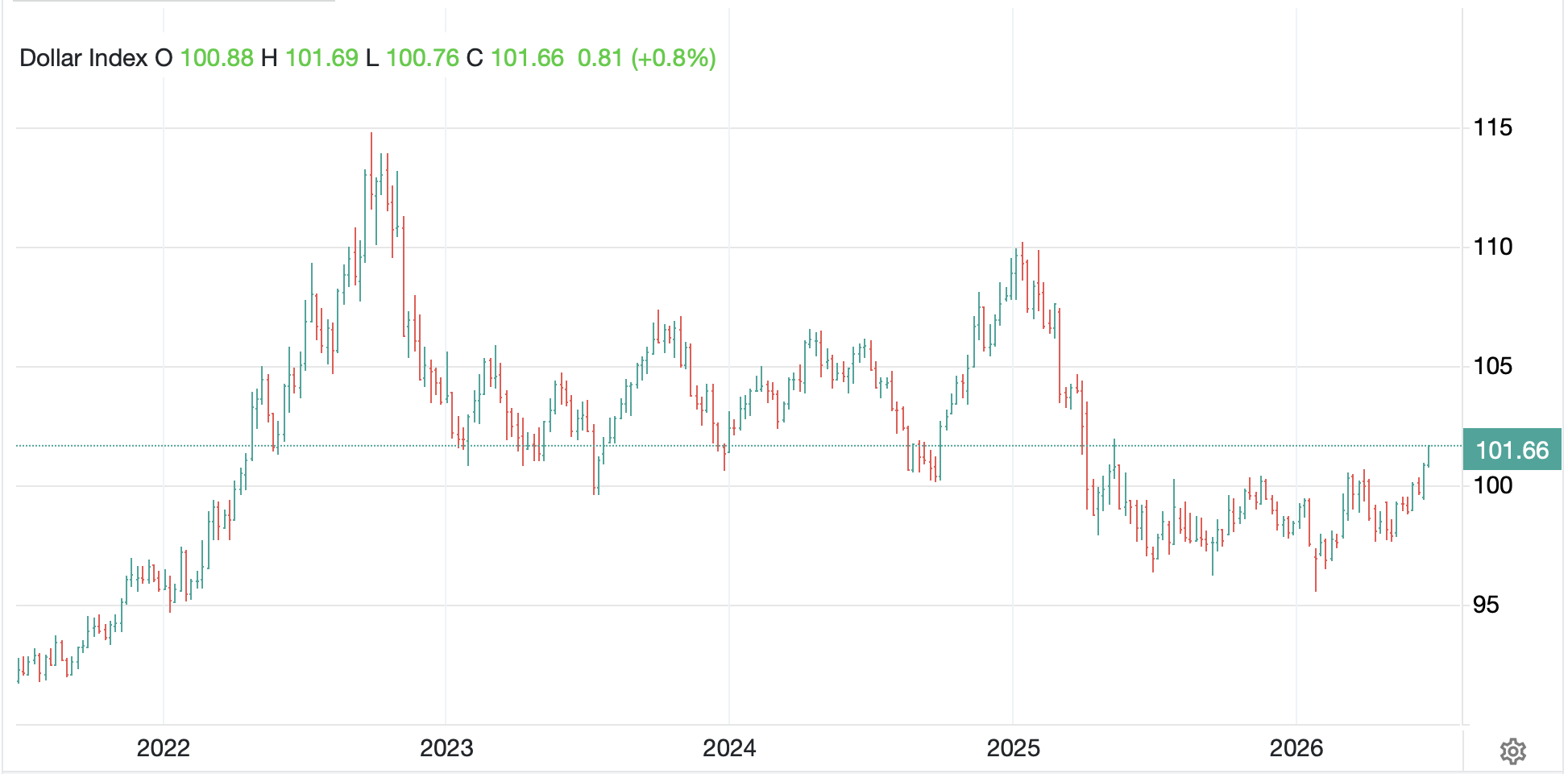
Using the DXY as proxy, the first chart is the one everybody wants you to focus on, showing the last year and how we have had a clear break above the trading range top of 100.50 and now people are creating targets for just how high it can go.

Source: tradingeconomics.com

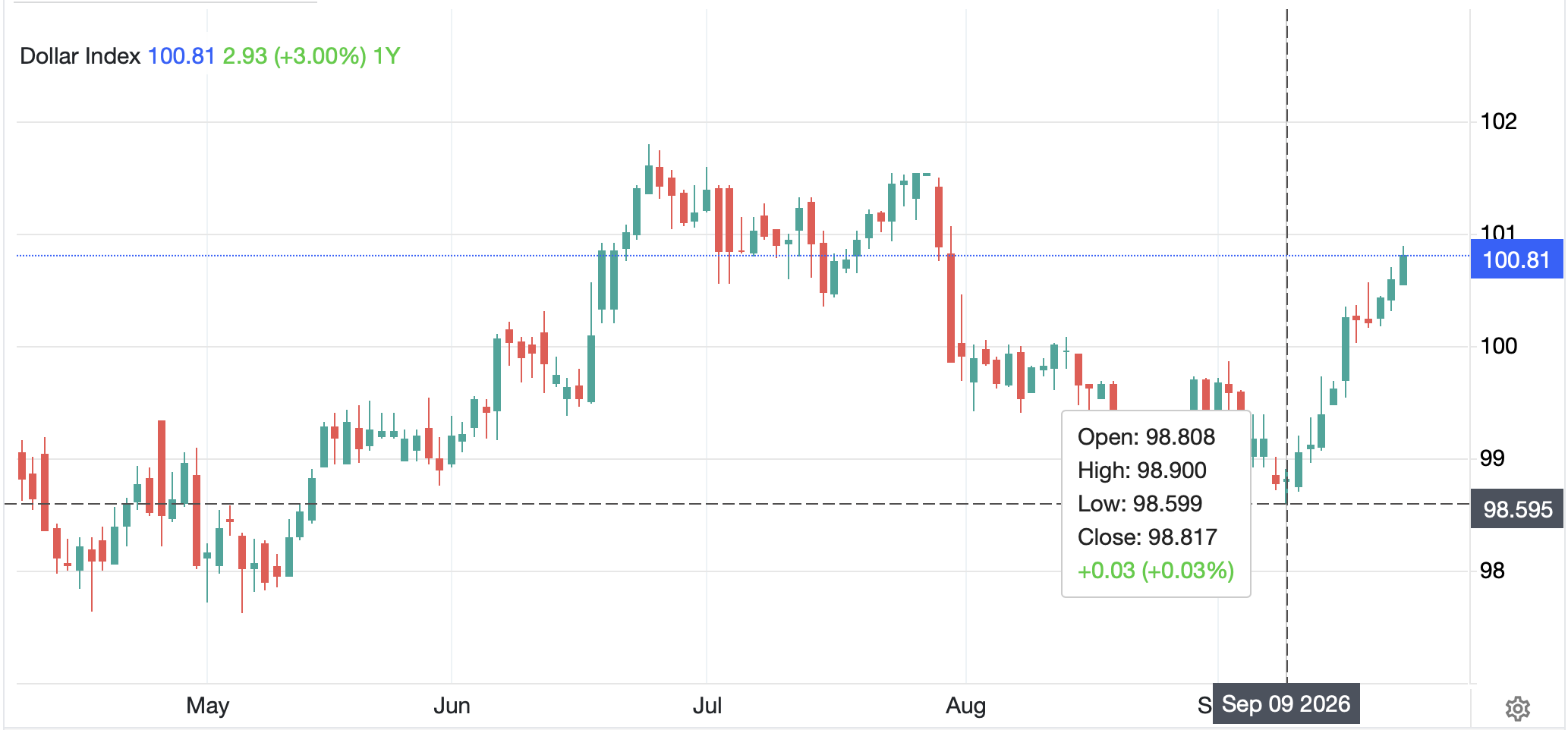
And it certainly can go higher, as a quick step back to get some more perspective shows where the dollar has been during the past 5 years. It seems to me I could create a narrative that the dollar has been massively undervalued over the past 18 months, and this move is simply returning it closer to its longer-term fair value.  In fact, just eyeballing, it seems quite reasonable to think the 5yr average of the DXY is somewhere around 103-104 (subsequently confirmed with Grok), still a few percent higher than current levels.  Reversion to the mean anyone?

Source: tradingeconomics.com

All of this, though, begs the question, are rate hikes really on the near-term horizon?  I remain firmly in the camp that is not the case.  Fortunately, someone on my side is super smart, Bob Elliott, former hedge fund manager at Bridgewater.

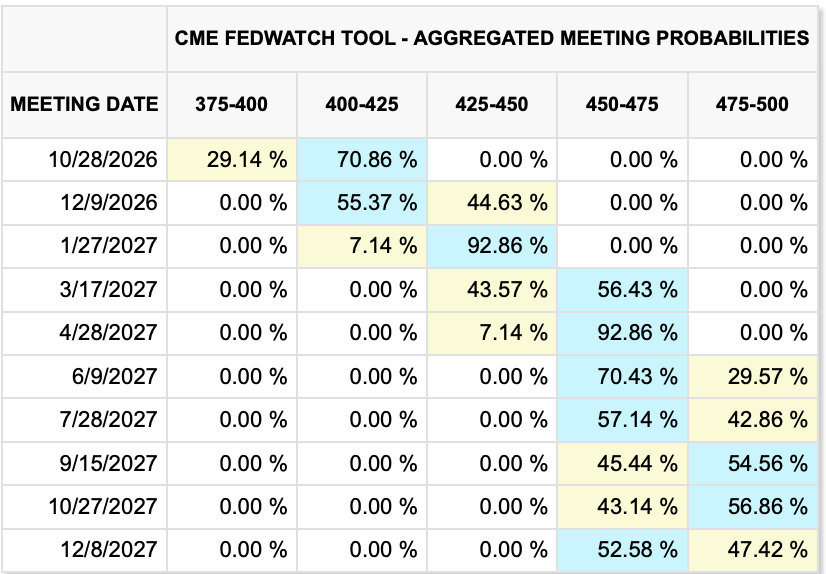
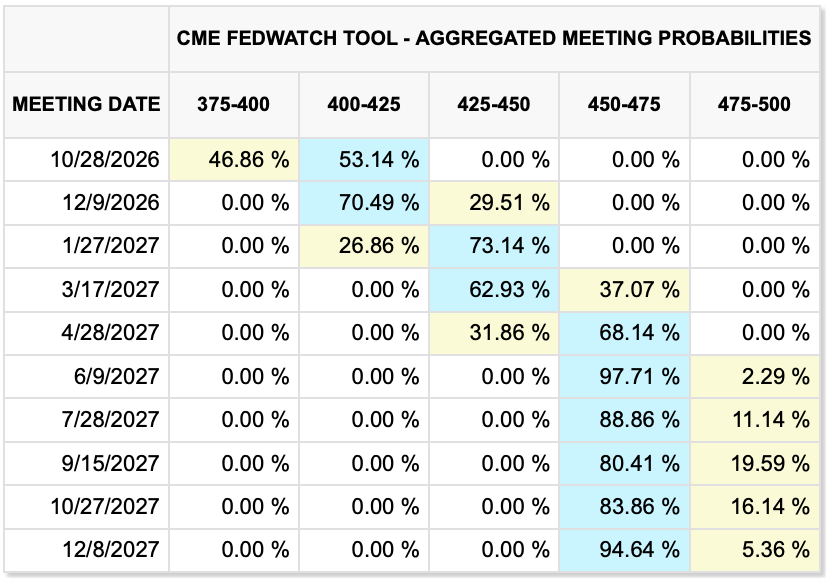
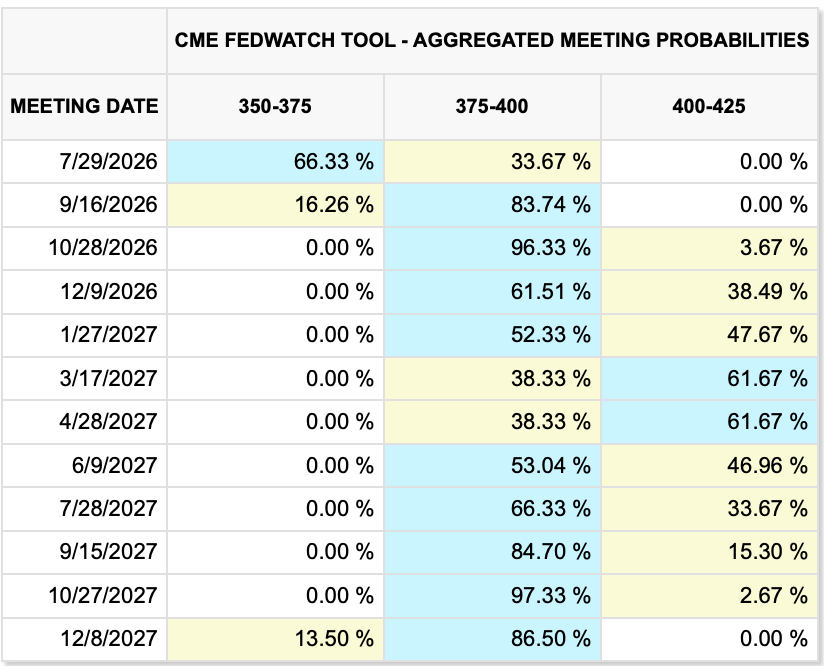
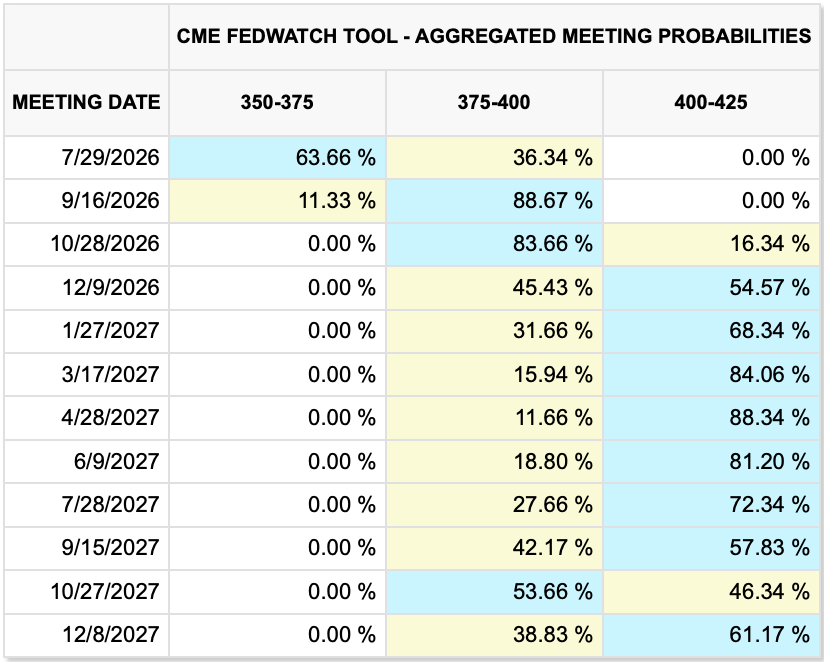
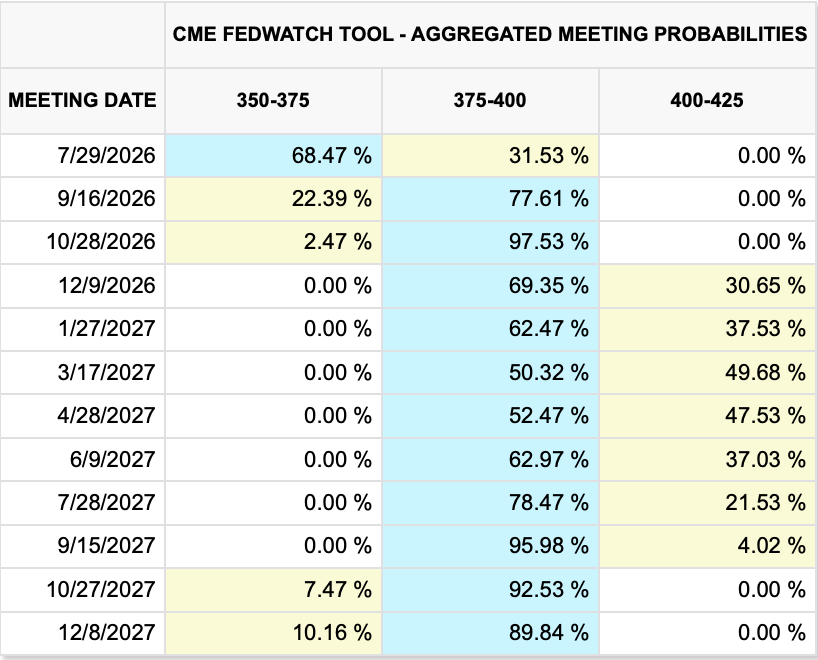
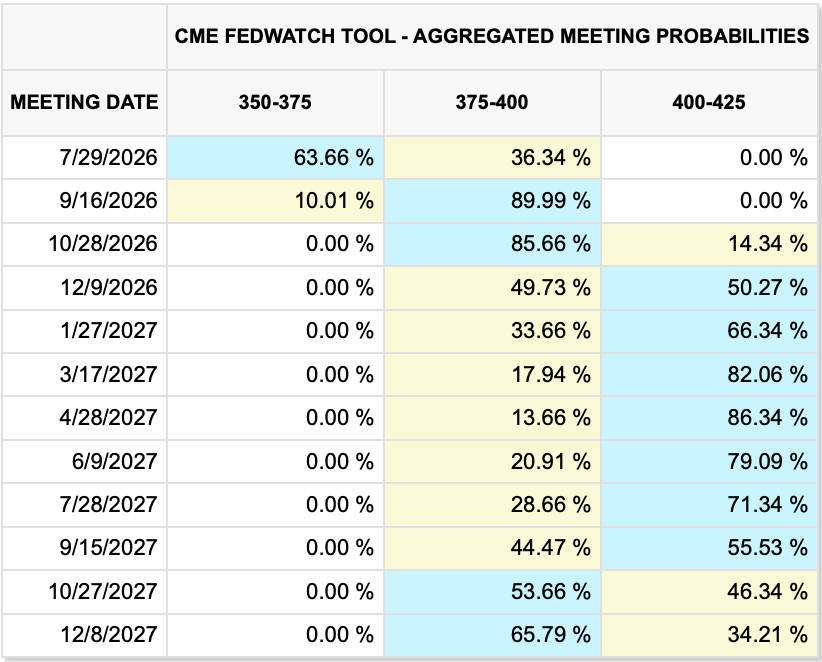
On the rate hike front, the below CME probability table has barely changed from yesterday as the narrative is strong that rate hikes are coming.  

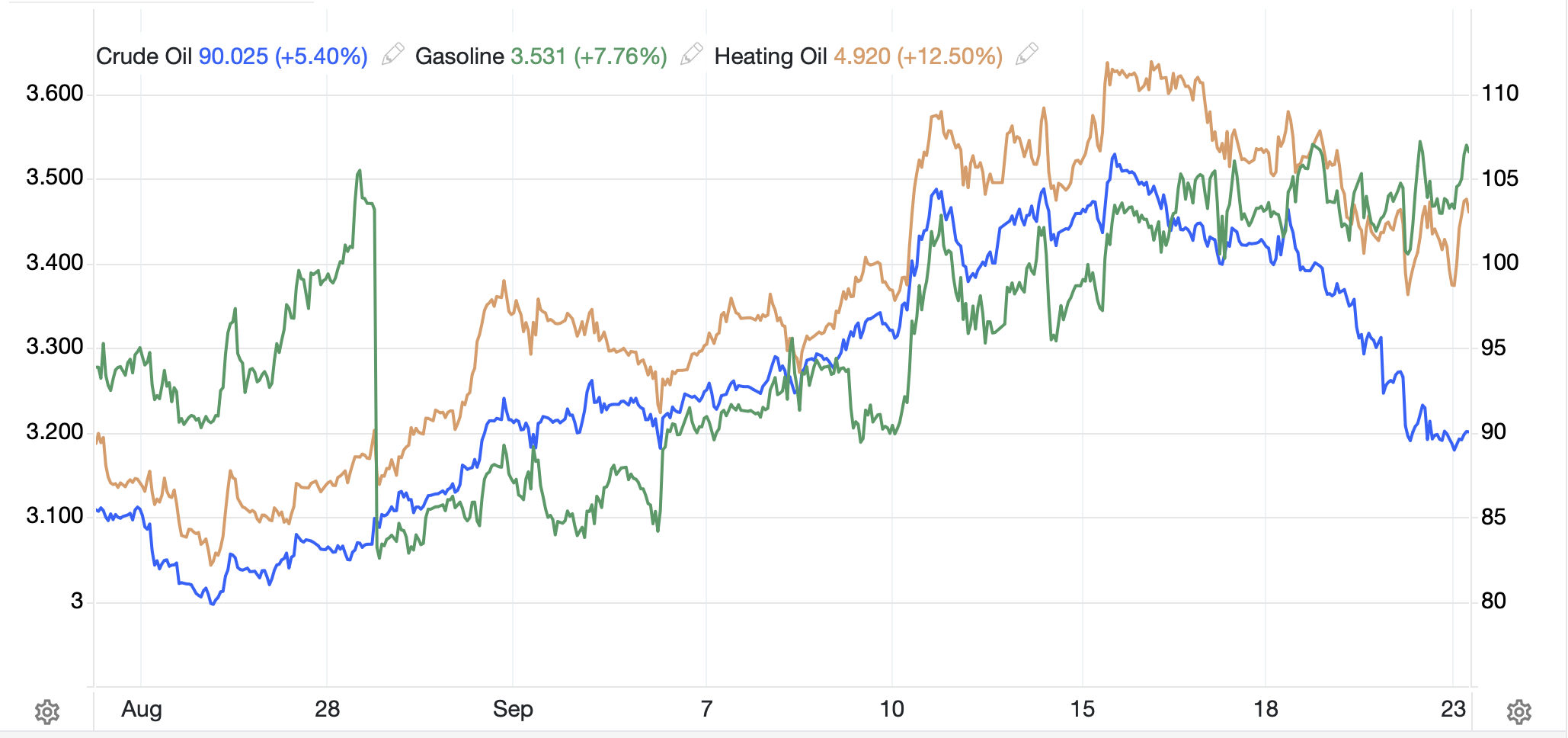
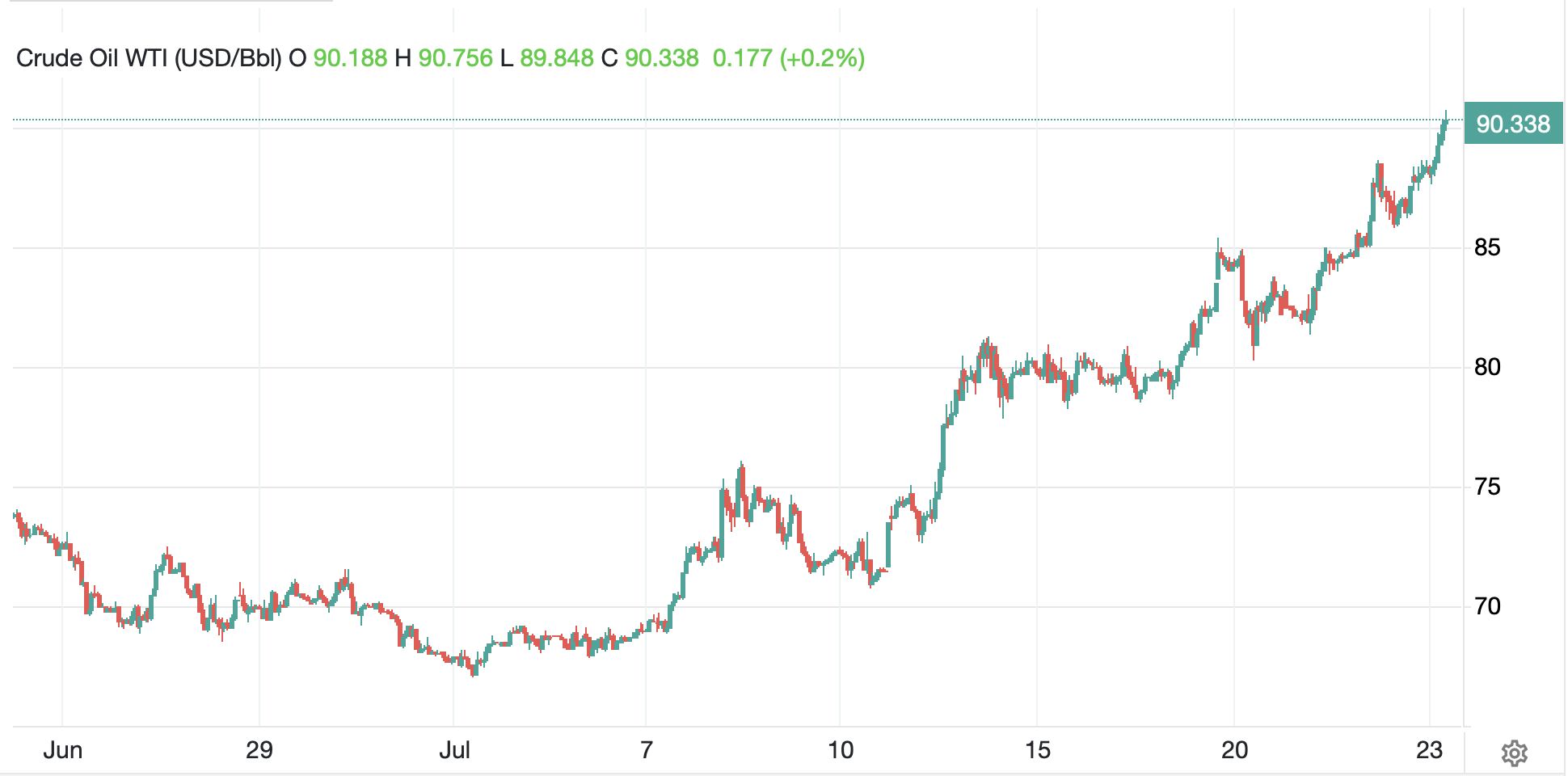
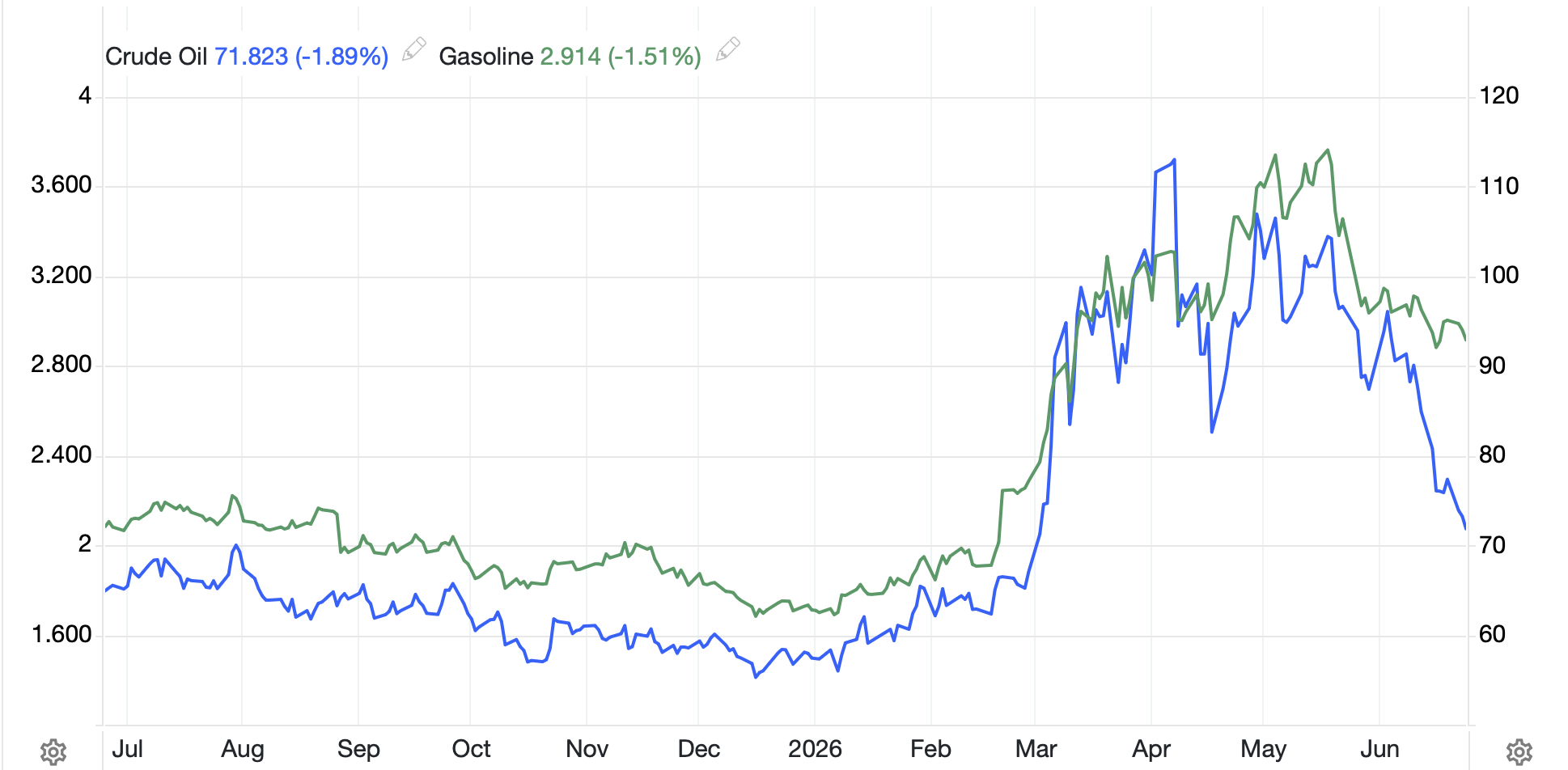
I cannot really understand why this is suddenly the belief set given the fact that the key driver of recent higher inflation data has been the price of oil, and that price continues to fall, down a further -2.0% this morning.  I understand that gasoline prices have not fallen quite as dramatically, but nothing about the chemistry has changed and I remain highly confident that those prices will be falling as well, catching down to oil.

Source: tradingeconomics.com

So, I remain confused as to why everybody seems to believe the Fed, which despite a new Chair remains the same institution that observed inflation run higher for years during Covid and calling it transitory, has become the reincarnation of the Bundesbank.  In fact, the only rationale I see is that other than Waller, Warsh and Bowman, who were all appointed by Trump, everybody else in that room has TDS and is terrified that things will work out such that by the time the election rolls around, the economy is ticking over nicely with inflation a historical issue.  And frankly, I think most of them do share that affliction.

But other than Powell, and Cook to some extent, none of them have really felt the force of the critiques that come with upsetting President Trump, and frankly he didn’t care about Cook per se, she was just a convenient target to get ousted so he could put his man in there.  And in fairness, Cook is a massive dove, and should agree with Trump on this policy, but I’m sure she doesn’t because…Trump.  I am confident none of them signed up for being in that spotlight.

Apparently, BOA is calling for 3 rate hikes this year in the final four meetings.  I think that’s nuts, but futures are pricing a 2/3 chance of a hike at the end of July, which I also think is nuts.

The recent hiccup in stocks, and the steadier downturn in commodities has been blamed on dollar strength which is being driven by expectations of rate hikes coming soon.  While I like the dollar in the long-term, that is because I believe investment flows into the US will drive it, not financial arbitrage flows.  As things evolve, I expect the market to understand the Fed will not be hiking rates and narratives will need to find a new bogeyman.

Ok, let’s tour markets quickly.  Yesterday’s equity market selloff in the US, following the tech selloff in Asia closed well off the lows and futures this morning are pointing slightly higher.  Asia was mixed overnight with Korea (+3.3%) rebounding sharply although there was weakness in Japan (-0.9%), Taiwan (-2.25%), Indonesia (-3.6%) and the Philippines (-2.2%).  But on the flip side, China (+0.5%), HK (+0.3%) and India (+1.0%) all followed Korea while other regional exchanges had much more limited movement.  It appears that people are trying to figure out what to do for now.

In Europe, Germany (-1.0%) is the laggard after Germany cancelled its plans for a new warship and Rheinmetall, the company set to win biggest there, got crushed.  But elsewhere +/-0.3% or less is the norm with little new information as traders await the next shoe to drop.

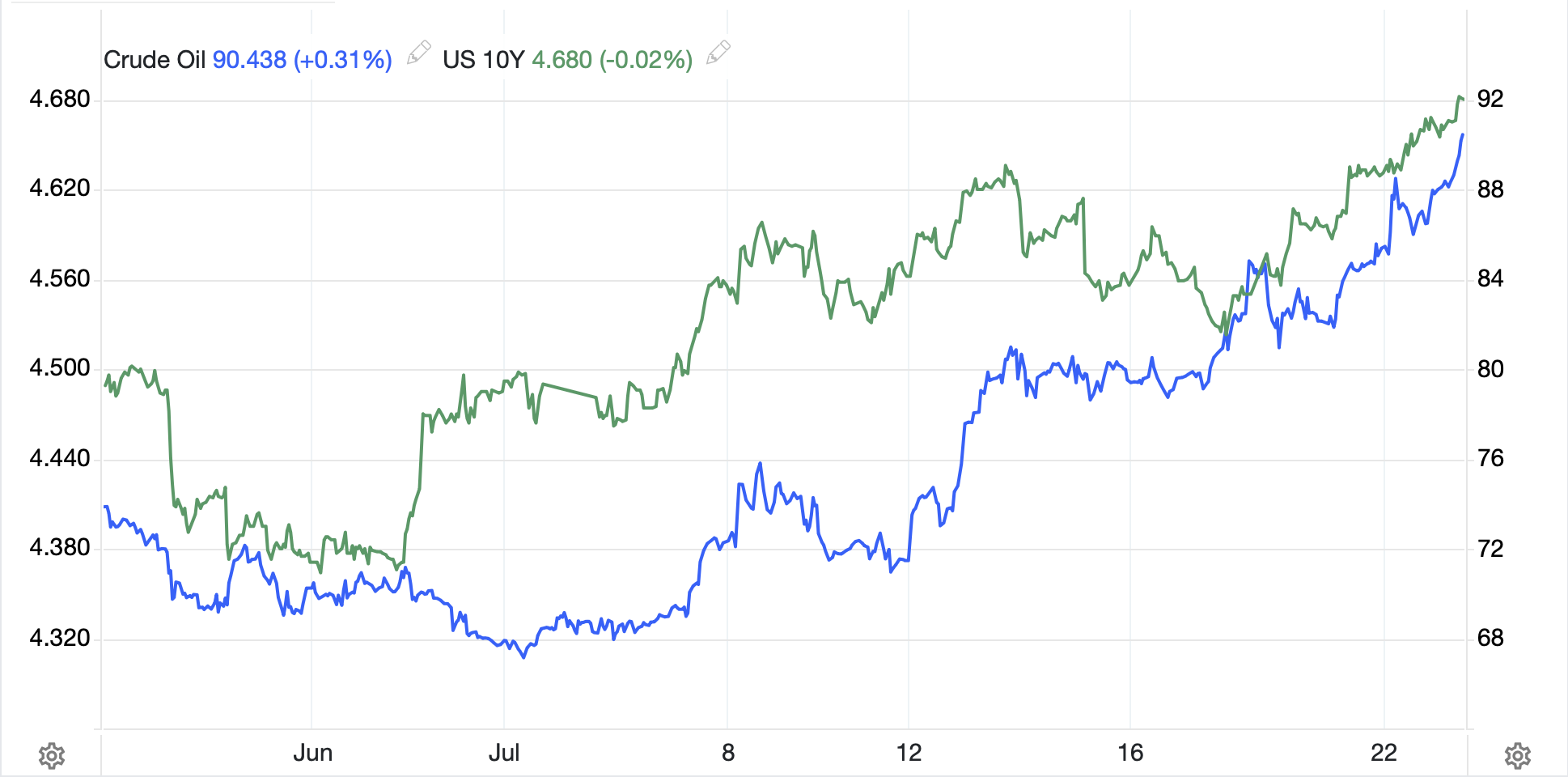
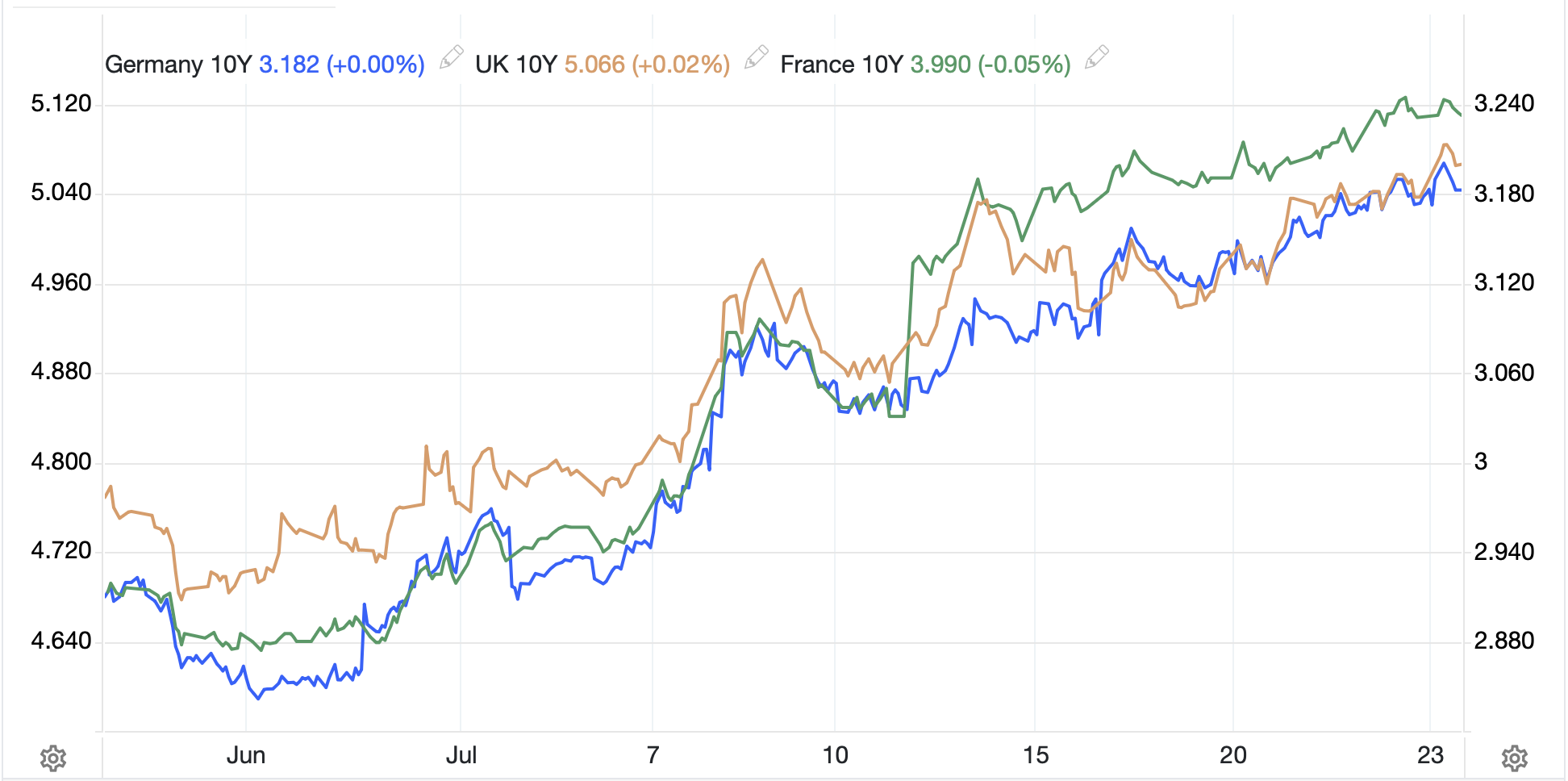
In the bond market, interest is low as 10-year Treasury yields continue to track around the 4.5% level and movement has been 1bp or so lower across all of Europe.  Nothing to see here for now.  Just wait until views start to change on rate hikes though!

Metals markets continue to get hammered with gold (-1.7%), silver (-2.9%) and copper (-1.6%) all still falling as the opening narrative about higher rates and a stronger dollar play out.  The thing is, I think the fundamentals remain positive for metals markets as there continues to be central bank demand for gold as well as industrial interest in silver and copper and long-term shortages of supply.  But right now, none of that matters.

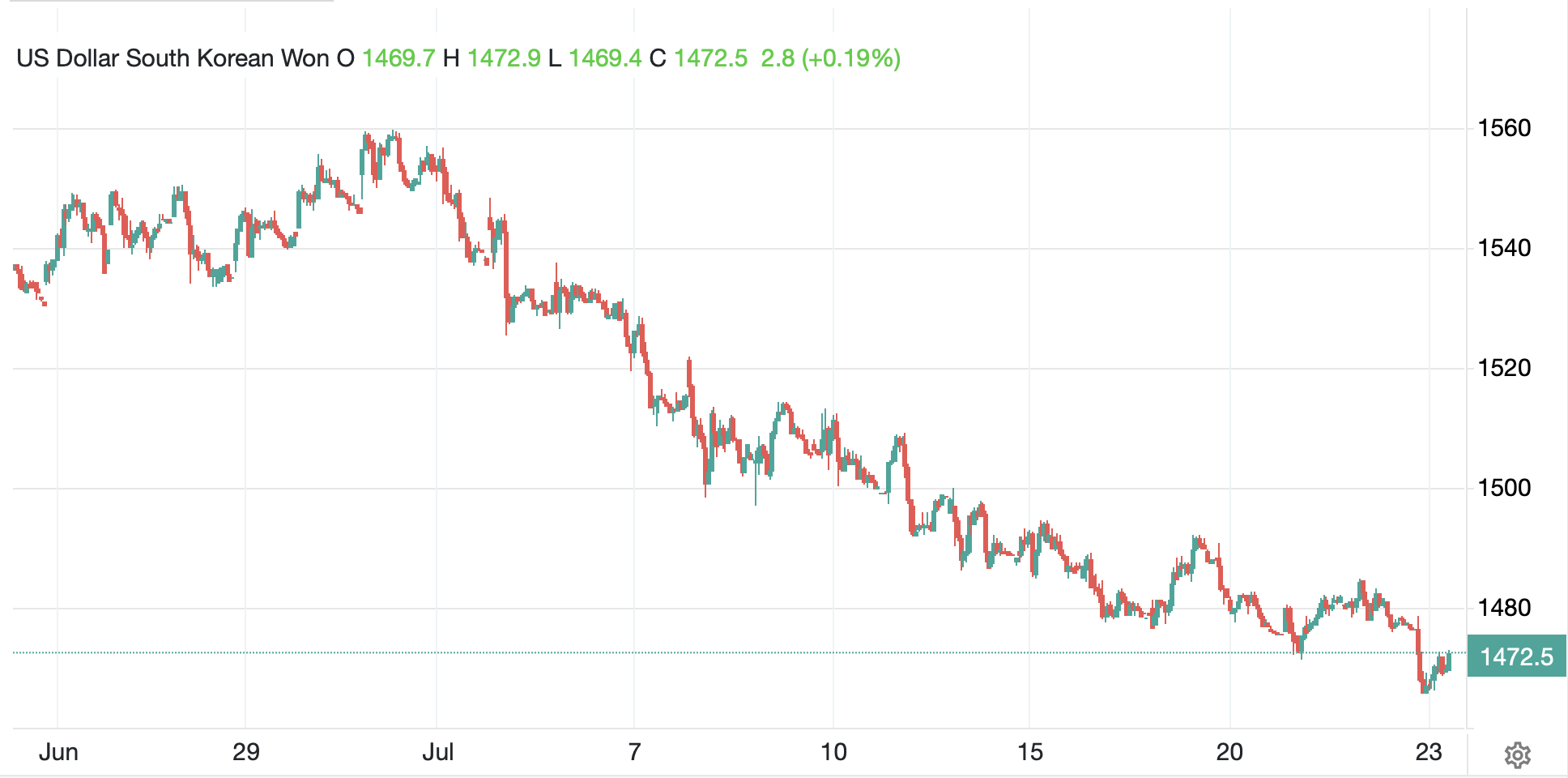
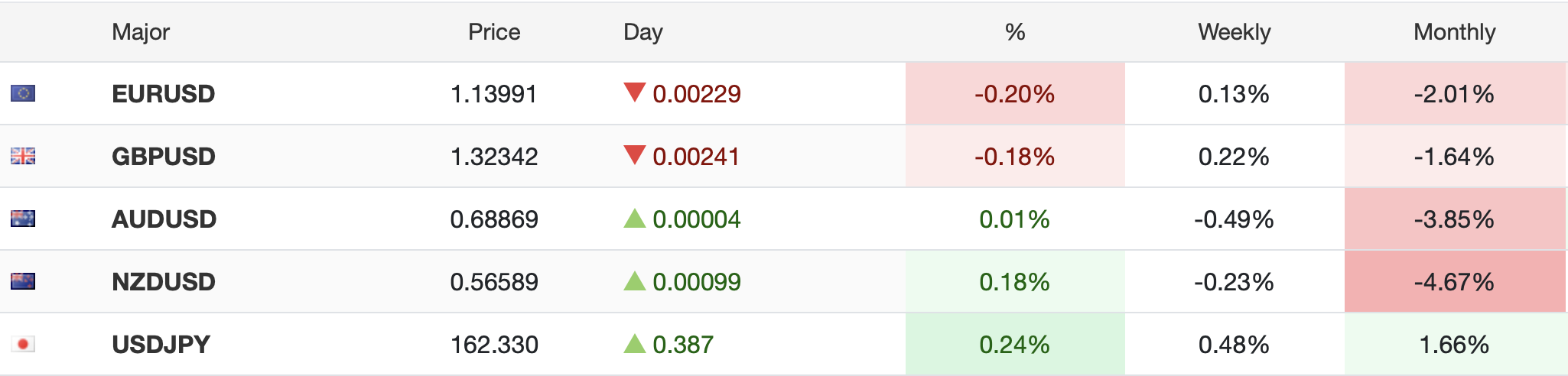
Finally, looking beyond the DXY, it is no surprise the euro (-0.35%) and pound (-0.35%) are lower given the DXY’s continued rise, but the yen (-0.1% and at a new low (dollar high) for the move) continues to slide and there is weakness pretty much across the board in both the G10 and EMG blocs.  KRW (-1.0%) is today’s laggard while INR (+0.2%) is the lone currency holding its own.  This continues to be a dollar focused story so when the rates story changes, so will the dollar.

On the data front, we see New Home Sales (exp 640K) and then EIA Oil inventories with yet another large draw expected.  And that’s it for today.  As long as this rate hike narrative remains primary, look for weaker risk appetite and a strong dollar.  But I think it is a short-term phenomenon.

Good luck

Adf
What’s Next To Be Feared?

For Holmes, when the dog didn’t bark
He recognized that was the spark
To solving the case
And so, we must brace
For narrative changes quite stark

This morning, no headline appeared
Regarding Iran, which is weird
Have markets moved past
This problem, at last?
And if so, what’s next to be feared?

So, perusing the WSJ on-line this morning, the notable absence was any story on Iran and the current situation regarding the ongoing peace talks.  There was a throwaway article about Trump and what he has said about Iran, but nothing of substance.  Part of me is amazed that this is the case as the conflict would still seem to be the most important issue in the markets given the impact on oil prices and inflation, as well as its general geopolitical impact.  But part of me cannot be surprised at all.  It’s not just traders who have the attention span of a fruit fly, apparently so does the general public.

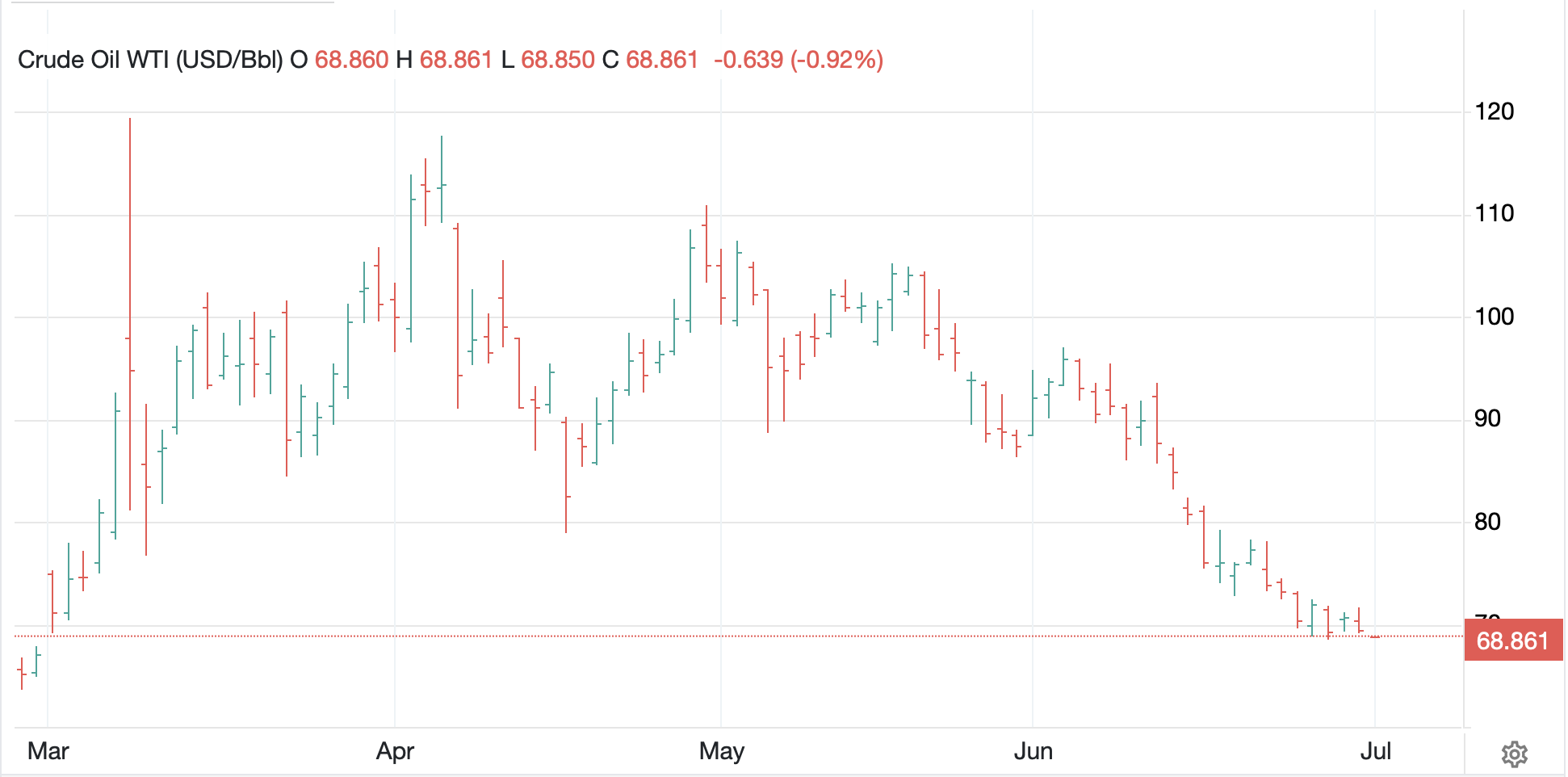
I made the point several weeks ago that this conflict would fade into history quickly when it was ending based on the fact that the Venezuela incursion, back in January, fell from headlines within about three days.  Given the generic MO for most publications of, if it bleeds, it leads, the fact that bombs are no longer falling, and peace talks are ongoing is no longer that interesting.  Add to that the generic TDS of most of the media, where they loved to play up rising oil prices as a major policy failure for Trump, now that those prices have been falling for the past 11 weeks and have slipped >30% in that period, and quite frankly, have further to fall, most editors have moved on.  If they cannot tar Trump with a policy failure, they would rather not discuss the subject at all.

Source: tradingeconomics.com

So, here we are this morning with the market now turning its focus to an ostensibly hawkish Fed despite the recent analysis by the BLS indicating that more than 60% of the recent uptick in inflation was driven by the rise in energy costs.  So, with energy costs reversing course dramatically, what does that say about their impact on inflation and exactly how hawkish does the Fed need to be in that case.

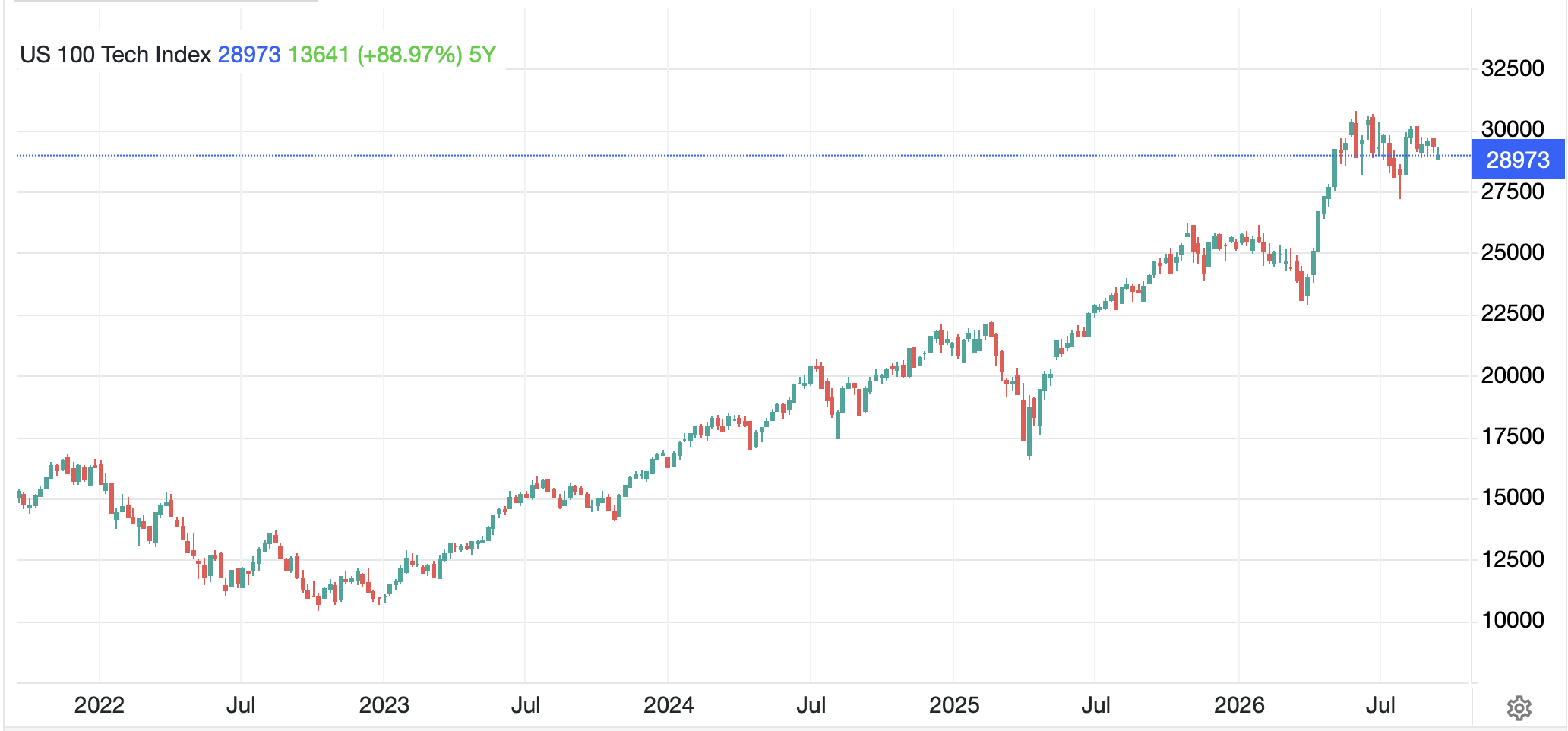
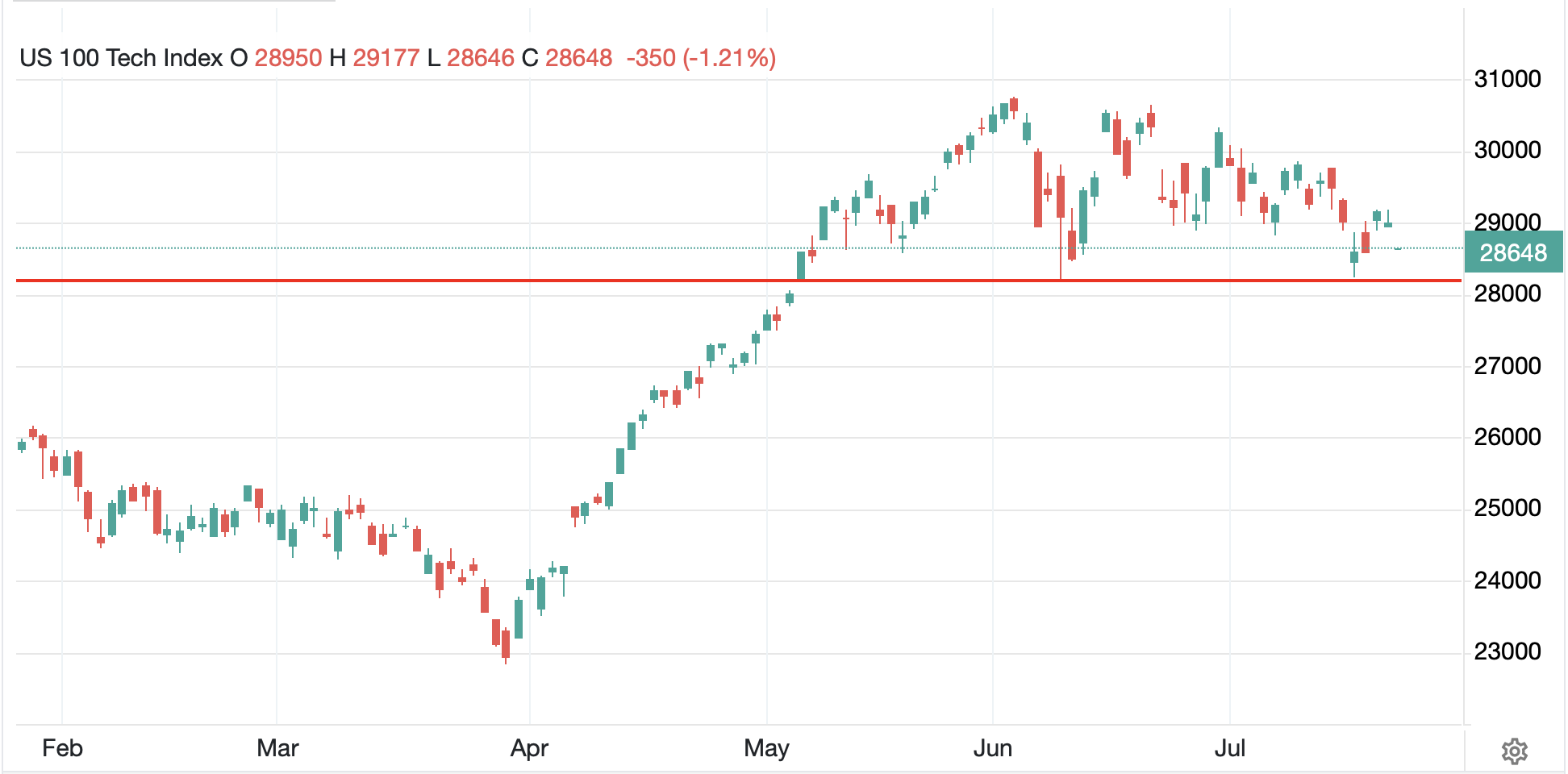
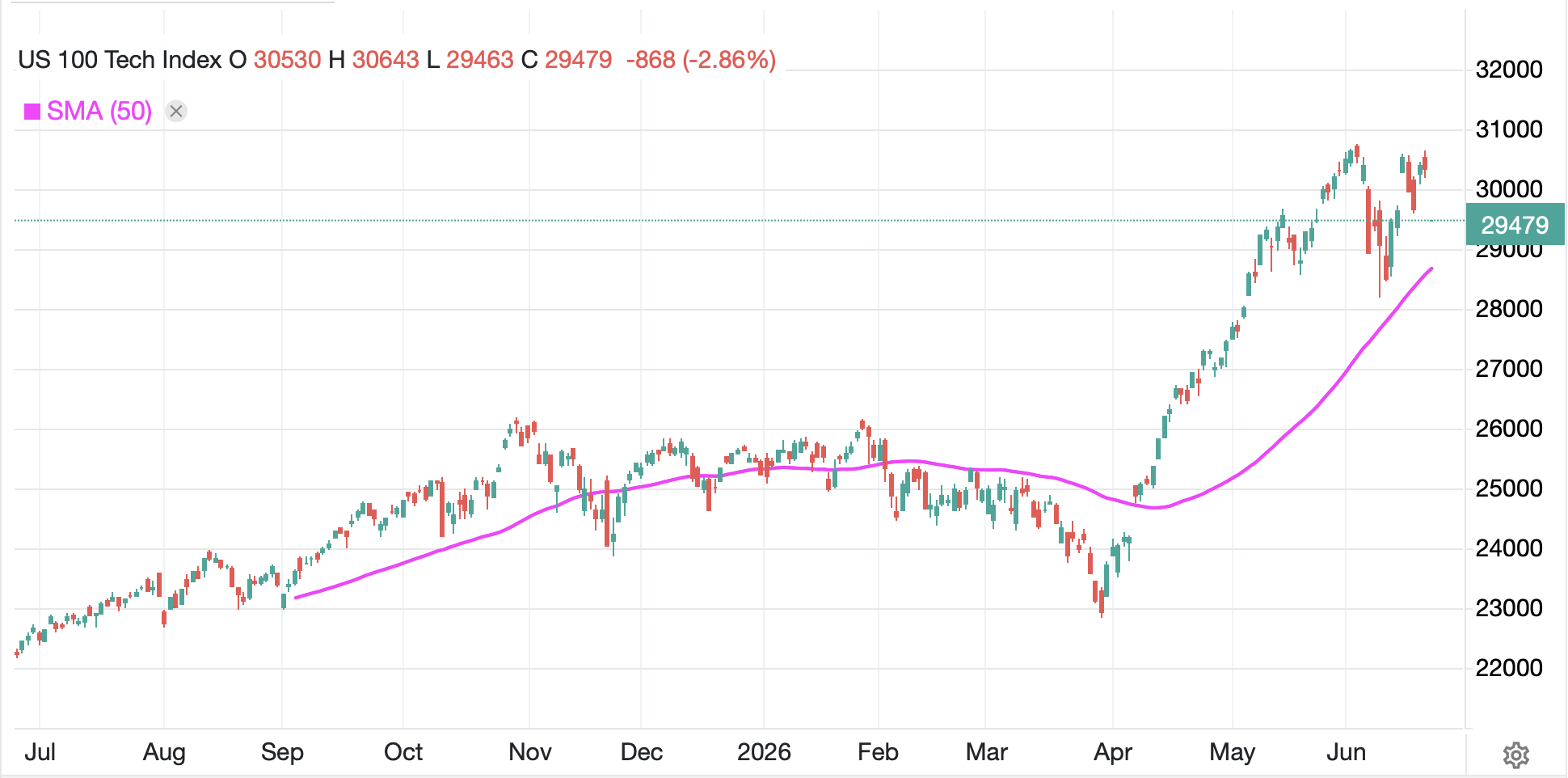
Right now, equity markets are under some pressure as some of the euphoria associated with the rising tech sector’s stock prices and the ongoing AI mania, is wearing a little thin.  And let’s face it, things certainly seemed a bit bubblicious.  But the combination of ongoing fiscal support from the OBBB and tax cuts and declining energy prices is likely to help support things going forward.  No matter the timeline you observe, we have seen a remarkable rally in tech stocks, as evidenced by the NASDAQ’s chart below.  A correction to the 50-day moving average would hardly be surprising, nor would it be damaging to the overall market structure, I think, although it would almost certainly result in ‘end of days’ headlines!

Source: tradingeconomics.com

So, while futures this morning are lower across the board (NASDAQ -2.9%, SPX -1.4%, DJIA -0.6%) as of 6:40am, and we could easily see some weakness for a few more days/weeks as positions shake out, I am not in the camp of things are about to collapse.

Speaking of equity markets, the overnight session was filled with red ink led by the KOSPI (-10.0%) in South Korea, although there was weakness pretty much everywhere (Nikkei -3.6%, CSI 300 -2.8%, Hang Seng -1.8%) with India and Taiwan also slipping more than -1.0% although Australia, NZ and Singapore had more muted declines.  Tech was clearly under pressure.  Of course, we cannot be surprised that European shares are also lower in a generally weak risk scenario, but given the lack of tech companies headquartered there, the declines have been far less significant (DAX -1.0%, CAC -0.6%, IBEX -0.2%, FTSE 100 -0.2%) although the Netherlands (-1.3%) home to ASML, the only tech name of note on the continent, is underperforming as well.

Meanwhile, the bond market has peeked at the oil market and decided, perhaps inflation is not a chronic condition, or at least not as bad as previously feared.  Yields are lower across the board with Treasuries (-3bps) leading the way while European sovereigns are all lower by between -3bps and -4bps.  Overnight, though, JGB yields could make no headway lower as the yen continues to be under enormous pressure.

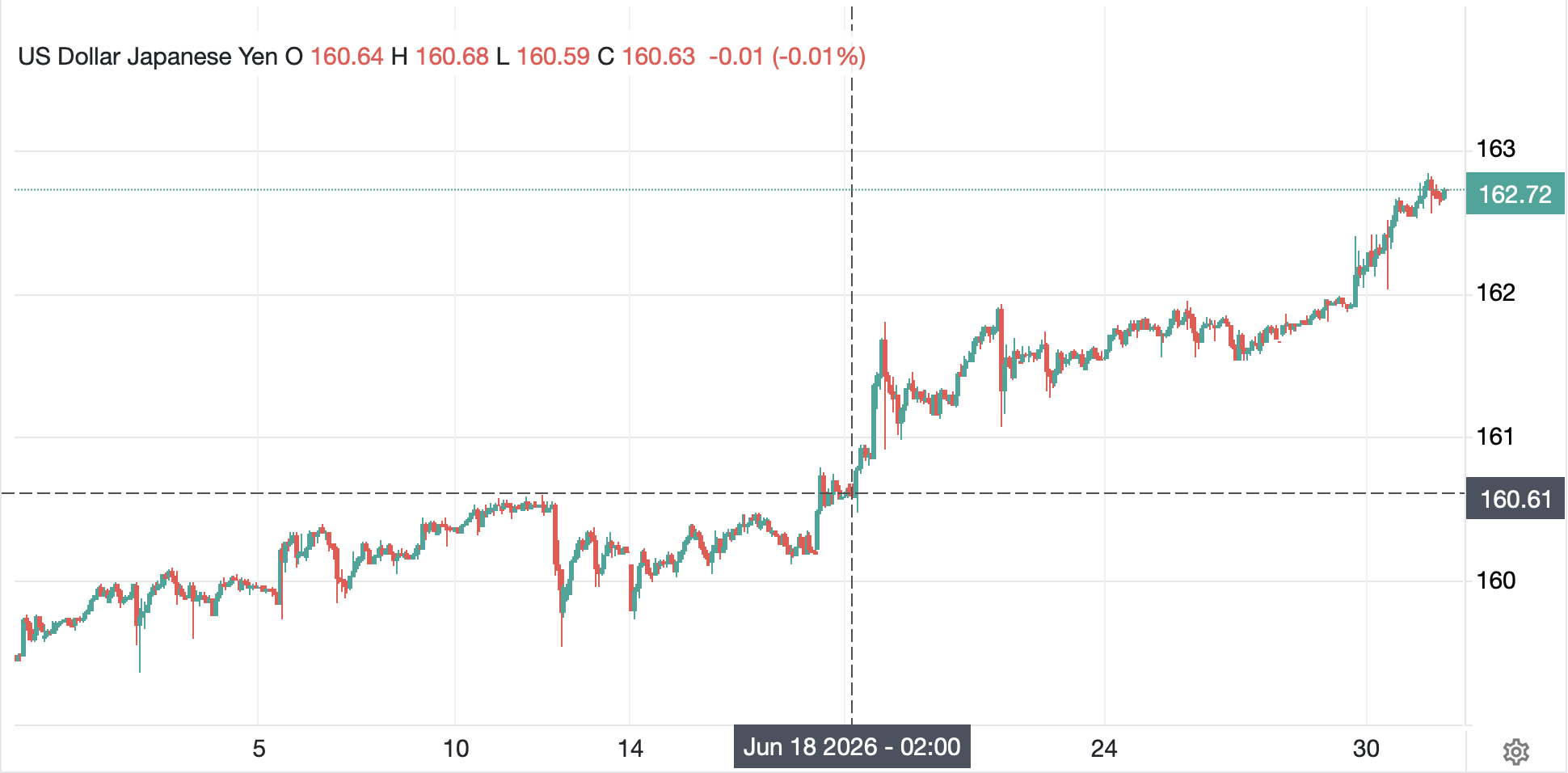
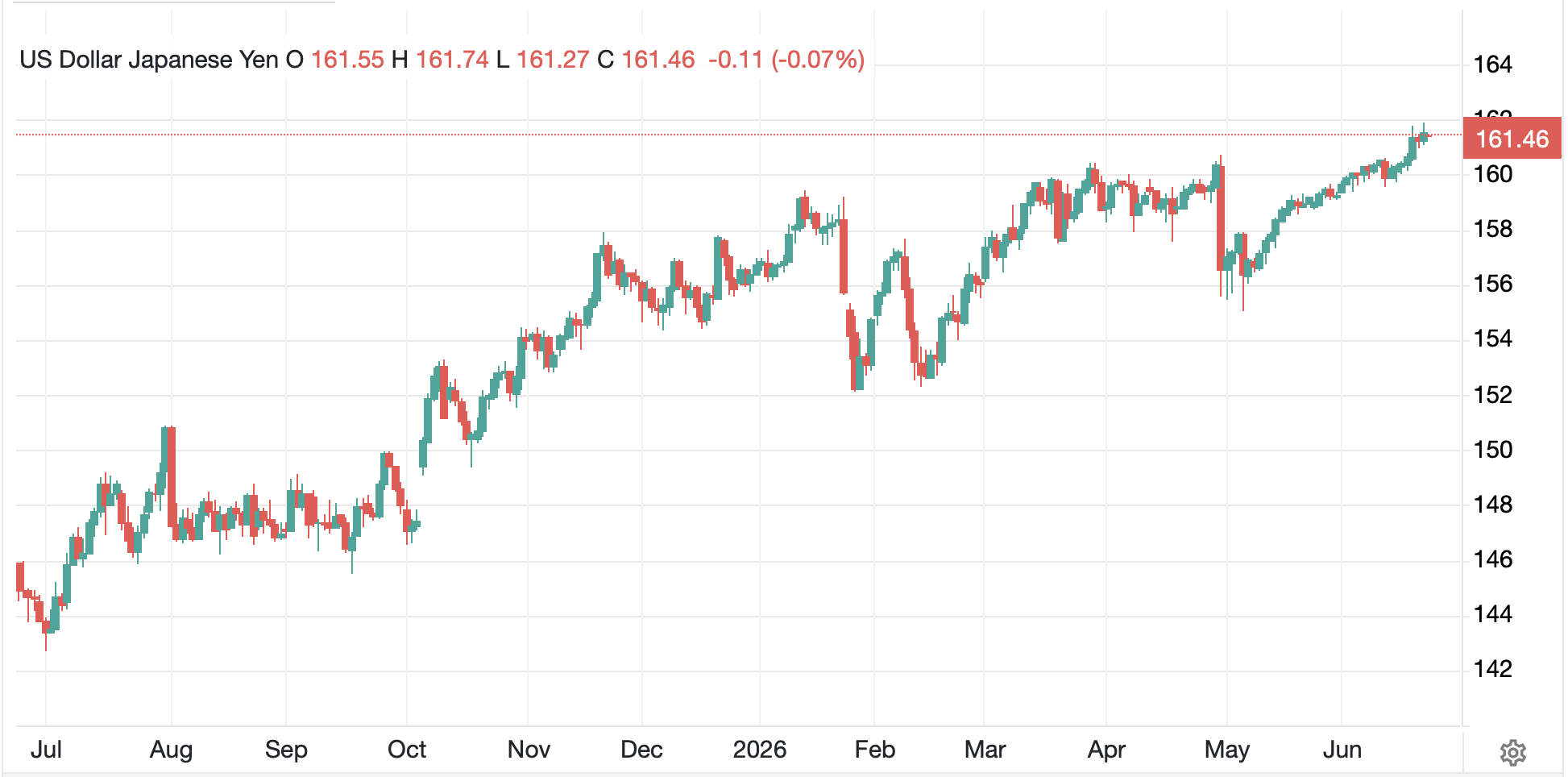
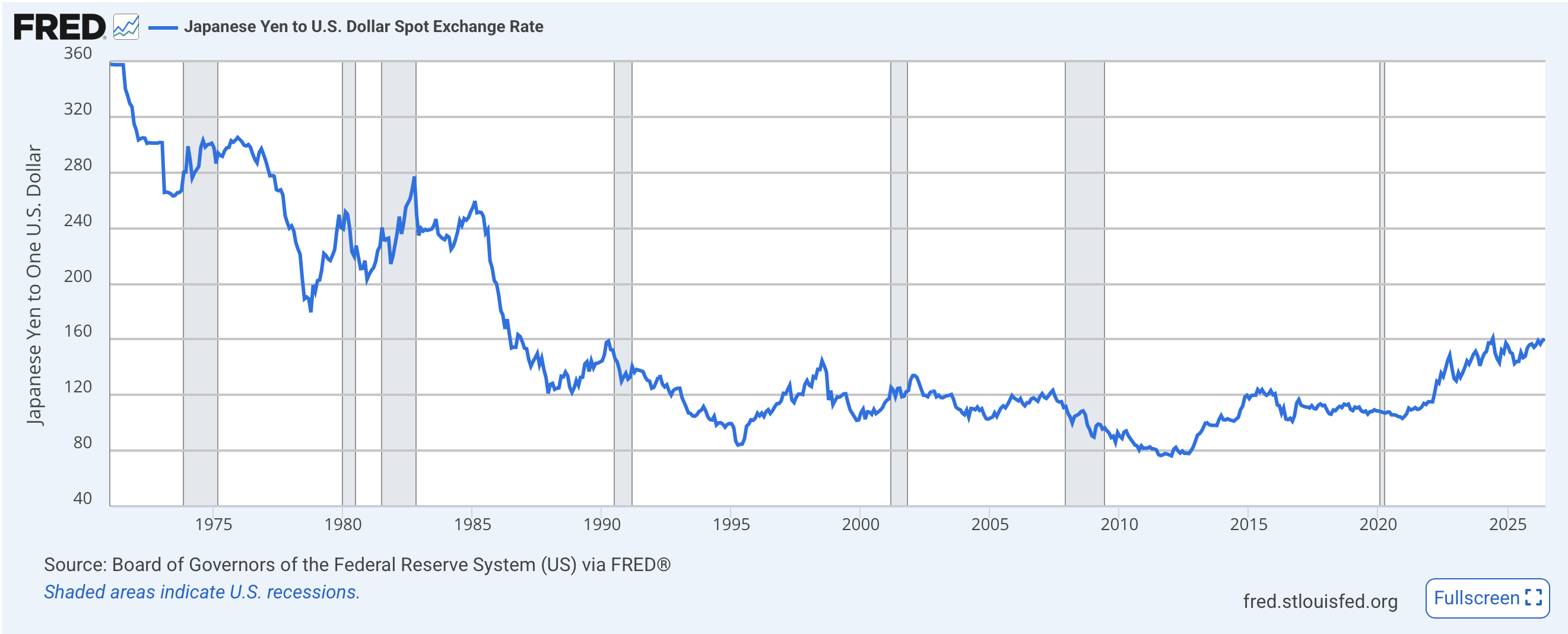
Speaking of the yen, it continues to slowly weaken despite prominent statements by Japanese FinMin Katayama about her discussions with Treasury Secretary Bessent and their agreement to have the US coordinate with Japan in the event it is decided something needs to be done in the markets.  But so far, no signs of actual intervention.  A look at the chart below shows a very slow and steady climb in the dollar, and frankly, I do not see what will change this trajectory.

Source: tradingeconomics.com

While interest rates aren’t the only driver, they still have a key impact, and they are the one thing that can be changed quickly.  In fact, the best hope for the yen, in my view, is the fact that at some point soon, the market is going to understand the Fed is not about to raise rates again, and the next move will likely be lower, albeit not until later in the year.  but that change in tone will change a lot of opinions on how the yen should behave, and a move back toward 155 amid modest overall dollar weakness could easily be seen.  But right now, everybody is of the opinion that the FOMC is going to hike this year, and Japan cannot afford to be aggressive in that context, hence the yen’s weakness.

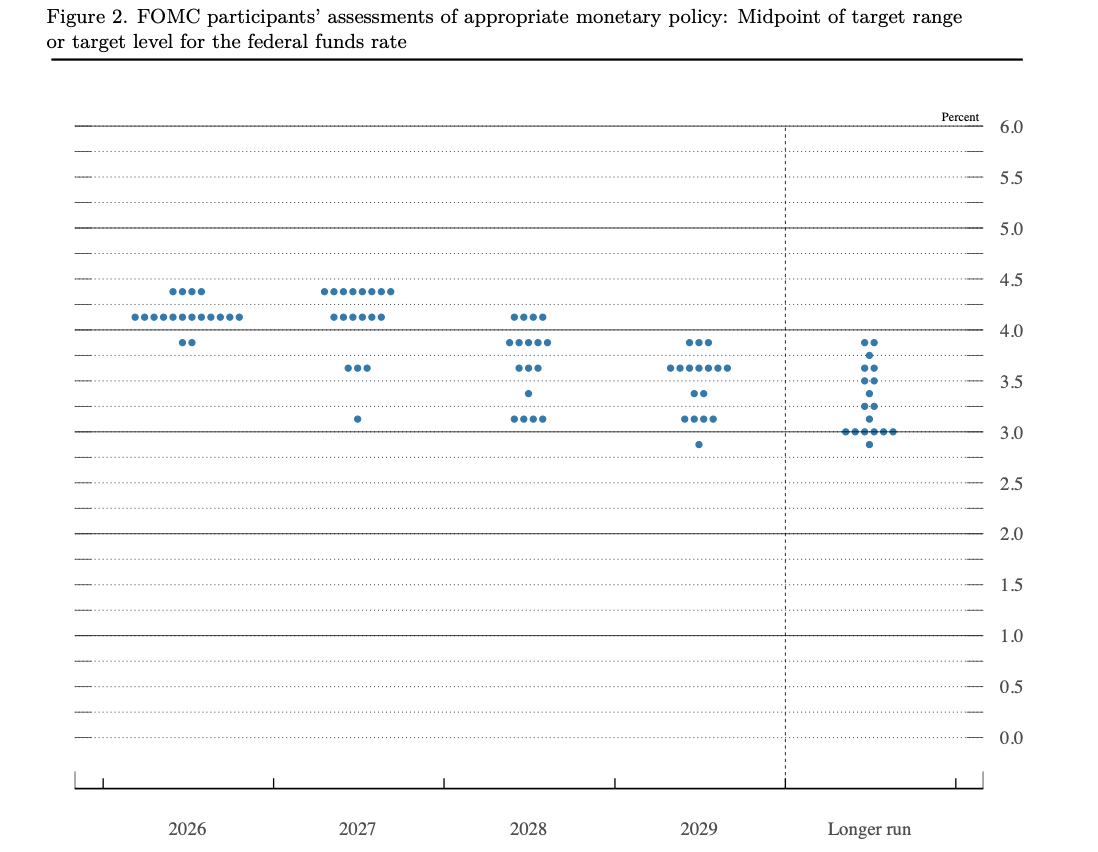
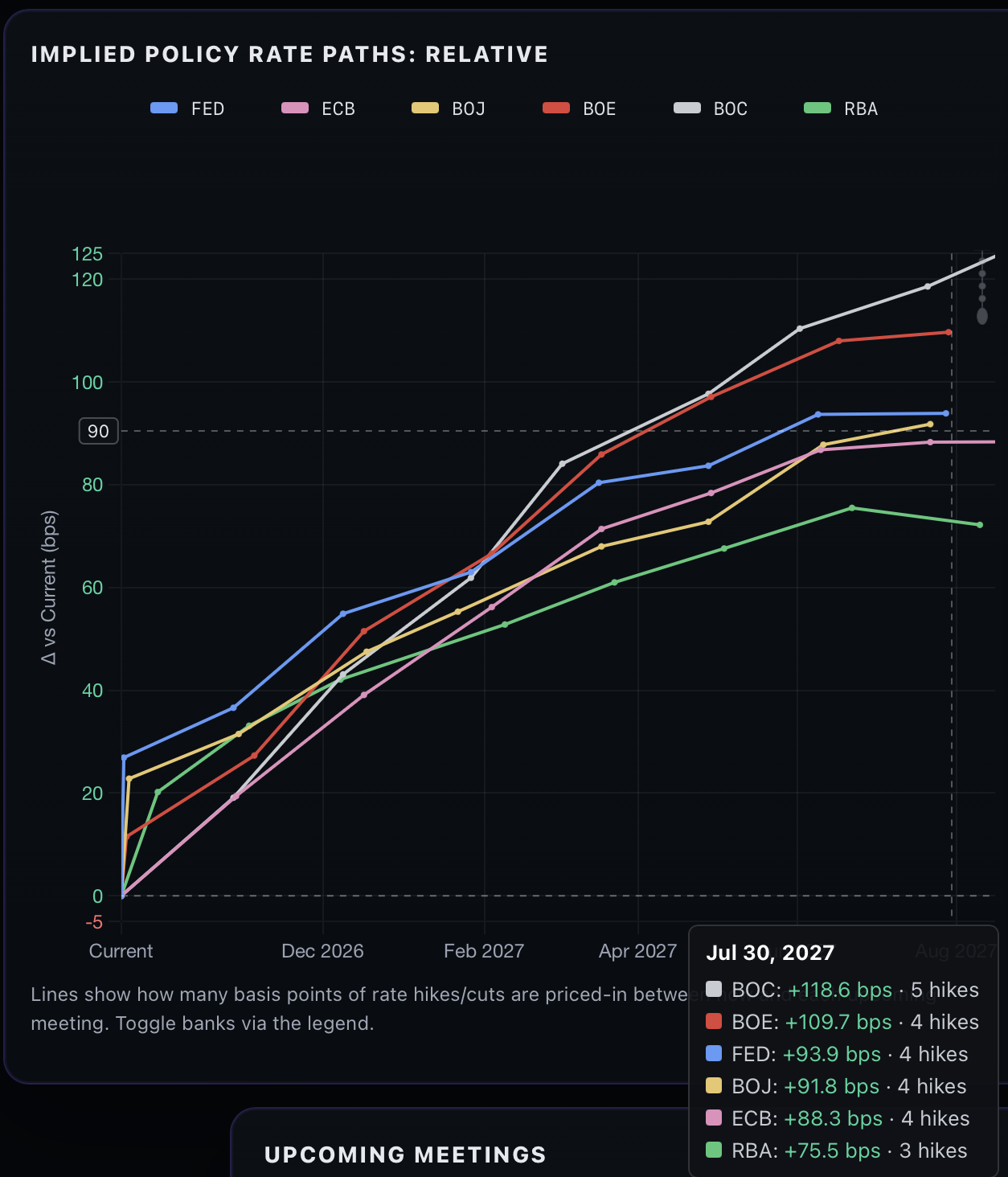
Here is a forecast I do not make lightly, Fed funds will finish the year lower than they are now, probably 3.25%-3.50%.  And the current Fed funds futures market has bottomed (rates peaked) as per the CME table below.

As to the rest of the FX world, the dollar reigns supreme this morning as the euro (-0.3%) is below 1.1400 this morning, its weakest in more than a year as the Flash PMI data did it no favors, but the new hawkish Fed, higher US rates strong dollar narrative has been the driver.  We have seen the same type of movement elsewhere, except where the dollar has moved further, with AUD (-0.8%) the worst performer in the G10 although HUF (-1.0%) is actually the biggest laggard.  However, given the overall decline in commodity prices, those currencies that benefit from rising commodities are also under pressure (NOK (-0.7%, ZAR -0.5%, SEK -0.8%, MXN -0.7%) and we already discussed AUD.

Lastly, the metals markets are also under serious pressure with gold (-1.6%), silver (-4.5%) and copper (-3.3%) all tumbling on the same new view of higher rates and a stronger dollar.  The thing about the commodities story is the fundamentals still seem positive to my eyes, and this seems like the last of the fluff getting taken out.

On the data front, Thursday’s PCE data is the big day and here’s what we have overall:

TodayFlash Manufacturing PMI54.8
 Flash Services PMI51.0
WednesdayNew Home Sales640K
ThursdayInitial Claims225K
 Continuing Claims1800K
 Q1 GDP Final1.6%
 Personal Income0.4%
 Personal Spending0.6%
 PCE0.5% (4.0% Y/Y)
 Core PCE0.3% (3.4% Y/Y)
 Durable Goods-4.3%
 -ex Transport0.7%
FridayMichigan Sentiment50.3

Source: tradingeconomics.com

In addition to the data, we start to hear from some of the FOMC members, although I am confident Chairman Warsh won’t be out and about.  Some analysts claim that Warsh’s view of less communication is going to weaken him as others will get to make their point and he won’t be able to counter it.  But I think that Warsh has a plan, and if we continue to see oil prices decline, which seems the likely outcome, then all the inflation fears are going to dissipate and by the time the next meeting rolls around, it will be far harder to make the case that tighter policy is necessary.  Historically, hiking into an energy price shock has been a central banking mistake, and I think Warsh knows this and is keen not to repeat it.

Net, for now, everybody loves the dollar and hates risk on this new hawkish Fed narrative.  But going forward, I like the dollar on the back of a better economy and better investments and expect that the hawkish Fed narrative is going to fade away.  But I’m just an FX poet.

Good luck

Adf
No Plan of Action

In England and Scotland and Wales
Kier Starmer has gone off the rails
A buffoon-like clown
He’s set to step down
As from the Brits eyes, fall their scales

But will his replacement gain traction
Or will Burnham be a distraction
From solving their woes
As Lord only knows
They’ve many, and no plan of action

It has been an eventful weekend for me so let me start by telling you that Marvel was Best of Breed in back-to-back shows last Thursday.  We are very proud and happy.

Second, Friday was a more difficult day for me as I wound up having emergency surgery, although everything is fine.  But I am still in recovery mode.  Sometimes, aging is harder than other times.

With that in mind, we can talk about the three things that matter, I believe, the change of PM in the UK, the on-again-off-again peace talks in Iran and the fact that the yen is now weaker than the level that got the MOF to intervene back in April.

Starting with the UK, PM Starmer has promised to step down now that his most likely successor, Andy Burnham, the former mayor of Manchester, is in Parliament and will now become PM sometime in the next several months depending on the actual timing of certain technicalities.  He is described as left-wing, even by the press, which tells you that he must be quite far to the left.  But the UK has serious problems with respect to their economy, slowing growth and high inflation, and the social structure due to massive immigration, both legal and illegal.  As well, the report that just dropped about the Pakistani grooming gangs that were systematically raping young English girls is so damning, it is hard to believe, yet it was all covered up.  The government doesn’t have to go to the national polls until 2029, so Burnham will have time to try to implement policies, but the nation has many troubles ahead.

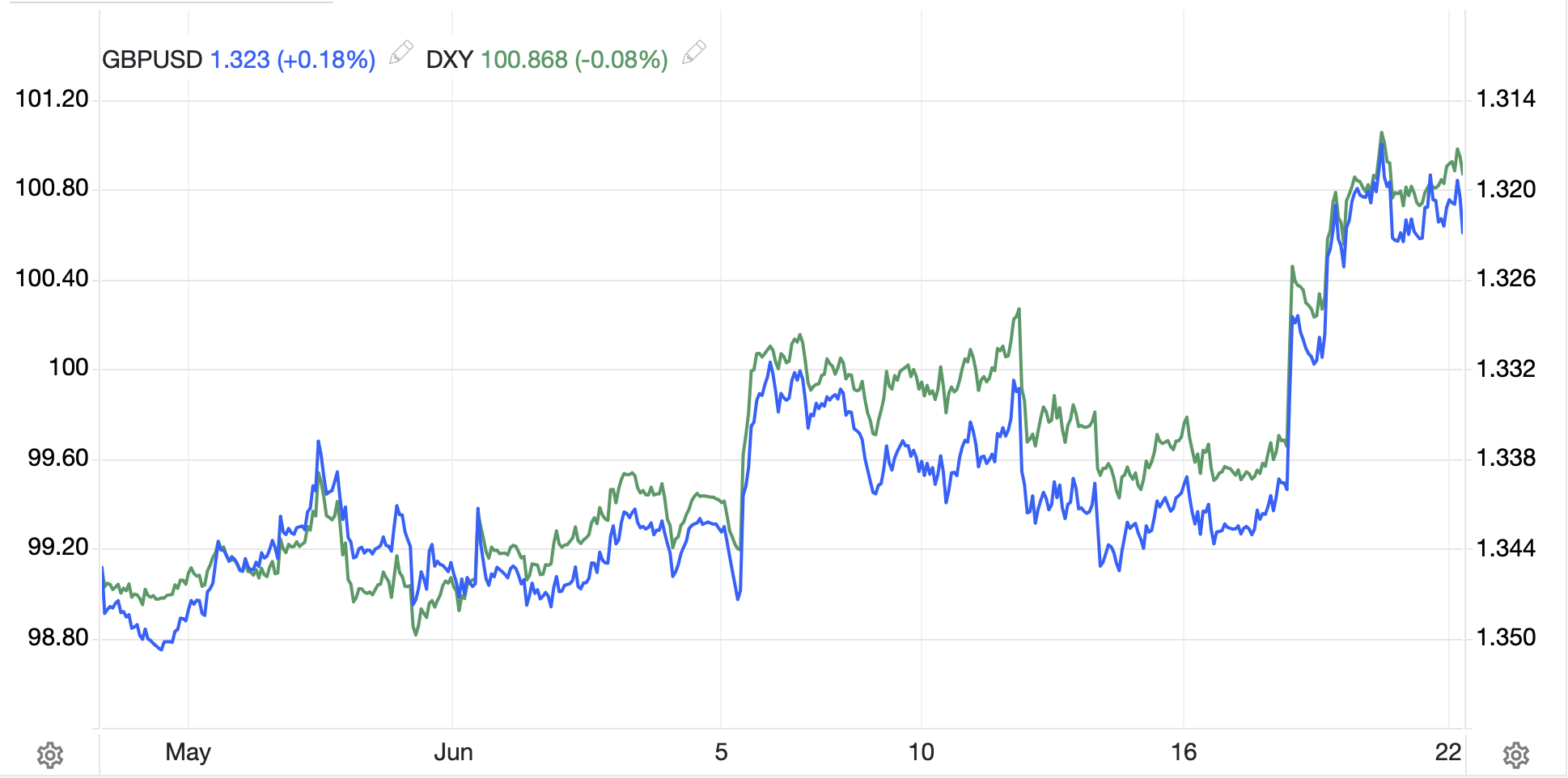
As to UK markets, both the pound and FTSE 100 have been underperformers relative to their peer European counterparts over the past month or so as this process has heated up, but in truth, not by very much.  Much of the pound’s weakness can be attributed to dollar strength (see chart below), where the dollar has broken through key technical resistance in the DXY, while the FTSE is just drifting given the lack of positive news.  Certainly, this story didn’t help either one, as both are unchanged on the day.

Source: tradingeconomics.com

In Switzerland, talks are ongoing
As Trump and the Mullahs try showing
That they are the ones
Who have the most guns
But progress seems like it is growing

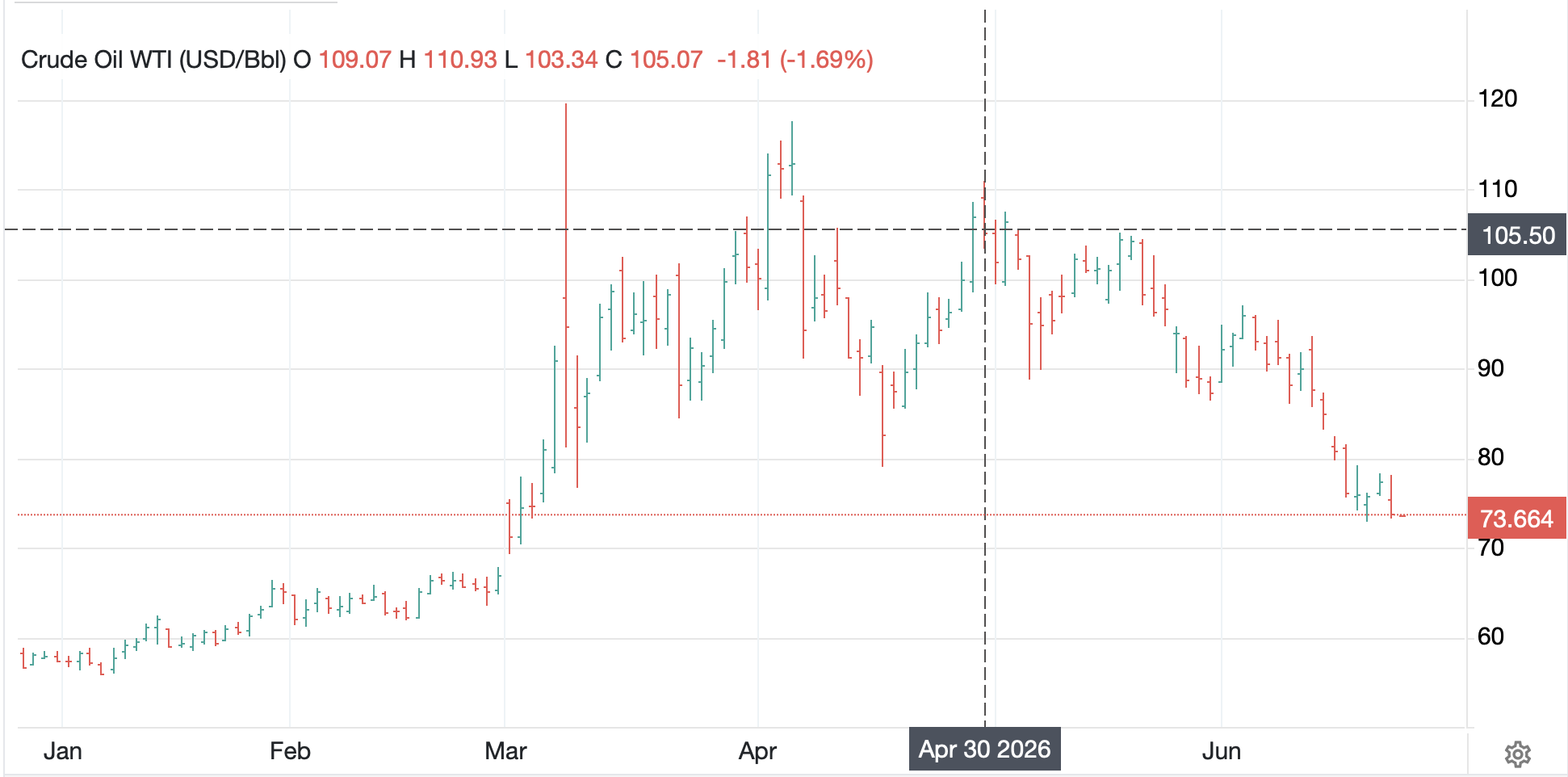
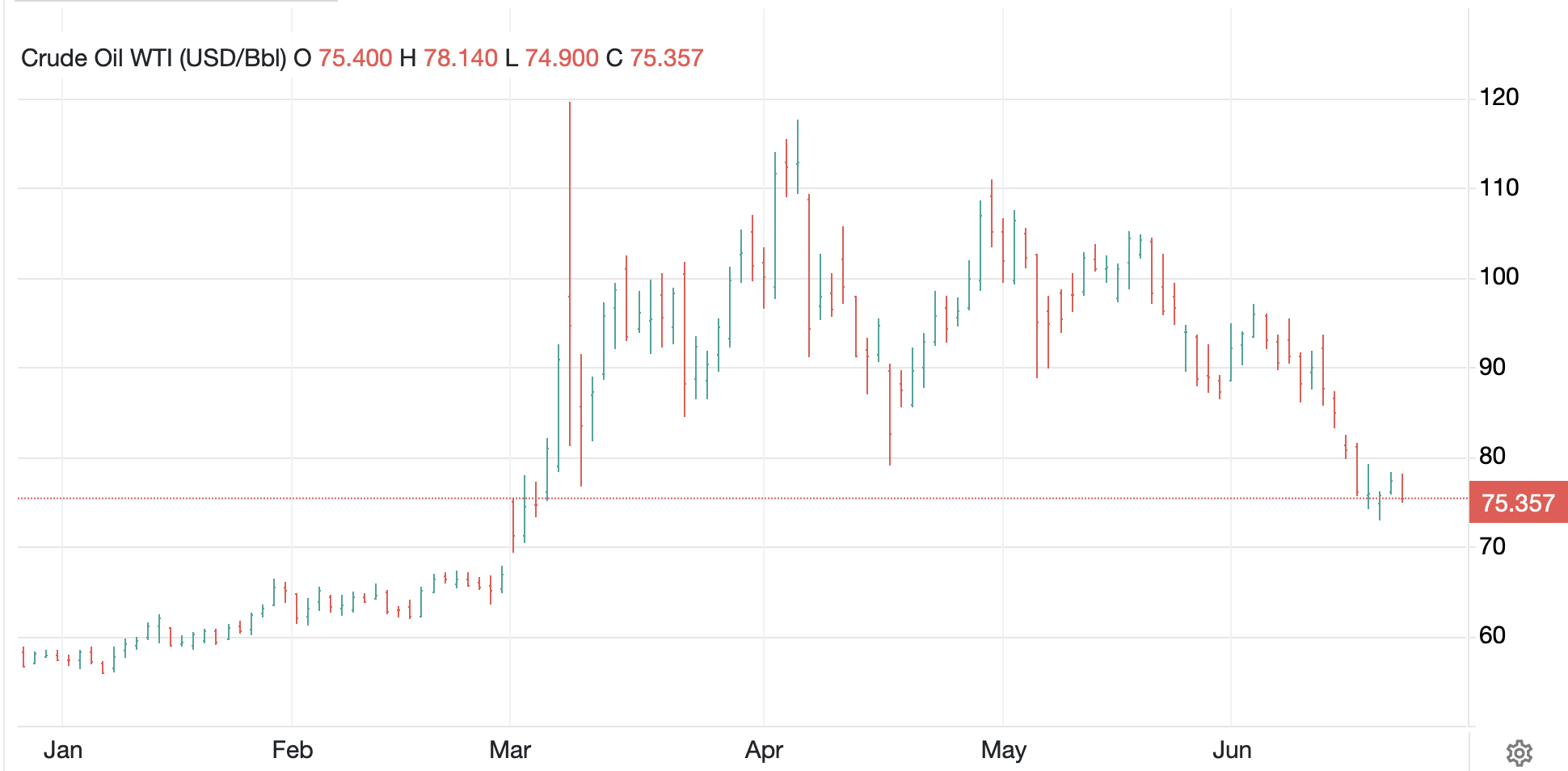
It cannot be a great surprise that there is a lot of bluster from both sides of this negotiation between the US and Iran as President Trump tries to end the conflict in Iran.  After all, both sides are famous for their bluster!  And you can read whatever you like from whatever source you want to get your spin, but I’m not smart enough to understand the intricacies of international diplomacy.  However, what I do understand is market price movement, and here we are this morning, with oil prices falling further, down -2.5%, and back to levels last seen in early March, right at the beginning of this conflict.

source tradingeconomics.com

Thus far, every story about tank bottoms being reached and an insufficient amount of oil for the pipeline infrastructure to be effective has proven not to be true.  There is still a large group of analysts who are calling for end of days, but the market signals just don’t agree.  I suspect that the only ones who really want to see oil prices remain high are the oil companies who sell the stuff, but for the rest of the world, lower is clearly better.  Obviously, anything can still happen, but by all appearances, it seems that more and more traffic is flowing through the Strait and we are going to see lower prices going forward.

In the end, from my vantage point thousands of miles away from the action, it appears that Iran was greatly weakened by this conflict on a military basis, but more importantly, every one of its Gulf neighbors realized that they needed alternative routes to get their oil to market, and we are going to see a lot more pipeline infrastructure built to do just that, so as time goes by, this choke point is going to lose its effectiveness.  And that is probably a bigger weakness for Iran, as that was something they held over the world, but now it seems it is not as impressive a strength as it had been made out to be in the past.

It’s no waterfall
But the yen keeps dripping down
Whence the BOJ?

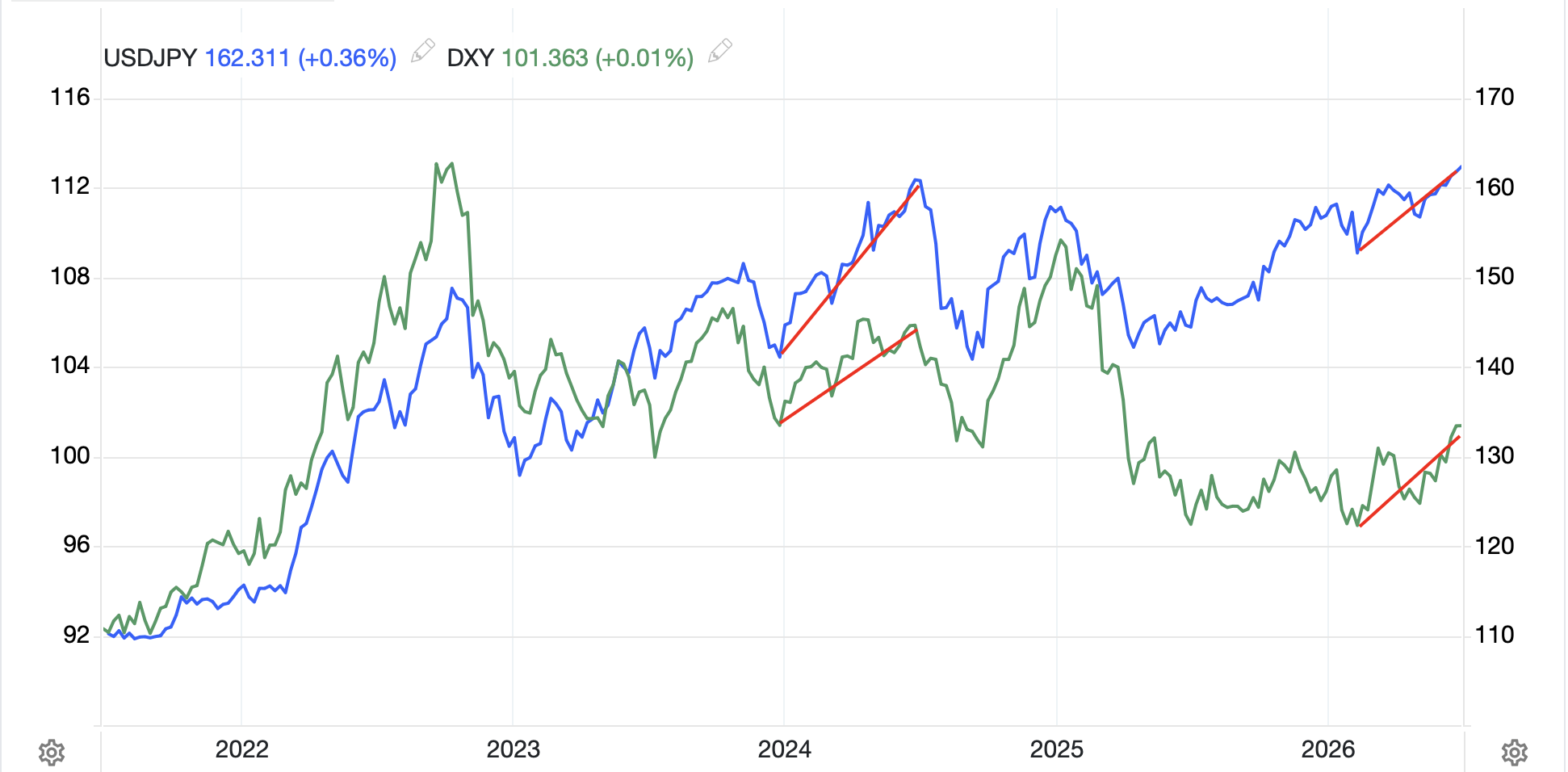
Finally, the yen (-0.3%) is having a tough time right now as it has traded back to its lowest level vs. the dollar since 1986!  That’s right folks, it has been forty years since USDJPY traded above 162.00, and we are pushing that level right now as you can see in the chart below.

The last two times the yen reached these levels, back in April and in July 2024, the BOJ intervened in the markets aggressively.  But so far, crickets.  I think the issue for them is the dollar continues to be quite strong, especially as traders are now pricing in rate hikes by the Fed, and so intervening is going to be a waste of money.  And it’s true, if the dollar is rallying across the board, there is very little Ueda-san can do.  As I have repeatedly said, the only way for the yen to break this slide is for serious fiscal and monetary policy changes, and frankly, that doesn’t look like it is in the cards right now.  While I know there are many who think the dollar is heading to its graveyard, it apparently still has a bit of life left in it.

Which takes us to the overnight activity.  Equity markets have been mixed as all this new information gets digested.  In Asia, Tokyo (+1.6%) and China (+2.4%) both had strong sessions although HK (-0.7%) couldn’t keep up.  Elsewhere in the region, there was slightly more green than red led by Taiwan (+2.75%) while the Philippines (-1.65%) was the biggest laggard.  Uncertainty continues to reign although as the Iran situation slowly resolves, I expect to see things brighten here as Asia was the region hurt most by the entire conflict.

In Europe it is also a mixed picture with the UK (+0.3%) now rallying on the news that Starmer is leaving and Spain (+0.4%) has managed a gain as well while both Germany (-0.3%) and France (-0.7%) are lagging this morning, although there is no news of note in either place.  US futures are basically unchanged at this hour (7:15).

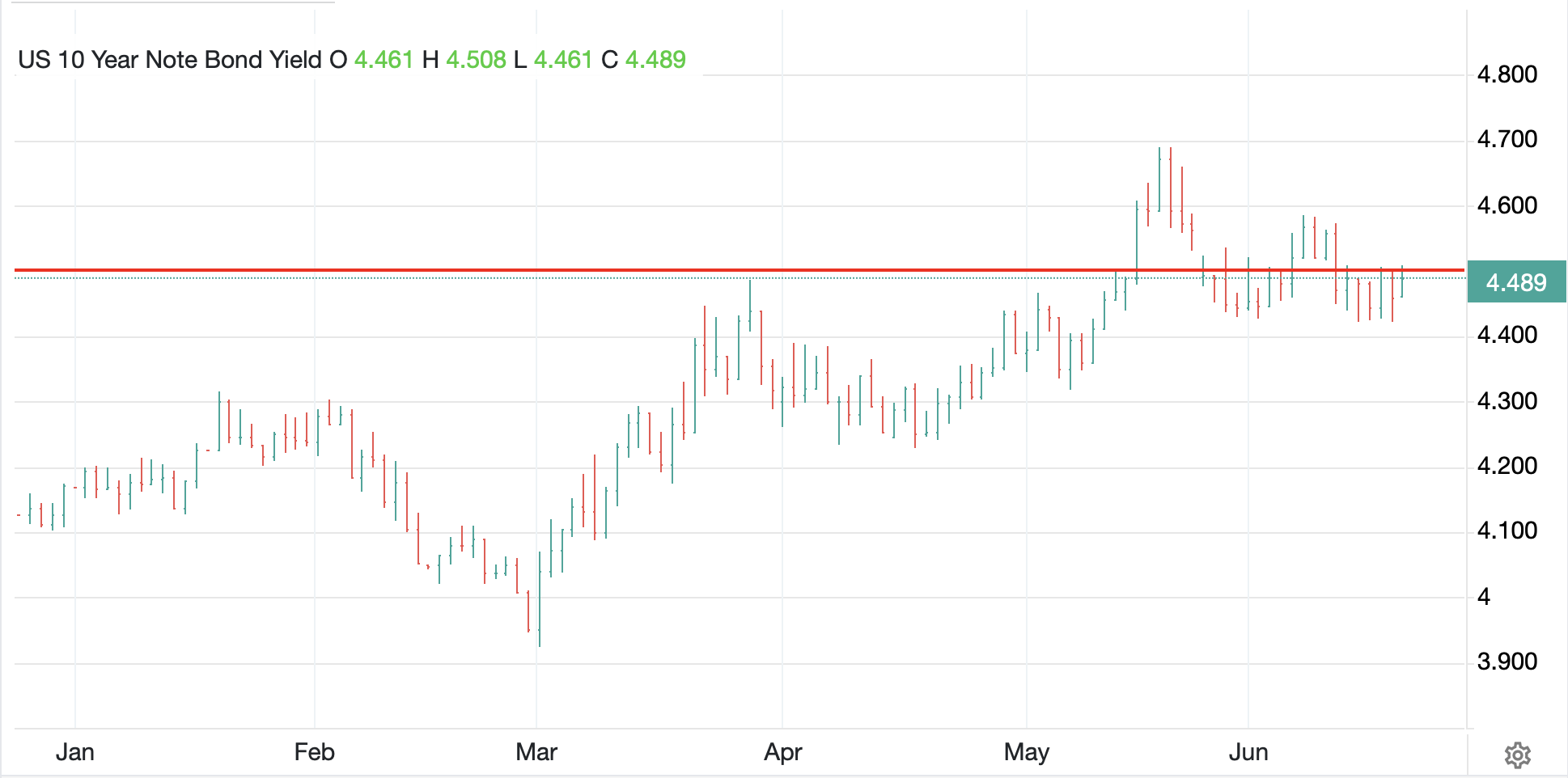
In the bond market, Treasury yields (+3bps) have edged higher this morning, I guess on this new belief in higher Fed funds, although I would have thought the bond market would appreciate a hawkish Fed fighting inflation.  European sovereign yields, though, are lower across the board down about -2bps everywhere.  Bonds remain less interesting now that they are back in their ranges and not breaking out as so many though was occurring back in May as per the below chart.

Source: tradingeconomics.com

With oil prices lower, it should be no surprise that gold (+1.35%) and silver (+2.4%) are both higher this morning.  Many have made the case that with the dollar strengthening, the precious metals complex will remain under pressure, and it is a valid case, but for some reason, I have a feeling it will not be as dramatic as they believe.

Finally, the dollar is firmer across the board this morning, albeit not by very much.  Wednesday and Thursday of last week were the big moving days in the wake of the FOMC meeting and the new hawkish read.  Since then, not much has happened, just a slow drift higher across the board.  FWIW, I don’t think that Chairman Warsh is going to be that hawkish, but I look forward to the structural changes that he makes.  However, for now, that is the market assessment.

On the data front, there is nothing today and really nothing of import until Thursday so I will go through it tomorrow.

That’s how things are shaping up, with the dollar gaining, oil sliding and stocks uncertain what to do next.  I am a fan of uncertainty as it will reduce systemic risk, and that is something we really need to see.

Good luck

Adf
Still on Hold

Despite faster growth
The yen continues to sink
Are rate hikes anon?

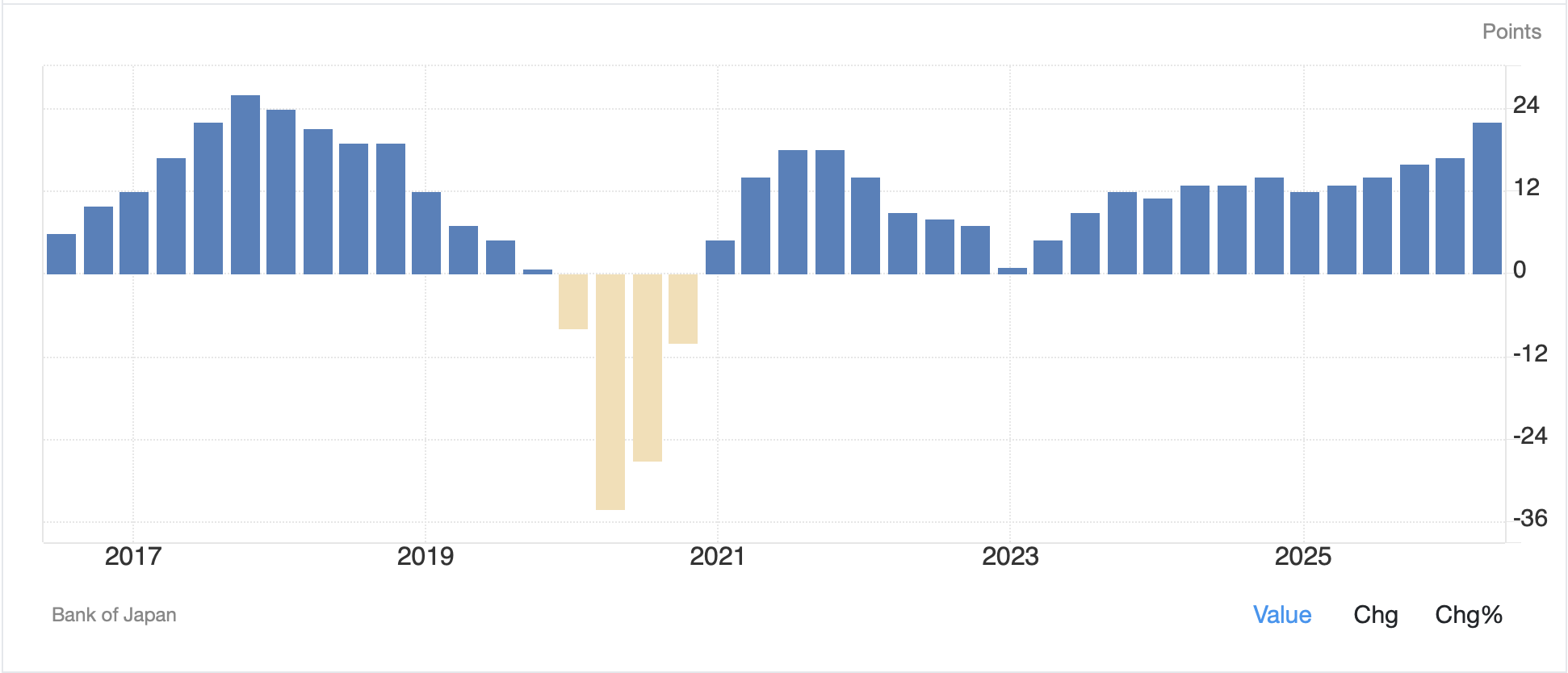
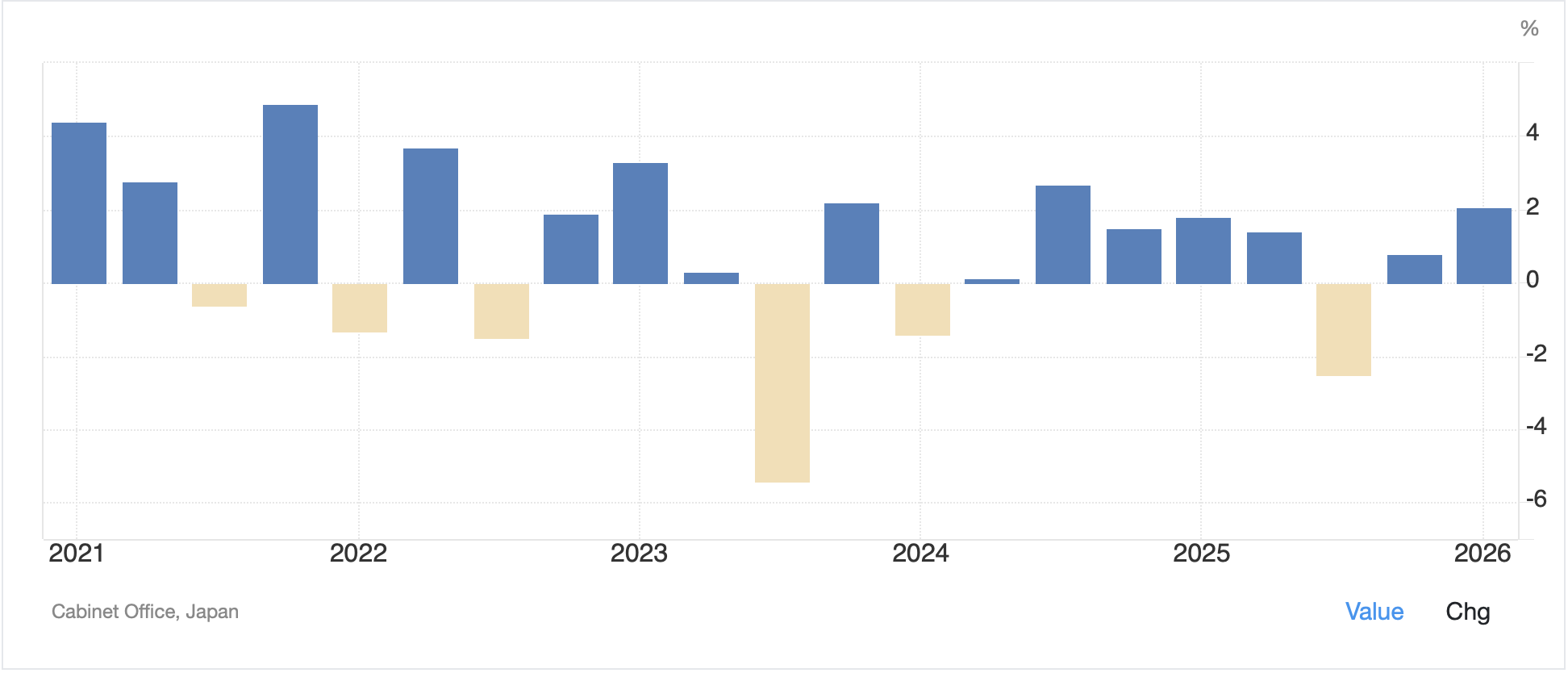
It’s funny, in Japan, there is a great deal of angst amongst government officials that the economic situation is under significant duress, and they appear uncertain how to act.  Now, in fairness, the ongoing Iran conflict is clearly problematic for a country that imports essentially 100% of its oil, and most of it travels through the Strait of Hormuz.  But if we look at the data, Japan is holding up remarkably well.  For instance, below is a chart of annual GDP which was released last night showing 2.1% annualized growth in Q1.

Source: tradingeconomics.com

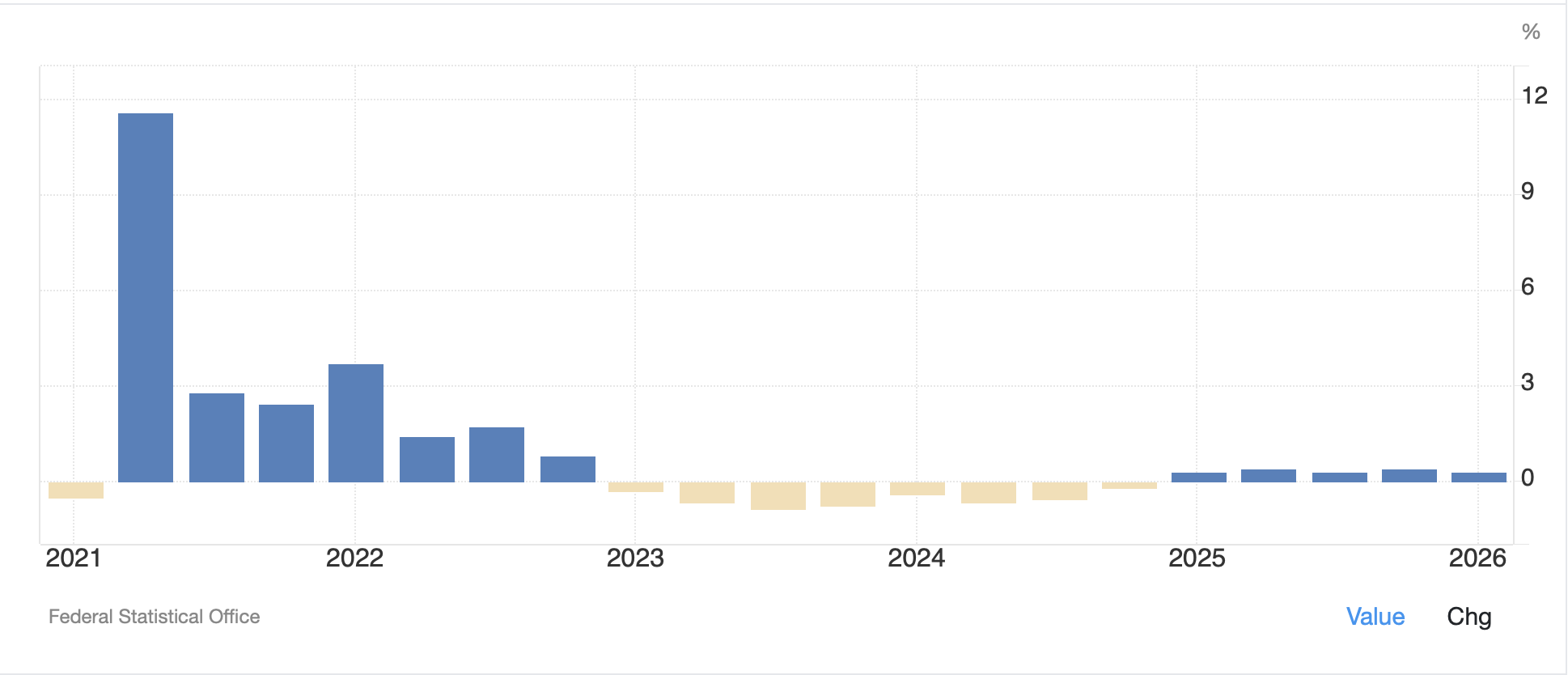
Granted, this is not a chart of an extraordinary expansion, but it is also, relative to its European counterparts, a chart to be envied.  For instance, the below chart of German GDP growth (and I use the term growth loosely) shows that after the Covid reopening, things have basically gone into stagnation.

Source: tradingeconomics.com

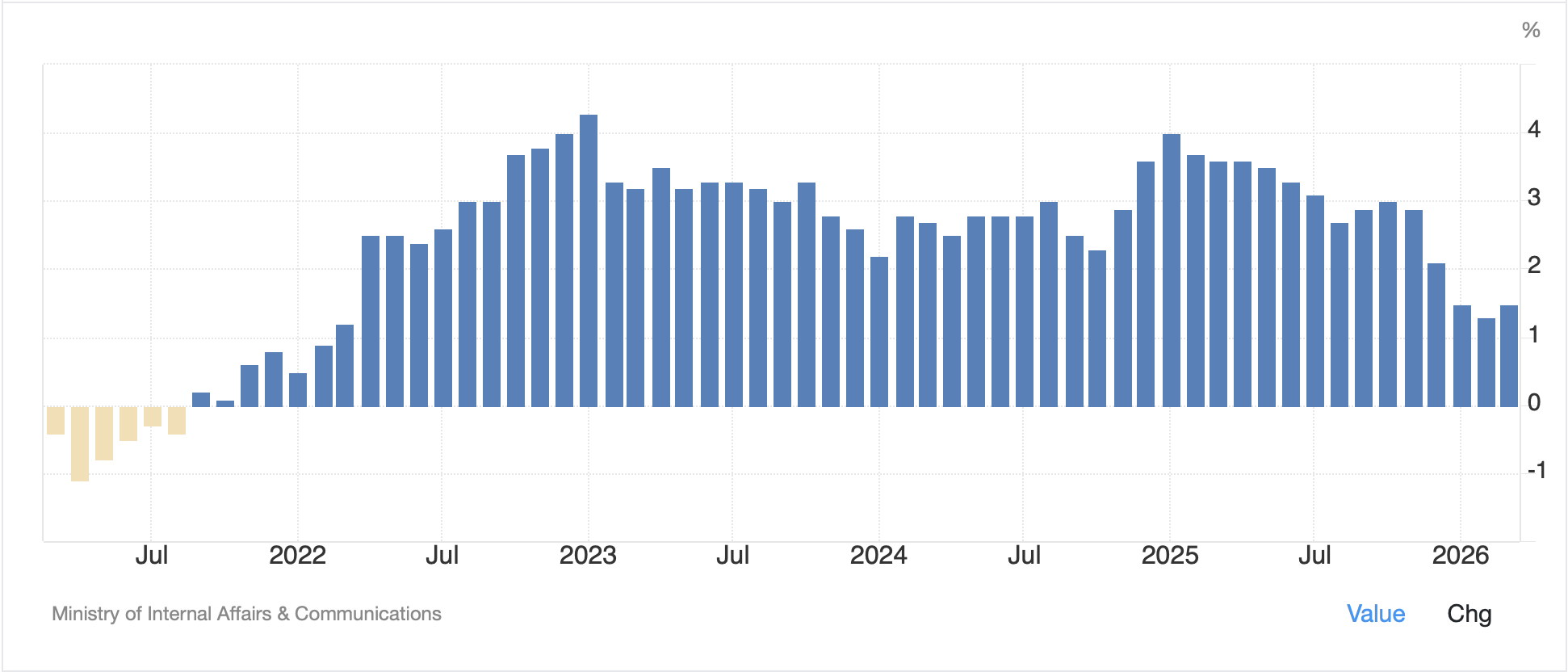
My point is that things in Japan seem to be moving along relatively well, with solid growth, especially when one considers that the population in Japan is shrinking, so given GDP = # people working x output/person, it is hard to grow the economy with a shrinking population.  Meanwhile, inflation in Japan remains sticky, although because of government subsidies to ameliorate the costs of electricity and fuel in the wake of the Iran conflict, it is below the 2% target for now.  However, apparently it remains a concern amongst the population there.

Source: tradingeconomics.com

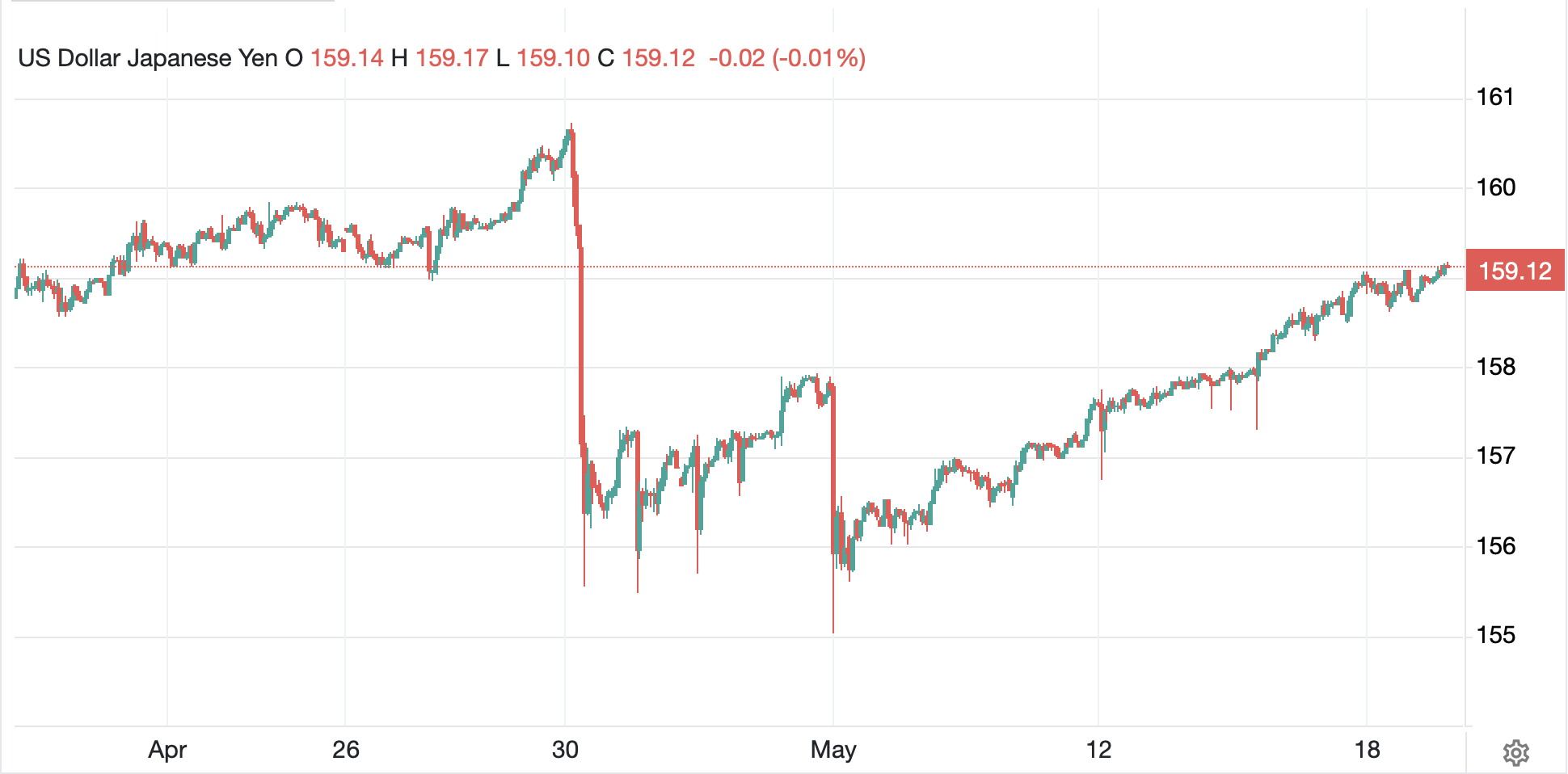
Which brings me to the true market related question, what of the yen?  You may recall a few weeks ago when the BOJ intervened because the yen had traded through the 160 level vs. the dollar and then there seemed to be a few mini interventions in the days that followed.  Yet this morning, as you can see in the below chart, the yen is once again marching toward 160, although I have not seen any commentary from the BOJ or MOF on the subject.

Source: tradingeconomics.com

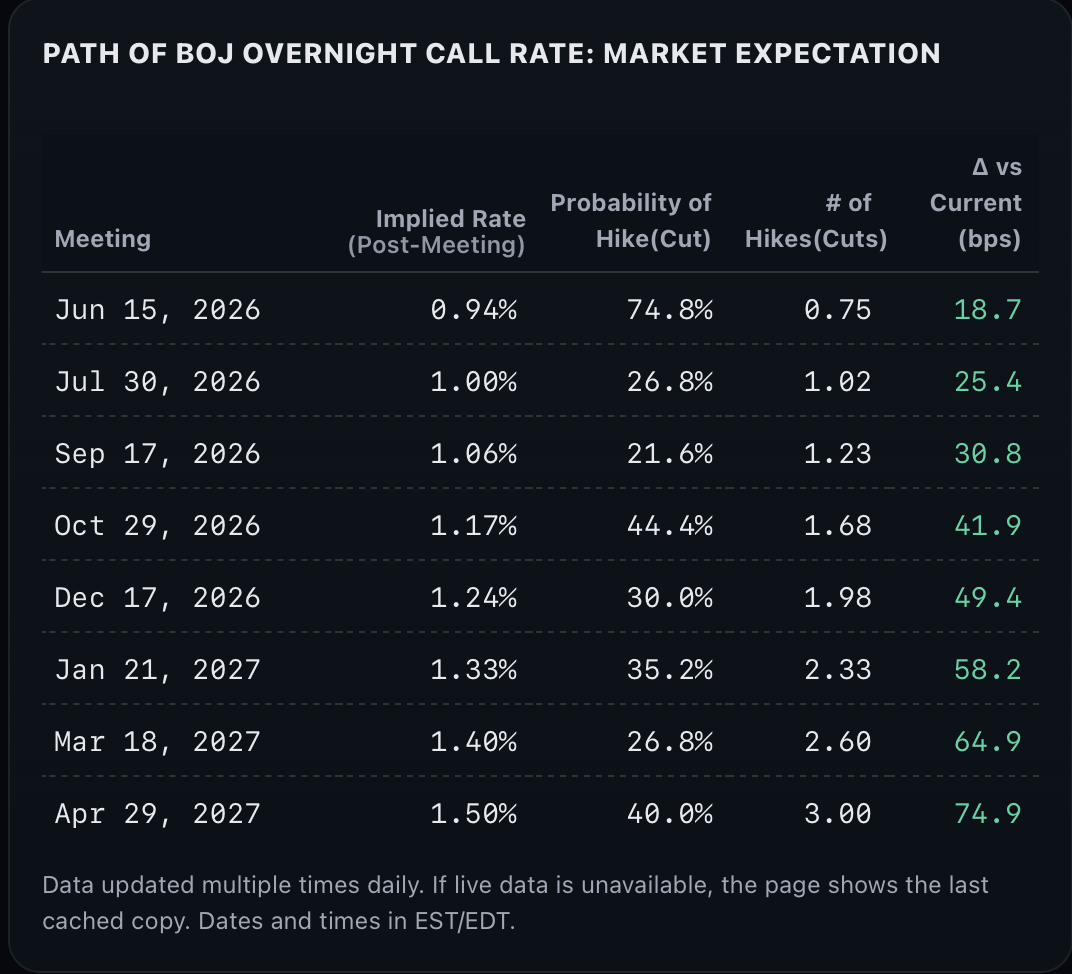
Bringing it all together, the question I would ask is, why is the BOJ even concerned about raising rates at their next meeting in a few weeks?  Ueda-san has been around a long time and understands the only way to address persistent currency weakness is via policy changes.  Especially now that markets have begun to price rate hikes as the next move in the US (I personally don’t believe that will be the case but that is a different story), the yen will continue to slide unless the BOJ moves.  Yet, with GDP growing decently, and underlying price pressures extant, a rate hike should be an easy call.  Currently, the probability appears to be about 75% that they will hike in June, but certainty they will hike by July, at least according to rateprobability.com as per the below table.  I’m not sure why it is even a question.

The war in Iran’s still on hold
As prices for crude stay controlled
But dollars are bid
And equities skid
While nobody wants any gold

As to the Iran situation, President Trump announced he was delaying, for two or three days, any renewed military action at the behest of the UAE and Qatar who claim that substantive negotiations are underway.  Once again, I make no claims of knowledge about what is actually happening there, although that admission is one that most of the punditocracy seems unwilling to make.  

But here’s a thought.  If you were Ahmad Vahidi, the ostensible leader of Iran, and you have spent the last 3 months in spider holes, caves and basements, moving every 8-12 hours lest someone leaks your location to the Israelis or Americans, how comfortable are you in your position?  After all, one of the reasons that people aspire to lead nations is for all the trappings that come with the job. Not only do you get a nice place to live, but you command respect from the people, at least a significant portion of them.  Is it impossible to believe that Vahidi is actually looking for a way out as well, perhaps willing to give up his nuclear ambitions for the removal of the price on his head?  I know that does not fit the narrative for many folks, and is pure speculation on my part, but is it really that far-fetched?

Ok, in the meantime, as we await the next news from Iran, let’s look at market activities.  Starting in the bond market, yields continue to climb higher pretty much all around the world as inflation concerns remain high and there is a growing concern that government bond issuance is going to grow even faster going forward as countries everywhere seek to rearm quickly.  So, Treasury yields (+3bps) are pushing back to the levels seen in January 2025, although remain 15bps below those levels as per the below Bloomberg chart.

And as has been the case for quite a while now, Treasury yields are leading the global yield market with European sovereign’s all higher by about 2bps and JGB yields jumping 6bps last night after the GDP data.  Certainly, JGB traders believe the BOJ is going to hike rates.

In the equity markets, though, risk appetite remains remarkably robust through all the complexities of the war and economic data.  Yesterday’s US session, which started off deeply in the red, rallied back so the DJIA actually closed higher while the other two major indices dramatically reduced their losses.  This morning, futures markets are pointing slightly lower with the NASDAQ (-0.8%) the laggard as questions continue to arise about how long AI will drive the thesis there.  As to the rest of the world, Asia was mixed with the Nikkei (-0.4%) slipping, although every other index in Tokyo rose, China (+0.4%), HK (+0.5%) and Australia (+1.2%) all gaining.  Korea (-3.25%) and Taiwan I-1.75%), though, had rough sessions as those two markets have been driven by semiconductor companies just like the NASDAQ.  The only other noteworthy move was in Indonesia (-3.5%) as investors are concerned about the central bank raising rates after their meeting concludes tonight.

Europe is in fine fettle this morning with gains across the board led by the DAX (+1.4%) and followed by the CAC (+0.8%), FTSE 100 (+0.7%) and Spain’s IBEX (+0.4%).  I keep reading that there is optimism that an agreement will be reached as the rationale for these moves, but I guess that is the way things go.  Never forget this perfect illustration of how market information is passed.

Turning to oil markets, this morning has seen that war ending optimism here as well with WTI (-0.4%) and Brent (-0.9%) both slipping a bit.  Interestingly, metals markets are not behaving as they have recently as they, too are lower; gold (-0.65%), silver (-2.1%), copper (-1.1%).  In the end, like every market, movement here is entirely dependent on the Iran situation, at least in the short run.

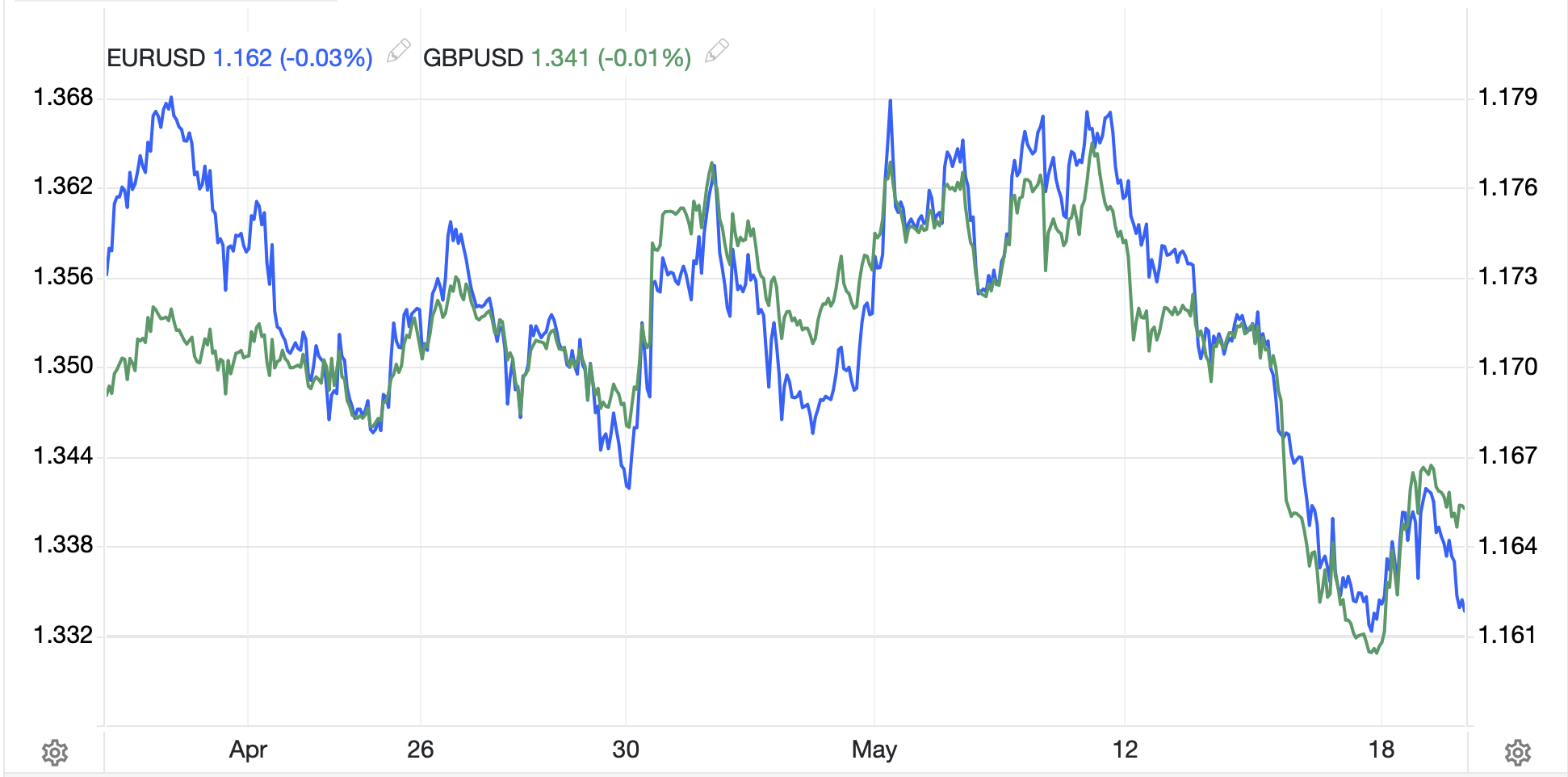
Finally, the dollar is flexing this morning rising against virtually all its major counterparts.  In the G10, AUD (-0.7%) is the laggard, but the euro (-0.3%) and pound (-0.2%) are both under continued pressure with both trading near recent lows as per the tradingeconomics.com chart below.

The rest of the block has not fallen as much but is uniformly lower.  In the EMG bloc, KRW (-1.3%) suffered after the sharp decline in the equity markets there and ZAR (-0.5%) continues to suffer on the back of weaker gold prices.  The one outlier is BRL (+0.3%) which is benefitting despite a weaker economic outlook after some soft data yesterday continues to encourage the potential for further rate cuts there.

And that’s really it for today.  There is no data today although there are 3 Fed speakers, including Governor Waller who many have come to believe is a critical voice for the FOMC.  Broader movement continues to be all about Iran and how things evolve there.  With renewed military engagement on hold, I suspect that the speculators are going to buy stocks again in hopes of a positive outcome.

Good luck

Adf
The Strait’s Dead

The president’s on his way home
And pundits with TD Syndrome
All say that the trip
Did not flip the script
And still see the world in a gloam

But markets, one thing, seemed to hear
That though China wants Hormuz clear
The President said
To him the Strait’s dead
And markets responded with fear

With President Trump on his way back home from his trip to Beijing and meeting with Chinese President Xi, we can now expect reams of stories about all the things that he either did or didn’t accomplish.  Much has been made of Xi’s opening comments about Taiwan and how it is a critical issue that cannot be mishandled or it would impact the relationship between the two nations.  But as I think about Taiwan and China, I certainly understand Xi’s interest in having the island reintegrate into China as it would bring an enormous number of technological skills and abilities in areas currently absent on the mainland.  And, of course, Xi will point to history and claim it has always been part of China, yada, yada, yada.

However, ask yourself why any Taiwanese would want to become part of China.  After all, per capita income in Taiwan is ~$42K annually compared to ~$14K on the mainland.  That is a serious reduction in living standards.  Add to that the ability to vote in free elections and the accompanying belief that one’s voice can be heard, and that is a powerful argument to remain independent.  Now, as TSMC builds out is fabs in Arizona and elsewhere in the world, it seems to me that the US will lose interest in the Taiwan independence issue overall because, especially for President Trump, who views almost everything transactionally, if the US can get its semiconductors from elsewhere with no problems, notably domestically, defending an island on the other side of the world, one that is decidedly not in the Western Hemisphere, seems far less critical. 

Here’s a forecast, by the end of Trump’s term, with TSMC fabs up and running in Arizona, Japan and even Germany, we can see a Taiwan deal similar to the Hong Kong deal, which will sound great but over time China will absorb it in the same way it has done Hong Kong, removing freedoms and its appeal as a manufacturing center.

On to the other part of the trip that has had a much larger impact on markets, when Mr Trump explained, “We don’t need the Strait of Hormuz open.”  While the comments from the trip were that China wants it open and agrees tolls are inappropriate, the last throwaway line is what has markets on edge this morning.  And on edge, they certainly are!

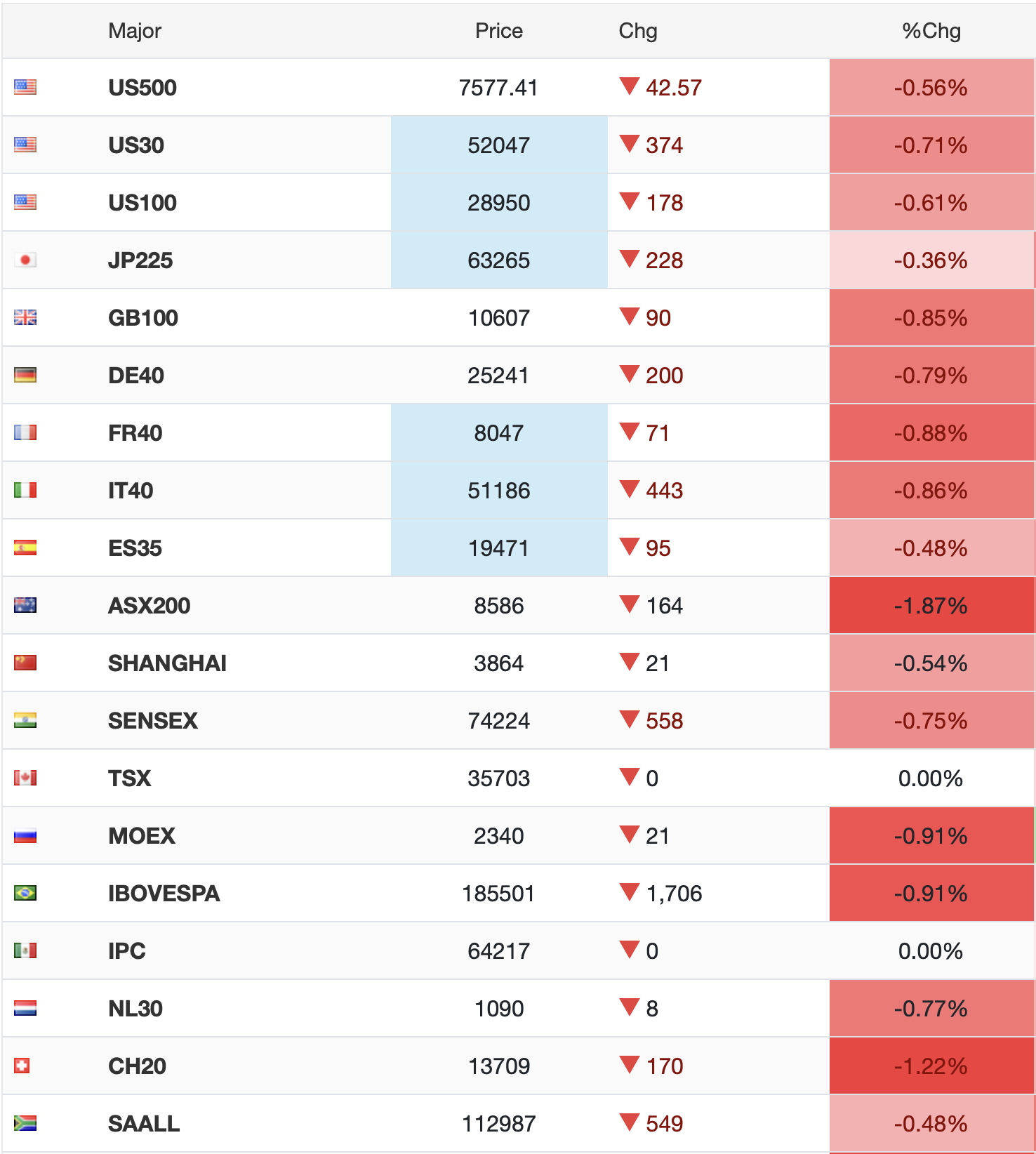
Thus, without further ado, let’s take a look with pictures serving their purpose.  As of 7:15 this morning, here are the major equity index futures from tradingeconomics.com

The caveats here are that Toronto’s TSX and Brazil’s IBOVESPA futures markets are not yet open, but I’m confident both will open lower.  Russia’s MOEX is irrelevant which makes the Swiss Market Index the only equity market anywhere that is not falling.  Perhaps more than the Swiss franc, their stock market has achieved some haven status.

The thing to remember about this sell-off, though, is that we have had a remarkably strong week overall, and so this feels more like a profit taking retracement than the beginning of a new move lower, at least to me.  

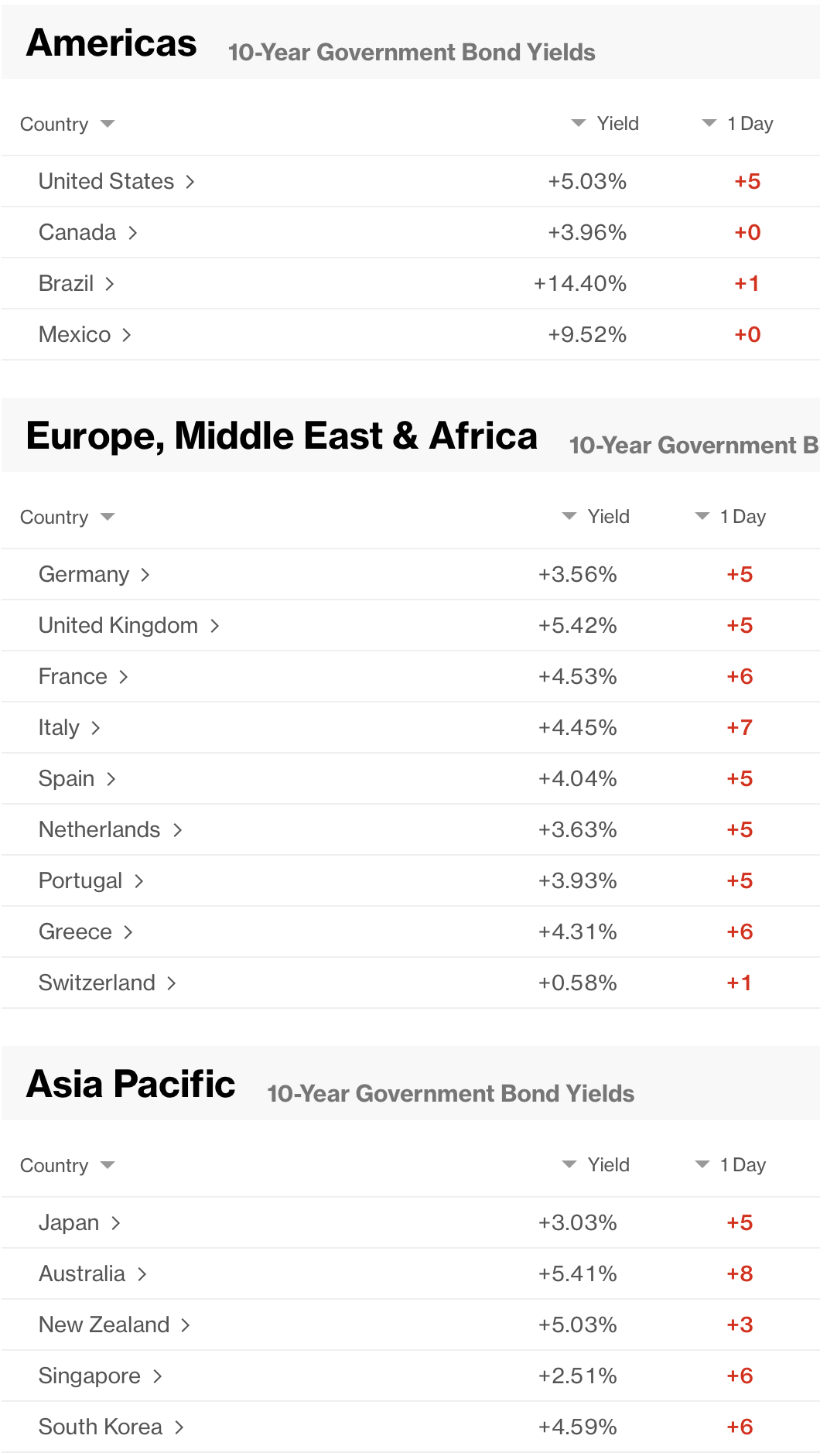
In the bond market, sellers are the dominant force with yields higher everywhere around the world as per the below Bloomberg screenshot.

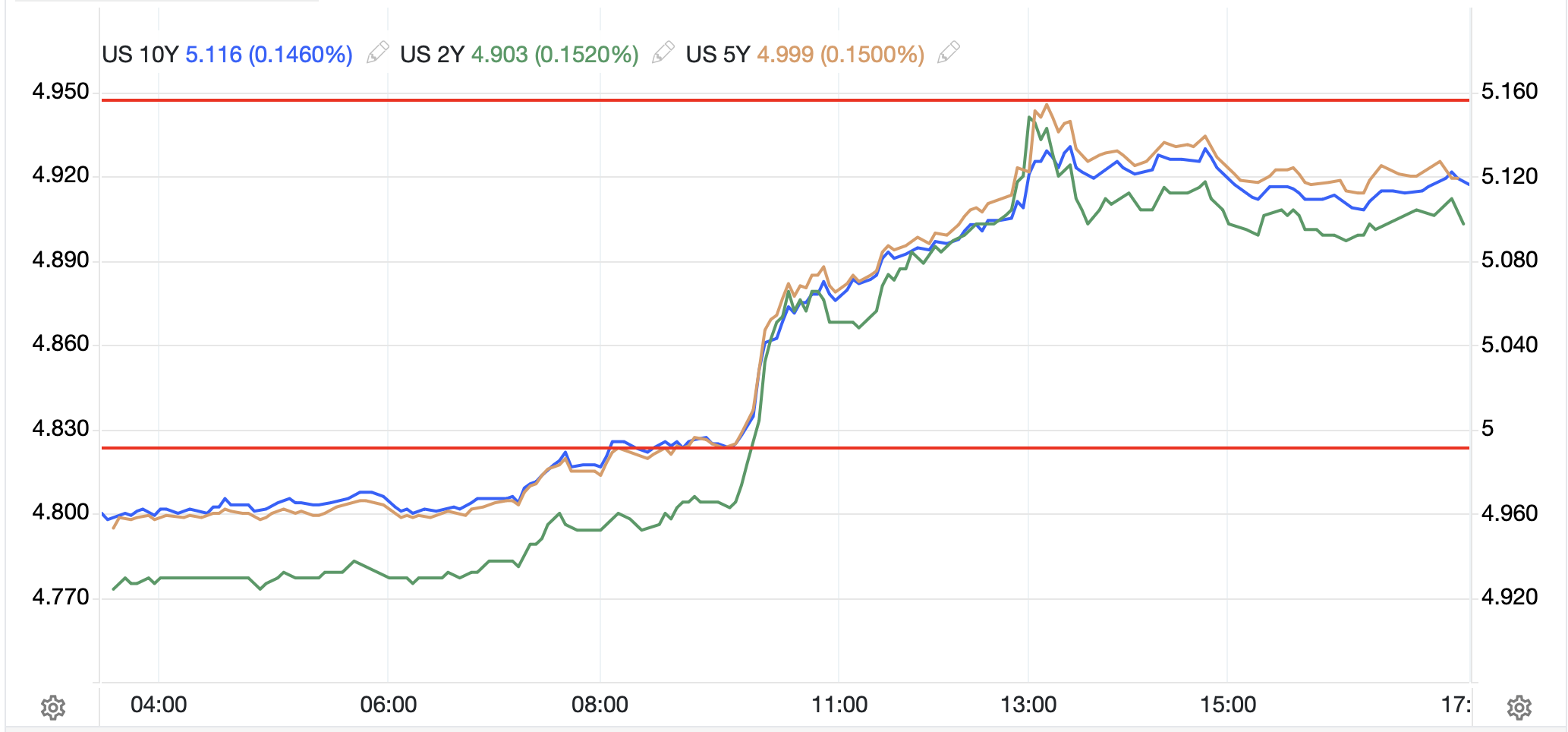
Much has already been written about 10-year Treasury yields trading at their highest level in almost exactly a year, and 30-year Treasury yields now firmly above 5.0% and how that spells the end of the good times in the US.  Maybe that is the case, but I am not convinced.  My take of the biggest problem is in the UK, where PM Starmer is under even more pressure this morning after several moves where a key cabinet member, Wes Streeting, resigned to open his path to run for PM as well as where a Labour party member stepped aside so that the very popular Andy Burnham, who is Mayor of Manchester, can now run for parliament and be in a position to become PM.  The issue here is that since Starmer will do all he can to hold on to his seat, and the Chancellor, Rachel Reeves, is in his corner, we will see even more deficit spending there to try to help Starmer stay in power.  Apparently gilt investors are not impressed with that potential.  Of course, neither is anybody holding pounds as a position as is apparent in the FX markets.

While the pound (-0.25%) is only modestly lower this morning, since Monday, as you can see below, it has fallen 3 cents and does not yet seem to have found a bottom.

Source: tradingeconomics.com

But this is of a piece with the dollar writ large this morning, which is higher virtually across the board.  In fact, as you can see, in what may be my most frequently printed chart to dispel the idea that the dollar is dying, the DXY remains firmly in its range for the past year and is now heading toward the upper band.  If you look at the calculated mean/variance of the DXY, you can see the trend line (the black line in the center) is completely flat, i.e. the dollar is trending neither higher nor lower over the past year.

Source: tradingeconomics.com

Looking at specific currencies, AUD (-1.0%) and NZD (-1.45%) are the worst performers in the G10, although NOK (-0.9%) and SEK (-0.9%) are giving them a run.  Kind of surprising for NOK given oil is much higher this morning.  in the EMG bloc, ZAR (-1.0%), CLP (-1.0%), MXN (-0.8%), and KRW (-0.5%) are the laggards in their respective regions with ZAR suffering from the commodity movements, as is CLP with copper sharply lower this morning.  MXN seems to be reacting to the news that the US has been stepping up its aggressive tactics against the drug cartels there and concerns about how that will end up.

Finally, on to commodities where oil (+3.0%) has responded exactly how you would expect to the Trump comment about his cares about Hormuz.  Meanwhile, the metals are back in full negative correlation mode with oil as all of them are sharply lower this morning (Au -2.0%, Ag -5.9%, Cu -4.3%, Pt -4.0%).  The one thing you have to admit about the commodities markets these days is that they are living up to their reputation of extreme volatility.

On the data front, this morning brings Empire State Manufacturing (exp 7.5), IP (0.3%) and Capacity Utilization (75.8%), none of which typically have a big impact and given the oil/Hormuz fears extant this morning, will almost certainly be completely ignored.  There are no Fed speakers today but I do want to mention one from yesterday, Governor Michael Barr, who directly contradicted everything Chairman Warsh has been saying about the size of the Fed’s balance sheet, explaining that if they move away from their current ‘ample reserves’ model, it could have very negative impacts on the functioning of money markets.

There is an irony here as prior to the ‘ample reserves’ framework, there was a very active Fed funds trading market on an interbank basis and banks were able to borrow from each other whatever they needed for liquidity purposes.  The Fed has usurped that role ever since the GFC and are now clearly concerned (afraid?) about going back.  The thing is, it seems to me that there continues to be a tremendous amount of liquidity around and it would be quite feasible to create an intraday loan market to help alleviate those concerns.  In fact, cash rich corporates (Berkshire Hathaway anyone?) could be part of the market as it would be entirely interbank and those corporates would know the counterparties quite well.  Suffice it to say that Mr Warsh will have quite a time getting his way at this stage.

And that’s what we have going into the weekend.  Gloom and doom about the near future, or profit taking, I’m not sure which.  As I have said all along, play it close to the vest, in think.

Good luck and good weekend

Adf

Less Than Ideal

Some mornings the quiet is real
With limited news of appeal
But traders still need
Their families, to feed,
A story far less than ideal

Yes, oil prices have traded a bit higher overnight and this morning, albeit amid extremely low volumes.  In fact, it is the volumes that speak to how little people seem to care about markets right now.  We are seeing extremely low volumes across oil, gold, stocks, bonds and even FX markets are quiet.  It’s not that they haven’t moved a bit, it’s just that there is no conviction amongst the trading community as to where things should be heading.  

Of course, this is never true of the narrative community, who will spin up something to get clicks, but frankly their stuff, which is often the thinnest of gruel, has even less traction now.  Arguably, reading through as much as I could this morning, the most noteworthy thing was the following clip I saw on X (and it is a worthwhile use of 13 seconds, I assure you) showing Representative Ilhan Omar discussing World War Eleven.  I wish there was more to say, but since there is not, let’s head to the markets.

The most relevant argument in markets right now is how long can Iran hold out while their revenue stream is stopped by the US naval blockade and correspondingly, how long before they have to start shutting in production?  How full is their storage?  I have seen estimates from what I believe are credible sources of between half full and 80% full which would mean, even in the best case for them, they have about another 2 weeks before shut-ins begin.  And if that happens, they are looking at the permanent destruction of upwards of half their current output.  In other words, this war is not merely existential for the IRGC and their grip on power, but potentially for Iran’s longer-term future as an economy.

In the meantime, oil prices (+3.3%) continue to grind higher on limited volumes as you can see in the chart below with the lower bars indicating volumes.

Source: finance.yahoo.com

As consumers, we are all feeling the pain of this price action, but BP just reported record profits, and we can expect similar outcomes from all the oil majors, making hay while the sun shines as all corporates do.  At the same time, gold (-1.6%) and silver (-3.2%) continue their direct negative correlation to oil.  This relationship seems quite robust at this point.  It appears that the ongoing dollar strength on the back of the rise in oil prices is undermining the status of gold as a haven asset.  I continue to believe this is a temporary phenomenon, but for those long gold, it is nonetheless a painful reminder of how markets can remain perverse.

Speaking of the dollar, yesterday’s modest declines have been reversed this morning with the greenback gaining on the order of 0.25% this morning across the board.  The biggest news here was the BOJ meeting last night where, as expected, Ueda-san left policy unchanged, although the vote was 6-3, with the three dissents seeking a rate hike.  From what I can tell, Ueda-san prattled on for an hour in his press conference without giving any clear direction as to the future, confusing one and all by explaining they may not reach their objectives but may raise rates anyway.  You can see in the chart below when Ueda started speaking as it initially sounded hawkish, but here we are, 7 hours later and it was as though he never opened his mouth.

Source: tradingeconomics.com

The overriding concern in the yen is whether it will weaken through (dollar above) the 160 level, which it briefly touched back in late March, but has since been trading just below.  That is perceived by many as the ‘line in the sand’ regarding intervention.  However, if we go back to the summer of 2024, when the BOJ last intervened, USDJPY was pushing 162 before they pulled the trigger as you can see below.  It certainly suits them that the market is afraid of pushing this envelope, but my take is it will happen before too long.

Source: tradingeconmics.com

As to the rest of the FX space, zzzzz is the story.  Perhaps the other interesting thing is that NOK (-0.15%) is weaker despite oil’s climb.  Everything else is softer vs. the dollar by -0.2% and -0.4% with no real outliers.  FX is just not that interesting, like most markets these days.

In the equity space, yesterday’s US performance was uninspiring, but we saw more weakness (Tokyo -1.0%, HK -1.0%, China -0.3%, India -0.5%, Australia -0.6%) than strength (Korea +0.4%, Malaysia +0.7%) across Asia.  However, there are no new stories to drive things here with the Iran war and energy prices the only topic of note.  In Europe, markets are feeling better this morning with gains across the board led by Spain (+1.0%) and the UK (+0.6%). I must admit I am confused by the Spanish performance as the only data point of note released this morning was Spanish Unemployment which jumped to 10.83% (such precision), far above last month’s 9.93% and a full point above economists’ forecasts.  But I guess if you look at the longer-term history of Spanish Unemployment, this is still far better than it has been in the past and the trend remains intact.

Source: tradingeconomics.com

Meanwhile, US futures are pointing lower at this hour (7:25) with OpenAI having missed its own targets for user acquisition undermining the overall AI thesis thus far this morning.  Plenty of time for that to change though, at least based on how buying remains the default position.

Finally, bond markets have sold off with yields continuing to edge higher across the board.  While it’s not really a rout, as you can see from the Bloomberg screenshot below, every European sovereign yield is higher along with treasuries, although JGB’s managed to remain unchanged overnight.

Certainly, there is nothing new in the bond market right now, although I imagine as the Iran war drags on, we will see increased government borrowing across the board which ought to pressure yields higher.

And that’s it, really, for this morning.  We see the Case-Shiller Home Price Index (exp 1.1%) at 9:00 this morning and Consumer Confidence (89.0) at 10:00.  Neither of these is going to matter to traders anywhere, not even algos.  

Until there is a change in the situation in Iran, it is hard to see more than lackluster interest across most markets.  I imagine that if this extends for weeks, the offsetting forces of reduced supply and demand destruction will find an equilibrium point, which may well have already been found around $100/bbl.  Remember this with respect to the dollar, since oil is priced in dollars almost universally, there is going to continue to be demand for the greenback everywhere in the world.  It is hard for me to make a significant bearish case for the dollar right now, at least in the medium or long-term.  In the short term, who knows?

Good luck

Adf
Dumfound

The clock has been wound and rewound
And meantime stock buyers dumfound
The good and the great
Who mostly, Trump, hate
And fear that their power’s southbound

But still the blockade is in force
And info depends on your source
Will Trump send marines
To take Iran’s means
And break them as matter of course?

Another day and nothing has changed in the Persian Gulf or the Strait of Hormuz.  The US’s naval blockade is still in force with several Iranian tankers being stopped on outbound routes.  As well, Iranian small gunboats have attacked several freighters seeking to exit the Gulf.  No negotiations are on the calendar, although Pakistan, Egypt and Turkey are ostensibly working to get the two sides together.  This has become a waiting game, it seems, to see if Iran can suffer the loss of 90% of its revenue for longer than President Trump can suffer the political damage that higher oil prices are inflicting on the economy.

The funny thing is the economy doesn’t seem to be that bad overall.  Clearly, nobody is happy to pay more for a tank of gas, but the data has yet to show a major disruption in the US economy.  And in fact, this morning’s Flash PMI data from around the world has shown a pickup in manufacturing activity as per the below table (data from tradingeconomics.com):

CountryActualPrevious
Australia51.049.8
Japan 54.951.6
India 55.953.9
France52.850.0
Germany51.252.2
Eurozone52.251.6
UK53.651.0
US52.5 expected52.3

The narrative on this improvement centers on the idea that people/companies are trying to get ahead of the future where price hikes and shortages of goods become extant, similar to the front-running of the tariffs in Q1 last year and that is certainly part of the story.  But it also appears that, in the US at least, there is real manufacturing growth occurring.  

Freightwaves is a company that tracks trucking and freight movement around the US, and its latest data show solid increases in activity along with a tighter market (rising costs) as demand rises.  Too, this activity is emanating from the center of the country not the West coast, indicating this is domestic production and not imports.  Anecdotally, I have a friend in the trucking business, and I asked him about this situation yesterday.  He confirmed that the trucking business is booming.  

Remember, too, that in the last NFP report, Manufacturing employment rose 15K, far surpassing expectations.  I make these points to highlight that the US economy continues to perform pretty well despite the angst over the war and rising gasoline and diesel prices.  One last tidbit is Retail Sales, which rose a greater than expected 1.7% last month, and 0.7% in the control group which excluded gasoline.  Those numbers do not confirm economic weakness.  

And you know what helps confirm that the US economy is ticking over nicely?  The continued equity market rally.  Since the war began, after the initial fears that rising oil prices were going to collapse the global economy, the market has completely reversed course as you can see in the below. Chart.

Source: tradingeconomics.com

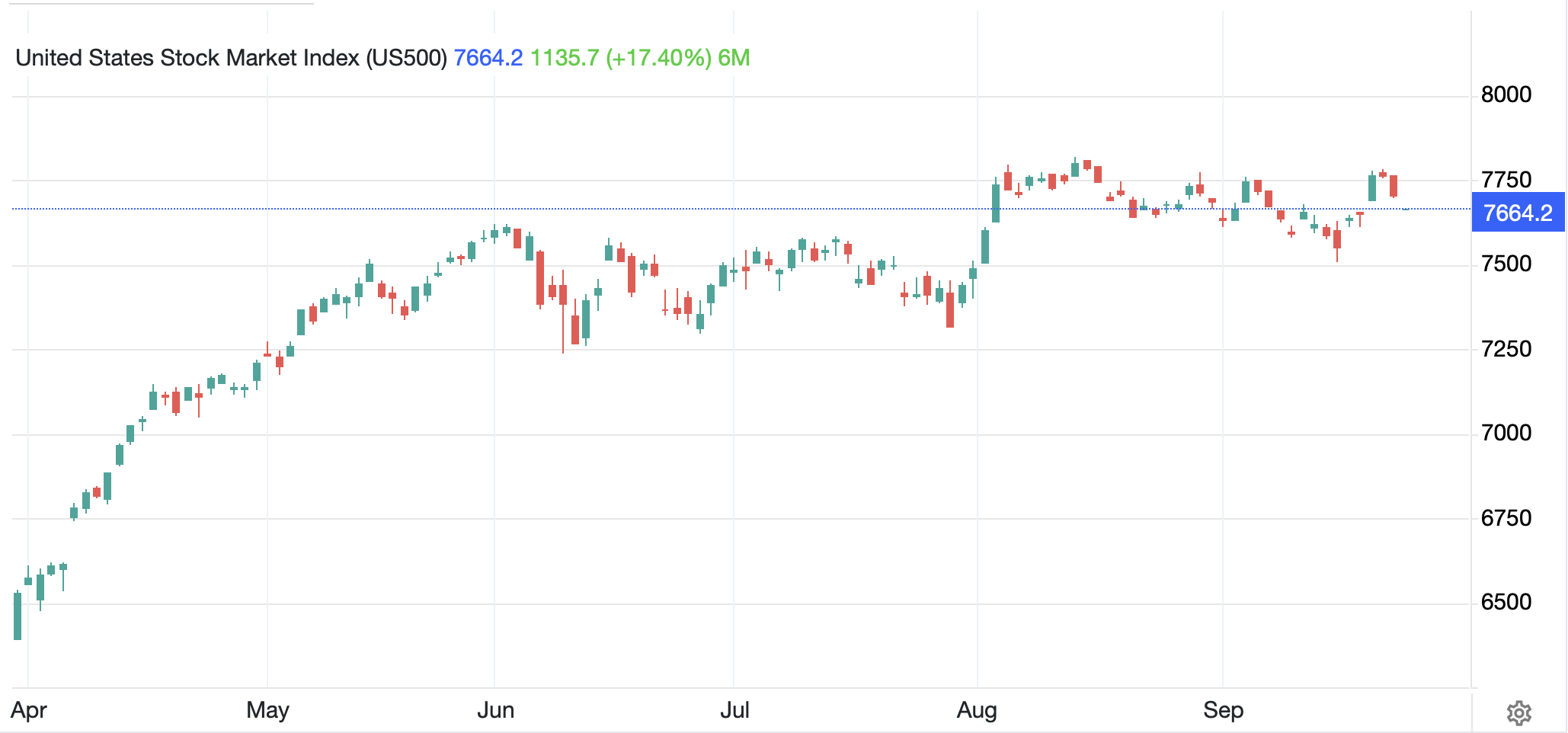
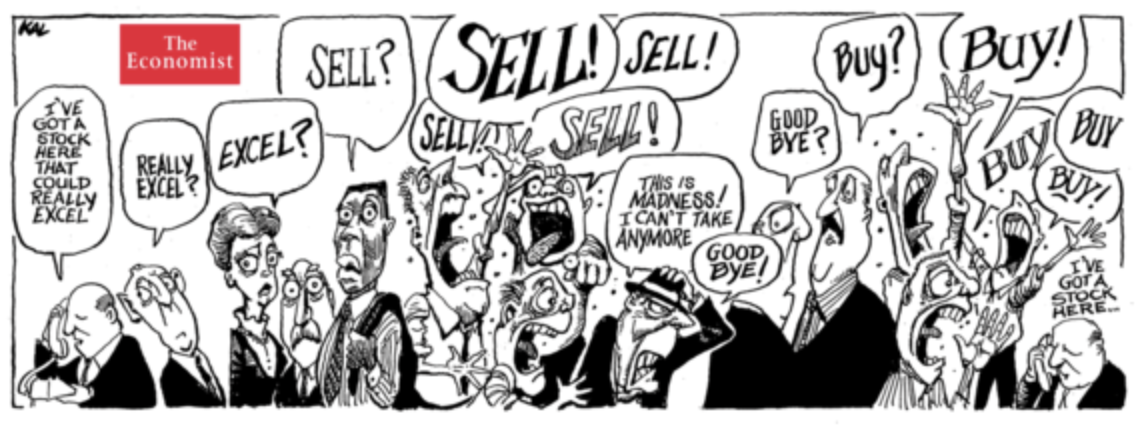
From the nadir on March 30th, the S&P 500 has rebounded 12.5% to new all-time highs.  Earnings data that has been released for Q1 thus far has shown significant growth, upwards of 18% profit growth, again not a sign of a struggling economy.  And perhaps the key feature of my argument is the following cover of The Economist magazine, which seems to have an almost perfect track record in terms of its cover articles, it is wrong nearly 100% of the time.

There continues to be a great deal of doom porn available if you like that type of stuff, but I am having a hard time seeing the depth of the damage that many claim.  Certainly, things can get worse if Iran lashes out in final death throes of the regime and seeks to destroy as much GCC infrastructure as possible, but right now, I don’t see that outcome.  My belief is the marines go for Kharg island shortly and are better than even odds to be successful.  If that is the case, then we will be in the final stages of this conflict and people will move on.  After all, who remembers Venezuela as a major crisis today?  Most people have very short attention spans.

Ok, let’s see how things stacked up overnight after yesterday’s continued US equity rally.  This morning, feelings are not as buoyant although it is not clear why.  Equity markets in both Asia and Europe were broadly lower although that could simply be a bit of profit taking after some strong runs all around.  Tokyo (-0.75%), HK (-1.0%) and China (-0.3%) all slipped as did Australia (-0.6%), India (-1.1%) and Taiwan (-0.4%).  But Korea (+0.9%) bucked the trend along with Malaysia (+0.6%) while the rest of the region was weak.  The Korean economy showed surprising strength in Q1 with GDP last night released at 3.6% annualized in Q1 supporting the market there.

As to Europe, despite the solid Manufacturing PMI data, Services data has been under more pressure and equity markets seem to be following that with Spain (-1.3%), the UK (-0.9%) and Germany (-0.5%) all slipping although France is unchanged this morning.  As to US futures, they are softer as well at this hour (6:55), down by -0.5% or so across the board.

In the bond markets, Treasury yields have backed up 2bps this morning with European sovereign yields higher by between 1bp and 3bps.  The outlier here is UK gilts (+5bps), which seems to be responding to general financing concerns in the UK as the budget deficit there continues to grow faster than forecast.  JGB yields also backed up 2bps.

Oil (+1.2%) is beginning to get concerned again about the Iran situation as we are currently in the midst of a 3-day rally.  While the WTI price, at around $94/bbl, is sitting in the middle of its range since the inception of the war, clearly there is some concern.  

Source: tradingeconomics.com

The EIA inventory data showed a build in crude inventories but a pretty large draw of gasoline and distillates.  Perhaps it was the latter that is the driver.  As to the metals markets, the negative correlation between oil and gold is back with the barbarous relic (-0.8%) slipping while silver (-3.8%) is really having a rough session.  It is key to remember, though, that silver is an inherently more volatile commodity than gold given the market’s much smaller size.  In truth, looking at the chart over the past six months, it is hard to get the sense that it is doing too much at all right now.

Source: tradingeconomics.com

Finally, the dollar is rebounding a bit this morning, with the DXY (+0.2%) continuing to trade in its broad range from the past year as per the below chart.

Source: tradingeconomics.com

While the death of the dollar and de-dollarization narratives remain popular amongst a broad set of analysts, data outovernight from SWIFT shows that the dollar’s portion of international transactions rose to a record 51.1% in March, its highest level since SWIFT revised its procedures.

Source: Bloomberg.com

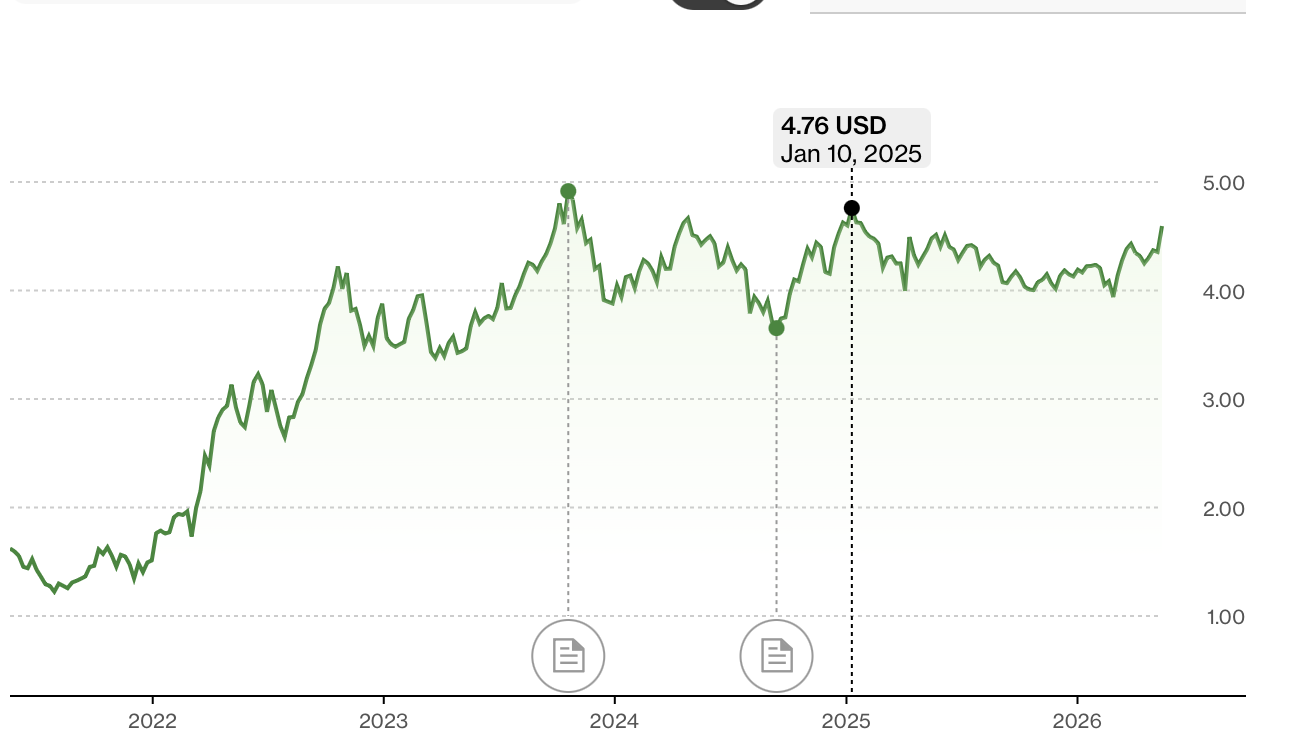
I regularly read analysts who are very smart explaining all the reasons why the dollar is destined to collapse amid concerns over the unsustainable debt and the use of the dollar as a political tool, and those things are true as far as they go, but for the foreseeable future, TINA is the rule.  No other fiat currency is going to be an effective substitute because no other nation has the heft and strength of capital markets to do so.

The dollar’s strength today is pretty universal with nothing terribly noteworthy regarding specific moves.  Perhaps the one surprise is NOK (-0.3%) which is not following oil higher.

On the data front, this morning brings the weekly Initial (exp 212K) and Continuing (1820K) Claims data as well as the above-mentioned Flash PMI data.  Again, despite all the teeth gnashing, the labor market seems to be holding in quite well overall.  Perhaps my glasses are tinted rose and I don’t see that, but the data releases that we continue to see do not point to an imminent collapse in the US economy.  Rather, continued strength seems the most likely result.  With that in mind, I do not see the dollar falling sharply under any scenario and suspect that a test of 100 on the DXY and 1.15 in the euro may be on the horizon.

Good luck

Adf
No Longer Benign

The war in the Gulf shows no sign
Of ending by any deadline
Some victims now bleeding
Are bonds, with yields speeding
To levels no longer benign

Already we’ve seen, efforts, great
By nations, impacts, to abate
So, price caps on gas
Worldwide came to pass
But will central banks raise their rate(s)?

Nothing of note has changed in the Iran war as the US continues to refrain from further attacks while negotiations to end the conflict ostensibly continue.  Both sides have made their demands, but from what I have read about them, neither side can accept the others wishes.  If pressed, my take is the ongoing US pause is simply allowing the Marines and 82ndAirborne to get into place for their attempt to take over and control Kharg Island and the other small islands in the Strait.  Frankly, I would not bet against their tactical success in that endeavor.  However, it is not clear how Iran will respond in that situation.  After all, if the US does control Kharg Island, that means Iran no longer controls their own revenue stream, and that is truly existential for the regime.  However, I could be completely wrong about this, which is why I am not a military strategist.

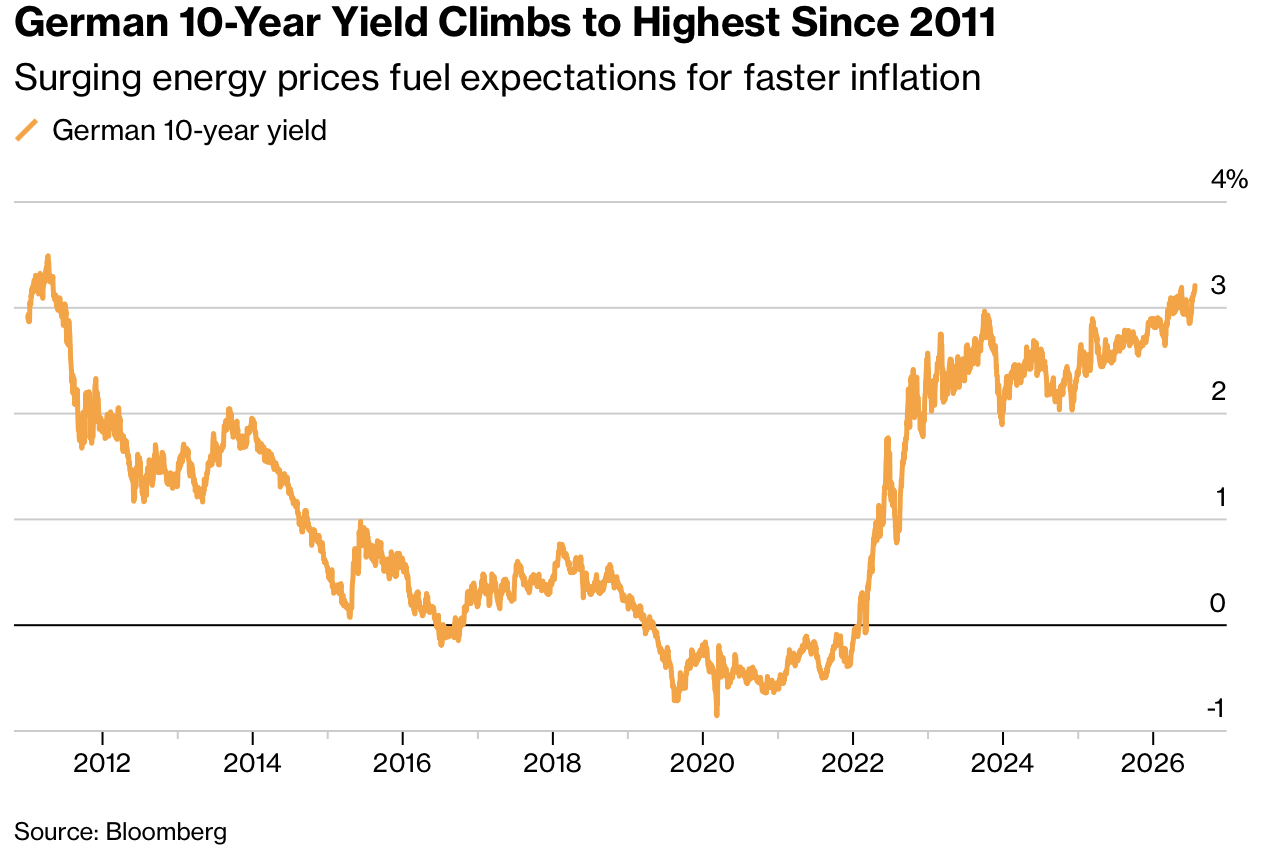
But I think it is worthwhile taking a peek at the bond market this morning.  For the first few weeks of the war, while yields edged higher, there was no indication that investors were getting terribly nervous about the longer-term impacts of the war.  However, that no longer seems to be the case.  I have several charts below showing US, UK and German 10-year yields over the past six months, and then a longer-term perspective showing those same yields over the past 20 years. 

Six months of yields

Source: tradingeconomics.com

Long-term charts (source marketwatch.com)

UK Gilts

German bunds

US Treasuries

As you can see from the first chart, yields across all three of these nations have risen sharply now in the past month.  In fact, the numbers are US (+52bps), UK (+83bps) and Germany (+47bps).  It is very clear that fixed income investors are getting worried, and reasonably so given the idea that inflation readings, at least in the short-term, are going to be much higher.  As to the longer-term view, though there is certainly a similarity amongst the movement of yields of all three nations, UK yields are currently at their highest level since the GFC, July 2008; German yields are at their highest level since the Eurozone bond crisis in 2011, but Treasury yields were higher at the beginning of this year, and 25bps higher in late 2023.  

This is not to dismiss the potential problems that may arise if government bond yields continue to rise, especially given the already extraordinarily high debt/GDP ratios that exist throughout the G10.  However, I am not prepared to concede that the US is going to collapse because 10-year yields are back at 4.50%.

What we have seen, though, almost everywhere in the world, is government attempts to cap prices on energy, whether gasoline, diesel or even electricity, to help moderate some of the obvious pain that higher energy prices are inflicting on their populations.  We have also heard a great deal from central bankers about needing to tighten monetary policy to combat the rising inflation, despite the fact that inflation is coming from a supply shock in energy rather than either excess demand or money supply.  I fear that will not work out that well if they do so, but as is often the case, central banks (and governments in general) feel they must “do something” when an exogenous event, out of their control, occurs.  Ultimately, history has shown that is when policy mistakes are made.  Here’s hoping the hostilities end quickly enough so nations don’t make those mistakes.

Away from bonds, with yields higher this morning across the board (US +5bps, Germany +5bps, UK +11bps, Japan +11bps) and the rest of the European sovereigns somewhere in between, if we turn to oil (+2.7%), WTI is pushing back up to $100/bbl this morning, which I take as an indication market participants are getting nervous things will last longer than they thought a few days ago.  You can see the chart below that oil has rallied steadily all week since the Tweet that things were going to be ending soon back on Monday.

Source: tradingeconomics.com

The more interesting price action to me, this morning, is that gold (+0.7%) is also higher this morning, which may be the first session since the first day of the attacks, where both have risen in sync.  There is a story around that Turkey sold 58 tons of gold right when things began, but even at $5000/oz, that is only about $9 billion of gold compared to average daily trading volumes of between $200 billon and $300 billion (according to Grok).  My point is that would not be enough to move markets like we have seen in gold, but it could well be a harbinger of what other nations did as well.  Again, there is no sense that the long history of gold’s role is changing here.

As to equity markets, yesterday’s weakness in the US has been followed across Europe (DAX -1.6%, CAC -1.1%, FTSE 100 -0.75%, IBEX -1.4%) but the picture in Asia was more nuanced.  While the Nikkei (-0.4%) slipped a bit, both China (+0.6%) and HK (+0.4%) managed to rally as did Malaysia, Singapore and Thailand albeit not very much.  On the downside, though, India (-2.2%) made up for the fact it was closed on Thursday, while Korea (-0.4%) and Taiwan (-0.7%) both slipped and the rest of the region edged lower by lesser amounts.  As to US futures, at this hour (7:30) they are lower by about -0.35%.

Finally, the dollar continues to be a major beneficiary of the war as the DXY is back above 100 this morning with several EMG currencies coming under greater pressure today.  We see CLP (-1.1%) feeling the pain of copper’s inability to rally at all, as well as INR (-0.6%) and MXN (-0.5%) suffering this morning.  NOK (+0.2%) continues to benefit from oil’s recent strength, and CAD (+0.1%) is holding its own on the same basis, but both the euro (-0.15%) and pound (-0.2%) are struggling as the energy problem there is a major detriment to their economies.

The only US data this morning is Michigan Sentiment (exp 54.0) while yesterday’s Jobs data continues to show that layoffs are not increasing in any meaningful way, which I believe is a result of the dramatic change in immigration policy as well as deportations.  Like so much of what is ongoing these days, old models regarding the labor market are no longer representative of the new reality on the ground.  I suspect this is true across large segments of the economy which just means that relying on econometric models will be a fraught exercise going forward.  Here is a reason to pity the central bank community as they are truly flying blind now.

And that’s all there is today.  To me, we are biding our time until the Marines land on Kharg Island and then we will see a new phase of the war.  It is a high risk, high reward venture as success would certainly reopen the Strait of Hormuz and oil prices would plummet quickly.  Failure, however, would leave Iran with greater control over that key chokepoint and potentially cause greater difficulties elsewhere in the world, not least because it would call into question the US ability to project power.  War is not only hell, but also incredibly risky.

Good luck and good weekend

Adf

The Beating War Drum

Each day it gets tougher and tougher
To figure out things that can buffer
Portfolios from
The beating war drum
And so, we are all set to suffer

Remember, too, I’m just a poet
And I do my best not to show it
But my Spidey sense
Says come some days hence
The end will be nigh and we’ll know it

Basically, as Herbert Stein explained back in 1986, “If it can’t go on forever, it will stop.”  The pressures on the global economy are increasing dramatically as not only markets in oil and natural gas, but also fertilizer and helium (critical for semiconductor manufacturing) markets are being significantly impacted.  And frankly, the world as we know it now cannot exist without a healthy supply, and supply chain, in all those things.  It is this pressure, which is building up on both sides of this war, that will ultimately push both sides to some resolution.  Iran cannot live without the oil and its revenues, but it can certainly destroy a lot of other nations in its death throes.  That is not the outcome we want to see.

And frankly, it appears to me that markets are pricing an off-ramp, because otherwise, I would expect the inelasticity of demand for oil would have driven oil prices much higher than we have seen.  But, while that may be the medium term (next several weeks) view, on a day-to-day basis, one never knows what’s going to happen.  Yesterday, there was a sense that things were going to deescalate.  But overnight, that sentiment changed and now risk is under pressure as oil heads higher once again.

Here’s the problem, if you read all the headlines about the situation in the Persian Gulf, you are no more well-informed than if you ignore them all.  We continue to be bathed in opinions and propaganda from both sides, and it is certainly not within my ability to determine what is truth, assuming any of it is.  Which takes us back to markets as our best indicator, because as it has been said, opinions are like a$$holes, everybody has one and they all stink.

So, let’s go to the tape.  Yesterday saw a positive outcome, but as you look at the chart of the S&P 500 below, you can count that from the beginning of March, when this all began, there have been 19 trading sessions including today.  Nine of those sessions saw green candles (higher) and 10 saw red candles (lower).  This does not strike me as a market where investors have capitulated in any serious manner.  As I mentioned earlier in the week, despite all the angst, right now the S&P 500 is lower by just 6.5% from its all-time high from late January.  That’s not even a correction by most definitions, let alone a war footing.

Source: tradingeconomics.com

As it happens, today is a down day, with US futures sitting lower by about -0.5% across the board as of 7:00.  And that is consistent with what we observed overnight with both major Asian (Tokyo -0.3%, HK -1.9%, China -1.3%) and minor Asian (Korea -3.2%, Taiwan -0.3%, Indonesia -1.9%, Australia -0.2%) markets all lower in the session.  Clearly, rising oil prices continue to weigh heavily on every nation in Asia as they are the primary recipient of Middle East oil and, as oil prices rise once again, it hurts all those nations.  I assure you that as much as we dislike rising gasoline prices, it is nothing compared to what those nations are feeling.

Europe, too, is lower across the board this morning led by Germany (-1.4%) which is not only suffering from general risk-off sentiment but has the added disincentive of declining consumer confidence as measured by the GfK indicator falling to -28.0, its lowest level in two years.  a quick peak at the chart of this indicator shows that while things have rebounded since the darkest days of the 2022 inflation problems, the downward trend is strengthening again.

Source: tradingeconomics.com

But the rest of European bourses are also under pressure with the UK (-1.1%), France (-0.9%), Spain (-0.9%) and Italy (-1.1%) all falling sharply.

As has been the case on days like this, bond prices are under pressure as well, with yields correspondingly rising.  So, after a 6bps decline in the 10-year Treasury yield yesterday this morning it has backed up by 4bps.  As to European sovereign yields, the picture is quite ugly as you can see in the below Bloomberg screenshot.

‘Nuff said.

Which takes us to the driving force in all markets these days, oil (+2.6%) which is rebounding with WTI back above $90/bbl and Brent above $100/bbl.  The one consistent thing I have seen on X this morning is that the propagandists on both sides seem to be preparing for a final outcome soon.  Whether it is the idea that the US is going to run away with its tail between its legs, or the Iranians are going to collapse, the timeline definitely seems to be shortening.  Hence my view that this will not be ongoing very much longer.

Turning to precious metals, as has been the case for the entire war, with oil rising, both gold (-2.0%) and silver (-4.2%) are under pressure.  I must admit the consistency with which this price action holds; oil up, gold down, is somewhat baffling to me.  My initial thesis was that we were seeing central banks liquidate gold to help pay bills, but why would they only do that on days when oil rose?  Something else is going on here and I have not yet been able to figure it out.  I do not believe that gold, after 5000 years as the safest of moneys, has suddenly lost that mojo.  I also know that the premium for physical metal in Shanghai remains substantial.  With this in mind, it is not hard to conclude that the futures market, where the price action is most visible, has seen a great deal of manipulation by someone trying to keep prices low, although to what end I cannot tell.  We need to watch closely.

Finally, the dollar, as has been its wont, is higher this morning alongside oil, albeit not dramatically so.  There are still numerous analysts who are calling for the dollar to decline sharply going forward, once the war premium is gone, but then they have been expecting that for a year and have not been able to explain its stability since early last year.  

Like the CME’s futures page, the ECB publishes its own market-implied probabilities for the deposit rate there as per the below from ecb-watch.eu

Now, I grant that if I look at the table at the bottom of the screenshot and compare it to the CME futures probabilities below, the market is pricing in more rate hikes in Europe than the US.

But I can never get over the actual interest rate involved as an important part of the interest rate parity decision process and mechanics.  Sure, if the ECB hikes 50bps over the next three months and the Fed only hikes 25bps, that is a marginal advantage to the euro but owning euros after that is still a negative carry trade.  Ultimately, the question is exactly how aggressively will central banks around the world address the initial bout of higher inflation that is coming alongside the higher oil prices.  In truth, I think the US has far more leeway to raise rates as the underlying economy is in far better shape than that of the Eurozone, but as we heard yesterday, Madame Lagarde will not be “paralyzed” by events, i.e. she will hike rates if someone whispers in her ear to do so.  I sincerely hope none of the central banks go down that road.

Elsewhere in the FX world, it is worth noting that USDJPY is pushing back toward the 160 level, although is unchanged this morning.  As to today’s trading, NOK (+0.5%) is the big winner on oil’s strength, with BRL (+0.2%) the only other currency showing strength vs. the greenback.  Otherwise, modest weakness (GBP -0.1%, AUD -0.2%, CNY -0.25, MXN -0.2%, ZAR -0.4%) is the order of the day.

On the data front, yesterday had some surprising outcomes with the Current Account ($-190.7B) falling to its lowest deficit in five years.  meanwhile, oil inventories showed a much large build of crude and even distillates, while only gasoline saw an inventory draw.  Perhaps that helped yesterday’s oil price decline.  This morning, Initial (exp 210K) and Continuing (1850K) Claims are on the docket and that’s really it.  There was an interesting article in the WSJ this morning describing how many cities are actually shrinking because of the change in immigration patterns we have seen since the border was closed.  The importance of this is that old expectations of how much job growth defines economic strength need to adjust to the new population realities and frankly, nobody knows the adjustments yet.  But the old idea that we need to see 200K new jobs each month seems to way overstate how to stabilize the Unemployment Rate.

And that’s really it.  Today is a risk-off session and likely to remain so unless we get a new headline about a potential end to the conflict.  But based on the recent pattern, tomorrow seems just as likely to be a risk-on session, although with the weekend coming, and the propensity for military action to start on the weekend, perhaps not.  As to the dollar, it ain’t dead yet!

Good luck

Adf
Not Be Sublime

Investors are starting to shun
The riskiest things one-by-one
So, stocks feel the pain
And bonds, too, feel strain
The dollar, though’s, on quite a run

It’s nearly two weeks since this started
And so far, no ending’s been charted
The impact o’er time
Will not be sublime
Thus, trading’s not for the faint-hearted

Another day and there is no end in sight for the ongoing military action in Iran.  US strikes continue apace and Iranian retaliation also continues, albeit at a lesser rate it seems.  However, the information from the war zone remains difficult to trust as all of it is spun for various audiences with no sense of objective truth.  As such, it is difficult to have an opinion on how long this will continue.
With that in mind, all we can do is observe market behavior and see what we can glean.  Starting with equity markets around the world, the below screenshot from Bloomberg.com this morning shows that risk is clearly off, although not catastrophically so, at least not yet.

So, weakness in the US yesterday was followed by weakness overnight in the major markets in Asia as well as in other regional markets (Korea -1.7%, India -1.9%, Indonesia -3.1%) with the rest having declined by lesser amounts.  It is important to see that all the Asian markets (and European and US markets) have fallen in the past month, but remain higher, in some cases substantially so, since this time last year.  The point is that this move can still rightly be considered corrective, rather than a dramatic change in opinion.

European bourses are demonstrating similar behavior although US futures at this hour (6:45) are slightly higher, about +0.15% across the board.  Thinking about equity markets overall, one of the main features of the US market was that it maintained a relatively high P/E ratio, no matter whether measured on a forward looking or historical basis.  Thus, a correction in equity prices, even absent the war, would not have been that surprising.  The same could not be said about European or Asian markets, which trade at much lower valuations, but then, in Europe especially, prospects for growth remain hampered by individual national domestic policies along with EU wide policies, notably in the energy sector.    Under the rubric a picture is worth 1000 words, it is not hard to understand why US equity markets dominate global markets.

Source: tradingeconomics.com

Germany has averaged -0.3% GDP growth over the past 3 years, and the EU is just above it at +0.4%.  Meanwhile, this morning’s UK GDP data showed weaker than expected outcomes, with Y/Y of 0.8% after a stagnant January.  Are US markets richly priced?  Sure, but what prospects do you have elsewhere?

Turning to bond markets, the traditional safe haven appeal of bonds, especially Treasuries and Bunds, is MIA.  While this morning, Treasuries (-1bp) and most European sovereigns (-1bp across the board) have seen prices stop declining, the picture over the past two weeks has not been encouraging.  The chart below shows the price action in both Treasuries and Bunds and, as you can see, both have seen yields rise sharply since the beginning of the month/war.  Given the ongoing stress in oil markets, and the implications that has for inflation worldwide going forward, it should not be a surprise that bonds don’t appear to offer their ordinary haven characteristics.

Source: tradingeconomics.com

The big question here, and around the world truthfully, is how will central banks respond to the rise in energy prices and subsequent rise in headline inflation?  If they try to address price pressures by raising rates in this scenario, it will almost certainly lead to recessions everywhere.  But will their models allow them to hold their policies if inflation starts to rise sharply?  It’s funny, I have been remarking how central bank policies have lost their luster recently, having been overwhelmed by fiscal policies, but suddenly, monetary policy is back in the limelight.  We shall see how they perform.

In the commodity markets, WTI (-1.3%) rallied sharply yesterday but is giving back a bit this morning.  The big headline yesterday was that Brent crude closed above $100/bbl for the first time since 2022 in the wake of Russia’s invasion into Ukraine.  Of course, that was more about the big, round number feature, than the percentage rise.  After all, is there really a difference of $98/bbl or $100/bbl in the broad scheme of things?  Oil continues to be THE driving factor in all markets right now and that is not likely to change anytime soon.  As long as the Strait remains closed to traffic, this pressure will continue to build. 

In the metals markets, both gold and silver continue to consolidate around their recent levels ($5100 in gold, $85 in silver) and it appears we are going to need another catalyst of note to get that to change.  I see no change in supply metrics, that’s for sure, but if there is a recession, silver demand may well be reduced given its industrial uses.

Finally, the dollar is king of all it surveys, at least in the FX markets.  The euro is below 1.15 (it seems like only last week that pundits were talking about the consequences of the euro trading above 1.25.  The DXY has broken above 100, although we will need to see an extension of this move to be convinced that it is going to head much higher, and USDJPY is now pushing near 160 again, which brought out comments from Katayma-san, the Japanese FinMin, about closely monitoring the yen’s value.  Of course, given the broad-based rise in the dollar, the current yen weakness cannot be seen as that troubling.

But what is a bit more interesting to me, and more definitive proof that the dollar is not about to collapse, is the coincident moves higher in the dollar vs. a number of other currencies.  Look at the chart below of ZAR (-0.15%), SEK (-0.3%) and MXN (0.0%).  Each demonstrates virtually identical trade patterns, and all of them reached their respective peaks (dollar’s nadir) on January 29th.  You may recall that was the day president Trump named Kevin Warsh as the next Fed Chair, and we saw a major reversal in stocks, gold, silver and other markets.  

Source: tradingeconomics.com

My best estimate is that FX markets are pricing in a tighter Fed at this point, which. Based on Fed funds futures, showing just one cut potentially this year in December, makes a lot of sense.  I guess it remains to be seen how other central banks will respond to the ructions in markets caused by the war, but this is the first order consequence.

Source: cmegroup.com

Turning to this morning’s data, we see a bunch as follows: 

Q4 GDP (2nd estimate)1.4%
Personal Income0.5%
Personal Spending0.3%
Durable Goods1.2%
-ex Transport0.5%
PCE0.3% (2.9% Y/Y)
Cpore PCE0.4% (3.1% Y/Y)
JOLTs Job Openings6.7M
Michigan Sentiment55.0

Source: tradingeconomics.com

As with Wednesday’s CPI data, the PCE data does not include the war, so will be dismissed.  My take is the Income and Spending numbers, and the JOLTs number will be the most impactful if they are a long way from estimates.  

And that’s where we stand.  Markets are still unsure of what to believe regarding the war, and when it comes to war, things happen that are unexpected all the time, the so-called unknown unknowns.  In the end, it is hard to bet against the dollar for right now, but that could change in an instant based on the next headline.

Good luck and good weekend

adf