Quite Sublime

Though skeptics do not yet believe
That Trump, a peace deal, will achieve
The markets are saying
This sunshine they’re haying
And fading this move is naïve

So, oil continues to fall
And stocks are just having a ball
It’s peace in our time
And all quite sublime
To many, though, this tale is tall

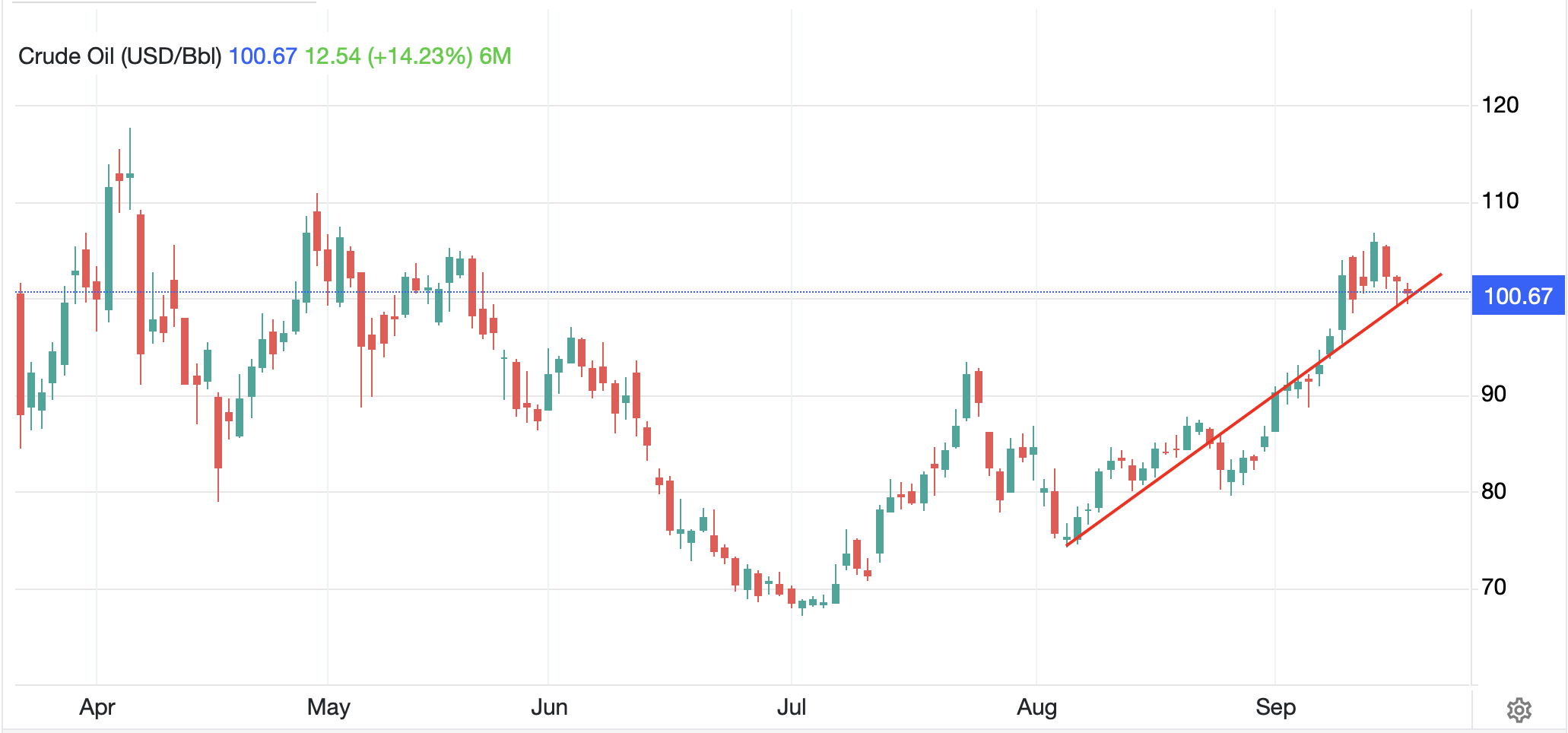
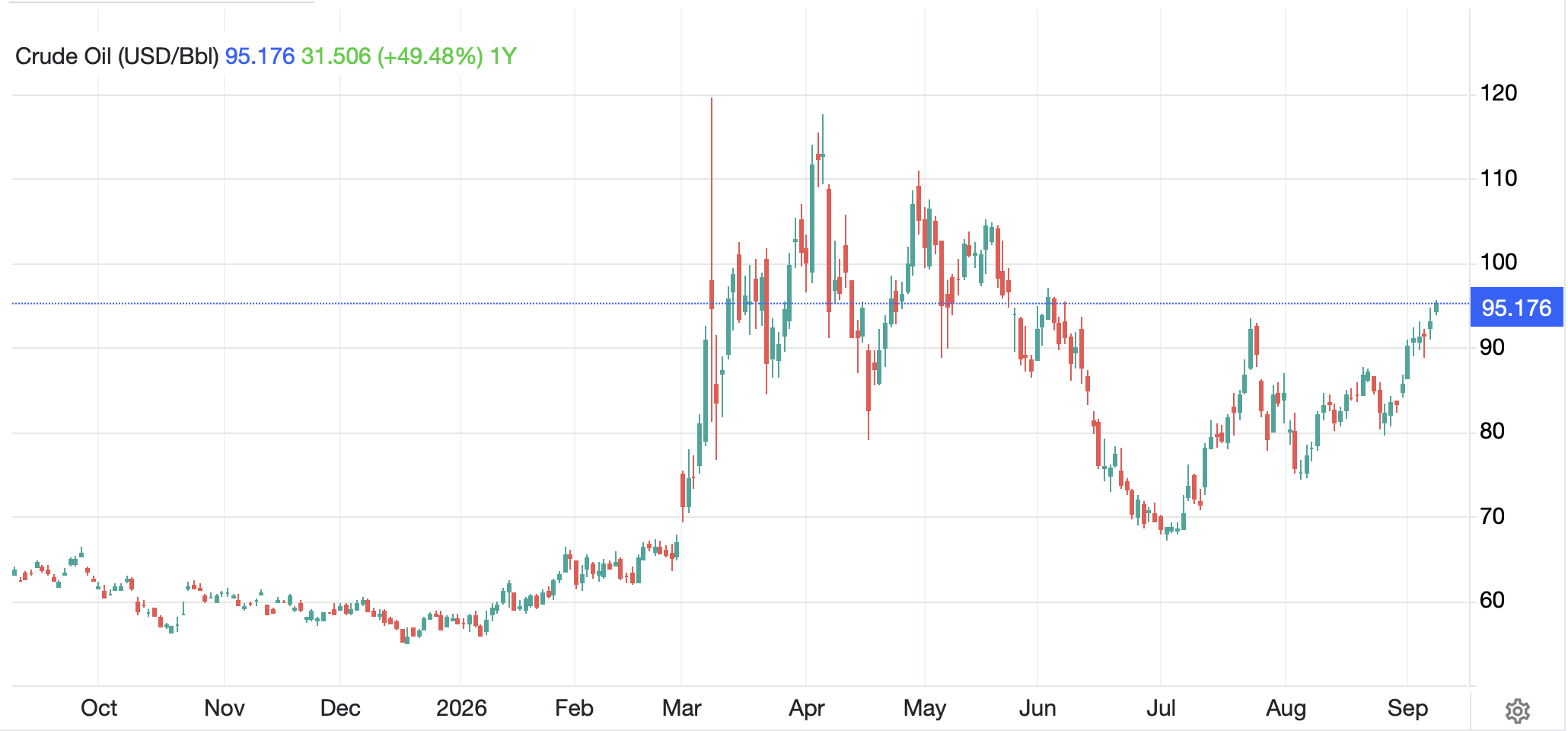
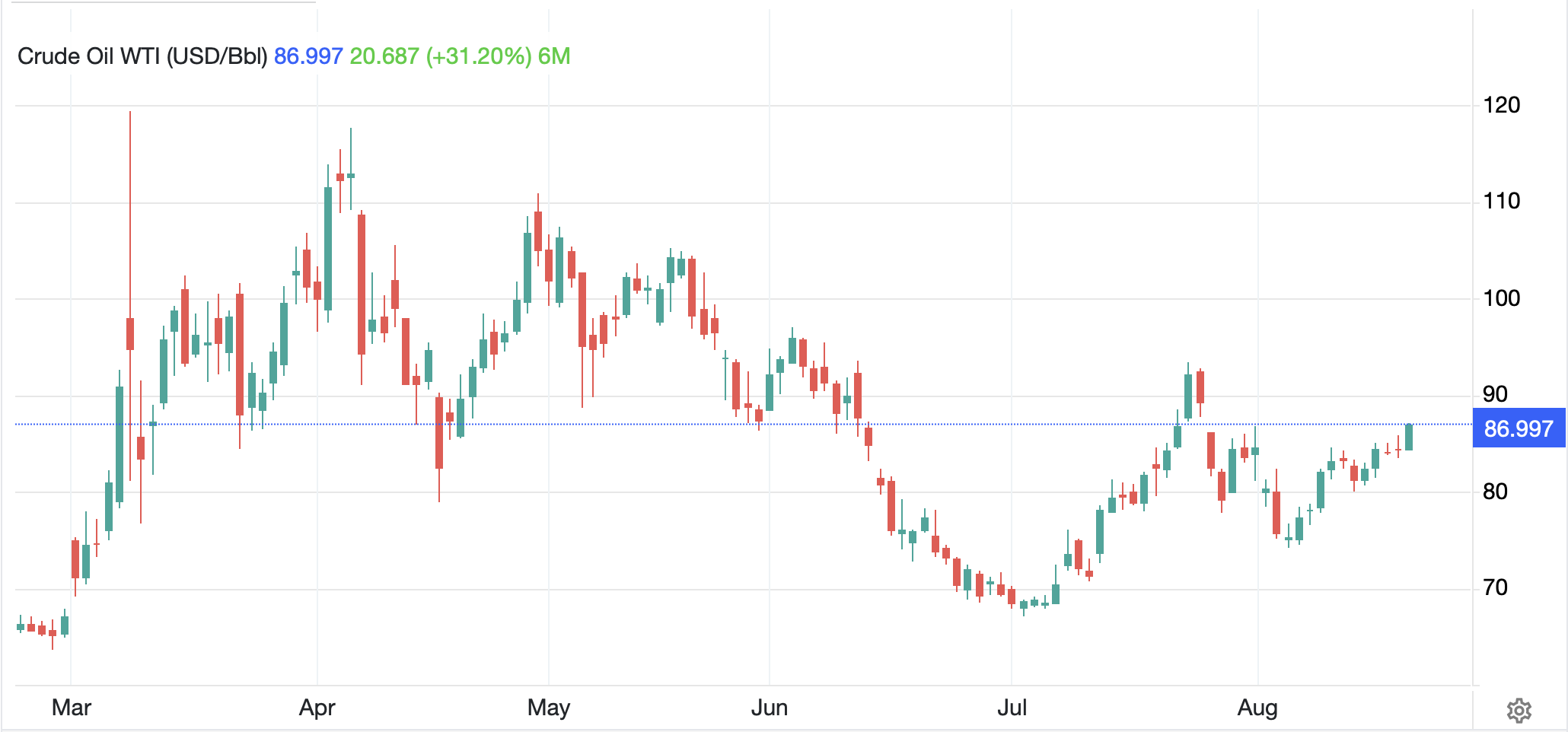
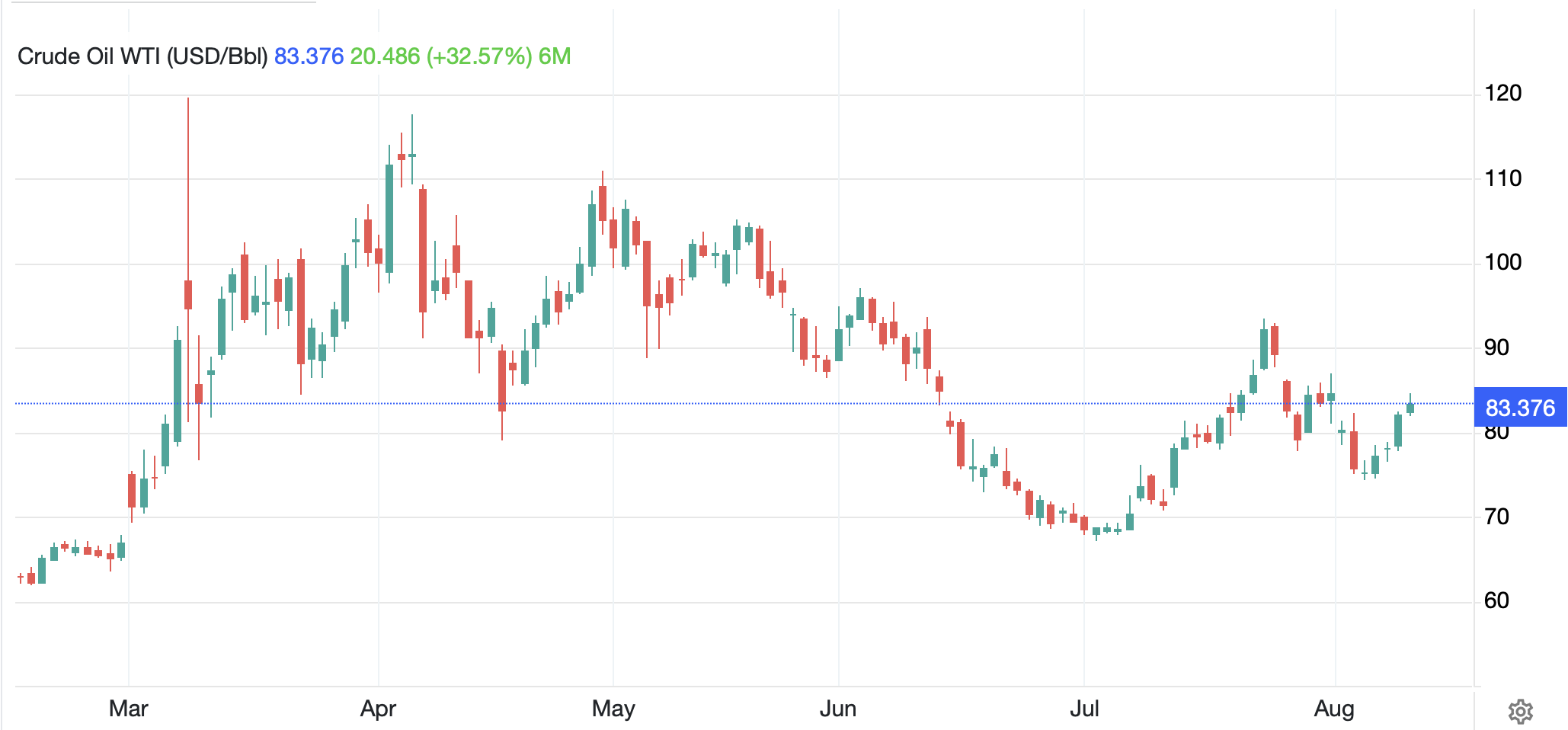
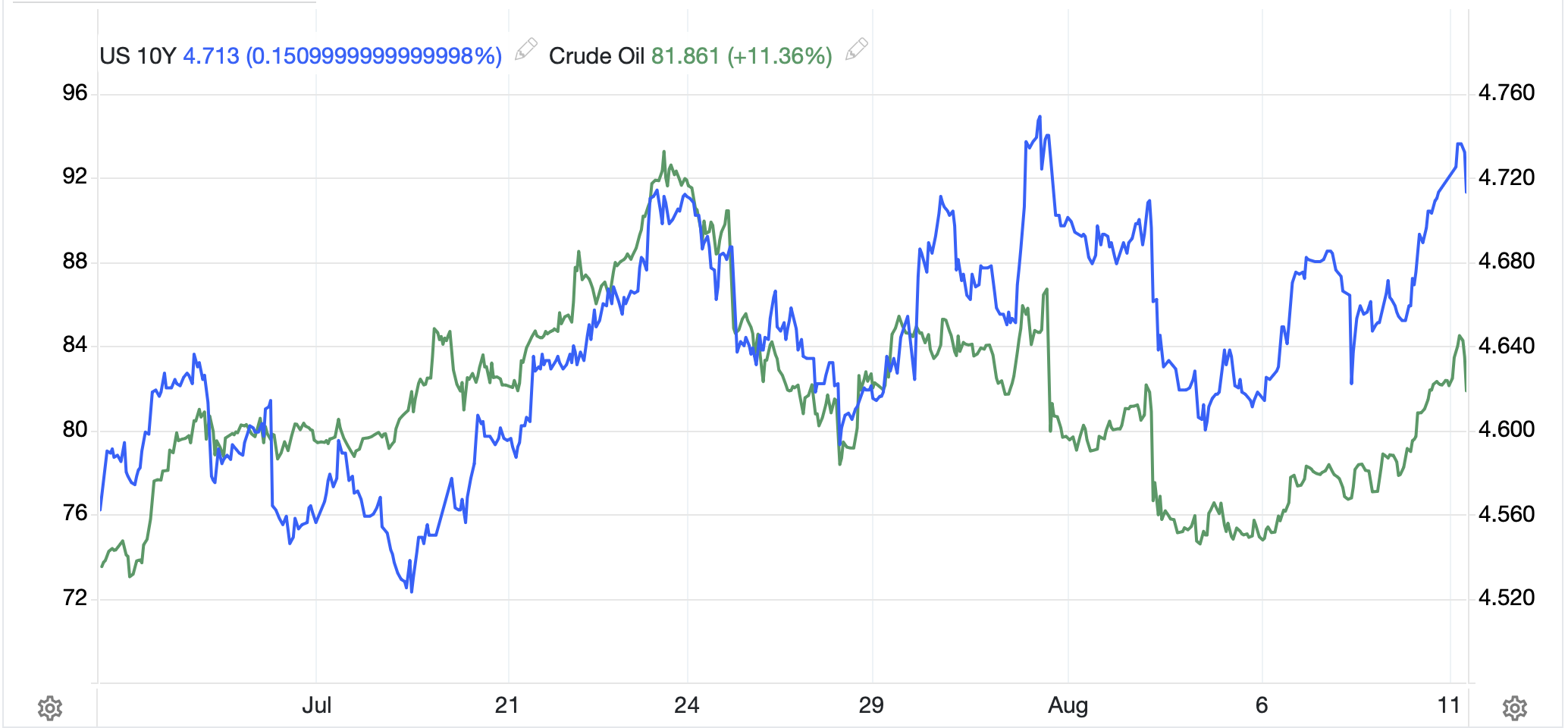
It is not clear what else to say about the current situation other than the markets are starting to believe that the Iran conflict is coming to a close.  The headlines from the administration and news from Pakistan seem to indicate a deal is near, something we all should welcome.  Certainly, the market is ready to accept this as gospel, at least based on the current risk appetite being demonstrated across all markets.  So, this morning, oil (-2.8%) continues its rapid decline, down more than $18/bbl from its highs just one week ago.

Source: tradingeconomics.com

The commentariat refuses to accept that the conflict is ending and I cannot tell if that is because they hate President Trump so much, they cannot stand the idea of him concluding things having achieved objectives, or because if the conflict is over, they will need to find the next thing to prove their ‘expertise’ and they don’t know what that is yet (hantavirus anyone?)  Regardless, markets are on board with this narrative as the moves we saw yesterday are simply extending this morning.  

Meanwhile, the data from yesterday showing that ADP Employment was a stronger than expected 109K and the JOLTs quit numbers rose, meaning more people are willing to quit their jobs for a new one, indicating a growing confidence in the labor market, point to a continuation of the US equity rally, and by extension, the global rally.  (As an aside, I chuckled at the article in the WSJ this morning about how the next target of taxes should be ‘compute’ since AI is going to replace human workers.  My comment here, which has been confirmed by my time this week at the Consensus 2026 cryptocurrency conference, is that machines are great, but people still want to deal with people they can trust!)

Anyway, with the conflict ostensibly coming to a close, there is not much else to discuss outside actual market activity, so let’s see how things responded to this news.

By this time, you have all checked your PA’s and saw the green from yesterday there.  Overnight, Asian markets were also quite positive with Japan (+5.6%) exploding higher after their Golden Week holidays ended.  Excitement on tech as well as a market that is looking forward to Treasury Secretary Bessent’s visit were the drivers.  But we also saw strength in China (+0.5%), HK (+1.6%), Korea (+1.4%) and Taiwan (+1.9%).  In fact, looking across the region, you are hard pressed to find a true laggard, as India (0.0%) was the worst performer of note.  European markets, though, are not quite in as fine a fettle with most of them essentially unchanged this morning although the UK (-0.7%) is lagging after some underwhelming earnings reports as it appears profit taking is today’s motive.  As to US futures, at this hour (6:45), they too, like Europe, are essentially unchanged

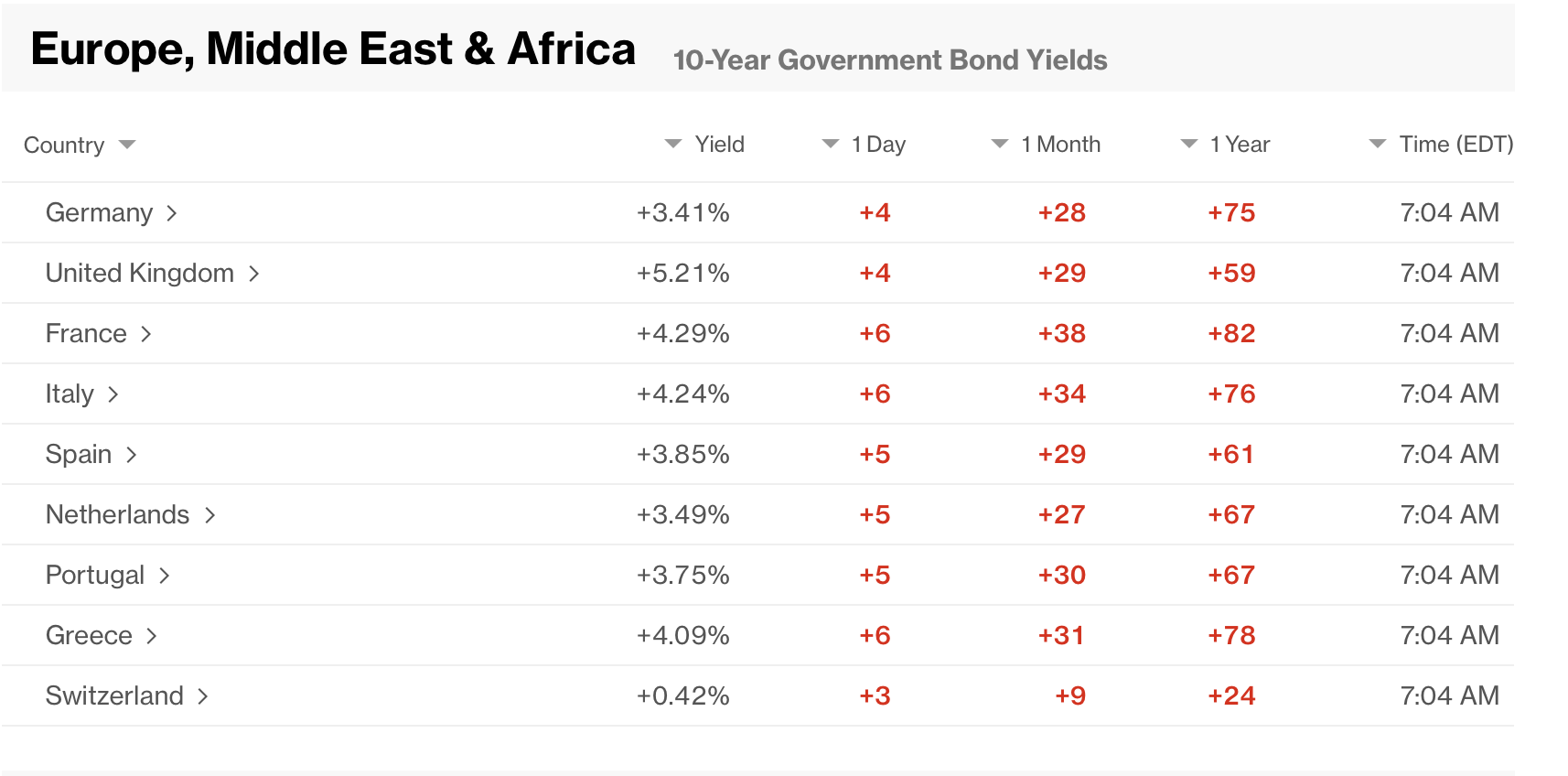
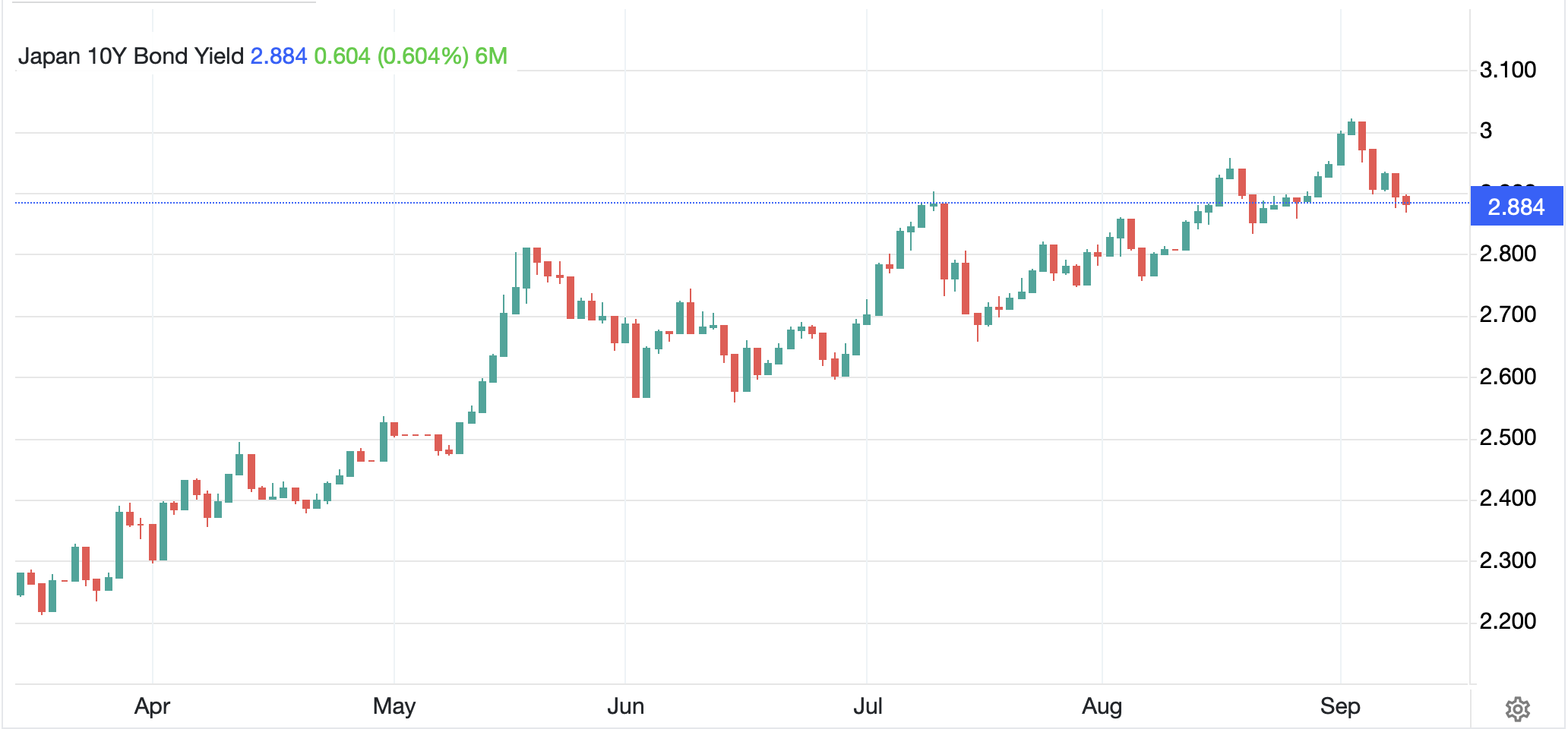
In the bond markets, yields continue to slide with Treasury yields lower by -2bps and virtually all European sovereign yields slipping -1bp.  Overnight, JGB yields fell -3bps as markets there reopened and essentially all Asian government bonds saw yields decline as well.  Apparently, fears over rampant inflation are ebbing.  You may recall on Tuesday I discussed the 30-year Treasury as it traded above 5.0% on Monday and stayed there for about a minute.  That had engendered a great deal of apocalyptic discussion.  However, here we are this morning with 30-year yields slipping another -2bps, and now 10 bps below that little spike, and back below 5.0%.  But I think it is worthwhile to offer a little perspective on the 30-year bond and the idea that 5.0% is deadly.  Here is the chart of 30-year Treasury yields since 1985.  Perhaps the anomaly was much lower yields, not 5.0%!

Source: finance.yahoo.com

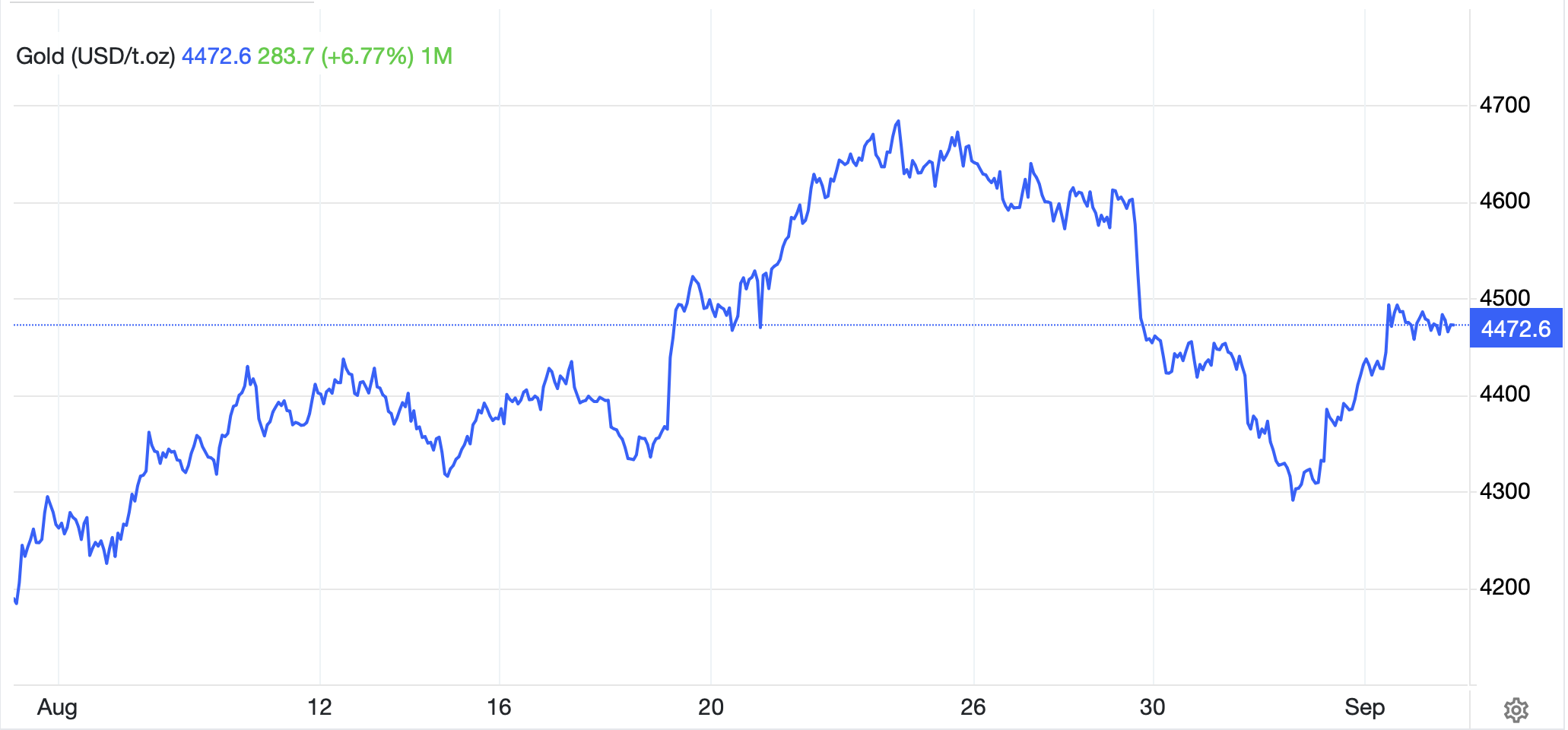
Precious metals are continuing to benefit from the peace initiative and oil’s delice with gold (+1.0%) and silver (+4.0%) both stronger again after big gains yesterday.  In fact, I am starting to read more about why silver is set to make massive gains because of shortages, a narrative that was set aside for the past two months but seems to be reawakening.  Now, I am no technician, but I am given to understand that if you look at this trend line in silver from its January peak, we have broken above the line and that portends a massive move higher.  (full disclosure, I am long silver so would be happy to see that but have not spent the extra money yet!)

Source: tradingeconomics.com

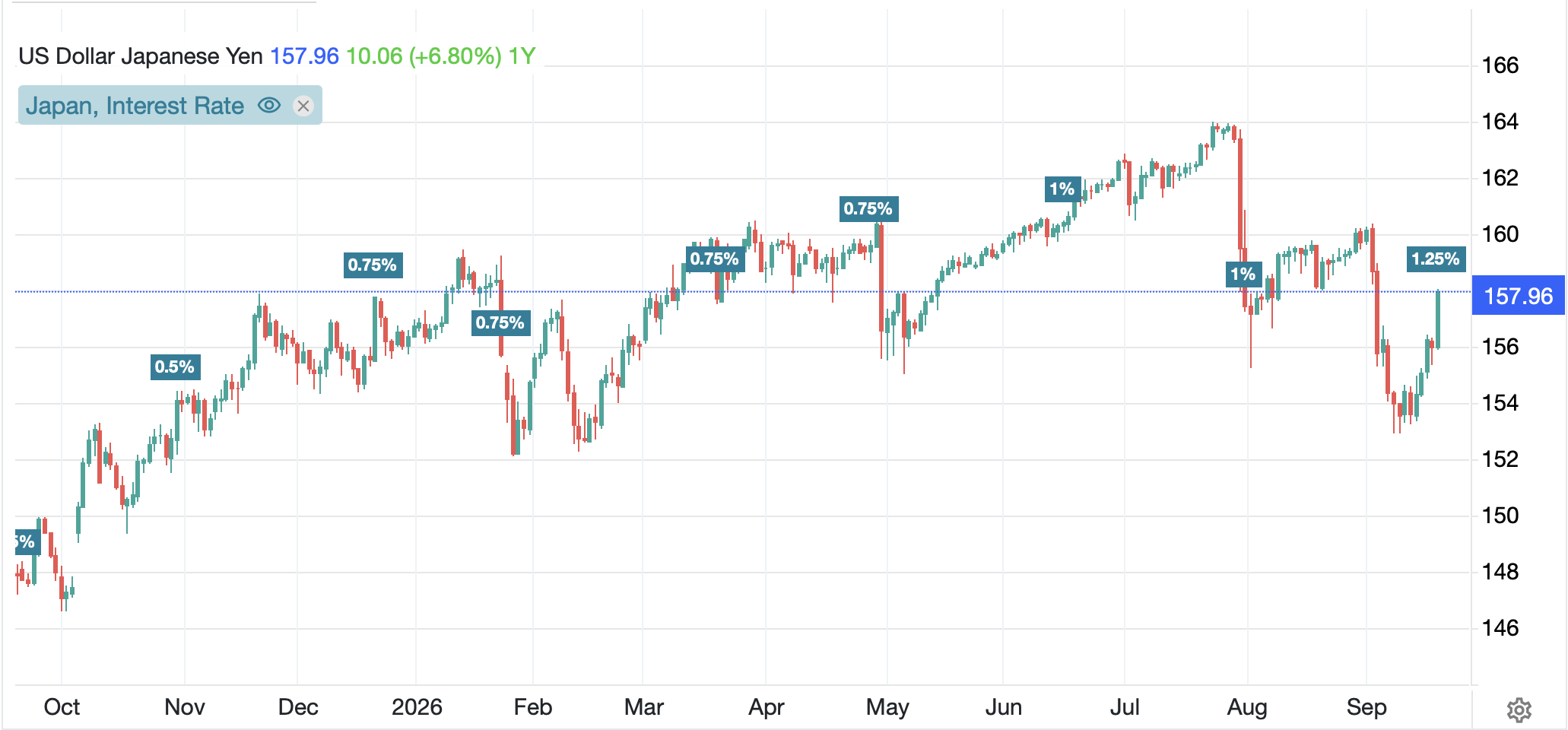
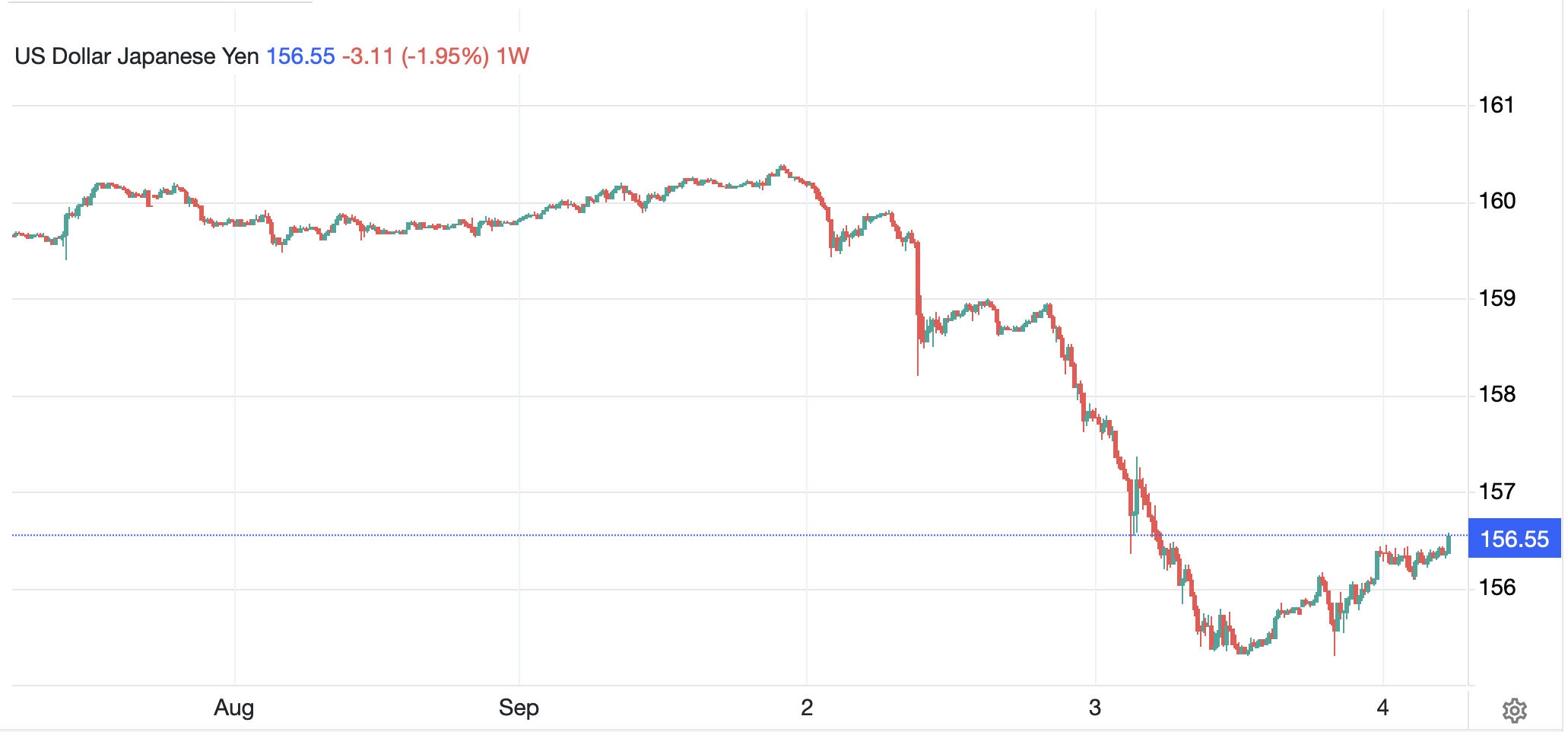
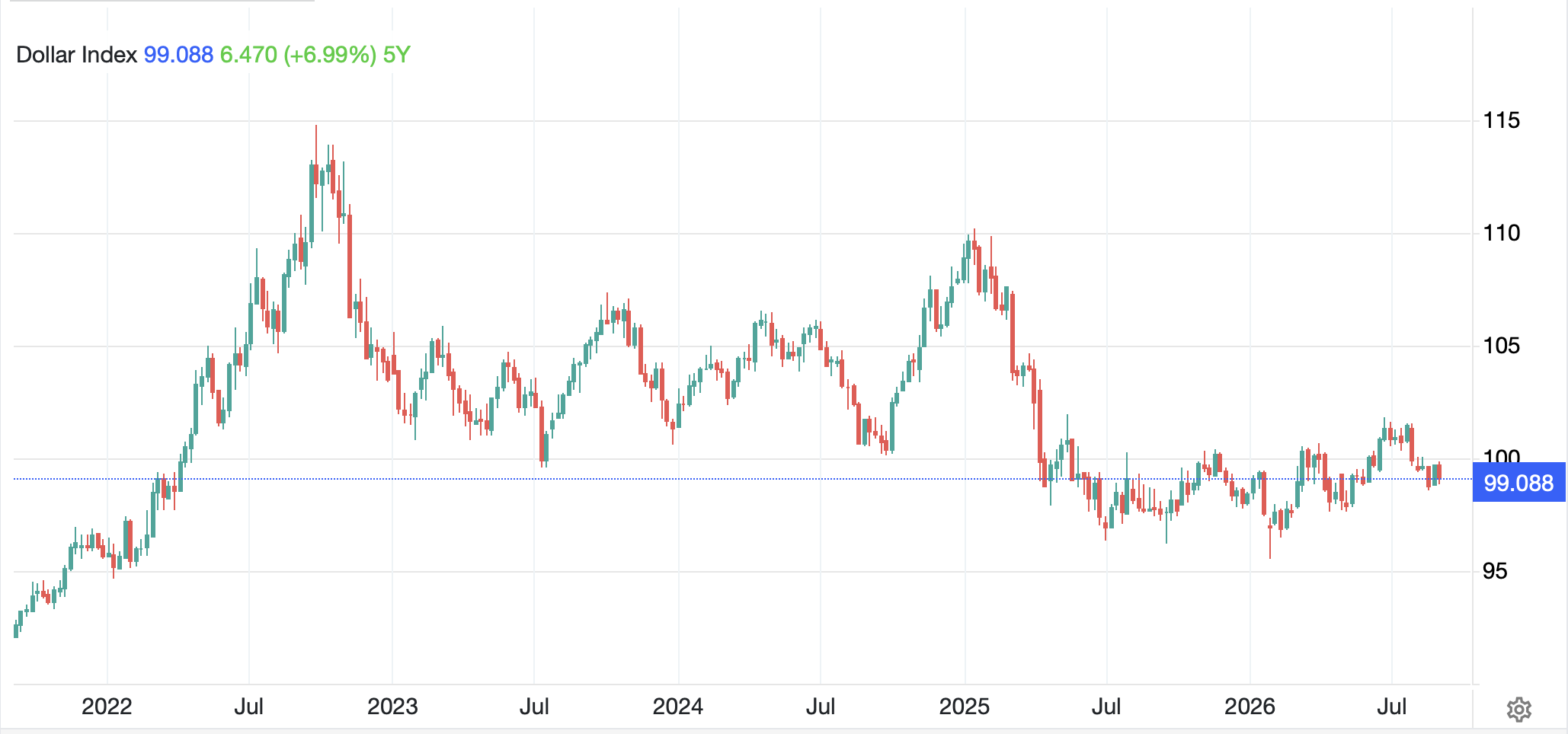
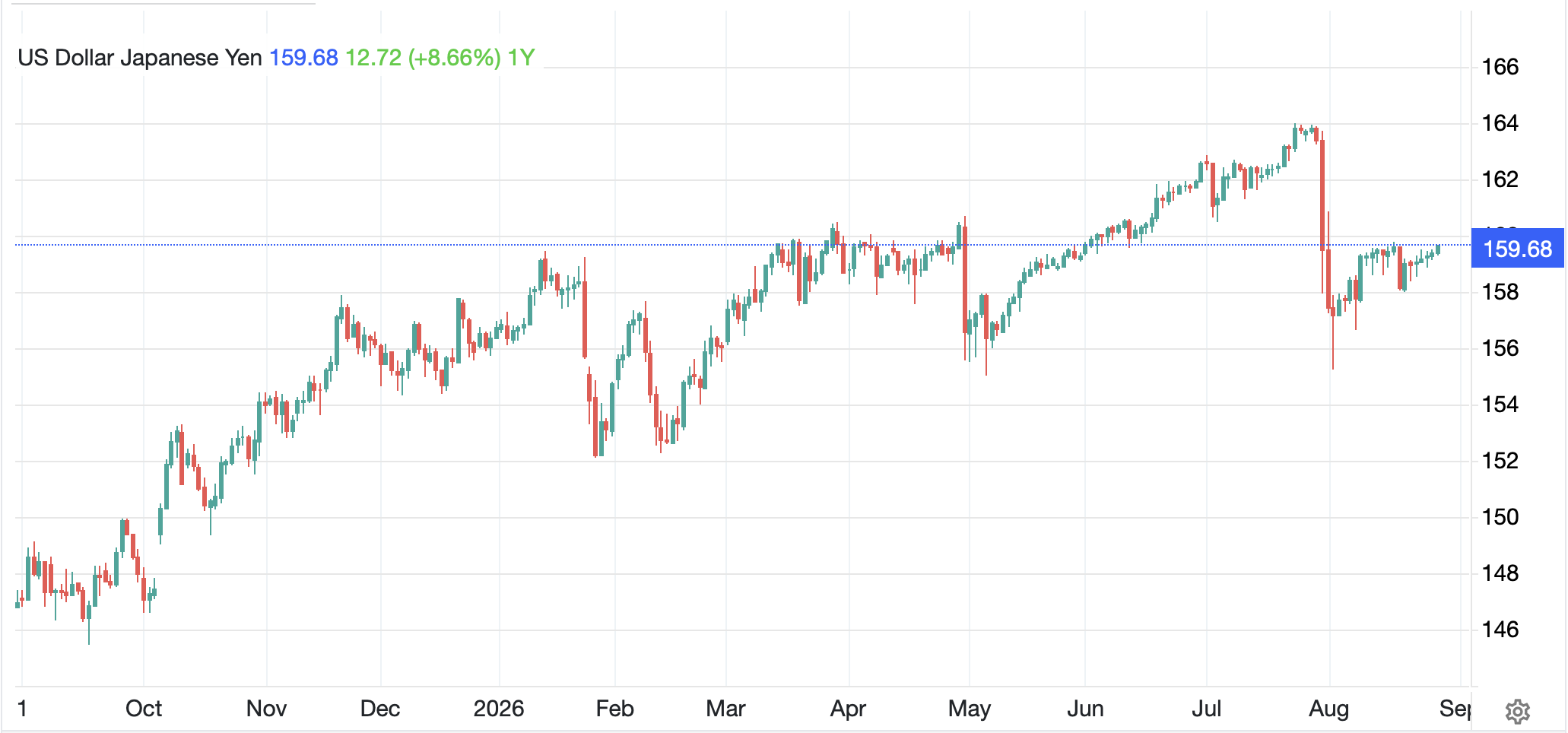
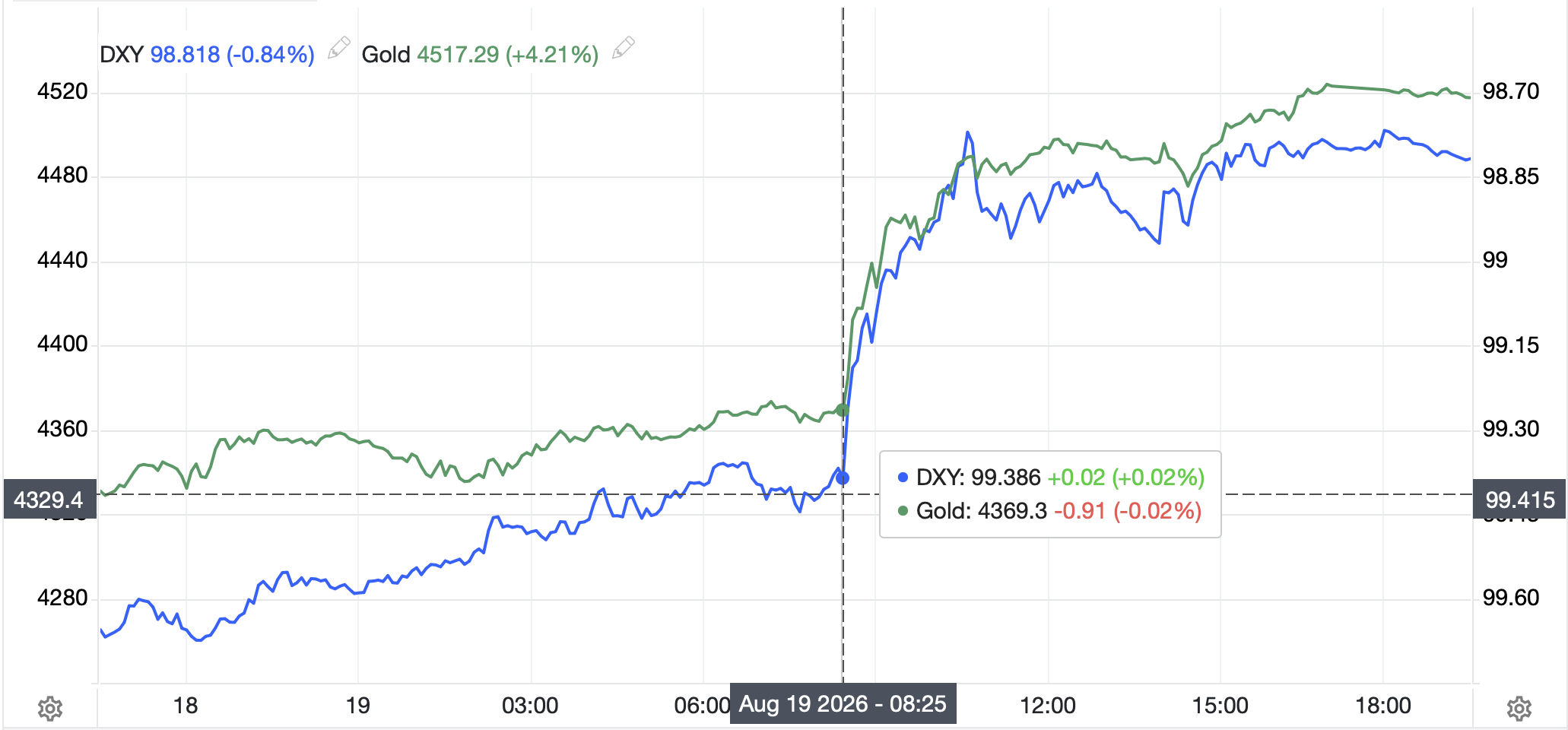
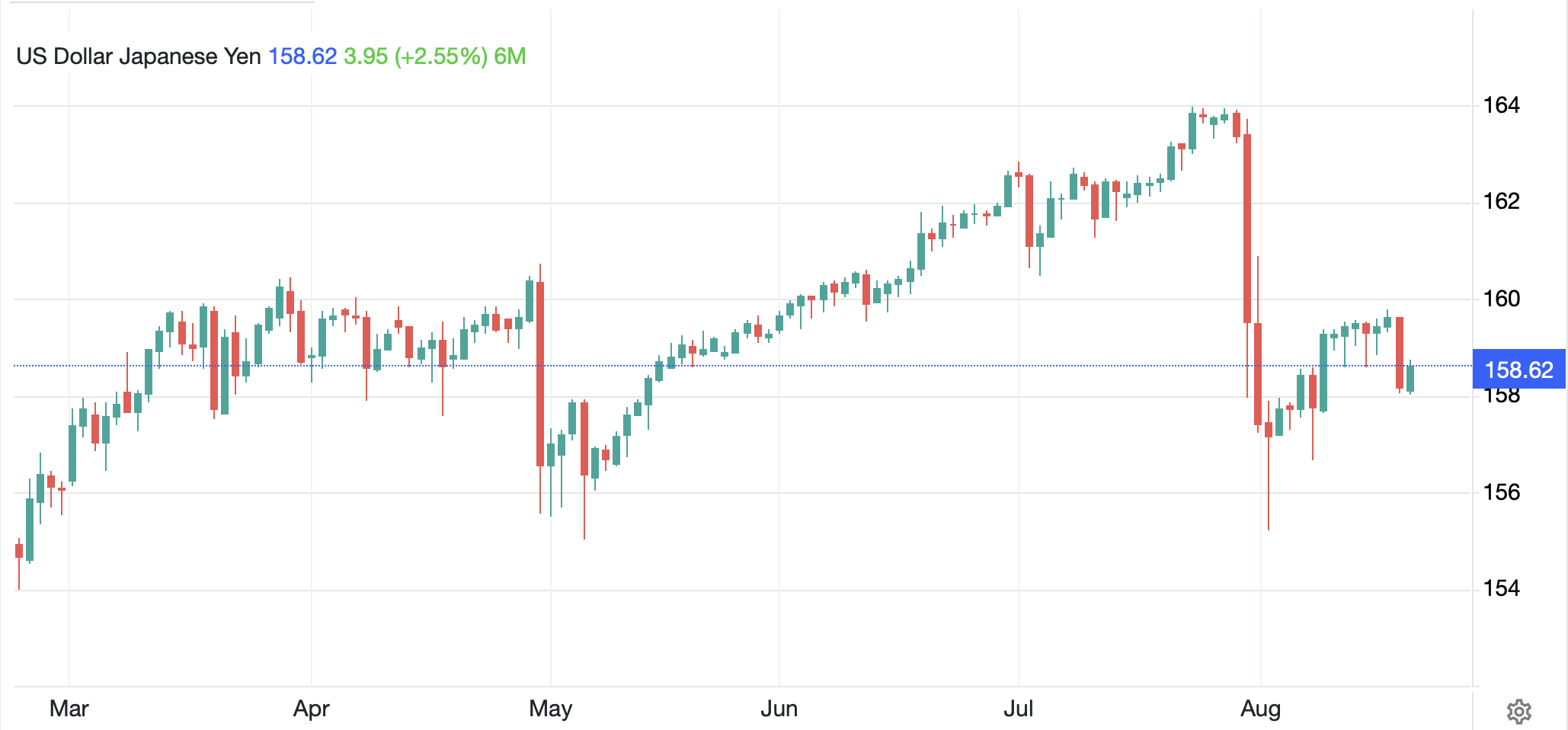
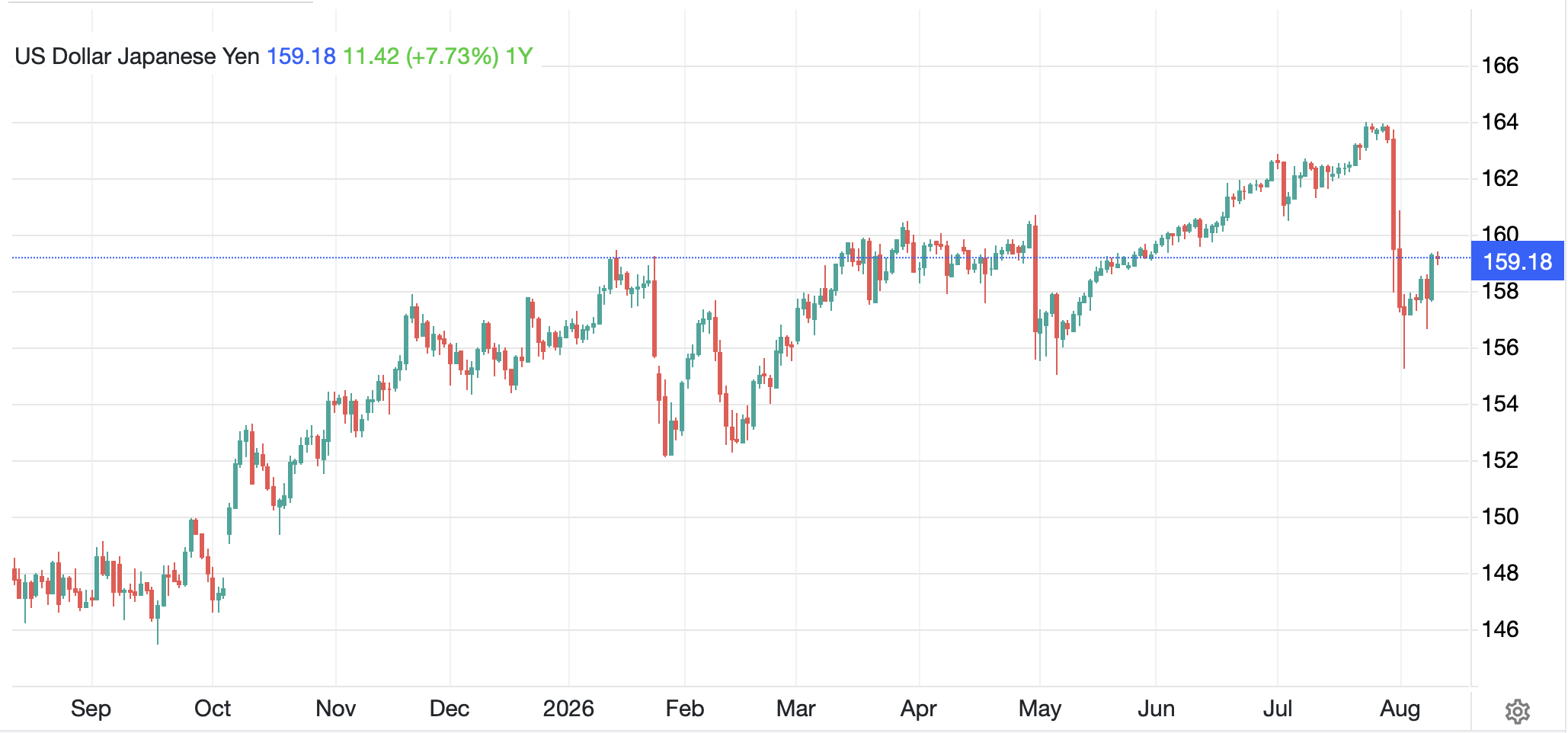
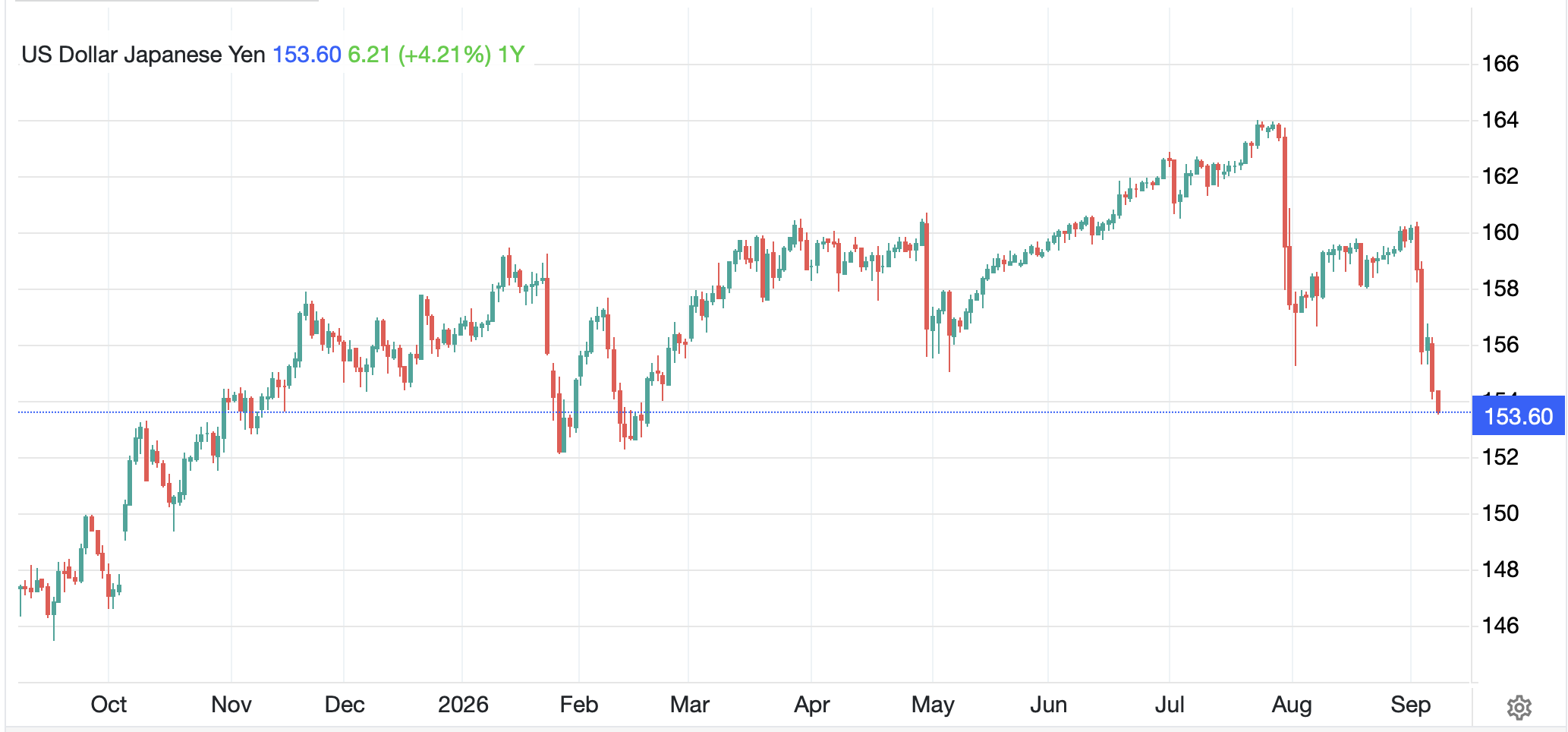
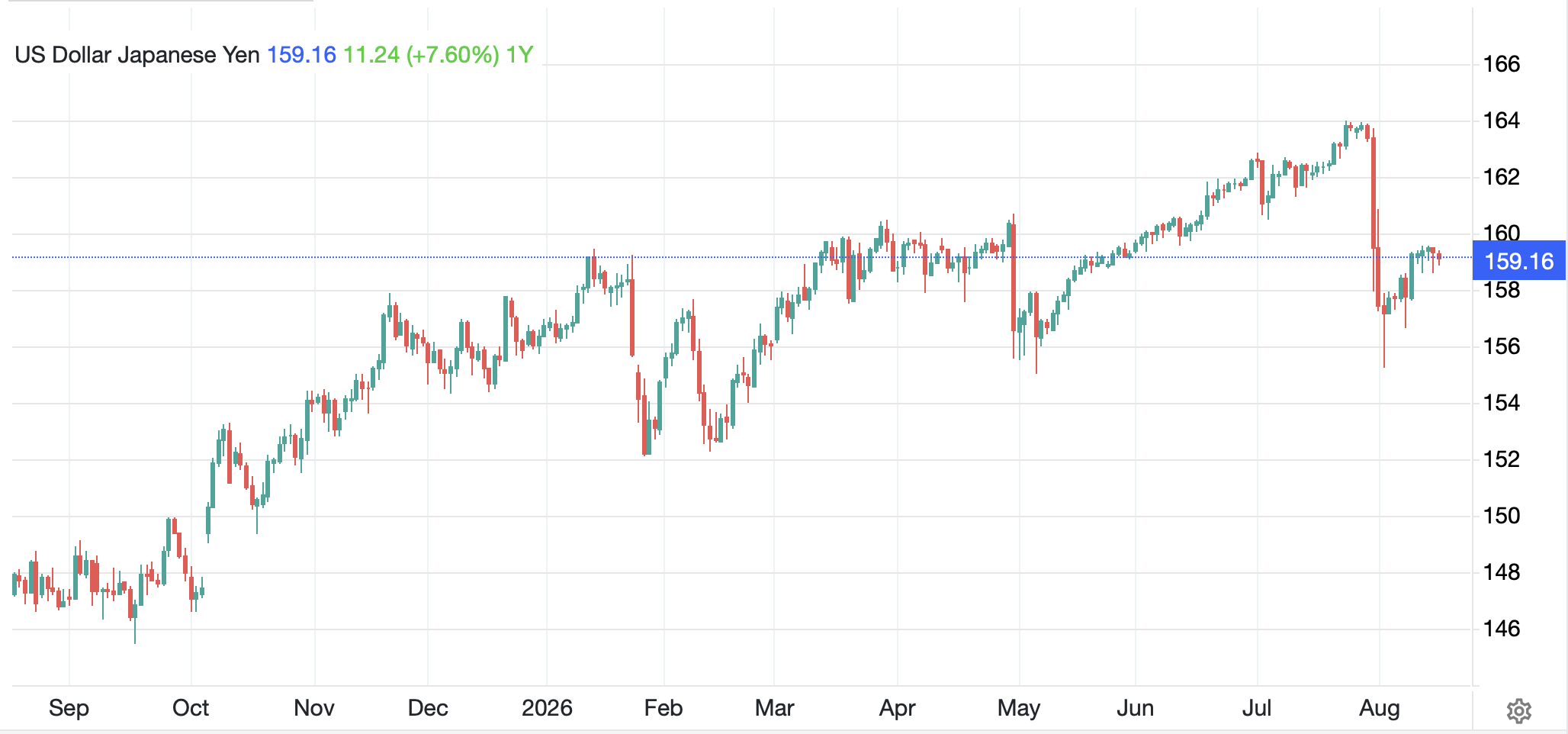
Finally, the dollar is softer again this morning, which should be no surprise based on the overall market zeitgeist this morning.  So, the DXY (-0.15%) is a pretty good approximation of what is happening, although we have seen some larger moves, notably NOK (+0.8%) which seems to be responding to the fact that the country is going to reopen some shuttered oil and gas drilling sites in the North Sea as Europe tries to figure out where to get energy from.  As to the yen (0.0%) after a series of what appeared to be modest interventions by the BOJ during Golden Week, it appears the market may be explaining that the fundamentals are still pointing to yen weakness and while the BOJ may be able to cap the dollar for a short time, establishing real JPY strength will take a lot more effort, and real policy changes (i.e. much higher interest rates).

Source: tradingeconomics.com

Turning to the data this morning, we get the weekly Initial (exp 205K) and Continuing (1800K) Claims data, which continues to hover near historic lows despite the angst over the labor market.  We also see Nonfarm Productivity (1.4%) and Unit Labor Costs (2.6%) and hear from several more Fed speakers, although most of their comments are back page news.  Of course, tomorrow we will see the NFP report, and that will certainly garner all the attention.  Personally, I will be focused on the Manufacturing Payrolls outcome as a proxy for the reshoring initiative and the potential for continued strong economic activity going forward.

And that’s really it.  Despite the ongoing narrative of the dollar’s demise, it remains well within its recent trading range, and I keep reading about other nations issuing dollar debt as that is the market with the most liquidity.  Over time, I continue to see the dollar as the best fiat around, although I still like stuff more than paper.

Good luck

Adf

Ere Fears They Shed

The status is still very quo
As ships still cannot come or go
However, Iran
Proposed a new plan
With nukes as a part of the show

But thus far, whatever they said
Has not moved discussions ahead
So, oil’s crept higher
As traders require
More certainty ere fears they shed

While President Trump has announced a new plan to help escort ships trapped in the Persian Gulf through the Strait of Hormuz, thus far, none have taken the chance.  Over the weekend, Iran ostensibly put forth another peace proposal, and this time their nuclear activities were part of the plan, a major change, although President Trump has rejected it overall.  To me, though, this is major progress as it demonstrates that there is a negotiation ongoing.  

My armchair analysis, FWIW, is that Ahmed Vahidi is watching his nation crumble and beginning to really feel the pinch of the US naval blockade as his revenues shrink rapidly.  While there are many estimates of how long Iran can withstand a lack of revenue, and I have no idea what that answer is, I feel it is reasonable to assume that if he doesn’t have enough to pay his soldiers, many of them will simply go home.  Already I have read reports that many of their payments to soldiers and proxies have been dramatically reduced as the US continues to tighten the financial screws via sanctions on banks and companies that have been acting as Iran’s middlemen.  I believe it is widely agreed on all sides of the conversation that the Iranian economy has been virtually collapsing with the rial having fallen 95% in value, access to basic staples limited and suffering widespread.  

The one thing of which I feel certain is that Vahidi wants to remain in power, and I would estimate as the pain increases, and the money stops flowing, his grip on power is slipping.  Staying in power without nuclear weapons is likely much preferred to being deposed.  

In the end, like every negotiation, the parties start far apart and get closer over time.  Now, my view is likely not worth all that much, but the oil market’s view is worth billions of dollars and if we look at how the price of oil has behaved, while uncertainty remains, (especially after a report this morning that Iran fired on and struck a US naval vessel, although that report has been denied), the market does not appear to believe that this is going to continue that much longer.  

Source: tradingeconomics.com

Several things continue to occur as at $100/bbl; there is some level of demand destruction; production elsewhere in the world continues to grow (I read that Venezuelan production rose to 1.25 mm bpd ,more than had been assumed prior to the Iran war); and the Saudi east-west pipeline is now pumping its capacity 7 million bpd, thus the amount of oil ‘missing’ has been reduced from the initial headline 20 mm bpd to somewhere along the lines of 12 mm bpd, still extremely painful to the global economy, but obviously not (yet) catastrophic.  However, since oil prices remain around $100/bbl, and have not risen to $150/bbl or $200/bbl as many pundits had forecast, there remains a great deal of confidence that this is going to end before too much more time has passed.  I certainly hope so for everyone’s sake.

Away from that, there is precious little other news to note as Asia is basically on holiday until Thursday and the UK is closed today, so market activity has been more muted.  But let’s take a look.  In the equity markets, weirdly HK (+1.2%) was open despite both China and the UK being closed and given HK’s history, I would have thought it would have responded to one of those situations.  But the big news was Korea (+5.1%) which was dramatically higher on rallies in Samsung and SK Hynix shares, both of which have been major beneficiaries of their semiconductor businesses booming alongside AI demand.  I guess we shouldn’t be surprised Taiwan (+4.6%) followed that path and in truth, there were more positive outcomes (India, Philippines, Malaysia, Singapore, New Zealand) than laggards (Australia).  Remarkably, everything I read is that Asia is the region most negatively affected by the Iran war, yet here we continue to see equity markets rising.

In Europe, things are less optimistic this morning with red across the screen led by Spain (-1.6%) and France (-1.0%) although both the UK and Germany are nigh on unchanged.  One of the weekend stories is that the US is now going to be raising tariffs on European auto imports to 25% from the 15% initially agreed as Trump claims the Europeans weren’t following the agreement.  As to US futures, this morning they are marginally lower as I type (7:30) but remain just ticks away from the all-time highs set last week.  Again, it is difficult to accept the idea that the world is about to end based on the market’s current behavior.  Look at the chart below and worry does not seem to be prevalent, nor has it been for any extended length of time in the past 5 years.

Source: tradingeconomics.com

In the bond market, yields are higher this morning with Treasuries (+4bps) leading the way and European sovereigns all higher by between 3bps and 4bps as well.  It’s interesting that this is the behavior but I suppose it has to do with the Keynesian view that higher economic activity leads to higher rates.  If we look at the PMI data from around the US and Europe, manufacturing has been doing quite well.  Look at the ISM Manufacturing chart below for the past 3 years and it is clear that investment is growing there.

Source: tradingeconomics.com

It is a similar tale in Europe with Manufacturing PMI data this morning all being released healthily above the 50 level and rising from last month.  The market response to lift yields seems anachronistic, but such is life.  However, it is worth highlighting that if we take a bit of a longer-term perspective on 10-year Treasury yields, while they are pushing toward the top of a 4.00% – 4.50% range, you can see that range has largely been intact for the past 3 years.  It is not clear to me that it is time to panic on yields yet.

Source: tradingeconomics.com

In the commodity space, with oil (+3.3%) having risen on the reports of a US ship being attacked, we cannot be surprised to see gold (-1.2%) and silver (-2.6%) both slipping along with copper (-1.6%). This is especially true with China and most of Asia on holiday as official buying of gold is probably on hold for now.  

Finally, the dollar is firmer this morning as risk is under pressure across the board.  US futures are lower, European stocks are lower and oil is higher.  So, gains of 0.25% for the dollar against most currencies are the norm.  There was a very sharp appreciation in the yen early in the overnight session and another one a few hours ago, as you can see in the chart below, with many believing the BOJ was in again during quiet markets, but it has completely reversed.  My take is the BOJ would not have spent reserves like this and would have been far more emphatic if they wanted to move the market again.

Source: tradingeconomics.com

But, as market in Asia were quite thin, any large sell order would have been able to force a move like these.  In addition, with the dollar now several percent below their level of concern, I suspect they will save their ammunition.  In the EMG bloc, ZAR (-0.5%) continues to feel most of the pressure from Iran as the combination of higher oil prices and lower gold prices are a double whammy.  As well, NOK (+0.35%) continues to respond positively to the oil price.   Net, the dollar remains in demand for now.

On the data front this week, it is a mixed week until Friday’s NFP data is released.

TodayFactory Orders0.5%
 -ex Transport0.7%
TuesdayTrade Balance-$60.5B
 ISM Services53.7
 JOLTs Job Openings6.83M
 New Home Sales668K
WednesdayADP Employment99K
ThursdayInitial Claims205K
 Continuing Claims1800K
 Nonfarm Productivity1.4%
 Unit Labor Costs2.6%
 Consumer Credit$11.0B
FridayNonfarm Payrolls60K
 Private Payrolls73K
 Manufacturing Payrolls5K
 Unemployment Rate4.3%
 Average Hourly Earnings0.3% (3.8% y/Y)
 Average Weekly Hours34.2
 Participation Rate61.7%
 Michigan Sentiment49.5

Source: tradingeconomics.com

In addition, Fed speakers are back on the circuit (I sure hope Warsh shuts them all up) with 12 speeches from 9 different speakers.  The funny thing is, we already know their views, Miran wants to cut and everybody else is on hold, so what are they going to say?

The war remains the only thing that matters right now, so watch for headlines that an agreement is coming closer.  If that happens, oil will slide along with yields and the dollar while metals and stocks will rally.  (Of course, apparently, we don’t need anything else to get stocks to rally!)

Good luck

Adf

Twiddle Their Thumbs

While nations worldwide celebrate
The holiday Marxists made great
Most markets are closed
With traders disposed
To twiddle their thumbs and just wait

Almost every market in both Asia and Europe was closed last night and this morning as the May Day holiday, which while it became a labor celebration in the late 1800’s was actually a pagan ritual in ancient times, coincides with the Golden Week holidays in most of Asia.  Yes, US markets are open, and so are UK markets, but that’s pretty much it.

The biggest market news, I would argue, was the BOJ intervention that we saw early yesterday morning, and then, apparently, again during the session.  Bloomberg calculated they spent ¥5.4 trillion in their efforts, a cool $35 billion or so.  As you can see from the chart below, it did look like there might have been a second, smaller wave this morning, but there is no confirmation of that happening.  The second sharp decline could simply be an order in thin holiday markets.

Source: tradingeconomics.com

Of course, the Japanese intervening in the FX markets is not that newsworthy in the big picture, they have done so many times.  What was much more interesting was the fact that they ostensibly intervened in the oil market as well, selling futures to help cap the price there.  While there are many market participants who decry official intervention in markets, and I understand their concerns, long ago I recognized that governments, by the very fact that they make the rules, are going to do what they want.  And while some will claim this was a sop to President Trump to help keep energy prices down, it helps the Japanese economy as well.  Japan has been negatively impacted to a much greater degree than the US by high oil prices.

Source: tradingeconomics.com

My final thought on this subject is that it is likely to be a huge win for the Japanese as well, shorting oil at $108/bbl, or whatever their price is will be seen as genius when the end game plays out and oil prices tumble due to massive supplies becoming available.

But really, it is hard to look around and see much more than that.  While there is still some discussion of Powell’s decision to remain on the FOMC after his chairmanship ends, I don’t think the market cares all that much anymore as all eyes are now on Mr Warsh to see how he navigates things.

Otherwise, every other story is clickbait and largely unrelated to financial markets today.  Rather, it is a good day to play golf, or sit outside and read a book, at least in NJ where it is sunny and heading to 65 degrees.

So, let’s do a quick recap of the few things that did happen overnight.  Apple reported strong earnings last night which helped confirm the new record highs in US equity markets, at least in the S&P 500, and helped all US markets to a strong session yesterday.  This morning, though, the NASDAQ futures are pointing slightly lower, -0.2%, as I type at 7:15 although the other major indices are in the green.  Overnight saw Tokyo (+0.4%) rally a bit as did Australia (+0.7%) and New Zealand (+1.0%), but they were the only markets open.  The rest of Asia was on holiday.  In Europe, only the UK (-0.5%) is open today with a lackluster performance on weaker banking profits and forecasts.

In the bond market, Treasury yields (+2bps) have moved a bit higher as have UK gilt yields (+2bps) with the rest of Europe closed.  One of the interesting things about the bond market is the fact that US economic activity continues to prove remarkably resilient as yesterday’s data showed strong Personal Income and Spending data (0.6% and 0.9% respectively), with GDP growing 2.0% and Initial Claims falling to 189K, its lowest print since 1968!  Meanwhile US energy exports have been growing to record levels, and the US economy is benefitting massively from the relative abundance of energy available here, especially with NatGas prices still one-sixth their price in Europe.  I must admit it doesn’t feel like the data points toward the need to cut rates.

Turning to commodities, oil (-0.6%) has not been able to reverse the impact of the Japanese intervention yet as all eyes remain on Iran to see if the blockade will force them to concede soon.  As well, the fact that the UAE has left OPEC, the 4th nation to do so in the past seven years, is an indication that OPEC has lost virtually all its pricing power.   I remain medium term and longer term bearish on oil as the political constraints fall away with the war just accelerating that process.  As to the metals markets, after a nice rally yesterday, gold (-1.0%) is backing off a bit while silver and copper are essentially unchanged.

Finally, the FX markets are also extremely quiet overall once you move away from the yen, which today is also little changed from yesterday’s closing level.  In fact, the entire market has only moved +/-0.25% or less from yesterday.  There is no story here.

And in fact, there is no story anywhere today.  ISM Manufacturing (exp 53.0) and Prices Paid (80.0) are on the docket and that’s it.  No speeches, and quite frankly I expect very little price action overall as most trading desks will take my advice and leave early.

Good luck and good weekend

Adf
That’s Nuts

Seems Jay is a narcissist too
Refusing to leave when he’s through
He claims he won’t try
To stop the new guy
But sticking around is the clue

Meanwhile, in his last vote as Chair
The poll, for his views, didn’t care
As one wanted cuts
And three said that’s nuts
Seems politics is in the air

Starting with the FOMC meeting, as universally expected, they left policy on hold with the Fed funds rate target 3.50% to 3.75%.  However, in an extension of the last meeting’s three dissents, this time there were four, so the vote was 8-4 to leave rates on hold.  However, that seems a bit disingenuous to my eyes, as while Governor Miran wants a 25bp rate cut, as he has said all along, the other three ‘dissents’, regional presidents Hammack, Kashkari and Logan, “did not support inclusion of an easing bias in the statement at this time.”

However, after having read the statement numerous times, I challenge anyone to highlight where they expressed an easing bias.  Here is the exact wording:

Recent indicators suggest that economic activity has been expanding at a solid pace. Job gains have remained low, on average, and the unemployment rate has been little changed in recent months. Inflation is elevated, in part reflecting the recent increase in global energy prices.

The Committee seeks to achieve maximum employment and inflation at the rate of 2 percent over the longer run. Developments in the Middle East are contributing to a high level of uncertainty about the economic outlook. The Committee is attentive to the risks to both sides of its dual mandate.

In support of its goals, the Committee decided to maintain the target range for the federal funds rate at 3‑1/2 to 3‑3/4 percent. In considering the extent and timing of additional adjustments to the target range for the federal funds rate, the Committee will carefully assess incoming data, the evolving outlook, and the balance of risks. The Committee is strongly committed to supporting maximum employment and returning inflation to its 2 percent objective.

In assessing the appropriate stance of monetary policy, the Committee will continue to monitor the implications of incoming information for the economic outlook. The Committee would be prepared to adjust the stance of monetary policy as appropriate if risks emerge that could impede the attainment of the Committee’s goals. The Committee’s assessments will take into account a wide range of information, including readings on labor market conditions, inflation pressures and inflation expectations, and financial and international developments.

But that is the narrative.  Of course, the fact that there were four dissents led to much tongue wagging by the narrative set with some claiming that Powell had lost the room, while others claimed that this is a warning to Warsh that he will not be able to get his way.  

During Warsh’s nomination hearing, one of the things he discussed in terms of the institutional changes necessary, was that there needed to be less communication by FOMC members as it didn’t do anything to help the process.  I heartily agree with this approach, and perhaps this was all the regional presidents, who are looking ahead and seeing that they will not be able to move markets anymore, certainly a heady feeling I’m sure, trying to stake their turf.

Meanwhile, Chair Powell, the arch traditionalist as we have been told, will be breaking with tradition and remaining on the board in his governor’s role after his chairmanship has ended, although he claims this is to ensure the institution remains protected from politics. (🤣🤣🤣🤣🤣🤣🤣🤣🤣). Whatever.  I am willing to wager that Mr Powell is a consistent dissent as long as he is on the board.

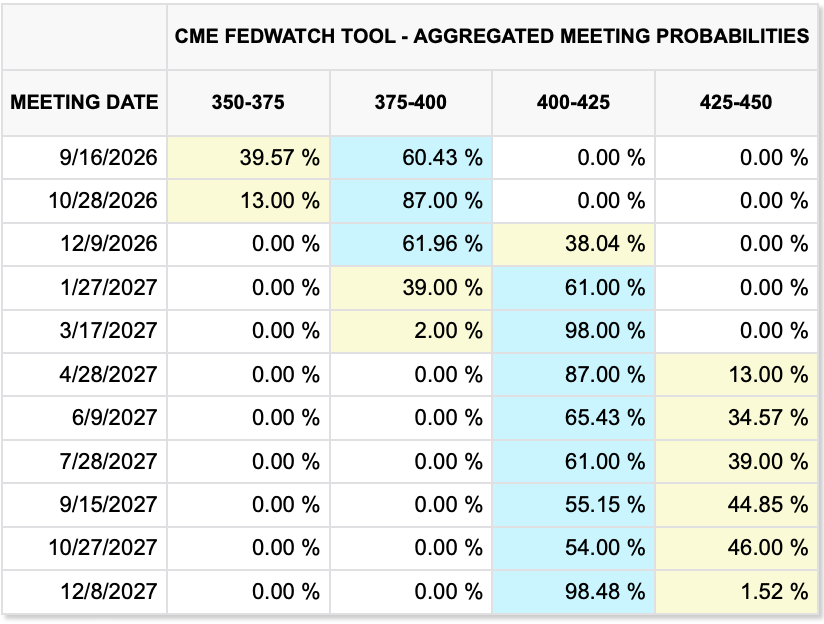
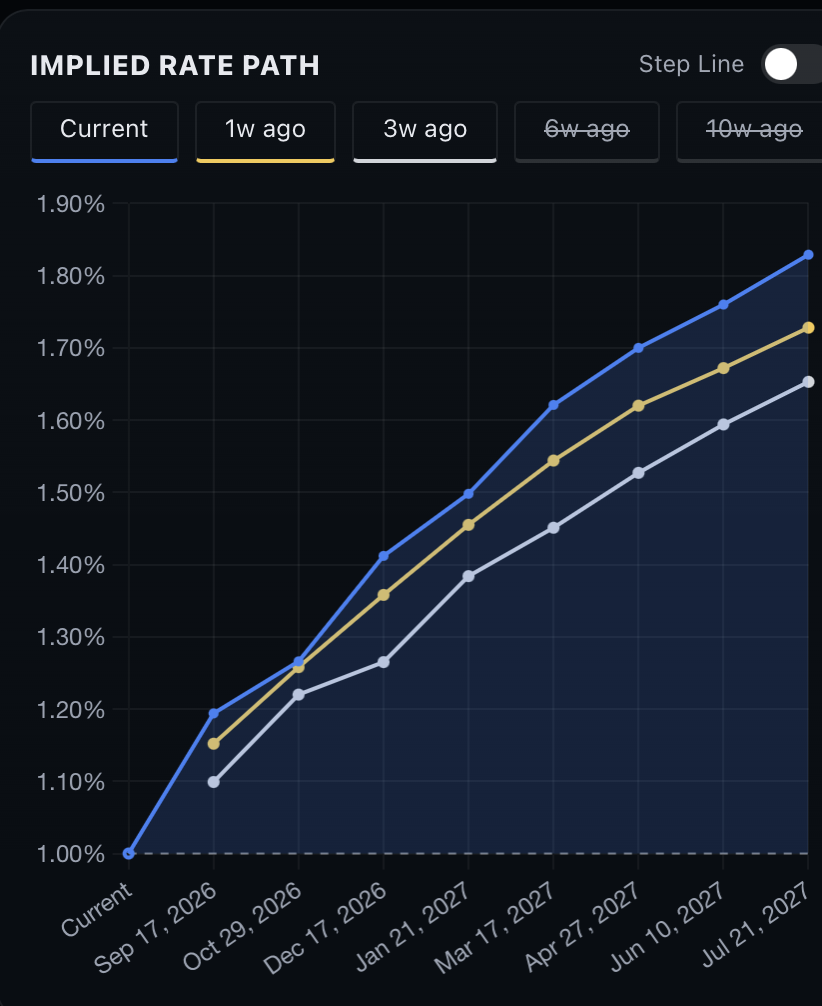
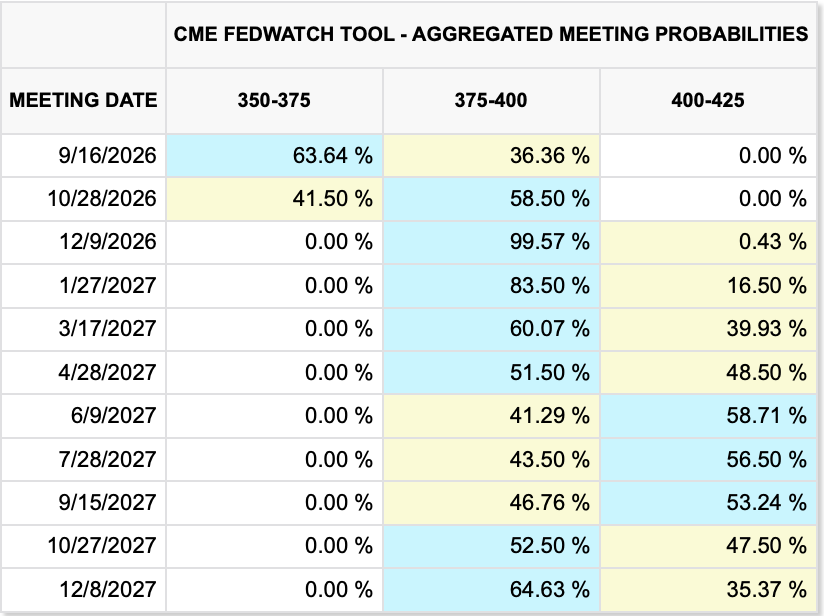
In the end, no policy changes were expected nor forthcoming.  As of the close of yesterday’s session, the Fed funds futures market looks like this:

Source: cmegroup.com

Basically, market participants do not believe the Fed is going to do anything for nearly the next two years.  I hope they are right!

Remember Monday?
Ueda explained…nothing
That’s what the yen heard

Early this morning
Katayama, with a smile,
Hinted at bold action

Monday’s BOJ meeting resulted in no policy changes, as was widely expected, but Ueda-san perfectly illustrated the futility of central bank chiefs trying to guide markets with their words instead of deeds.  Basically, he fumbled around exhibiting no commitment to anything.  And, one look at the chart below shows that traders continued to sell the yen in the wake of the BOJ meeting on the 28th.  However, traders are nothing if not attentive to signals and while it took her a little while, Japanese FinMin Katayama livened things up a bit after Tokyo markets closed as follows [emphasis added]:“We are nearing the point where bold action on exchange rates will be necessary,” and more entertainingly, “I just want to remind everyone: whether you’re traveling or taking a break, don’t put down your smartphone.”

Source: tradingeconomics.com

One of the problems for them is that we are coming to Golden Week, with the first of the holidays already past yesterday.  But Friday through next Wednesday are all Japanese holidays with no markets open.  On the one hand, lack of liquidity can suit the BOJ as any intervention may have a much larger than normal impact.  On the other, holiday activity is very rare.  The term ‘bold action’ is, I believe, step 6 in the 7 steps to intervention and as you can see from the above chart, traders are listening.  The problem Katayama and Ueda have is that the fundamentals remain negative for the yen.  Is it really speculative to respond to weakening Japanese economic data that is worsened by the current energy situation vs. surprisingly strong US economic data where the energy situation is a benefit for the US?

If history is any guide, the dollar is likely to trade below that 160 level for a little while as traders may not want to test things during the Golden Week lack of liquidity, but ultimately, I suspect that dollar can push higher and the BOJ will be in.  Their problem, though, is fundamental, and until the fundamentals change, the yen will be under pressure.

Speaking of fundamentals, let’s take a quick look at GDP figures and ask ourselves about the prospects for currencies in the future.  The below chart from tradingeconomics.com shows annual GDP for the US (grey bars), Germany (blue bars), France (red bars) and Italy (black bars).  See if you can tell the difference!  The US number for Q1 is to be released this morning and expected at 2.3%.

Yesterday’s US data surprised on the high side with strong Durable Goods and Housing data.  This follows stronger than expected Retail Sales data as well, which is the opposite of the situation in Europe.  In fact, a look at the Citi Surprise Index below shows just how surprisingly bad things are in Europe relative to the US.

Again, please explain to me the case for the euro’s strength.

Ok, on to markets.  Bonds were the big tell yesterday as yields in the US rose sharply, up 8bps at their peak, although have since retraced -3bps to 4.40%.

Source: tradgineconomics.com

While that is not the highest yield we have seen since the war began, it is near the upper bound, but I suspect that has more to do with the fact that the US economy, as demonstrated above, is anything but weak right now.  Maybe the dollar should be considered a petrocurrency going forward!  European sovereign yields tracked Treasury yields and this morning, they too are lower by between -2bps and -4bps.  One noteworthy aspect is that ahead of the BOE meeting this morning, 10-year Gilt yields are above 5.0% for the first time since 2008, higher even than during the Liz Truss inspired liability management crisis.

Of course, the other thing weighing on bonds is the oil price (+0.1%) which while it is little changed this morning has climbed steadily and is higher by nearly 12% in the past week.  The entire discussion here is about the naval blockade and whether it will be able to force Iran to capitulate soon.  Certainly, President Trump is doing all he can to apply increased pressure on the Iranians with more secondary sanctions on all the banks that have surreptitiously handled Iranian money in the past.  WTI remains below the spike highs from the first night of the war, but it has been climbing steadily of late.  There is no doubt that there has been material damage done to the oil infrastructure in the Middle East and it will take time to repair once the fighting is done.  As the blockade continues, it appears some of that destruction is being priced in.  However, with the UAE out of OPEC and Venezuela likely to leave as well, there will be a race to see who can pump oil fastest.  I remain convinced that there is a firmer cap than floor over time.

Perhaps the biggest surprise today is that gold (+2.0%) and silver (+3.2%) have rebounded sharply despite oil’s continued rally.  That inverse correlation had been quite strong, although I continue to have a difficult time understanding its underlying cause.  Nonetheless, commodities across the board are in demand today.

In the equity markets, yesterday’s US performance was lackluster ahead of the big earnings releases, two of which were quite strong (GOOG and AMZN) while two were less optimistic (MSFT and META).  Asian markets were broadly negative as rising oil prices continue to weigh on the region with the Nikkei (-1.1%) and Hang Seng (-1.1%) leading the way lower amid mostly poor outcomes throughout the region.  Only Singapore (+1.1%) and New Zealand (+1.0%) managed to buck the trend, after better-than-expected PMI data.   Meanwhile, in Europe the picture is mixed with France (-0.5%) and Spain (-0.3%) softer while Germany (+0.3%) and the UK (+1.0%) are in better shape.  The BOE just announced no policy change but seemed to sound more hawkish as they are going to try to use monetary policy to prevent higher oil prices.  Historically, that has been a catastrophic central bank error, but I will not be surprised if they go down that road.  As to US futures, at this hour (7:15), they are pointing higher across the board by between 0.3% and 0.6%.

Finally, the dollar is softer this morning, with the yen (now +2.0%) leading the way, although that is hardly a dollar story and decidedly limited to the yen.  But, vs. the G10, the greenback is universally softer (EUR +0.3%, GBP +0.35%, AUD +0.6%, CHF +0.7%).  Frankly, this doesn’t make sense to me, but markets will do that to you.  Versus the EMG bloc, the dollar is also softer across the board with KRW (+1.0%) the leader as it follows the yen higher, and the rest of the block showing gains of between 0.25% and 0.5%.  I still stand by my view that the dollar benefits over time, but apparently not today.

And while I fear I have gone on too long already today, there is a lot of data coming out as follows: Personal Income (exp 0.3%), Personal Spending (0.9%), Q1 GDP (2.3%), PCE (0.7%, 3.5% Y/Y) and Core PCE (0.3%, 3.2% Y/Y), Initial Claims (215K), Continuing Claims (1820K) and then later this morning, Chicago PMI (53.0) and Leading Indicators (-0.1%).  With the Fed ostensibly showing a hawkish bias, all eyes will be on the Core PCE data.  But really, my take is the combination of position liquidation in the yen and the twists and turns in the war are going to be today’s drivers.  While you cannot catch a falling knife, I do see this dollar downtick as quite temporary.

Good luck

Adf
Less Than Ideal

Some mornings the quiet is real
With limited news of appeal
But traders still need
Their families, to feed,
A story far less than ideal

Yes, oil prices have traded a bit higher overnight and this morning, albeit amid extremely low volumes.  In fact, it is the volumes that speak to how little people seem to care about markets right now.  We are seeing extremely low volumes across oil, gold, stocks, bonds and even FX markets are quiet.  It’s not that they haven’t moved a bit, it’s just that there is no conviction amongst the trading community as to where things should be heading.  

Of course, this is never true of the narrative community, who will spin up something to get clicks, but frankly their stuff, which is often the thinnest of gruel, has even less traction now.  Arguably, reading through as much as I could this morning, the most noteworthy thing was the following clip I saw on X (and it is a worthwhile use of 13 seconds, I assure you) showing Representative Ilhan Omar discussing World War Eleven.  I wish there was more to say, but since there is not, let’s head to the markets.

The most relevant argument in markets right now is how long can Iran hold out while their revenue stream is stopped by the US naval blockade and correspondingly, how long before they have to start shutting in production?  How full is their storage?  I have seen estimates from what I believe are credible sources of between half full and 80% full which would mean, even in the best case for them, they have about another 2 weeks before shut-ins begin.  And if that happens, they are looking at the permanent destruction of upwards of half their current output.  In other words, this war is not merely existential for the IRGC and their grip on power, but potentially for Iran’s longer-term future as an economy.

In the meantime, oil prices (+3.3%) continue to grind higher on limited volumes as you can see in the chart below with the lower bars indicating volumes.

Source: finance.yahoo.com

As consumers, we are all feeling the pain of this price action, but BP just reported record profits, and we can expect similar outcomes from all the oil majors, making hay while the sun shines as all corporates do.  At the same time, gold (-1.6%) and silver (-3.2%) continue their direct negative correlation to oil.  This relationship seems quite robust at this point.  It appears that the ongoing dollar strength on the back of the rise in oil prices is undermining the status of gold as a haven asset.  I continue to believe this is a temporary phenomenon, but for those long gold, it is nonetheless a painful reminder of how markets can remain perverse.

Speaking of the dollar, yesterday’s modest declines have been reversed this morning with the greenback gaining on the order of 0.25% this morning across the board.  The biggest news here was the BOJ meeting last night where, as expected, Ueda-san left policy unchanged, although the vote was 6-3, with the three dissents seeking a rate hike.  From what I can tell, Ueda-san prattled on for an hour in his press conference without giving any clear direction as to the future, confusing one and all by explaining they may not reach their objectives but may raise rates anyway.  You can see in the chart below when Ueda started speaking as it initially sounded hawkish, but here we are, 7 hours later and it was as though he never opened his mouth.

Source: tradingeconomics.com

The overriding concern in the yen is whether it will weaken through (dollar above) the 160 level, which it briefly touched back in late March, but has since been trading just below.  That is perceived by many as the ‘line in the sand’ regarding intervention.  However, if we go back to the summer of 2024, when the BOJ last intervened, USDJPY was pushing 162 before they pulled the trigger as you can see below.  It certainly suits them that the market is afraid of pushing this envelope, but my take is it will happen before too long.

Source: tradingeconmics.com

As to the rest of the FX space, zzzzz is the story.  Perhaps the other interesting thing is that NOK (-0.15%) is weaker despite oil’s climb.  Everything else is softer vs. the dollar by -0.2% and -0.4% with no real outliers.  FX is just not that interesting, like most markets these days.

In the equity space, yesterday’s US performance was uninspiring, but we saw more weakness (Tokyo -1.0%, HK -1.0%, China -0.3%, India -0.5%, Australia -0.6%) than strength (Korea +0.4%, Malaysia +0.7%) across Asia.  However, there are no new stories to drive things here with the Iran war and energy prices the only topic of note.  In Europe, markets are feeling better this morning with gains across the board led by Spain (+1.0%) and the UK (+0.6%). I must admit I am confused by the Spanish performance as the only data point of note released this morning was Spanish Unemployment which jumped to 10.83% (such precision), far above last month’s 9.93% and a full point above economists’ forecasts.  But I guess if you look at the longer-term history of Spanish Unemployment, this is still far better than it has been in the past and the trend remains intact.

Source: tradingeconomics.com

Meanwhile, US futures are pointing lower at this hour (7:25) with OpenAI having missed its own targets for user acquisition undermining the overall AI thesis thus far this morning.  Plenty of time for that to change though, at least based on how buying remains the default position.

Finally, bond markets have sold off with yields continuing to edge higher across the board.  While it’s not really a rout, as you can see from the Bloomberg screenshot below, every European sovereign yield is higher along with treasuries, although JGB’s managed to remain unchanged overnight.

Certainly, there is nothing new in the bond market right now, although I imagine as the Iran war drags on, we will see increased government borrowing across the board which ought to pressure yields higher.

And that’s it, really, for this morning.  We see the Case-Shiller Home Price Index (exp 1.1%) at 9:00 this morning and Consumer Confidence (89.0) at 10:00.  Neither of these is going to matter to traders anywhere, not even algos.  

Until there is a change in the situation in Iran, it is hard to see more than lackluster interest across most markets.  I imagine that if this extends for weeks, the offsetting forces of reduced supply and demand destruction will find an equilibrium point, which may well have already been found around $100/bbl.  Remember this with respect to the dollar, since oil is priced in dollars almost universally, there is going to continue to be demand for the greenback everywhere in the world.  It is hard for me to make a significant bearish case for the dollar right now, at least in the medium or long-term.  In the short term, who knows?

Good luck

Adf
No Desire

Some days markets have no desire
To move, lacking seller or buyer
But don’t be concerned
The one thing we’ve learned
Is narratives always point higher

While it is clearly not summer as I look out my window and see a snow-covered yard, the doldrums seem to be the best description of markets right now.  A dearth of data, and in truth, a lack of commentary by all the usual players, at least new commentary, has both investors and traders looking elsewhere for signals.

Now, this is not to claim that there is nothing happening in the world, but right now, it all seems to be on hold.  With the SOTU behind us, we have had nothing new from the White House regarding virtually anything, tariffs, taxes, Iran, you name it.  Nvidia earnings last night beat expectations, but apparently not by enough to get people excited.  And virtually every other story is a warmed-over version of things we already know.

I think the most interesting market related news that I saw this morning was that the most hawkish member of the BOJ, Hajime Takata, said the BOJ needed to raise rates to fight Japan’s “heated” inflation.  This seemed a response to Takaichi-san appointing two doves to the board there.  However, the market response was essentially nil, as it should be, with the yen (+0.2%) edging higher while JGB yields (+2bps) also edged higher.  

Other than that, seriously, I cannot find a single thing that seems to matter to markets.  And it’s not like we have that much to look forward to today in the US, with Initial Claims the only data, so there is no reason to go on too long.

Here is a recap of the overnight session.  As I touched on JGB’s above, I will start with the rest of the government bond markets. What we see is that yields are literally unchanged this morning from yesterday’s closing levels.  All of them!  I am hard-pressed to describe a less exciting market than this.

Turning to equities, yesterday’s solid US performance was followed by mixed outcomes in Asia (Tokyo +0.3%, HK -1.4%, China -0.2%) in the major markets while most other regional bourses saw modest gains or losses with no driving stories.  The exception to this was Korea (+3.7%) which has been on an amazing tear lately, as the two largest market cap stocks there, Samsung and SK Hynix, continue to explode higher on demand for memory chips.  In fact, I think it is worthwhile to visualize this move as it is rare for equity markets to go parabolic like this.

Source: finance.yahoo.com

Of course, remember what happens to parabolic markets.  We just saw that in silver one month ago as per the below, so traders beware!

Source: tradingeconomics.com

Turning to Europe, France (+0.9%) is rallying on some earnings data from key companies, but the rest of the continent, and the UK, are doing little (Germany +0.4%, Spain -0.2%, UK +0.1%).  Fittingly, US futures are also unchanged at this hour (7:00).

In the commodity space, oil (-1.7%) has softened substantially this morning as the absence of a war in Iran weighs on long positions, but more importantly, I believe, yesterday’s EIA data showed a massive build of inventories of 16mm barrels, far higher than expected and the largest build since February 2023.  Back then, it appeared to be the residual response to the Russian invasion of Ukraine as there was a scramble for barrels.  Perhaps this is a signal that in the event of a war, there is supply around.  If you look at the inventory chart below, we have certainly seen a net build over the past three years.  Again, it is hard for me to look at things like this and see significantly higher prices in the future.

Source: tradingeconomics.com

In the metals markets, gold is unchanged this morning, though trading well above the $5000/oz level and seems like it is consolidating before moving higher.  Silver (-2.5%) is sliding as there continues to be a discussion regarding deliveries into COMEX contracts with the first notice day for the March contracts tomorrow.  There are many pundits who claim there is insufficient silver available to handle the likely deliveries which, if true, would likely cause a significant short squeeze.  However, I have no insight into how this will play out.  My longer-term view remains that there is a structural shortage of the stuff for industrial applications and the price trend will continue higher, but we have learned how volatile it can be.

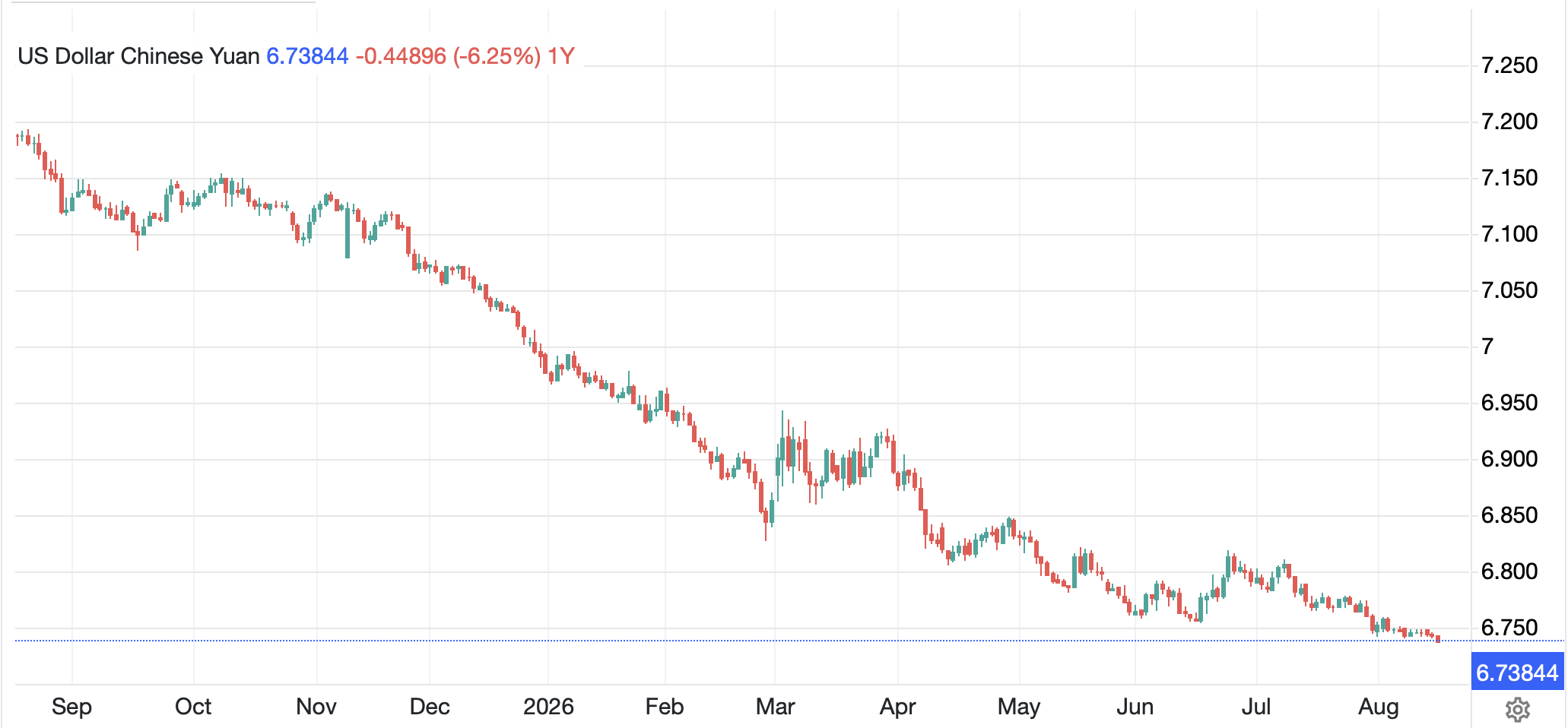
Finally, the dollar is modestly stronger this morning with the yen’s rise the exception in the G10 space (EUR -0.1%, GBP -0.2%, AUD -0.2%, CHF -0.3%, NOK -0.3%).  In the EMG bloc, we are seeing similar modest weakness across the board (PLN -0.2%, ZAR -0.3%, MXN -0.2%) with the outlier here being CNY (+0.2%).  Regarding the renminbi, the Chinese have been marching it slowly higher for the past year, as per the below chart.  My take is President Xi is very focused on convincing others the CNY is a viable reserve currency candidate despite all the capital flow restrictions.  I’m not sure how that would work, but that is the best I can come up with.

Source: tradingeconomics.com

And that’s all we have in markets this morning.  On the data front, Initial (exp 215K) and Continuing (1860K) Claims are the only releases and we hear from Fed governor Bowman, although to the best of my knowledge, nobody is listening to Fedspeak right now.  The market continues to price just one 25bp cut for 2026 at this point, although that seems likely to change once we get a better idea as to what Mr Warsh would like to do when he gets the Chair.

My guess is that if there is going to be an attack on Iran, it will happen this weekend, so until then, given the absence of data, I think we drift in all markets and wait for Monday.  Today, and tomorrow, ought to be quiet.

Good luck

Adf
To Excess

The State of the Union Address
Was, as is Trump’s wont, to excess
He touted his claims
And handed out blames
While focusing on his success
 
The market responded, it seems
Like Trump answered all of its dreams
Stocks round the world rose
Which shows, I suppose
The world does approve of his schemes

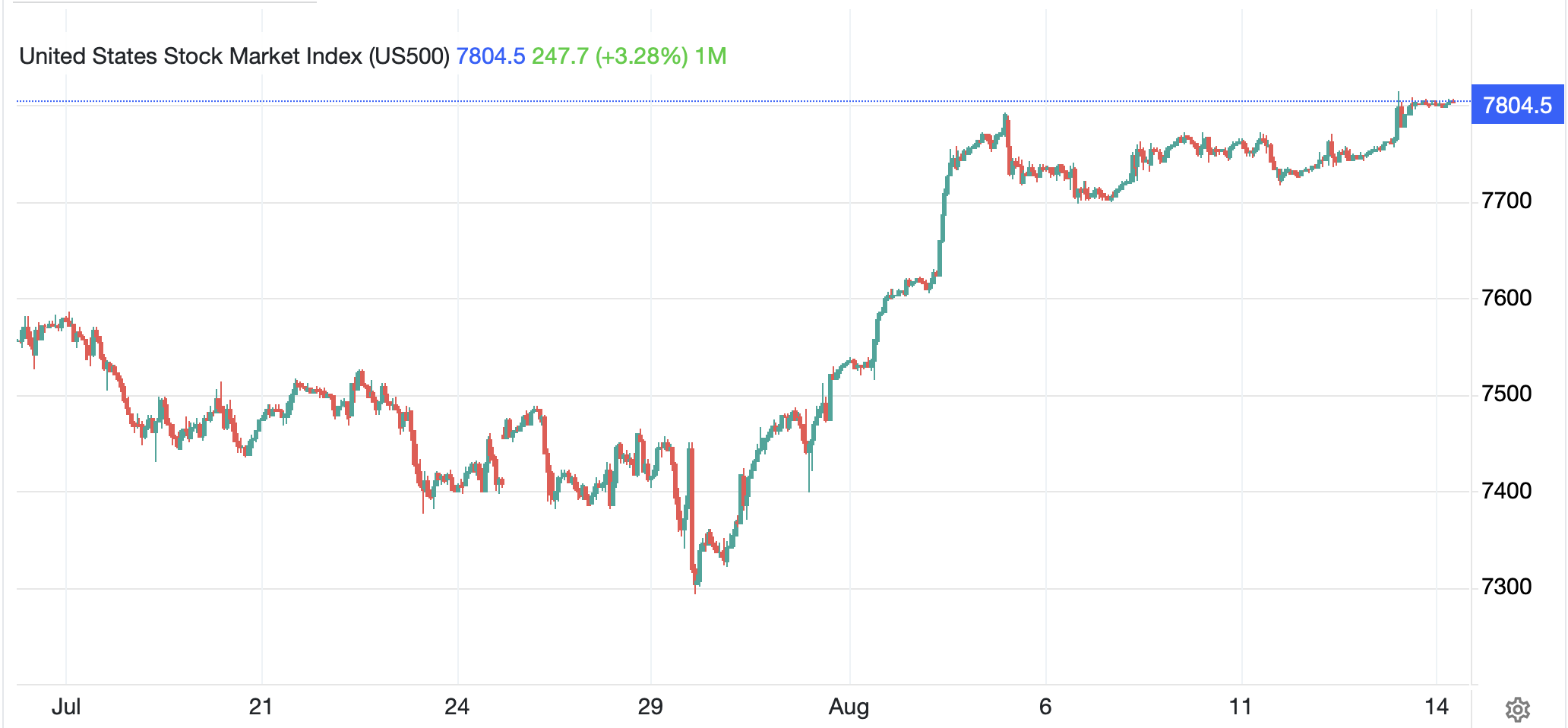
As I look at my screen this morning, literally every major equity market is higher, as per the below screenshot, as are US futures.

Source: tradingeconomics.com

In fact, if you ignore Russia, which hasn’t really been relevant since the Ukraine invasion-imposed sanctions, every market is higher over the last year, and US markets are the true laggards as seen by their monthly performance.  But you cannot look at this picture and determine that anything President Trump said last night was negative for the global economy.  I guess it’s full speed ahead now.

In true Trumpian fashion, the president remains incredibly optimistic about the future for the US and the Western world and perhaps that is what is reflected here this morning.  However, there were precious few new initiatives announced so it is unclear to me that this is going to be a topic of discussion in the financial markets going forward, although you can be sure that the political narrative is going to be very active.

So, let’s move on to things that matter for markets.

Is she hawk or dove?
Takaichi hates China,
Not easy money

As you can see in the above table, Japan’s Nikkei 225 rose sharply, nearly 4%, but that had nothing to do with the SOTU.  Rather, her administration named two new BOJ governors (it was simply time to rotate some) and both were seen as quite dovish.  In fact, one, Toichiro Asada, is known for his belief in the benefits of MMT (you remember the magical money tree idea that governments that print their own currency don’t need to worry about overborrowing).  The upshot is that while Japanese stocks raced to yet more new highs, as per the below chart, JGB yields reversed their recent declines and rose (10yr +5bps, 30yr +10bps) and the yen (-0.6%) continued its recent slide, although remains well above (dollar below) the 160.00 level, which many see as the BOJ’s line in the sand regarding intervention.

Source: tradingeconomics.com

But other than this story, it is much harder to find things that have been market drivers.  To my eye, we continue to see market participants laying back in most places as they are still recuperating from the raucous first six weeks of the year.

So, let’s go to the tape.  We’ve already seen the equity performance around the world, with the narratives forming that the US tariff situation is now a reduced stress on global trade as they have been reduced to 10% globally.  As well, there have been an increasing number of rebuttals to the AI piece I mentioned on Monday, with this one, I think, the most succinct takedown of the idea that AI is going to eat the world and drive us into a recession with no jobs left for people.  As such, Monday’s narrative of all stocks being worthless has changed.  Elsewhere, the tariff story and tech rally have been the key discussion points across markets.

In the bond market, yields are a touch higher with Treasuries (+2bps) edging up on what seems like ordinary trading.  The short-term trend here is lower yields, as per the chart below, but we know that nothing moves in a straight line.

Source: tradingeconomics.com

As to European sovereign yields, they, too, are mostly a few ticks higher this morning although, this also appears to be simple trading activity rather than a new narrative.  It is interesting that there are more stories today about ECB President Lagarde stepping down early, which is diametrically opposed to what she said when asked the question recently.  As I said before, I think she steps down and is going to run for President of France.

The commodity markets continue to be the place with the most price action and this morning is a continuation of that recent trend.  Gold (+0.9%), silver (+3.7%) and platinum (+5.5%) are all continuing their rebound from the extreme declines seen back on January 29th.

Source: tradingeconomics.com

I do not have any inside track as to the driver of those moves, but I continue to read and hear about significant intervention designed to burst those bubbles (and they were clearly bubbles) and allow key institutions to cover short positions at better prices.  The problem with these stories is that we have heard for years about the manipulation of the prices of both gold and silver by large banks, and the purveyors of those stories have neither great reputations nor track records, so it is always a tough sell in my mind.  There is no question that when markets go parabolic, as the precious metals did through January, the reversals have always been dramatic.  However, I cannot speculate on the driver as often times, there doesn’t need to be one.  This cartoon from Kaltoons demonstrates it perfectly.

Turning to oil (+0.8%), Iran remains a key narrative and continues to support the front month pricing.  However, it appears that several futures spreads are falling sharply, indicating a potential glut in physical supplies has developed, at least for now.  As I look at the front contracts in the futures curve, we are still in backwardation, which implies a shortage, although I suppose that is the Iran effect.  

Source: barchart.com

I understand the short-term concerns here regarding potential military escalation there, but nothing has changed my view that the long-term energy situation is one of abundance and maintaining much higher oil prices will be very difficult for the long-term.  After all, look at Venezuela, which has already increased production back above 1mm barrels per day with contracts being signed for more activity.  Too, Argentina’s Vaca Muerta shale production is at new record levels, also ~1 mmm bpd and we continue to see growth offshore Brazil and Guyana.  Longer term, there is plenty around, I think.

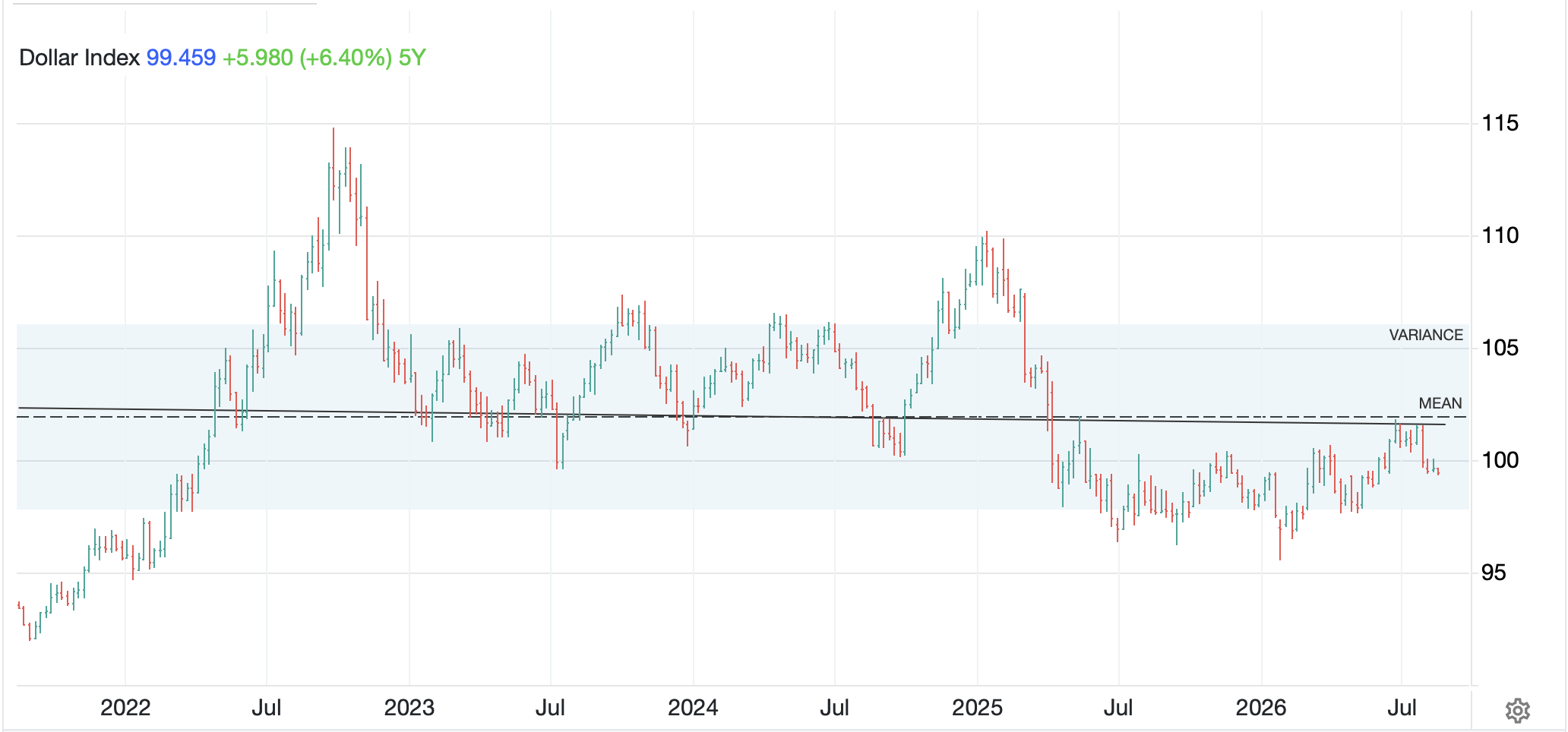
Finally, the dollar is mixed this morning as the yen’s weakness is being offset by modest strength in the euro (+0.1%) and pound (+0.2%).  However, the big movers today are KRW (+0.9%) which has benefitted from inward equity flows and hopes for tariff relief, as well as ZAR (+0.5%) on the back of the precious metals rally and CLP (+0.4%) on copper’s strength.  Remember, the US is not overly concerned about USD weakness in the FX markets as it suits the administration’s goals of reducing the trade deficit and encouraging onshoring of production.  But even with that, looking at the DXY, it is just below 98.00 and remains right in the middle of its trading range for the past 9 months.

Source: tradingeconomics.com

There is no major data out this morning with only the EIA oil inventories where a very modest build is anticipated.  

Big picture, I don’t think anything has changed.  Fiat currencies continue to lose value relative to ‘stuff’.  Equity markets continue to benefit from the global ‘run it hot’ policy and there is no clarity regarding the outbreak of a war in Iran.  With this in mind, it is hard to see a large move in the dollar in the near future.

Good luck

Adf

A Future, Dystopic

On Monday, an analyst wrote
His thoughts how AI might promote
A future, dystopic
Though somewhat myopic
And offering no antidote
 
Although prior views had explained
That once AI’s suitably trained
Most labor would suffer
And lacking a buffer
Folks’ politics would be quite strained

This is the research report that got tongues wagging on Wall Street yesterday and the fear it allegedly engendered was impressive.  In essence, it said that by 2028, AI would replace vast swaths of the labor force, notably white-collar workers, and that it would lead to a massive recession, and more importantly to the Street, a significant decline in stock prices.  The back and forth on X was amusing all day as there were those who hyperventilated over the coming tragedy, and those who fought back.

It is important to understand this was not a prediction, per se, but one of the scenarios they came up with, although clearly the most dramatic one.  It certainly gained a lot of clicks and notoriety, and let’s face it, isn’t that the idea these days?

Given that the tariff story has now become too complex for anyone to truly understand, and while we all await the denouement in Iran, this appeared to be the best thing to occupy time amongst the trading community.  Personally, I spent the entire morning shoveling snow, but then, I’m no longer a trader.

The upshot is that the major indices all fell more than 1% while gold and silver rallied and bond yields fell.  Fear was palpable.  But will it last?

Last month’s yen rate checks
Came not from Ueda-san
But Bessent, himself

The other story of note was almost an aside, although it helps outline recent movement in USDJPY.  We all remember last month when the yen rallied very sharply during a Friday session in NY as word got out the Fed was “checking rates”.  As a reminder, this is when the Fed calls out to bank FX desks and asks for prices, although doesn’t actually deal.  However, the signal is strong as all the banks recognize the opportunity for intervention, and the news quickly spreads through the market with the effect you can see in the chart below.  During the next three sessions, the yen rallied 4.5%.

Source: tradingeconomics.com

During my career, I had never heard of this activity driven by anyone other than the BOJ, as they were always the most concerned with the yen’s value.  Certainly, they may have been responding to US pressure, but it was always their call.  Now the news comes out that Treasury Secretary Bessent did this on his own last month, a clear indication that the administration is not happy with an over weak yen.  This sets an interesting precedent regarding who controls any given currency.  Now, I doubt we will see this type of thing frequently, but we need to keep it in the back of our mind.  Meanwhile…

Seems Takaichi
Told Ueda, higher rates
Are not helping her

Last night, in a surprise to many in the market, news of a meeting between PM Takaichi and BOJ Governor Ueda resulted in Takaichi-san imploring Ueda-san to leave rates alone, rather than continue raising them.  Higher rates are not helping her growth agenda, and I imagine her belief set is that if the yen weakens too far, she can always intervene, and now that we know about Bessent’s actions, she can count on the US to help.  But I cannot observe this and think anything other than the market is going to test 160 and do so before long.  One poet’s opinion.

Ok, let’s see how markets traded overnight.  First off, last night was the first that all of Asia was back at work so overall liquidity was improved.  However, the results were mixed with Tokyo (+0.9%) ignoring the AI driven US rout while the Hang Seng (-1.8%) fell right alongside the US.  China (+1.0%) rallied in its first day back but consider that simply offset the decline of their last session and, like most other markets, it remains relatively unchanged over the period.  Meanwhile, the tech sense was strong with Korea (+2.1%) and Taiwan (+2.75%) both up nicely while India (-1.3%) suffered under the AI fear umbrella.  Elsewhere in the region, there was no pattern of note with both gainers and losers.

In Europe, the largest markets (UK, Germany and France) are basically unchanged this morning while both Spain (-0.7%) and Italy (-0.4%) are under some pressure.  There is talk of tariff issues, but I’m not sure why only those two markets are taking the heat.  As to the US, at this hour (7:00), all three major indices are higher by about 0.2%.

In the bond market, after a -4bp decline in Treasury yields yesterday they are unchanged this morning while European sovereigns are seeing yields slip -1bp across the board.  Too, JGB yields (-2bps) have continued their slow descent as it appears investors have acclimatized to the risks of Takaichi-nomics.  I think we will have to see inflation figures there to get a better sense.  Regarding Treasury yields, I’m not sure I can explain why I feel this way, but given how bearish sentiment is for bonds, (leveraged players are short >1 million futures contracts), it feels to me like we could see a short-term continuation of the recent rally with yields heading back to test the 3.8% level at least.  I understand both the fiscal argument and the technical argument (see long-term chart below) but neither rules out a short-term rally to inflict pain.  After all, that is what markets do best!  (full transparency, I bought some June TLT call spreads yesterday, so I am talking my book!)

Source: finance.yahoo.com

In the commodity markets, oil (+0.3%) continues to hold its recent Iran inspired gains as the world awaits the outcome of Friday’s meetings between the US and Iran.  I have no insight as to the potential outcome here other than what I read, but it does seem like there will be some type of military action as I do not see Iran ceding anything.  As to the precious metals, gold (-1.0%) is giving back yesterday’s gains but remains in its recent uptrend after the end-January crash, although it has yet to regain the old highs.  I imagine this will take more time, but it also seems quite likely to happen. This is still a quite bullish chart in my view.

Source: tradingeconomics.com

Interestingly, silver is little changed this morning as there continues to be much talk of delivery questions at the COMEX given the apparent lack of available ounces relative to outstanding contracts.  My take is things will get rolled as they usually do, but if not, beware a major spike higher on Friday!

Finally, the dollar continues to be the least interesting space there is with today’s JPY (-0.8%) move the exception that proves the rule.  Having already touched on that situation, there is literally nothing else to describe in either G10 or EMG currencies as +/-0.15% describes the entire session.

As to data this week, here’s what we have coming:

TodayCase Shiller Home Prices1.4%
 Consumer Confidence87.0
ThursdayInitial Claims216K
 Continuing Claims1872K
FridayPPI0.3% (2.6% Y/Y)
 -ex food & energy0.3% (3.0% Y/Y)
 Chicago PMI52.5

Source: tradingeconomics.com

In addition to this bit, we hear from seven more Fed speakers across nine venues, but I still don’t think anybody cares.  The market has priced out any rate cuts before Powell leaves, although there is still one cut priced for the year, expected in October.  

Frankly, it is not surprising that markets have calmed down so much given how much activity we saw in January.  As I wrote then, markets have a great deal of difficulty maintaining high volatility as traders and investors simply get tired and tune out.  We will need a new catalyst to get things going, either an attack on Iran or some new China news in my view.  Tariffs are no longer interesting, and frankly I think Iran and AI have both lost some pizzazz.  Maybe the UFO releases will get things going again!

Good luck

Adf

Havoc He’s Wreaking

The focus has turned to the data
And whether it’s good or it’s bad-a
We all want to see
Today’s NFP
Then listen to punditry chat-a
 
It’s funny, cause generally speaking
Most pundits are strongly critiquing
The numbers released
Declaring they’re greased
To help Trump and havoc he’s wreaking

It’s NFP day today, which given it is Wednesday is a bit odd, but that’s what happens when the government shuts down for a few days.  At any rate, this is the biggest data week we’ve had in a while as not only did we see Retail Sales yesterday, which disappointed at 0.0% despite showing the largest actual jump, $80 billion, ever between November and December, although that was completely removed by the largest seasonal adjustment ever, (Read about it here at WolfStreet.com) we also get CPI on Friday.  For good order’s sake, here are the current consensus forecasts for NFP:

Nonfarm Payrolls70K
Private Payrolls70K
Manufacturing Payrolls-5K
Unemployment Rate4.4%
Average Hourly Earnings0.3% (3.6% Y/Y)
Average Weekly Hours34.2
Participation Rate62.3%

Source: tradingeconmomics.com

As the market continues to adjust to the recent gyrations, there is hope that the data will lead to unequivocal conclusions about the economy, which could drive Fed decisions and then coalesce around a clear direction of travel.  I’m not holding my breath.  

The first thing to remember is that the data is revised virtually every month, and when the economy is at an inflection point, or even when it is showing more pronounced activity in one sector than another, those revisions can tell a very different story than the original print.  But even beyond that, while the algorithms are clearly programmed to respond to the data, longer term investors have a much tougher time discerning what is happening.  All that is a long way of saying, nobody still has any idea where things are headed!

While I dismiss the FOMC speaking circuit, yesterday’s two speakers, Logan and Hammack, who are both voting members this year, said that they felt the current rate is at neutral.  Remember, right now Fed funds are 3.75%, which is a far cry from the Longer run neutral rate they have been feeding us in the Dot Plot!

In fact, their median expectation is 3.0%, so the fact that two voting members think 3.75% is neutral is somewhat confusing especially as both indicated they expected inflation to continue to decline and exhibited concern over the employment situation.  My views of where things are headed don’t matter nearly as much as theirs do, but there seems to be a little inconsistency involved here.  As it happens, the current Fed funds futures market pricing shows that there is a 22% probability of a rate cut in March and then it’s 50:50 in April as per the below chart fromcmegroup.com.

At this point, I suspect we will need to see negative NFP numbers along with continuing declines in CPI/PCE for the Fed to cut as I think Chairman Powell is so miffed at President Trump, he doesn’t want to do anything that Trump wants.  It would also not surprise me if that attitude has suffused the bulk of the FOMC.  The irony remains that Governors Cook and Jefferson are raging doves but would rather keep policy tight to stymy Trump rather than act as they otherwise would.  At least that’s my take.

Anyway, that’s what we have to look forward to this morning.  So, how have things behaved overnight?  Let’s look.  Tokyo (+2.3%) continues to be the star of the show, continuing to rally on excitement and optimism that PM Takaichi is going to solve Japan’s problems.  Maybe she will, but they have a lot of them, so it will take time.  But the tech story is strong there and it appears that foreign buying is picking up, which has been one of the drivers of the JPY (+0.5%) lately.  In fact, this week, the yen is leading all currencies having gained more than 2.3% so far.

Source: tradingeconomics.com

As to the rest of Asia, China (-0.2%) and HK (+0.3%) did little although the tech-based Korean (+1.0%) and Taiwanese (+1.6%) exchanges did well, as did Australia (+1.6%) on the back of stronger metals prices.  One other interesting note is Indonesia (+2.0%) where the government just restricted mining of Nickel (+1.7%) in order to raise the price of their largest export!

Europe is a lot less interesting with the continent under some pressure (France -0.2%, Spain -0.3%, Germany -0.2%) although the UK (+0.7%) is performing well on the back of strength in mining and natural resource shares.  US futures at this hour (7:35) are pointing slightly higher, about 0.15%.

In the bond market, things have gone back to sleep with 10-year yields lower by -1bp pretty much throughout the US and Europe.  JGB yields also did nothing last night, and it appears that despite the massive debt that continues to grow around the world, bond investors are comfortable right now.  Perhaps they see deflation in our future, but that doesn’t feel right to me.

Turning to the markets that continue to show the most volatility, commodities, let’s start with oil (+2.1%) which is demonstrating concern over re-escalating tensions regarding Iran, the negotiations and the potential for military activity there.  There are reports that the US may intercept Iranian tankers and if you look at the chart below, a pretty good uptrend has developed over the past two months.  You won’t be surprised that NOK (+0.6%) has benefitted from today’s move either.

Source: tradingeconomics.com

As to the precious metals, after yesterday’s modest decline, we are back on the rise with gold (+0.85%), silver (+5.5%), copper (+2.1%) and platinum (+3.3%) all nicely higher.  The silver story is about declining inventories in Shanghai, which was the last place that can afford it since both the COMEX and London are already light on available ounces.  While we saw a dramatic decline nearly two weeks ago, I have to say things appear to be shaping up to recoup all those losses and then some!

Finally, the dollar is back under pressure this morning across the board.  I’ve already mentioned the two biggest movers and AUD (+0.5%) joins the list on the back of commodity strength.  Otherwise, the movements are not terribly large here, with the euro (+0.1%), pound (+0.3%), KRW (+0.3%), and ZAR (+0.2%) indicative of the situation.  I expect that the dollar will be responsive to today’s NFP data with a strong print helping the dollar and a weak one pushing it down a bit further.  However, remember that it remains within its trading range, albeit nearer the bottom than the top of that range as per the below.

Source: tradingeconomics.com

And that’s really it for today.  The NFP should drive the first movement and after that, there is still White House bingo for fun and surprises.  While the dollar is soft, I don’t see a collapse coming, and in the end, the more I read about EU energy policy, I can only expect that any collapse will be that of the euro, not the dollar.  But that is a ways into the future I think.

Good luck

Adf

Dissension

It seems that there’s still quite some tension
As metals and stocks show dissension
Though Friday both puked
Of late, metals juked
Much higher, to stocks contravention
 
So, what can we learn from this split?
That tech stocks all now trade like sh*t
While silver and gold
Are what folks will hold
And bonds? No one just gives a whit

It seems the government shutdown has ended, just as quickly as it began and the only people impacted are traders who were looking forward to the NFP data on Friday.  Given the shutdown was only for a few days, and that apparently, all the data was already collected, it was the compilation that was being delayed, I presume we will get the numbers next week.  Of course, this is a government bureaucracy, so it may take a bit longer.  Nonetheless, this morning we see the ADP Employment number (exp 48K) and analysts will have to work from that, plus the reports like the ISM hiring data, to give their views of the economy.  It really all does seem like theater, I must admit.

Anyway, away from that, the only other news of note that is impacting markets has been an increase in tensions in Iran after the US shot down an Iranian drone heading toward the US aircraft carrier, Abraham Lincoln.  However, it appears that talks are still scheduled for Friday, so oil (+0.2% today, +1.4% since yesterday morning) is creeping back higher, although remains well below the levels seen last week when concerns over a US attack there were mounting.

Source: tradingeconomics.com

Which takes us to markets and what appear to be the key internal drivers.  Starting today with stocks, the narrative revolves around concern that AI is going to destroy software companies and SaaS models since their user base will no longer need those companies.  As well, there are the lingering concerns about the AI investment bubble and the circular dealing between Nvidia and its customers being an indication of the end of the era.  This is akin to what happened during the tech bubble in 2000-01 and has been highlighted by numerous analysts for several months, although is gaining more traction of late.  Finally, the Business Development Companies (BDC’s) and PE firms are under increasing pressure as their portfolio of loans and positions, many of which are being hurt by AI, are starting to hemorrhage cash.  This trifecta has been weighing on the NASDAQ, preventing any significant strength, although other sectors, notably energy and materials, have been doing pretty well.

The funny thing is, while the NASDAQ (-1.4%) fell yesterday amid widespread US equity weakness, if I look at the chart (below from tradingeconomics.com) it doesn’t seem that negative, rather it seems to be consolidating ahead of another leg higher.  But then, I am no technician, so don’t pay attention to me.

However, the narrative is strong here that the world is about to end because Nvidia hasn’t made a new high in the past three months.  I am no tech stock expert, but my take from the cheap seats is that future equity market outcomes are going to continue to be reliant on the success of the Trump administration’s plans regarding reshoring and changing the nature of trade.  It is likely to be bumpy, especially if the Fed does not cut rates to support equity markets, especially since that has been the MO for the past 40 years.  But I remain positive overall.

Looking around the rest of the world, last night saw a mixed picture, although definitely more green than red.  While Tokyo (-0.8%) slid along with Malaysia and the Philippines, the rest of the region had a nice session led by Korea (+1.6%), China (+0.8%) and Australia (+0.8%).  It appears the tech fears were less concerning there, either that or PE and BDC companies aren’t yet so prevalent.  In Europe, meanwhile, despite mixed PMI Services data, there are more gainers than laggards led by the UK (+1.0%), which does have miners, benefitting from the rebound in metals prices.  But France (+0.9%) and Spain (+0.15%) are also higher although Germany (-0.2%) is lagging after a modest miss in the PMI data. As to US futures, at this hour (7:15), they are pointing higher by about 0.25%.

Back to metals, which continue to be THE story these days, gold (+2.0%) has reclaimed the $5000/oz level and while it is lower in the past week, remains nearly 17% higher YTD.  Silver (+6.0%) is also rebounding nicely along with platinum (+3.8%) as more and more discussions have ascribed last Friday’s rout to month end delivery and position issues amongst a few very large players who were able to prevent some major damage to their own balance sheets.  However, as I have maintained all along, the fundamentals are unchanged; there is a shortage of silver for industrial use and has been for several years.  As to gold, there is no indication that central banks have stopped buying.  These continue to be long-term plays and will likely drag the entire metals sector along for the ride.

What about bonds, you may ask?  Well actually, nobody is asking about bonds!  They remain mired in a tight range with dueling narratives about the long-term view.  On the one hand, there are those who continue to look at the US debt load, and the expectation of fiscal deficits as far as the eye (or the CBO) can see, and expect supply issues to dominate, forcing the government to seek inflation to create the soft default necessary to pay back the debt.  They will point to the long-term trend, which saw yields decline for 40 years and then reverse back in 2020 (see chart below from finance.yahoo.com) as evidence that yields are going to trend higher for the next decades.

On the other side, you have those who believe the future is deflationary, with AI driving massive increases in productivity and driving down prices, while focusing on Truflation’s recent readings of 1.0% and claiming that is the way.  Personally, I have more sympathy for the former view than the latter, as it is increasingly difficult for me to understand the view that AI will be able to achieve all its currently stated desires without sufficient energy and materials, whose increasing prices are going to limit any downside in inflation.  As well, while a Warsh Fed chairmanship may strive to change the current central bank model of QE whenever needed, there is zero evidence any other central banks are going to follow suit.  

In the meantime, the tension between those two views has kept yields in a very tight range for a while, and we need an exogenous catalyst to break that range.  Peace in Ukraine?  War in Iran?  I’m not sure.

Finally, the dollar is a touch firmer this morning, notably against the yen (-0.6%), which continues to give back its gains from two Friday’s ago when the Fed ‘checked rates’ in the NY session as seen in the chart below.

Source: tradingeconomics.com

However, the point was made this morning, and it is a good one, that while Japanese 10-year yields are at 2.24%, 10-year yields, 10-years forward are about 4.10%, which would be a devastating yield for the Japanese government given its debt/GDP ratio remains above 230%.  It is difficult to get excited about owning the yen with that backdrop, especially given the demographic implosion of population that is ongoing there.  As to the rest of the currency market, Zzzzz.  Aside from the narrative of the dollar is dead, which gets recycled by somebody every day, it is very hard to look at recent price action and think something remarkable is going to happen.  We will need major monetary and fiscal policy changes, which while they may arrive, are going to take quite some time to get here.

And that’s really it this morning.  Aside from ADP, we get the ISM Services (exp 53.5) and we get the Quarterly Treasury refunding announcement, which will garner a great deal of attention only if Secretary Bessent explains he is going to issue more bonds and less bills, which seems unlikely.  Monday’s ISM data was quite strong.  Strength today could well portend that the US economy has a bright future ahead, in the near term, and that should support stocks and the dollar, while commodities will benefit from the increased demand.  Bonds?  Well, we’ll see which side of that argument is correct.  And what happens if the deficits are smaller than expected?  That is the question nobody is asking because the ‘smart’ folks don’t believe it is possible.  Remember, the dollar is still king.

Good luck

Adf