The Great Denouement

While talks in Qatar carry on
No outcome, as yet, is foregone
Thus, traders are waiting
Before speculating
As all seek the great denouement

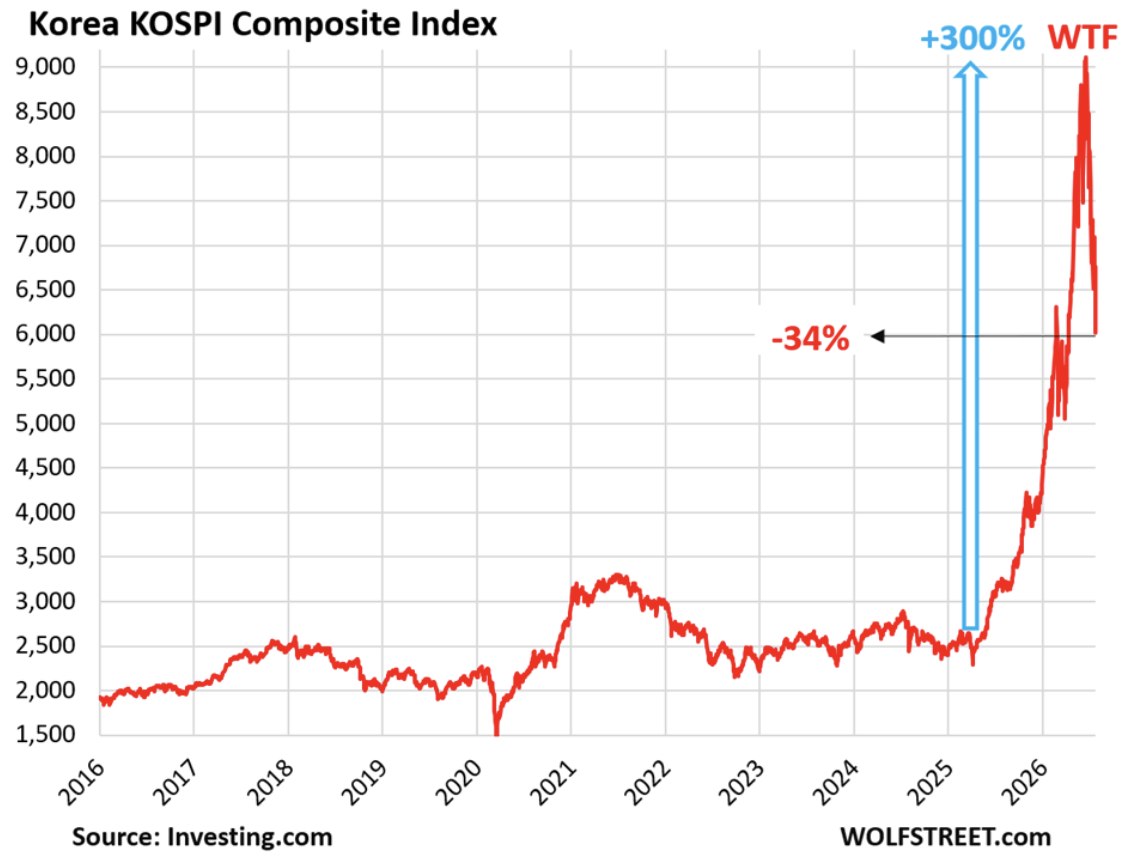
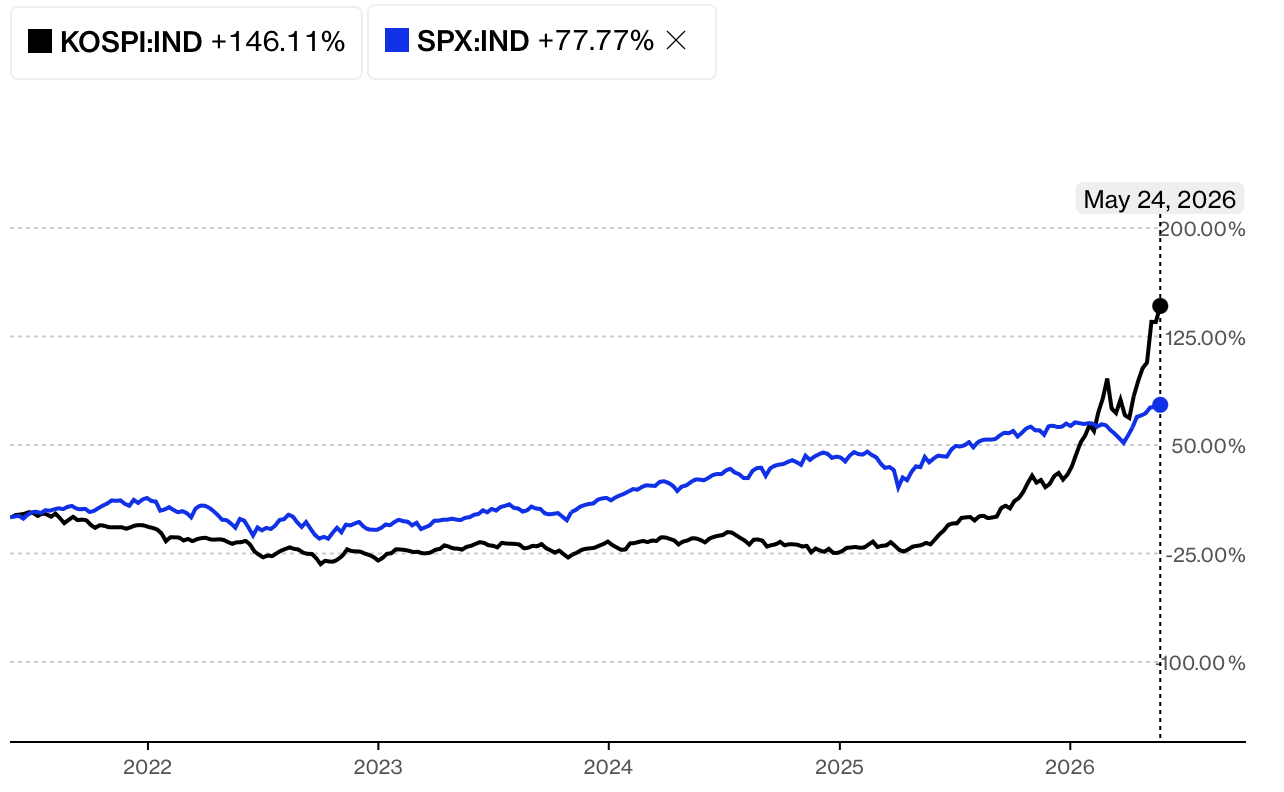
Range trading remains the norm, except for the S&P 500 which continues to make new highs almost every day.  At least that is true in US markets.  The KOSPI in Korea is also rocketing higher.  In fact, when comparing the percentage movement over the past 5 years, the S&P looks quite ordinary, but that is because the KOSPI has been insane!

Source: Bloomberg.com

But away from a few select equity markets, it is getting increasingly difficult to find markets that are doing much more than chopping back and forth.  This is especially true if we take a step back and look at movement over the past several years.  

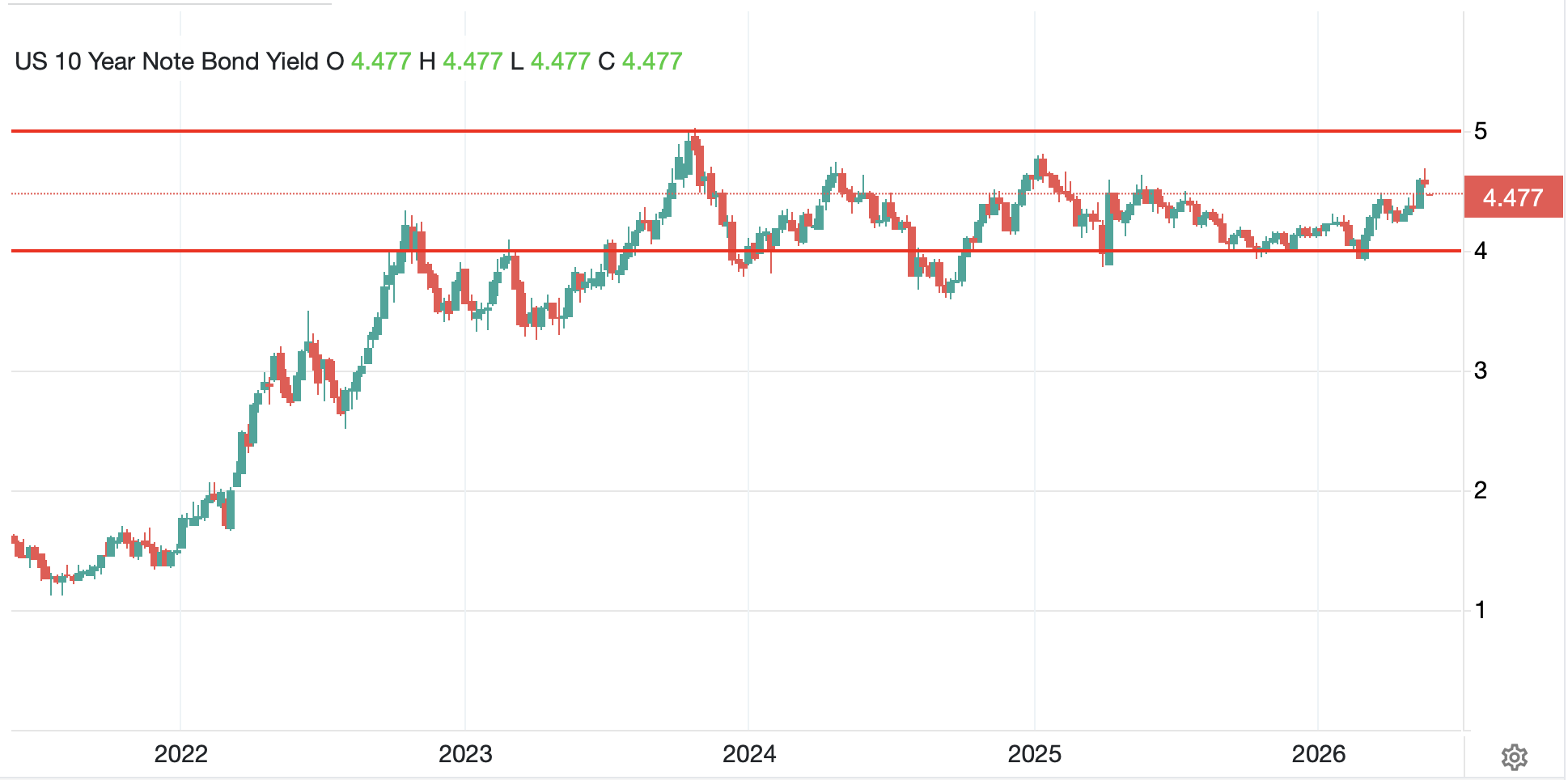
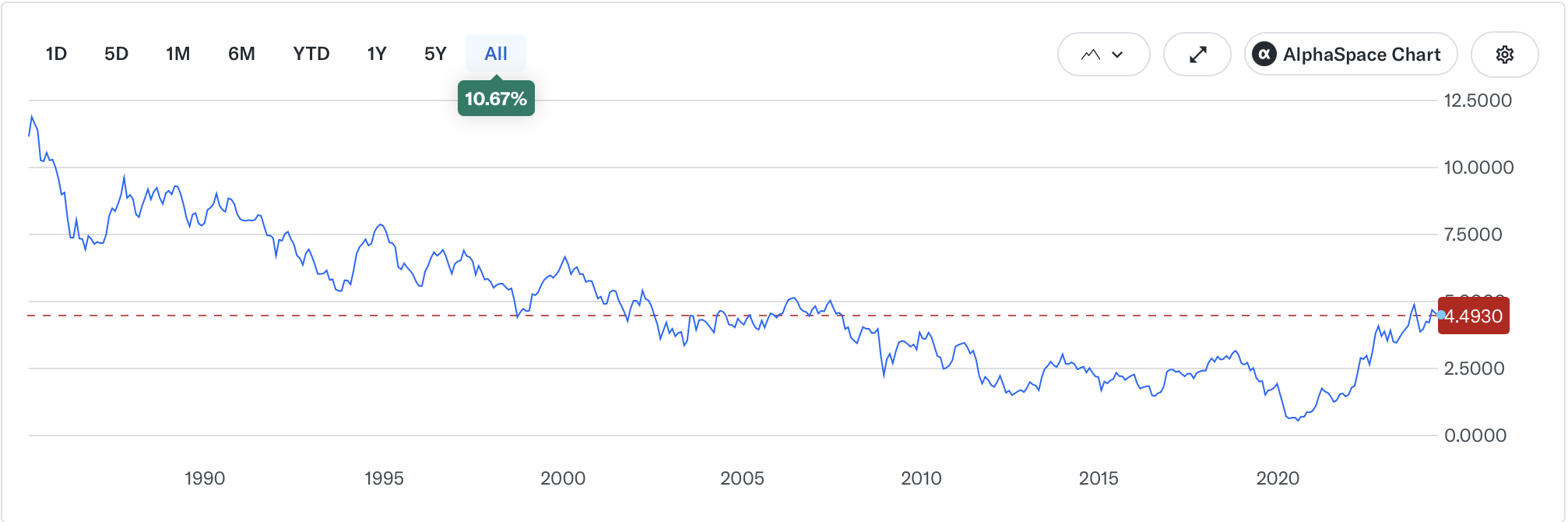
For instance, if we look at the 10-year Treasury, where we saw all sorts of angst last week when it traded to its highest level, near 4.70%, in a year, realistically, we have been rangebound for more than two years as per the chart below.  And prior to that we were in the massive abnormality of ZIRP.  So, if we go back over a longer time frame, the current 10-year yield is right around the long-term average as per the second chart.  It is really hard to get excited about this movement.

Source: tradingeconomics.com

Source: finance.yahoo.com

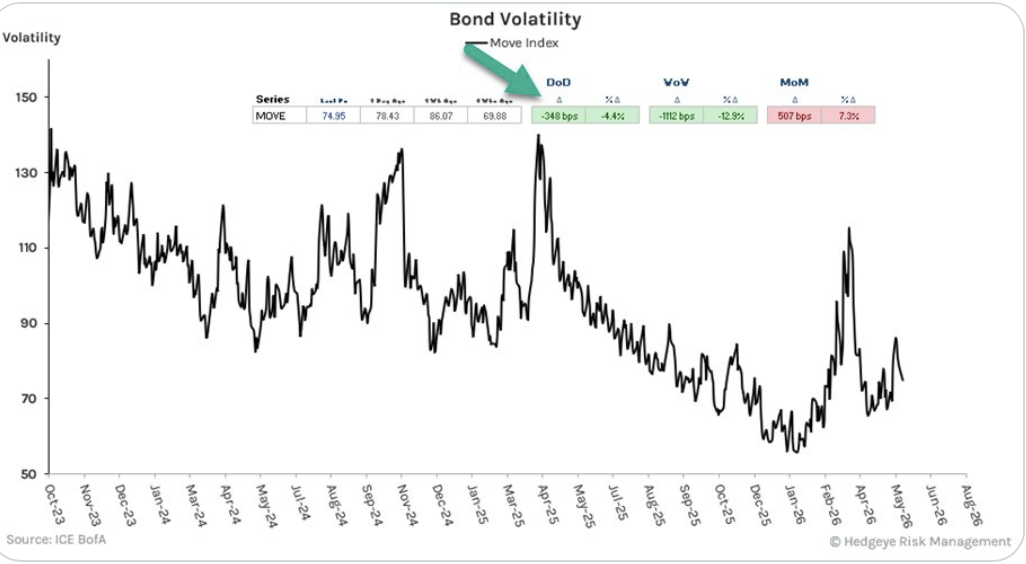
Perhaps we ought not be surprised that bond market volatility is heading lower again as per the below chart of the MOVE Index from Hedgeye

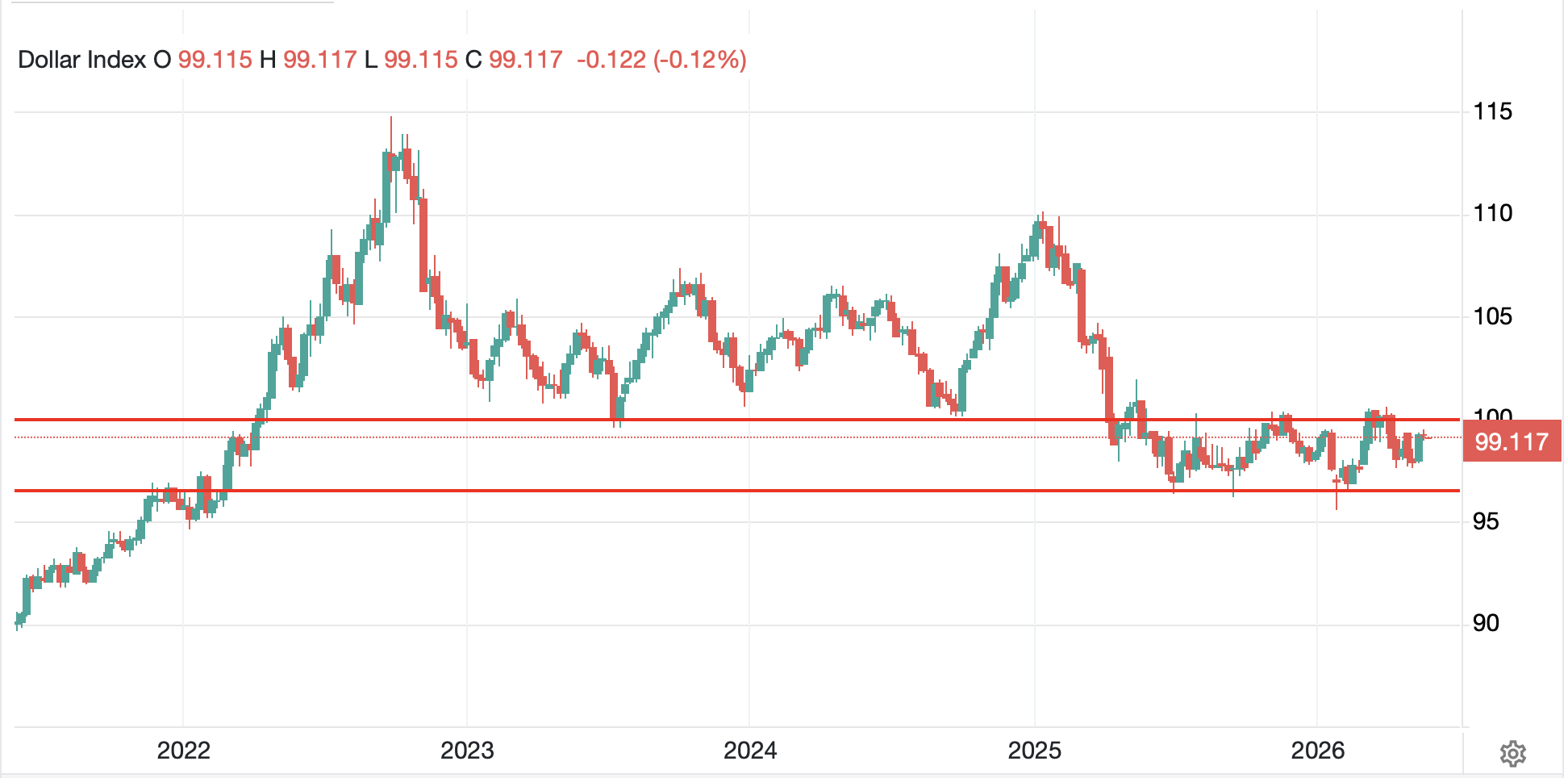
The same story exists in currencies, where major currencies have been in a range for more than a year as per the below chart of the DXY from tradingeconomics.com.

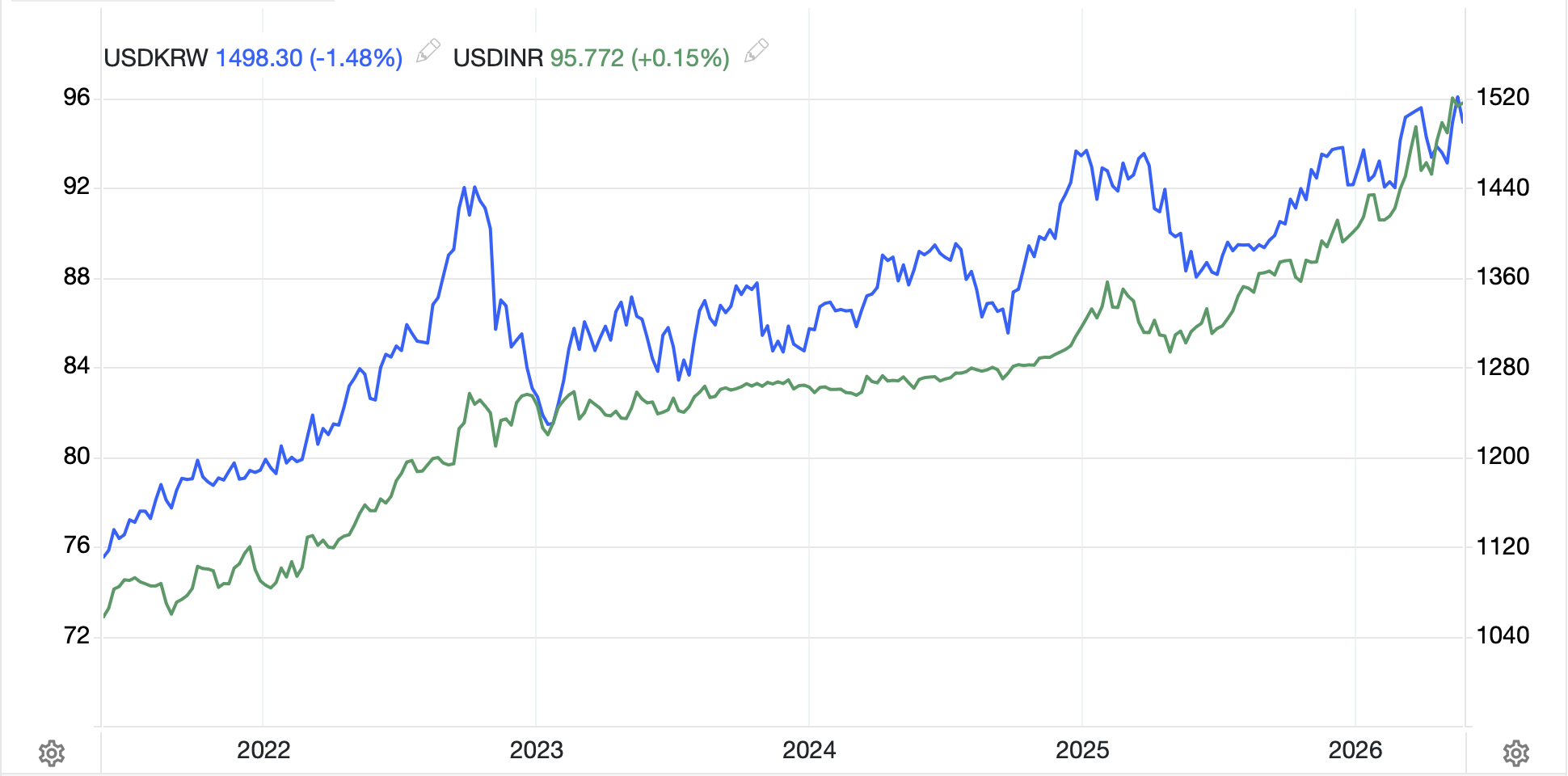
Now, there are currencies that have seen substantial movement over the past year, in both directions.  For instance, both KRW and INR have been weakening consistently for the past five years, and this is despite a massive equity rally in both nations, although, in fairness, India’s market has not kept up over the past few months.

Source: tradingecoomics.com

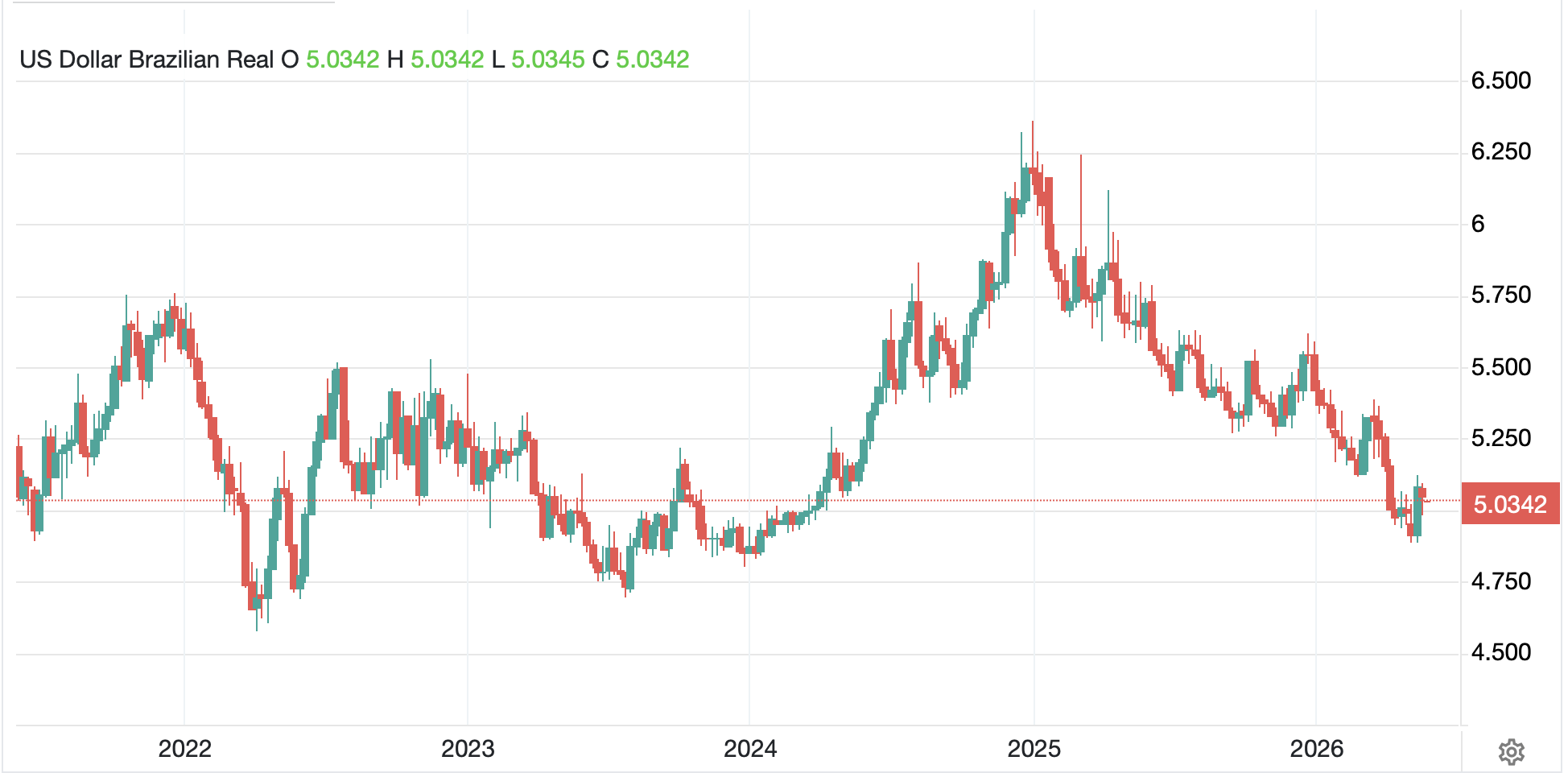
At the same time, BRL has been broadly rallying vs. the dollar for almost 18 months, as per the below chart, as it remains a favorite in the hedge fund community for its high interest rates.  And the fact that they continue to find more oil offshore is only helping things.

Source: tradingeconomics.com

But these currencies are secondary in the FX market, which has generally been dull.

Meanwhile, the oil story appears to be one of increasing belief that a deal is going to be done soon.  This morning, WTI (-3.7%) is falling again and back to $90/bbl.  Obviously, this is higher than where things were before this all started, but if there really was a shortage of the stuff, I expect prices would be much higher.  From what I have read this morning, the two sides continue to talk with Iran looking for a release of frozen financial assets while the US still wants the nuclear material.  

To me, the interesting thing is the tone of the comments from both sides.  President Trump continues to highlight the positive view of a deal coming, although assuring us he won’t make a bad deal.  Iran, though, continues with its apocalyptic rhetoric, threatening extremely painful revenge for every US action, although not really doing much at this point.  It appears to me that both sides are speaking to the domestic audience, not each other.  Trump needs to show progress and a victory, however defined, is near.  Iran needs to show they are strong and will not be beaten by their sworn enemies.  But at this point, I think both sides really need this to end.  The fact that Iran is now talking about money is the tell.  They know they are just about broke, and if there is no money to pay their armies, will their armies fight for the leadership?  I maintain my July 4th deal timeline. 

And that’s really today’s market story; oil’s slide is supporting other markets as we all await the end game.  Elsewhere in the news, there is far more excitement over the NY Knicks winning the NBA’s Eastern Conference than there is over the political stories of primary elections which are ongoing around the country.  While the mid-term elections are coming up in less than six months, the fields are not yet set, so it is difficult to handicap.  

On the data front, there is little of note today in the US although we do hear from several more Fed speakers.  But I maintain that their comments, today it is Governors Cook and Jefferson, are largely irrelevant and that can best be seen by the fact that the WSJ barely mentions any of their speeches anymore.  They are no longer newsworthy.  These two, though, will be an interesting case as both are avowed doves, but also hate President Trump, so will they vote with their belief set (rates should always go lower) or with their politics (Trump wants lower rates so they cannot vote that way)?  I guess we’ll find out in a few weeks at the next FOMC meeting.

One aside on central banking was last night the RBNZ met, left rates on hold at 2.25%, but were more hawkish than anticipated in their comments indicating rate hikes were coming.  This did help NZD to rally nearly 1%, an outlier in today’s market.

And that’s really it, I think.  Until the next headline on Iran, I cannot see a reason to trade in anything.

Good luck

Adf

Impacts of War

The financial impacts of war
Are many, and so here are four
Inflation will rise
And what this implies
Investors, most bonds, will abhor

The dollar is like to remain
Demanded and that will cause pain
For stocks everywhere
But one thing will fare
Just fine, look for gold, more, to gain

Obviously, the war in Iran remains the top story and is likely to remain so for a few more weeks at least.  Arguably, the only way this will change is either a regime change takes place and talks for peace begin, or Iran is able to retaliate in a heretofore unknown fashion sufficient to force the US and Israel to withdraw.  President Trump has indicated he believes this campaign will last 4-5 weeks with that regime change the result.  But remember, the Russia/Ukraine war slipped from the headlines after 6-8 weeks, and it is still ongoing.  In fact, I challenge you to find a story about that war anywhere these days.

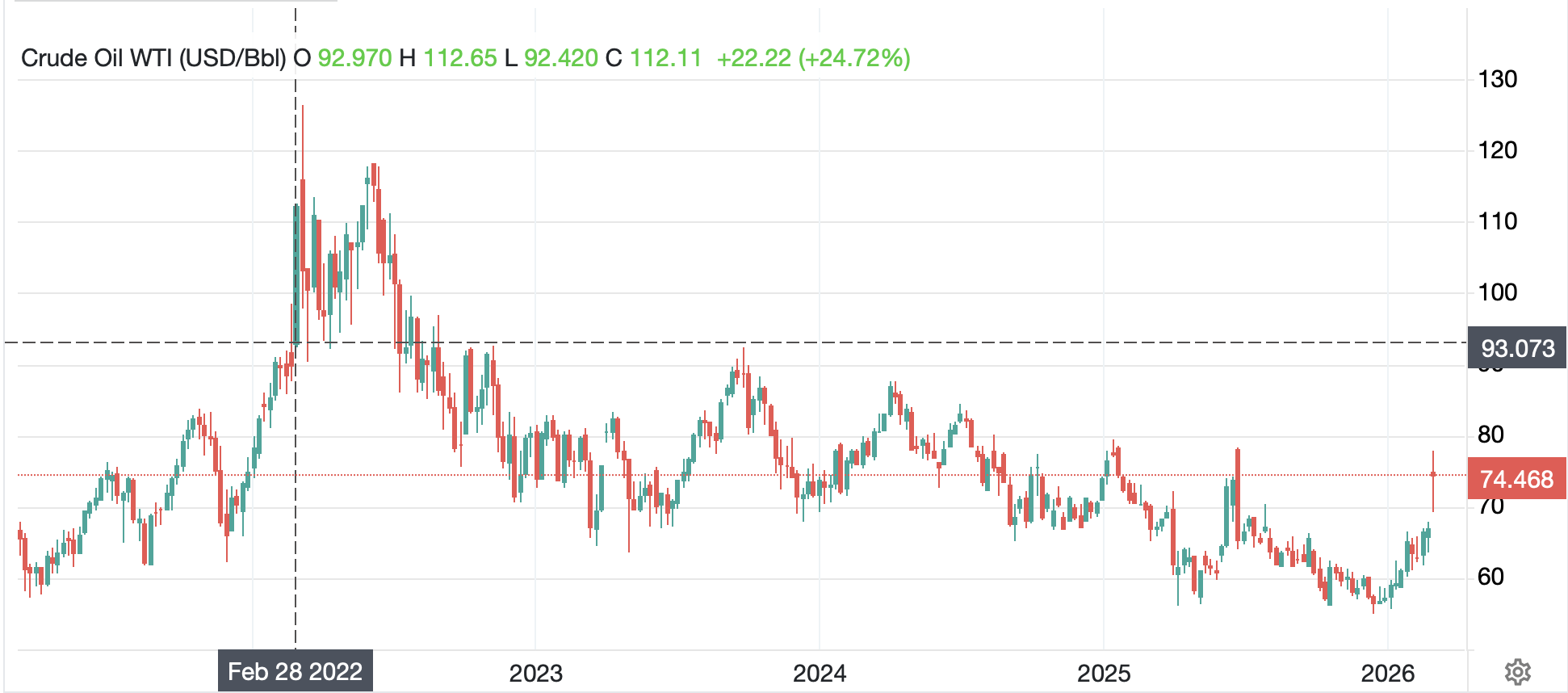
My point is, despite the ongoing hostilities, the rest of the world continues on its way, albeit with some new bumps in the road.  Clearly, the biggest bump remains the price of oil and, for much of Europe and Asia, its continued availability.  While the price of oil (+0.1% today) has risen about 18% in the past month, a look at the long-term chart below offers a bit more perspective as to just how limited this movement has been so far.

Source: tradingeconomics.com

I have highlighted the week of the Russian invasion from February 2022, which saw oil rise more than 20% at the time and remain elevated for about 5 months before it retraced to prewar levels.  The reaction this time has not been nearly as dramatic even though the effective closure of the Strait of Hormuz has removed about 20% of global oil supply from the market right now, as well as a similar proportion of LNG.  This is why we have seen the massive spike in European and Asian LNG prices as that was the destination of those cargoes.  Ironically, one of the most negatively impacted nations is China, which was Iran’s biggest oil customer, but now has seen a dramatic decline in the availability of oil. Of course, they have built a significant stockpile, their own SPR, which holds between 1.2 -1.5 billion barrels, enough to supply the nation for upwards of 4 months.  While not an immediate concern, it will start to hurt after a while if this continues.

It appears to me that unless Iran starts targeting and destroying oil production facilities throughout the Middle East, which is certainly possible, the upside for prices from here is limited under current circumstances.  My guess, and it is just that, is another 10%.  Of course, the risk for Iran there is that it draws the Saudis, Emiratis and the rest of the Gulf into the war against Iran, probably not a desired outcome either.  

As an aside, I wonder if prices rise far enough in a worst-case scenario, if the UK removes its drilling restrictions, although thus far, PM Starmer has not indicated anything of the sort.  It depends on just how painful things become I suppose.

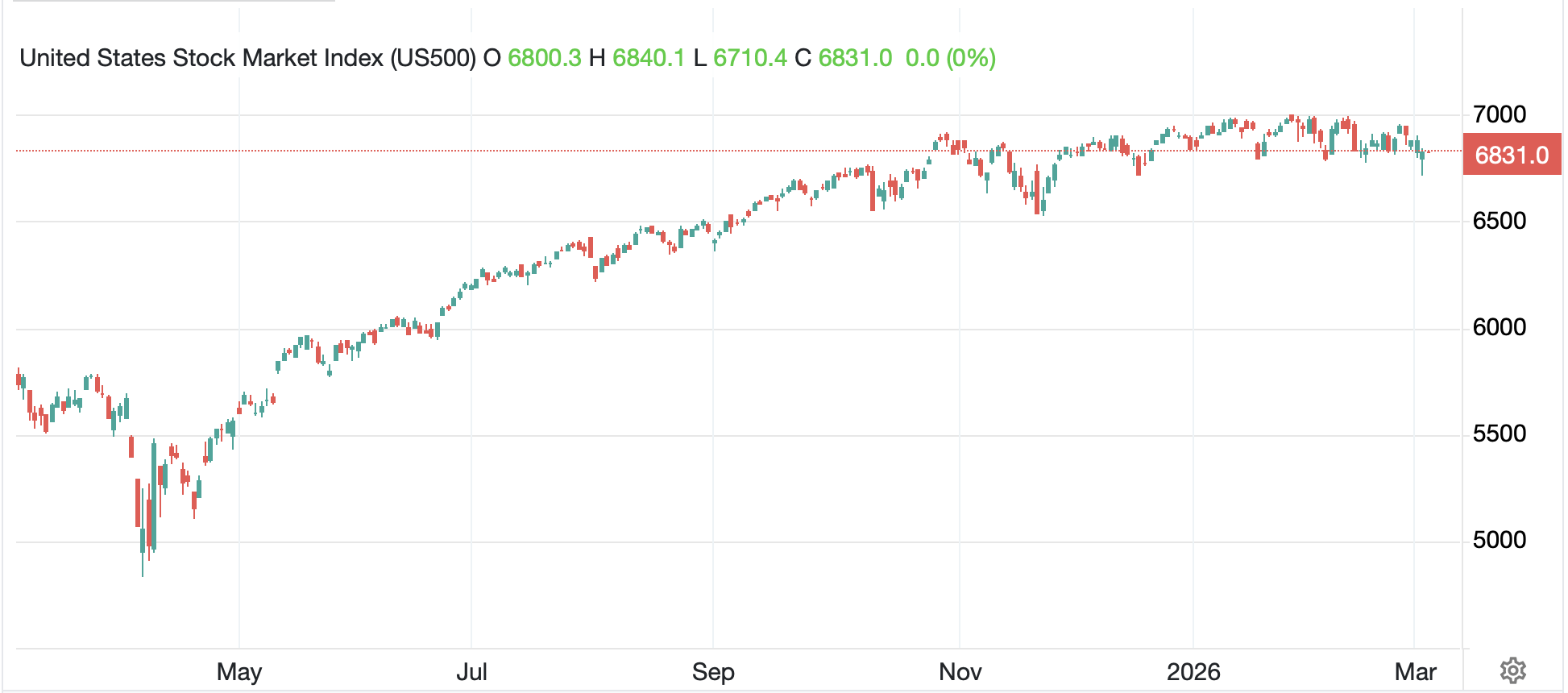
Moving on to the equity markets, while US markets have declined somewhat since the war began, the S&P 500 remains just 2.5% below its all-time high set February 28, and as you can see from the chart below, does not appear to be altering the recent trajectory in any meaningful fashion.

Source: tradingeconomics.com

However, the same cannot be said for several other markets, notably those in Asia.  The Kospi (-12.1%) is the worst offender as seen below.  But weakness in the region was widespread with the Nikkei (-3.6%), Hang Seng (-2.0%), Taiex (-4.3%) and Thailand’s SET 50 (-5.4%) leading the way lower with most other bourses falling on the order of -1.0% to -2.0%.  This makes sense as virtually all these nations rely on energy from the Middle East, and with both higher prices and reduced supply, trouble is afoot.

Source: finance.yahoo.com

Of course, as you can also see in the KOSPI chart above, with similar price action elsewhere in the region, these stock markets have been on a tear given their tech focus (Korea’s two largest companies are Samsung and SK Hynix, both semiconductor manufacturers) so there was some room for a reversal.  In fact, remarkably, despite the KOSPI having fallen almost 20% this week, it remains above its trend line.  My take is this is a major correction and something we will see until things in the Middle East settle down.

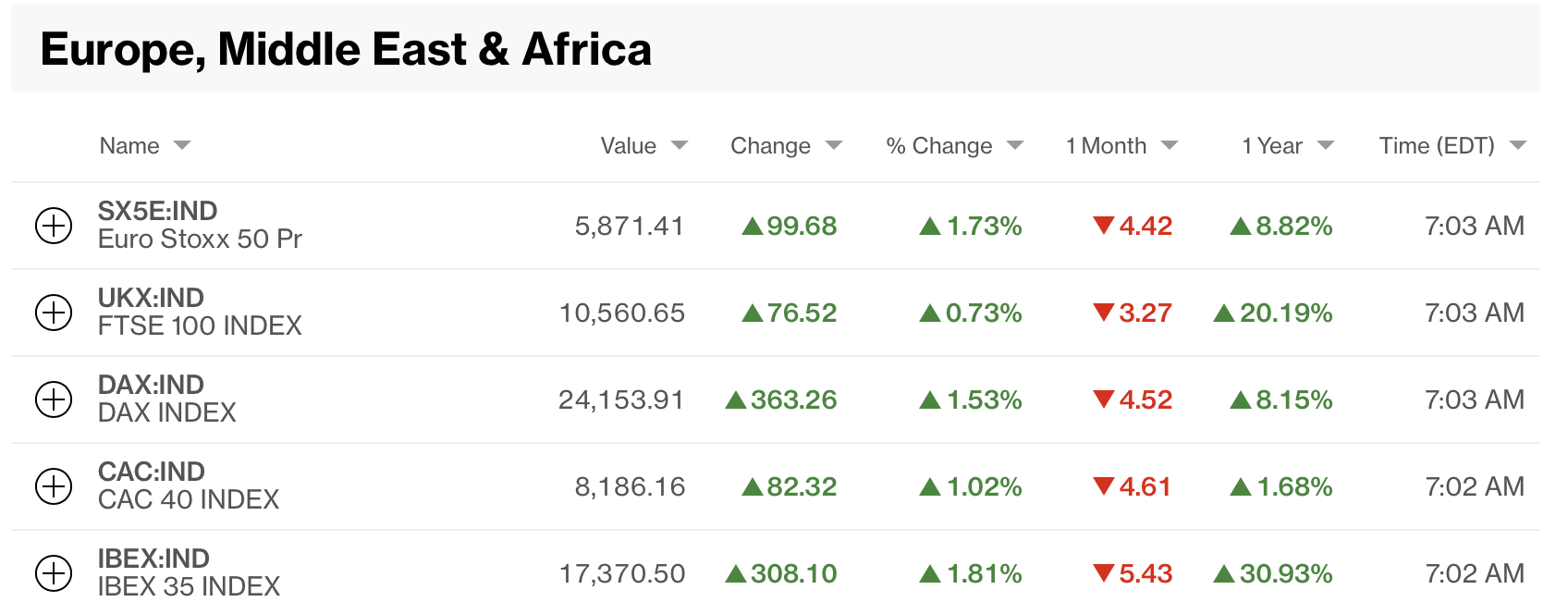
Working in favor of my correction explanation is the fact that European bourses, which all fell sharply yesterday, are all higher this morning as per the below Bloomberg table.

 As to US futures, at this hour (7:30) they are little changed. 

Turning to the bond market, after some initial fears over the inflation implications of the war, as well as the selling that accompanies margin calls, yields have settled down a bit.  This morning Treasury yields (+2bps) are a touch higher but, at 4.08%, hardly running away.  As to European sovereign yields, they are essentially unchanged this morning, and even JGB yields (-2bps) slipped a bit last night.  As I discussed above, markets have digested much of the news and seem to have found a new equilibrium

I didn’t mention metals markets above, but this morning, in sync with other markets that are rebounding, we see the entire space higher; Au +1.7%, Ag +4.3%, Cu +1.1%, Pt +3.8%.  This story of insufficient supply to meet ongoing industrial demand has not changed, nor has the demand by both central banks and individuals, especially in Asia, to hold gold as a store of value.

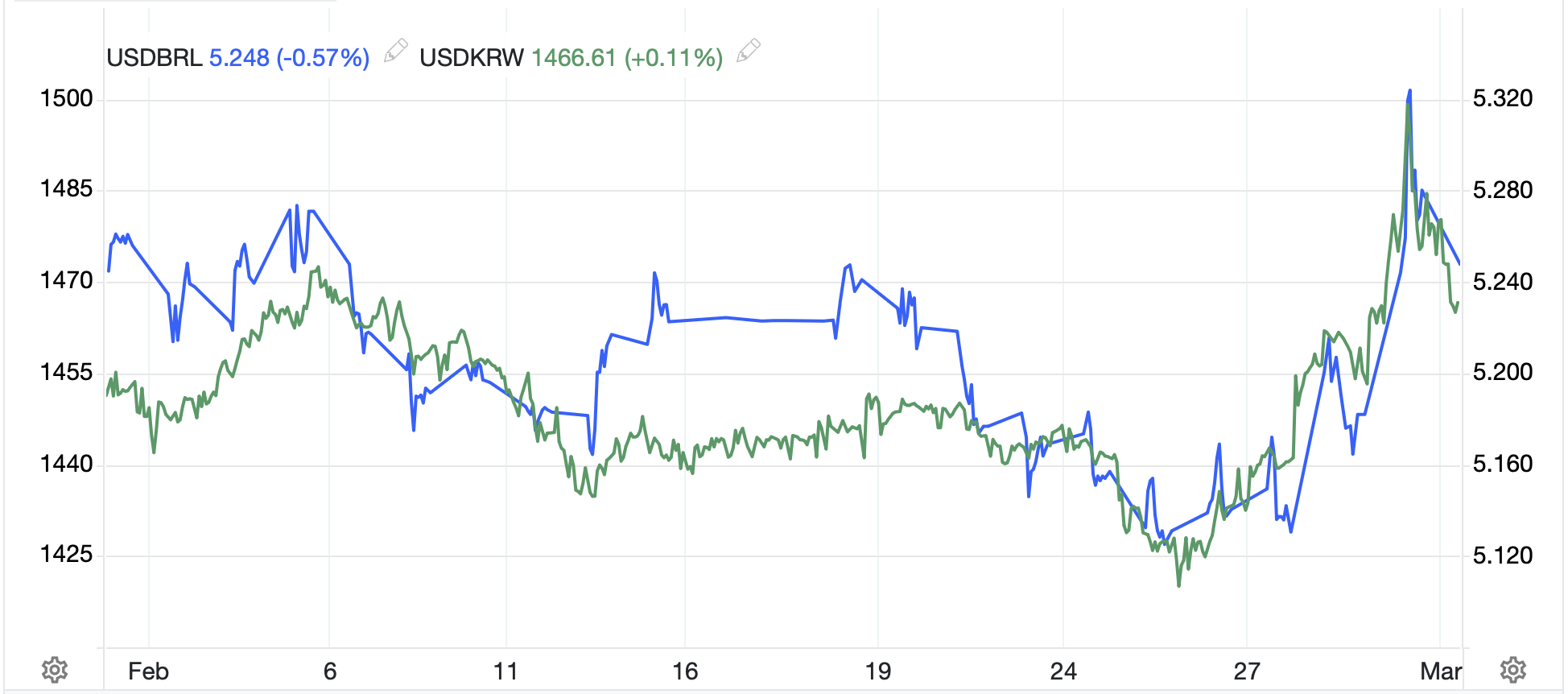
Finally, the dollar is backing off slightly this morning, which given the price action elsewhere, makes perfect sense.  In the G10 space, the movement has been on the order of 0.1% to 0.2% for the majors (EUR +0.2%, GBP +0.1%, AUD +0.1%, CHF +0.2%) with only JPY (+0.35%) and SEK (+0.8%) showing real gains.  However, it is important to remember that SEK was one of the worst performers recently, so had more ground to regain.  As to the EMG bloc, movement there has been more substantial, but again, this is after much larger declines.  For instance, BRL (+0.6%) and KRW (+0.9%) have both seen sharp declines in the past week before reversing overnight as per the below chart.

Source: tradingeconomics.com

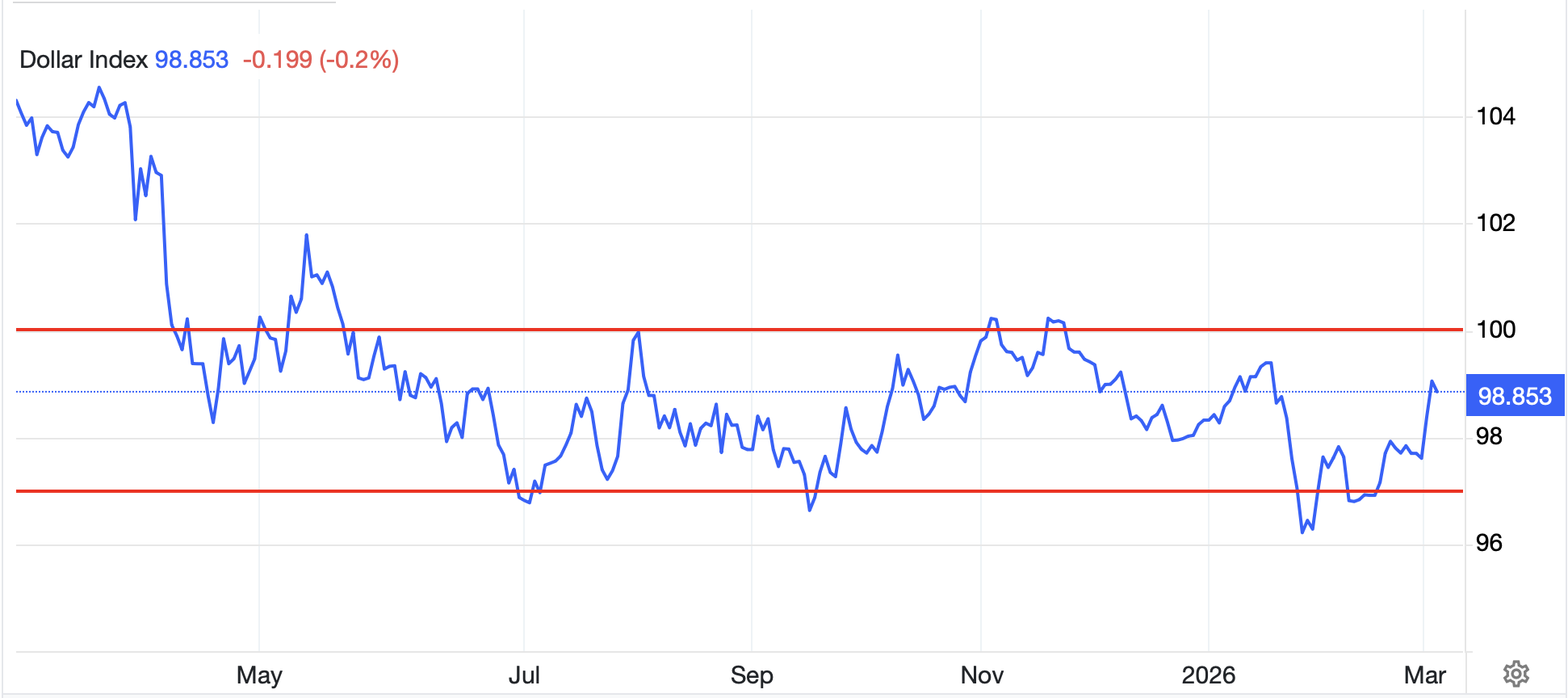
However, if we look at the DXY as our proxy, it remains in the middle of its trading range of the past 9+ months.

Source: tradingeconomics.com

In sum, we are three trading days into an entirely new geopolitical situation, and markets have digested the news and are seemingly trying to return to some sense of normalcy.  Now, there is still significant headline risk as nobody knows how things will evolve here.  What I will say is that if the Iranian regime falls or capitulates, I would look for risk to be quickly scooped up while oil prices slide.  Conversely, if things drag on much longer than another month, I think we could well see investor concern over how this will impact the global economy, especially if oil prices remain in the $75 – $80/bbl range, which likely means equity markets will suffer.

To the extent that anyone is still looking at data, this morning brings the ISM Services (exp 53.5) and then we see Crude Oil inventories later this morning.  The Services PMI data throughout Europe and Asia was in line with expectations showing slow growth remains the story.  Chinese data was marginally softer for large companies and marginally stronger for small companies.  As well, the Fed’s Beige Book is released at 2:00 this afternoon.

However, I don’t see data as a driver yet, so headline risk remains the biggest one out there, but the indications are markets are starting to absorb the war and move on.

Good luck

Adf

No Desire

Some days markets have no desire
To move, lacking seller or buyer
But don’t be concerned
The one thing we’ve learned
Is narratives always point higher

While it is clearly not summer as I look out my window and see a snow-covered yard, the doldrums seem to be the best description of markets right now.  A dearth of data, and in truth, a lack of commentary by all the usual players, at least new commentary, has both investors and traders looking elsewhere for signals.

Now, this is not to claim that there is nothing happening in the world, but right now, it all seems to be on hold.  With the SOTU behind us, we have had nothing new from the White House regarding virtually anything, tariffs, taxes, Iran, you name it.  Nvidia earnings last night beat expectations, but apparently not by enough to get people excited.  And virtually every other story is a warmed-over version of things we already know.

I think the most interesting market related news that I saw this morning was that the most hawkish member of the BOJ, Hajime Takata, said the BOJ needed to raise rates to fight Japan’s “heated” inflation.  This seemed a response to Takaichi-san appointing two doves to the board there.  However, the market response was essentially nil, as it should be, with the yen (+0.2%) edging higher while JGB yields (+2bps) also edged higher.  

Other than that, seriously, I cannot find a single thing that seems to matter to markets.  And it’s not like we have that much to look forward to today in the US, with Initial Claims the only data, so there is no reason to go on too long.

Here is a recap of the overnight session.  As I touched on JGB’s above, I will start with the rest of the government bond markets. What we see is that yields are literally unchanged this morning from yesterday’s closing levels.  All of them!  I am hard-pressed to describe a less exciting market than this.

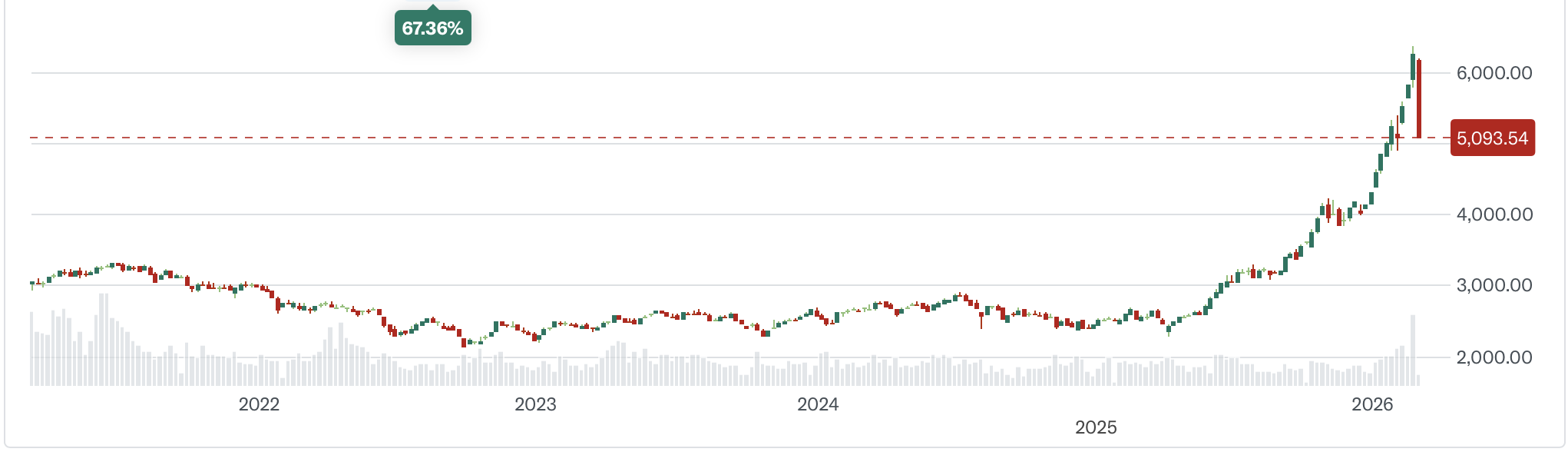
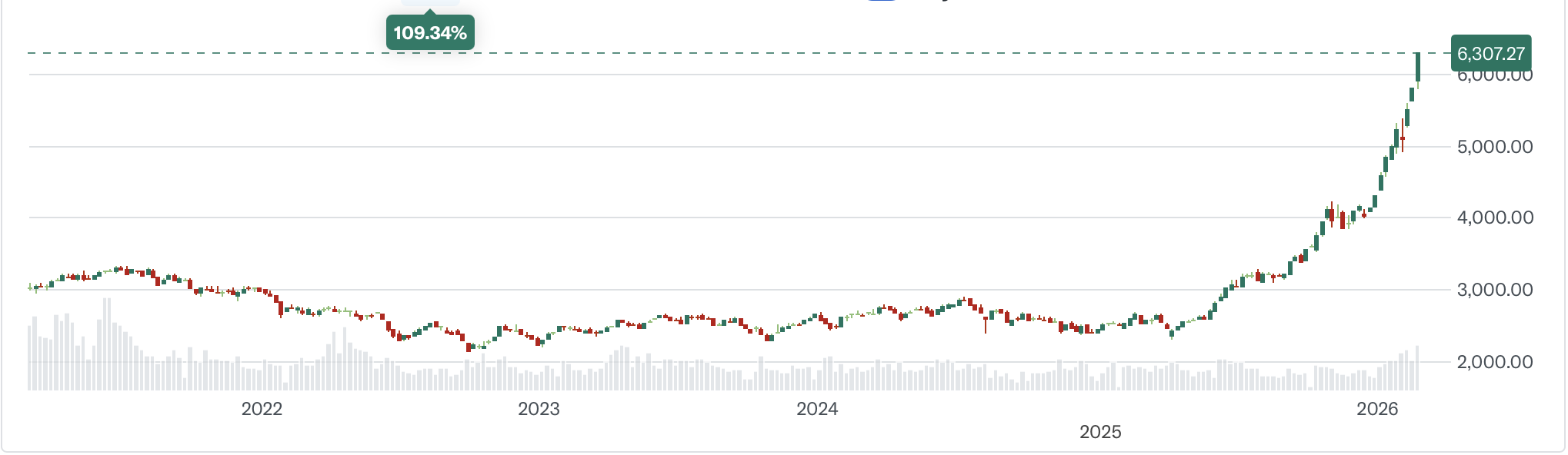
Turning to equities, yesterday’s solid US performance was followed by mixed outcomes in Asia (Tokyo +0.3%, HK -1.4%, China -0.2%) in the major markets while most other regional bourses saw modest gains or losses with no driving stories.  The exception to this was Korea (+3.7%) which has been on an amazing tear lately, as the two largest market cap stocks there, Samsung and SK Hynix, continue to explode higher on demand for memory chips.  In fact, I think it is worthwhile to visualize this move as it is rare for equity markets to go parabolic like this.

Source: finance.yahoo.com

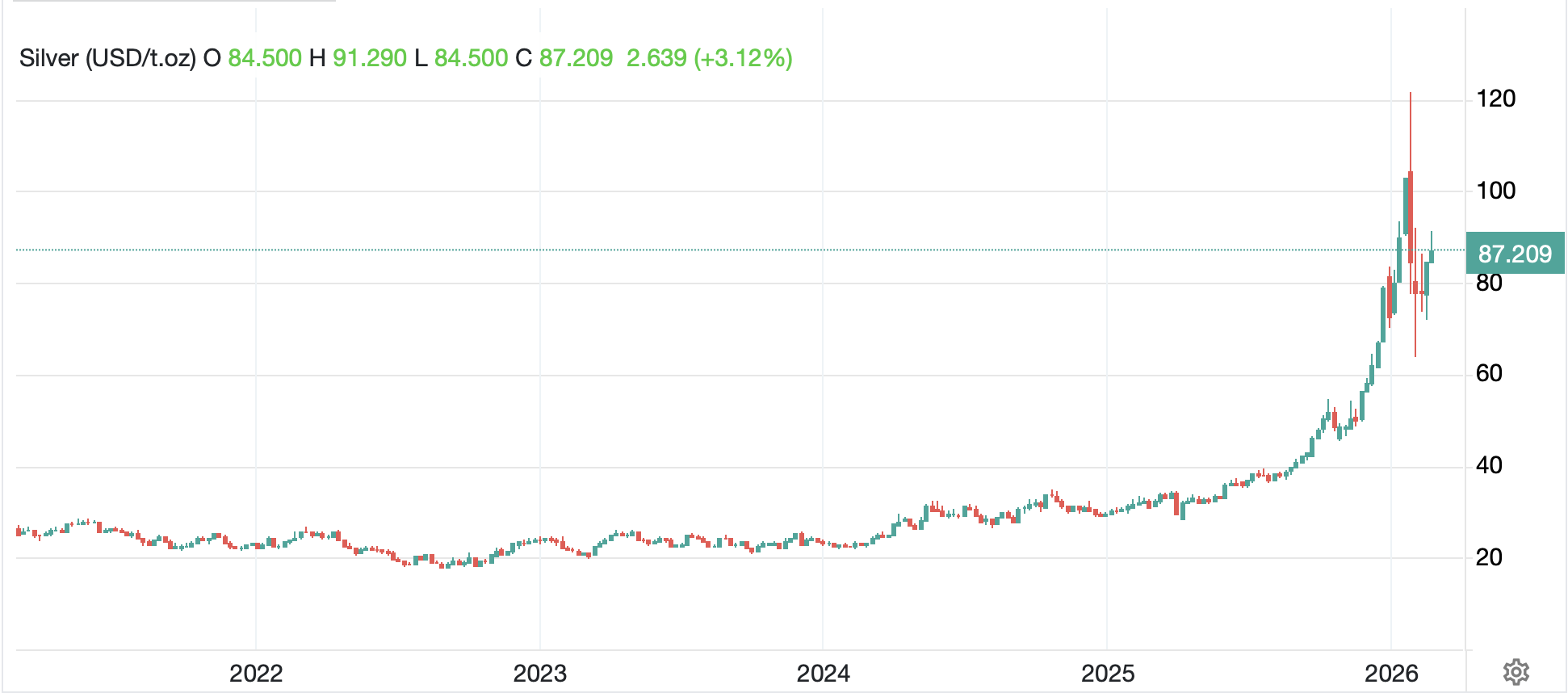
Of course, remember what happens to parabolic markets.  We just saw that in silver one month ago as per the below, so traders beware!

Source: tradingeconomics.com

Turning to Europe, France (+0.9%) is rallying on some earnings data from key companies, but the rest of the continent, and the UK, are doing little (Germany +0.4%, Spain -0.2%, UK +0.1%).  Fittingly, US futures are also unchanged at this hour (7:00).

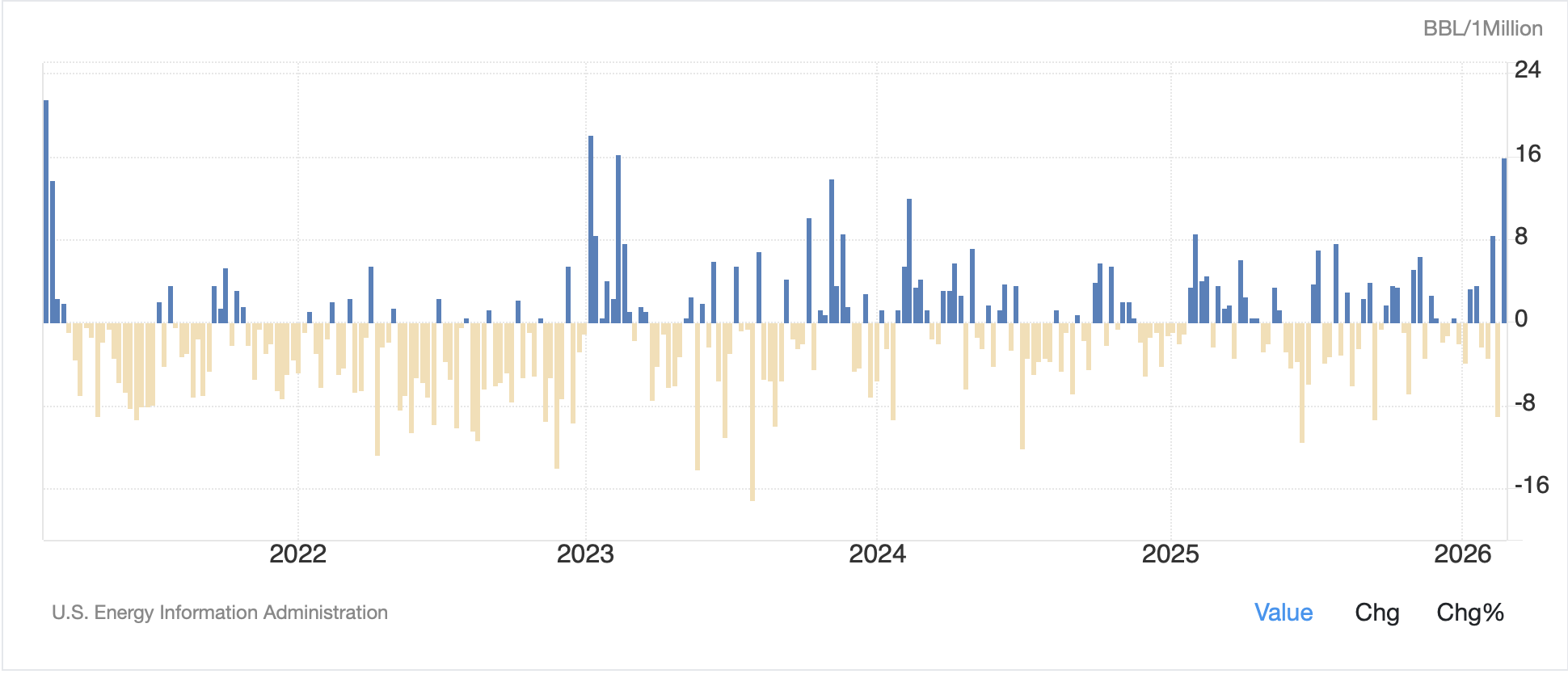
In the commodity space, oil (-1.7%) has softened substantially this morning as the absence of a war in Iran weighs on long positions, but more importantly, I believe, yesterday’s EIA data showed a massive build of inventories of 16mm barrels, far higher than expected and the largest build since February 2023.  Back then, it appeared to be the residual response to the Russian invasion of Ukraine as there was a scramble for barrels.  Perhaps this is a signal that in the event of a war, there is supply around.  If you look at the inventory chart below, we have certainly seen a net build over the past three years.  Again, it is hard for me to look at things like this and see significantly higher prices in the future.

Source: tradingeconomics.com

In the metals markets, gold is unchanged this morning, though trading well above the $5000/oz level and seems like it is consolidating before moving higher.  Silver (-2.5%) is sliding as there continues to be a discussion regarding deliveries into COMEX contracts with the first notice day for the March contracts tomorrow.  There are many pundits who claim there is insufficient silver available to handle the likely deliveries which, if true, would likely cause a significant short squeeze.  However, I have no insight into how this will play out.  My longer-term view remains that there is a structural shortage of the stuff for industrial applications and the price trend will continue higher, but we have learned how volatile it can be.

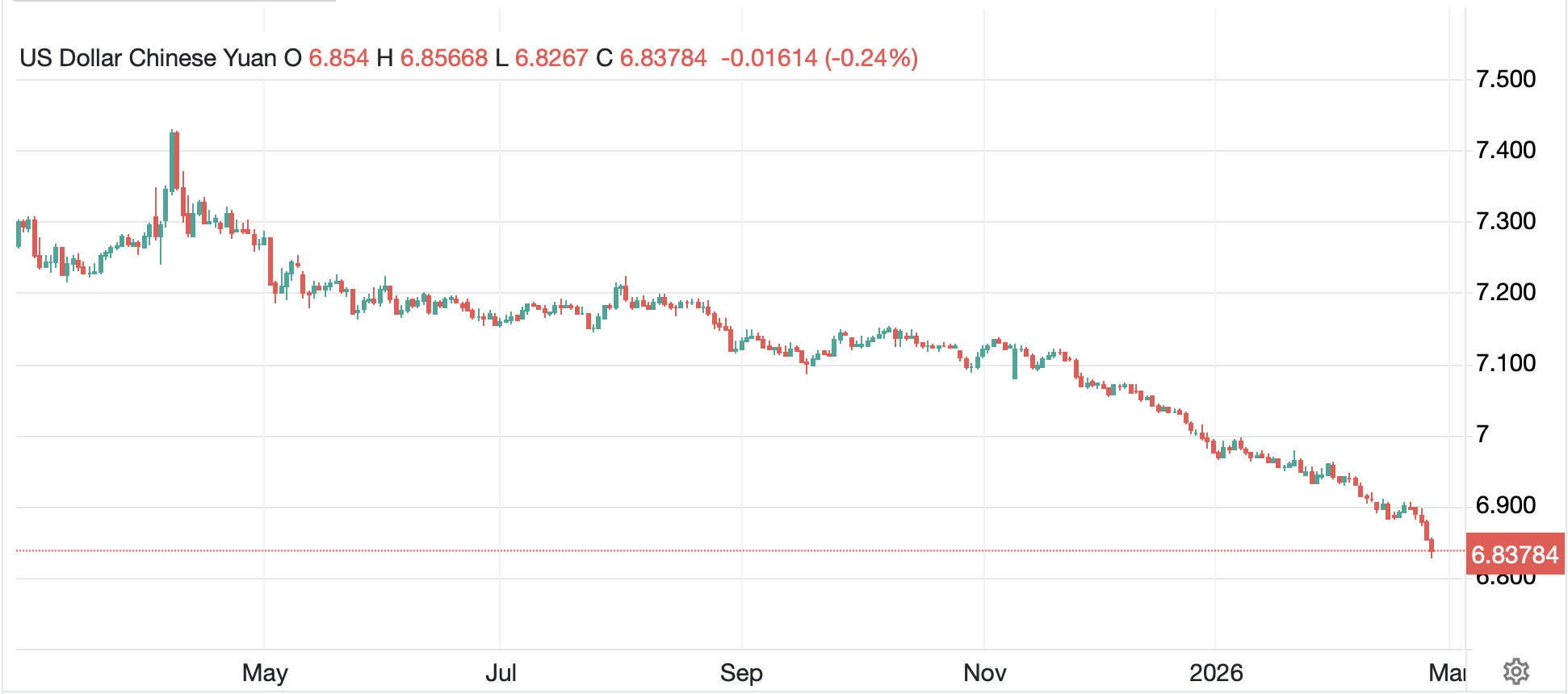
Finally, the dollar is modestly stronger this morning with the yen’s rise the exception in the G10 space (EUR -0.1%, GBP -0.2%, AUD -0.2%, CHF -0.3%, NOK -0.3%).  In the EMG bloc, we are seeing similar modest weakness across the board (PLN -0.2%, ZAR -0.3%, MXN -0.2%) with the outlier here being CNY (+0.2%).  Regarding the renminbi, the Chinese have been marching it slowly higher for the past year, as per the below chart.  My take is President Xi is very focused on convincing others the CNY is a viable reserve currency candidate despite all the capital flow restrictions.  I’m not sure how that would work, but that is the best I can come up with.

Source: tradingeconomics.com

And that’s all we have in markets this morning.  On the data front, Initial (exp 215K) and Continuing (1860K) Claims are the only releases and we hear from Fed governor Bowman, although to the best of my knowledge, nobody is listening to Fedspeak right now.  The market continues to price just one 25bp cut for 2026 at this point, although that seems likely to change once we get a better idea as to what Mr Warsh would like to do when he gets the Chair.

My guess is that if there is going to be an attack on Iran, it will happen this weekend, so until then, given the absence of data, I think we drift in all markets and wait for Monday.  Today, and tomorrow, ought to be quiet.

Good luck

Adf