
The data of late offers nought
To help decide what should be bought
Or sold, so we wait
For CPI’s rate
With risk takers feeling quite fraught

Despite NFP being weak
Some Fed members, when they do speak
Are pining to hike
Into the crude spike
I fear much more havoc they’ll wreak
The below chart from cmegroup.com describing Fed fund futures probability pricing for a rate hike at the September meeting is an excellent description of many markets right now, nobody knows nothin’. It has been pretty rare of late, really in the past 15 years, that market participants were so uncertain about the future path of short-term interest rates. And frankly, I think this is exactly what Chairman Warsh wants to see. If uncertainty is high, then risk-taking recedes and that offers a more robust market framework.
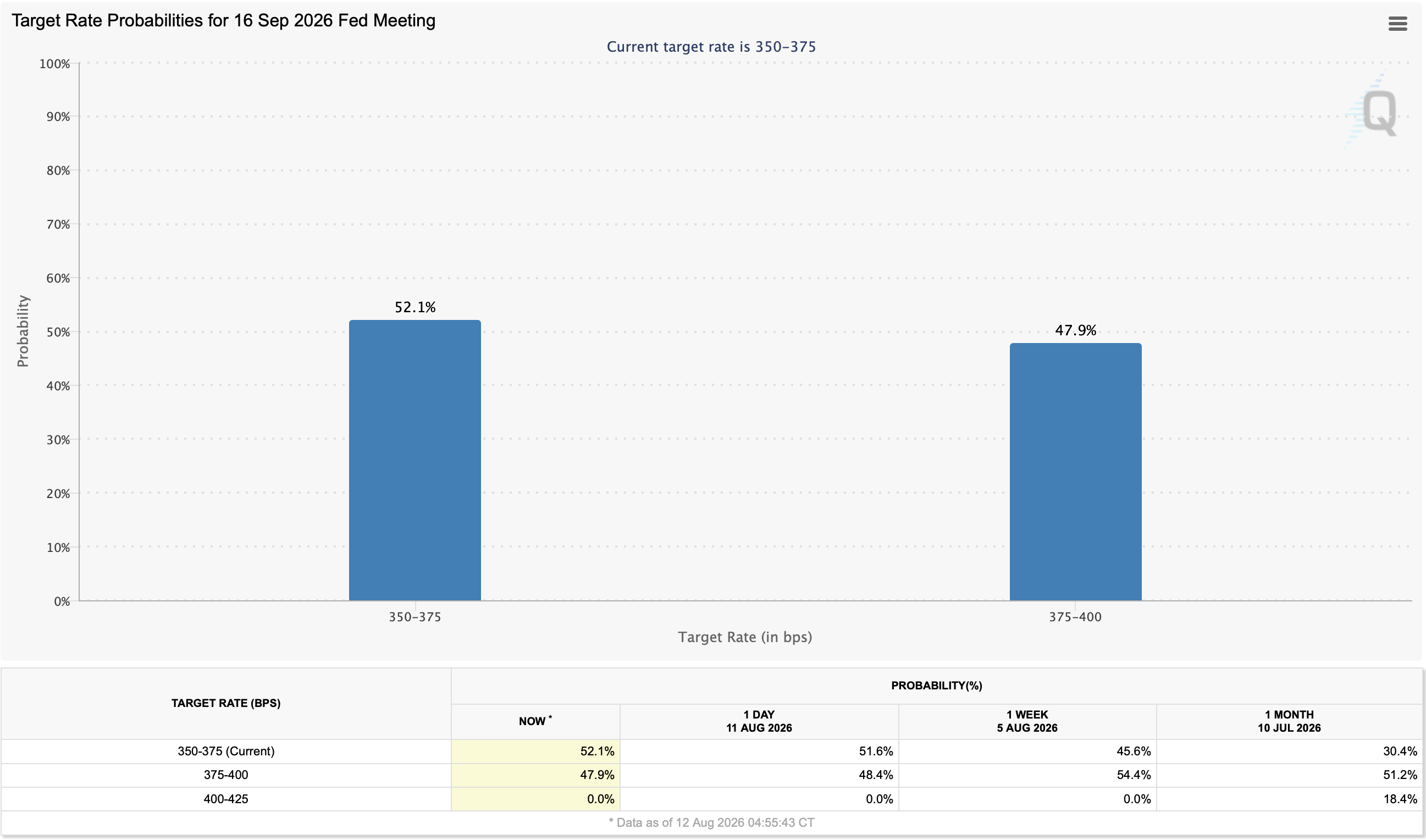
If pressed, I think he would be happy if this were the situation going into every meeting, although obviously, there is no meeting imminent, this is a response to today’s CPI data.
Current consensus expectations are as follows:
- CPI M/M: 0.1%
- CPI Y/Y: 3.4%
- Core CPI M/M: 0.2%
- Core CPI Y/Y 2.5%
I have no model nor framework to anticipate whether the outcome will be seen as either hot or cold, but since this is for July, we can look at the price of gasoline during the month and see how much it changed. I apologize for the chart below but it is the only way I could determine how to show the movement from month end to month end where on June 30, RBOB futures closed at $2.8949/gal and on July 31 they closed at $3.1142/gal so a gain of 7.5%, but if you look at the chart, it does seem like it spent a lot more time above the month end close than below it. In fact, my best estimate of the average price during the month is ~$3.18/gal, higher still, so energy prices were certainly firmer during the month.

Source: tradingeconomics.com
Of course, the question the market is asking is, will this change the Fed’s generic viewpoint on inflation? The current downside of Chairman Warsh’s attempts to adjust the way the Fed works is that neither traders nor analysts have a good idea of their current reaction function when it comes to data. We know that there are a group of FOMC members who are itching to hike, but with a relatively soft NFP report last week, if today’s number is also soft, will that change attitudes? It is this conundrum that neatly defines why the analyst community is so up in arms, since they seem no longer able to think for themselves, they don’t know what to think!
But that’s where we stand for now, a major data release upcoming and a market that has, arguably, pulled in its risk-taking wings to make sure they can fly afterwards. As this is the biggest story for the day, let’s take a twirl around markets overnight to see what they did in anticipation of the release.
While yesterday’s US session was lackluster, with all three major indices slipping a bit, overnight saw more winners than losers. So, Tokyo (+0.8%), China (+0.6%), Korea (+3.7%) and Taiwan (+0.9%) all continue to perform well on the back of the tech story although HK (-0.8%) and Australia (-0.5%) lagged. As to the smaller, regional exchanges, it was a mixed picture, although certainly not an extremely negative one. It appears that risk appetite remains reasonable if not gigantic. Certainly, if we look at the Fear & Greed Index, it demonstrates that point exactly.

Meanwhile, in Europe, equity markets are generally a bit firmer led by the DAX (+0.5%) and Spain’s IBEX (+0.2%) while both France and the UK are essentially unchanged although there has been no data to drive things in either direction. It appears like these markets are awaiting the CPI data just like US markets. Speaking of which, futures at this hour (7:10) are pointing slightly higher with the NASDAQ (+0.5%) leading the charge.
In the bond market, despite all the angst, Treasury yields are lower by -2bps this morning and this is dragging the entire bond market down with European sovereign yields all lower between -2bps and -3bps as well. Is that an indication that a soft number is expected? The outlier here is Japan where JGB yields (+4bps) rose last night and are now just 5bps below the recent 30-year high level reached in early July.
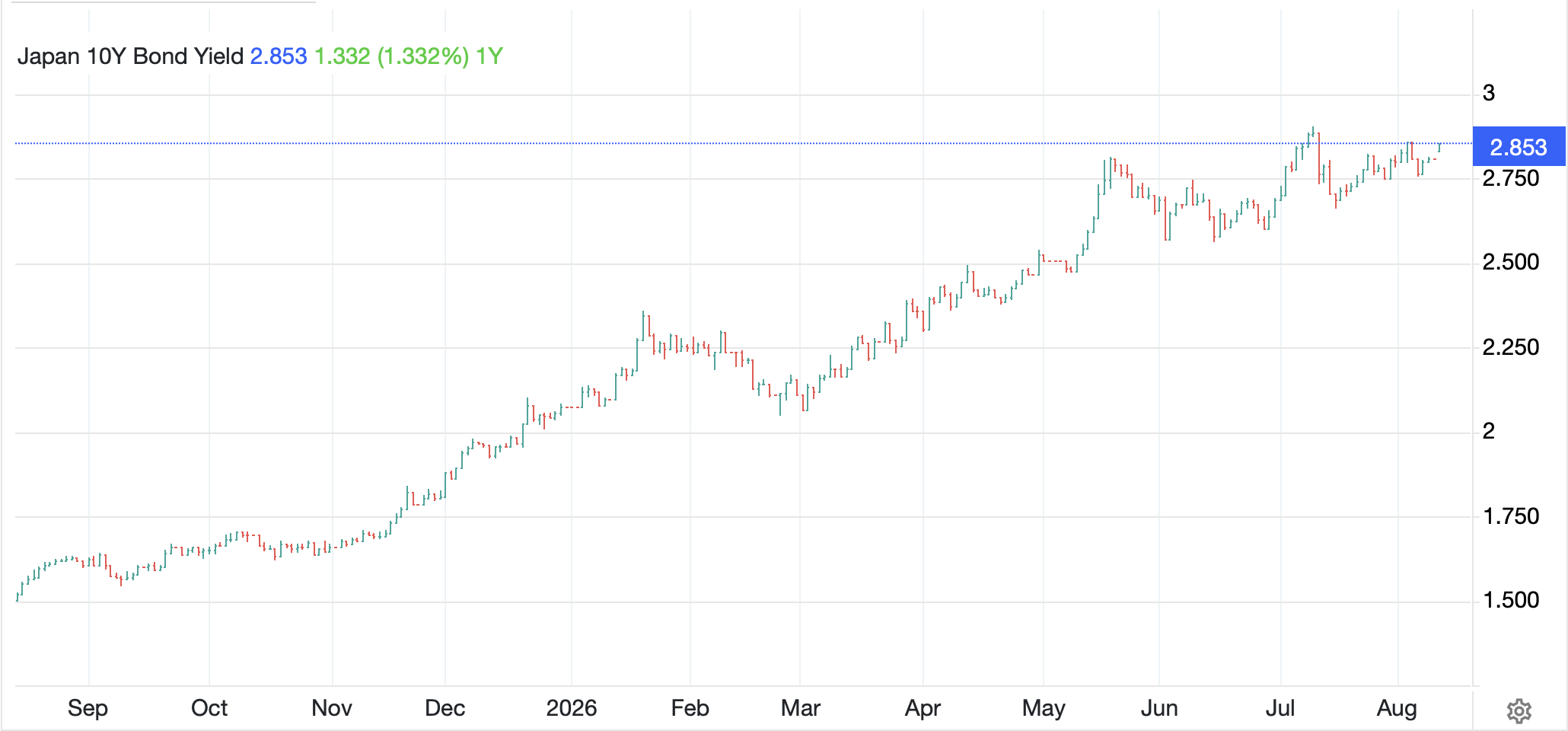
Source: tradingeconomics.com
Bloomberg had numerous articles this morning about Japan and the issues they have with the yen, their monetary policy, their relationship with the US and were generally of the opinion that Japan is making all the wrong moves, hence the weakness in the currency.
In the commodity markets, oil (+0.3%) is back above $83/bbl now having gained 11% in the past week. The ongoing tit for tat comments from both Iran and President Trump have become just background noise to most of the market these days. Later this morning we get the EIA inventory data with a small draw expected, although that was expected last week and there was a build in inventories. It has been nearly 6 months since the war started and the Strait became compromised and there is still seemingly plenty of oil and products available to users. As to the metals markets, this morning they are quite shiny (Au +0.9%, Ag +2.4%, Cu +0.7%).
Finally, the dollar is…well nobody seems to care much about it these days. It is virtually unchanged vs. almost all its G10 counterparts with NZD (-0.3%) the lone exception. The best explanation I can see is that employment data last week may be weighing on the belief the RBNZ is going to hike rates at their next meeting, but that is fishing. It is quite likely there was an order that went through to drive the price.
In the EMG bloc, there is also little to discuss overall as FX markets are generally quiet. But I want to mention CNY as I read something this morning about which I was unaware. Mike Nicoletos, a very solid analyst, made the point that banks in China are paying up for USD deposits there, as high as 4% vs. 1% for CNY deposits. This has been occurring despite the fact that the renminbi has been strengthening steadily all year as per the chart below.
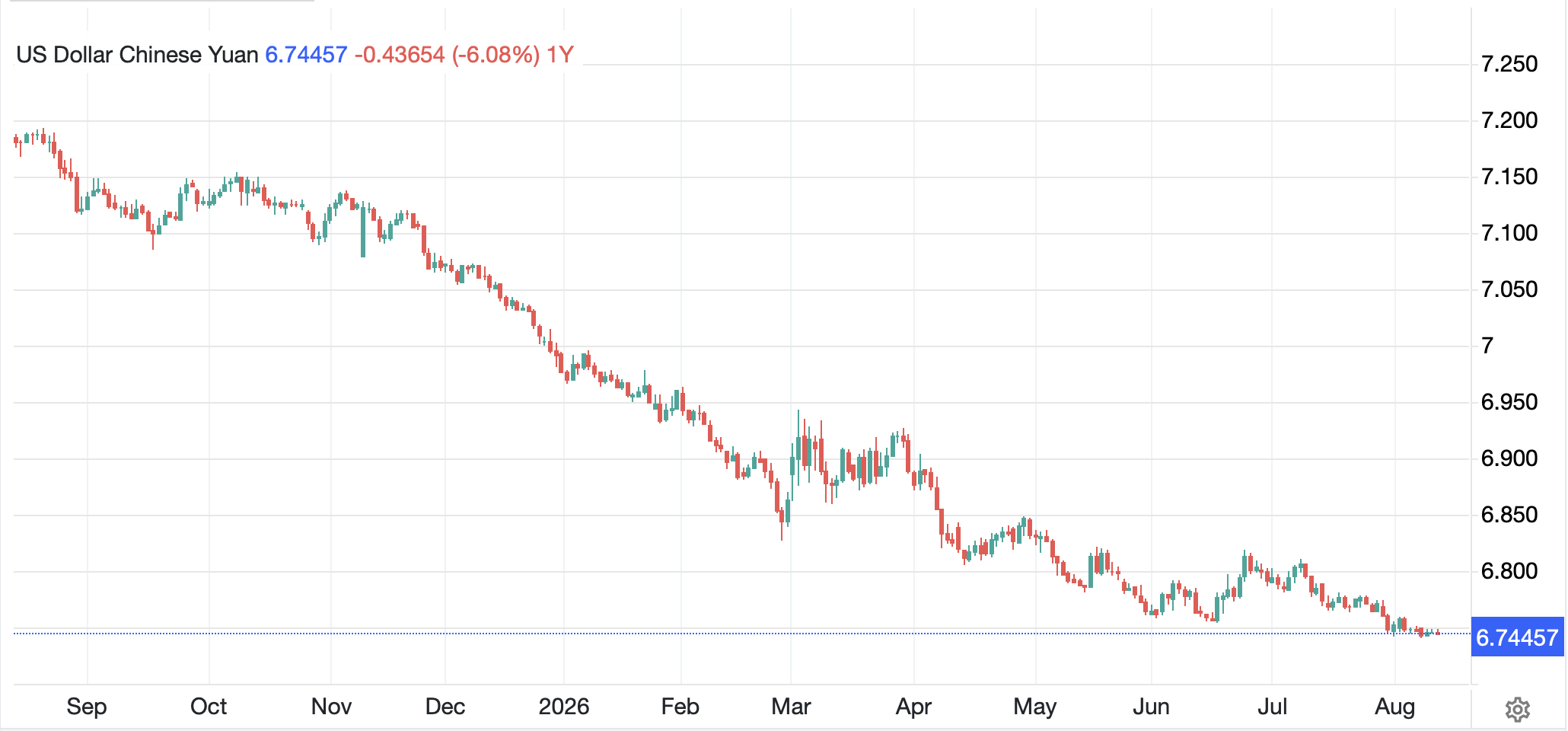
Source: tradingeconomics.com
Now, the renminbi is arguably at least 30% undervalued, even after its recent relative strength, which is one reason that China’s exports continue to grow. The undervalued currency is a key reason China finds itself the subject of tariffs and trade restrictions all around the world. But recall, there is a narrative that nobody wants dollars and China is de-dollarizing as they try to move to more local currency trade and settlement. The very fact that banks in China are paying up so much for USD deposits may tell a different story. Perhaps there is a significant need for dollars, even in China, and banks have no funding. Remember, there is no Fed swap line with the PBOC so they have to source their dollars the old-fashioned way, pay up for them. It is interesting that the renminbi continues to strengthen despite this dollar demand, but I suspect this will continue for a while. Maybe the de-dollarization narrative has some flaws in it after all.
And that’s really it for today. A hot CPI number will probably see higher yields and some dollar strength and equity weakness with the opposite true for a soft number. We shall see.
Good luck
Adf
 fxpoetry