
More systems have shown they can fail
With Chase and United quite frail
Is this World War III?
If so, it could be
A sign all positions are stale

So far, both these companies claim
Twas internal, tech was to blame
But risk appetite
Has now taken flight
With short sellers fanning that flame
Over the course of the past four days, we have seen major tech problems at Microsoft, the FAA, United Airlines and JPMorgan Chase although all of them have ostensibly been fixed. In each case, internal technical issues were declared to be the problem with no evidence of a major hacking. I know yesterday I called on Sir William of Ockham in discussing the FAA outage as likely to be just that, a tech glitch. But I must admit it is getting harder to ignore the idea that there may be a larger issue ongoing in the background.
After all, if there was a major cyber-attack by Iran or North Korea or China, or anybody, a group of anarchists for example, would the government really admit that up front? It would not speak well of our tech capabilities and defenses for these things which have been discussed frequently over the past several years. It is certainly possible that these large organizations, each having their own fiefdoms and each having a great deal of technology investment that dates back generations in tech terms, are having their own Y2K moments, with their internal systems unable to keep up with ever increasing demands. But four major organizations within a four-day span and it certainly raises eyebrows if not questions.
As of now, markets have taken the explanations at face value and are trading on other issues, largely puking tech shares everywhere around the world as fears the AI trade is ending continue to grow, but remember, markets are fickle and they could collectively decide there is a bigger problem and flee to Treasury bonds all at once if we see another tech problem at another well-known company in the coming days. Something to keep in mind.
Meanwhile, President Trump is in the Philippines today before heading onto the APEC meeting in Shenzhen, China later in the week. The mooted meeting between Presidents Trump, Xi and Putin remains a key focus for the world, but not so much for markets.
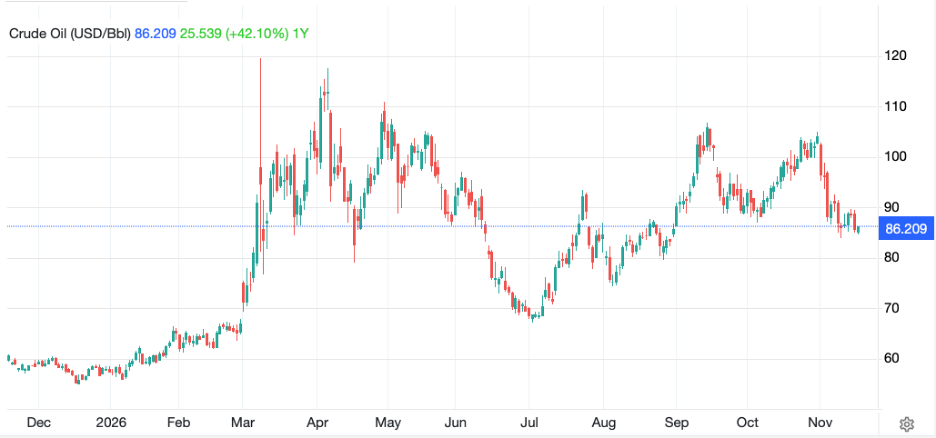
So, let us turn to the markets and calculate the damage we have seen of late. Remember when oil prices were the key driver of everything? Ever since March and the initial foray into Iran, oil was the number one indicator of what was happening in markets. But not anymore. There were many who expected the oil price to rise to $200/bbl or beyond with the disruption caused by the closure of the Strait of Hormuz. Yet if we look at the chart over the past year, the initial spike high of $119.48/bbl is the peak, and that came a week after the initial attacks.
Source: tradingeconomics.com
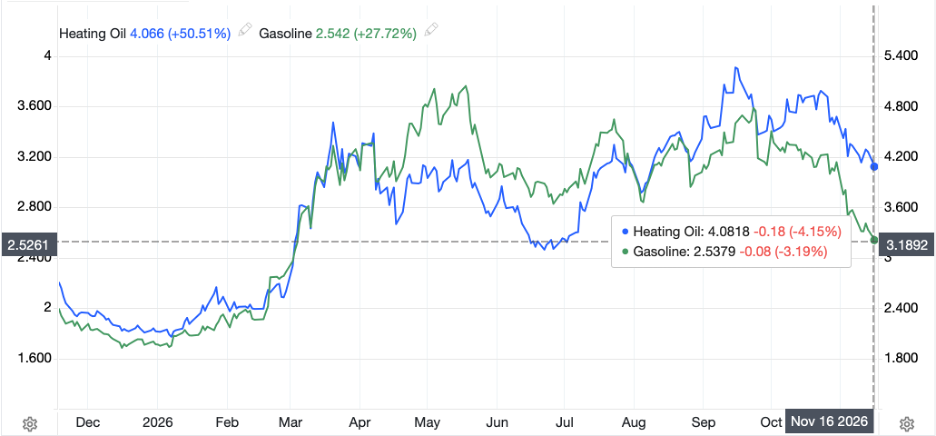
Quite frankly, eyeballing the current level, as depicted by the blue line on the chart, it is fair to say we are right in the middle of the range having declined from the late October peak pretty steadily. By all accounts, there is plenty of supply of crude around, and as evidenced by the fact that both gasoline and heating oil (a diesel proxy) futures prices are falling even faster than crude, there is plenty of that as well. In fact, if you look at the below chart of those two products, you can see just how much they have fallen, each nearly 20% from those late October levels, and both are down sharply today as per the chart inset.
Source: tradingeconomics.com
As well, the coming glut narrative is picking up steam, with several articles this morning discussing just that situation, how there is plenty of the stuff around, and while current shipping costs are high, the strong belief that the entire conflict will end sooner rather than later has resulted in fears that we could see a very sharp decline in oil prices soon. At least fears by the oil companies making a killing these days.
But you know who hasn’t developed those fears? That’s right, the FOMC! Yesterday Cleveland Fed president Hammack was explaining why numerous small rate hikes were her preferred method of keeping the Fed up to speed while expressing concern that people’s behavior was beginning to change. But is that really the case? Once again, the biggest risk in my view is that the Fed tightens aggressively into the oil price shock just as oil prices start falling sharply. Consider this possible outcome:
- Fed hikes 50bps in December (to catch up)
- Equity markets extend their recent decline
- Energy demand wanes amid high interest rates
- Strait of Hormuz reopens
- Oil prices go back to $50/bbl with gasoline at $2.00/gal
- Economy slows sharply
I wonder how frequently Fed speakers will be on the tape if the economy slows to recession levels after they hike rates. I’m guessing they will disappear. This is not to say this is what is going to happen, just that it is a viable scenario. I fear the probability of a major central bank error is growing.
In the equity markets, tech hatred fear is strong and that has been the driver. Yesterday’s sharp declines in the US were followed by sharp declines throughout Asia (Tokyo -1.3%, HK -1.0%, Korea -2.6%, Taiwan -2.3%, Australia -1.8%) with China the outlier here as the plunge protection team was at it again capping the loss at -0.1%. The problem the Chinese have is that their latest program, a cheap loan program for companies to buy their own shares, has far less take-up than anticipated, i.e. companies don’t want to repurchase their own stock. If they don’t with cheap financing, why would anybody else?
In Europe, despite the fact that they have virtually no tech, stocks are lower there as well (France -0.8%, Germany -0.6%, Spain -0.6%, UK -0.8%) and US futures at this hour (7:25) are mixed with NASDAQ bouncing slightly while DJIA futures fall.
One of the markets doing a bit better, though, is the bond market with treasury yields (-2bps) slipping again today and European sovereign yields all lower by between -2bps (Germany, UK) and -7bps (France) with everything in between. This is not a sudden belief that debt problems are going to disappear but rather a flight to something that seems less likely to drop 50% on a whim.
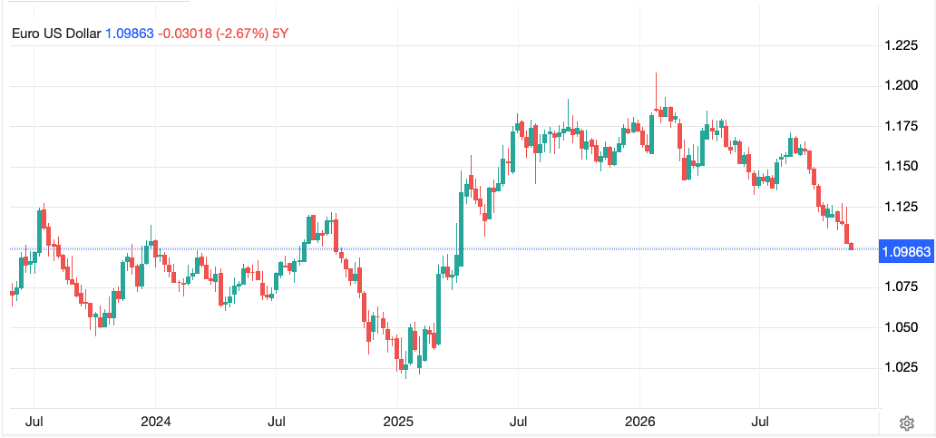
Which takes us to the FX markets. Looking at the broad dollar, it continues to garner support as whatever my data center concerns might be, in the current period of growing fears about equity markets, the dollar’s haven status is making itself felt. So, the euro (-0.2%) is below 1.10 for the first time since April 2025 and I continue to believe is heading toward parity, or certainly 1.0500. The combination of the growing hawkishness from the Fed and ongoing Eurozone economic weakness is adding to the haven trade.
Source: tradingeconomics.com
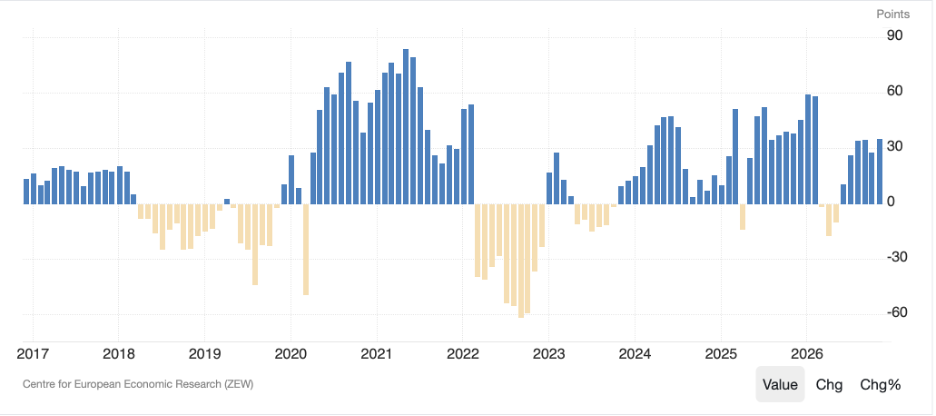
Now, in fairness, German ZEW data this morning was the best since the Iran war began but if you look at the below chart, it doesn’t inspire that much confidence that things are great in Germany.
Source: tradingeconomics.com
Recall the Germans are still deindustrializing based on their energy policy and have a barely functional government given the deep divide in the nation politically. German companies are openly explaining they will not be investing in new production facilities there, so the future needs to be called into question absent some major policy shifts.
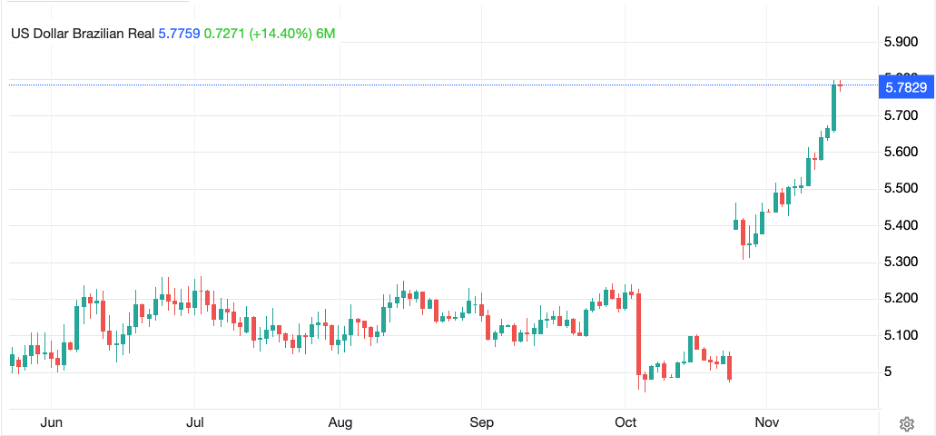
But if we widen our scope to the EMG bloc, the one that jumps out is BRL, which slipped -2.1% yesterday, extending its decline in the past month (since Lula’s re-election) to -15%!
Source: tradingeconomics.com
The proximate cause was the Brazilian Senate approving Lula’s spending plans, which given the Socialist leanings of that government, are unfunded and driving investors away. While that is an extreme example, my take is that going forward, we are going to see similar spending plans from governments all around the world (France anyone?) and investors are going to seek out relative safety. This bodes well for the dollar, the Swiss franc, gold and potentially the yen.
As to the data this morning, Retail Sales (exp 0.2%, 0.4% ex-autos) along with IP (0.1%) and Capacity Utilization (76.8%) are on the docket. We have lots more Fed speak with Hammack, Waller and Williams all almost certainly going to explain why they need to hike further. Interestingly, the declining stock market seems to have given pause to those thinking 50bps is coming next month, although the 25bp hike is still a ‘lock’.
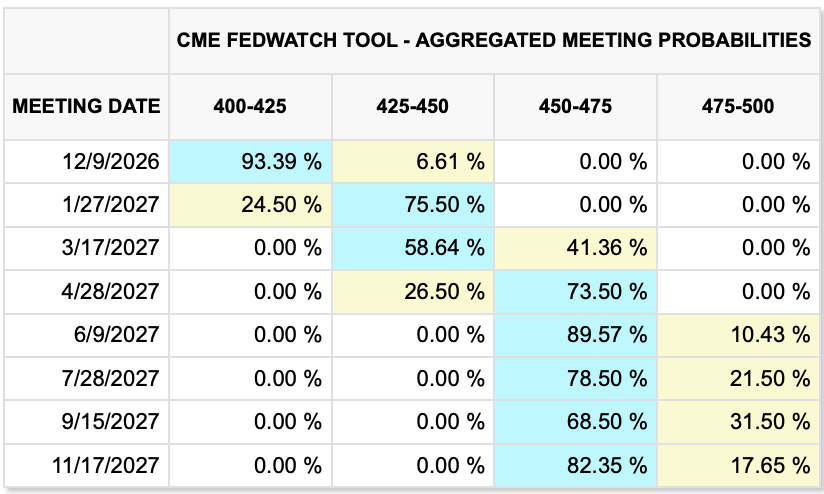
Uncertainty reigns right now and in that scenario, the dollar does feel safer than most currencies and Treasuries are likely to maintain their bid.
Good luck
Adf

