
The story of note was a stock
That everyone thought was a lock
To go up forever
‘Cause Jensen was clever
And built AI chips round the clock

But suddenly, there was a shock
With Jensen’s head put on the block
So, his stock got crushed
With longs getting flushed
While all of the haters did squawk

And elsewhere, the Fed’s fiercest hawk
Explained that inflation’s hemlock
To not just the people
But also the sheeple
Who cut rates while talking the talk
First things first, Marvel was Select Dog yesterday and we look forward to the show tomorrow, the National Dog Show, which is televised on NBC right after the Thanksgiving Day parade. We are hopeful that he will be Best of Breed and compete on TV.
Second, I can offer very little insight into the Nvidia situation. I recall writing last year about the news of Singapore being the second largest market for their chips and discussing how those might have been heading to China. I guess that was, in fact, the case. My observation about Jensen Huang is that when men, and specifically men, get that rich and powerful, they become of the belief that nobody can touch them. We have seen it in business and politics throughout history, and this is no different.
My take, FWIW, is that Nvidia is still going to be making chips and AI is going to continue to be a part of our future. I saw someone on X this morning compare Nvidia to Enron, claiming the entire company is a fraud. That feels extreme to me, but then I neither own the stock nor followed it closely. If it is a fraud, it would certainly be the largest in history! It would also have a deleterious impact on the rest of the global equity markets, so keep that in the back of your mind.
In the meantime, perhaps our time is better spent on the FOMC speakers who have turned incredibly hawkish over the past several weeks. It’s almost as though the committee, looking through a post-election, political lens, has decided to concentrate on their PRIMARY mandate, stable prices. It’s been six years since the core PCE, their preferred metric, has been at their 2.0% target or lower, a track record of failure unmatched in history as you can see in the FRED chart below.
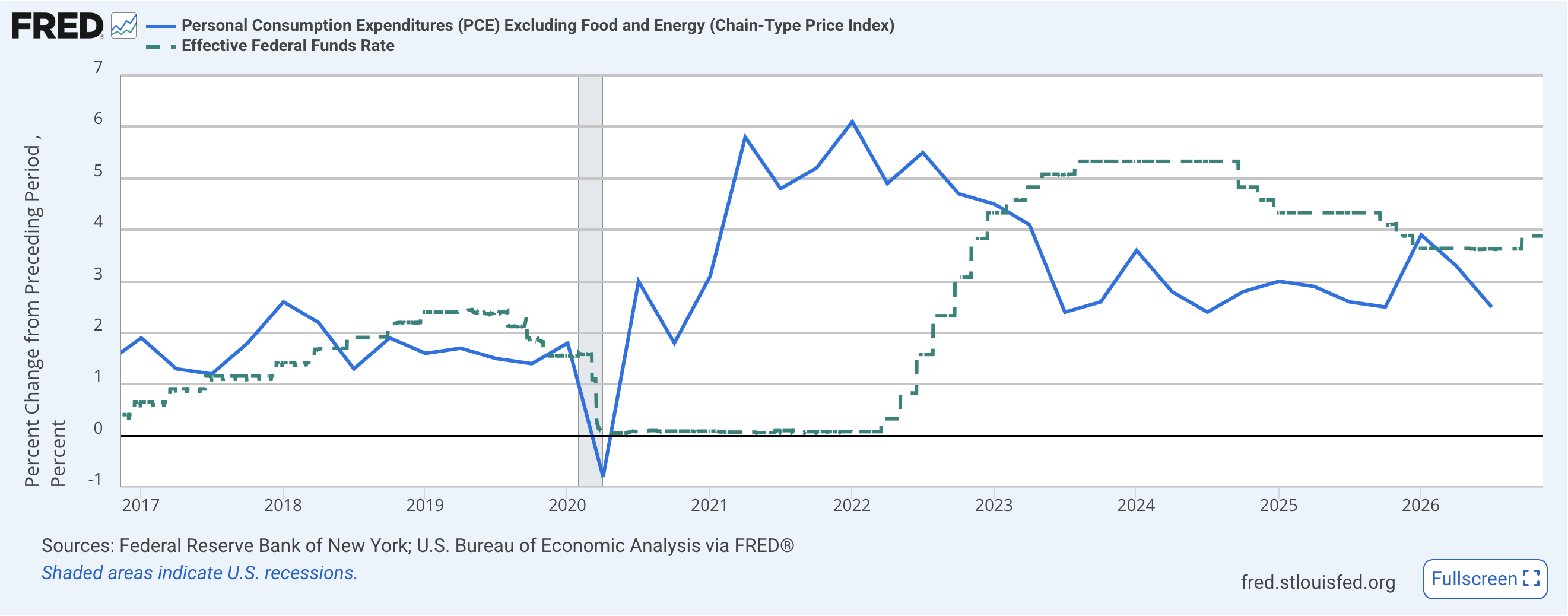
As I’ve discussed here many times, there has been zero evidence that inflation would be retreating to their target for years, but they managed to cut the Fed funds rate from 5.33% to 3.63% anyway. At the time I called it out as political, and nothing has changed my mind it was anything but. Perhaps President Trump should have a national address and call them out by name as the ones who have overseen rising inflation and remind everyone that he wanted to fire a bunch of them, but the Supreme Court said he couldn’t. If people are upset, they should take it up with the FOMC directly. He could even, helpfully, offer up their addresses.
Removing my tongue from my cheek, my point is, and has been, the FOMC has been failing at its role for many years. I’m trying to understand why they have suddenly decided inflation is too high. Alas, politics continues to be the most likely answer to that question.
All week, we have been inundated by Fedspeak, and there are four more speeches on the calendar today. While it is no surprise that the most hawkish, Hammack, Schmid, Logan and Waller, have been calling for more rate hikes, even the previously more moderate voices have been coming out strongly in favor of more hikes. The below list of speakers offers an idea of just how much they want to get their point across.
Monday, November 9
- Michelle Bowman (Vice Chair for Supervision) — ~8:40 AM
- Austan Goolsbee (Chicago Fed) — ~10:00 AM
- Tom Barkin (Richmond Fed) — ~12:15 PM
Tuesday, November 10
- Christopher Waller (Governor) — ~4:00 AM (London event)
- Lorie Logan (Dallas Fed) — ~10:50 AM
- Jeffrey Schmid (Kansas City Fed) — ~1:30 PM
- Michelle Bowman — ~3:30 PM
- Anna Paulson (Philadelphia Fed) — ~6:30 PM
Wednesday, November 11
- No major speakers listed (Veterans Day; Fed holiday for some releases)
Thursday, November 12
- Beth Hammack (Cleveland Fed) — ~9:00 AM
- Michael Barr (Governor) — ~10:00 AM
- Austan Goolsbee — ~11:15–11:30 AM
- Mary Daly (San Francisco Fed) — ~1:10 PM
- Jeffrey Schmid — ~1:30 PM
- John Williams (New York Fed) — ~6:30 PM
Friday, November 13
- Susan Collins (Boston Fed) — ~9:10 AM
- Michelle Bowman — ~10:50 AM
- Mary Daly — ~11:10 AM–12:00 PM
- Philip Jefferson (Vice Chair) — ~7:00 PM
More importantly, though, is the question of whether it is this hawkishness that is driving the bond market, or if it the bond market’s recent sharp back up in yields that is driving this hawkishness. I would contend Chairman Warsh wants to believe the latter and there is an old bond market saying that goes, ‘when the Fed is worried about inflation, the bond market stops worrying but until then, the bond market is the one doing the work’. If that still holds, I expect that given the near unanimity of hawkishness being expressed across the entire FOMC, that bond yields may well be peaking here. That certainly feels out of consensus this morning.
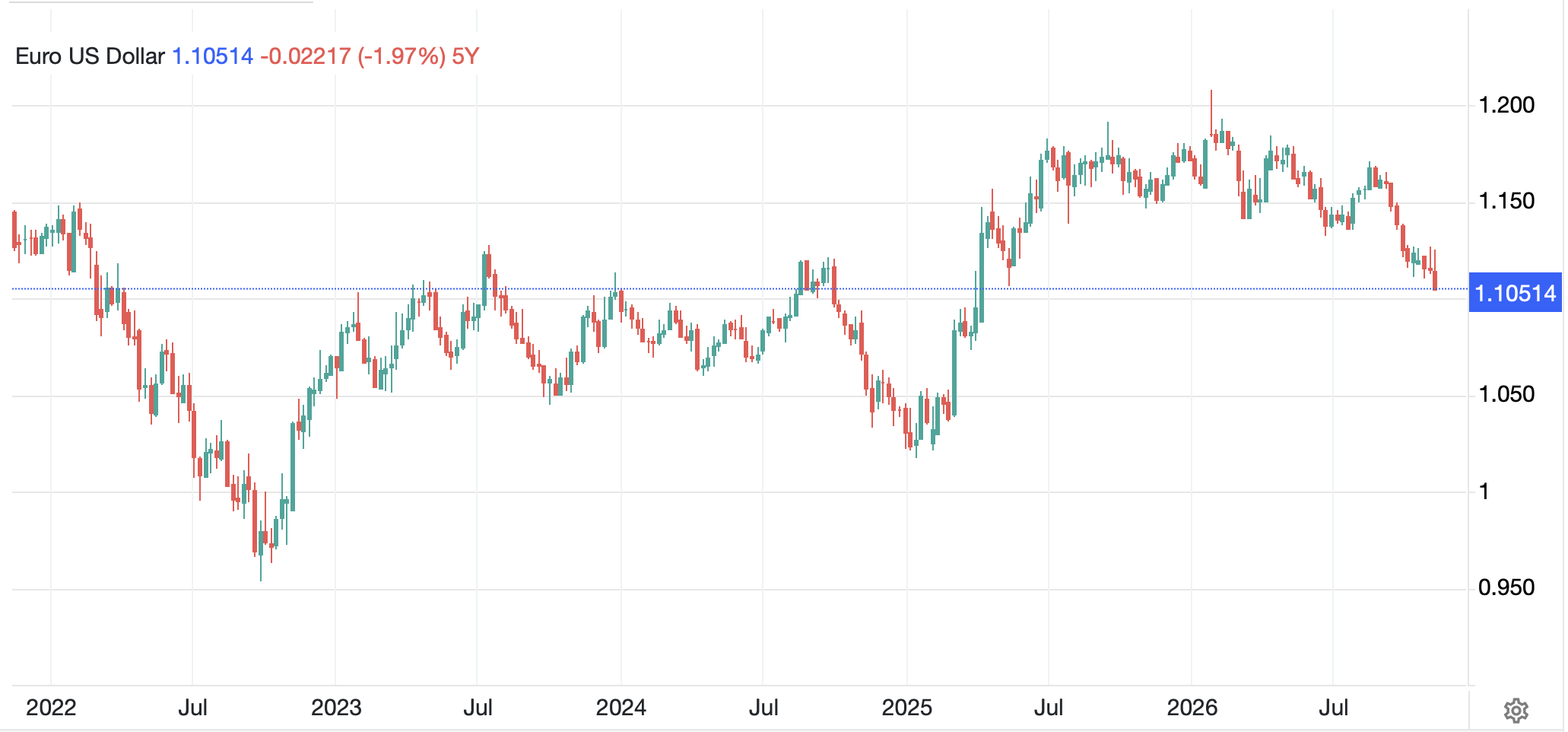
The one thing that does seem clear, though, is that the dollar has been the main beneficiary of the recent hawkish tone in both the bond market and by the Fed. Using the euro as our proxy, as you can see in the chart below, it has back to its lowest level since Liberation Day in April of last year.
Source: tradingecnomics.com.
However, once again I remind everyone that all the teeth-gnashing about the dollar’s strength is extremely myopic. As you can see just over the past five years, the euro has been both much weaker and stronger. If anything, it remains virtually impossible for me to look at Europe, with the fiscal problems and rioting in France, as well as the energy policies that are impoverishing the entire continent and think keeping capital there is the safe bet. Add to that the fact that yields across Europe are substantially lower than in the US, and economic activity, which was released this morning at 1.3% for the Eurozone over the past year, is much slower. So, low rates and slow growth, quite the combination, but maybe not where you want to invest.
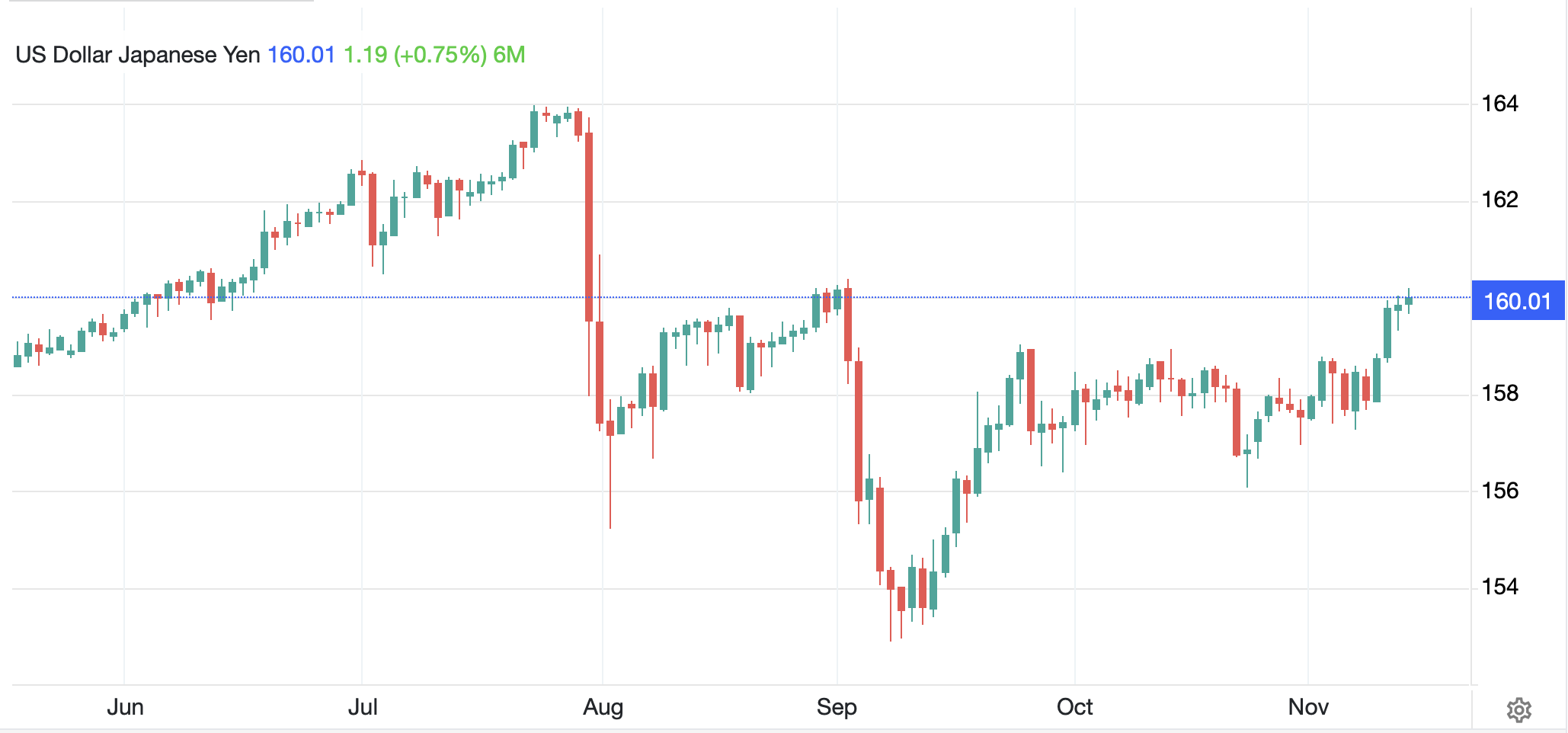
As well, there has been recent discussion about the yen, which traded through 160 again yesterday, and is right there as I type, for the first time since the last intervention back in early September. This has tongues wagging that the BOJ may need to come back to the market
Source: tradingeconomics.com
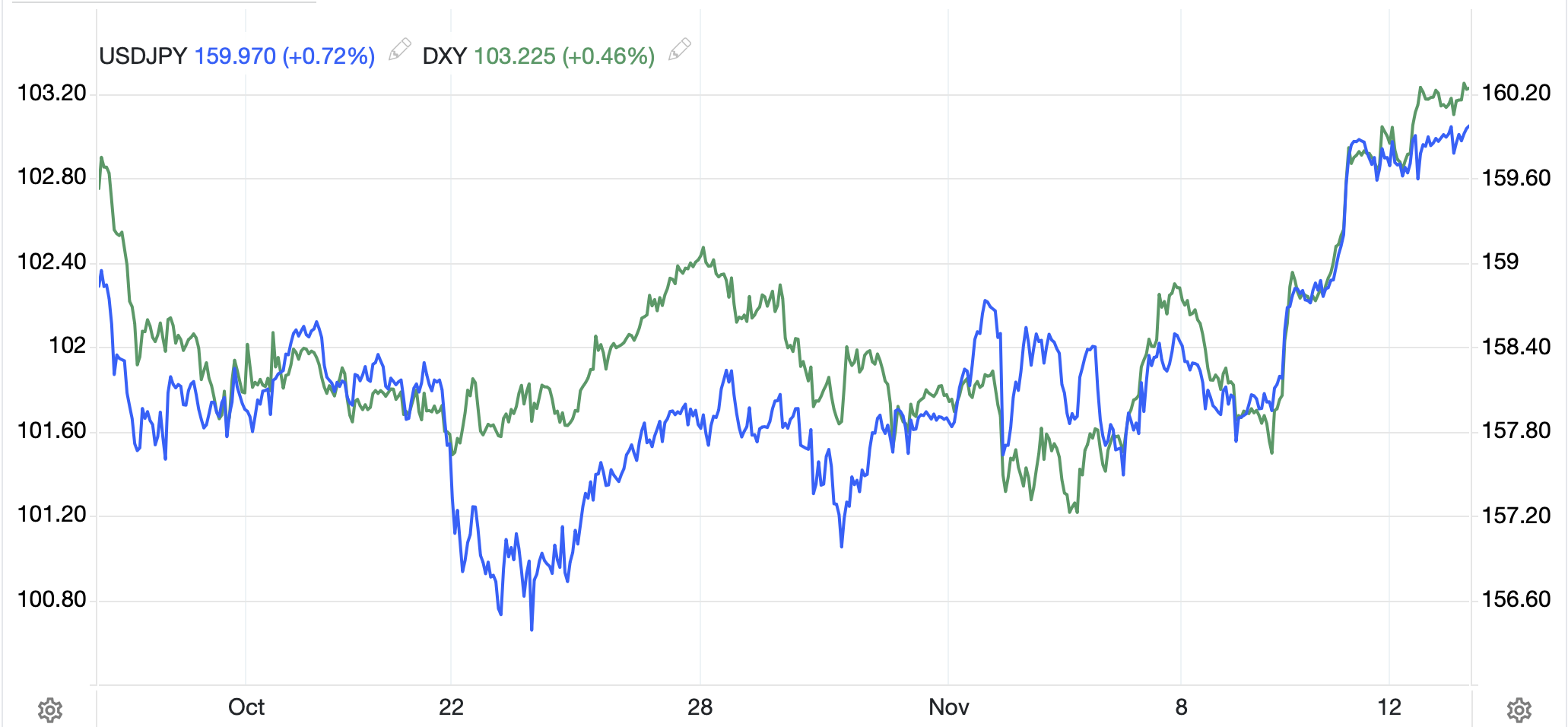
But consider the fact that the dollar is strong against everything as you can see in the below chart of the DXY and USDJPY over the past month. The movement is virtually identical, hardly indicative of a weak yen, but rather a strong dollar. No matter what the BOJ does, it will have virtually no impact of note, so I am extremely skeptical there will be any activity there.
Source: tradingeconomics.com
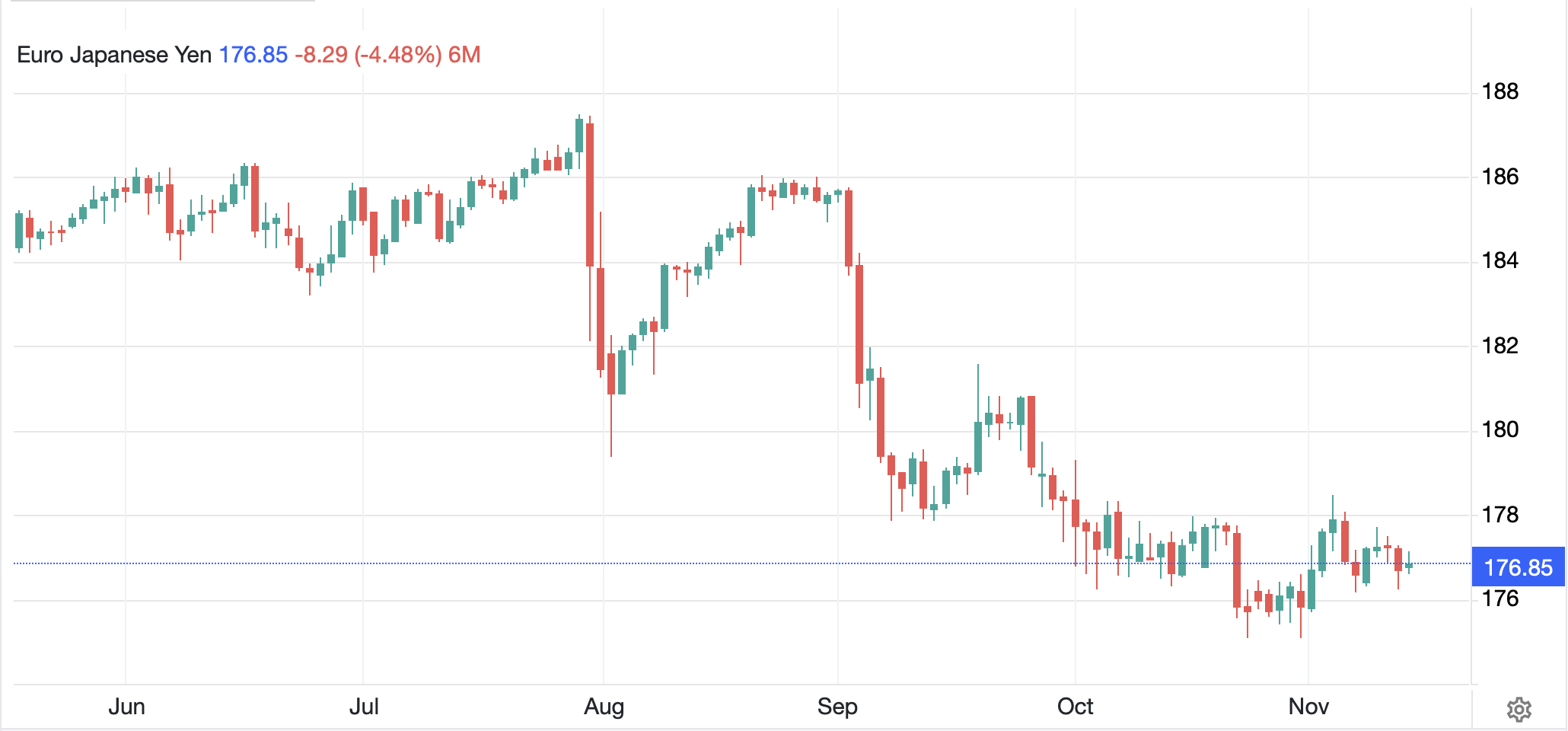
In fact, there is no better way to demonstrate this fact than to look at the EURJPY cross, which shows that the euro is, in fact, declining more rapidly than the yen as you can see below. The idea of yen intervention is off the table in my mind.
Source: tradingeconomics.com
Ok, well, this is, theoretically, an FX commentary, so some days, that’s what you get. Maybe the most interesting thing as we look through the rest of the markets is how little the Nvidia issue impacted equity markets overall. The three main US indices fell by -0.35% yesterday, hardly a rout, and this morning futures are higher by 0.2% across the board as I type (7:20).
Last night, Asia was mixed with some gainers (Japan +0.5%, Taiwan +1.4%) and some laggards (China -0.7%, HK -1.6%, Korea -1.0%) with the rest of the region showing similar ups and downs. Certainly, there was no overriding theme. In Europe this morning, bourses are tantamount to unchanged as the data showed weak growth and rising inflation but was released as expected. And of course, given there is no tech space of which to speak in Europe, selling tech shares doesn’t impact those indices!
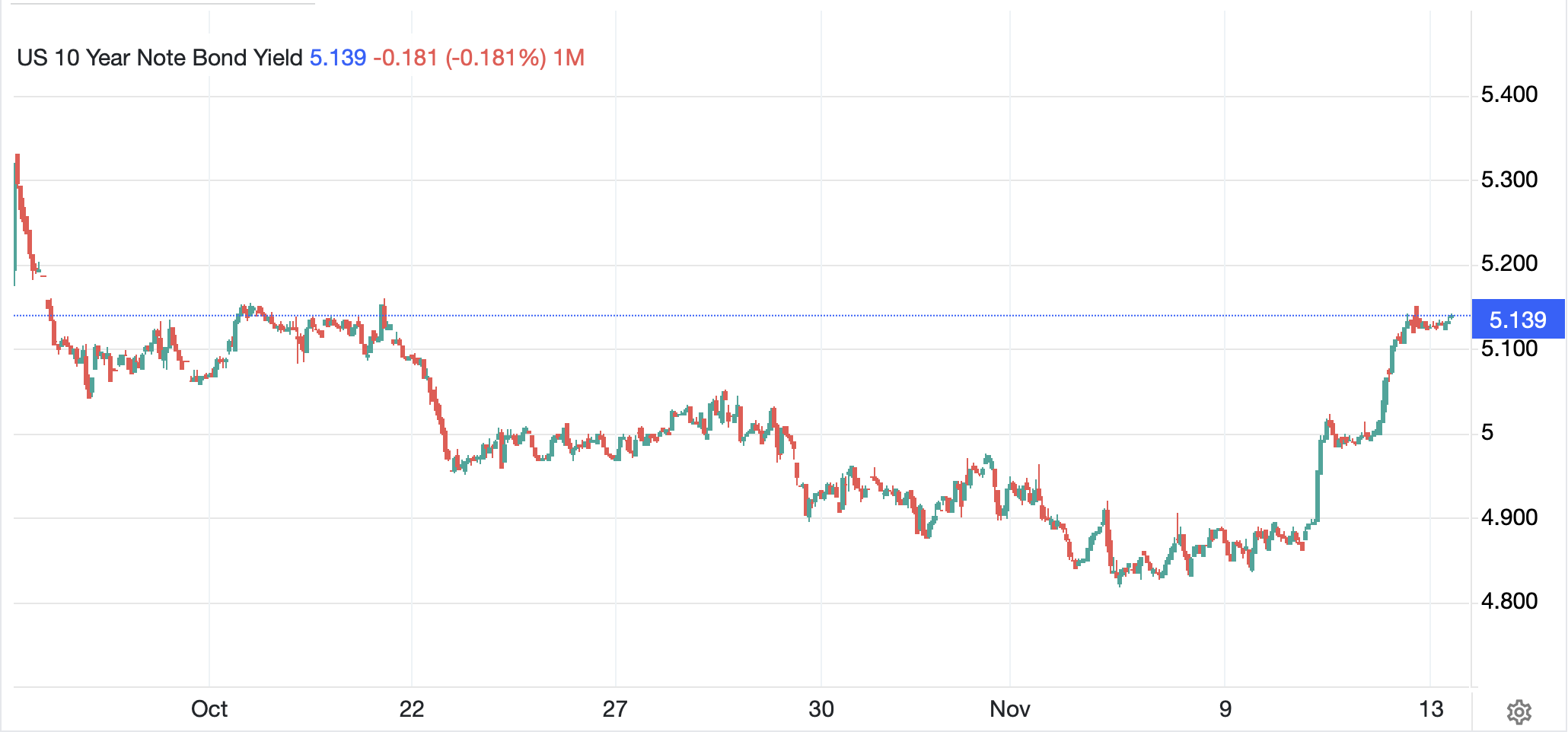
The bond market, though stable this morning (Treasury yields +1bp, European sovereigns +2bps to 3bps) has seen yields rise rapidly during the past week. In the US, as you can see in the below chart, we are higher by 32bps in the past week. As per my discussion above, perhaps we are toppish if the Fed is going to get on the case.
Source: tradingeconomics.com
Finally, commodities have moved to the back burner. Again, it’s almost as though affordability was a political issue, not a real one, as since the election, I cannot remember hearing about one person explaining prices are rising too quickly that was not a Fed speaker. Oil is bored and little changed this morning, still below $90/bbl. EIA inventory data showed builds in both crude and gasoline and the price of gasoline is lower by -18.4% in the past month with heating oil (a diesel proxy) -12.1%. It continues to be difficult to know what to think about the Iran situation as we continue to get mixed messages regarding the US stance. Are there negotiations? Have they ended? President Trump indicated there would be no escalation and that seems to be the driver in oil markets for now.
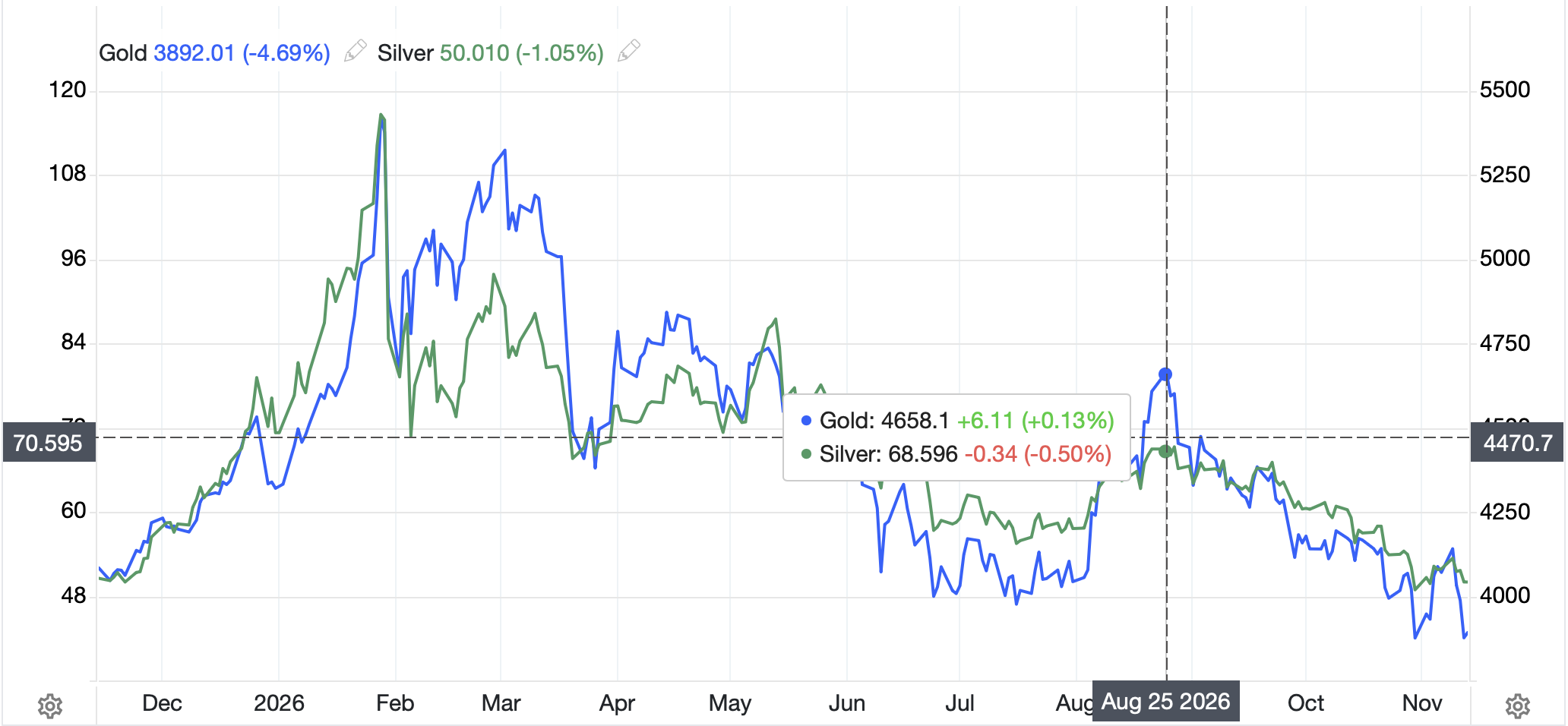
As to the metals markets, rising interest rates have been killing them as the alternative to non-yielding gold and silver has become far more attractive. While they are stable this morning, since late August, as you can see below, gold (-16.3%) and silver (-27.5%) have both been under significant and steady pressure.
Source: tradingeconomics.com
There is no evidence that governments are going to stop printing money as their promises remains far larger than their fiscal means. But as long as we continue to hear the hawkish commentary, I suspect the metals will struggle.
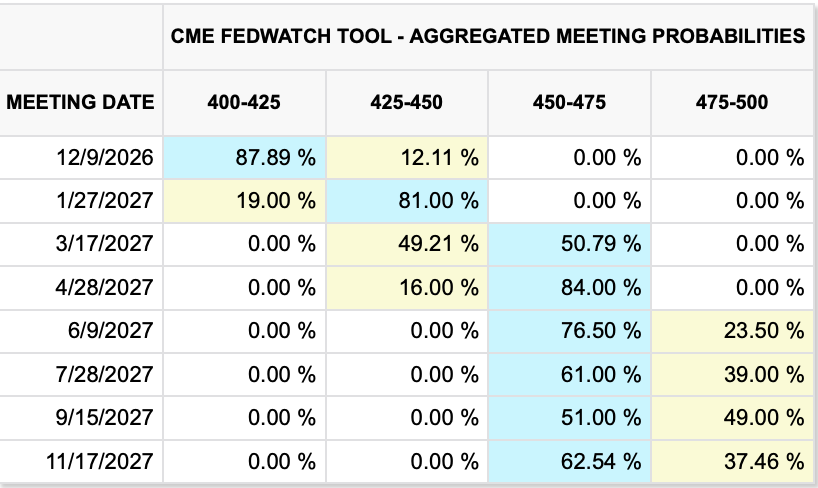
On the data front, this morning brings PPI (exp 0.4%,6.6% Y/Y headline; 0.3%, 5.0% Y/Y core) but with CPI already out, will it matter? And as per the above, we have four more Fed speakers to regale us with why they need to raise rates further. At this point, as you can see from the cmegroup.com table below, pricing for a full 100bps further of hikes is starting to come around. Personally, I don’t see it, but I’m not on the Fed.
There is a great deal of uncertainty right now in markets, with many things that had been assumed being called into question. However, the data continues to show that despite the angst, economic activity in the US continues to move along well. With the rate situation as it is, you have to like the dollar to continue its recent rise.
Sorry for the extended length this morning, but I missed so much yesterday
Good luck and good weekend
Adf

