
Conspiracy theories abound
As Friday saw air travel downed
But Occam would say
That all the delay
T’was simply the tech was unsound

Its impact on markets was nil
Instead, PPI was the thrill
With readings so hot
Each Fed speaker thought
That more rate hikes they must instill

Meanwhile, as we look round today
The shadow of Jensen holds sway
Tech stocks were sold hard
And bonds are still scarred
The buck?  It, right now’s, the best play
Fortunately, I was not flying anywhere on Friday, nor did I have plans on Saturday or anytime soon, as that turned into a huge clusterf##k. One of the remarkable things about information flow these days is the speed with which conspiracy theories are propagated. Whether it was the crash of Microsoft office tools (the Babylon Bee captured it well) last week or the crash of the FAA’s communication network which forced the ground stoppage on Friday, people immediately assume that there is a cyber-attack of some sort and are hunting for culprits. But as William of Ockham postulated so many years ago, “plurality should not be posited without necessity” which is an old English way of saying that usually, the correct explanation of something is the simplest. And ask yourself whether it would be harder for a major cyberattack by parties unknown, or that the 1960’s era technology that underpins the FAA’s communications are simply likely to fail given their age?
But all that happened as the markets were approaching their closes anyway, and the day’s activity was really driven by the PPI data released Friday morning, that while actually slightly softer than forecasts, was deemed smoking hot and led to further selling of Treasuries although the equity market remains in thrall to the Huang Chronicles. As well, we had more Fed speakers explaining that they were quite concerned about inflation with the implication that the Fed would be hiking more aggressively going forward.
If we look at the below chart from rateprobability.com, you can see that over the course of the past week, the markets have added an additional 25bps of rate hikes to their pricing (I hesitate to use the word forecast).
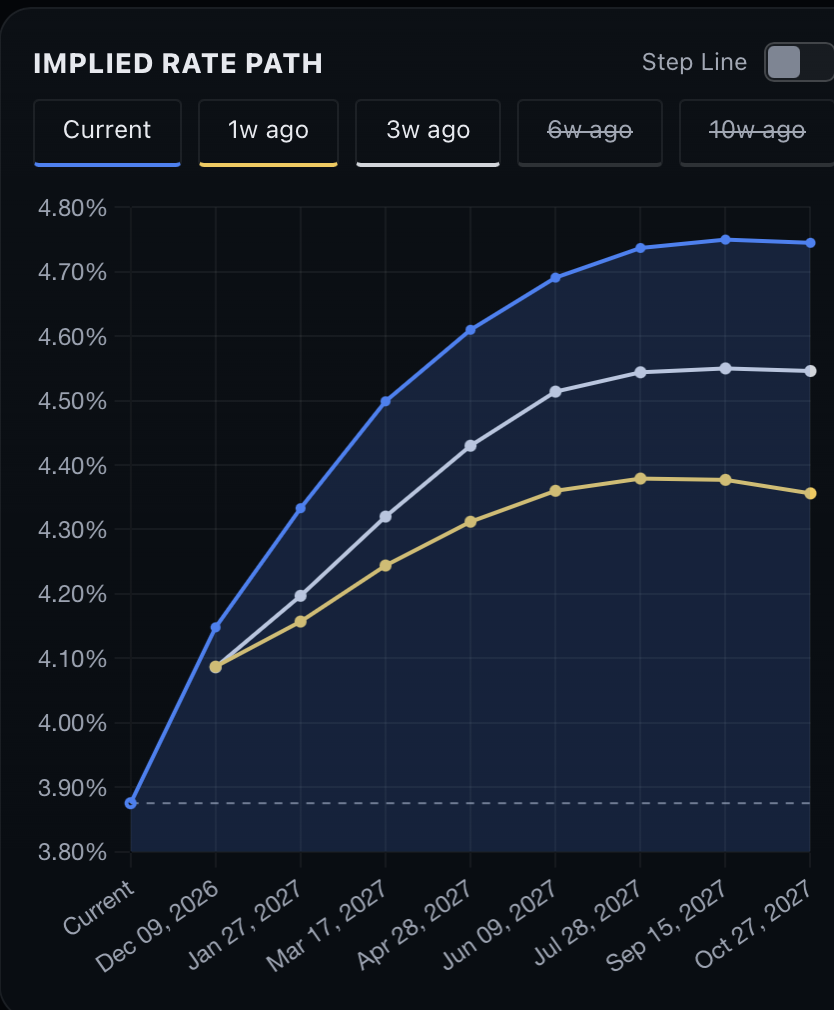
So, after a stronger than expected NFP number and CPI and PPI both continuing to show price pressures, albeit not accelerating ones, the market, as led by the numerous Fed speakers who have suddenly become Volckeresque, is all in on at least 75bps and possibly 100bps of hikes over the next year.
If we consider what has been the underlying cause of the recent price pressures, it is fair to look at energy prices, notably oil and its derivatives, although electricity has also risen dramatically, as at least one of the primary drivers. And yet, over the past month or so, gasoline prices, the product with the highest correlation to CPI as well as public angst, have fallen nearly 20%, far outstripping oil’s -11% performance as per the below chart from tradingeconomics.com
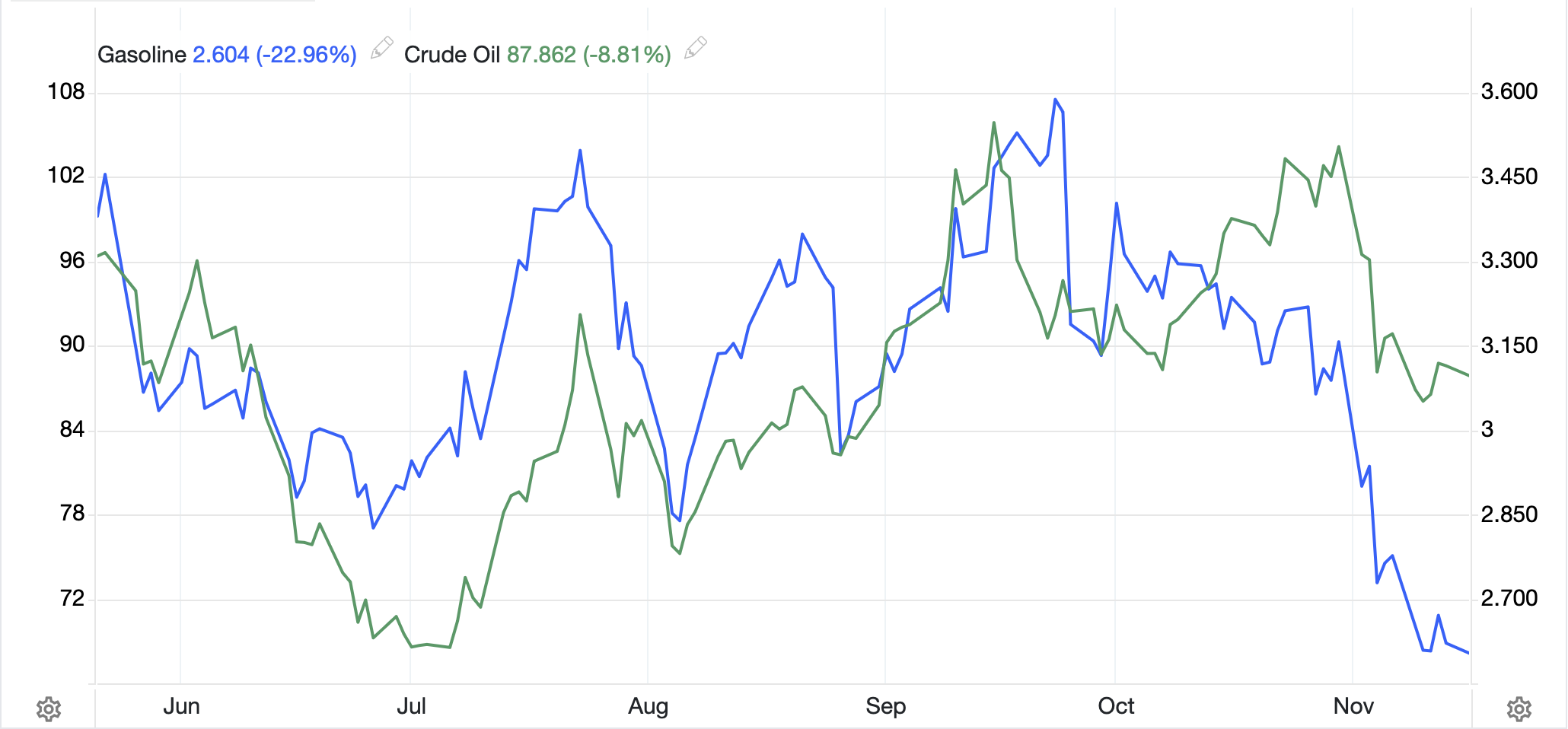
Regardless of the day-to-day in the Strait of Hormuz, from what I read the flow through the Strait has been in the 80% – 100% of its pre-war flows, with more products making their way through lately. History has repeatedly shown that central banks hiking interest rates into an energy price shock have committed significant monetary policy errors. I fear we are going to see the Fed join this roster of ignominy yet again. (If they wanted to reduce price pressures, they could stop expanding the balance sheet and start to restrict M2 growth, but that is not the Keynesian way.). In the end, I fear that Fed rate hikes in conjunction with questions over the future investment in technology, especially on the data center front (more on this in a minute) may well portend a much slower growth environment in 2027.
Regarding data centers and the seeming wholesale rejection, or at least the numerous restrictions, seen from the recent elections, I have a feeling this could be the trigger for a reversal in the dollar. Let me explain.
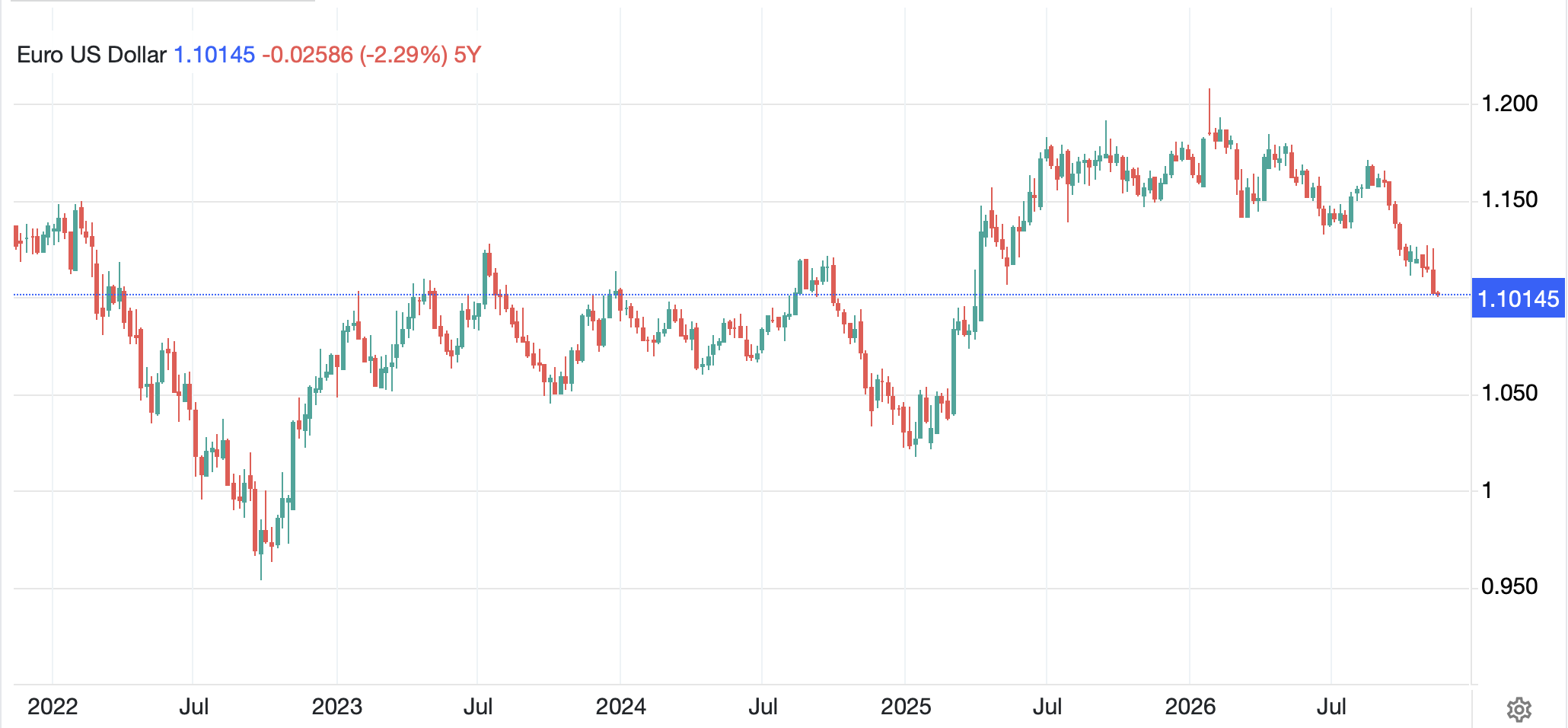
I have repeatedly made the case that when looking around the world, the broad macroeconomic picture is one where the US has absolutely been the driving force for growth. We have seen massive inward investment flows as President Trump’s policies, whether you love them or hate them, have been a clear catalyst to bring significant manufacturing back into the US. This has been a key support for the dollar, especially when comparing to, for instance, the Eurozone, where their energy policies have been destroying whatever industry they had. Certainly, there is no inward investment there and that has been a key driver of my view the euro would head to parity and below. As you can see in the below chart, the euro peaked in January of this year, alongside gold and silver, and has been falling ever since, and at an increasing rate lately.
Source: tradingeconomics.com
Parity is within sight and a place we traded just three years ago. However, if the new national direction is going to prevent the ongoing investment in data centers and AI, the deleterious effects, both short and long term are going to grow, and the US growth advantage may well disappear. If that is how things play out, the case for a strong dollar takes a severe hit. After all, slower growth will result in the Fed reversing course and looking to cut rates, it will undermine equity market performance reducing inward investment there, and it will alter perceptions of where companies should build their facilities. Right now, those things all point to the US as the prime location. If we change that, the consequences will be real.
On to the rest of the market situation. In the equity markets, Friday’s US activity that saw the DJIA edge higher while the NASDAQ continues to suffer from AI exhaustion, led to broad weakness across Asia (Tokyo -2.4%, China -0.9%, Korea -3.6%, Taiwan -6.0%) although there were a few bright spots (HK +0.5%, India +0.6%, NZ +0.9%). Both China and Japan released key data last night and it was not pretty in either place as per the below from Bloomberg.com.
Actual Forecast Previous
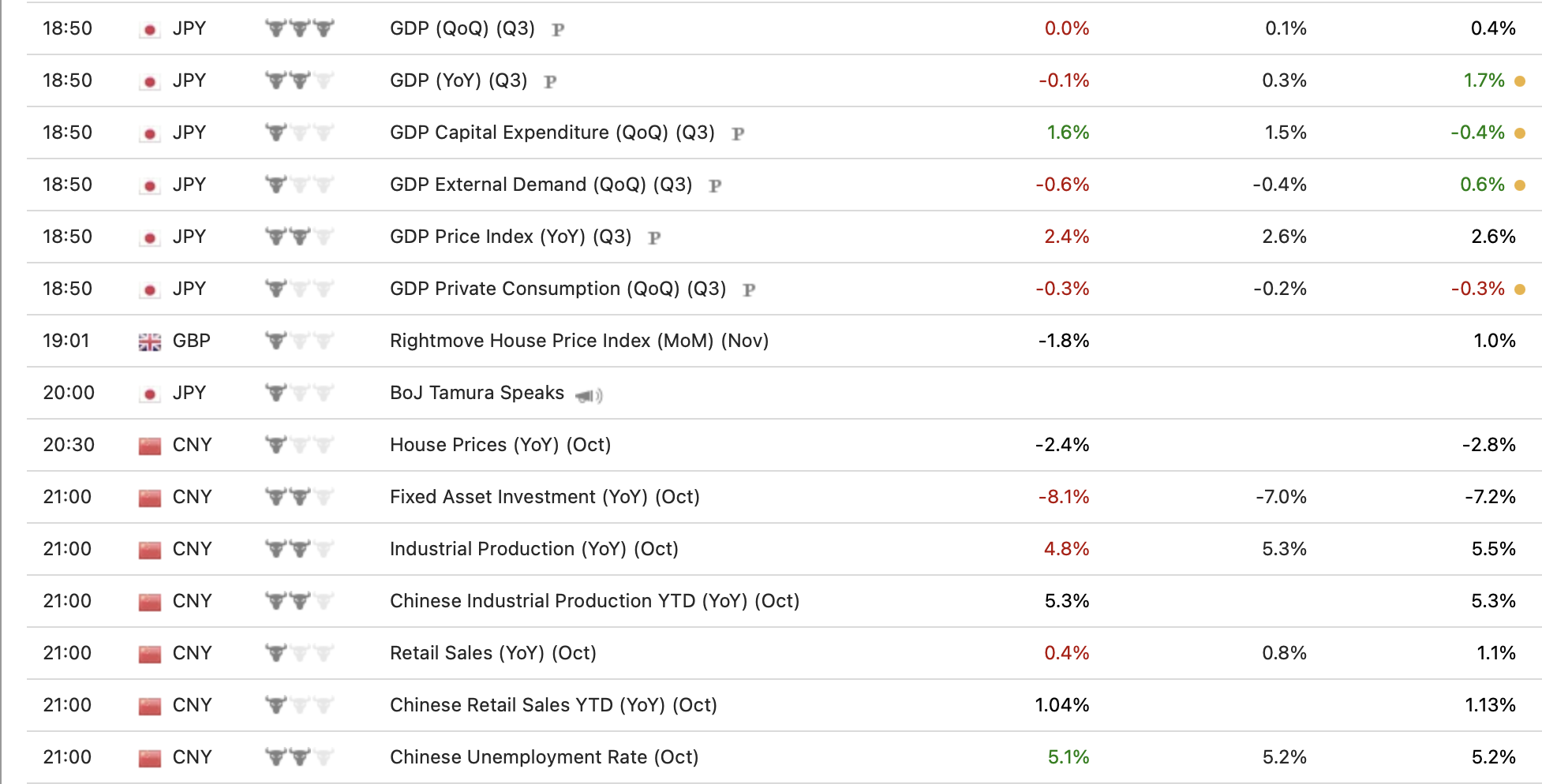
Slowing growth in both nations with the Chinese housing market still under pressure and investment collapsing while Japanese GDP slips is the current situation. Going back to my point about the US leading the global growth impulse, if the political winds have shifted, it is not impossible to foresee a global growth slowdown which benefits nobody, except maybe bond investors!
Quickly, European equity investors needn’t worry about these gyrations since they have no tech companies to be impacted and the result is +/-0.2% in equity markets across the UK and the continent this morning. As to US futures, at this hour (7:35) the NASDAQ (-1.5%) is weighing on everything and dragging them lower.
In the bond market, last Wednesday and Thursday were the big movers with Friday’s price action seeing very modest bond weakness, yields edging higher slightly. And this morning, Treasury yields (-2bps) have slipped a bit while European sovereign yields are basically unchanged to higher by 1bp. Sliding oil and product prices as well as potentially slowing growth is convincing more and more investors that bonds are not a bad place to be.
We’ve already discussed oil and gas, and despite their price declines, we are seeing weakness in both gold (-0.3%) and silver (-2.3%) as it appears that short selling is the new driver here. Certainly, the dollar’s strength and prospects for higher Fed funds are weighing on the precious metals sector, but if you step back, things seem riskier than not these days.
Finally, the dollar continues to rally vs. most of its counterparts although this morning’s movement has been modest, on the order of 0.1% to 0.25%. Right now, the safe haven story seems to have the strongest legs and that can certainly last for a while. But I cannot look at that EUR chart above without concluding that we are merely seeing ordinary market movement as the dollar heads higher from an oversold position and will soon find itself in an overbought position instead. Technicians are all excited about the dollar’s breakout higher, but I will warn again that if the politics are truly changing in the US, the future prospects for the dollar are probably dimming.
On the data front this week, there is some interesting stuff as follows:
| Today | Empire State Manufacturing | 18.0 |
| Tuesday | Retail Sales | 0.2% |
| -ex autos | 0.4% | |
| IP | 0.1% | |
| Capacity Utilization | 76.8% | |
| Wednesday | Housing Starts | 1.27M |
| Building Permits | .38M | |
| Thursday | Initial Claims | 196K |
| Continuing Claims | 1725K | |
| Philly Fed | 19.2 | |
| Leading Indicators | 0.1% | |
| Friday | Michigan Confidence | 52.0 |
Source: tradingeconomics.com
But more frighteningly interestingly we hear from eleven FOMC members, including Chairman Warsh today at noon, across 17 different venues. It seems that Chairman Warsh’s view of allowing the markets to do the work and have the FOMC keep quiet has not been embraced yet. As I continue to explain, they love the sound of their own voices too much to simply shut up!
The question at hand is whether the ongoing rout in AI focused stocks, especially with the Anthropic IPO due to come this Thursday, will upset the applecart elsewhere. If so, 10-year yields at 5.12% are probably pretty attractive overall as a slowing economy will likely see demand pressures abate. And if the oil shortage is indeed followed by a glut (which has historically been the case of every commodity shortage) and gasoline and oil prices fall back to pre-Iran levels, is the Fed really going to hike that much? Maybe the trade is getting long Fed funds futures in December 2027.
Good luck
Adf’

