Subterfuge

The narrative right now is run
By hawks who think Warsh is the one
To raise short-term rates
Right out of the gates
And so, they’re long bucks by the ton

Thus, futures positions are huge
With no effort at subterfuge
But if they are wrong
About being long
The hawks will have all been the stooge

In an otherwise quiet session, this morning I am going to borrow from Ole Sloth Hansen, the futures maven at Saxo Bank.  He publishes a Substack that is well worth reading if you are actively involved in the markets as he breaks down futures positions and offers context.  This morning I am going to juxtapose those positions with my views, which are diametrically opposed to the way the market is currently positioned.

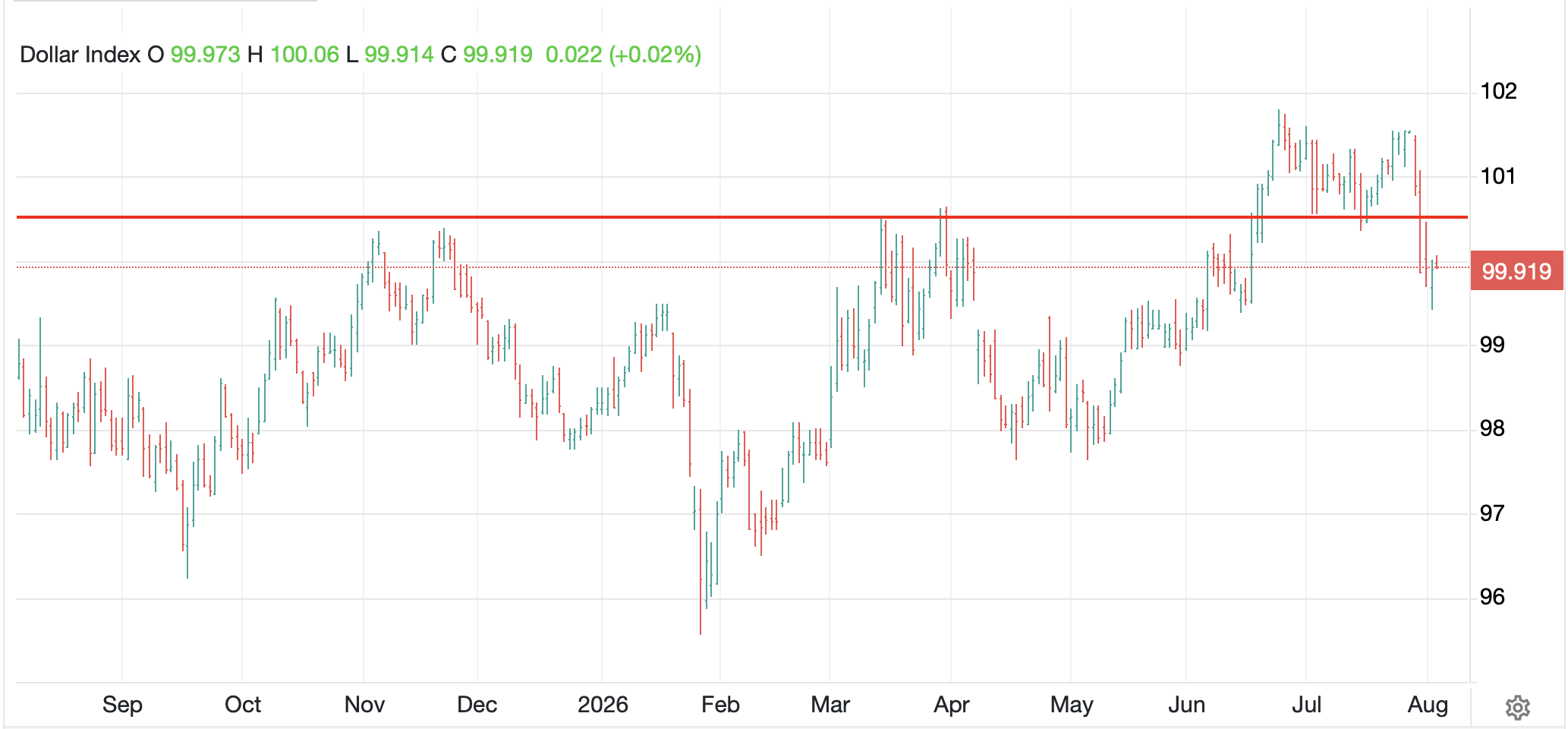
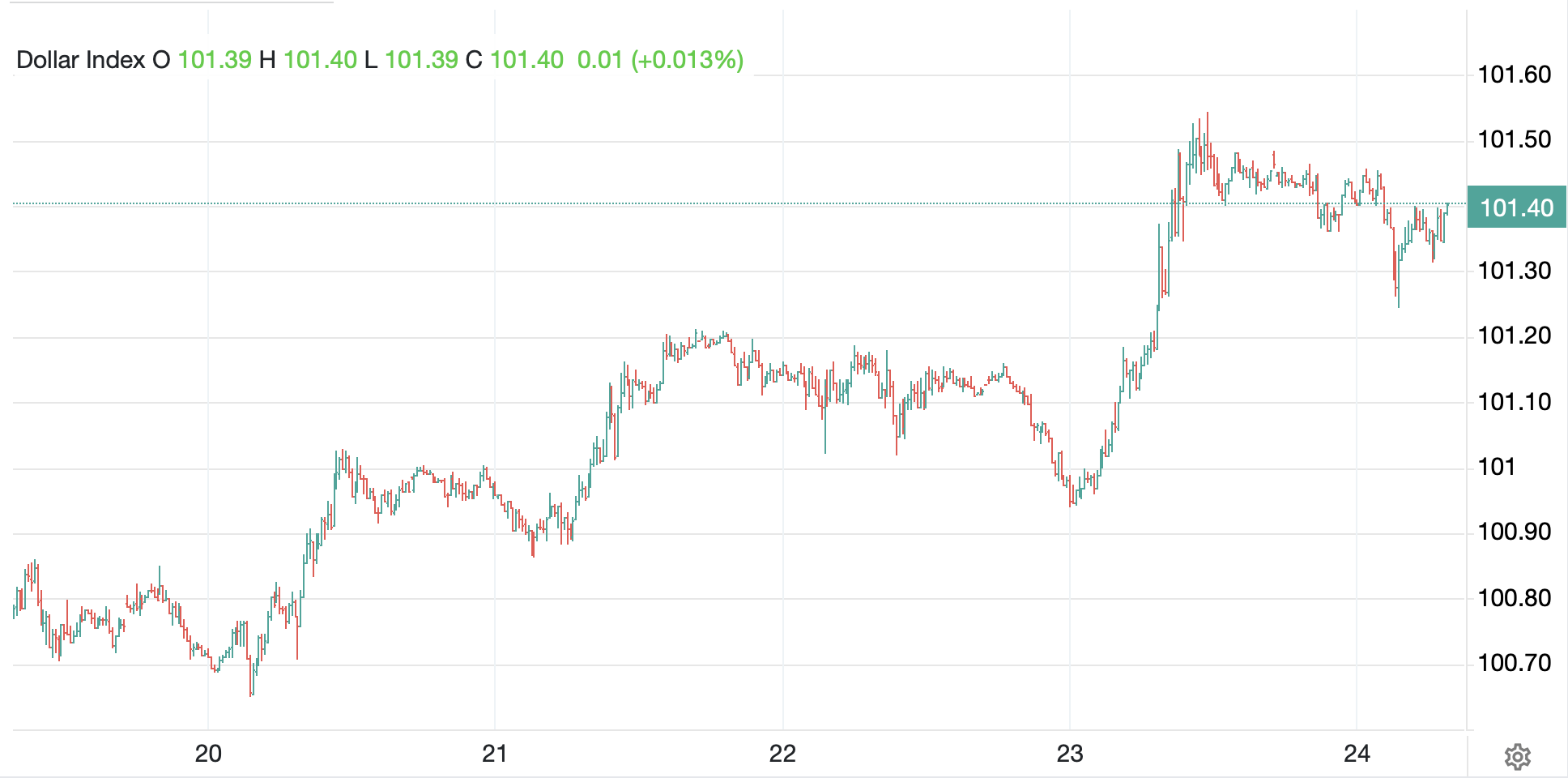
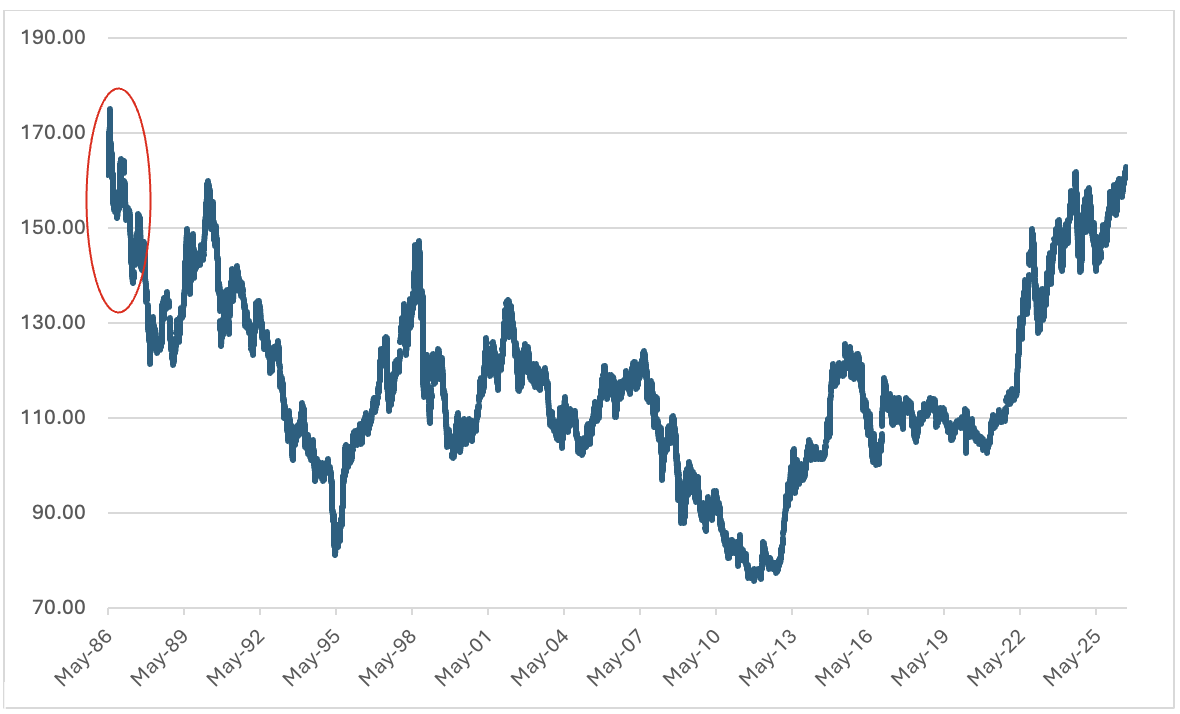
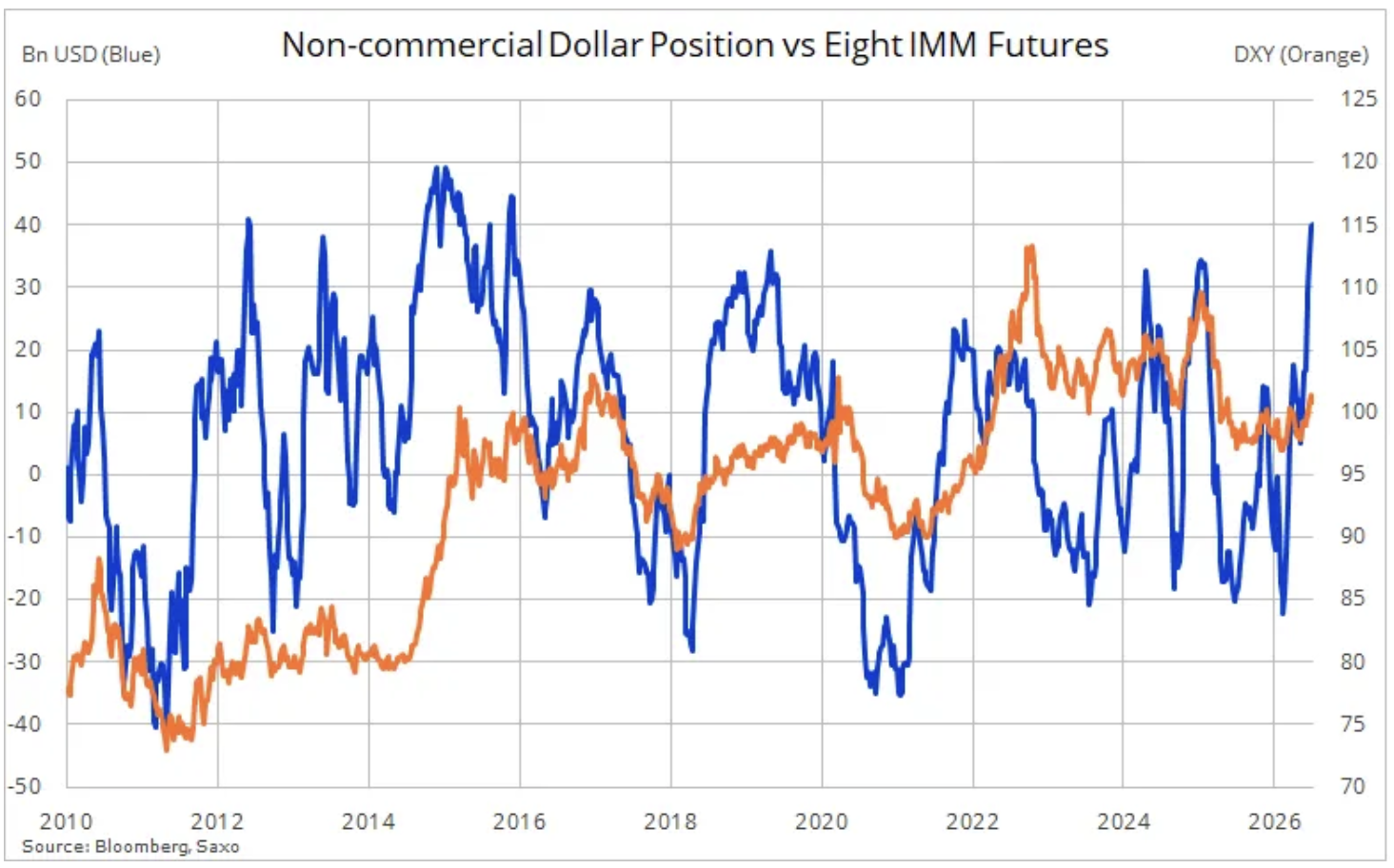
Starting with the FX market, he has created a wonderful chart showing that the net non-commercial long USD position against eight major currencies has reached 10-year highs.  Interestingly, the DXY is not anywhere near those highs, although it appears that is the growing expectation of many traders.

Arguably, this is based on the idea that Chairman Warsh is Paul Volcker redux and will be quite hawkish going forward.  Now, I cannot tell if this is the narrative because, absent forward guidance, narrative writers must now think on their own and are incapable of doing so, or if they truly believe that despite all the talk that rising oil prices were going to feed through to inflation readings, declining oil prices won’t have the same impact on the way down.

But it is not just the FX trading community that is on board with this story, so too is the short-term interest rate trading community.  While LIBOR has been forced out of existence, SOFR (Secured Overnight Funding Rate) is the new benchmark in interest rate markets and, naturally, there is an active futures market there as well.  As you can see from the below chart, also from Mr Hansen, the current positioning is strongly expecting higher short-term interest rates.

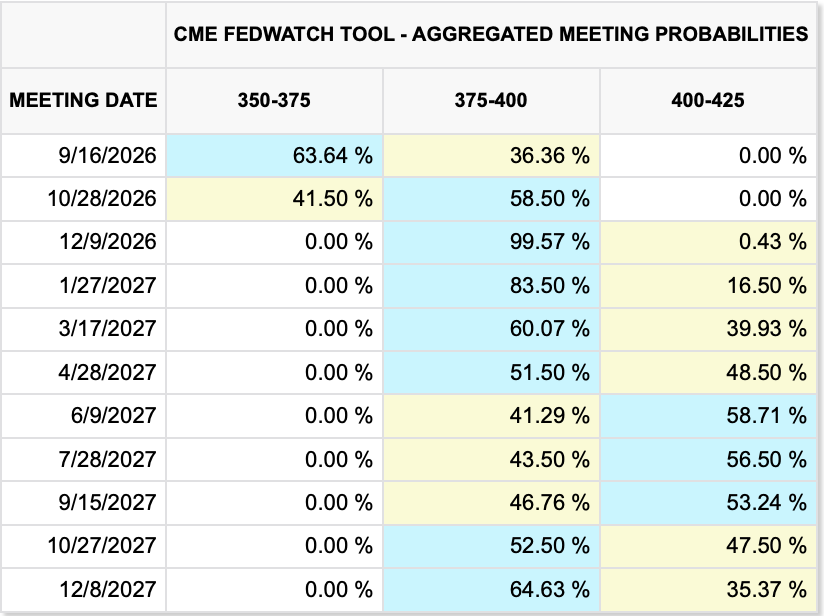
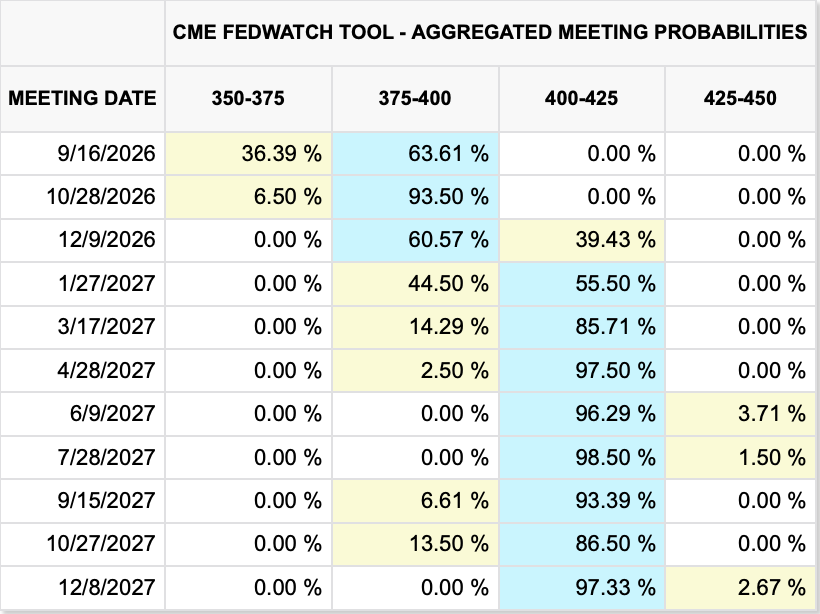
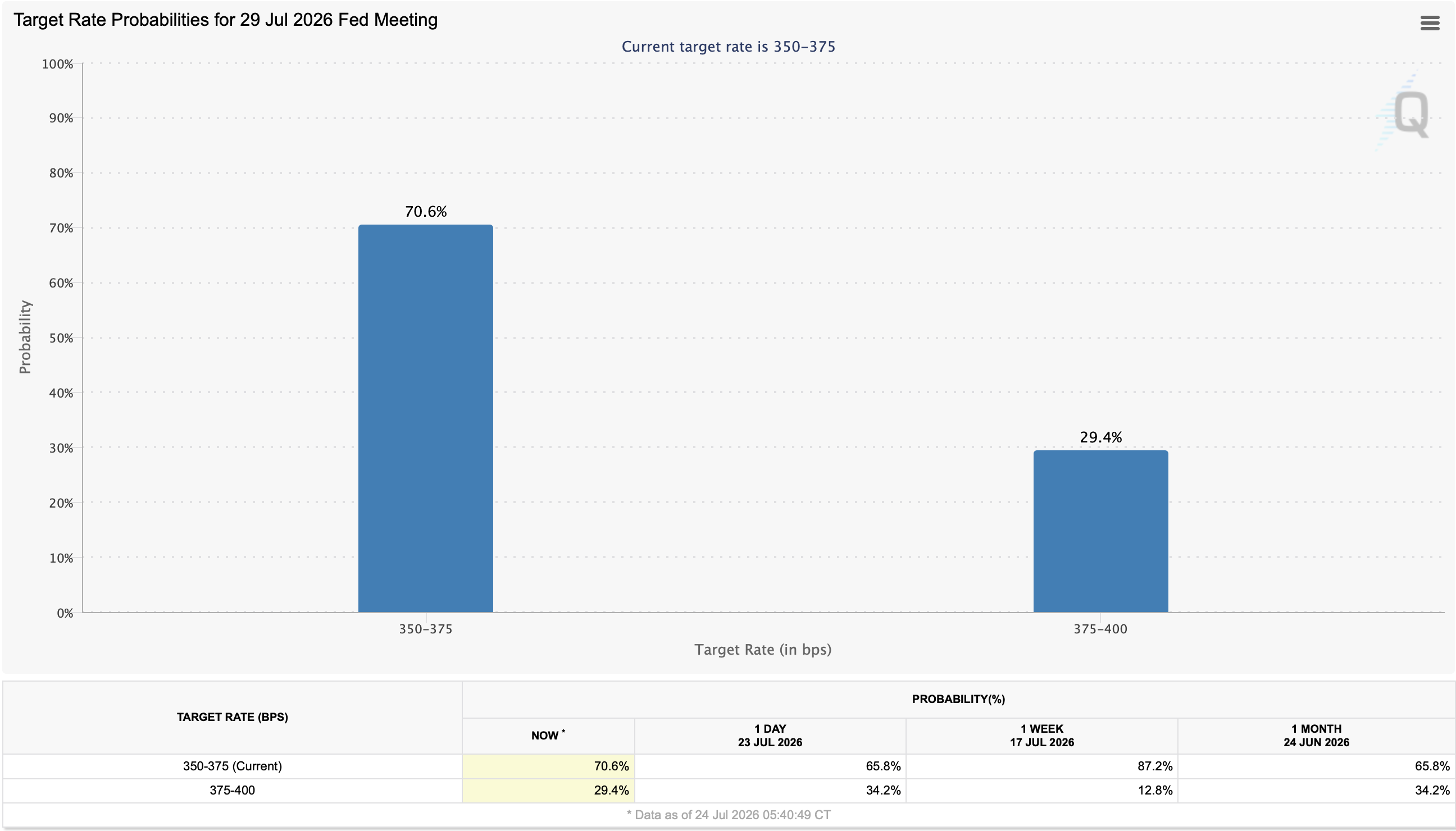
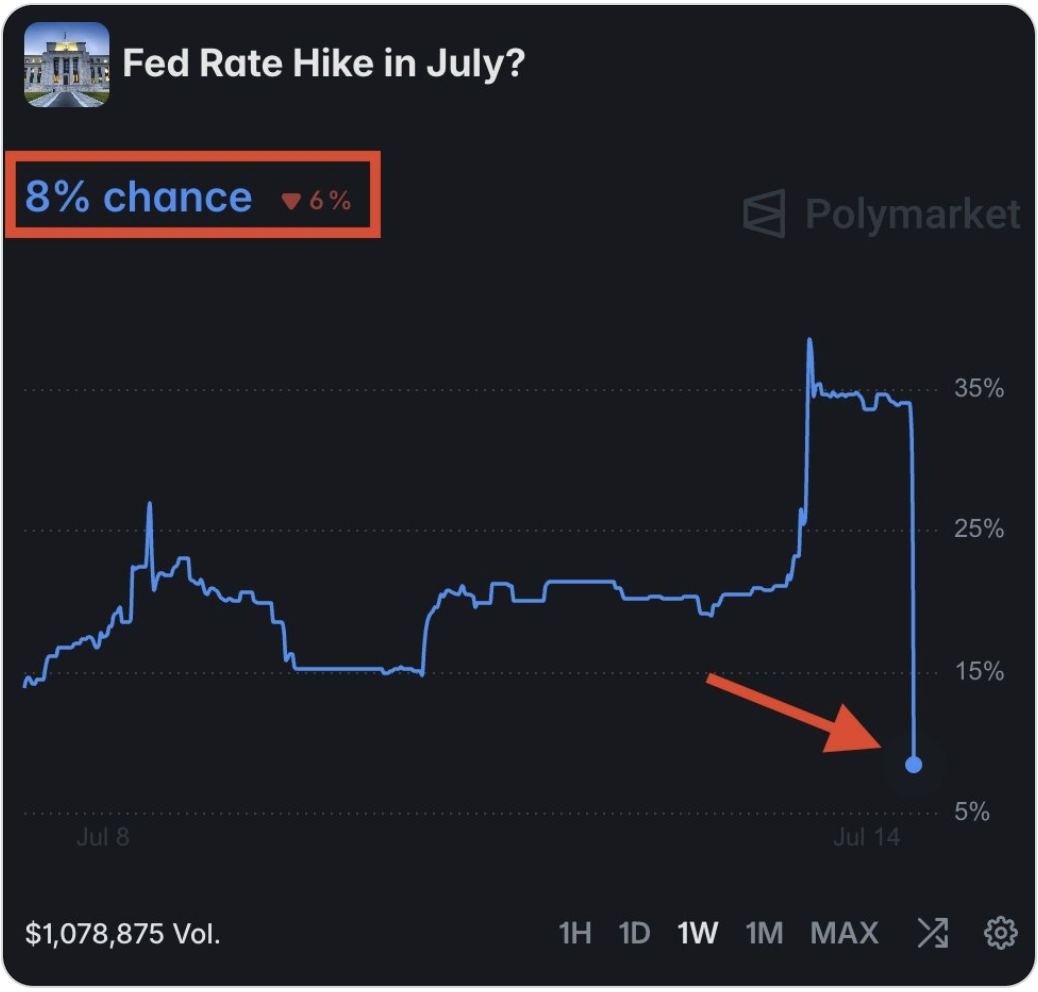
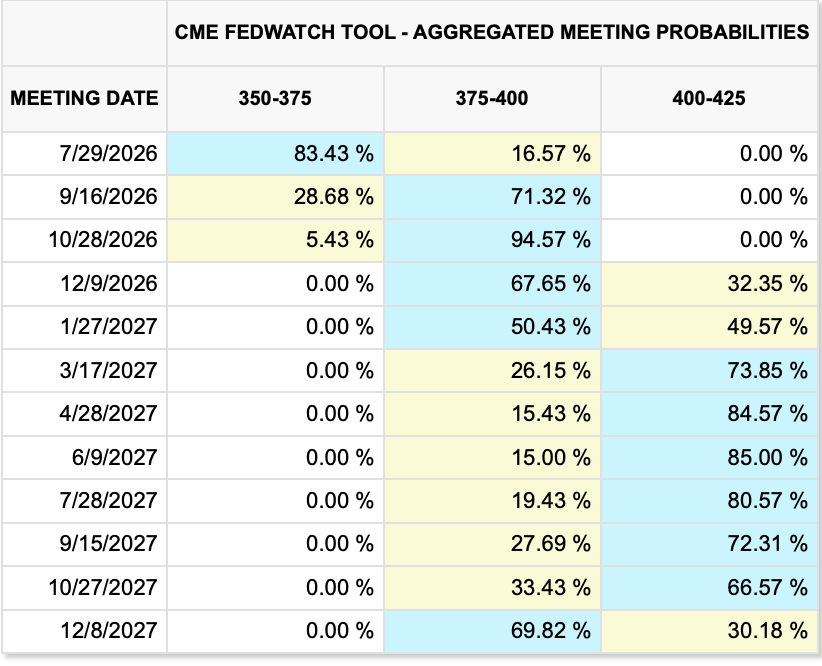
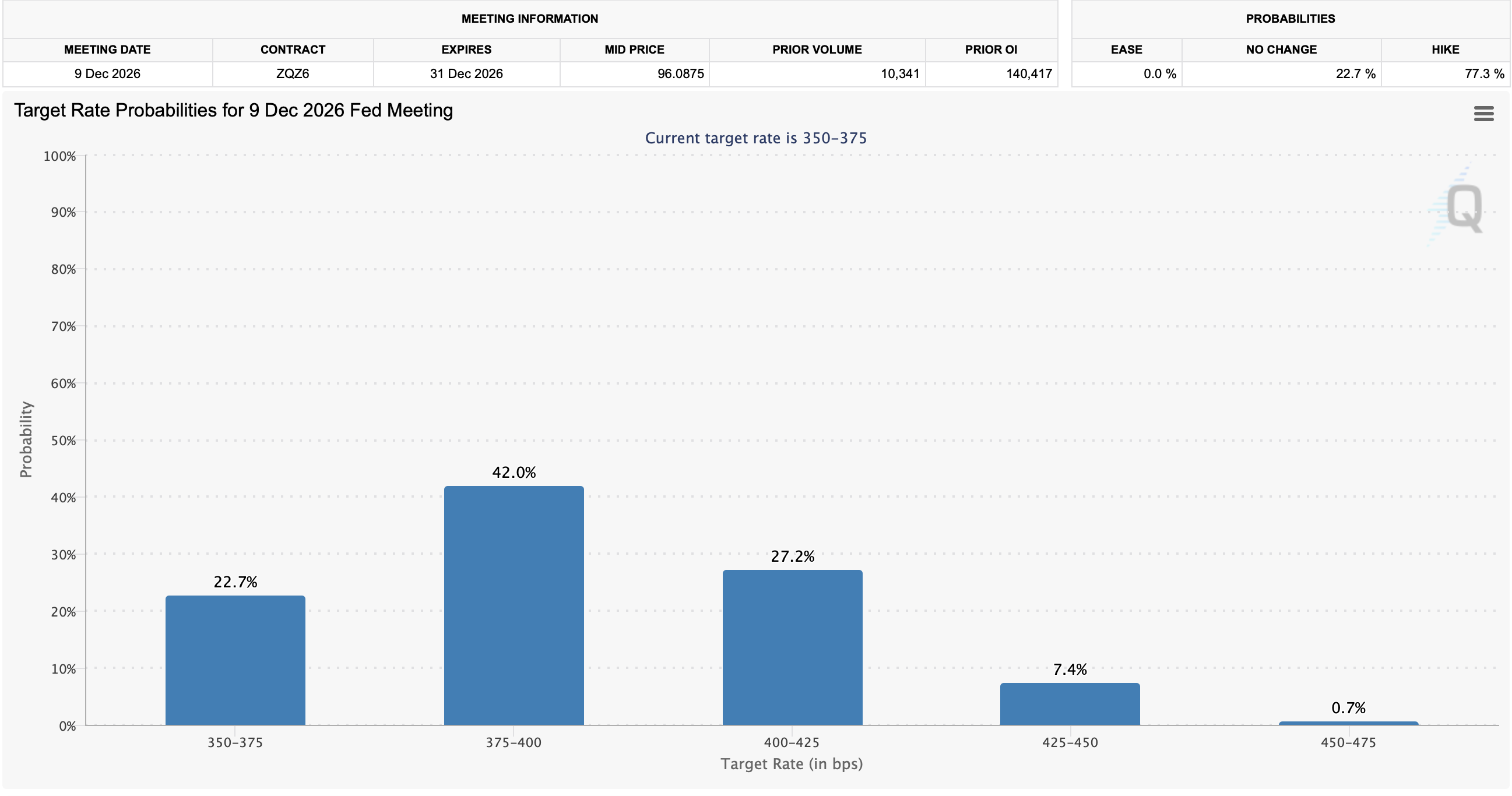
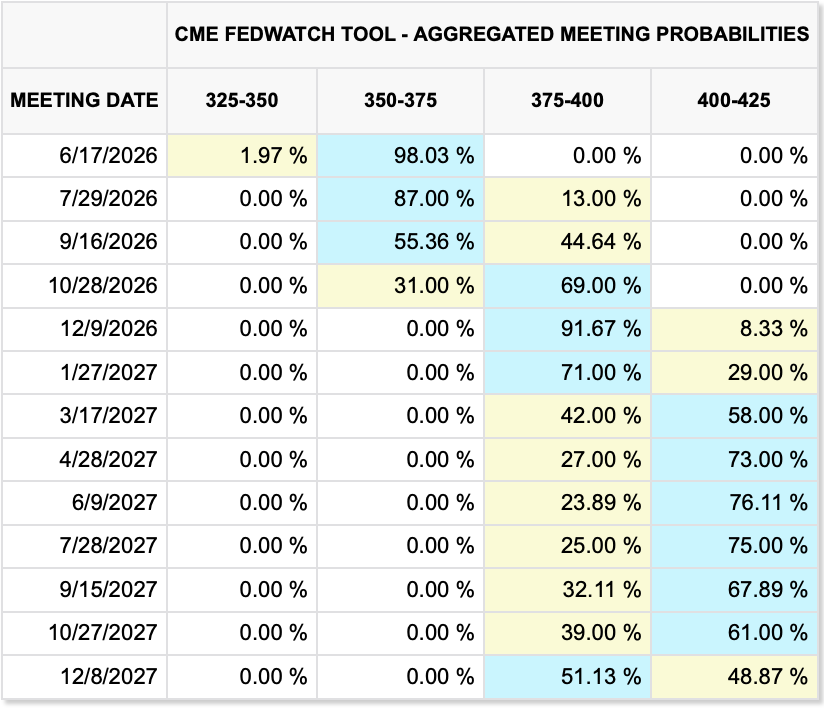
This is completely in accord with the Fed funds futures market where the market continues to price a 25% probability of a hike at the end of July and a virtual certainty of a hike by October.  By my calculations, as per the chart from cmegroup.com below, the market is pricing about 30bps of rate hikes by the December meeting.

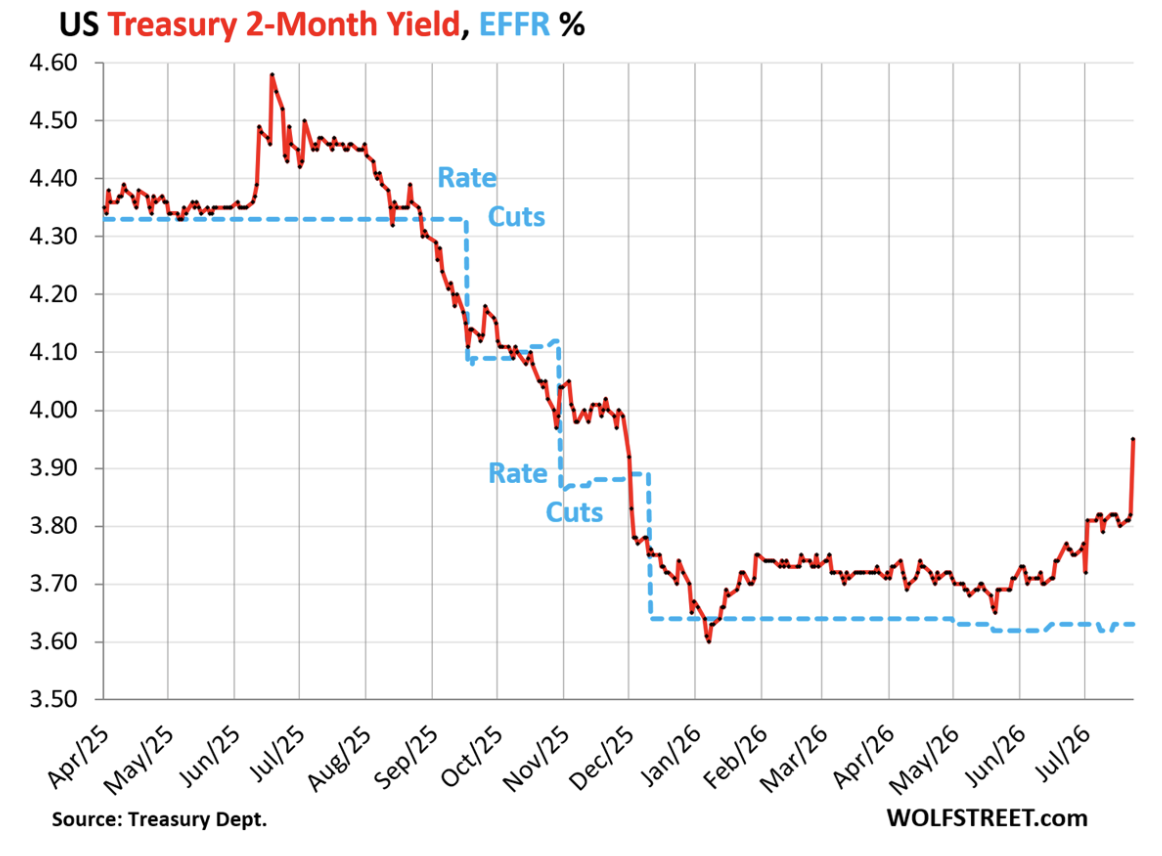
Or course, by now you know that my view is the Fed will not be hiking rates at all, and as measured inflation slides back (just look around the world and at oil prices) the narrative will belatedly shift to the need willingness to reduce rates on Warsh’s part and all these market positions will adjust.  

My longer-term positive view of the dollar is based on the ongoing investment inflows into the US, for real investment, not merely equity market participation, and nothing has happened to change that view.  In fact, the announcement yesterday by Toyota that they will be expanding their San Antonio truck and SUV plant with a $3.6 billion investment is just the latest in a series of these announcements.  But that is not the carry trade driving things.  In fact, ironically, we could easily see US rates slide a bit as the dollar rallies on natural investment demand rather than financial demand.  As well, if I am correct, the Fed funds futures market is going to head back to pricing no rate hikes, perhaps as soon as next week after the CPI data is released.

I think the lesson is that the narrative writers need to bone up on their understanding of macroeconomics and international finance as the central bank policy driver may not be the future.  Certainly, if Mr Warsh has anything to say about it, and he does, that will likely be the case.

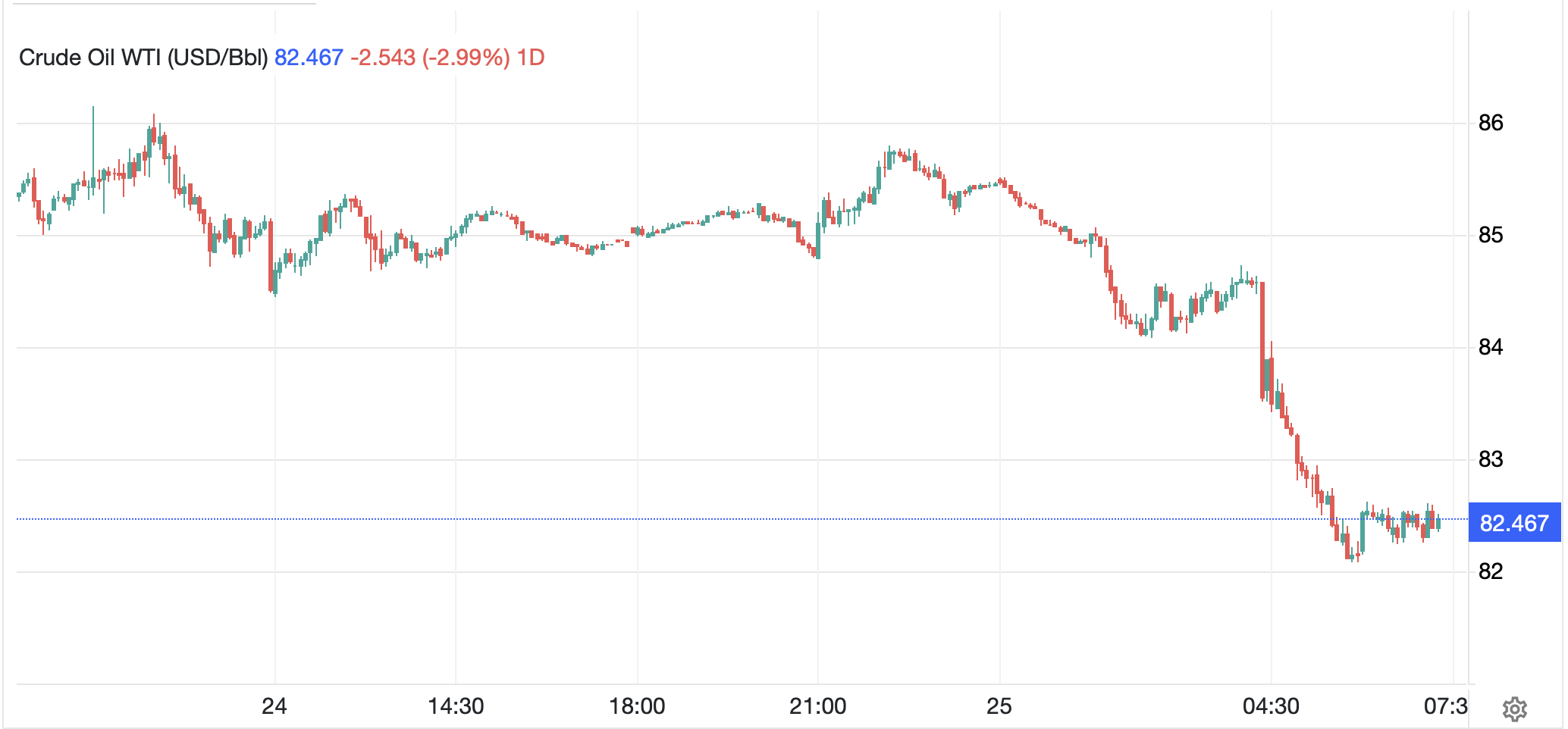
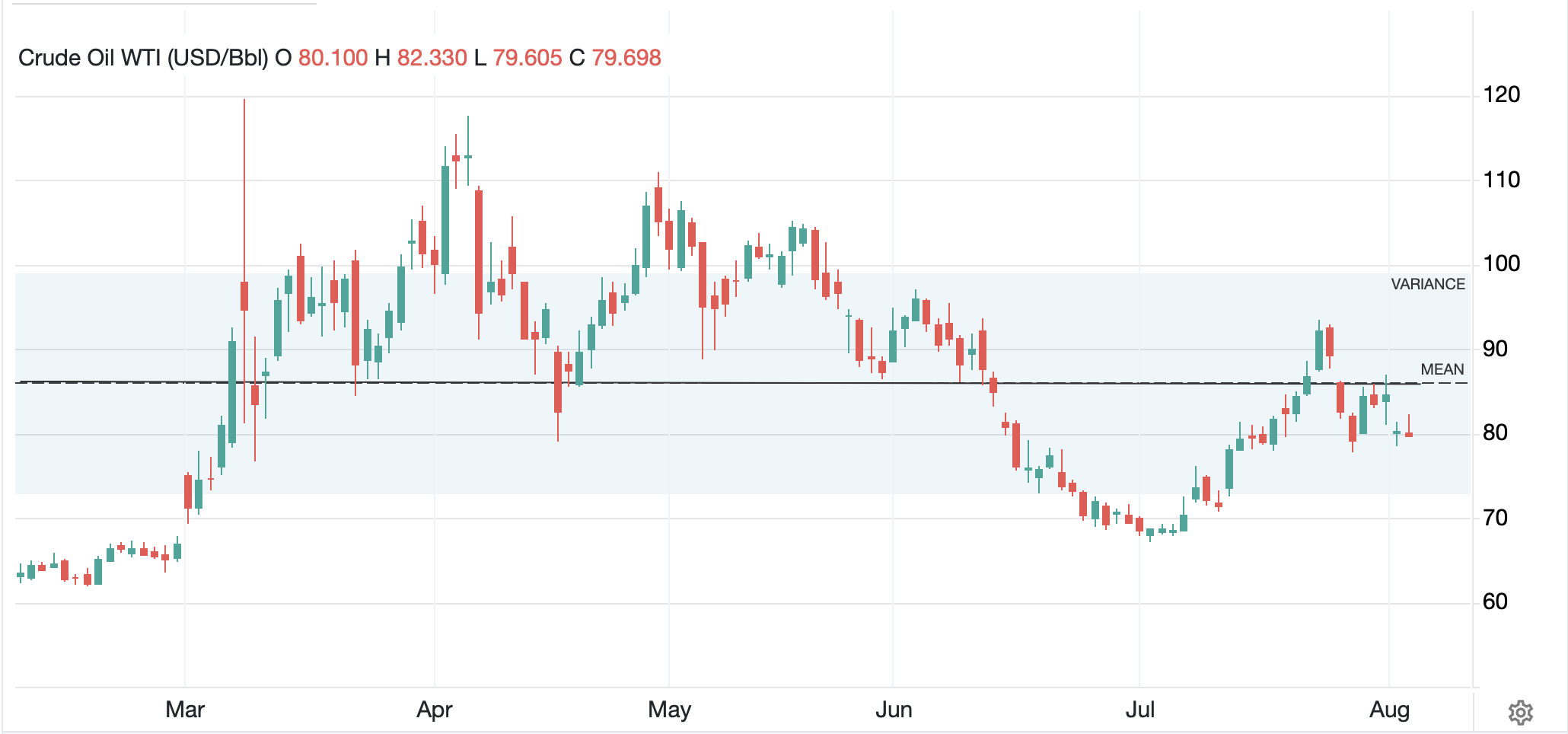
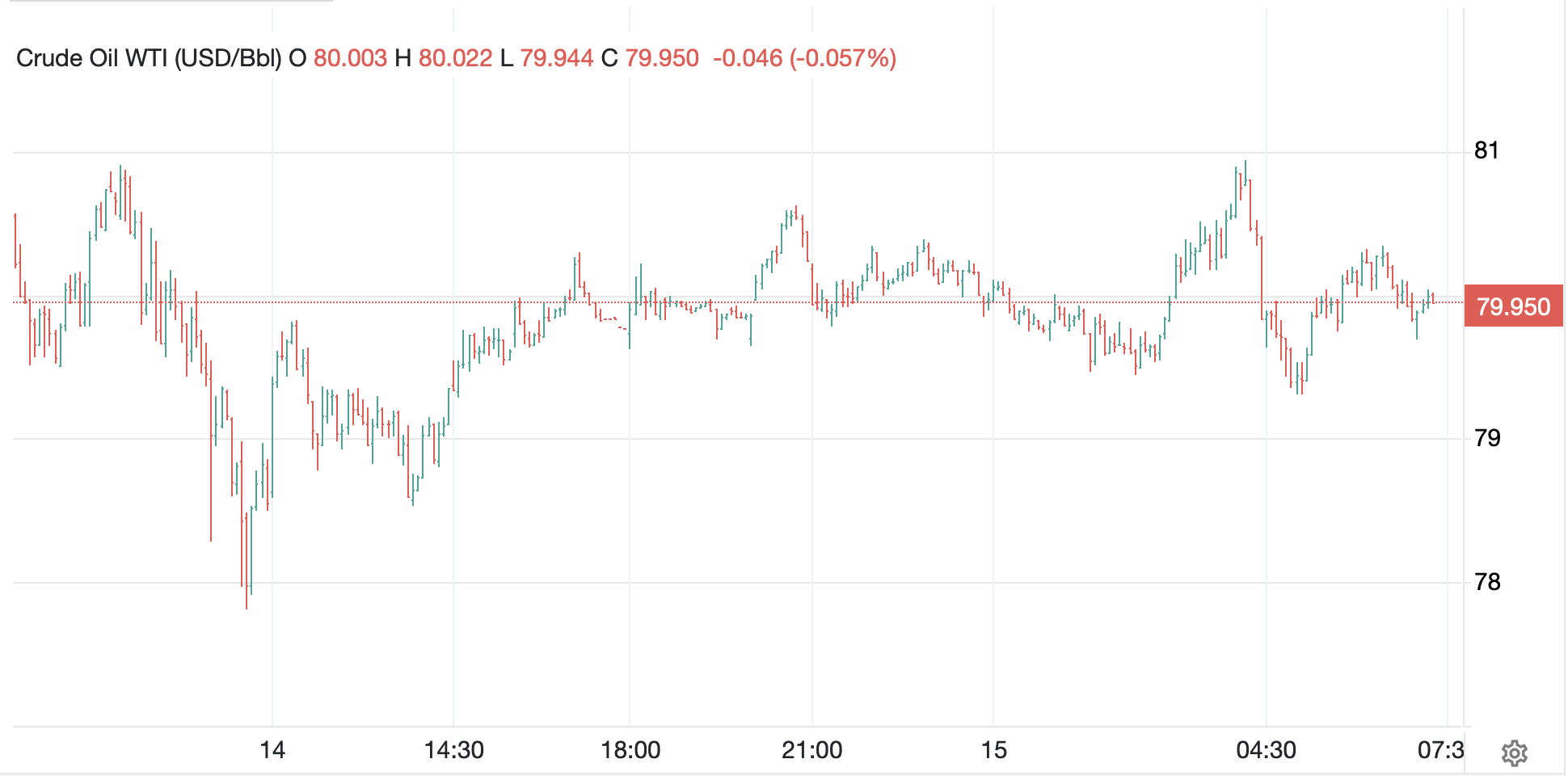
Which takes us to the overnight session. The most excitement overnight was for Belgium as they completely outplayed the USMNT in a 4-1 victory in Seattle.  But otherwise, the story that Iran fired two missiles at ships heading through Hormuz helped support oil prices, but as I type, they are higher by just 0.7% (~50¢/bbl) so not really very much.  The interesting discussion in the oil market this morning is the fact that Iranian oil, which is no longer sanctioned, cannot seem to find any buyers with some 58 million barrels in floating storage and no takers.  Meanwhile, despite ongoing buying by central banks around the world, gold (-0.5%) continues to struggle, although appears to be putting in a base and silver (-1.4%) is suffering as well.  

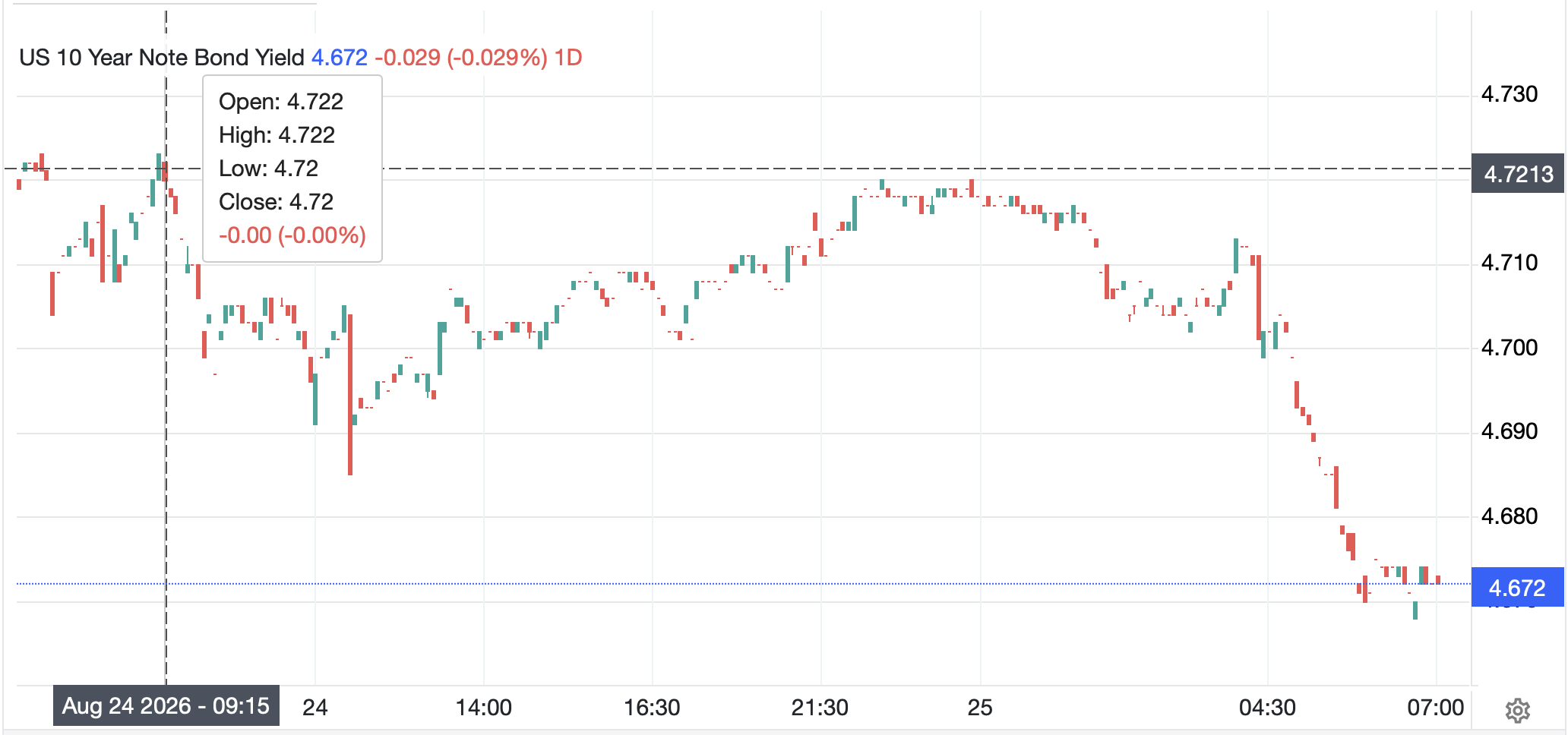
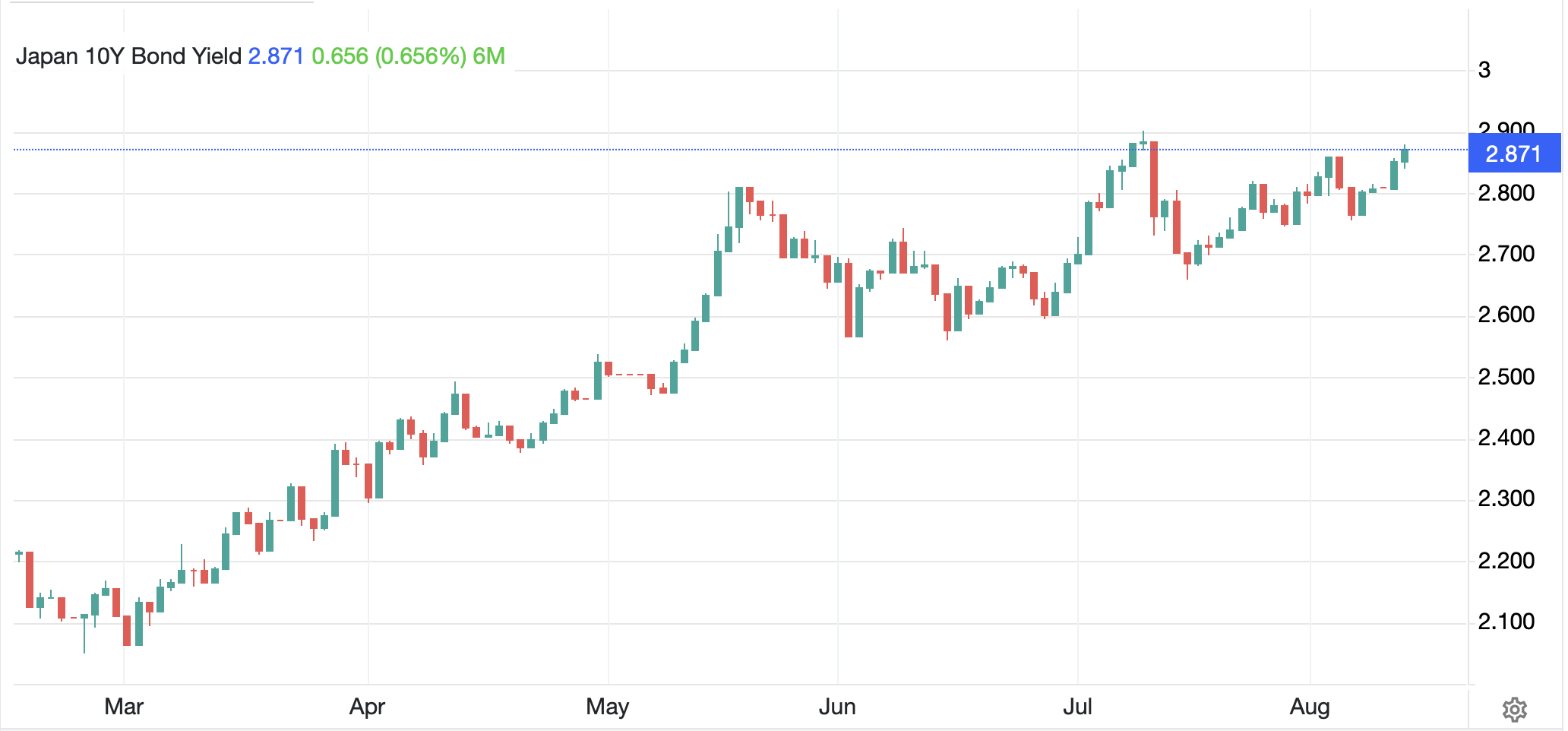
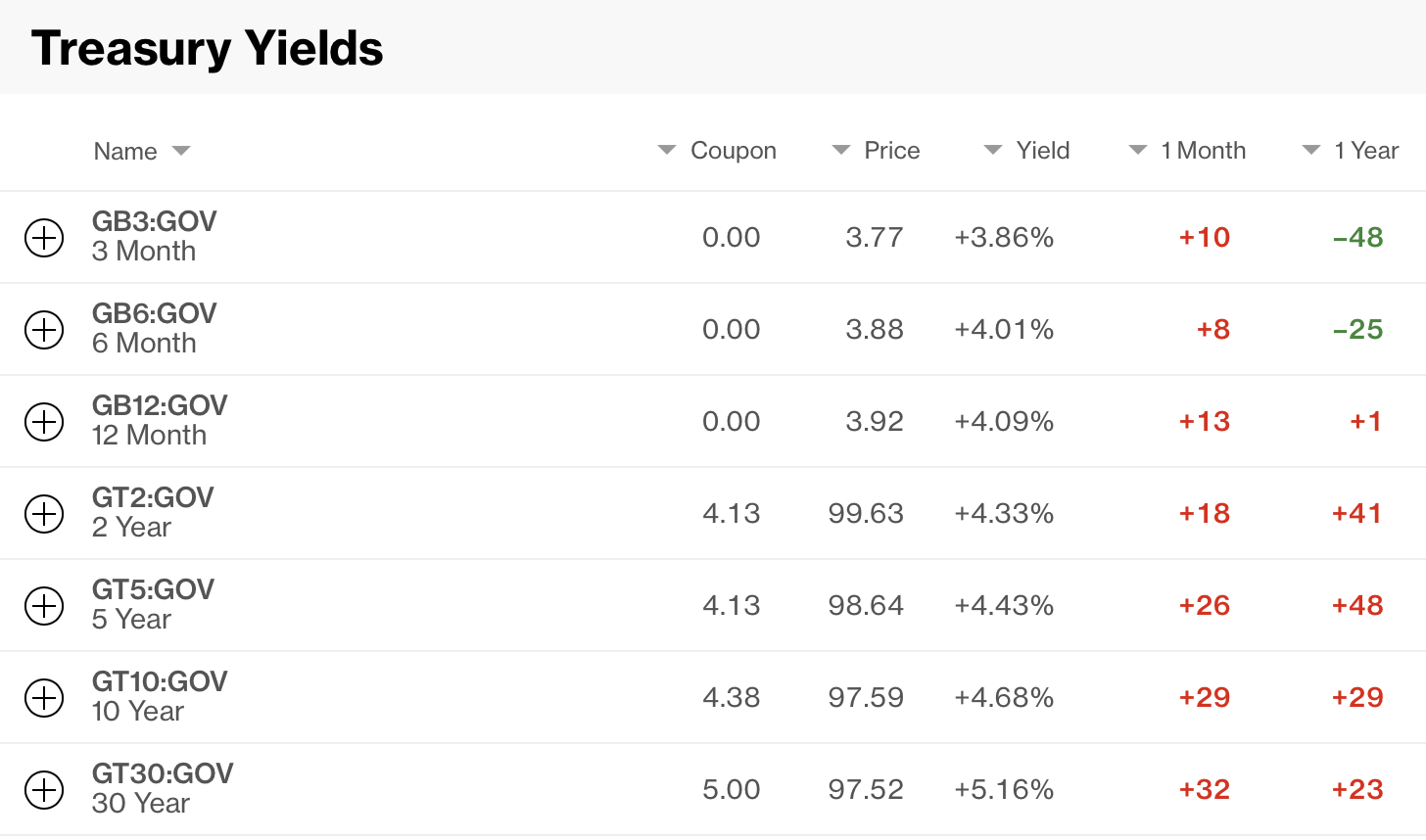
In the bond market, yields are creeping higher with both Treasuries and European sovereigns all higher by 2bps this morning with a similar move by JGBs overnight.  My take is this is less of an inflation concern than a supply concern.  Certainly, there is no indication that the US, Europe or Japan are about to slow down their fiscal stimulus, with Europe now further ramping up its defense spending as the US pressures NATO further.  To me, this is where the rubber will meet the road as if Warsh really does seek to reduce the Fed’s balance sheet, it is not clear where buyers are going to be found to replace them.  I suspect we will see more regulatory freedom for banks and insurance companies to hold Treasuries without capital penalties, but that is a big hole to fill.  

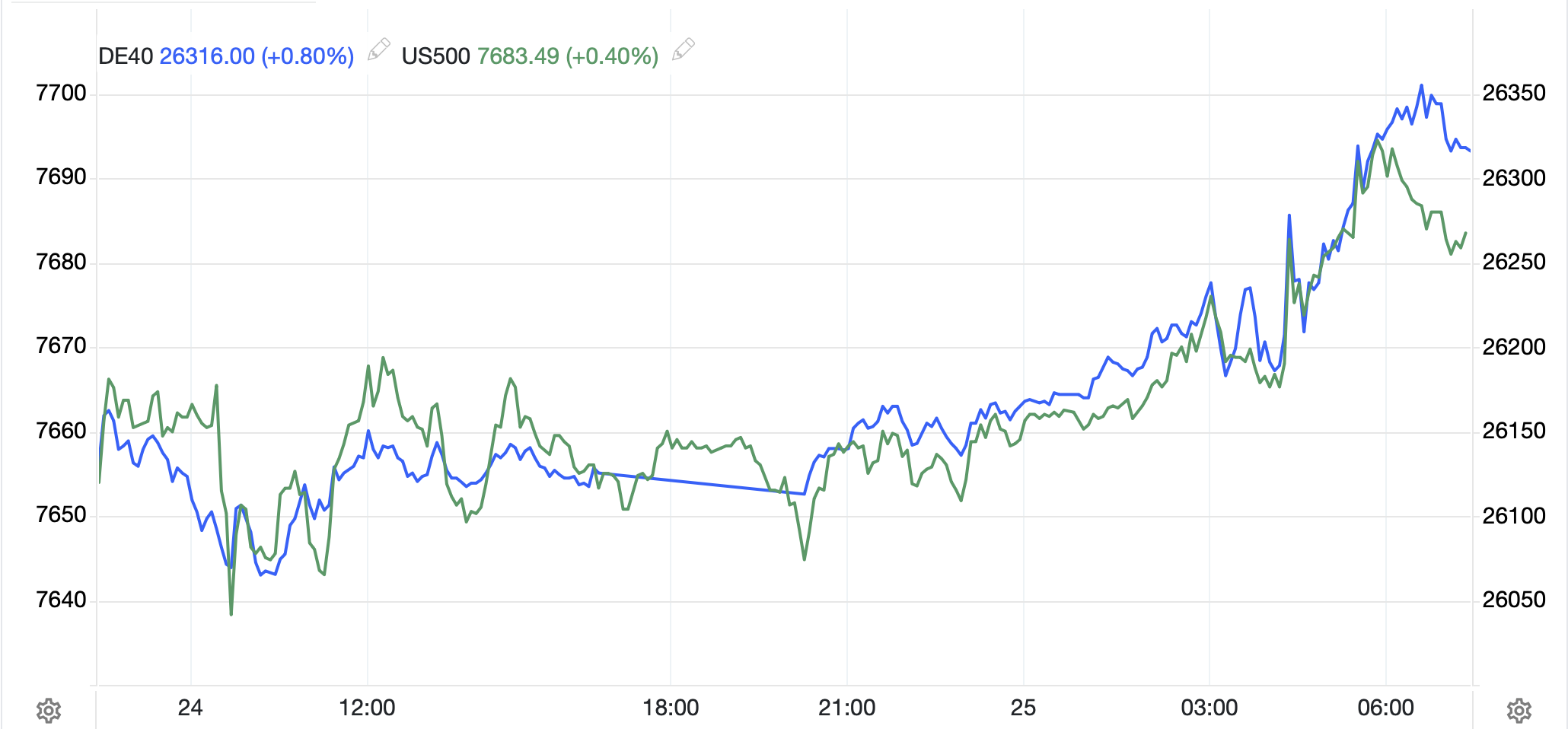
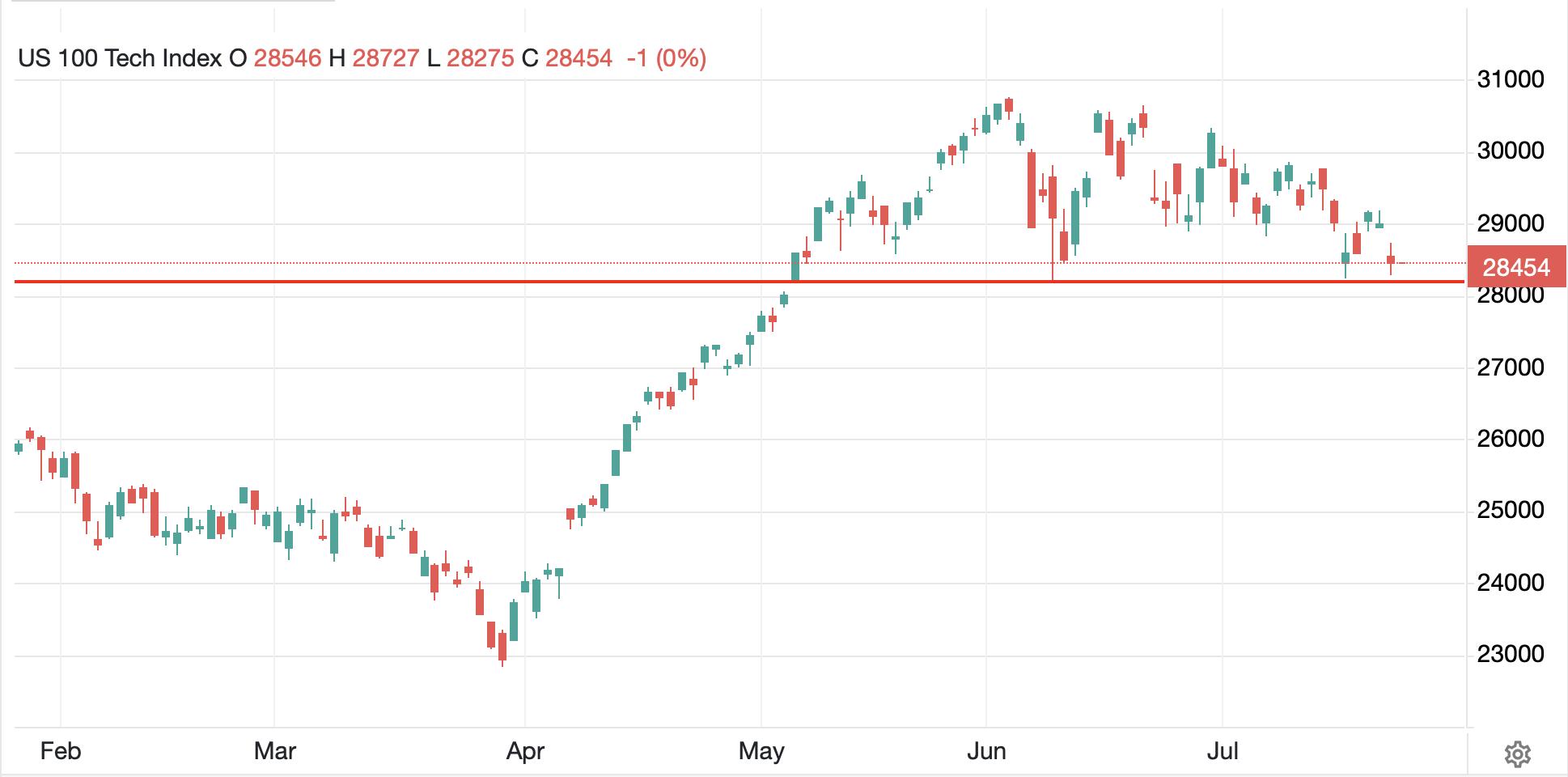
In the equity markets, yesterday’s US rally was followed by a reversal in Asia with Korea (-4.9%) leading the way lower on the back of weakness in SK Hynix stock despite stellar earnings.  But that dragged down the entire region (Japan -2.1%, China -1.0%, HK -0.5%, Taiwan -2.3%) and various declines everywhere else except Singapore (+1.4%) although I can find no specific catalyst for that outlier move.  In Europe, things are more mixed with Germany (-0.7%) under pressure although there is modest strength in the UK (+0.3%), France (+0.2%) and Spain (+0.1%).  All the talk here is about defense spending, although one would have thought that would help Germany the most.  As to US futures, at this hour (7:55), NASDAQ futures are following Asia lower, -1.3%, but the other indices are little changed.

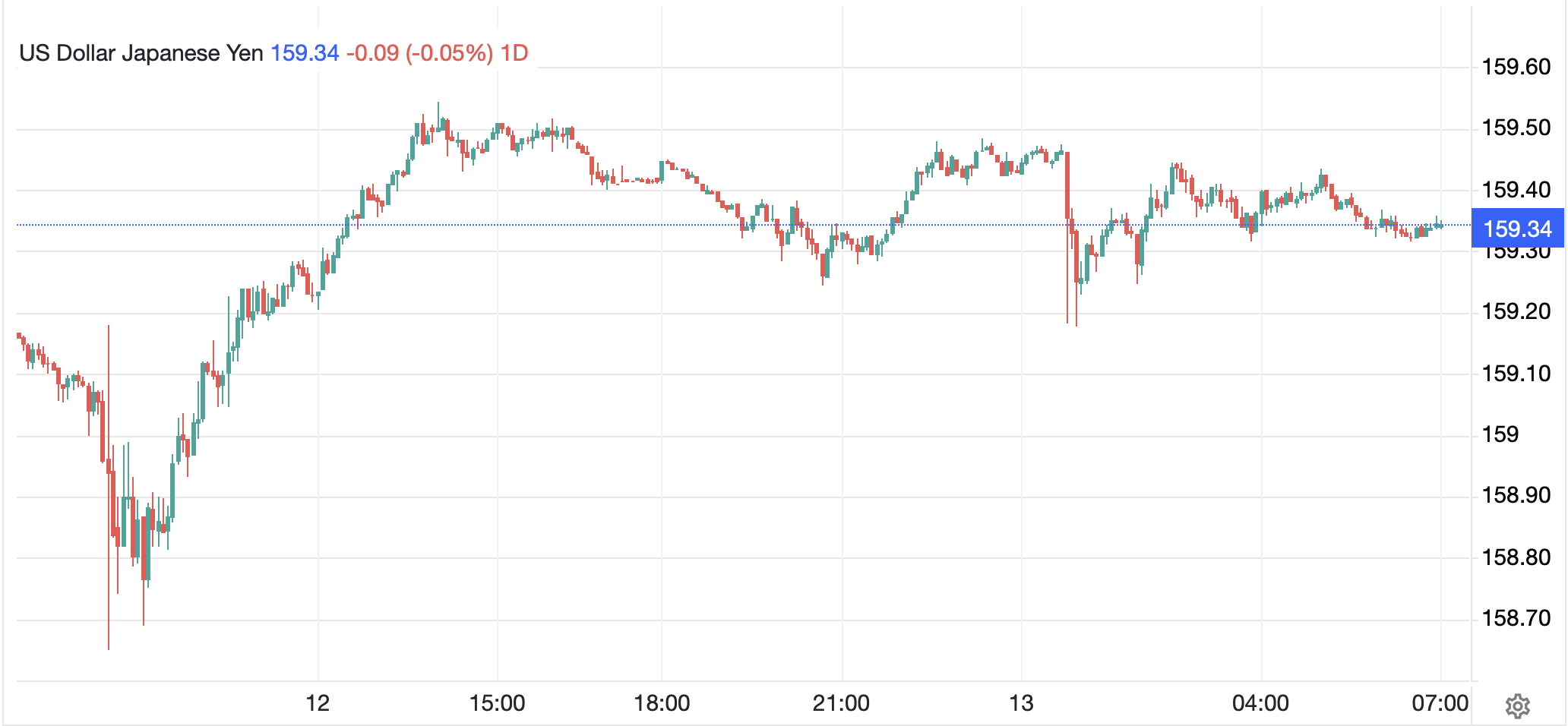
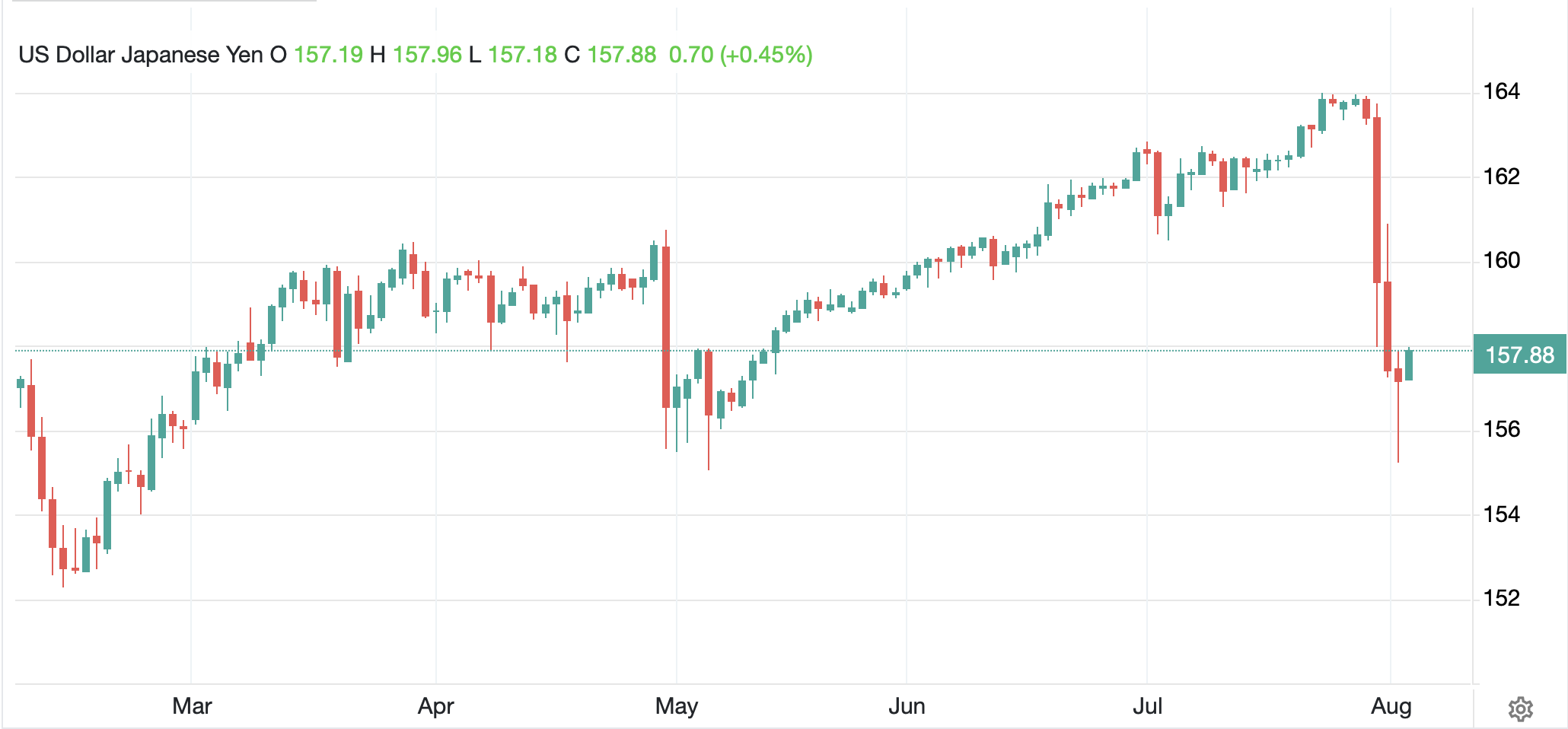
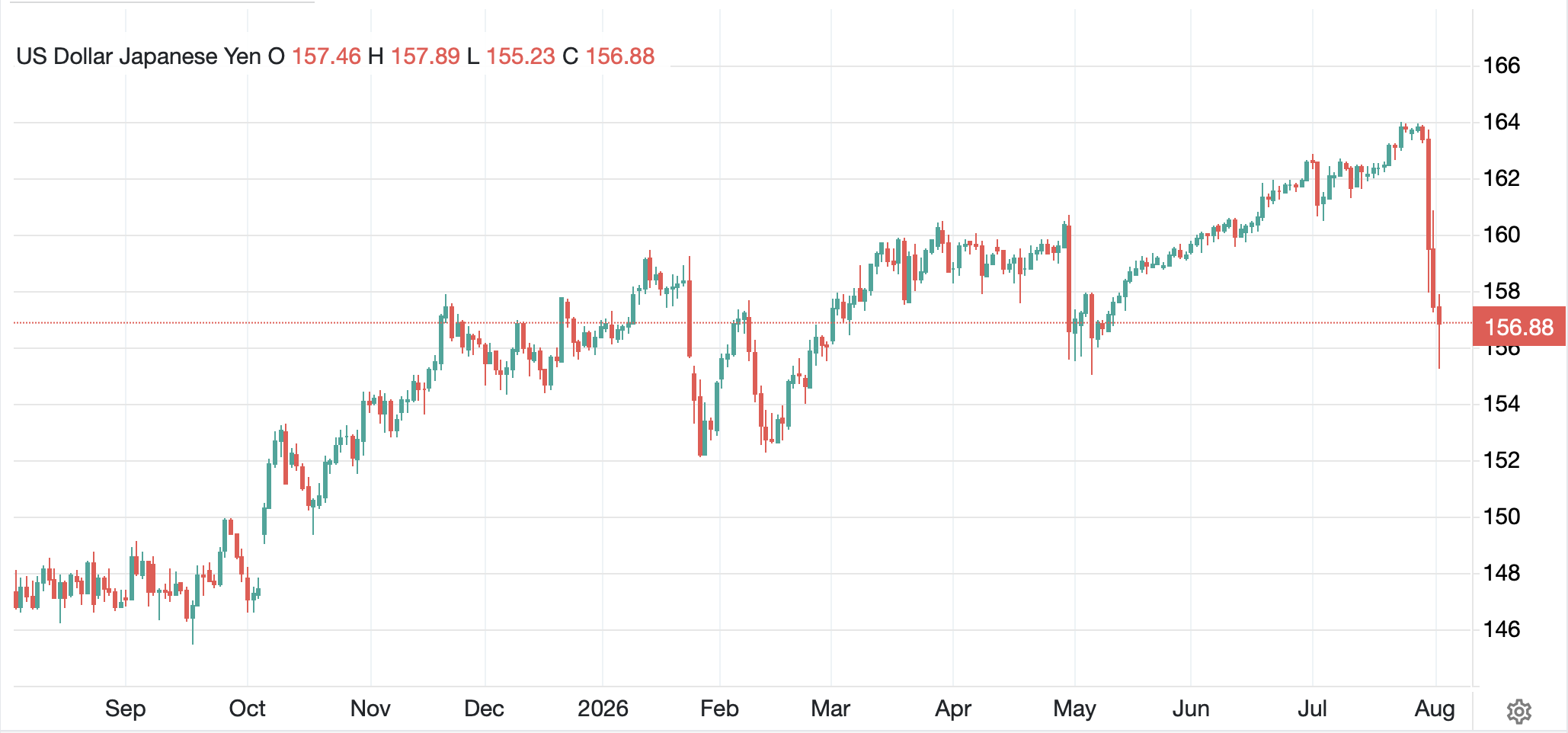
Finally, the dollar is generally a bit stronger this morning, at least against its G10 counterparts, although JPY (+0.1%) is holding up.  But the dollar’s gains are minimal, about 0.1% to 0.2%, so it is difficult to get too excited.  In the EMG bloc KRW (+1.0%) is the clear leader after the country expanded trading hours in the currency markets, and there has been modest strength in BRL (+0.4%) and INR (+0.4%) although neither has seen any major policy changes.

On the data front, yesterday’s ISM Services data was right on the button at 54.0.  This morning we see the Trade Balance (exp -$78.5B) and that’s it.  The hawkish Fed story continues to be the most popular, and until we see some data that can undermine that story, I expect it will remain in place.  Tomorrow’s FOMC Minutes should be interesting as there was obviously a lot of back and forth at the meeting, but since we have already heard further from Mr Warsh, and it is way too early to hear back from the task forces, I suspect we are in for more quiet markets for now.

Good luck

Adf

My House

Said Kevin, the Fed’s now MY house
And views that we choose to espouse
Will no longer guide
So, when we decide
To move, we expect some to grouse

As well, we are set to review
Our policies all the way through
So, comms will be changed
And data arranged
In truth, it is quite the to-do

This is an evening note as I will be unavailable to write tomorrow morning as we head off to show GCH Nubia’s Take Your Breath Away, aka Marvel to a show.  That is his handler and the judge who awarded him Best of Breed that day.

But not surprisingly, the only thing that really mattered today was the FOMC meeting.  I have to say, having watched the entire press conference I am really impressed with Chairman Warsh.  I love the fact that he shortened the statement and that they are ending forward guidance.  And it was quite interesting that half the reporters’ questions were trying to get guidance about what the Fed may do in the future, despite him repeating that there was no more forward guidance.  My take is Fed reporters are going to have to learn about how markets work and more importantly, market practitioners are going to make up their own minds rather than rely on the Fed to bail them out.  This is all really positive!

The most noteworthy thing was the creation of five task forces to address issues with the way the Fed currently does things on the following subjects:

  1. Communications
  2. Balance Sheet
  3. Data Sources
  4. Productivity and Jobs
  5. Inflation Framework

So, it strikes me that Chairman Warsh is going to look to reprogram the Fed, something that has been sorely in need.  Do not be surprised when much of the commentary is negative on these subjects because those are the folks who benefitted from the old way of doing things.  They now need to change their models and their narratives and they are unhappy.  Another benefit.

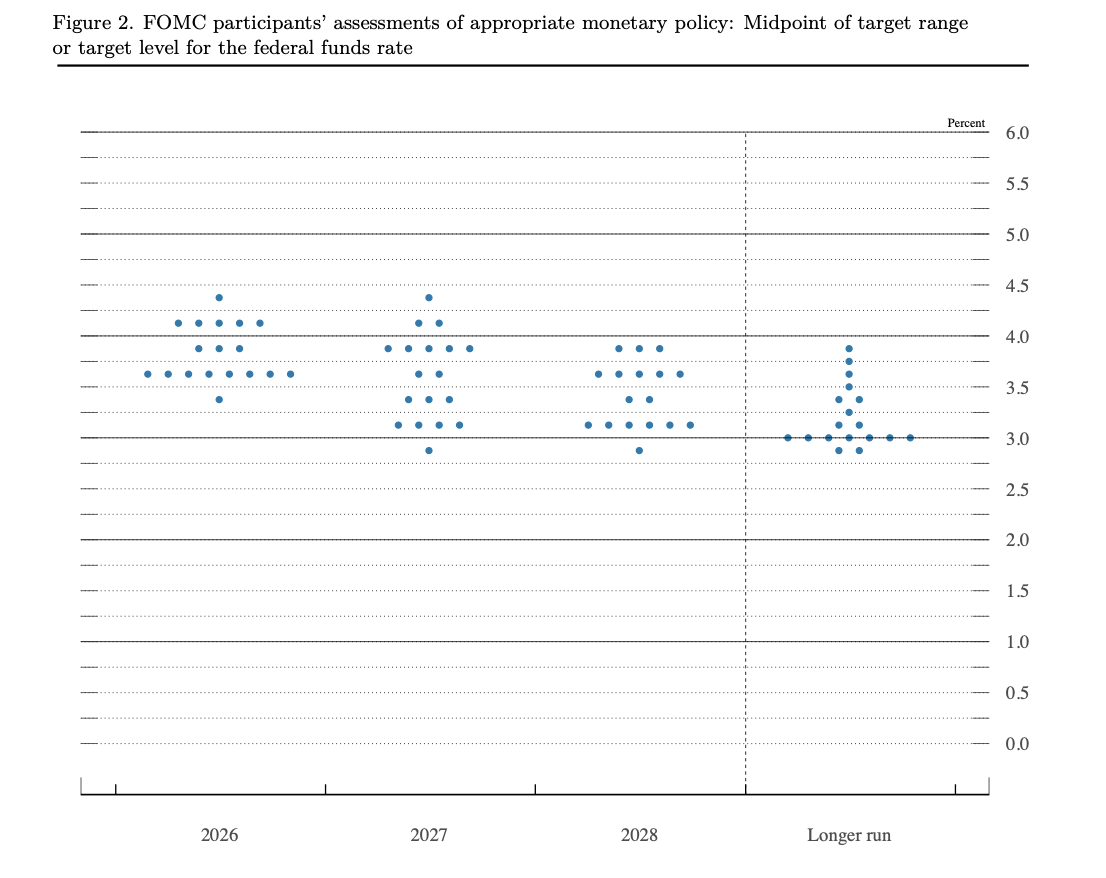
The upshot of the meeting was that rates were left on hold and the dot plot, where Warsh did not supply a dot, showed that half the committee thought rates appropriate, and half thought they would be higher by the end of the year.

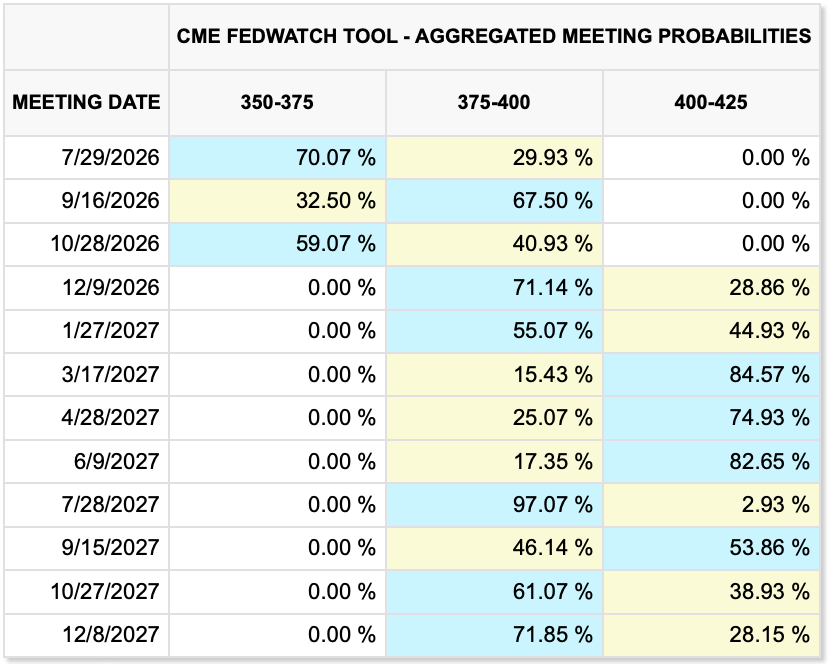
Of course, this largely jibes with the Fed funds futures market as you can see in the latest table from the CME.

Of course, looking at this table, something seems amiss for September, perhaps there was a large position put in place that drove the market.  At any rate stock markets were unhappy with the major indices slipping -1.0% or more after the FOMC although bonds did very little and commodities continue to show oil slipping while gold and silver rise.  As to the dollar, it rallied pretty much across the board.

It is way too early to anticipate exactly how things are going to play out, but I am encouraged.  I strongly believe a little price volatility is a small price to pay to reduce systemic risk by reducing leverage in the system, and that is very likely to be the outcome if Mr Warsh has his way.  My forecast is the “ample reserves” balance sheet program is going to change before he is done.  If that is the case, I think they will have a real opportunity to get inflation under control.  As well, I believe that prospect will undermine much of the ‘death of the dollar’ narrative.  It truly will be significant.  We shall see.

Good luck

Adf
Future With Dread

The story today is the Fed
And whether, when looking ahead
Inflation they see
Stays well above three
Or if it just might fall instead

Meanwhile, every comment I’ve read
Discussing the ‘deal’ have all said
Too much was conceded
The US retreated
And look to the future with dread

Starting with the MOU with Iran, and having read the text of the agreement, at least the one published by Bloomberg, Iran has sworn to never have a nuclear weapon and then will effectively be readmitted to polite society, with sanctions and restrictions eventually removed.  The several comments I have read on the deal highlight numerous potential loopholes and semantics regarding tolls and fees and are uniformly unhappy with the deal.  But I’ve also read that many on Iran’s side are unhappy with the deal.  Arguably, the best sign the deal is going to last is just that, neither side got everything they wanted, but both got some of the things they wanted.  Time will tell how this all plays out, but certainly the oil market remains positive that the direction of travel is toward a normalization of flows through the Strait of Hormuz.

However, while the political pundits are going to continue to focus on that issue, markets have turned their focus to the FOMC meeting and how things play out under new Chairman Kevin Warsh.  The previous Fed whisperer, Nick Timiraos at the WSJ, continues to push Governor Powell’s message as there is not yet a new Fed whisperer.  My take is Timiraos will not be the one simply because his loyalties will not lie with Warsh. 

The thing in which we can be most confident is there will be no rate change at today’s meeting although the market continues to price a rate hike in December as per the below CME table.

All the drama will come with the release of the SEP (Summary of Economic Projections) which is the quarterly document the Fed publishes showing the range of economic forecasts by the individual FOMC members regarding GDP, Unemployment and interest rates.  This document also includes the dot plot.  It is important to note that the SEP only started to be released in 2007, so this is not a long-standing tradition, but part of Ben Bernanke’s changes to the institution.

And this is a key feature of what makes Kevin Warsh different.  He has indicated that the Fed talks too much (I agree) and believes that some ambiguity in what is going on is a desired outcome.  This is a controversial stance as Wall Street has minted money on the back of forward guidance, recognizing the Fed has their back whenever they blow up because they built up huge leverage and were wrong.  

While I completely understand the idea that political discussions need to be in the open, I am far more suspect with respect to monetary policy discussions.  Prior to forward guidance, market participants were far more cautious in their positioning as the probability of getting the direction of a trade wrong was far greater.  But once the Fed says, ‘rates are going to stay low for a very long time’, traders can lever up positions massively relying on the fact that their funding costs are going to remain in check.  And it is the massive leverage where the risks to the market lie, not the level of rates per se.

So, the question today is how Chairman Warsh will handle his desire to reduce communications compared to the previous actions of publishing the data and numerous FOMC members speeches.  One thought is he may refuse to put his own forecasts into the document, a sign of what he wants going forward but I am confident he has other ways to move forward.

The other issue is the question of the tone of the statement, which had ostensibly been leaning dovish but seems now likely to be neutral.  My sense is whatever he does, it will be incremental, at least at the beginning, but I anticipate that he is going to make substantial changes to the way the FOMC operates during his tenure as that is why he was put in the role. 

So, with that as our backdrop, let’s see how markets have absorbed the text of the deal as we all await the FOMC this afternoon.  Yesterday’s mixed US performance, with only the DJIA managing a gain while tech stocks dragged down both the NASDAQ and the S&P, was followed by more positivity than not in Asia with gains in Japan (+0.7%), China (+1.0%), Korea (+1.6%) and India (+0.5%) while HK (-0.75%) slipped a bit.  It is always a bit of a surprise when HK and China move in opposite directions, and it seems today’s split arose from different interpretations from a policy conference regarding future PBOC activities as well as potential future government support for a clearly weakening consumer economy.  Other regional exchanges had a mix of gainers and laggards as well, as the overall session was directionless.

In Europe, the picture is also mixed although the movement has been more muted than those in Asia.  Both Germany and the UK are flat to slightly lower this morning with the former under pressure after BMW offered a terrible profit forecast while the latter, despite lower-than-expected inflation readings, is lagging on growth concerns.  However, France (+0.2%) and Spain (+0.5%) have both managed to rally a bit on some slightly positive earnings news.  As to US futures, at this hour (7:15), they are modestly higher across the board.

Bond yields are generally little changed this morning with only UK gilts (-5bps) and JGBs (-4bps) showing any movement at all.  Gilts responded positively to the inflation data while JGBs seemed to take solace in the trade data showing Japan was back to a deficit.  

In the commodity markets, oil (+0.7%) is having a very quiet session after several sharp declines in a row while metals markets are largely unchanged this morning.  It appears even traders here are awaiting the FOMC outcome.  One thing I have seen is a recent report from the World Gold Council showing 45% of central banks surveyed plan to buy the barbarous relic in the next 12 months.

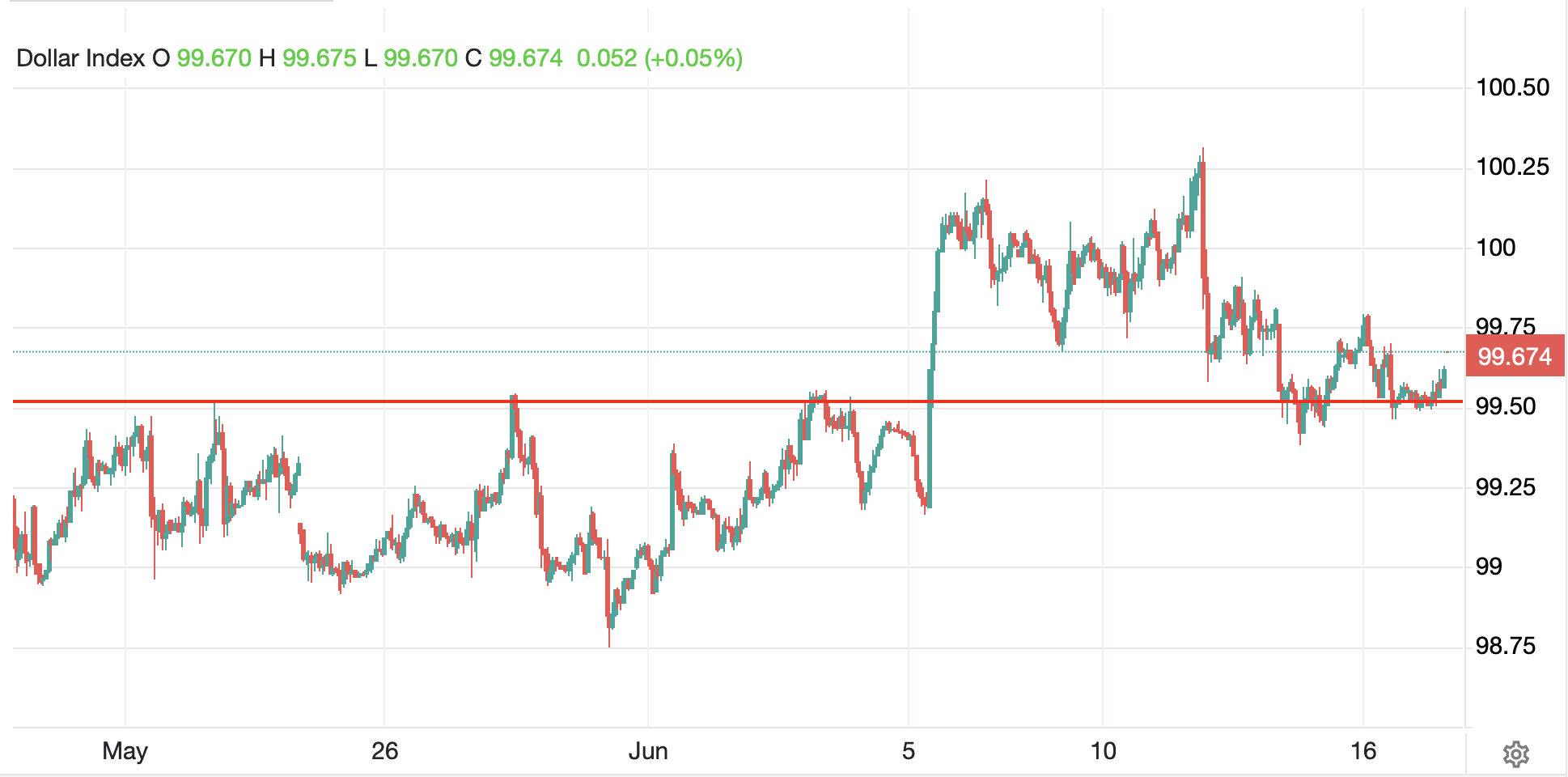
And finally, the dollar is slightly stronger this morning, but like most other markets, not showing much movement at all.  The below chart of the DXY for the past month shows just how lackluster price action has been with a total range of just 1.5%.  The red line is the midpoint of that range showing there is just not a lot of pressure in either direction right now.

Source: tradingeconomics.com

Meanwhile, USDJPY has basically spent the past two weeks hovering just above 160.00 with nary a peep from the MOF or BOJ.  Again, the situation there is the policy changes necessary to strengthen the yen are likely to have very negative economic consequences initially, and that is not something any government is likely to do.

On the data front, ahead of the Fed we see Retail Sales (exp +0.5%, +0.5% ex-autos) and then the EIA oil inventories with more draws expected.  And that’s really all there is.  I anticipate a very quiet session ahead of the Fed and then all will depend on how the market interprets Warsh’s signals.

Good luck

Adf

Changing the Fate

With things in the Gulf getting hotter
And risk assets heading to slaughter
The question on lips
Can stocks e’er eclipse
Their highs, or ‘stead sink ‘neath the water

But really, the question I’d ask
Is Chairman Warsh up to the task
Of changing the fate
Of the Fed funds rate
And if so, what will he unmask?

It is very difficult to focus on the Gulf situation as not only is it fluid, but there is also no direction of travel whatsoever.  So, this morning I want to have a different conversation.  Let me start by explaining this isn’t my idea, per se, although the analysis is solely mine.  Listening to the Macro Voices podcast Sunday morning while walking the dog, (he’s the one on the left)

Michael Every was on and expressed a very interesting thought, one that I had not considered, nor heard anywhere else.  What if the Fed, as Chairman Warsh seeks to adjust how it works, decides that they are going to put their fingers on the scale with respect to the interest rates paid by different industries, not merely by differently rated credits.  The idea is that in conjunction with the Treasury, Warsh and Bessent would decide which industries needed to have the most cost-effective funding for the nation to be able to maintain and develop the industries necessary for national defense reasons.

Now, I know this is anathema to almost all of us having been raised on the idea(l) of free markets and that markets are better at allocating, well everything, but in this case credit, than any cabal of central bankers.  And in a world where markets were truly free and where everyone competed on a level playing field, I am 100% in agreement with that view.  Alas, I’m not sure if you noticed, but that is not the world in which we live.

If Covid taught us nothing else, it was that 40 years of globalization and creating the most efficient processes for manufacturing resulted in significant fragility in those very processes.  It turns out that while economists in the US, Europe, Japan, the World Bank and IMF all explained that this was a great outcome (the US prints paper notes and gets lots of stuff for it), that only works when there is peace on earth.  During this period, China chose to play by a different set of rules, explaining they were just a poor country so didn’t need to play by the G10’s rules, and massively subsidized numerous industries while essentially ignoring all environmental issues.  That tilted the playing field pretty aggressively, and while President Trump has been adamant about that very issue for a decade, he was largely ridiculed, right up until Europe recently figured out that China was eating their lunch too, and now they are looking to impose tariffs on China’s excessive exports.  There is an excellent Substack that comes out Sunday mornings called The Brawl Street Journal,written by an analyst in Germany.  This week’s, linked here, explains that very issue extremely well.

So, I’ve set the table here, and the key to understand is the table is tilted horribly, with China getting the benefit of the doubt for almost everything.

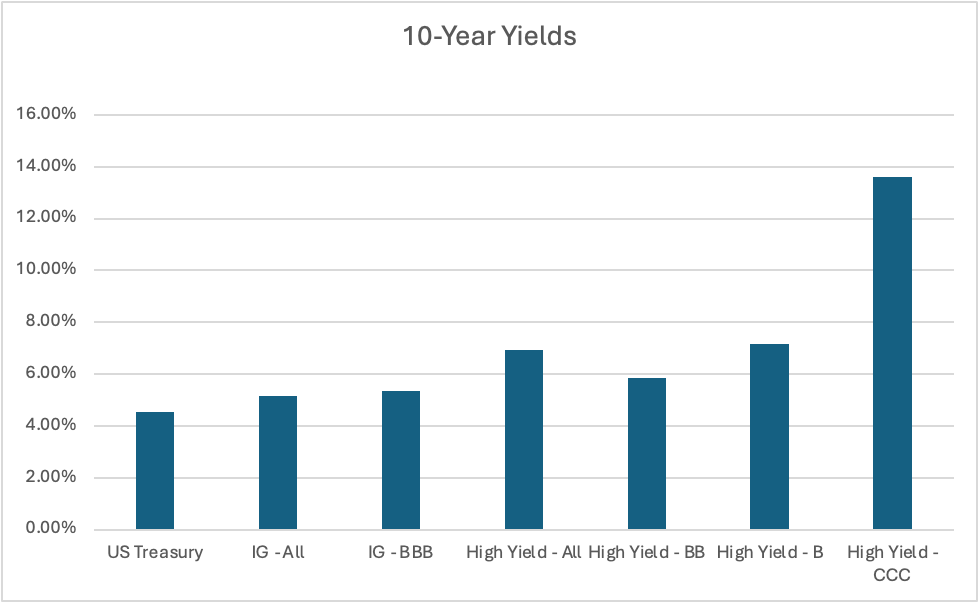
Now, let’s consider what Mr Every’s idea would mean.  Below is a chart showing current 10-year yields for Treasuries and a series of corporate bonds delineated by their credit ratings.

Data: streetstats.finance

Makes sense, less creditworthy names pay more.  That is how things have always been within a market system as the worse the credit rating, the higher the perceived risk of the investor and therefore the higher yield they demand.

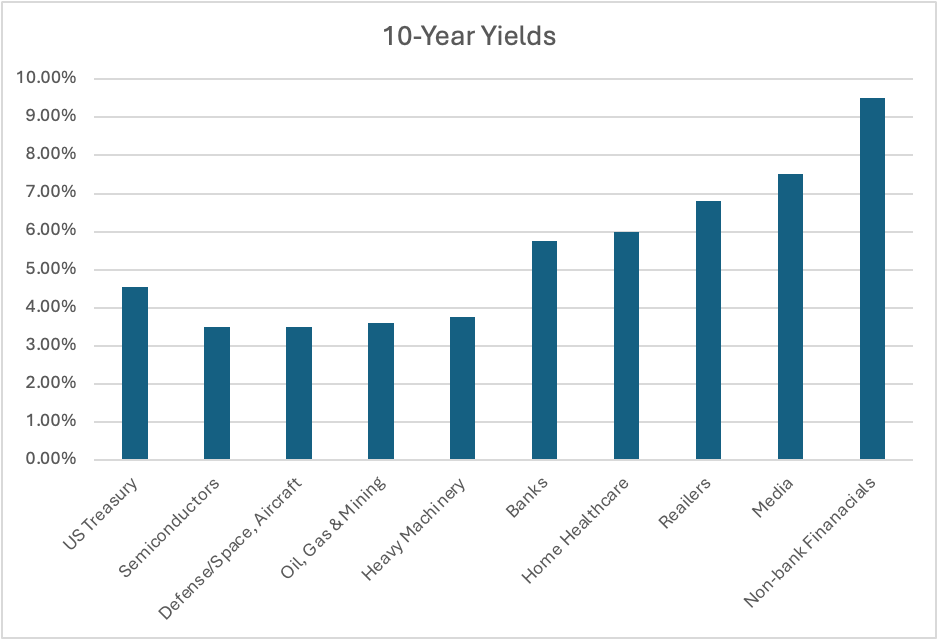
But what if that were to change?  What if the Fed and Treasury decided that companies that manufactured products, be they semiconductors, automobiles, tractors, airplanes or flat panel screens, and mining companies that mined in the US (and Canada) and energy extraction companies that drilled in the US (and Canada) needed a lower cost of capital to be more competitive globally as those companies were the ones necessary for the US to maintain its global hegemon status.  But media companies, and retailers, non-bank financial institutions and home health services companies, for example, were not deemed as critical.  Perhaps the new “credit” curve might look like this instead (all hypothetical)

The point is, China has been subsidizing numerous manufacturing industries for decades with the goal of excess production designed to drive other nations’ competitors out of business and gain a strategic advantage in all those industries.  It is why President Trump’s tariffs were a problem for them, and the rest of the world, as the US had been the dumping ground for much excess Chinese production in the past, and now that stuff is going elsewhere.  

The world we once knew is no longer the world in which we live.  Mr Every’s term, economic statecraft, is much more applicable today than any time in the past 40 years, probably longer, since the end of WWII.  Statecraft implies nations will use all the power they have, economic, military and diplomatic, to achieve their desired goals.  For more than 70 years, the US did not play by those rules under the assumption that if they created a level playing field, and even tilted it in favor of weaker allies, peace would reign.  China doesn’t play by those rules, and that is how we have arrived where we are.  

This is all hypothetical, but remember, Chairman Warsh has talked about restructuring the Fed.  All the economists think he is talking about shrinking the balance sheet.  But what if he is talking about completely changing credit markets with Fed support?  I would argue that is not on many bingo cards.

So, briefly, let’s consider how markets would respond to this action by the ‘new’ Fed.  Here are my conclusions, I would love to hear yours.

  • Stocks – broadly lower, although clearly favored sectors would continue to perform well.  But overall leverage would shrink and that has been a huge part of this rally.
  • Bonds – a steeper Treasury yield curve seems certain as subsidies for those favored industries will weigh on the US budget.  Meanwhile, non-favored industries would find themselves with real difficulties in terms of financing.
  • Commodities – offsetting forces here as industrial metals would see increased demand, and getting supply on line takes years if not a decade, but energy may result in a glut sooner as drilling takes much less time to get going.  Precious metals would soar, I believe, on the basis of investors and central banks, seeking an asset with no counterpart.
  • FX – this is the toughest call as different nations will be impacted in very different manners.  Commodity producing nations (e.g., Chile, Norway, US) should see relative strength.  Consuming nations would likely suffer somewhat, although Japan and Korea, for instance, could essentially fall within the US umbrella as their key industries are the US focus.

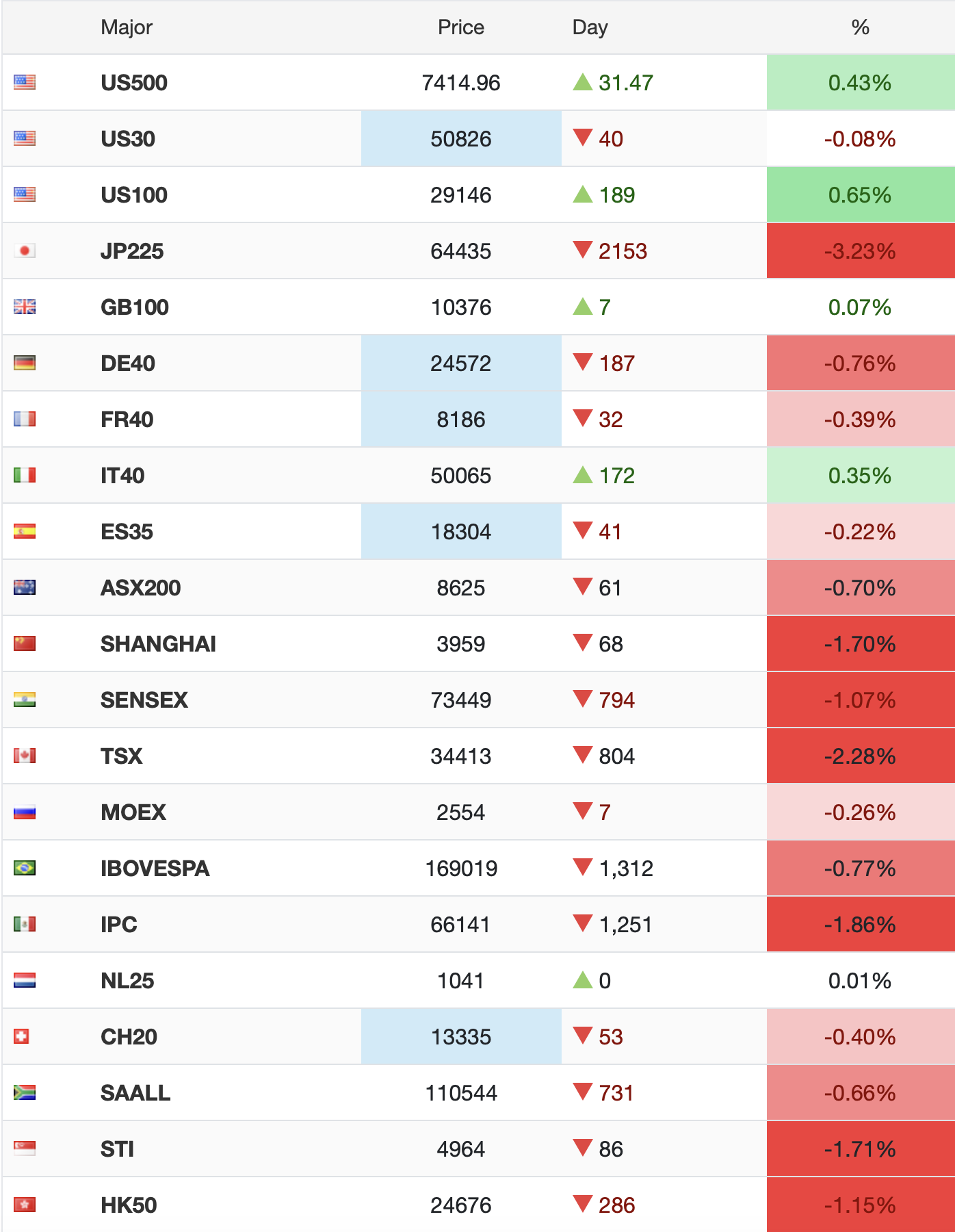
Again, this is all hypothetical but is probably worth some thought.  In the meantime, a brief tour of markets overnight after Friday’s sharp declines in the US shows nobody is very happy this morning.  The tradingeconomics.com screenshot below shows futures as of 6:10am.

What sticks out to me is Italian equities are bucking the trend, although there has been no data and I cannot find a specific catalyst there.  Also, it is interesting that US futures are broadly higher this morning despite growing concerns that the situation in the Gulf is going to heat up again.  But Asia had a rough session and most of Europe is feeling a little pain as well.

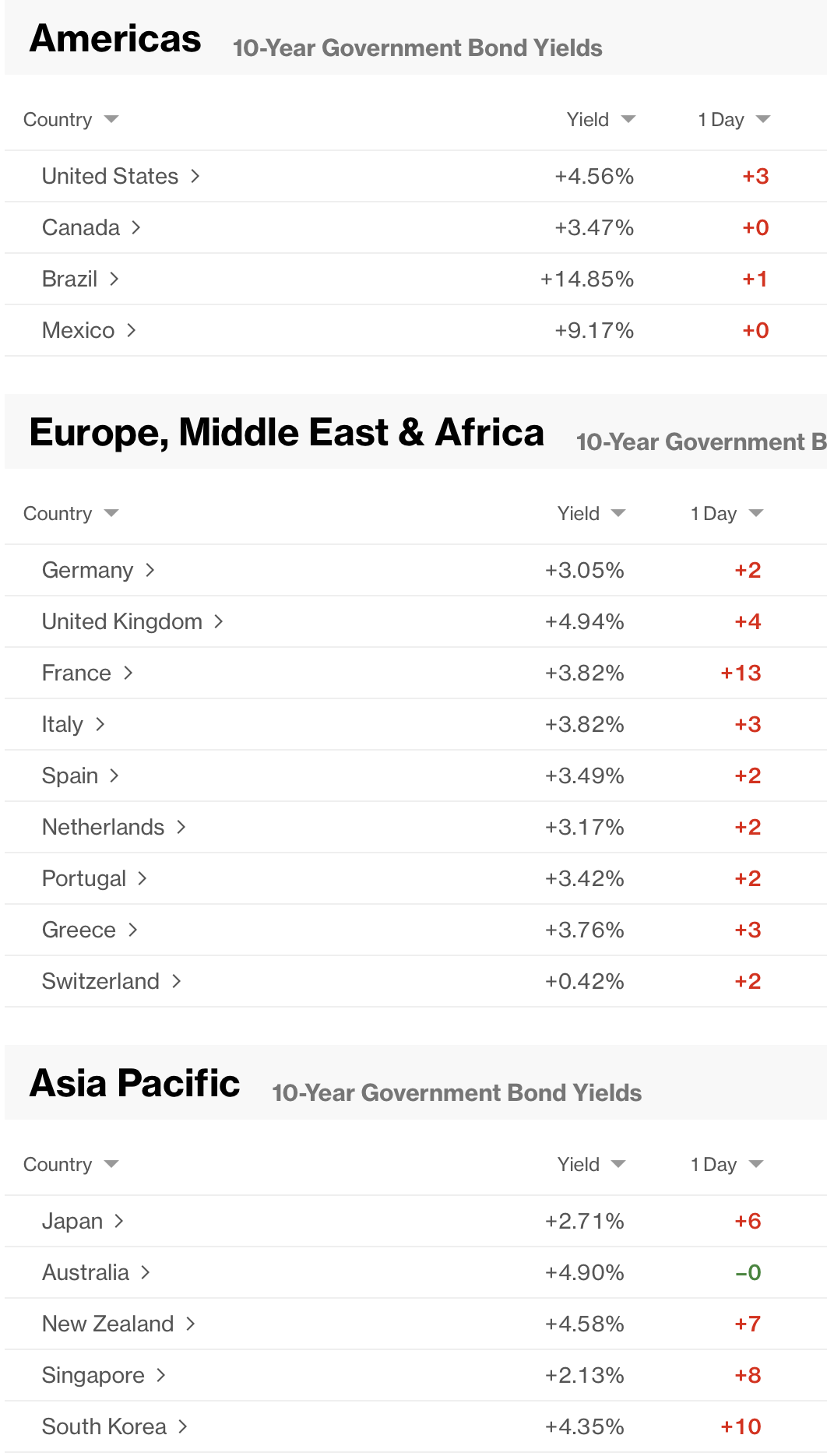
In the bond market, after climbing on Friday, yields continue higher this morning across the board.  The below Bloomberg screenshot explains things well.  Recognize that Canadian and Mexican markets haven’t opened yet and Australian markets were closed last night for the King’s Birthday.  But net, there is growing concern over inflation on a worldwide basis it appears.  

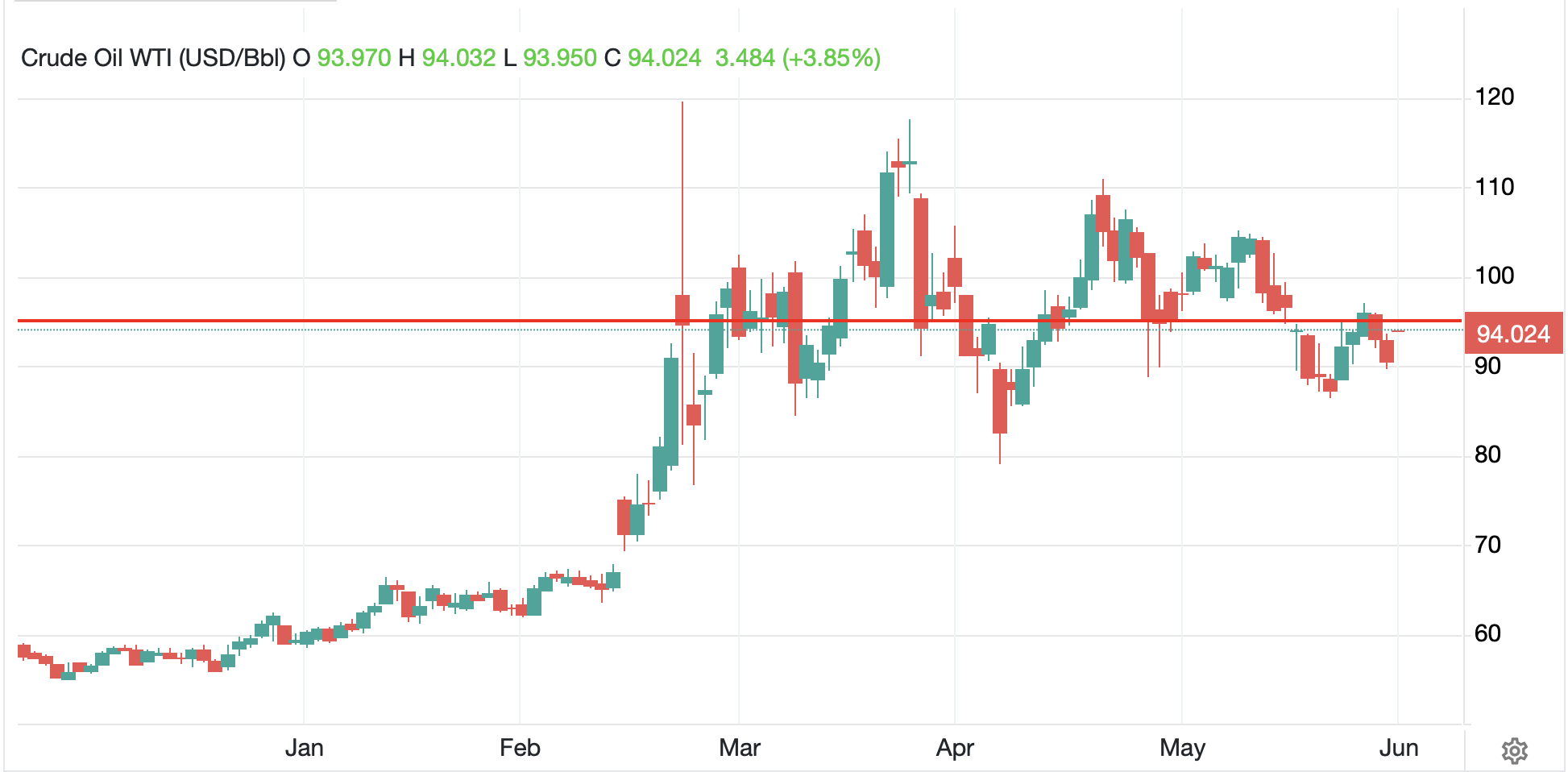
Turning to the commodity markets, oil (+3.8%) is higher again, after falling on Friday as there were missile attacks by Iran on Israel in response for Israel’s ongoing attacks on Hezbollah in Lebanon. This situation remains fraught and frankly nobody has any idea when it will settle down into something a bit less volatile.  If we look at a chart of the past six months of oil price movement, I have drawn a line at $95/bbl, which to my eye offers a pretty good estimate of the average since things began.  There are still many doomsayers who believe $200/bbl oil is coming soon, but that has been their forecast since March.  Something to remember about commodity markets is that they do not forecast the future, they are the prices at which physical stuff clears, so it appears that so far, there is ample inventory available.

Source: tradingeconomics.com

Not surprisingly, given the recent relationship between gold and oil, the barbarous relic is lower this morning by -0.7% while silver, though unchanged on the day, suffered dramatically on Friday, falling $6/oz or about 8%.

Finally, the dollar is little changed this morning, but that is after a sharp rally on Friday in the wake of the much better than expected NFP data (+172K with revisions higher in the previous two months of +93K) which helped push yields higher as a rate hike this year has now been priced by the futures market as per the below CME table.

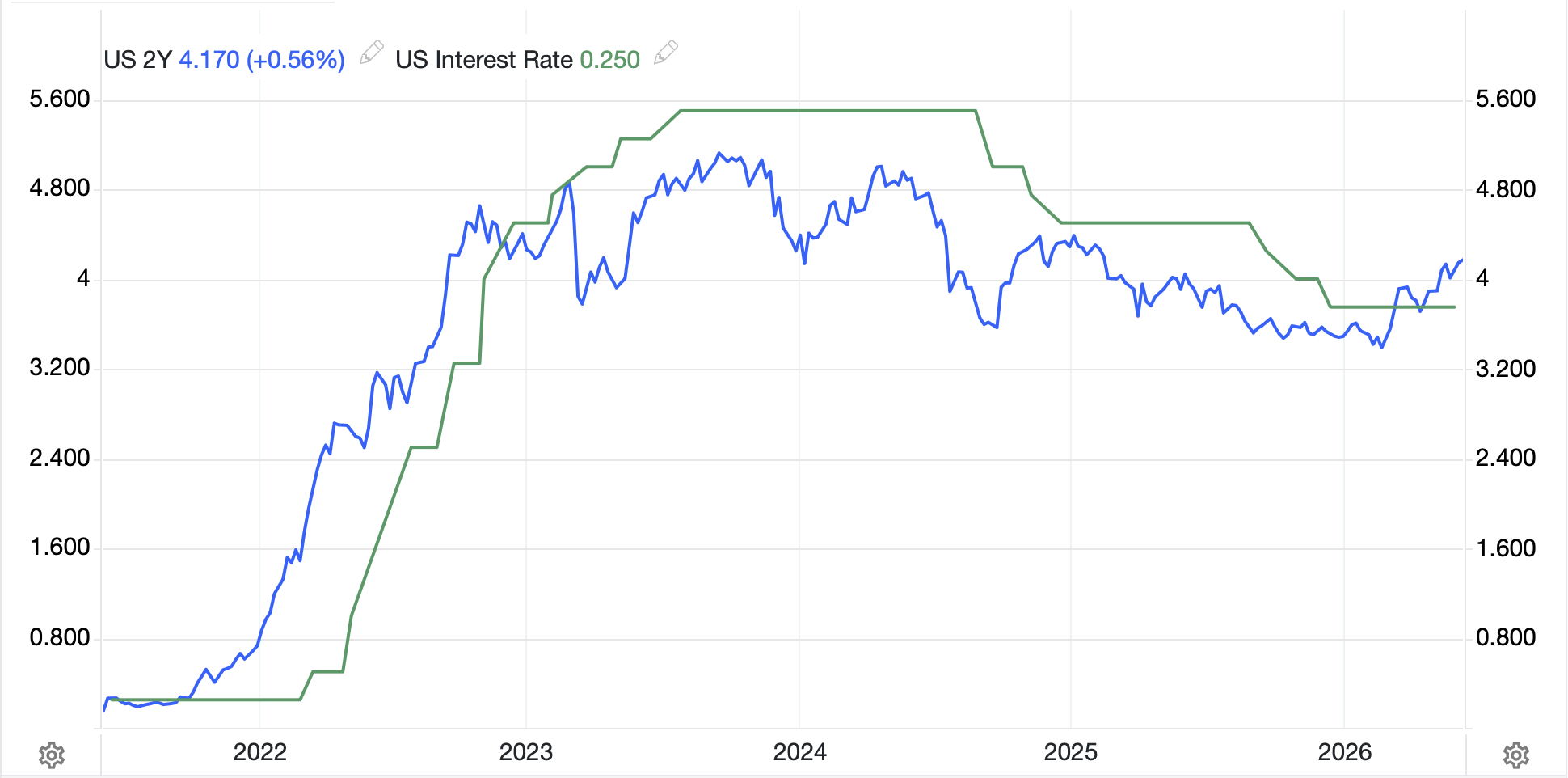
But more than just the futures market is thinking that way.  The below chart showing the 2-year Treasury vs. Fed Funds shows that not only have 2-year yields moved above Fed funds, but they are accelerating higher.  This is seen as another harbinger of a higher Fed funds rate.

Source: tradingeconomics.com

So, the DXY is back over 100.00, USDJPY breeched 160.00, and is right on that number as I type at 6:50am, and generally, the dollar is pushing the top of its recent ranges.  The one exception here is KRW (+1.6%) where the central bank and Finance Ministry both were actively jawboning the currency higher after it traded to yet another new low (dollar high).

As there is no data of note this morning, I will go through that tomorrow given how long things got today.  The world is changing rapidly and the most important thing, I think, is to recognize that old relationships may no longer be valid.  Nimbleness is critical, whether investing or hedging.

Good luck

Adf
The Abyss

This month has seen traders dismiss
The idea that risk led to bliss
Stocks worldwide have fallen
And those who were all in
With leverage now face the abyss

But it’s not just war in Iran
That’s scrambled most everyone’s plan
The data, as well
Are heading to hell
With no central banking wise man

As I didn’t write on Friday, and it seems some things happened while I was away, I thought I might offer my views of where things stand as we enter the new week.

🤯🤯 😱😱 🤮🤮

I think that sums it up nicely.

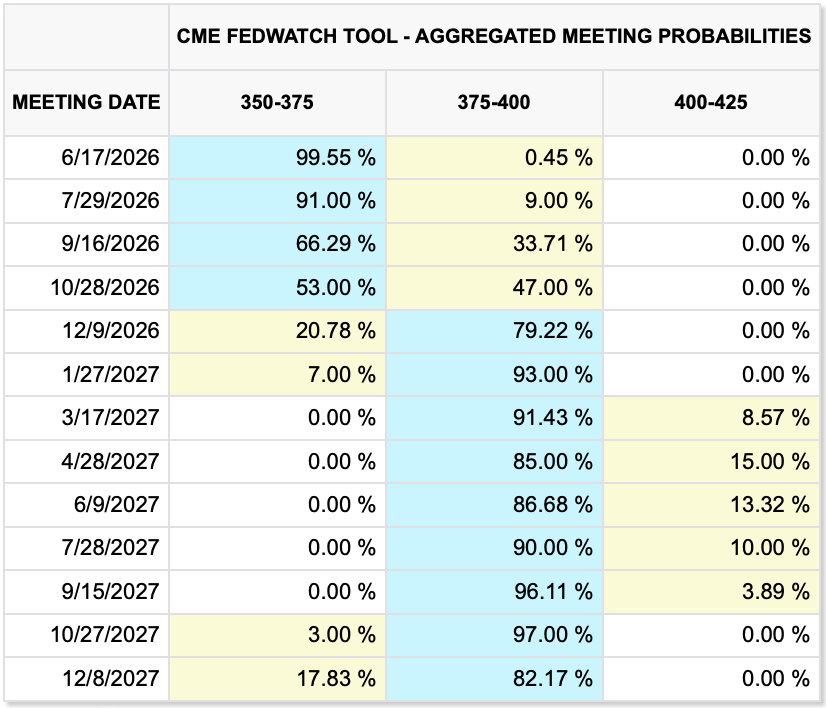
Recapping the end of last week quickly, all the central banks left policy on hold, as was expected with all showing a more hawkish lean given the dramatic rise in energy prices, so far, and fears that food will follow shortly.  The BOE was the most obvious as rather than a 5/4 vote with 4 votes for a cut, it was 9/0 for no movement.  Adding the Thursday decisions to the previous ones from the week, and looking at the Fed funds futures market, the two tables below from cmegroup.com show the change over the past month from modest expectations of a cut at the next meeting to modest expectations of a hike, first:

Then, if we look at the aggregated probabilities, you can see that the market has priced out any cuts for 2026 at this stage, with nothing, really, until the end of 2027.

Now, here’s the thing about this pricing.  It is a current estimation based on the Fed funds futures curve and certainly is subject to massive change going forward.  However, other markets that rely on interest rate cues see this and respond accordingly.

For instance, the 2-yr Treasury note (gray line) also has seen a major yield rally as you can see in the chart below and now sits above Fed funds effective (blue line) for the first time since late 2022 when the Fed finally caught up in its race against the raging inflation of the time.

Source: tradingeconomics.com

So, inflation is once again a major worry of the markets, and investors have come to believe that central banks are not going to be coming to the rescue for their risk assets as their hands will be tied by higher energy prices driving headline inflation higher.  Of course, we all know that central banks raising rates will not adjust short term price inelasticity for energy products, although it could well cause a deep recession which would likely have an inflation impact.  But my take is, that is not their goal either.

And that is why everyone is so unsettled.  The idea that the central banks are going to come to the rescue of risk assets has been killed and now the pricing of those assets needs to rely on their own fundamentals, a much tougher task historically.  

This is especially so given the data from Thursday showed PPI much hotter than expected, which adds to the narrative that the Fed, and other central banks, are on hold, at best, if not getting itchy to hike rates.

With this in mind, we cannot be surprised that equity markets suffered greatly on Friday, as did bond markets and precious metals.  However, I believe the drivers of equities are different than those of the traditional havens of bonds and gold.  In the case of equities, high valuations, which have existed for a long time, and significant leverage, with margin debt at record highs, although as you can see from the chart below, I created from FINRA data, it turned down ever so slightly in February have started to take their toll.

And in fact, that toll on margin debt is being played out in both bonds and gold as both are clearly feeling the effects of massive deleveraging as hedge funds and CTAs all scramble to make their margin calls.  In this case, they sell what they can that is liquid, not what they want to sell, so bonds and gold fit the bill.  My take is if the war continues very much longer, we will see the margin selling diminish and soon, both gold and bonds are going to seem like pretty good places to hide.  (Now, if you want to keep up with inflation, USDi, the fully-backed inflation tracking crypto currency available at www.usdicoin.com) is going to do so far better than short-term interest rates which are almost certainly going to lag inflation for a while going forward!  Ask me about this and I am happy to discuss.)

And that’s all I have this evening.  There is a great deal of back and forth with threats from both sides in the war, and whether or not the Iranian electricity infrastructure is hit, or if their nuclear power plant at Bushwehr is hit and if so, how they retaliate remains unknown and fodder for the narrative writers.  I have no opinion other than I hope none of that happens.

In the meantime, risk reduction is likely to continue as equities suffer while the dollar maintains its value and oil is the real risk, as any indication that the military action is ending is likely to see a major downdraft there.  Unless you are a professional trader, with real capital behind you and a great market and news feed, this is not a time to play in my view. However, if I look at things and where they currently sit as Sunday night opens, gold seems to be too cheap.  For millennia it has served as the last recourse of safety, and I do not believe this war will be any different than any of the countless wars in the past.  This doesn’t mean it cannot go lower, just that it probably is approaching a place of ‘value’ especially as you can be sure that at some point later this year, every central bank will be printing as fast as they can if economies start to stutter.  One poet’s thought.

Let’s see what happens overnight and I will be back again tomorrow.

Good luck

Adf

Venting Spleen

It used to be data was seen
As noncontroversial and clean
But politics, lately
Has damaged it greatly
With both D’s and R’s venting spleen
 
So, it ought not be a surprise
That yesterday’s NFP rise
Was claimed by the left
To lack any heft
While R’s crowed out loud to the skies

By now, you are well aware that the NFP number was released much higher than the forecasts, printing at 130K vs a consensus forecast of 70K.  The previous two months were revised lower by 17K, so still a huge number, and it was the main topic of conversation in the markets all day. 

To me, the big news was that private sector jobs rose 172K, while government jobs declined by 42K.  In fact, the Federal civilian workforce is back to its smallest count since 1966!  That is an unalloyed positive in my view.  Too, manufacturing jobs increased by 5K, which is the first time we have seen a rise since November 2024.  In fact, if you look at the chart below of manufacturing jobs for the past 5 years, it is easy to see what President Trump is trying to achieve.  One month does not indicate success, but it’s a start.

Source: tradingeconomics.com

The last positive was that the Unemployment Rate fell to 4.3%, so overall, this seems like a pretty good report.  But as with everything these days, it depends on the lens through which you view it.  As with most national data in an economy as large and varied as the US, there were real and perceived negatives.  The BLS made their annual benchmark revisions to the data which removed 403K jobs from 2025’s numbers.  These revisions come as they adjust their birth-death model as well as get updated population statistics.  But for those who seek bad news for this administration, that reduction of 403K jobs is proof that the president’s policies are failing.  Another complaint has been that the bulk of the increase in NFP was in the health care sector, although given the ongoing aging of the population, that cannot be very surprising.

Nonetheless, just like every other piece of data these days, NFP was a Rorschach test of your underlying political beliefs and not so much a description of the economy.  My question is, if the employed population is ~159 million, is an adjustment of 400K really meaningful?  After all. It’s about 0.25% of the working population in a measurement of a dynamic statistic amid people changing jobs and the economy growing.  Perhaps the politics are the signal, and the data is the noise.

Given that there were two very different takes on the data, it ought be no surprise that the S&P 500 finished the day exactly unchanged which is a pretty rare occurrence, happening less than 2% of the time in the past 10 years.  In fact, that lack of movement was the norm with both the NASDAQ and DJIA slipping -0.1%.  Net, I don’t think we learned much new and now markets and the algorithms will focus on tomorrow’s CPI data.

However, the narrative writers had their work cut out for them.  All those who were seeking to pan the government had to change their tune and now they are focused on the fact that there don’t need to be rate cuts if the employment situation is better.  Again, through a political lens this is good if you are anti-Trump because it prevents him getting the rate cuts he has been demanding.  I guess we cannot be surprised that Stephen Miran, in comments yesterday, continues to explain rate cuts make sense, which simply confirms the view that everything is political these days.

So, do we know anything new this morning?  Alas, I don’t think we learned anything to change the big picture yesterday, so let’s see how the data was received around the world.  Tokyo followed the S&P’s lead and was unchanged overnight with China (+0.1%) also doing little.  HK (-0.9%) lagged as traders prepare for the Chinese New Year holiday that runs all next week and took profits.  Korea (+3.1%) continues to perform well while India (-0.7%) continues to waver as the trade deal with the US impacts different parts of the economy very differently there.  Net, a mixed session.  In Europe, Germany (+1.3%) is the leader this morning on the strength of solid earnings reports by key companies as there has been no data released.  France (+0.75%) too is having a good day on earnings although Spain (-0.2%) is lagging.  The UK (+0.1%) is the only place where data made an appearance and it showed that GDP growth has fallen to 1.0% Y/Y there, another problem for the embattled PM Starmer.  It appears his time in office will be ending soon as literally every policy decision he has made has had a negative outcome.  As to US futures, at this hour (7:30) they are firmer by about 0.3%.

Bond markets saw the biggest move yesterday, with Treasury yields rising 4bps, although they have slipped back -1bp this morning and continue to trade in their range of 4.0% – 4.2%.  while we did spend some time above that range, it appears that fears of a bond market meltdown, or that China was going to sell their bonds or something else have faded somewhat.  In fact, globally, 10-year yields this morning are essentially unchanged.

Source: tradingeconomics.com

In the commodity space, the Iran situation continues to be top of mind for oil traders although WTI (-0.3%) is not really moving much this morning.  There was no announcement from the White House regarding the meeting between President Trump and Israeli PM Netanyahu which indicates, to me at least, that nothing was decided.  While a second US aircraft carrier steams toward the Persian Gulf, we are all on tenterhooks as to how this plays out.  Right now, it doesn’t appear that discussions between the US and Iran are leading anywhere.  Meanwhile, metals (Au -0.4%, Ag -1.6%, Pt -1.3%) are giving back some of yesterday’s strong gains with gold firmly back above the $5000/oz level again.  There is much talk of a major shortage on the COMEX for deliveries for March, but we shall see how that plays out.  Certainly, there has been no change in the demand structure for silver, but we just don’t know how much silverware has been sold for scrap to help alleviate the shortage at this point.  

Finally, the dollar is little changed vs most major counterparts with the two outliers KRW (+0.6%) on the back of strong equity market inflows and CHF (+0.4%) which appears to be the one haven that is behaving like one this morning.  JPY (-0.2%) has strengthened several percent over the past week, and comments from the latest Mr Yen, Atsushi Mimura, make clear they continue to watch the market closely, but for right now, there seems little concern, or likelihood, that intervention is coming soon.

One thing the NFP data did achieve was to alter the Fed funds futures market which now is pricing just a 6% probability of a rate cut at the March meeting with two cuts priced for the year.  I have to say that based on the comments from Logan and Hammack, as well as the NFP data, it certainly doesn’t appear likely that the Fed is going to cut again soon.  Tomorrow’s CPI data may change some opinions there, but we will have to wait to find out.

But riddle me this, if the Fed has finished its loosening cycle, and Kevin Warsh is seen as someone who is keen to reduce the size of the Fed’s balance sheet, why would we think the dollar is going to decline sharply from here?  For now, the buck remains rangebound, but as I watch what is going on elsewhere around the world regarding economic activity, the US continues to lead the way.  I still don’t see the dollar collapse theory making sense, although frankly, I think the administration would be fine with it.  Let me leave you with the entire history of the EURUSD exchange rate since its inception in 1999 and you tell me if you think the dollar is exceptionally weak or strong here.  Remember, a weak dollar is a strong euro, so higher numbers.  Frankly, it feels like we are close to the middle of the range, or if anything, stronger rather than weaker.

Source: data FRED, graph @fx_poet

Good luck

Adf
Havoc He’s Wreaking

The focus has turned to the data
And whether it’s good or it’s bad-a
We all want to see
Today’s NFP
Then listen to punditry chat-a
 
It’s funny, cause generally speaking
Most pundits are strongly critiquing
The numbers released
Declaring they’re greased
To help Trump and havoc he’s wreaking

It’s NFP day today, which given it is Wednesday is a bit odd, but that’s what happens when the government shuts down for a few days.  At any rate, this is the biggest data week we’ve had in a while as not only did we see Retail Sales yesterday, which disappointed at 0.0% despite showing the largest actual jump, $80 billion, ever between November and December, although that was completely removed by the largest seasonal adjustment ever, (Read about it here at WolfStreet.com) we also get CPI on Friday.  For good order’s sake, here are the current consensus forecasts for NFP:

Nonfarm Payrolls70K
Private Payrolls70K
Manufacturing Payrolls-5K
Unemployment Rate4.4%
Average Hourly Earnings0.3% (3.6% Y/Y)
Average Weekly Hours34.2
Participation Rate62.3%

Source: tradingeconmomics.com

As the market continues to adjust to the recent gyrations, there is hope that the data will lead to unequivocal conclusions about the economy, which could drive Fed decisions and then coalesce around a clear direction of travel.  I’m not holding my breath.  

The first thing to remember is that the data is revised virtually every month, and when the economy is at an inflection point, or even when it is showing more pronounced activity in one sector than another, those revisions can tell a very different story than the original print.  But even beyond that, while the algorithms are clearly programmed to respond to the data, longer term investors have a much tougher time discerning what is happening.  All that is a long way of saying, nobody still has any idea where things are headed!

While I dismiss the FOMC speaking circuit, yesterday’s two speakers, Logan and Hammack, who are both voting members this year, said that they felt the current rate is at neutral.  Remember, right now Fed funds are 3.75%, which is a far cry from the Longer run neutral rate they have been feeding us in the Dot Plot!

In fact, their median expectation is 3.0%, so the fact that two voting members think 3.75% is neutral is somewhat confusing especially as both indicated they expected inflation to continue to decline and exhibited concern over the employment situation.  My views of where things are headed don’t matter nearly as much as theirs do, but there seems to be a little inconsistency involved here.  As it happens, the current Fed funds futures market pricing shows that there is a 22% probability of a rate cut in March and then it’s 50:50 in April as per the below chart fromcmegroup.com.

At this point, I suspect we will need to see negative NFP numbers along with continuing declines in CPI/PCE for the Fed to cut as I think Chairman Powell is so miffed at President Trump, he doesn’t want to do anything that Trump wants.  It would also not surprise me if that attitude has suffused the bulk of the FOMC.  The irony remains that Governors Cook and Jefferson are raging doves but would rather keep policy tight to stymy Trump rather than act as they otherwise would.  At least that’s my take.

Anyway, that’s what we have to look forward to this morning.  So, how have things behaved overnight?  Let’s look.  Tokyo (+2.3%) continues to be the star of the show, continuing to rally on excitement and optimism that PM Takaichi is going to solve Japan’s problems.  Maybe she will, but they have a lot of them, so it will take time.  But the tech story is strong there and it appears that foreign buying is picking up, which has been one of the drivers of the JPY (+0.5%) lately.  In fact, this week, the yen is leading all currencies having gained more than 2.3% so far.

Source: tradingeconomics.com

As to the rest of Asia, China (-0.2%) and HK (+0.3%) did little although the tech-based Korean (+1.0%) and Taiwanese (+1.6%) exchanges did well, as did Australia (+1.6%) on the back of stronger metals prices.  One other interesting note is Indonesia (+2.0%) where the government just restricted mining of Nickel (+1.7%) in order to raise the price of their largest export!

Europe is a lot less interesting with the continent under some pressure (France -0.2%, Spain -0.3%, Germany -0.2%) although the UK (+0.7%) is performing well on the back of strength in mining and natural resource shares.  US futures at this hour (7:35) are pointing slightly higher, about 0.15%.

In the bond market, things have gone back to sleep with 10-year yields lower by -1bp pretty much throughout the US and Europe.  JGB yields also did nothing last night, and it appears that despite the massive debt that continues to grow around the world, bond investors are comfortable right now.  Perhaps they see deflation in our future, but that doesn’t feel right to me.

Turning to the markets that continue to show the most volatility, commodities, let’s start with oil (+2.1%) which is demonstrating concern over re-escalating tensions regarding Iran, the negotiations and the potential for military activity there.  There are reports that the US may intercept Iranian tankers and if you look at the chart below, a pretty good uptrend has developed over the past two months.  You won’t be surprised that NOK (+0.6%) has benefitted from today’s move either.

Source: tradingeconomics.com

As to the precious metals, after yesterday’s modest decline, we are back on the rise with gold (+0.85%), silver (+5.5%), copper (+2.1%) and platinum (+3.3%) all nicely higher.  The silver story is about declining inventories in Shanghai, which was the last place that can afford it since both the COMEX and London are already light on available ounces.  While we saw a dramatic decline nearly two weeks ago, I have to say things appear to be shaping up to recoup all those losses and then some!

Finally, the dollar is back under pressure this morning across the board.  I’ve already mentioned the two biggest movers and AUD (+0.5%) joins the list on the back of commodity strength.  Otherwise, the movements are not terribly large here, with the euro (+0.1%), pound (+0.3%), KRW (+0.3%), and ZAR (+0.2%) indicative of the situation.  I expect that the dollar will be responsive to today’s NFP data with a strong print helping the dollar and a weak one pushing it down a bit further.  However, remember that it remains within its trading range, albeit nearer the bottom than the top of that range as per the below.

Source: tradingeconomics.com

And that’s really it for today.  The NFP should drive the first movement and after that, there is still White House bingo for fun and surprises.  While the dollar is soft, I don’t see a collapse coming, and in the end, the more I read about EU energy policy, I can only expect that any collapse will be that of the euro, not the dollar.  But that is a ways into the future I think.

Good luck

Adf
Sanae Lightning

It has been two weeks
Since she rolled the dice. Sunday
It came up hard eight!
 
Leaders round the world
Would sell their soul to obtain
The Sanae lightning

Source: asia.nikkei.com

Japanese PM Takaichi scored a resounding victory yesterday, capturing more than 76% of the seats with her coalition partners, and she now commands a super-majority, enabling her to control the dialog completely, pass any legislation and even change the constitution.  As I said, every other elected leader in the world pines for that type of power and approval, even Xi!  

The immediate market response was a 5.0% rally in the Nikkei as expectations for an aggressive fiscal policy expansion to the economy gets priced in.  Add to this more defense spending and the mooted tax cuts on food, and it is easy to understand the response.  

Interestingly, the yen, which had been under pressure from fears of unfunded spending, after declining at first, reversed course and strengthened nearly 1% from its worst levels early in the Tokyo session as per the below chart.  It certainly seems logical that yen weakness would be coming on this basis, but perhaps, what we are going to see is the Japanese use some of their FX reserves, which total about $1.3 trillion, to help fund the ¥5 trillion (~$32 billion) that the tax cuts will cost.  That would mean selling Treasuries to sell USD and buy JPY, helping to support the yen while allowing the BOJ to leave rates on hold.  In truth, it makes a lot of sense.  We shall have to see how things progress from here.

Source: tradingeconomics.com

Some pundits, when looking ahead
Are worried that Warsh at the Fed
With Bessent, will try,
To Treasury, tie
Their efforts, some assets to shed

The other big story this morning is a growing concern about a potential accord between the Fed and the Treasury once Kevin Warsh is confirmed and takes his seat as Fed chair.  Bloomberg has a big article on the subject, but it is around all over.  When combined with another article on China recommending its banks to reduce their Treasury holdings, it has helped create a narrative that the US is going to have major fiscal problems going forward which will result in massive money printing and much higher inflation.

Of course, the thing about this that I don’t understand is that Warsh is on record, repeatedly, for saying he wants the Fed’s balance sheet to shrink, and that its expansion has been one of the major economic issues in the US since QE2 back in 2012.  I also find it interesting that Warsh’s apparent desire to see the Fed’s balance sheet hold almost exclusively short-dated Treasuries, 3-years and under, is seen as a concern given that has been the Fed’s stated goal since they started shrinking the balance sheet back in April 2022.

Recall, Chairman Powell explained that in order to maintain the ample reserves framework they are currently using, the balance sheet needs to grow alongside the economy.  However, this is completely at odds with Warsh’s stated beliefs that the ample reserves framework is no longer effective and needs to be replaced eventually.  Of course, if I look at 10-year Treasury yields (+2bps today) over the past 5 years, as per the below chart, it is hard to get overly excited that things have changed much since the end of the Covid adjustments.  

Source: tradingeconomics.com

Perhaps Chinese selling will drive yields higher, or perhaps others will sell because they are concerned that the Fed and Treasury working together is inherently bad for the economy and will lead to higher inflation but so far, that is not the case.  As to inflation, while CPI and PCE remain higher than the Fed’s target, it does not appear to be galloping away at this stage.  In fact, there is much discussion on X that Truflation is now running at 0.68% and that the Fed will soon need to cut rates aggressively!  Of course, if inflation is running at 0.68%, can someone please explain the ‘affordability’ crisis that has gotten so much press?  PS, I don’t see Truflation as being an accurate representation of the world, but it sure is good for narrative writers sometimes!

And that is how we have started the week.  The Super Bowl was pretty dull overall, with defensive excellence, but nothing spectacular.  Someone made the point that this was the AI Super Bowl for advertising and the last two times we saw something dominate the advertising (dot.com in 2000 and crypto in 2022), within a year, both sectors had been decimated in the equity markets.  In the meantime, a quick tour of the overnight session shows the following:

Stocks – Asia was strong across the board with Japan (+3.9%) giving back some of the early gains but still rocketing to new highs.  The rest of the region was similarly strong, especially Korea (+4.1%) but gains of between 1.5% and 2.0% were the norm.  I guess everybody is positive on Takaichi-san!  Europe, however, has not been as robust although there are mostly gains there led by Spain (+0.6%) and Germany (+0.3%).  The laggard here is the UK (-0.1%) which is struggling as PM Starmer appears to be coming to the end of his disastrous term.  His appointment of Ambassador to the US looks to be the final straw as Peter Mandelson is widely mentioned in the Epstein files and now Starmer has lost his chief of staff because of that.  The UK will be better off, I believe, if Starmer is pushed out, although if they put in Ed Miliband, it could actually get worse given his personal insanity regarding energy.  But I would buy a Starmer removal.  As to US futures, at this hour (7:20), they are modestly lower, -0.15% or so.

Bonds – European sovereign yields are edging higher this morning, around 1bp across the board as there has been no data to change opinions and the bond markets, worldwide (Japan excepted) remain the dullest of places to play.  Japan (+6bps) did see a response to the Takaichi victory, which is what one would have expected.  We will have to watch this yield closely as if it truly does start to break out, there will be ramifications worldwide.  However, if we look at the chart below of 10-year and 30-year JGBs, they remain below the peak seen several weeks ago and, surprisingly, the overnight move was more pronounced in the 10-year than the 30-year.  Watch this space.

Source: tradingeconomics.com

Commodities – oil (+0.3%) has been chopping around either side of unchanged all evening as questions about Iran remain unanswered.  There was a story in the WSJ about the US holding back on any military action because Iran has so many medium range ballistic missiles and any reprisal could be devastating to the Middle East overall.  But if I have learned anything from observing President Trump and his negotiating style, it is impossible to know what the next move will be.  I would not rule out either a successful deal or a military strike at this point, with the former resulting in lower oil prices while the latter would see a sharp rally.  In the metals, gold (+0.9%) and silver (+2.7%) are both continuing their volatile rebound from last week’s sharp selloff, while copper is unchanged this morning.  As I have said, nothing has changed this supply demand balance in physical metals, although the paper, futures market, can still do many remarkable things that don’t necessarily make sense.

FX – the dollar is softer across the board this morning, slipping against both G10 (EUR +0.5%, GBP +0.3%, JPY +0.4%, CHF +0.7%) and EMG (MXN and BRL +0.25%, PLN +0.65%, ZAR +0.25%, CNY +0.15%) with little in the way of data as a driver anywhere.  While I have not specifically seen a reboot of the dollar is collapsing narrative, I presume the concerns over a potential Fed-Treasury accord are an underlying thesis today.

On the data front, we see both NFP and CPI this week as they come a few days late due to the short government shutdown.

TuesdayNFIB Small Biz Optimism99.9
 Retail Sales0.4%
 -ex autos0.3%
 Employment Cost Index0.8%
WednesdayNonfarm Payrolls70K
 Private Payrolls70K
 Manufacturing Payrolls-5K
 Unemployment Rate4.4%
 Average Hourly Earnings0.3% (3.6% Y/Y)
 Average Weekly Hours34.2
 Participation Rate62.3%
ThursdayInitial Claims218K
 Continuing Claims1850K
 Existing Home Sales4.15M
FridayCPI0.3% (2.5% Y/Y)
 Ex food & energy0.3% (2.5% Y/Y)

Source: tradingeconomics.com

In addition, we hear from seven more Fed speakers, with Governor Miran making three appearances as he seeks to make his case for cutting rates.

Nothing has changed my view that Warsh and Bessent are the two most important voices now, with the rest of the Fed relegated to biding their time until Warsh shows up.  As to the data, the Citi surprise index continues to show that data is better than most forecasts which speaks well of the economic situation.

Source: cbonds.com

I am not a proponent of the world ending, the Treasury market collapsing or the dollar dying despite a lot of doom porn that this is the near future.  I would contend the dollar remains rangebound for now, and we need a definitive policy adjustment to see that situation change.  Until then…choppy is the way.

Good luck

Adf
Commodities Blazing

According to Jay and the Fed
The ‘conomy’s moving ahead
So, rates are on hold
With rallies in gold
And stocks and the dollar instead
 
But really, the thing that’s amazing
Is nobody cares about phrasing
Or Dot plots or pressers
‘Cause now all the stressors
Are Trump and commodities blazing

Once upon a time, the FOMC meeting was THE story for markets during the week leading up to the meeting and through the Chair’s press conference explaining the many virtues of what they did and why they did it.  Of course, this has not always been the case.  If we head back to the pre-Alan Greenspan days, the FOMC was peopled by 18 anonymous members and the Fed Chair, at that time Paul Volcker, and nobody ever spoke to the press and only grudgingly to Congress, they simply managed the money supply to the best of their ability to achieve their mandates.  The biggest data point of every week was the Thursday afternoon M2 release, and there was an entire subculture of ‘Fed watchers’, similar to ‘Kremlin watchers’ whose job was to read the tea leaves based on market behavior and data in trying to determine how the Fed would behave going forward.

Almost the only time Chairman Volcker spoke in public was at the semiannual Humphrey-Hawkins testimony to Congress, but he basically never answered any questions and clearly didn’t care what either Senators or Congressmen asked.

But then we got the “Maestro”, Alan Greenspan, who after Black Monday in October 1987, created the first Fed put.  At that time, the rest of the FOMC was still largely anonymous, but Greenspan craved the limelight, if only to try to show how much smarter he was than everybody else.  Famously, he explained in Congressional testimony in 1996, “If you understood what I said I must have misspoken.”  Greenspan was more available to the press than Volcker, but the rest of the committee remained in the background.

However, that simply set the table for the ensuing Fed chairs, Bernanke, Yellen and now Powell, all of whom give press conferences and clearly encouraged their minions to get out there and deliver the message.  As so many struggling leaders explain, it’s not the substance, it’s the messaging that’s the problem.  This is what we have all been dealing with since Bernanke sat down in 2006, mandated press conferences and pushed the narrative as a critical part of policy.

Then, along came President Trump’s second term, and times, they are a-changing.  While Trump rails on Powell to cut rates and lambastes him regularly, it turns out, the combination of new fiscal and economic policy is driving monetary policy into the background, at least from the perspective of market participants.  The result is that while FOMC members still get out there and give interviews regularly, they are never newsworthy.  In fact, my suspicion is that the reason Chairman Powell made his little video announcing the Fed received subpoenas was as an effort to get back on the front page, a place he and his committee members have clearly grown to enjoy, and from which they are increasingly absent.

Which brings us to the meeting yesterday where…nothing happened.  Policy rates remain unchanged, as universally expected, two voters wanted 25bp cuts (Miran and Waller), and they admitted that economic activity moved up from “moderate” to “solid”.  In the most stinging rebuke, the market virtually ignored the entire process.  In fact, the discussion about the next Fed chair is ebbing into the background.  My take is this is a better situation for all involved.  I only hope it stays this way.

So, what did happen?  Stocks were flat, bonds were flat, the dollar rebounded a bit, and commodities continue to rocket higher.  Let’s take a turn around markets overnight and start with commodities as that is where all the action is.

Copper (+6.1%) is the overnight star, soaring in Asia to record highs.  As with virtually all commodities right now, blame is laid at the feet of the weakening dollar (it didn’t move overnight) and with uncertainties about President Trump’s next actions and the potential risks attendant to those actions when they occur.  As we have seen with both gold (+1.9%, +27.1% in the past month) and silver (+1.3%, +54.6% in the past month), there is no doubt that fiat currencies are losing their status as a store of value, regardless of the interest rates they pay.  While copper’s movement has not been as extraordinary as that of either gold or silver, the trend, as you can see in the chart below, remains clearly higher.

Source: tradingeconomics.com

The underlying reality for all these metals is that the financialization of economies all around the world has resulted in far more market activity than was necessarily warranted by the physical markets.  And physical markets need ounces and pounds of stuff, which have very long lead times to get out of the ground.  As a trader, I look at these moves in precious metals and am very concerned they are overdone but as somebody with a basic understanding of physics, I see no reason to believe that the demand for these metals is going to slow down anytime soon.  The below chart shows just how extraordinary the silver move has been, and the table below it really tells the tale.

Source: tradingeconomics.com

As to oil (+2.6%), it is heading higher this morning on increasing fears that the President is going to initiate a military action to depose the Ayatollah in Iran.  Concerns are rising about Iran closing the Strait of Hormuz as well as its ability to respond via missile attacks.  Remember, though, a market that moves on a political issue will revert once that issue has either occurred, or clearly won’t occur, so do not mistake this move for the beginning of a new trend.  Consider what happened to oil after Russia invade Ukraine and after they invaded Crimea in 2014.

Source: finance.yahoo.com

Turning to the equity markets, yesterday’s US blahs were followed with a bit more price action in Asia as though Japan (-0.7%) slipped a bit, China (+0.8%), HK (+0.5%), Korea (+1.0%) and Taiwan (-0.8%) all so more significant movement, albeit not offering a larger theme given the relative gains and losses.  Elsewhere in the region, the smaller exchanges showed more red than green.  In Europe, Germany (-1.15%) is the dog, falling on idiosyncratic weakness in SAP and Deutsche Bank following weak earnings and forecasts, but the rest of the space is performing well (UK +0.4%, France +0.65%, Spain +0.4%) as earnings there have been relatively solid.  And, at this hour (7:10), US futures are pointing higher by about 0.25% or so as earnings numbers have been strong so far this week, highlighted by Meta last night.

In the bond market, activity is less frenetic with Treasury yields unchanged this morning, European sovereigns catching a bit of a bid as yields slip -2bps across the board and JGB yields (+2bps) rising after the latest poll showing PM Takaichi increasing her odds of getting an LDP majority in the Diet next week.  Something to watch closely going forward is the shape of the yield curve as there is growing concern that long-end rates may rise regardless of the Fed (yet another sign the Fed is losing its sway).  In fact, I suspect if that is the case, that we will see yet another bout of QE, although they will find an alternate name.

Finally, in the FX markets, despite all the pearl clutching about the end of the dollar, there is no movement of note in any currency today, with the entire screen showing gains or losses of 0.3% or less with one exception, CLP (+0.5%) following the remarkable jump in copper’s price.  The linked article is quite funny as they explain all the negatives of a weak dollar and then also explain that ECB members are concerned about a too strong euro.  I am frequently confused by whether a strong currency is good or bad for a nation, but I guess it depends on the narrative you are trying to push.

On the data front, weekly Initial (exp 205K) and Continuing (1860K) Claims come at 8:30 as does the Trade Balance (-$40.5B).  We also see final Nonfarm Productivity (4.9%) and Unit Labor Costs (-1.9%) which if those numbers are met indicate quite positive economic activity.  Then, at 10:00 we see Factory Orders from November (1.6%), but that is such old data I don’t think it matters.

Remember, it is Trump’s world (and Bessent) and we’re just living in it.  The White House is the source of all the news so let’s all be happy that the Fed is fading into the background.  With that in mind, based on President Trump’s goals, a weaker dollar is clearly his desire, at least in the short run, although I continue to see scope for longer term strength.

Good luck

Adf
Under Damocles’ Sword

It turns out the market ignored
Chair Powell, though many abhorred
The idea the Fed
May soon need to shred
Its views under Damocles’ Sword
 
So, stocks rose and set more new highs
And bonds ignored all the shrill cries
But metals retained
The heights that they gained
How long ere the bears euthanize?


Yesterday, of course, the big news was the Powell video describing the subpoenas that he and the Fed received on Friday.  This continues to be seen as an attack on the Fed’s “independence” and the talking heads remain aghast.  I couldn’t help but chuckle at 12 current central bankers from around the world putting out a statement that this was a terrible precedent.  Consider that most people have no idea who any of the signees are, so they hold no reverence for their views, and the people who do know them, are already in the camp.  Of course, I cannot help but remember the statement by 51 former FBI/CIA security apparatus people explaining that Hunter Biden’s laptop had all the earmarks of Russian disinformation.  My point is this type of response is not necessarily the unvarnished truth.  I wasn’t at the Senate committee meeting and do not recall what he said, if I ever heard it, so am in no position to judge what went on.  I guess, that’s what a grand jury is all about, to determine if there are sufficient grounds to go forward with a charge.  Again, this is a Washington DC grand jury, who will be biased against anything President Trump’s administration is doing.  I put it at 50/50 that any charges are even brought.
 
Meanwhile, despite all the angst, equity markets rebounded all day to close higher, bond markets absorbed a 10-year auction with little concern and yields were within 1bp of the morning levels while the dollar, which had initially fallen about -0.4% to -0.5% on the news, clawed back a part of that loss, and is slightly firmer this morning.  The only real outlier here were the precious metals markets where both gold and silver had monster days trading to new highs.  Such was yesterday.
 
Takaichi-san
Like a hungry boa, wants
To tighten her grip

First, my error in yesterday’s note regarding the Japanese stock market on Monday, which was actually closed for Coming of Age Day, but overnight did jump 3.1% on the news that PM Takaichi, she of the 70+% approval rating, is going to call for snap elections to try to consolidate her power more effectively in the Lower House of the Diet.  While the announcement has not officially been made, it has been widely reported that on January 23rd, she will dissolve parliament and seek an election on either February 8th or 15th.

The market response here was quite clear.  Aside from the jump in equity prices based on more government support for her fiscal spending, the yen (-0.5%) fell to its lowest point in more than a year and now, trading near 159, is seen as entering the ‘intervention range’.  A look at the chart below shows that in July of last year, the last time the yen weakened to this level, we did see the BOJ enter the market and it was quite effective in the short run.  If I recall correctly, there was a great deal of discussion then about the end of the carry trade.  Of course, that didn’t happen, and even though the BOJ has increased rates to 0.75% in the interim, I assure you, the carry trade is still out there in very large size.

Source: tradingeconomics.com

I expect that this evening we will hear more from the FinMin and her deputies regarding concerns over ‘one-sided’ moves and the need for the yen to represent fundamentals, but I sincerely doubt that there will be any activity before 160 trades, and maybe even 165.

Perhaps of greater concern for Takaichi-san is that JGB yields rose sharply on the news with the 10yr (+7bps) rising to a new high for this move, while the super long 40-year traded to 3.80%, higher by 9bps and a new all-time high for the bond.  Japan has serious financing issues and has had them for quite some time.  However, two decades of ZIRP and NIRP hid the problems as financing costs were virtually nil.  As a net creditor nation, they also have inherent strengths with respect to international finance, although it remains to be seen if the population there will accept the idea that their savings need to be used to pay down government debt.

As we have seen across many markets, the old rules and relationships don’t seem to apply these days.  The fact that Japanese yields are climbing far more quickly than US yields, with the spread narrowing dramatically, in the past would have seen a much stronger yen.  As well, rising yields tend to undermine equity markets, and yet, they sit at record highs.  This is not the world in which many of us grew up.

Ok, as we await this morning’s CPI data, let’s see how other markets behaved overnight.  While yesterday’s US gains were modest across the board, they were gains after a terrible start.  Meanwhile, in addition to Tokyo’s rally, we saw HK (+0.9%), Korea (+1.5%), Taiwan (+0.5%) and Australia (+0.6%) all rally although both China (-0.6%) and India (-0.3%) lagged.  It appears the latter two suffered from some profit-taking (although Indian shares have not really performed that well) while the gainers all benefitted from the US rally and ongoing excitement over tech shares.  In Europe, though, every major market is softer this morning although only Paris (-0.6%) is showing any substance in the decline. Elsewhere, declines of -0.1% to -0.3% are the order of the day, hardly groundbreaking, and given most of these markets have had a good run, it seems there has been some profit-taking ahead of this morning’s CPI data.  As to US futures, at this hour (7:00) they are basically unchanged.

In the bond market, this morning yields are edging higher everywhere with Treasury yields (+2bps) now touching the top of its forever range at 4.20%.  European sovereign yields are uniformly higher by 2bps as well although there has been no data of note nor commentary to really offer a rationale.  Of course, 2bps is hardly earth shattering.  

In the commodity markets, while precious metals (Au -0.2%, Ag +0.75%, Pt -1.1%, Cu +0.5%) have been the headline story, the oil market has taken a back seat.  Quickly, on the metals side, it seems that the supply scarcity remains the main driver overall, and the fact that there is limited new exploration, let alone new mines coming online, ongoing, my take is these have further to climb.  

But oil is quite interesting.  You all know my view that the trend remains lower, but today, it is bucking that trend with WTI (+1.9%) up nicely and back above $60/bbl for the first time since mid-November.  A look at the chart below shows that using my, quite imperfect, crayon if I ignore the massive Operation Midnight Hammer spike, even after a few solid up days, oil remains well within its down trend.  I am no technician, so others will draw lines as they see fit, but I am looking at longer term views, not day-to-day or intraday.  

Source: tradingeconomics.com

My take is that the Venezuela story has evolved into increased production from there will take quite a long time, so ought not pressure prices lower.  Rather, I would lean toward the ongoing uprising in Iran as the proximate cause for today’s recent gains.  After all, if the regime falls, and the Mullahs exit for Moscow, it is unclear who will fill the power vacuum and what will come next.  As such, it is easy to anticipate a reduction in Iranian supply, which is currently about 3.2mm to 3.5mm barrels/day (according to Grok), and if that goes missing, or even is cut in half, would have a significant short-term impact on the price.  

Regarding this situation, obviously I have no special insight.  However, the most interesting thing I read, and why I believe this will indeed be the end of the theocracy, is that the protestors have burned down 350 mosques, a direct attack on the belief system of the Ayatollah.  This appears quite widespread, and it would not surprise me if the regime falls before the end of the month.  Good luck to the people of Iran.

Finally, the dollar is little changed this morning other than against the yen.  For the dollar bearish crowd, which is quite large as doom porn about the end of the dollar’s hegemony remains quite popular, yesterday’s decline was tiny.  In fact, if we use the DXY as our proxy, it is higher by 0.1% this morning and trading just below 99.00 as I type.  Once again, if we look at the chart below, it has been 9 months since the DXY has traded outside the 97/100 range in any substantive manner and we are basically right in the middle.  Nobody really cares right now.

Source: tradingeconomics.com

Turning to the data this morning, CPI (Exp 0.3%, 2.7% Y/Y) for both headline and core leads the list.  This is December data, so as up to date as we will get.  We also see stale New Home Sales data, but it is hard to get excited about that.  The NFIB Small Business Optimism Index already printed right at expectations of 99.5.

It’s funny, despite all the discussion of the Fed regarding the Powell subpoena, Fed speakers don’t seem to be getting much traction.  Yesterday, three speakers indicated that rates seemed to be in a good place, and, not surprisingly, all defended Chairman Powell.  My view at the beginning of the year was that the Fed was going to become less important to the market dialog and in truth, that remains my view.  Rate cut probabilities have fallen to 5% for this month with the next cut priced for June.  Obviously, that is a long time from now and much can happen, but if the data showing GDP is accurate, it seems hard to understand why there would be a cut at all.  Too, remember one of the key theses behind dollar weakness was Fed dovishness.  If the Fed is not so dovish, tell me again why the dollar should decline.

It’s a crazy world in which we live.  Hedgers, stay hedged.  The rest of you, play it close to the vest.

Good luck

Adf