Doom Was Misspent

The 10-year yield hit Five Percent
And somehow, despite this event
The nation’s still here
And growth’s still in gear
Perhaps all that doom was misspent

It’s not to say things are all great
And many, til Wednesday will wait
To see if the Fed
And chief talking head,
Chair Warsh, will then bless a new rate

I’m going to let pictures do much of the talking to start this morning as we are seeing significant moves across the board in various classes.  To start with government bonds, here is this morning’s view from a Bloomberg screenshot.
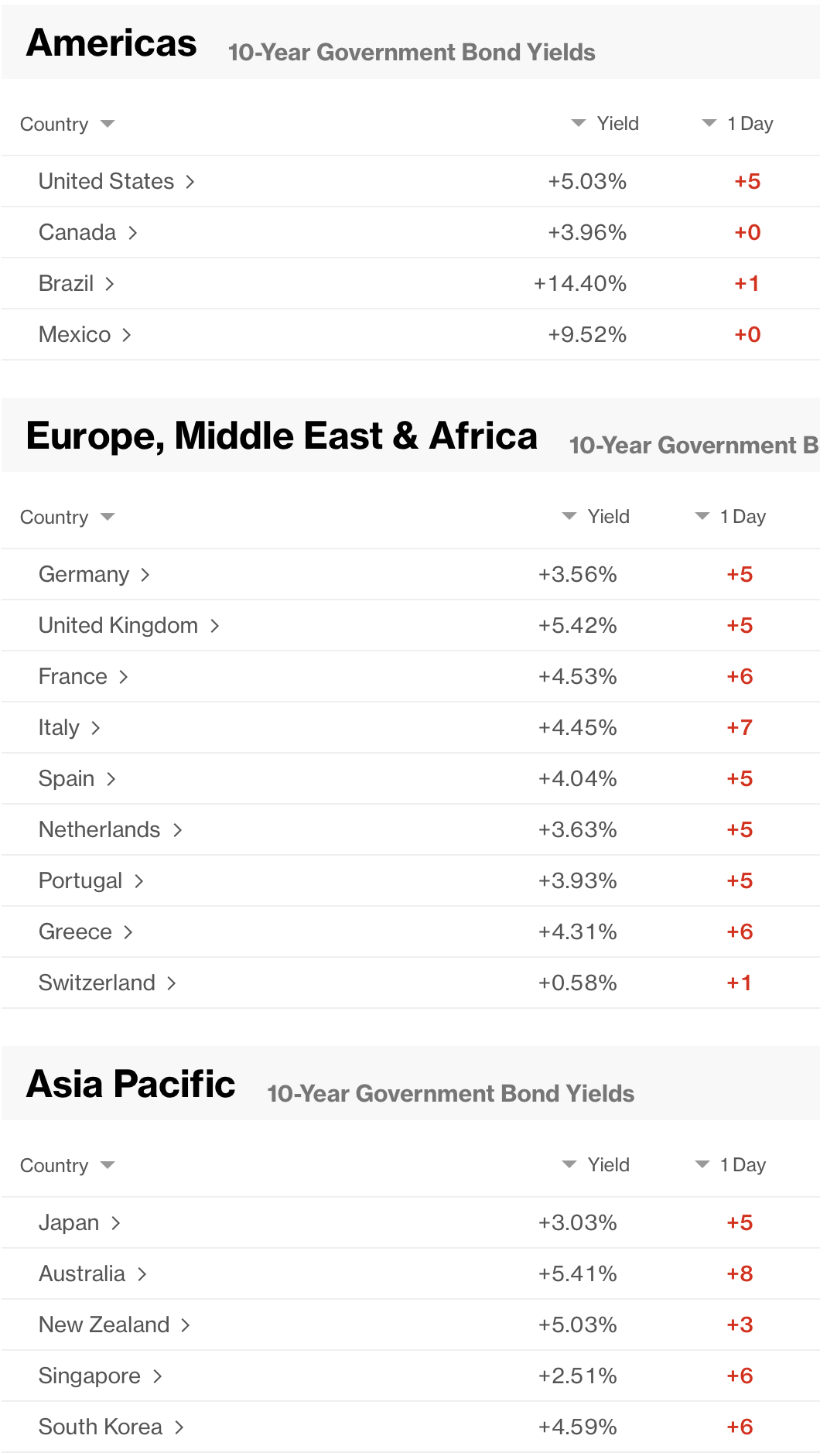
As you can see, yields have jumped with most nations seeing them climb around 5bps or more.  (Canada, Brazil and Mexico are not yet open, hence the lack of movement). Prior to touching, and now breaking the 5.0% level, the punditry had spilled a great deal of ink regarding how devastating this was going to be for both risk assets and for the US economy.  On the first count, if we look at equity markets around the world this morning, they were correct, selling is the name of the game as you can see in the below screenshot from tradingeconomics.com
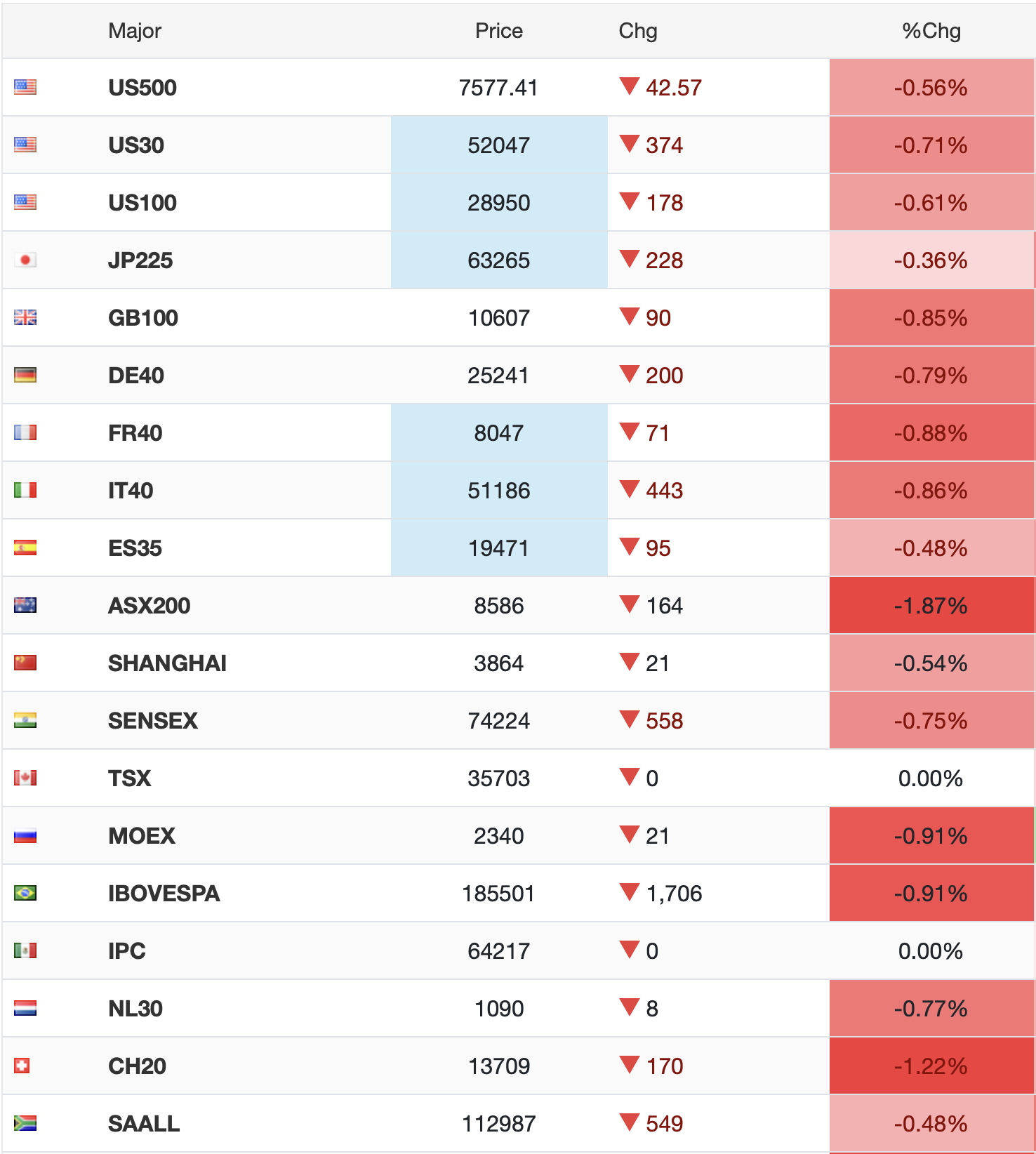
There are not many happy equity investors this morning, although energy shares are holding their own better than most other things.  (Again, Canada and Mexico are closed.)  But as to the second point, it remains to be seen how devastating 5.0% yields on the 10-year Treasury are going to be.  And of course, we still have the FOMC meeting starting today with the policy announcement and press conference coming out tomorrow afternoon. 

But here’s the thing to remember about the equity markets, even the NASDAQ, which has had the most discussion as the tech sector has been rerating lower, is only lower by 6.3% from its all-time high seen in early June.  While nobody ever likes to see their portfolios decline in value, prices remain dramatically higher over the past several years and all three major indices are still higher by 10% or more so far in 2026.  It is hard to call the below chart of the NASDAQ bearish!
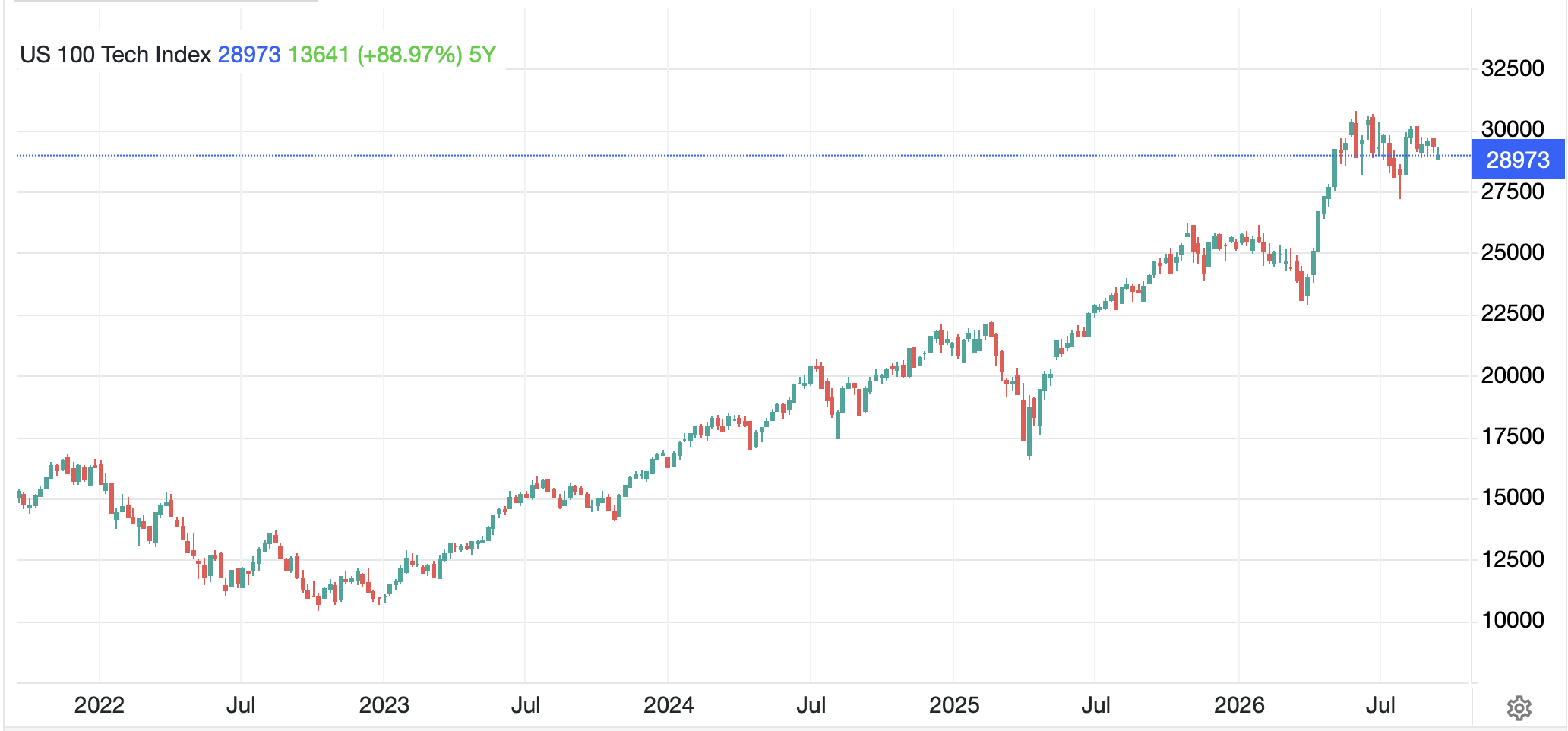
Source: tradingeconomics.com

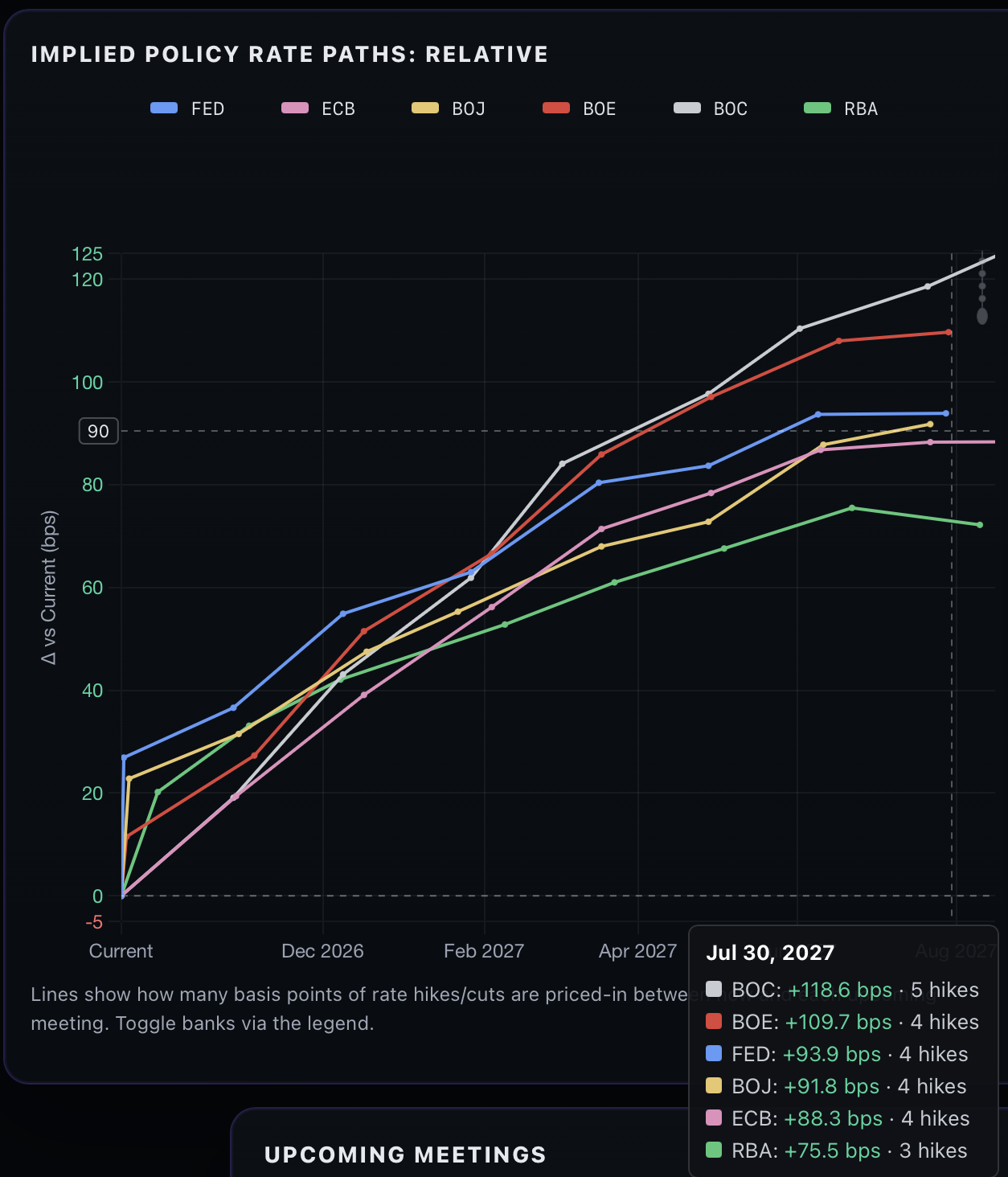
Which, I guess, takes us to the Fed and the ongoing discussion about what they will do.  Depending on where you look, the probability priced into markets for the Fed to hike rates tomorrow is 92% (CME futures) or 100% (rateprobability.com).  Looking at the latter’s most recent chart of the six major G10 central banks, market expectations are for interest rates to rise over the next year by at least 100bps across the board.  (Australia just hiked rates last week so that was their first 25bps).
Now, I often make the case that market pricing ought to be the key feature to watch when considering a situation, but I have to admit, when it comes to the Fed funds rate, there is a bit more to the story, namely the politics involved.  

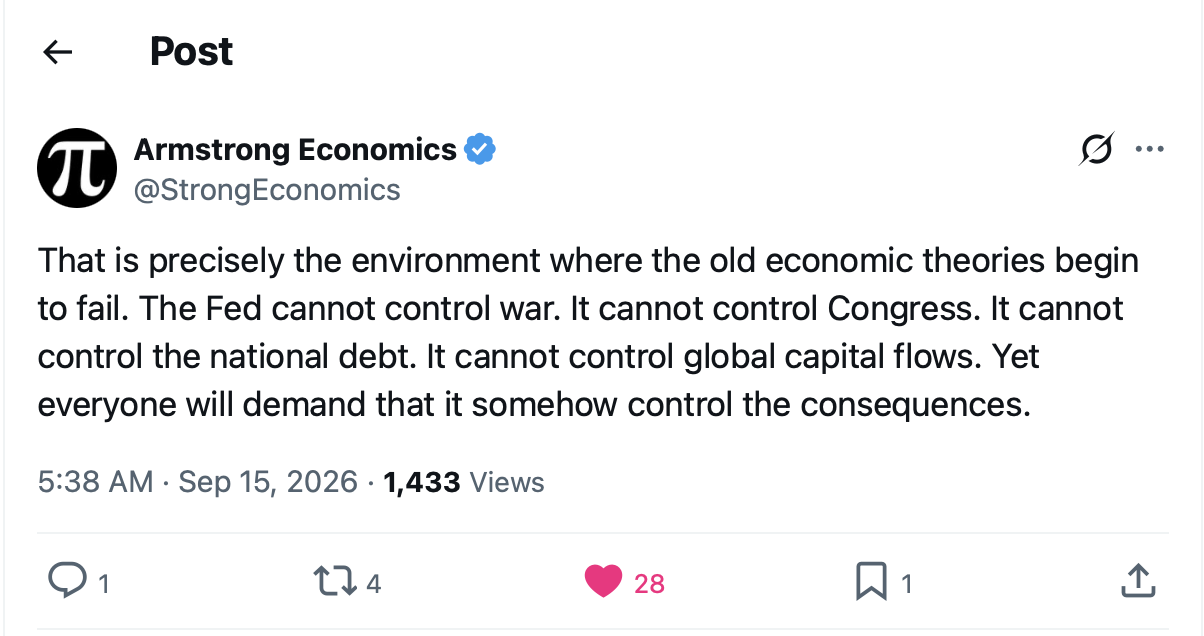
Let me start by repeating my view that I believe a rate hike would be a mistake.  While headline inflation is running above target, it remains largely an energy story, and we all understand that is outside the Fed’s control.  But if you dig deeper into the inflation statistics, things are not great, but not calamitous either.  It is ironic, if Congress were truly worried about inflation, they would cut spending to balance the budget at which point I am highly confident inflation would no longer be a concern.  Martin Armstrong (@StrongEconomics) made an excellent point this morning on X worth repeating here relative to the FOMC meeting.
As to Chairman Warsh, I think he still must be frustrated that the discussion revolves around what the FOMC is going to do but I presume he will take the information of higher yields in the back end into account regarding this decision.  Remember, too, it is not just his decision, 7 voters need to vote for a hike, and while we know there are three that believe it is proper, are there four more?  I guess we will find out tomorrow afternoon.

It’s interesting, even though oil and energy prices remain the key driver of market activity, they get remarkably little press compared to the stock and bond markets.  Sure, there are still stories about how the real energy crisis is about to come, and market pricing is certainly indicating more concern now than several months ago, but the price of Nvidia or Meta or the 10-year is the top story these days.  At any rate, oil (+1.25%) is higher this morning but has stalled just above $100/bbl for now.  Interestingly, NatGas (-0.6%) is softer and the same is true across Europe and the UK.  I find that quite interesting, especially in the latter places, as there is no indication that more supply is forthcoming.  And, not surprisingly, gold (-0.4%) and silver (-0.1%) are slightly softer with the ongoing rally in oil prices.

Finally, the dollar, which had a very strong session yesterday, is continuing to rally this morning.  it seems that even though interest rates are rising around the world, those higher rates only help the dollar.  Perhaps this is one reason that despite all the hate the dollar absorbs from a certain part of the financial community, it remains the haven of choice.  Open capital markets are worth an awful lot to international investors, and none are more open than those in the US.

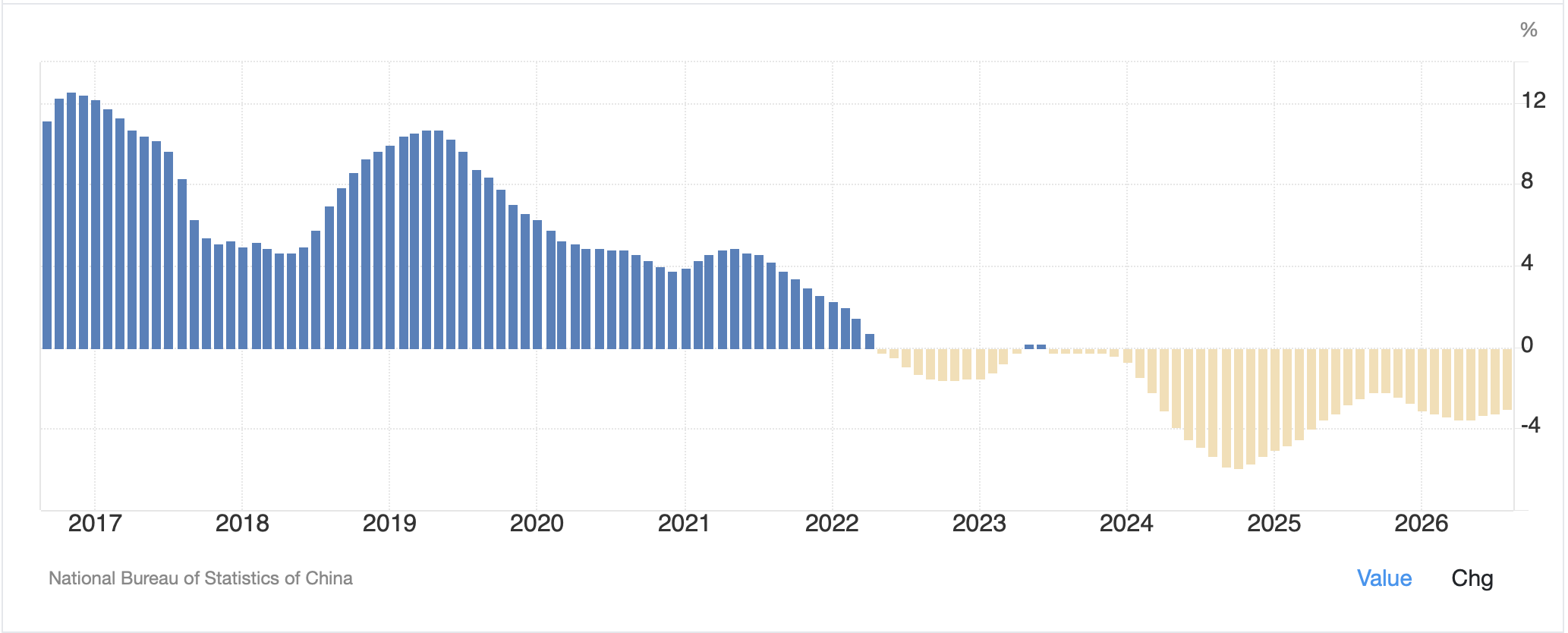
Perhaps this is a good time to discuss China, a land of closed capital markets,  and what is happening there.  Last night they released some of their key economic statistics and, the idea that domestic demand is being supported is a joke.  

Source: tradingeconomics.com

It is very difficult to look at these numbers and think things are going gangbusters there.  For instance, the housing market, which has been a key destination for private savings has been declining for five years and has been negative for more than four.
Source: tradingeconomics.com

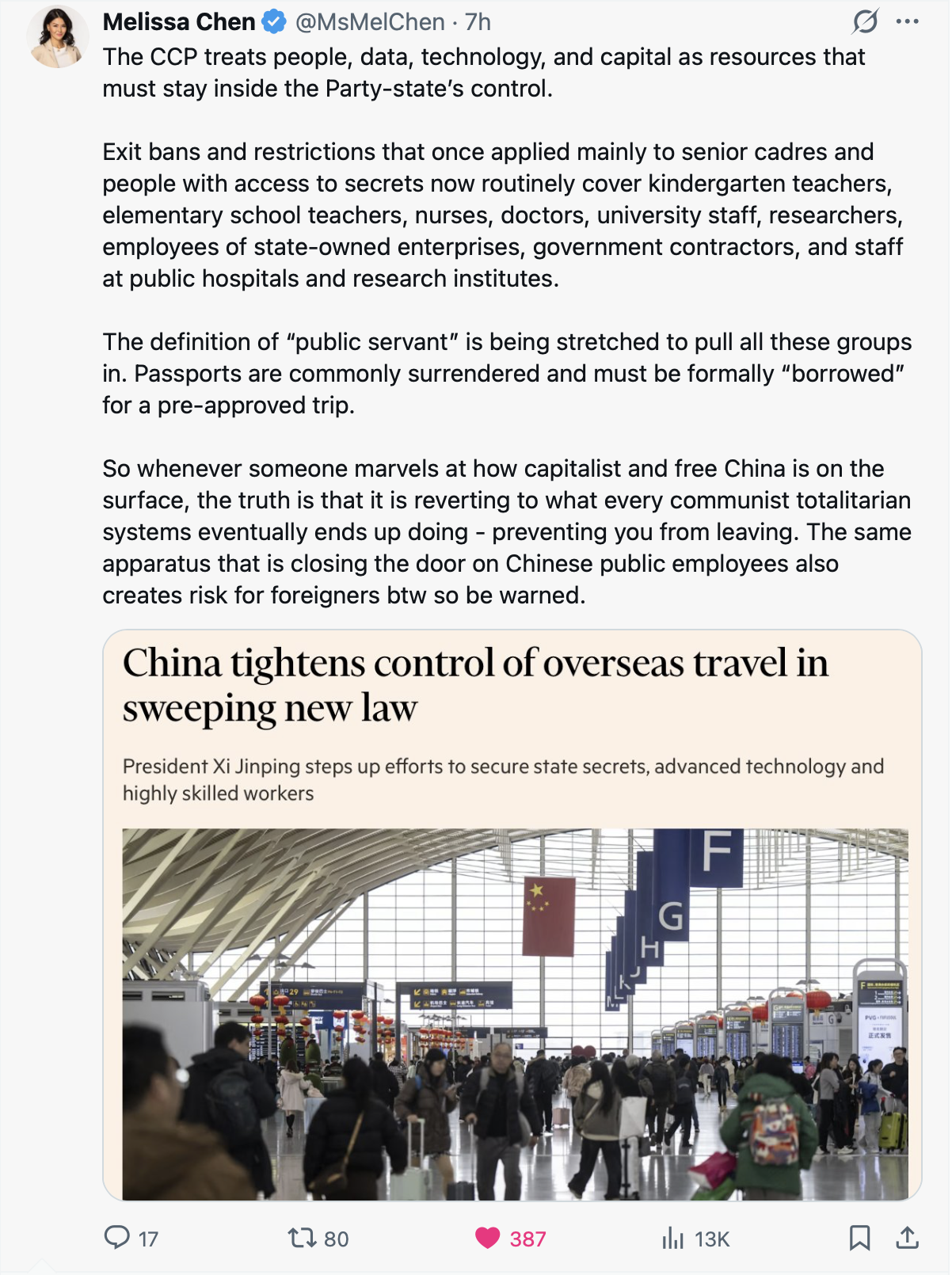
But more tellingly to me was the new regulations that were imposed starting today regarding the ability of people in China to simply leave the country on holiday.  The below tweet from journalist Melissa Chen from The Spectator is a telling sign that there is growing stress in that nation.
Again, my point is that as many problems as exist in the US, and we have plenty, it is not as though other nations are killing it.  Rather, they, too, are being killed.  Now, has this impacted the CNY?  Not at all.  It is a completely controlled currency and the PBOC is slowly driving it higher although it remains massively undervalued.  As to the rest of the FX market, the dollar is stronger by somewhere between 0.1% and 0.3% nearly across the board with only KRW (-0.9%) outside that window, but remember, the won has been flying over the past two months, so a little pullback is no surprise.

On the data front, this morning brings Empire State Manufacturing (exp 14.75) and that’s it.  It is also worth mentioning that the German ZEW Sentiment Index was released at a weaker than expected 34.7, just showing that there is a bit of despair all around the world.

I have a feeling today is going to be relatively quiet as all eyes look to the Marriner Eccles Building and Chairman Warsh tomorrow afternoon.

Good luck

Adf
Sanae Lightning

It has been two weeks
Since she rolled the dice. Sunday
It came up hard eight!
 
Leaders round the world
Would sell their soul to obtain
The Sanae lightning

Source: asia.nikkei.com

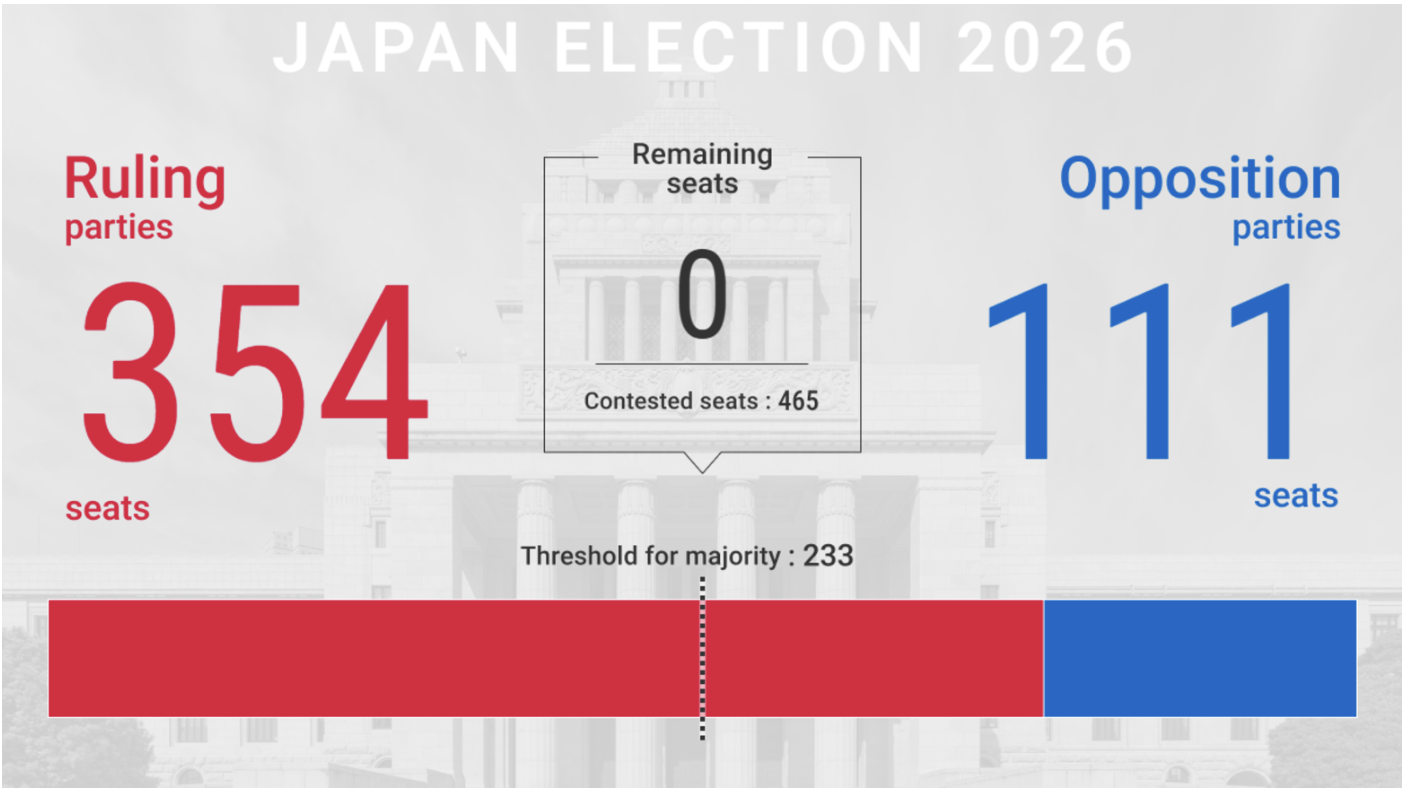
Japanese PM Takaichi scored a resounding victory yesterday, capturing more than 76% of the seats with her coalition partners, and she now commands a super-majority, enabling her to control the dialog completely, pass any legislation and even change the constitution.  As I said, every other elected leader in the world pines for that type of power and approval, even Xi!  

The immediate market response was a 5.0% rally in the Nikkei as expectations for an aggressive fiscal policy expansion to the economy gets priced in.  Add to this more defense spending and the mooted tax cuts on food, and it is easy to understand the response.  

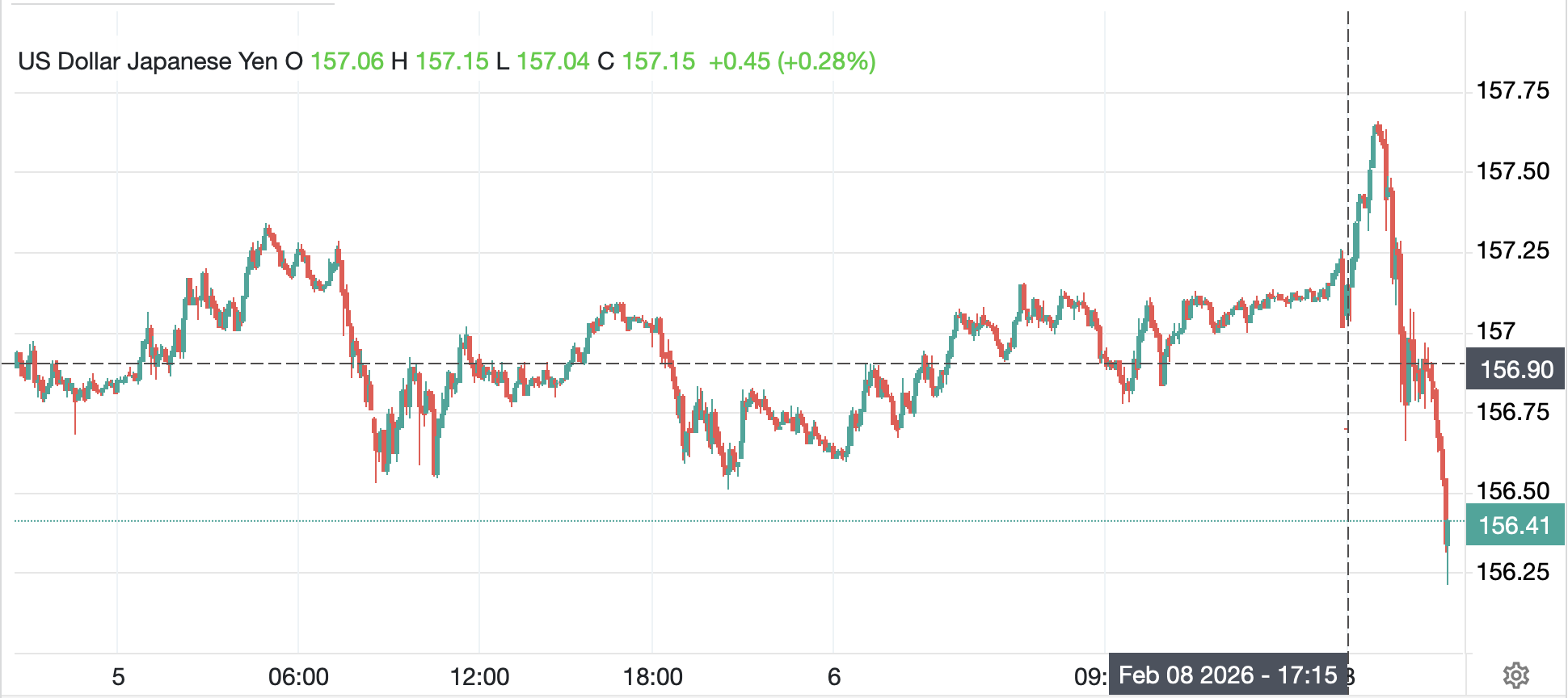
Interestingly, the yen, which had been under pressure from fears of unfunded spending, after declining at first, reversed course and strengthened nearly 1% from its worst levels early in the Tokyo session as per the below chart.  It certainly seems logical that yen weakness would be coming on this basis, but perhaps, what we are going to see is the Japanese use some of their FX reserves, which total about $1.3 trillion, to help fund the ¥5 trillion (~$32 billion) that the tax cuts will cost.  That would mean selling Treasuries to sell USD and buy JPY, helping to support the yen while allowing the BOJ to leave rates on hold.  In truth, it makes a lot of sense.  We shall have to see how things progress from here.

Source: tradingeconomics.com

Some pundits, when looking ahead
Are worried that Warsh at the Fed
With Bessent, will try,
To Treasury, tie
Their efforts, some assets to shed

The other big story this morning is a growing concern about a potential accord between the Fed and the Treasury once Kevin Warsh is confirmed and takes his seat as Fed chair.  Bloomberg has a big article on the subject, but it is around all over.  When combined with another article on China recommending its banks to reduce their Treasury holdings, it has helped create a narrative that the US is going to have major fiscal problems going forward which will result in massive money printing and much higher inflation.

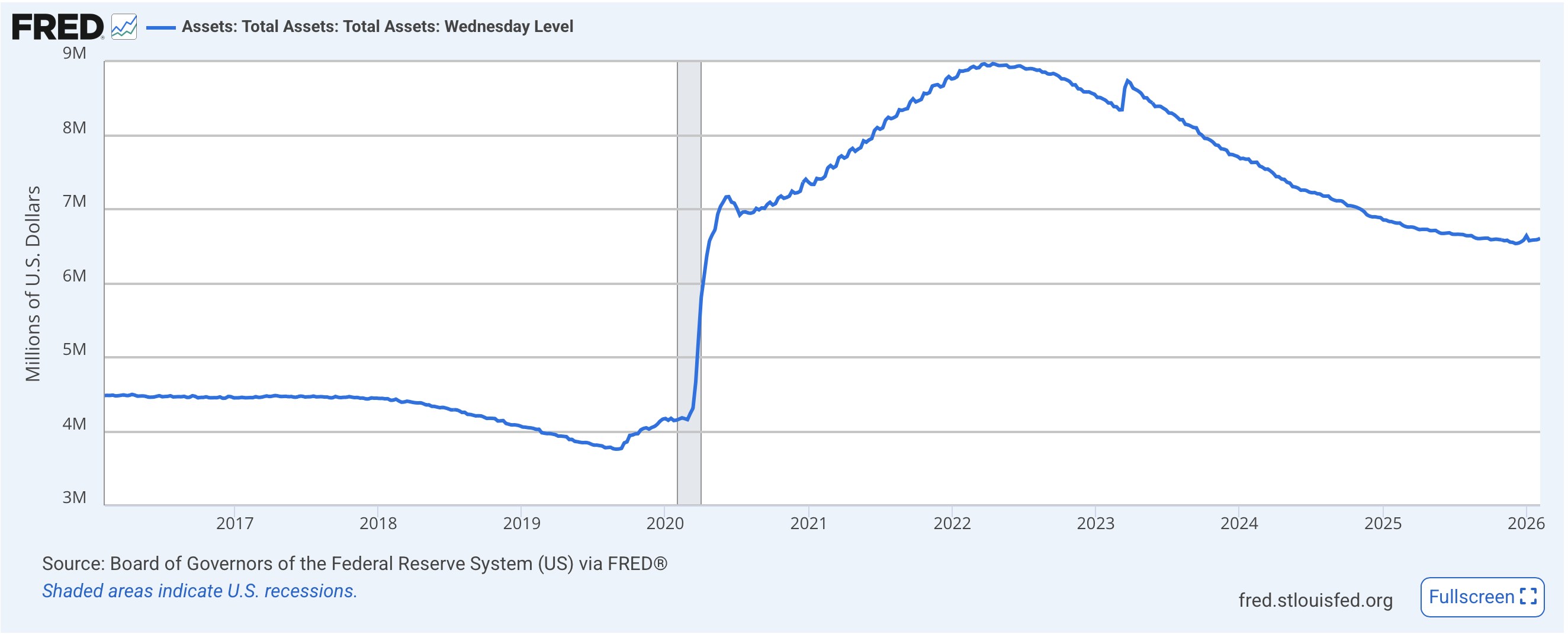
Of course, the thing about this that I don’t understand is that Warsh is on record, repeatedly, for saying he wants the Fed’s balance sheet to shrink, and that its expansion has been one of the major economic issues in the US since QE2 back in 2012.  I also find it interesting that Warsh’s apparent desire to see the Fed’s balance sheet hold almost exclusively short-dated Treasuries, 3-years and under, is seen as a concern given that has been the Fed’s stated goal since they started shrinking the balance sheet back in April 2022.

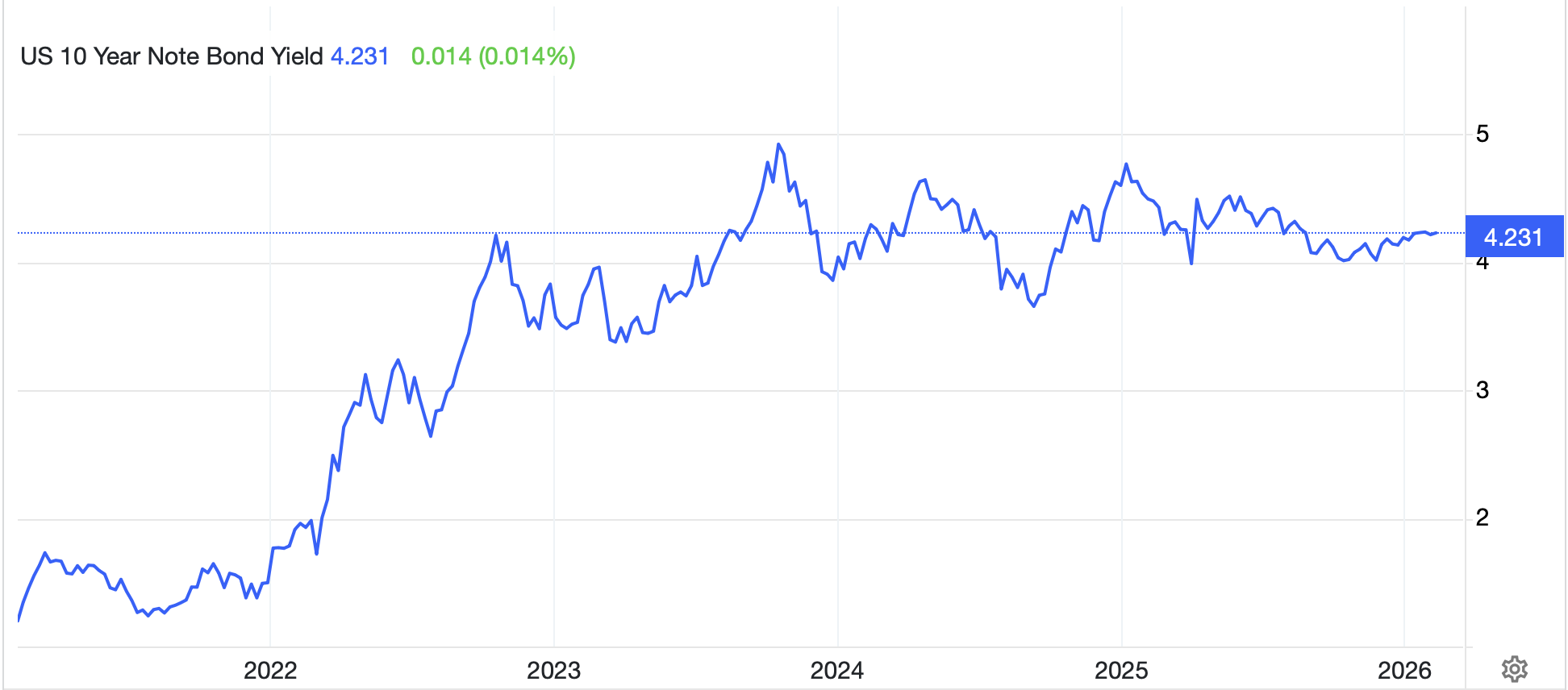
Recall, Chairman Powell explained that in order to maintain the ample reserves framework they are currently using, the balance sheet needs to grow alongside the economy.  However, this is completely at odds with Warsh’s stated beliefs that the ample reserves framework is no longer effective and needs to be replaced eventually.  Of course, if I look at 10-year Treasury yields (+2bps today) over the past 5 years, as per the below chart, it is hard to get overly excited that things have changed much since the end of the Covid adjustments.  

Source: tradingeconomics.com

Perhaps Chinese selling will drive yields higher, or perhaps others will sell because they are concerned that the Fed and Treasury working together is inherently bad for the economy and will lead to higher inflation but so far, that is not the case.  As to inflation, while CPI and PCE remain higher than the Fed’s target, it does not appear to be galloping away at this stage.  In fact, there is much discussion on X that Truflation is now running at 0.68% and that the Fed will soon need to cut rates aggressively!  Of course, if inflation is running at 0.68%, can someone please explain the ‘affordability’ crisis that has gotten so much press?  PS, I don’t see Truflation as being an accurate representation of the world, but it sure is good for narrative writers sometimes!

And that is how we have started the week.  The Super Bowl was pretty dull overall, with defensive excellence, but nothing spectacular.  Someone made the point that this was the AI Super Bowl for advertising and the last two times we saw something dominate the advertising (dot.com in 2000 and crypto in 2022), within a year, both sectors had been decimated in the equity markets.  In the meantime, a quick tour of the overnight session shows the following:

Stocks – Asia was strong across the board with Japan (+3.9%) giving back some of the early gains but still rocketing to new highs.  The rest of the region was similarly strong, especially Korea (+4.1%) but gains of between 1.5% and 2.0% were the norm.  I guess everybody is positive on Takaichi-san!  Europe, however, has not been as robust although there are mostly gains there led by Spain (+0.6%) and Germany (+0.3%).  The laggard here is the UK (-0.1%) which is struggling as PM Starmer appears to be coming to the end of his disastrous term.  His appointment of Ambassador to the US looks to be the final straw as Peter Mandelson is widely mentioned in the Epstein files and now Starmer has lost his chief of staff because of that.  The UK will be better off, I believe, if Starmer is pushed out, although if they put in Ed Miliband, it could actually get worse given his personal insanity regarding energy.  But I would buy a Starmer removal.  As to US futures, at this hour (7:20), they are modestly lower, -0.15% or so.

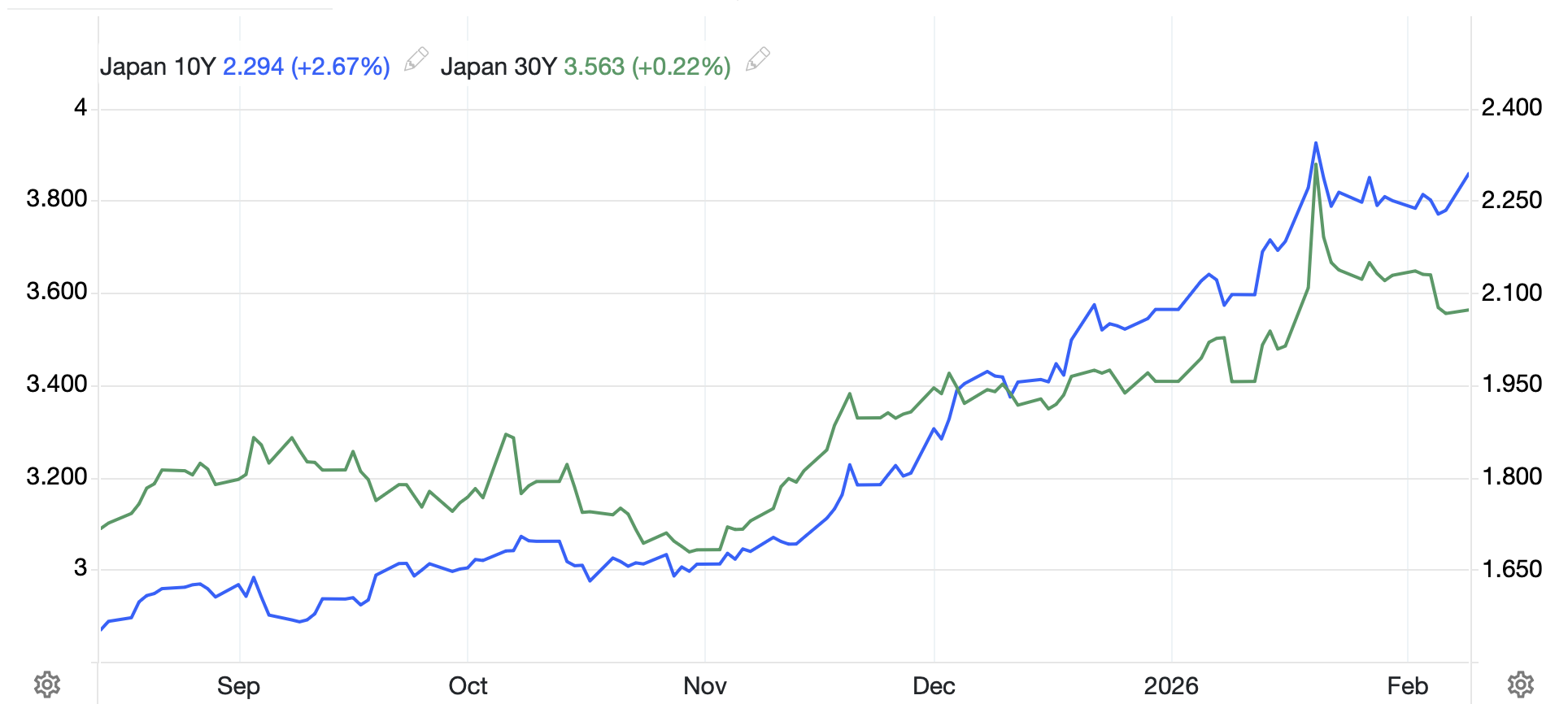
Bonds – European sovereign yields are edging higher this morning, around 1bp across the board as there has been no data to change opinions and the bond markets, worldwide (Japan excepted) remain the dullest of places to play.  Japan (+6bps) did see a response to the Takaichi victory, which is what one would have expected.  We will have to watch this yield closely as if it truly does start to break out, there will be ramifications worldwide.  However, if we look at the chart below of 10-year and 30-year JGBs, they remain below the peak seen several weeks ago and, surprisingly, the overnight move was more pronounced in the 10-year than the 30-year.  Watch this space.

Source: tradingeconomics.com

Commodities – oil (+0.3%) has been chopping around either side of unchanged all evening as questions about Iran remain unanswered.  There was a story in the WSJ about the US holding back on any military action because Iran has so many medium range ballistic missiles and any reprisal could be devastating to the Middle East overall.  But if I have learned anything from observing President Trump and his negotiating style, it is impossible to know what the next move will be.  I would not rule out either a successful deal or a military strike at this point, with the former resulting in lower oil prices while the latter would see a sharp rally.  In the metals, gold (+0.9%) and silver (+2.7%) are both continuing their volatile rebound from last week’s sharp selloff, while copper is unchanged this morning.  As I have said, nothing has changed this supply demand balance in physical metals, although the paper, futures market, can still do many remarkable things that don’t necessarily make sense.

FX – the dollar is softer across the board this morning, slipping against both G10 (EUR +0.5%, GBP +0.3%, JPY +0.4%, CHF +0.7%) and EMG (MXN and BRL +0.25%, PLN +0.65%, ZAR +0.25%, CNY +0.15%) with little in the way of data as a driver anywhere.  While I have not specifically seen a reboot of the dollar is collapsing narrative, I presume the concerns over a potential Fed-Treasury accord are an underlying thesis today.

On the data front, we see both NFP and CPI this week as they come a few days late due to the short government shutdown.

TuesdayNFIB Small Biz Optimism99.9
 Retail Sales0.4%
 -ex autos0.3%
 Employment Cost Index0.8%
WednesdayNonfarm Payrolls70K
 Private Payrolls70K
 Manufacturing Payrolls-5K
 Unemployment Rate4.4%
 Average Hourly Earnings0.3% (3.6% Y/Y)
 Average Weekly Hours34.2
 Participation Rate62.3%
ThursdayInitial Claims218K
 Continuing Claims1850K
 Existing Home Sales4.15M
FridayCPI0.3% (2.5% Y/Y)
 Ex food & energy0.3% (2.5% Y/Y)

Source: tradingeconomics.com

In addition, we hear from seven more Fed speakers, with Governor Miran making three appearances as he seeks to make his case for cutting rates.

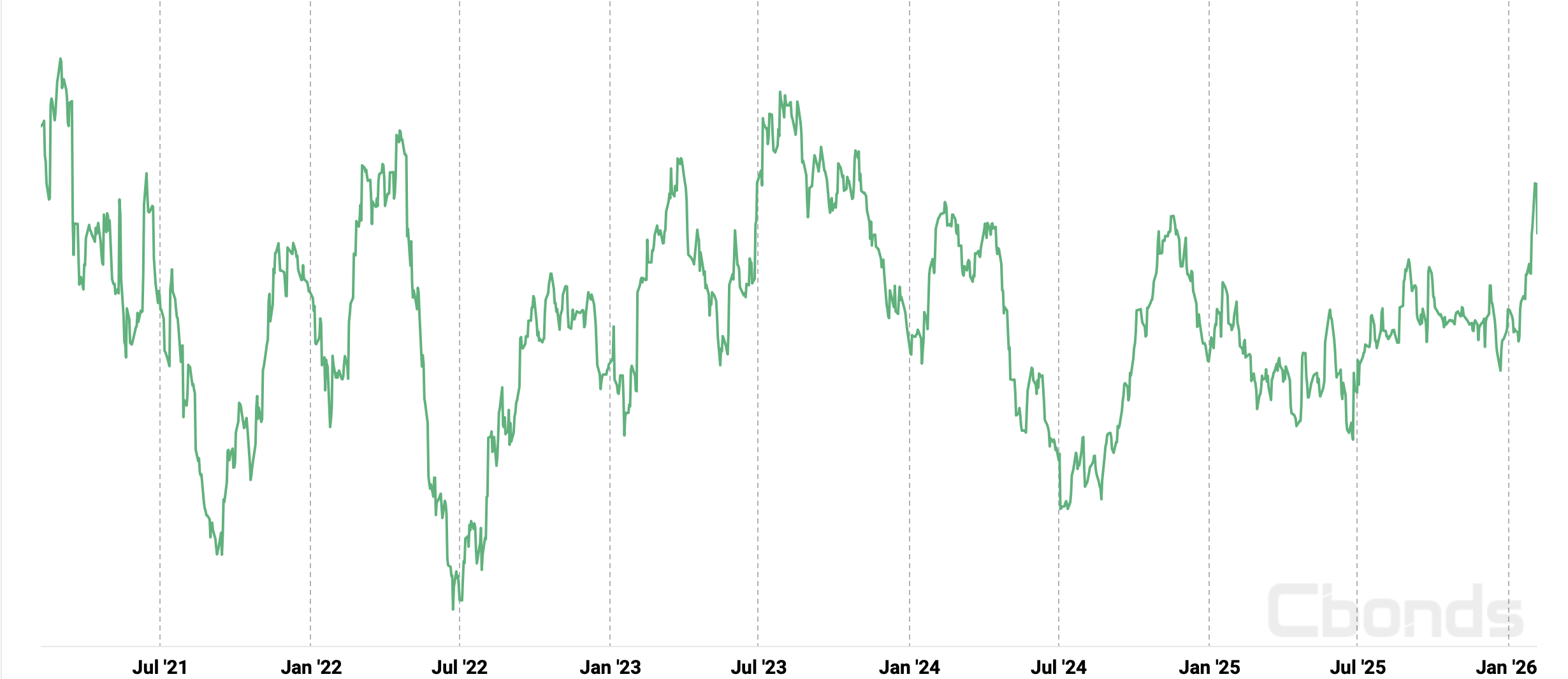
Nothing has changed my view that Warsh and Bessent are the two most important voices now, with the rest of the Fed relegated to biding their time until Warsh shows up.  As to the data, the Citi surprise index continues to show that data is better than most forecasts which speaks well of the economic situation.

Source: cbonds.com

I am not a proponent of the world ending, the Treasury market collapsing or the dollar dying despite a lot of doom porn that this is the near future.  I would contend the dollar remains rangebound for now, and we need a definitive policy adjustment to see that situation change.  Until then…choppy is the way.

Good luck

Adf

Tempt the Fates

For everyone, here’s a hot flash
The Treasury’s bagful of cash
May soon start to shrink
And analysts think
That could lead to quite the backlash

The Fed might be forced to raise rates
A prospect that could tempt the fates
How might stocks respond
If the 10-year bond
Sees yields rise as growth now reflates?

You cannot scan the financial headlines these days without seeing a story about either, the extraordinarily low interest rates that non-investment grade credits are paying for money (the average junk bond yield is now below 4.0%, a record low) or about the remarkable bullishness exhibited by investors regarding the future of the stock market given the ongoing reflation story and expected future growth once the pandemic subsides.  In other words, risk is on baby!

But is it really that simple?  There are those, present company included, who believe that the current situation is untenable, and that the future (for markets anyway) may not be as rosy as currently believed.

Consider the following: last summer, as Treasury bond yields were making new all-time lows, we saw a spectacular amount of investment in the stock market, with a particular concentration in companies that were deemed to be beneficiaries of the lockdowns and evolution toward working from home.  These (mostly) tech names have carried the broad indices to record after record and, quite frankly, don’t seem to be slowing down.  Essentially, it could be argued that the tech mega-cap stocks were acting as a substitute for Treasuries, and that the relationship between the stock and bond markets had evolved.  After all, if interest rates were going to remain permanently low, courtesy of the central banks, then it was far better to seek yield in the stock market.  and the situation was that the yield from the S&P 500, at 1.57%, was substantially higher than the yield on 10-year Treasuries, which traded between 0.6%-0.85% for months.  One could define this ‘equity risk premium’ as ~0.80%, give or take, and when combined with the growth prospects it was deemed more than sufficient.

But that was then.  Lately, as the reflation story has really started to pick up, we have seen the Treasury steepener trade come to the fore.  The spread between 2y and 10y Treasuries has risen to 1.13%, its highest level since early 2017 and up from the ~0.50% level seen last summer.  Not only that, but the strong consensus view is that there is further room for 10-yr and longer yields to rise.  After all, expectations are that the Treasury will be issuing another $1.9 trillion of bonds to pay for the mooted stimulus package, and all that supply will simply add pressure to the bond market, driving yields higher.

However, if the bond market story is correct, what does that say about the future of the equity market?  From a positioning perspective, it can be argued that being long the stock market, especially the NASDAQ, is akin to being short a put on the Treasury market (h/t Julian Brigden for the analogy).  In other words, if the premium required to own stocks over bonds is 0.8% of yield, and if the 10-year yield continues to rise to 1.50% (it is higher by 4 more basis points this morning), that means the dividend yield on stocks needs to rise to 2.3% to restore the relationship.  Doing the math shows that stock prices would need to decline by…33% to drive yields that much higher!  I’m pretty sure, that is not in the reflation story playbook, but then I’m just an FX salesman.

Which brings us back to the Treasury and the Fed.  The Treasury, during the pandemic, has maintained an extraordinarily high level of cash balances at the Fed, roughly $1.6 trillion, far above its more normal $500-$600 billion.  It seems that Secretary Yellen is looking to draw down those balances (arguably to spend money), which means that the likely market response will be much lower front-end yields, with the possibility of negative rates in the T-bill market quite realistic.  This outcome is something which the Fed would deeply like to avoid, and so they may find themselves in a situation where they need to raise IOER and the reverse repo rates in order to encourage banks to maintain the cash as reserves, like they currently are, instead of having them flow to the T-Bill market driving rates lower.  But how will the markets respond if the Fed raises rates, even if it is IOER and even though it will surely be described as a technical adjustment?  It could be completely benign.  But given that this is truly ‘inside baseball’ with respect to the markets functioning, it could also easily be misinterpreted as the Fed starting to remove liquidity from the markets.  And that, my friends, would not be taken lightly.

Summing all this up leaves us with the following: Treasury yields continue to rise on the reflation trade and pressure is coming to the front end of the curve which could result in the Fed acting to make technical adjustments to raise rates there.  The combination of these two events could easily result in a repricing of equity markets of some substance.  It would also result in a tightening of financial conditions, something the Fed is very keen to prevent, which means the story would not end here.

And how would this impact the dollar?  Well, the combination of higher rates and risk reduction would likely see a strong, initial bid in the buck.  But this is where the idea of the Fed capping yields comes into play.  A reflating (inflating) economy with rising yields will be quite problematic for the US government and with the justification of tighter financial conditions, the Fed will smoothly pivot to extending QE tenors if not outright YCC.  And that will halt the dollar’s rise, although not inflation’s, and the much-vaunted dollar weakness is likely to be a result.  But as I have said consistently, that is a H2 event for this year.

So, has that impacted markets negatively today?  Not even close.  Risk remains in favor as we saw the Nikkei (+1.3%) and Hang Seng (+1.9%) both rise sharply.  Shanghai remains closed until Thursday.  Europe, however, has been a bit more circumspect with very modest equity gains there (CAC +0.1%, DAX 0.0%, FTSE 100 +0.15%) although US futures are higher by roughly 0.5% across the board.

Bond markets are continuing to sell off, even after yesterday’s sharp declines.  Treasuries, this morning, are higher by 5bps now, while bunds (+2.1bps), OATs (+2.5bps) and Gilts (+3.7bps) are following yesterday’s moves further.  In fact, bund yields are now pushing toward their post-pandemic highs.

On the commodity front, oil continues to perform well, although WTI is benefitting from the ongoing problems in the Midwest where production is being shut in because of the bitter cold and ice thus reducing supply further.  Meanwhile, base metals are modestly higher, but precious metals are unchanged.

Finally, the dollar remains under pressure and for those who thought that the correction had further to run, it is becoming clear that this gradual depreciation is back.  Of course, with risk in demand, the dollar typically suffers.  In the G10, NZD (+0.5%) is the leading gainer although the entire bloc of European currencies is higher by about 0.3%.  The kiwi story seems to be expectations for eased pandemic restrictions to enable further growth, and hence reflation.  But given the dollar’s broad-based weakness, I don’t ascribe too much to any particular story here.

In the EMG bloc, there are more winners than losers, but the gains are not that substantial.  TRY (+0.6%) continues to benefit from the tighter monetary stance of the new central bank governor, while CLP (+0.6%) seems to be the beneficiary of higher copper prices.  On the downside, PHP (-0.6%) is the laggard, falling after both a sharp rise yesterday and news that foreign remittances and foreign reserves both declined in January.  But the rest of the movement here is much smaller in either direction and the main story remains broad dollar weakness

On the data front, this morning we saw that the German ZEW Expectations Survey was much better than expected despite the ongoing lockdowns across the continent.  Here, at home, we get Empire Manufacturing (exp 6.0), which seems unlikely to move things, but then we hear from three Fed speakers, ranging from the erstwhile hawkish Esther George to the unrequited dove Mary Daly.  But any change of message would be shocking.

And that’s it for the day.  With risk continuing to be embraced, the dollar is likely to remain under pressure.

Good luck and stay safe
Adf