Now, some have suggested the gov
Is showing the stock market love
Supporting the bulls
With deep pocketfuls
Of cash, lest the bears, too hard, shove

But who in the market will chance
Their own cash, if asked to advance?
The Fed’s not permitted
So who benefitted
From rallies?  At least at first glance

Which brings us to ‘flation today
And whether more views it can sway
A hot print may thrust
Funds up, when discussed
Next month as the politics fray
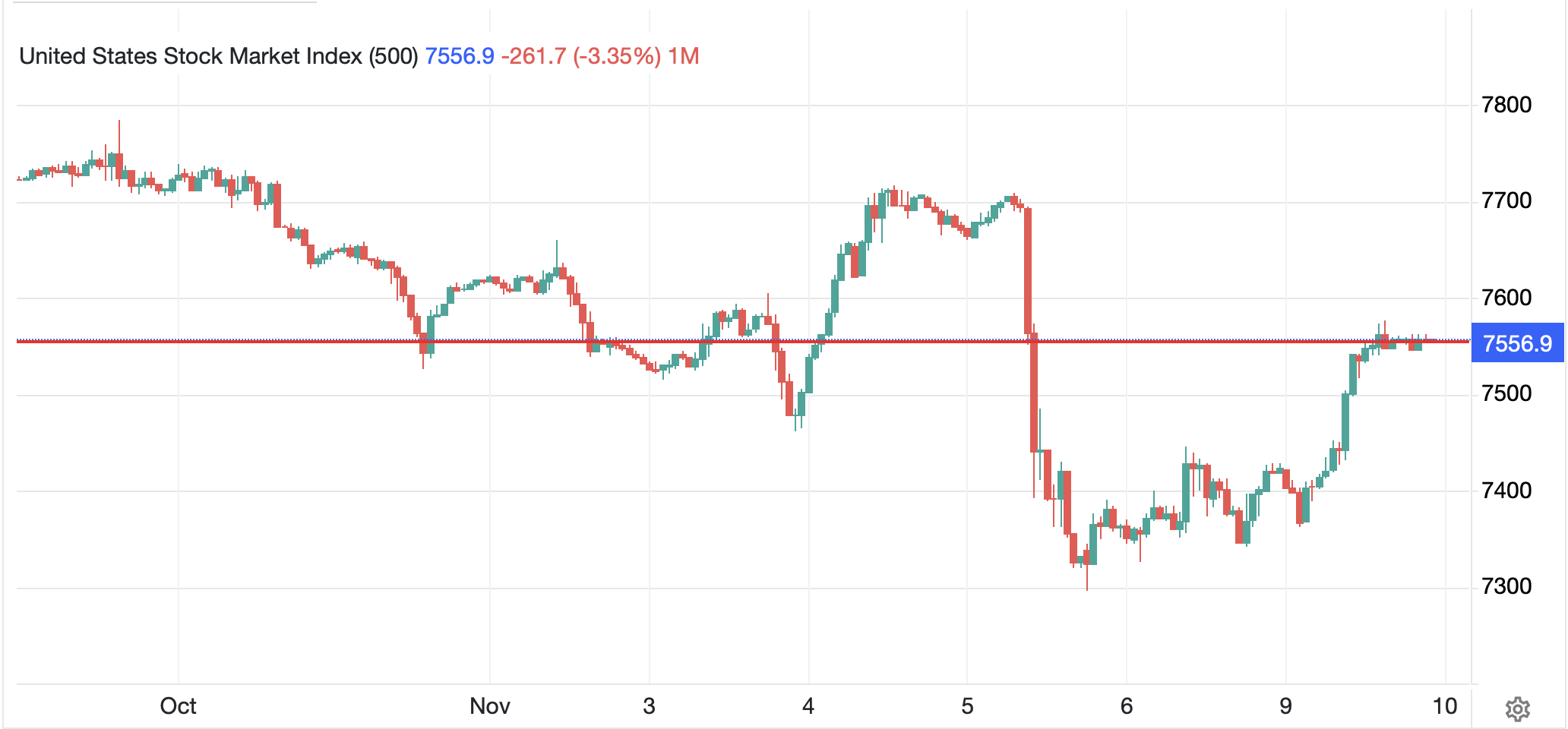
Starting with the stock market’s movement over the past several sessions, wow is all I can say. There have clearly been some changes in opinions, at the very least, as evidenced by the massive rally, then decline, then rally again. The horizontal red line on the chart is the closing level of the S&P 500 on November 2, the day before the election, at 7555. With all the gyrations of the post=-election hysteria, the market is in exactly the same place after last night’s close.
Source: tradingeconomics.com
Certainly, the immediate post-election rally made no sense to me, but the word is that the sharp sell-off the next day was led by deleveraging of ETF positions and some forced closures of smaller hedge funds. I have no insight into that, but it is certainly possible. But it has been hinted by some that both the Wednesday rally, as well as Friday’s and yesterday’s are part of a concerted government campaign to support the stock market. The thing about this story is I cannot comprehend the mechanism. Who is buying? Arguably, the Democratic victors would want to show the market approves of them, but they have no government tools to do so, and we know the Fed is not legally allowed to touch equities. I’m confident Secretary Bessent wouldn’t be part of that either. Did they get Soros and Gates to pony up on their own? Those two won’t spend 2 nickels of their own money for anything. China has an organized process, their national team, where insurance companies and banks are told to buy, and they do. That seems hard to believe here. I need proof to change my mind on this one.
So, what was the driver? Well, the one thing we know is that sometimes markets can be quite volatile, especially when they really don’t know what is coming up. The reading of Articles of Impeachment against Secretary of War Hegseth cannot help as it indicates things could get messy very quickly, well before the Democratic majorities are sworn in, and damage can be done with the current lame-duck session already destroyed. But that would be a distinct negative for stocks, so the rebound makes no sense. There are pieces to this puzzle that are very well hidden, I believe, so be careful.
But ask yourself who really benefits from this rally. What was a big issue in a number of races? Personal profits made by members of Congress. It is not hard to believe that they would impose as much pressure as possible on any players capable of buying to push things higher for their personal benefit. I don’t know how they can do it, but that doesn’t mean they can’t although I still need proof. Keep in mind though, sometimes stocks go up and other times they go down and it’s as simple as that.
The other story today is, of course, the CPI release. It is important, though, to frame the discussion based on new information we have from Fed Governor Waller who explained this morning in London, “However, if inflation comes in substantially higher than I expect, more robust action by the FOMC may be called for.” Now, he didn’t say what he expected, so there is some wiggle room, but he also indicated that 50bps might be appropriate. That’s a far cry from voting for no change last month.
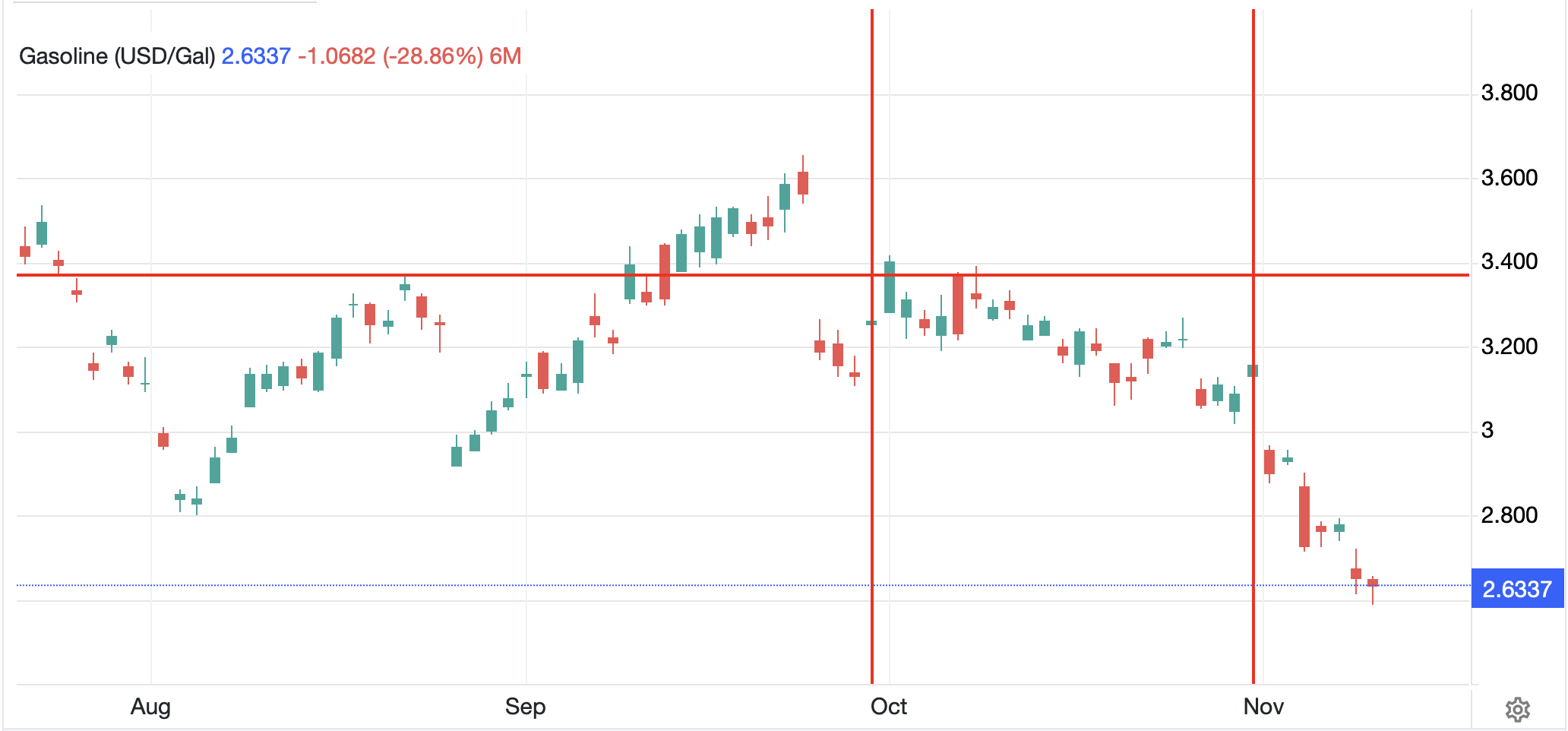
Forecasts for this morning are as follows: 0.3% headline and 0.2% core M/M with the Y/Y expectations missing because last year, you may remember, we were in the middle of the government shutdown and no data was printed. Of course, 0.3% still annualizes to ~3.7%, well above target. But this is all a story of the past. Arguably, the FOMC is supposed to address the future. So, what is one of the biggest drivers of CPI? Gasoline prices. If we look at the RBOB contract, the two red vertical lines represent the end of September and the end of October. In the interim, gasoline fell by 3.2% and as of this morning, has fallen substantially further on the latest word that President Trump indicated talks were going well and there is no need to escalate fighting in Iran.
Source: tradingeconomics.com
Oil prices (-1.0% today, -10.5% in the past week) are continuing to decline and that will surely have a positive impact on inflation, i.e. reducing price pressures. And I think this is exactly the point with respect to why the Fed, and basically every central bank, does things poorly. They respond to history that cannot be changed while ignoring what is happening at the current time (anybody remember transitory inflation?).
The fatal flaw in most current monetary policy is central banks seem to ignore money, ironically, with the virtually universal view amongst that set being Keynesian, or neo-Keynesian, which means they look entirely at the demand side. The other day I highlighted that M2 is growing quickly again and that is going to keep upward pressure on inflation regardless of the price of gasoline.
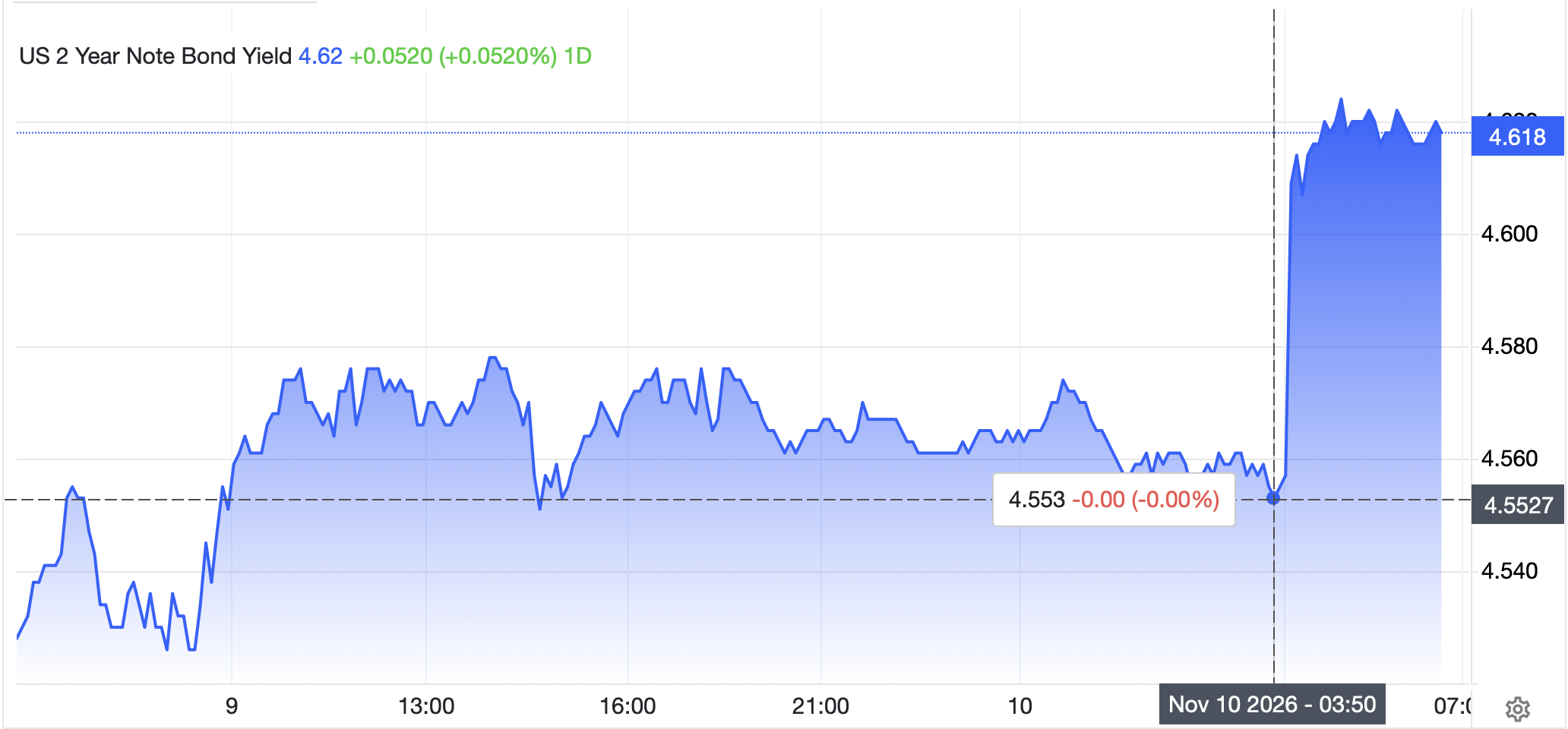
So, wrapping up, it appears that Governor Waller has highlighted today’s CPI print as THE critical piece of information in his next FOMC vote, the Fed funds futures market has moved back to a 99% probability of a hike in December after his comments and 2-year Treasury yields have jumped 6pbs on the Waller comments. See if you can determine what time he spoke this morning from the below chart. FYI, that was a 5-minute move.
Source: tradingeconomics.com
There is no shortage of moving pieces in the market right now and generating a coherent story as to the narrative has become difficult even for the narrative writers themselves. In the meantime, let’s tour the markets.
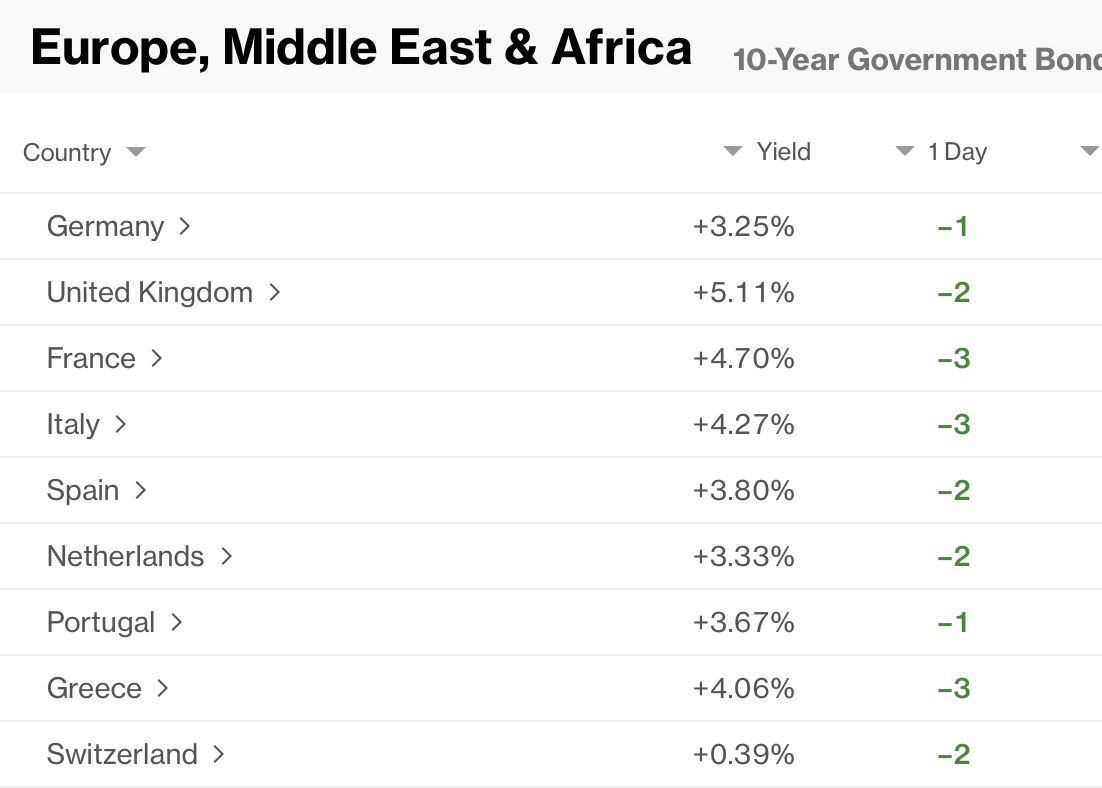
While 2-year yields jumped sharply on the Waller comments, 10-year yields are only higher by 1bp, and European sovereign yields are lower by between -1bp and -3bps across the board as per the below Bloomberg screenshot. These yields are more directly following the oil price, I believe.
Turning to equities, yesterday was a spectacular day with rallies almost everywhere in the world. Again, a (Bloomberg) picture is worth 1000 words here.
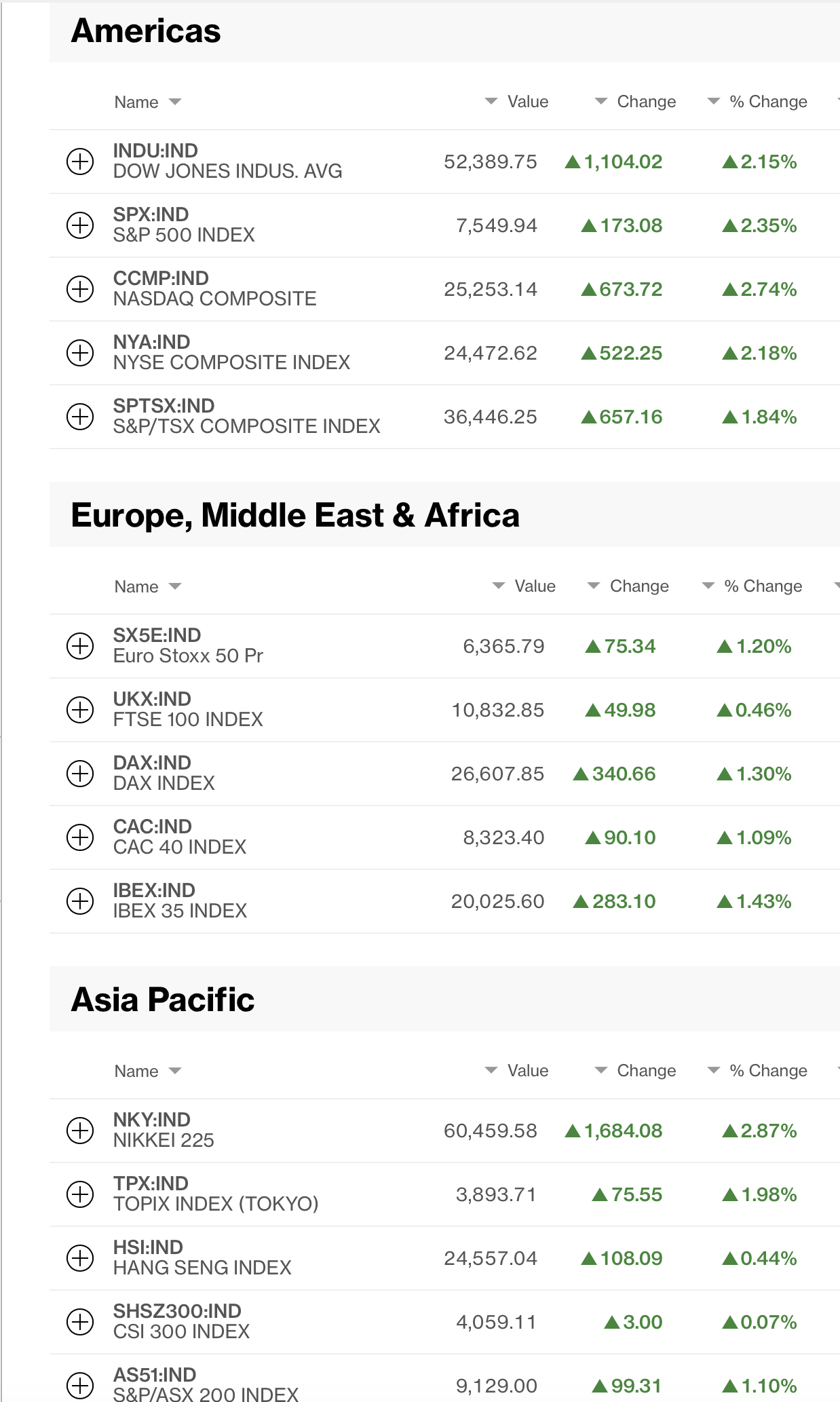
The regional Asian bourses didn’t disappoint either with Korea (+4.4%) and Taiwan (+2.5%) both up strongly on the rebound in tech and AI shares. However, as I type at 7:00, US futures are mixed with NASDAQ (-0.3%) slipping a bit although DJIA (+0.4%) are gaining a bit. All eyes are on the CPI number.
We’ve discussed oil already, but Governor Waller’s biggest impact may have been on gold (-1.6%) and silver (-2.0%) as both responded immediately to the call for higher US rates. Despite the Waller comments, though, we are still a long way from the next meeting, 29 days to be exact, and a lot can happen between now and then. Interestingly, the next CPI will be released the day after the FOMC meeting, but word is they get that info ahead of time, so perhaps they will know.
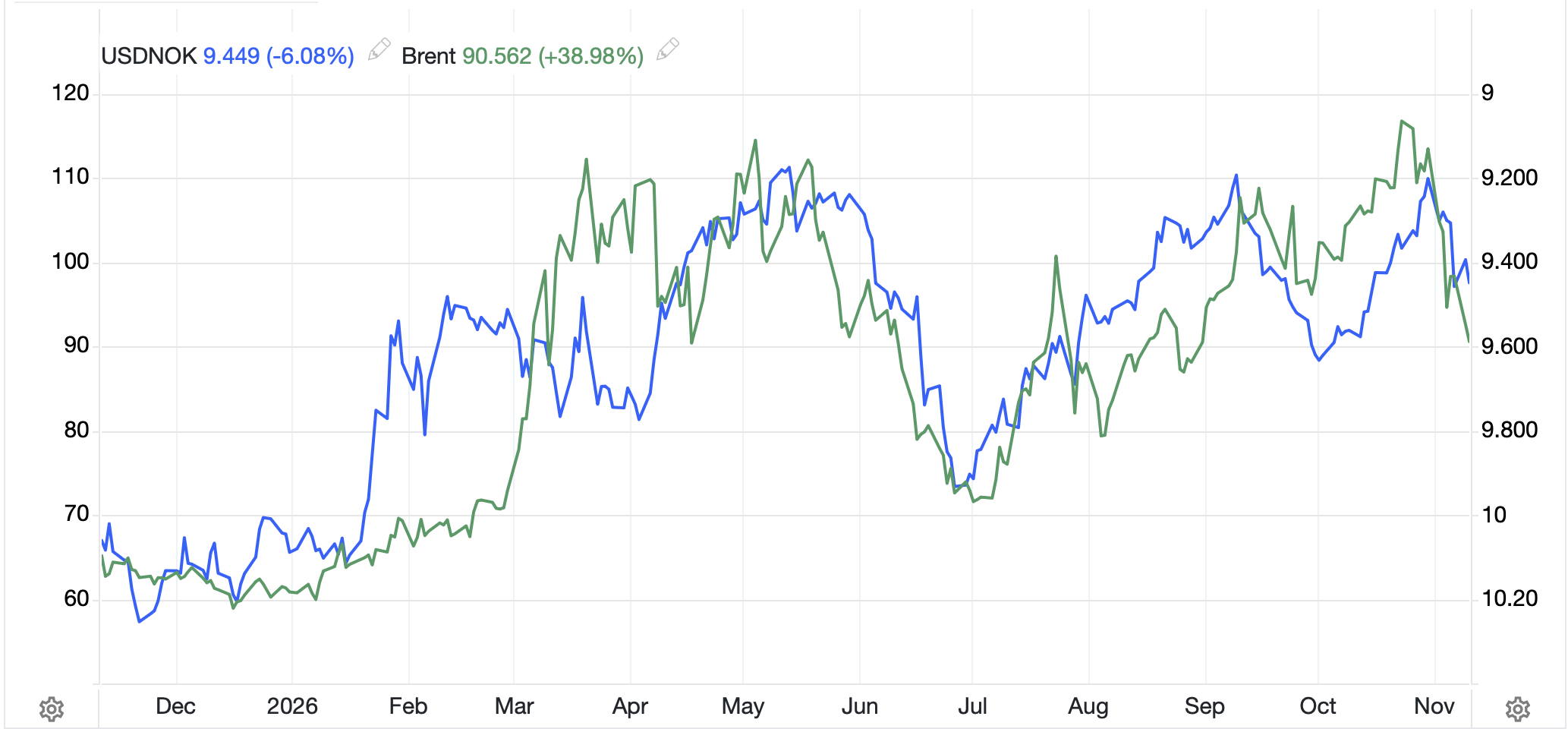
Finally, despite all the gyrations elsewhere, the dollar is still asleep this morning. Other than NOK (-0.5%) which is sliding on the oil price decline, the rest of the FX market is +/-0.25% or less relative to yesterday’s closing prices. Again, my view is that FX is decoupling, at least for now, from the broader market narrative. As an aside, the below chart of NOK vs Brent Crude offers proof of the petrocurrency status of the krone. It is so strong it is remarkable.
Source: tradingeconomics.com
And that’s really it for the day. We hear from a bunch more Fed speakers, Logan, Bowman, Schmid and Bowman again, and my take is there will be more hawkishness than dovishness, especially if this morning’s CPI is hot. The question becomes, if CPI is hot, will that push stocks lower? After all, the prospect of higher rates is seen as a negative for equity markets, but the ability of companies to raise prices is a clear positive for earnings. Which one matters more?
We have seen significant volatility already recently and there is nothing indicating that is going to slow down. I still don’t think a rate hike is in order, but I am not on the FOMC so they don’t care. And in their framework, they are suddenly terrified. (As I asked before, though, if they start hiking rates more aggressively and the economy slows, will the newly empowered Democrats be happy?)
Good luck
Adf

