Memories Morose

A score and five years now have passed
Since evil, near home, struck so close
And I will ne’er forget that blast
Though it brings back memories morose

While I have worked to block it out
We lived through a great deal of stress
And recent events leave no doubt
New York City is still quite the mess

I understand you weren’t there
But absence remains no excuse
To disregard those thoughts and prayers
Of folks who feel torment, profuse

No other day that I recall
Impacted our lives with such woe
And to this day, its darkened pall
Still hides much of life’s radiant glow

On this somber day, remembering the events of that bright and sunny morning, I sincerely hope none of you ever forget what happened.  From my vantage point, a single block away, the devastation was remarkable.  Unfortunately, I lost many friends that day, and they are all in my thoughts this morning.  If ever you wondered how important the markets are, they pale in comparison to the realities of life…and death.

And while I try to keep politics out of this missive, this morning, it pains me greatly that New York City mayor Mamdani, with a history of supporting the very people who perpetrated this heinous crime, will have anything to do with the commemorative ceremony.

Now back to our regularly scheduled programming.

The punditry’s near salivating
As Treasury yields keep inflating
The glee they express
O’er bond market stress
Can fairly be called fascinating

Elsewhere, there’s a new boogeyman
Replacing the war in Iran
AI is Skynet
Much worse than huge debt
As it will destroy all it can

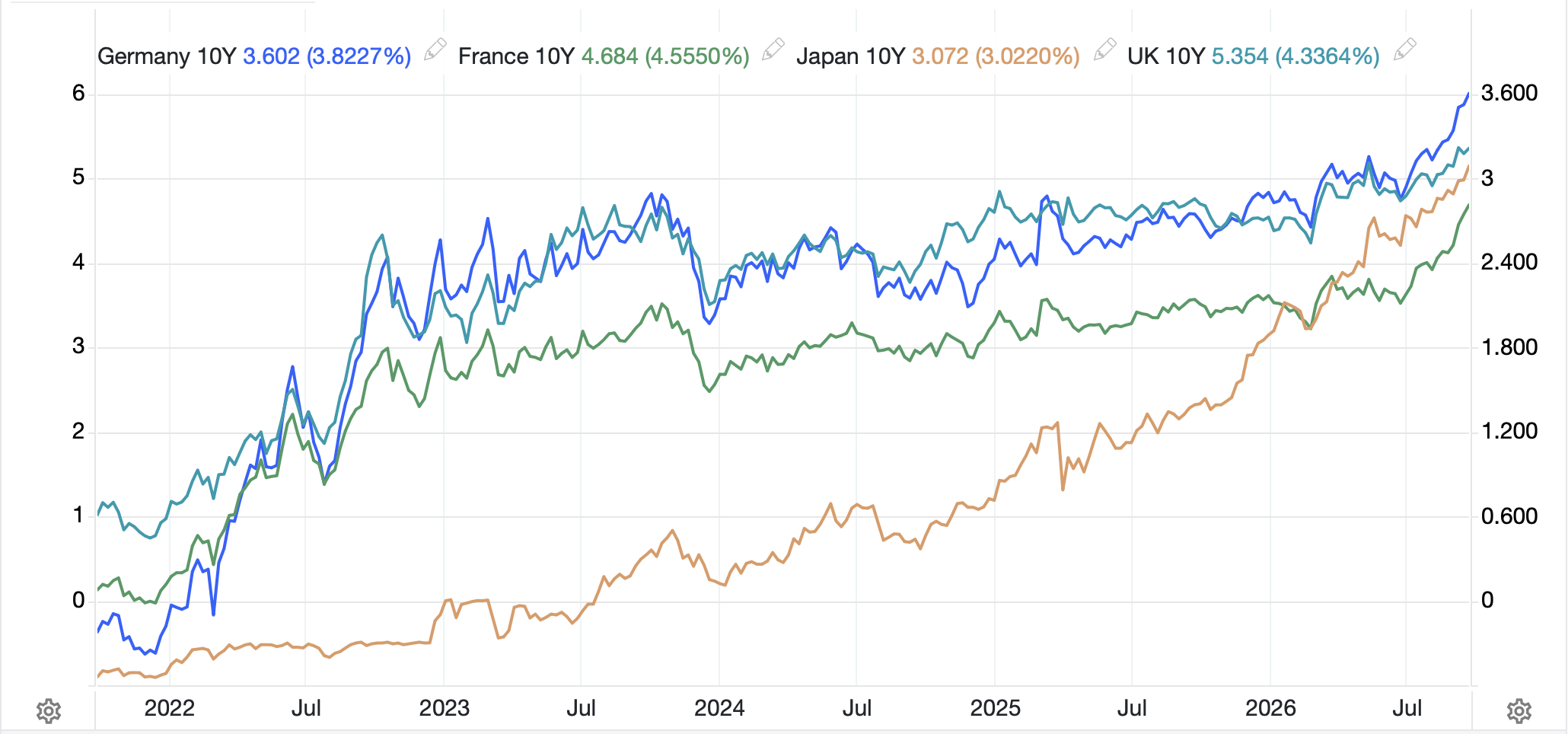
The primary market discussion this morning revolves around government bond yields after yesterday’s dramatic rise virtually across the board.  If you look at the chart below, it shows the yields for US, UK and German 10-year bonds and how they have all risen dramatically in the past week (18bps, 20bps and 15bps respectively) with the bulk of that coming yesterday.  

Source: tradingeconomics.com

There have been many theories as to why things broke yesterday with some pointing to oil’s dramatic rise, some pointing to President Trump’s $5k bonus payment and others pointing to Secretary Bessent’s bond repurchases where he was only able to buy $5.1 billion of the $6.0 billion they tendered for.  As is often the case, all of these likely had some impact, and you can throw in some views of yesterday’s PPI data, which while released at expectations did nothing to cool inflationary ardor.  

If we look at Fed funds futures in the table below from the CME, we can see that the probability of a rate hike next week has risen to 67%, but more interestingly, there is now pricing for a total of 100bps of hikes over the course of the next year.

In fact, if we look across the globe, the number of rate hikes has grown since yesterday.  Compare this morning’s chart from rateprobability.com to the one I published yesterday, and you can see that expectations have risen between 15bps and 25bps across all the major central banks.

Today’s chart.

Yesterday’s chart.

At this point, we are highly confident that Japan is going to raise rates at their meeting later this month because Nikkei News reported it last night, and their track record here is, literally, perfect, never having missed a call.  Of course, the ECB raised rates yesterday, and it appears quite likely that rate hikes are the new normal.  I wonder what will happen, though, if today’s CPI (exp 0.4% Headline, 0.2% Core) comes in cool.  Frankly, I think the market is so convinced that it won’t matter at all.

Ok, before I run down markets, I must comment on the increased chatter regarding AI.  Let me start by saying, I am not an expert on AI, although I have a pretty good feel for human behavior.  The recent comments from the Anthropic scientist who left and explained that AI was going to kill us all were remarkable.  But what is more remarkable is the call for ‘government experts’ to oversee AI’s ongoing evolution. Every time I hear of government experts I hearken back to the end of “Raiders of the Lost Ark” when Indiana Jones tells the army intelligence men that the Ark needs to be studied, and they reply it is being studied.  When queried ‘by who?’ they reply, top…men.

My point is there are likely zero AI experts who work in the government as all of them are working for companies building AI.  Congress has proven itself to be uniquely incompetent across virtually every sphere of thought and action, so having Bernie Sanders or Hakeem Jeffries or Josh Hawley say they need to be involved does not inspire confidence.  Here’s the thing, we have heard this before.  After all, wasn’t global warming or climate change or Covid going to kill us all if we didn’t do exactly what government said?  It is almost as if they are running the same playbook on AI and it is becoming pretty tiresome.  Perhaps AI is developing into Skynet, but like virtually everything else, early hysteria is regularly misplaced.

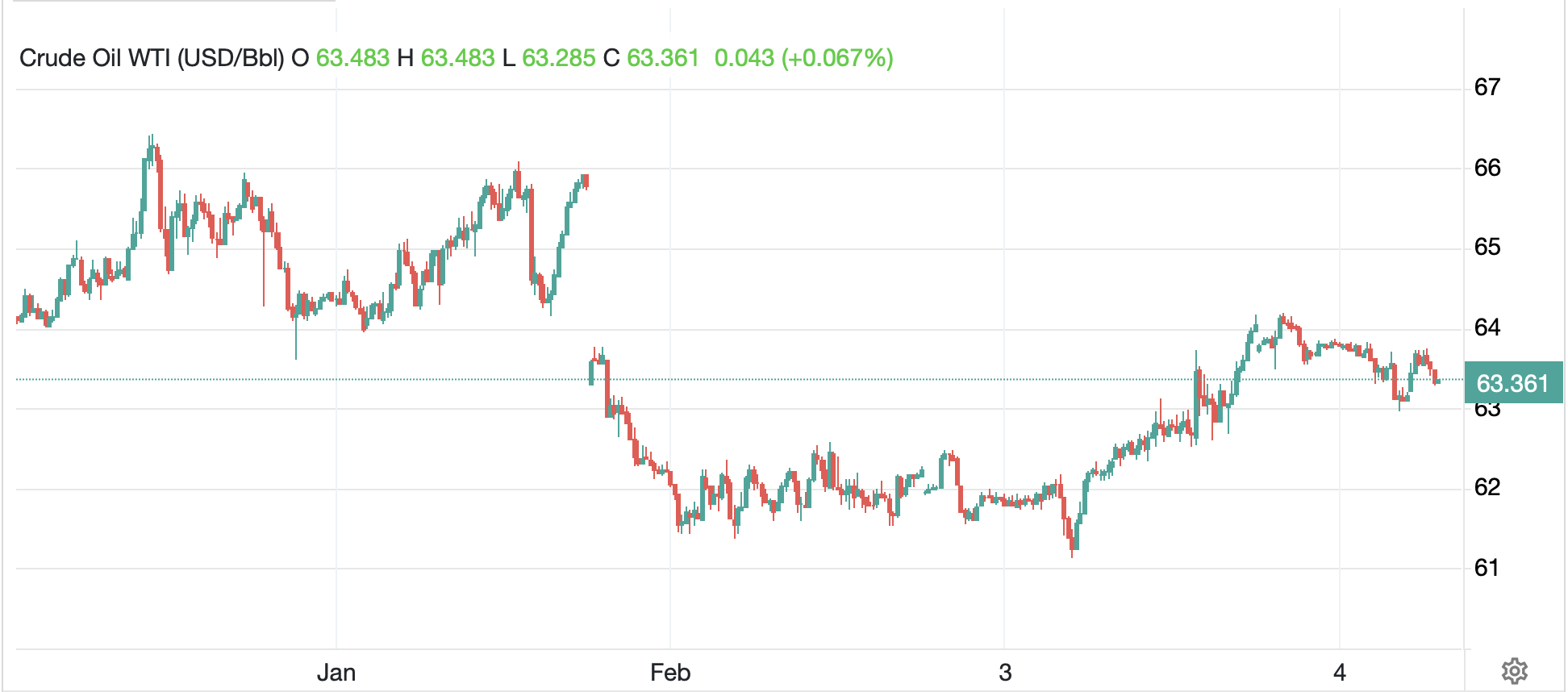
Which takes us to markets.  Oil (-3.2%) may have been a tad overdone yesterday during its $6.50 rally.  Threats and counter threats between the US and Iran continue to be the backdrop, and Saudi Arabia did announce they produced their least amount of oil since 1991, but the US is producing record amounts, and Venezuela is coming back faster than expected and there still appears to be a surfeit of the stuff around.  While EIA oil stocks had a very modest draw of 390K, gasoline stocks rose > 1mm barrels and there is no indication supplies are gone.  However, while refinery runs in the US are consistently near 98% of capacity, the lack of refining in Russia and the Gulf continue to drive prices.  I guess the question is how long can the IRGC withstand the very clear economic pressure the blockade and newer sanctions have imposed?  I have no answers.

As to metals, yesterday saw sharp declines across the board as both interest rates and oil prices rallied, but this morning they are rebounding a bit (gold +0.5%, silver +0.5%) although copper is still under some pressure (-0.25%).

In the equity markets, in truth, despite all apocalyptic talk, the major US indices were only lower by about -0.6% across the board, not great but not devastating.  Asia, however, had a rougher go of things with Tokyo (-1.9%), China (-0.8%) and HK (-0.6%) leading the way with most of the rest of the region also in the red (Korea -1.8%, Taiwan -1.6%, Australia -0.9%, etc.). But at some point overnight, things turned brighter as European bourses are higher by between 0.6% and 0.7% across the board with the only data release UK GDP and Production data, all coming in stronger than expected.  Perhaps the idea is that if the UK can grow despite extraordinarily bad economic and energy policies, so can the rest of Europe!  As to US futures, at this hour (7:30) they are higher by 0.6% across the board.

As we’ve already discussed bonds at length, it leaves us to the FX markets which continue to garner limited interest from the trading community.  While the dollar is a touch firmer this morning, DXY +0.1%, if we use that as the proxy, over the past month, as you can see from the below chart, it has traded within a 1.5% range (98.50 – 100.00) and that is with a key piece of the index, JPY having shown a substantial move.

Source: tradingeconomics.com

Someone on X this morning was claiming that this market is setting up for a big move lower with many attendant impacts if that is to be the case, but while he is a very smart guy (Tavi Costa) whose views I respect, he is looking at a VERY long-term chart.  Perhaps he is right, and I guess if we see major destruction in the bond market with yields exploding higher, that could be correct, but it is so hard to get excited about FX right now.  It continues to be a background event.

In addition to the CPI data, we also see the preliminary Michigan Sentiment (exp 51.0) Survey but that’s it.  My take on CPI is if the data is cool, it will have very limited impact, but if it comes in hot, we will see another wave of selling in bonds, and probably stocks, so an asymmetric outlook in my view.

Good luck and good weekend

Adf
Markets This Hated

No matter the nation you view
Its bondholders now see to rue
Their previous buys
And under that guise
Won't buy and bonds that are new

So, yields have been rising with haste
Though currencies have not debased
But markets this hated
Have often created
Reversals, which many then chased

Global Bond Yields Surge as Oil Prices Fuel Inflation Worries

The above article in the WSJ this morning captures the current zeitgeist in markets and seeks to explain why everything has turned bad.  Certainly, the rebound in oil prices (+2.5%) is putting pressure on economies around the world, but so, too, are the unrestricted spending plans seen throughout the G10, and frankly across most of the planet.  My take is that ‘run it hot’ (RIH) has become the economic strategy around the world.  Perhaps the only outlier here is China, but even that is not really true, they are just running it hot differently.  While most governments are responsive to their peoplevoters, Xi Jinping has demonstrated time and again he doesn’t really care about that.  Rather he has his strategic goals of global domination and is pushing his economy to achieve that.

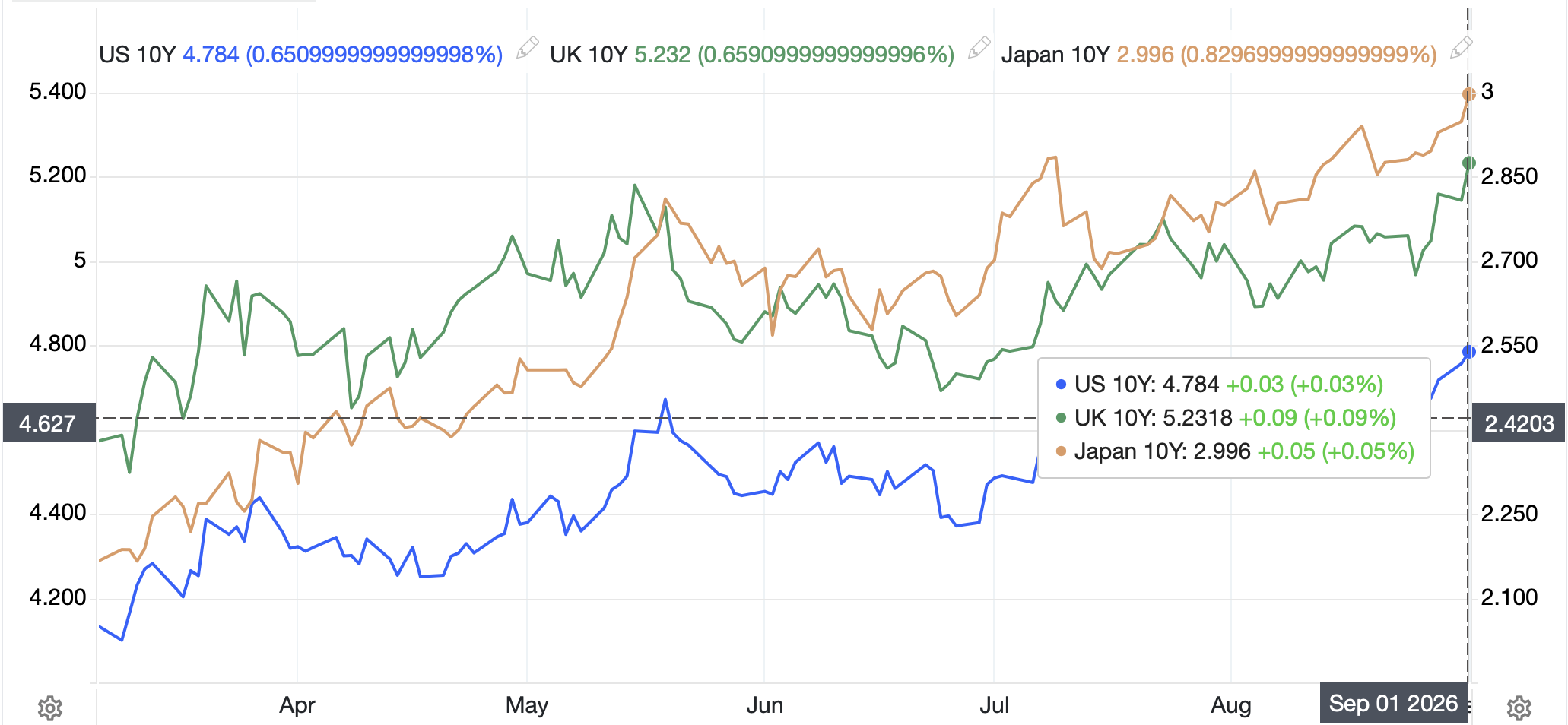
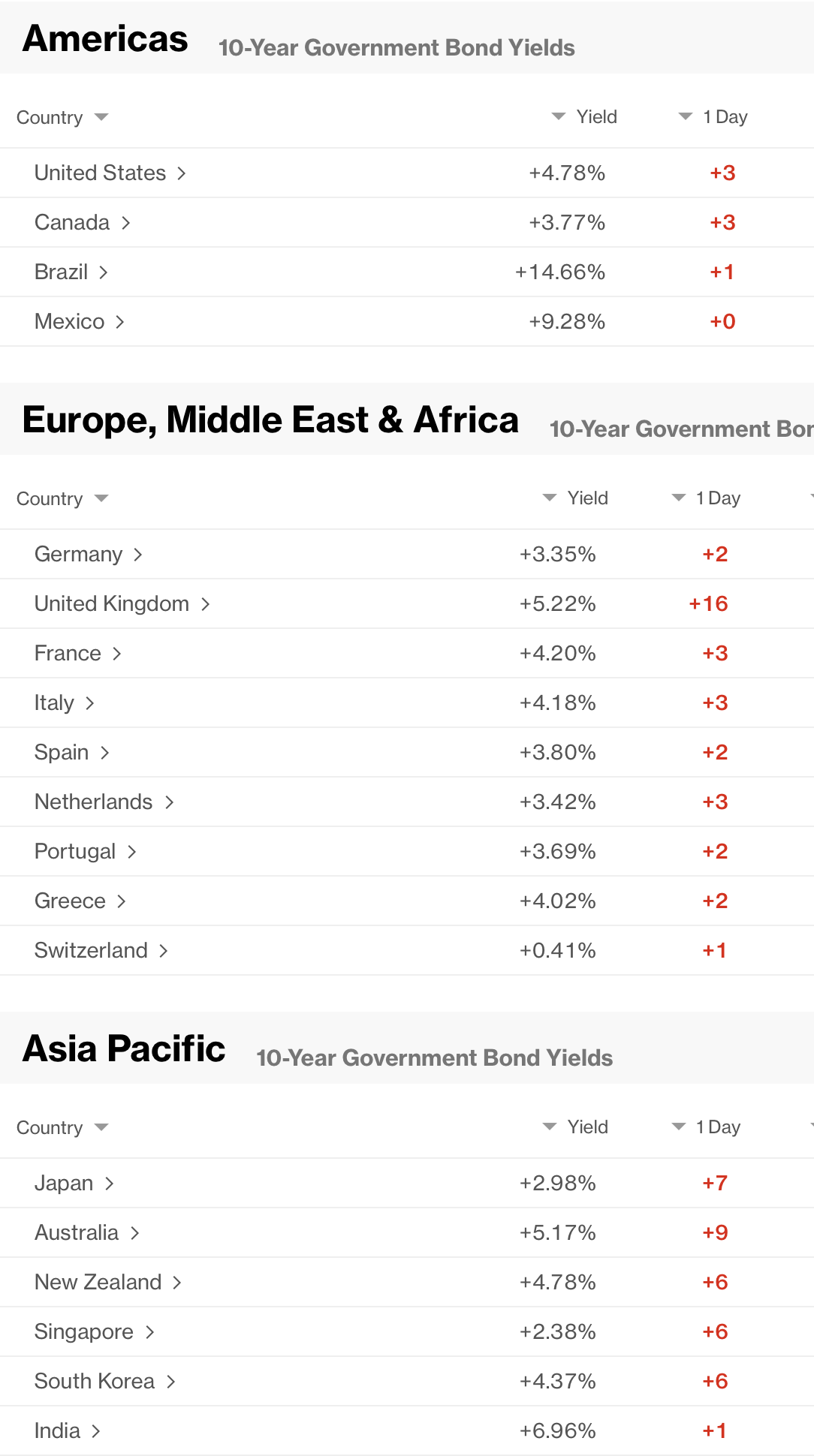
The upshot is that bond yields are rising and as you can see in the chart below, it is uniform, this is not just a US phenomenon.  In fact, much ink has spilled that 10-year JGB yields have traded to 3.0%, their highest level in 30 years.

Source: tradingeconomics.com

Now, as I said at the top, oil prices are clearly one of the pressure points as there are fears it will feed into higher inflation, thus investors are demanding higher yields.  And the other big story, which in my view is more concerning, is that governments are running increasingly larger budget deficits as the guns AND butter approach has become de rigueur in polite circles, or at least political ones.  In fact, the concern is that governments are increasingly running primary budget deficits (spending less interest payments) which is why debt loads are growing so rapidly.

Source: @KobeissiLetter

And this leads to the RIH theory.  If a country can grow its nominal GDP fast enough, then the denominator in the debt/GDP ratio will rise more quickly than the numerator thus reducing that ratio and implying a healthier fiscal outlook.  Now, nominal GDP is the sum of real GDP, the number that is reported, plus inflation and that sum can be any combination.  For instance, a nominal GDP growth of 7% could easily be 2% real GDP and 5% inflation, or vice versa.  In the RIH scenario the typical outcome is that wages rise, corporate earnings rise, stock market values rise…and prices rise.  The last point being the key political question.

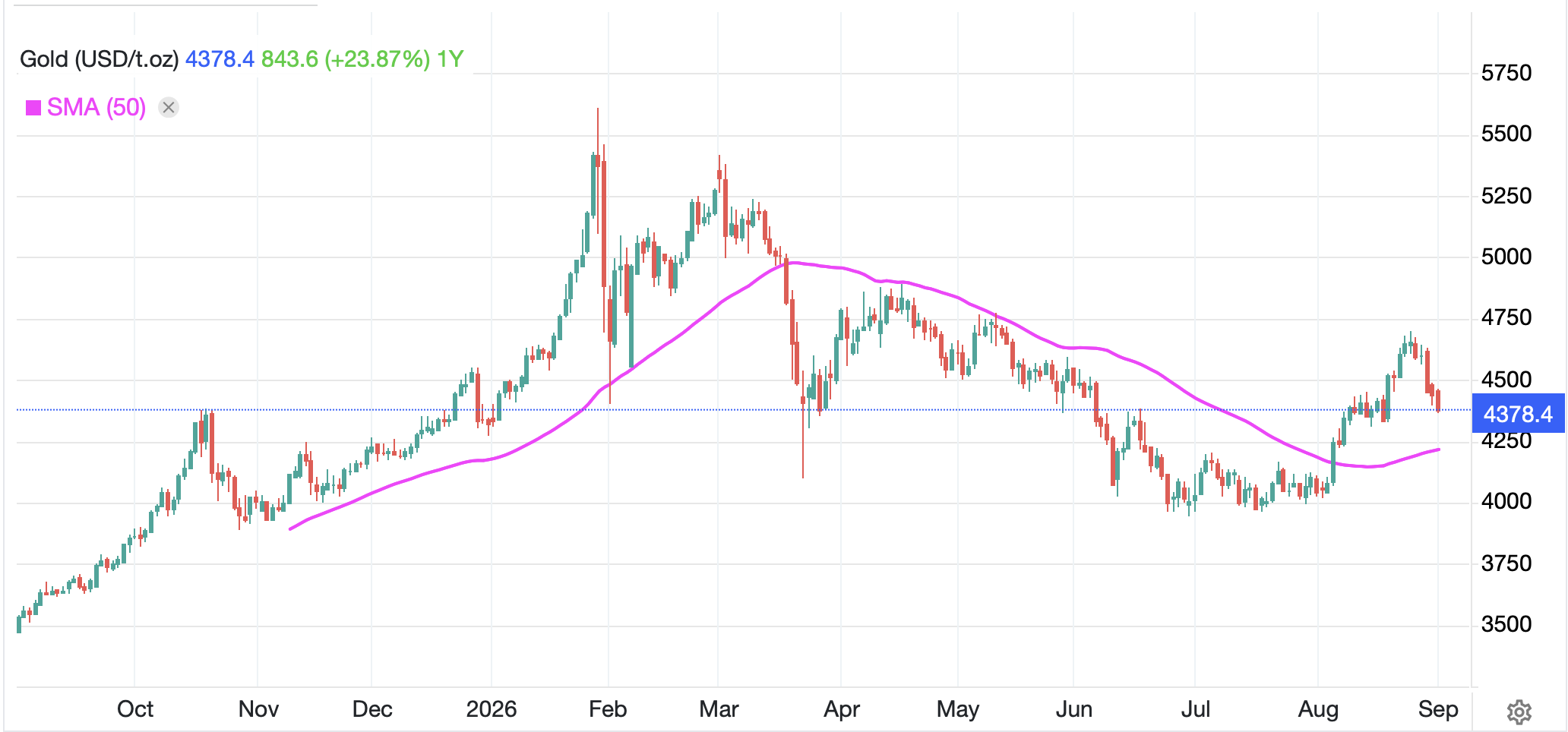
Which takes us back to the bond market and a few questions I have.  First an observation.  In the old days (Greenspan era) a rule of thumb in the bond market was the 10-year yield should approximate nominal GDP growth as a stable base.  I mention that because I am confused by the bond market reaction given the near universal view of Chairman Warsh’s speech on Friday was that he was hawkish and that rate hikes were coming.  But if that is the case, and the Fed is going to more aggressively address inflation, then why are bonds selling off?  Second, regarding the debasement trade, if bonds are selling off because of concerns over massive debt issuance and the assumed result that the dollar, and all currencies, are going to lose purchasing power, why is gold (-1.4%) selling off so aggressively?  It strikes me that gold should be flying higher on the view that inflation is going to rise, but then, I’m just a poet.  I guess one could make the technical argument that it is merely correcting its recent strong rally and it remains far above its 50-day moving average as per the below chart.

Source: tradingeconomics.com

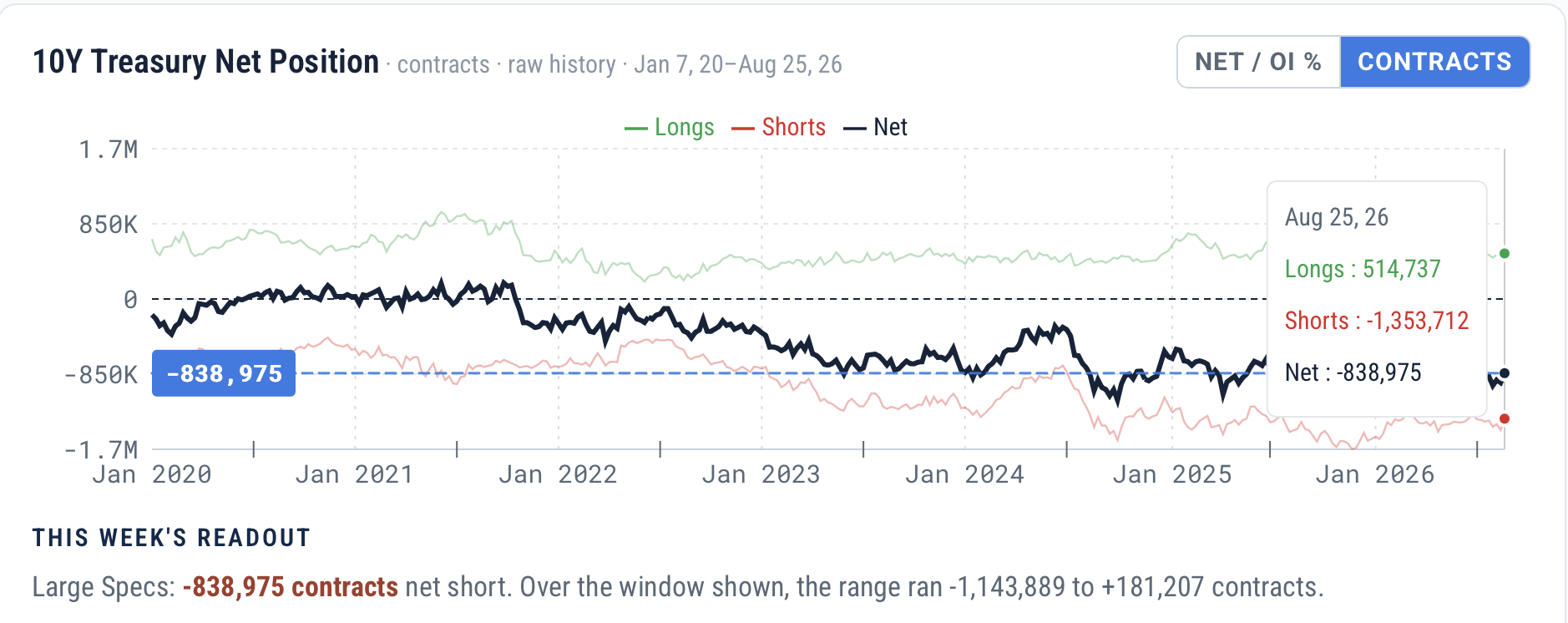
I wish I had the answers here, but I don’t.  However, something is amiss.  If the Fed was so hawkish, the bond market would not be aggressively selling off.  If the Fed was not hawkish, then the sell-off makes sense, but 90% of the punditry was wrong in their analysis of Warsh’s speech.  (My guess is they see that as a bigger problem.) One thing I do know, though, is that the bond market is quite bearish right now with nary a positive word to be found.  There is still a huge net short position in the bond futures market, as per the below chart.

Source: cotsignal.com

Here’s the thing about markets, at least in my experience.  Markets tend to seek out the ‘pain’ trade, the trade that will hurt the most participants most significantly.  As well, bull markets begin when all investors express uniform hatred of a product, like bonds right now.  Combining those two things leads me to believe that we could well be setting up for a significant bond market rally.  Just beware.

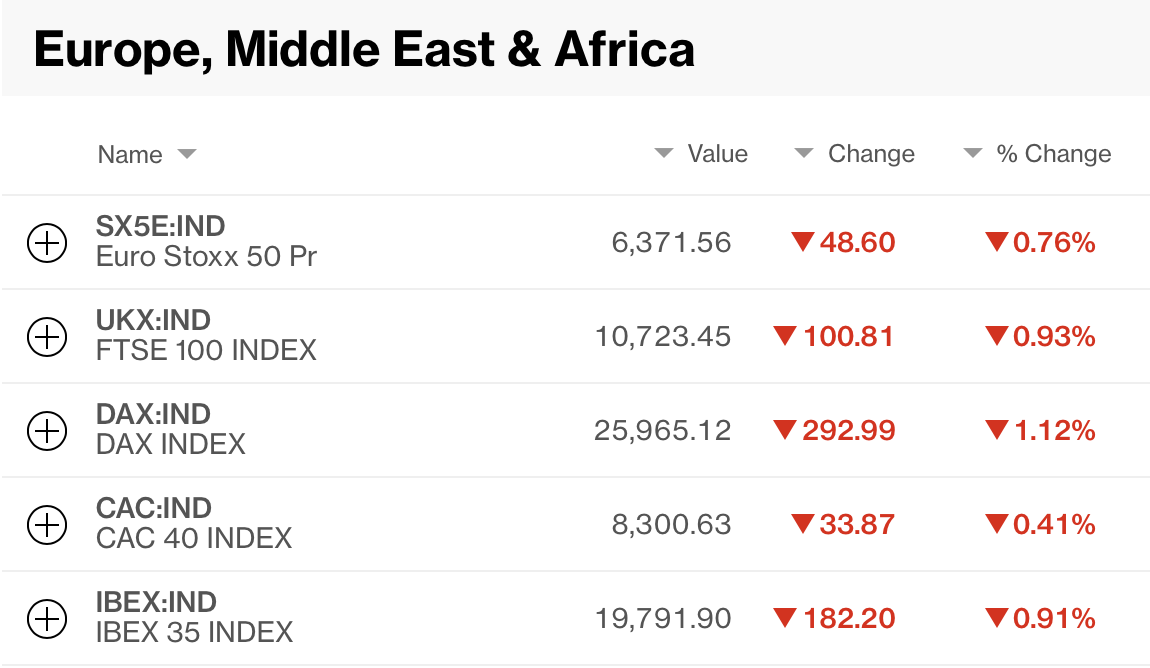
In the meantime, a quick tour of markets overnight shows negativity everywhere.  After yesterday’s declines in the US session, Asia saw mostly red numbers (Tokyo -0.15%, China -0.3%, HK -0.9%, Malaysia -1.5%, Singapore -0.8%) although Taiwan (+1.8%) and Korea (+0.25%) bucked the trend on some tech support which is also why the NASDAQ fell the least yesterday.  As to Europe, as you can see in the below screenshot from Bloomberg, it is universally red.

Lastly, US futures are under the gun this morning, down -0.5% except for the NASDAQ which is reversing yesterday’s outperformance and lower by -1.3% at this hour (7:20)

We’ve already discussed bonds, but this Bloomberg screenshot is worthwhile, I think.

Of course, the outlier here is the UK, which was closed yesterday so had a lot of catching up (down?) to do.

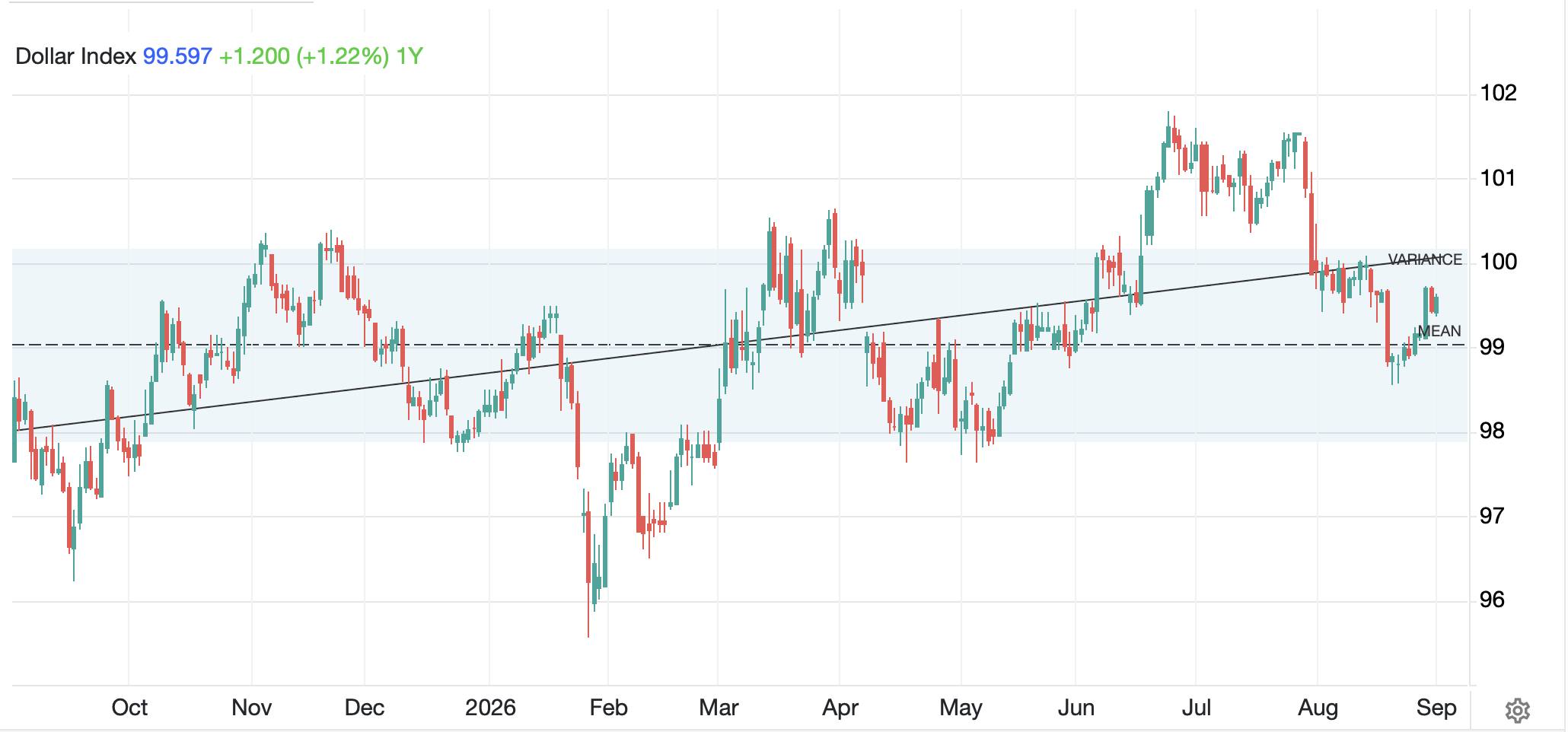
We’ve already discussed commodities which brings us to the dollar, which is rising despite yields rising everywhere.  Now, the DXY is at 99.60, hardly new territory although the trend over the past year is marginally higher as per the below chart.

Source: tradingeconomics.com

If we look at individual currencies, JPY (-0.2%) has seen the dollar rise back above 160 as the post intervention price action remains consistent with every previous effort.  Perhaps the most surprising outcome today is ZAR (-0.1%) which is holding up quite well despite much higher oil prices and much weaker gold prices, the two key issues in that economy.  But net, as much as people worry about the debasement of the dollar, it appears they are more worried about the debasement of other currencies more rapidly.

On the data front, this morning brings ISM Manufacturing (exp 55.2) and Prices Paid (72.0) as well as the JOLTs Job Openings report (7.3M). Fed Governor Barr speaks before the data at 9:00 this morning so I wonder if he will reaffirm the hawkish vibe, and if he does, shouldn’t that help the bond market?  I am still focused on Friday’s NFP as the next truly important piece of news, but there is an awful lot that can happen between now and then, especially with this President.

Good luck

Adf

A Great Deal of Sorrow

With Warsh set to speak on the morrow
The rate at which we all can borrow
Has been creeping higher
Which for some is dire
And causing a great deal of sorrow

The question is what will he say
Inflation'ry fears, to allay
Seems most want to hear
That during this year
Fed funds will rise without delay

Arguably, the biggest story this morning is that Nvidia’s earnings beat handily and Jensen’s forecasts were even more bullish.  The upshot is NASDAQ futures are rallying (+0.7%) and we saw strength in the tech sectors in equity markets overnight (Korea +1.5%, Taiwan +0.3%, China +0.9%), although it was not as euphoric as might have been expected.  I read this morning that price targets for Nvidia have been raised dramatically now, so there doesn’t seem to be any slowing of that thought process.

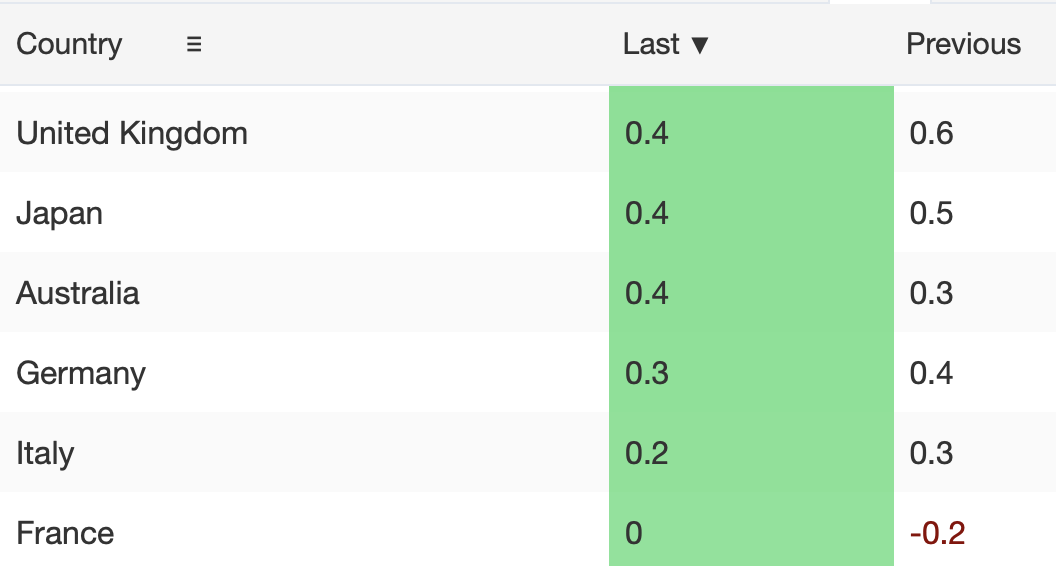
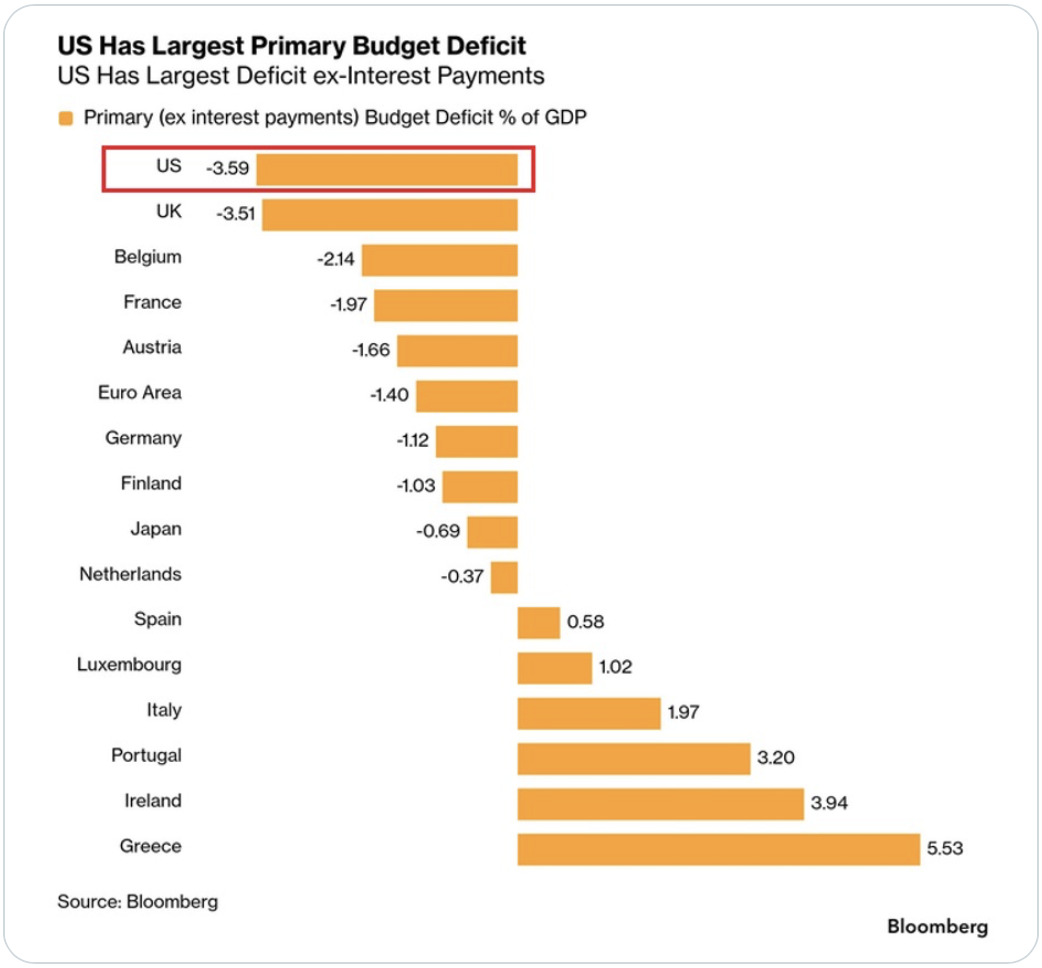
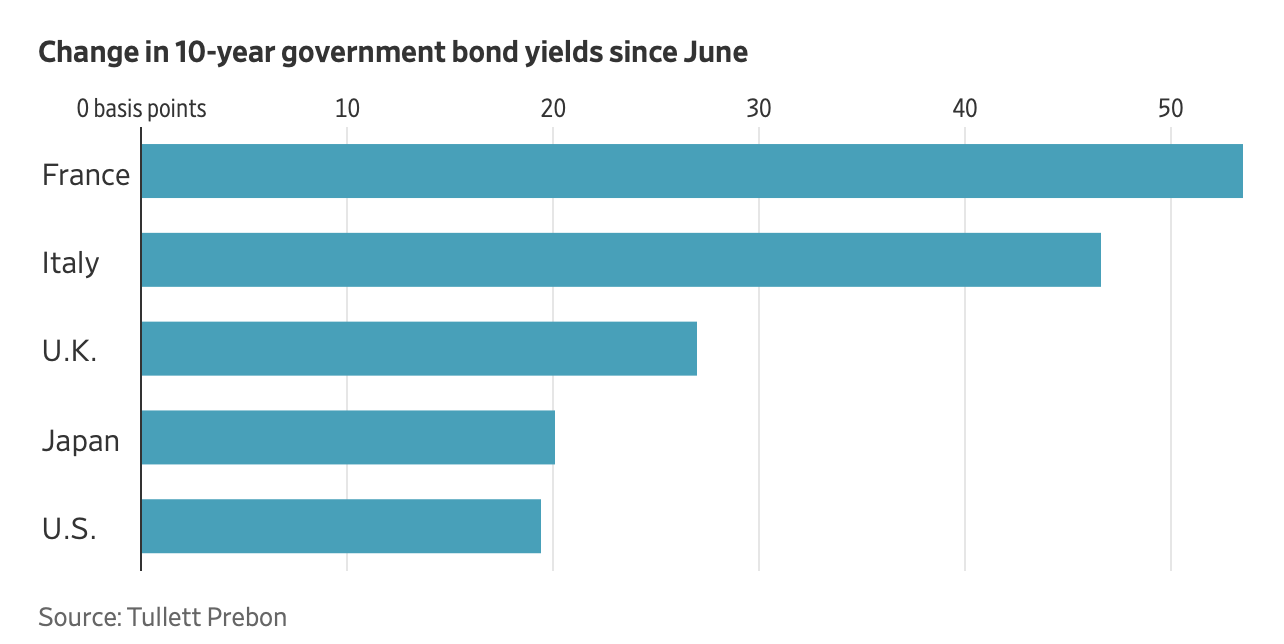
But otherwise, bond markets remain the focus as the combination of Secretary Bessent’s efforts to hold down long-term yields and anticipation of Fed Chair Warsh’s speech tomorrow are the main topics of conversation.  Interestingly, as much as the punditry loves to hate the US for its fiscal profligacy and the story of US yields rising has been top of mind, this morning the WSJ reminded its readers that the story in the US is not quite as bad as that in other major nations like France, Italy, the UK and Japan.  The below chart leads the story on the subject and is worth seeing.

The point is that virtually every Western nation is in the same boat and is likely to stay there for the foreseeable future.  The global regime that had been in place for upwards of 40 years; globalization leading to outsourcing manufacturing and financialization of major corporations is changing before our eyes.  Covid awakened many to the fact that the G10 had become dangerously reliant on China as a supplier for too many critical inputs which led to serious strategic concerns and weakness.  As that perceived weakness is being addressed by nations around the world, it turns out it costs a lot of money to do so, and nations are struggling to figure out how to pay for it.  Promises made when those nations could apply all their tax revenue to social causes are hard to keep when those resources are now being called upon to address strategic and security needs.  Hence the massive borrowing we have seen throughout the G10 and the corresponding rise in government bond yields.

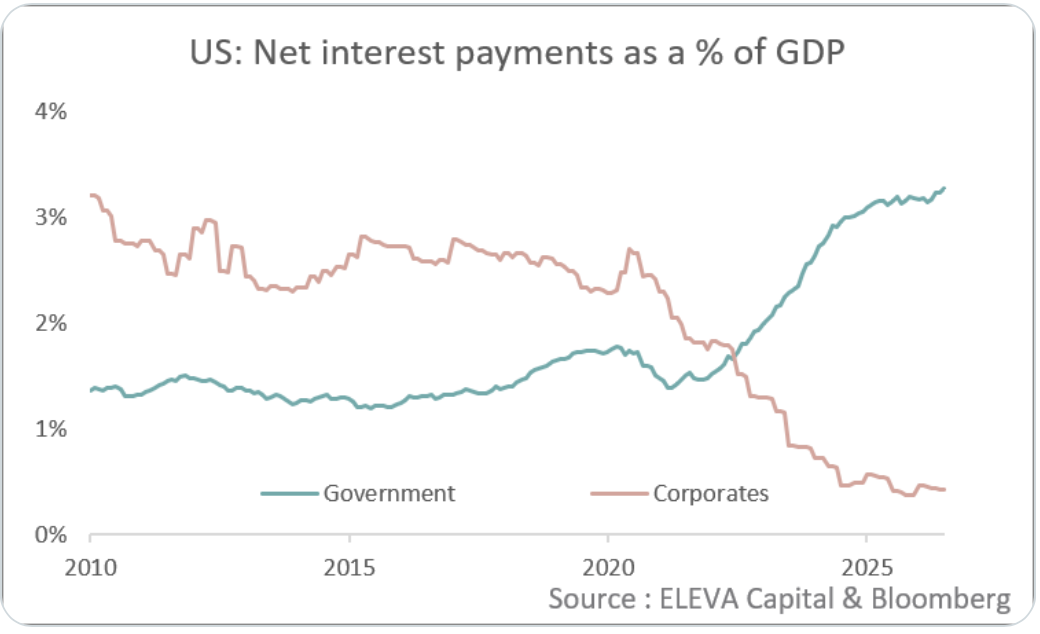
But one of the interesting things about this process is that despite government yields rising, corporate bond yields have been quite well behaved, with credit spreads remaining near their tightest levels ever.  I saw this chart this morning which helps explain that seeming anomaly and it helped clarify my thinking.

Basically, it is explaining that US corporates during Covid refinanced their debt at the rock-bottom levels of the time and reduced their interest expense dramatically.  Meanwhile, due to arguably the single greatest fiscal policy error of all time by then Secretary Janet Yellen, the US didn’t term out its debt, instead going the other way, issuing more T-bills when yields were low, thus government interest payments, as we hear on a daily basis, have climbed dramatically. I’m still waiting for some news organization to ask her about this boneheaded decision, but I won’t hold my breath.

At any rate, the bond market story is the one currently with legs and I assume that will be true at least until Chairman Warsh speaks tomorrow.  While speeches of this nature are often quite dry, I am truly looking forward to hearing what he has to say.

In the meantime, let’s see how other markets are behaving this morning.  After yesterday’s very modest declines in the US, the rest of Asia was mixed as Tokyo (-0.25%) slid alongside HK (-0.3%), neither being a major concern.  Australia (-1.0%) was the worst performer out there after stronger Household spending data bolstered the case for an RBA hike next month raising the probability to 54%.

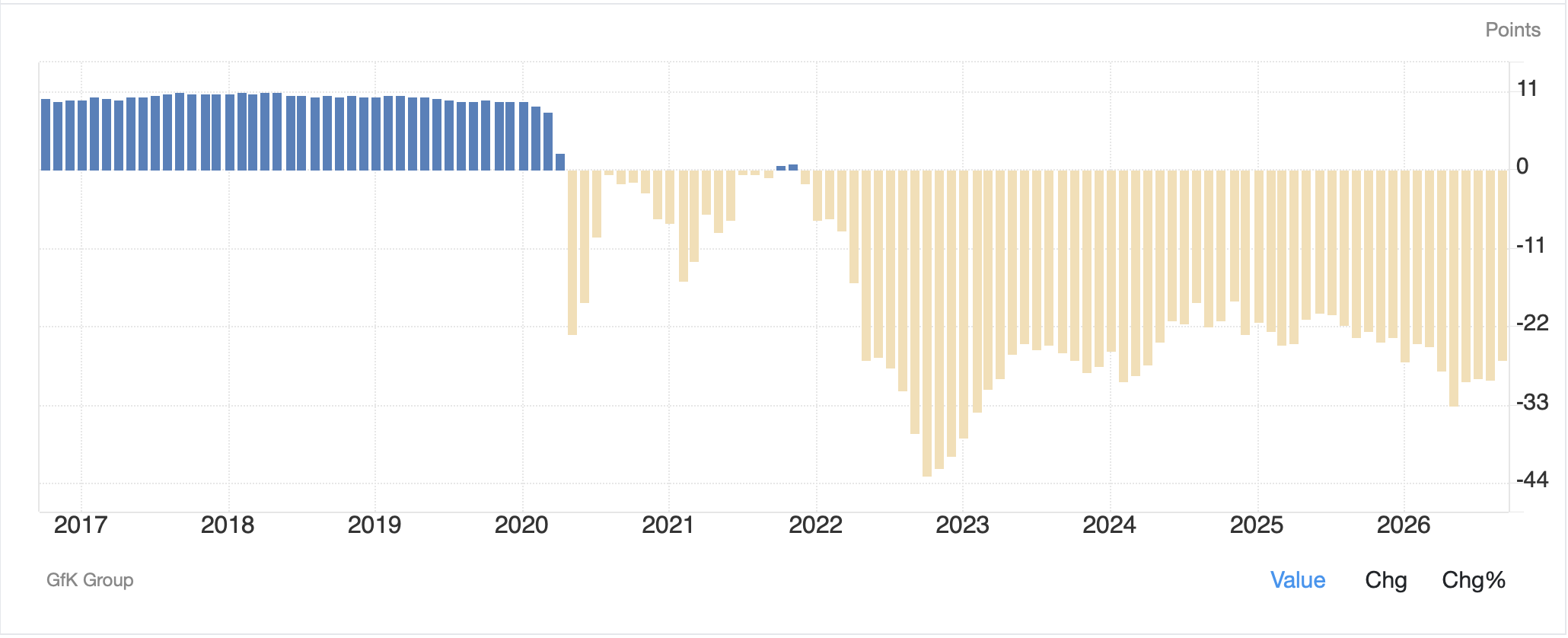
Europe, however, is having a tougher time this morning led by Paris (-1.1%) where concerns are rising based on both a Fitch credit review of the country (last year they were downgraded one notch to A+) as well as growing uncertainty over the presidential election next year as the main candidates describe their policies to business leaders in a debate format.  But both Spain (-0.5%) and the UK (-0.5%) are also under pressure with only Germany (+0.2%) bucking the trend after a slightly better than expected GfK Consumer Confidence reading of -26.6.  I think it is worthwhile, though, to get a better idea of the situation in Germany, and by extension all of Europe, to look at that confidence measure’s history below.

Source: tradingeconomics.com

Sure, the reading was better, but how awful must confidence be in Germany.  I guess this is the way people respond to their suicidal energy policies.

While I discussed bonds in general above, I didn’t mention the overnight movement which has seen yields continue to edge back higher led by Treasuries (+2bps) with European sovereigns right there, rising between 1bp and 2bps.

In the commodity markets, oil (+0.3%) has been trading around unchanged all night as it was slightly lower when I first sat down.  We continue to hear conflicting stories about the situation in Iran and the Gulf and whether tankers are transiting the Strait, but we have still not seen any blowout in prices.  EIA inventories yesterday showed a small net draw in gasoline and distillates, but crude remains available and Cushing inventories are being rebuilt.  As to metals, gold is flat this morning with silver (+0.6%) edging higher.  There continues to be real support for the precious metals as both grind slowly higher.

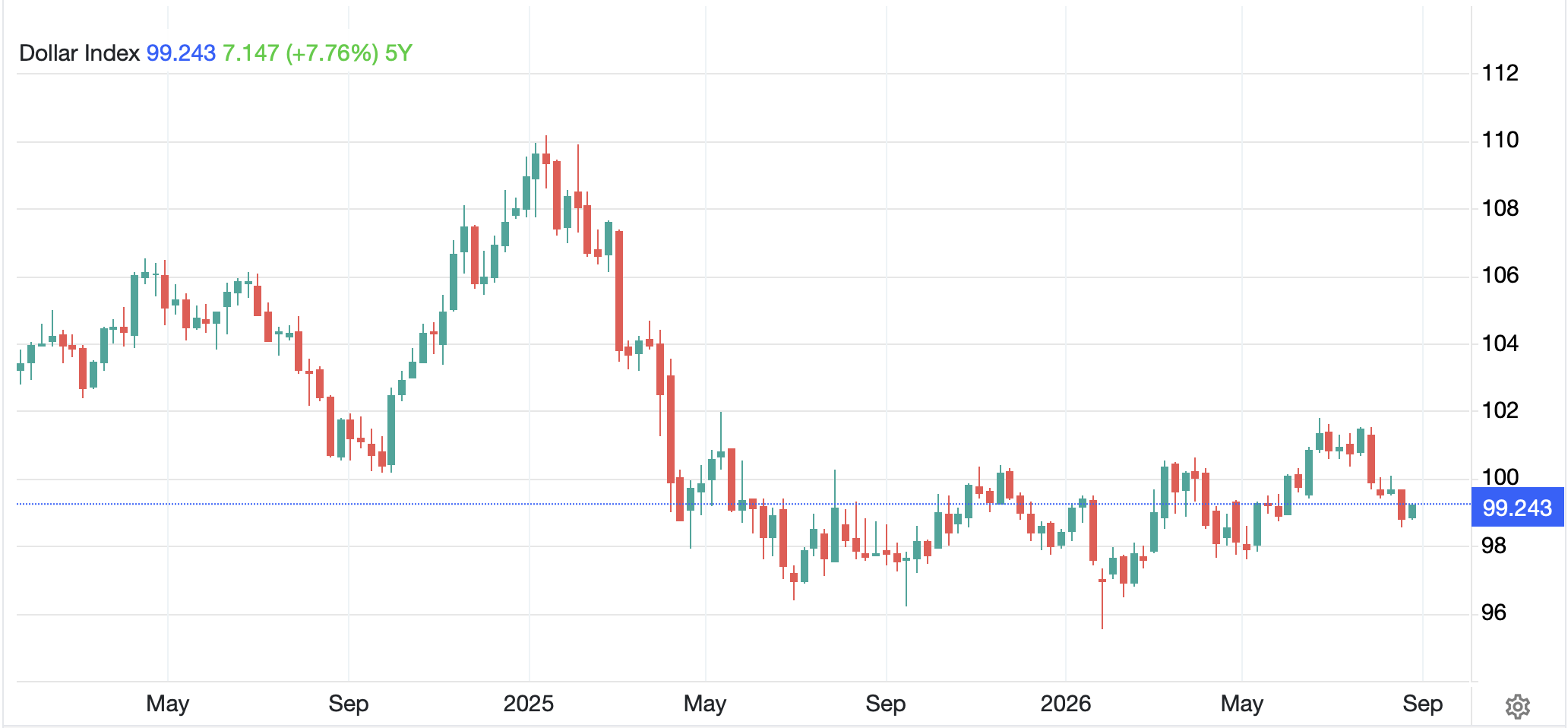
Finally, the dollar continues to languish, doing very little overall.  Despite much excitement several weeks ago about the dollar breaking out higher, the fact remains that the DXY is basically in exactly the same place it was in April 2025 as you can see below.  As I have repeatedly explained, at some point the dollar will matter again to markets, but I’m not sure what will drive that change.

Source: tradingeconomics.com

As it is Thursday, we see the weekly Initial (exp 208K) and Continuing (1790K) Claims data.  We also see the Goods Trade Balance (-$99.0B) and then some tertiary data.  Today has all the hallmarks of a sleeper as we await Chairman Warsh tomorrow.   

Good luck

Adf

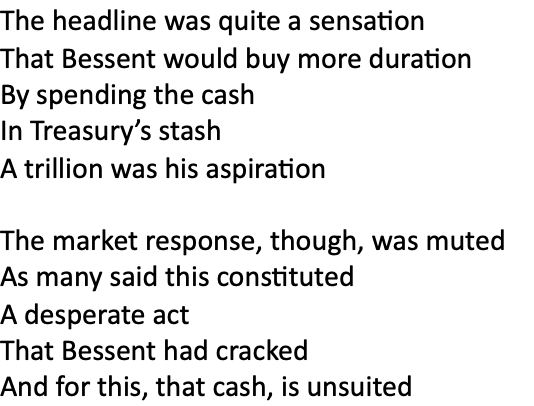
A Desperate Act

A key market story yesterday was that the Treasury buyback operations, you know the ones that would be “at least” doubled to $4 billion per event, could grow much larger as secretary Bessent would tap the Treasury General Account (TGA) for this purpose.  Now the TGA is the federal government’s checking account.  It is where your taxes get paid into, along with the receipts from bond sales and tariffs.  It is also the account that pays all the federal government’s obligations like salaries and purchases of defense and other equipment.  The current balance (a/o Aug 21st) is about $936 billion according to the Treasury website.  Obviously, that is a huge amount of money, but then the federal government has a huge amount of payment obligations.  I bet it is a hard checking account to balance!

Now, technically, I presume that all their operations are paid by the TGA.  The mechanics would work that Treasury would issue T-bills, receive the cash in the TGA and use that cash to buy back bonds.  But the implication was that he would just spend the money that was already there.  Personally, I doubt that will be the outcome, and frankly, it almost sounded more like a threat than a future course of action.  But it did get tongues wagging.  

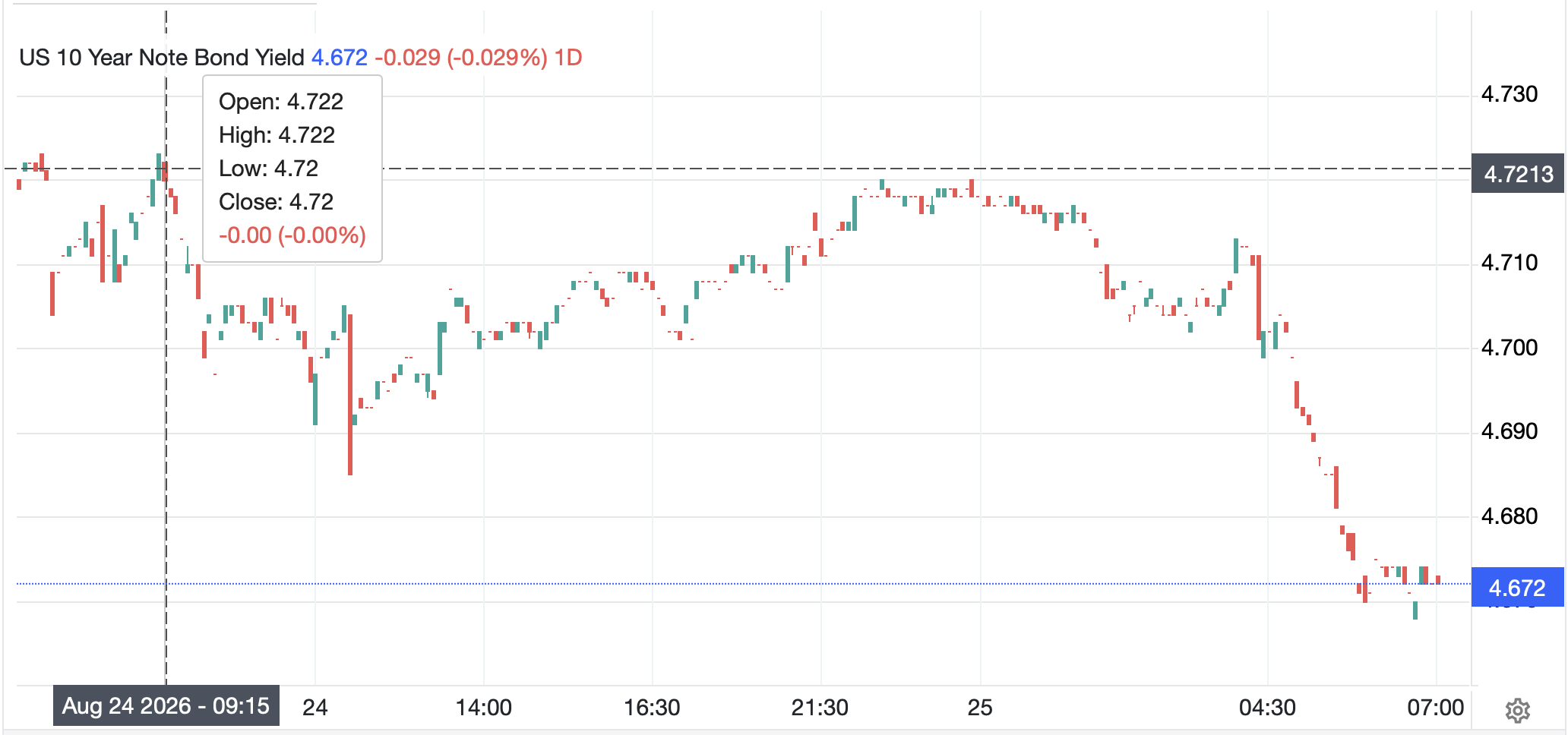
According to Grok, these comments came in an interview on CNBC at a bit after 9:00 yesterday morning.  The chart below shows the bond market price action from that point onward, which tells me that while there was a modest initial response, it completely disappeared until another catalyst (lower oil prices I believe) helped push yields down early this morning.

Source: tradingeconomics.com

But this clearly struck a nerve as in this morning’s WSJ, Stan Druckenmiller, Bessent’s mentor at the old Soros hedge fund, wrote an op/ed decrying the move.  As I survey all that I have learned thus far, it seems clear that Bessent is looking to remove duration from the market in an effort to drive longer dated yields lower.  But his tools are limited compared to the Fed’s abilities and, at least right now, it does not appear the Fed is going to cooperate.  The first operations aren’t scheduled until September 7th, so until then, it is all just speculation, and I’m not even going to try.

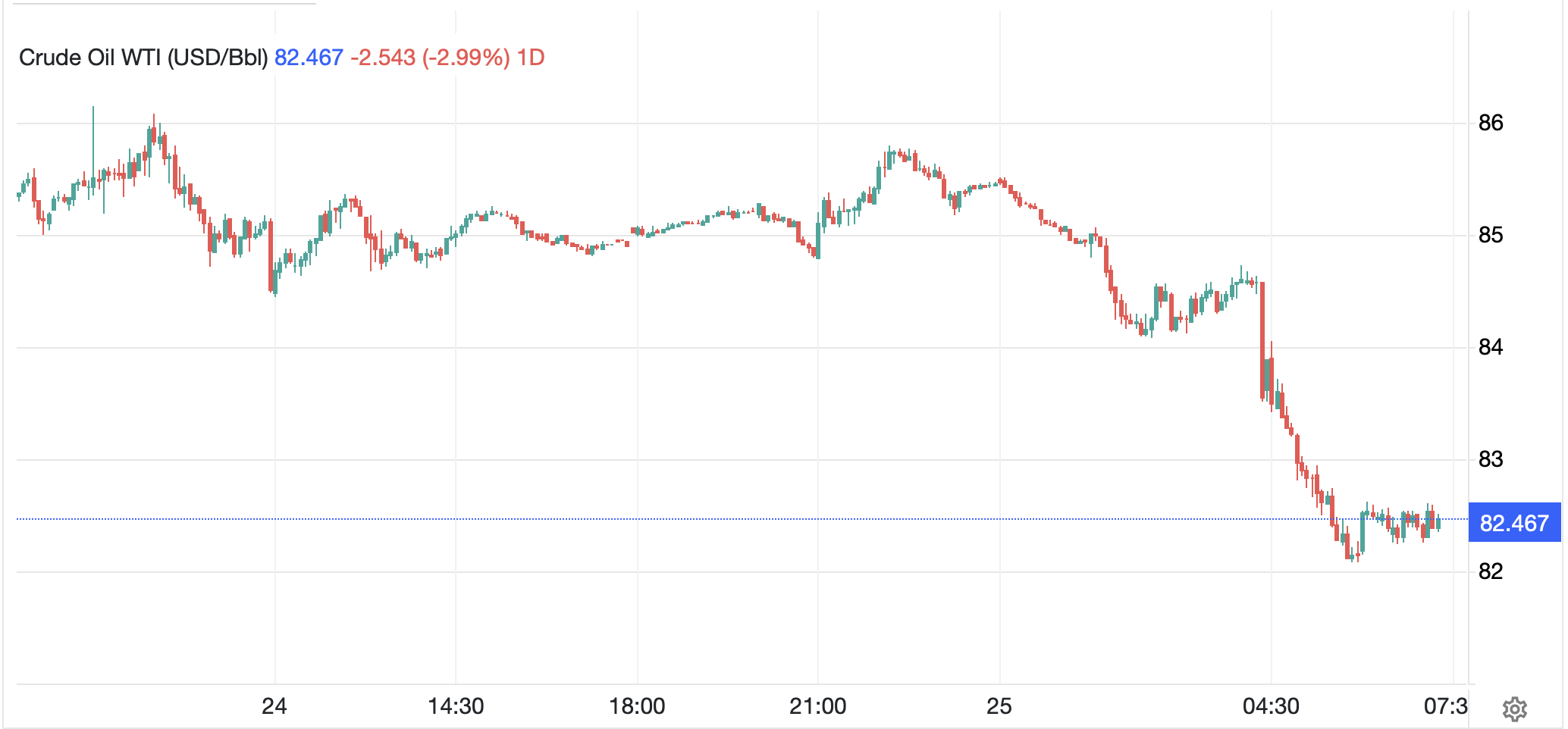
The other thing that Secretary Bessent did yesterday, that may have a larger impact on things, was announce sweeping new sanctions on Iran and countries that do any residual business with Iran in an effort to add further pressure on the regime.  It is possible, but not clear to me, that this is part of the rationale for this morning’s decline in the price of oil (-3.0%).  However, if you look at the chart of oil for the past 24 hours, it is remarkably similar to that of the 10-year Treasury above.

Source: tradingeconomics.com

Ostensibly, the news here, which of course would impact bond yields, is that the Pakistani army chief was intermediating between the US and Iran in an effort to find a solution and reduce tensions in the Gulf.  That would certainly be a welcome outcome for all, but I’m not holding my breath.  However, this price action has set the tone for risk markets this morning, so let’s take a look.

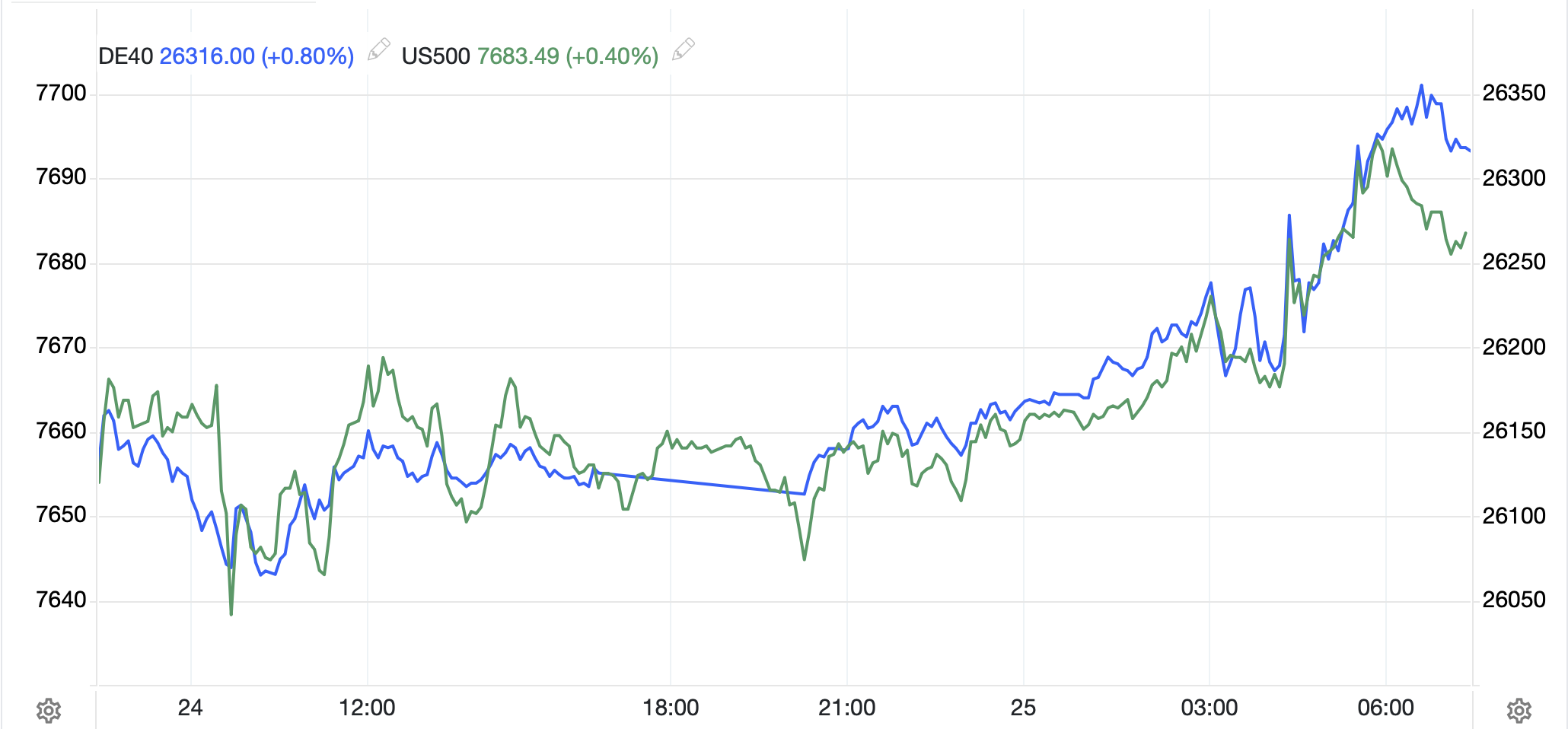
While Asia was mixed overnight (Tokyo +0.5%, China -0.3%, HK 0.0%) following the mixed US session, with pressure still evident on the tech sector, Europe is firmer this morning across the board (Germany +0.8%, Spain +0.4%, France +0.4%, UK +0.25%) with all those rallies timed almost exactly alongside the oil and bond moves.  As you can see in the chart below, the same is true in the US where futures at this hour (7:25) are also higher and moved right alongside other equity markets.  As to specific stories here, I think there is a great deal of breath holding for the Nvidia earnings report tomorrow after the close.

Source: tradingeconomics.com

In the bond market, as mentioned above, yields are lower across both Treasuries (-3bps) and all European sovereigns with the entire bloc seeing yields decline by between -3bps and -4bps.  It appears this all revolves on the same story driving oil and equities.

In the metals markets, gold (-0.2%) is edging lower but basically consolidating another strong day yesterday.  It is reasonable to conclude that market participants are growing cautious regarding US debt given there is no indication of spending restraint.  But the reality is that markets are growing cautious of all G10 debt given that statement regarding spending restraint is universally true in that bloc.  I continue to believe we are going to see governments around the world try to ‘run it hot’ with nominal GDP growth rising faster than government spending, thus reducing the real burden.  However, running it hot generally means higher inflation, and that is something that is a political problem.  As to the other metals, silver (-1.2%) is under pressure, although still far higher over the past week and month, while copper (+0.5%) is a bit firmer this morning.

Finally, the dollar is still sleeping this morning, virtually unchanged on the DXY at 99.00 and virtually unchanged vs. almost every major counterpart.  The biggest mover is INR (+0.35%) a major beneficiary of lower oil prices and not surprisingly, NOK (-0.2%) is suffering on the same catalyst.  But otherwise, everything is +/- 0.1% from yesterday’s close.

On the data front, there is not a ton this week, although PCE comes tomorrow, but really all eyes remain on Chairman Warsh’s speech Friday morning.

TodayCase-Shiller Home Prices1.7%
 New Home Sales620K
 Consumer Confidence90.2
WednesdayPCE0.1% (3.7% Y/Y)
 Core PCE0.2% )3.3% Y/Y)
 Q2 GDP1.5%
 Durable Goods0.7%
 -ex Transport0.5%
 Personal Income0.3%
 Personal Spending0.2%
ThursdayGoods Trade Balance-$99.0B
 Initial Claims208K
 Continuing Claims1811K
FridayChicago PMI57.0
 Warsh Speech 
 Michigan Sentiment51.0

Source: tradingeconomics.com

In addition, the EIA oil inventories are expected to see another build as there remains ample supply, at least so it seems.  While PCE is important, I think it will be less so given the pending Warsh comments.  To me, tomorrow’s Nvidia earnings and then Warsh are the keys for the rest of the week, absent a major change in Iran, and alas, I don’t see that.

The bond brouhaha is much ado about nothing I believe as it will not change the trajectory of Federal spending, and that is what is necessary to have a long-term impact.  Unfortunately, that usually takes a crisis, and those are unpleasant.  They also take a VERY long time to develop, after all Argentina imploded for nearly 100 years before electing Javier Milei who promised to do something about it.  It has only been 25 years here since we last ran a budget surplus.  I fear it could be much longer before things really change.

Good luck

Adf

In Secret, Would Toil

Since March, traders focused on oil
Where every explosion could roil
The bulls and the bears
In bonds and in shares
While data, in secret, would toil

Today, though, the payroll report
Is taking bows on center court
For those who are long
The buck, they need strong
Results, while a weak one helps short(s)

For a change of pace today, the market truly seems to be looking at the data release rather than the latest zig or zag in Iran.  It has been at least four months, since before the first bombs dropped in March, that this data point has had any real import for the narrative, so it is a welcome return to what we used to consider normal.  With that in mind, let’s look at what the current expectations are:

Nonfarm Payrolls85K
Private Payrolls85K
Manufacturing Payrolls2K
Unemployment Rate4.3%
Average Hourly Earnings0.3% (3.4% Y/Y)
Average Weekly Hours34.3
Participation Rate61.7%

Source: tradingeconomics.com

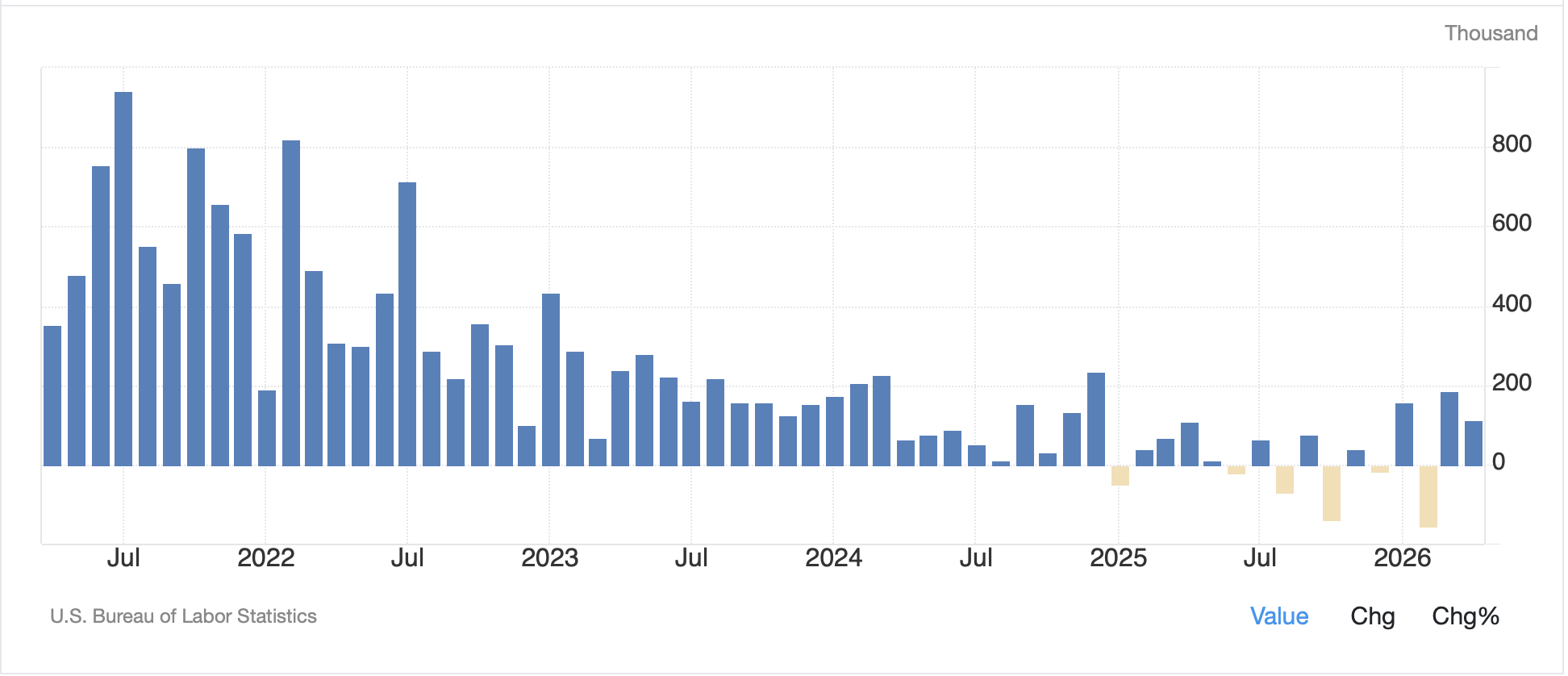
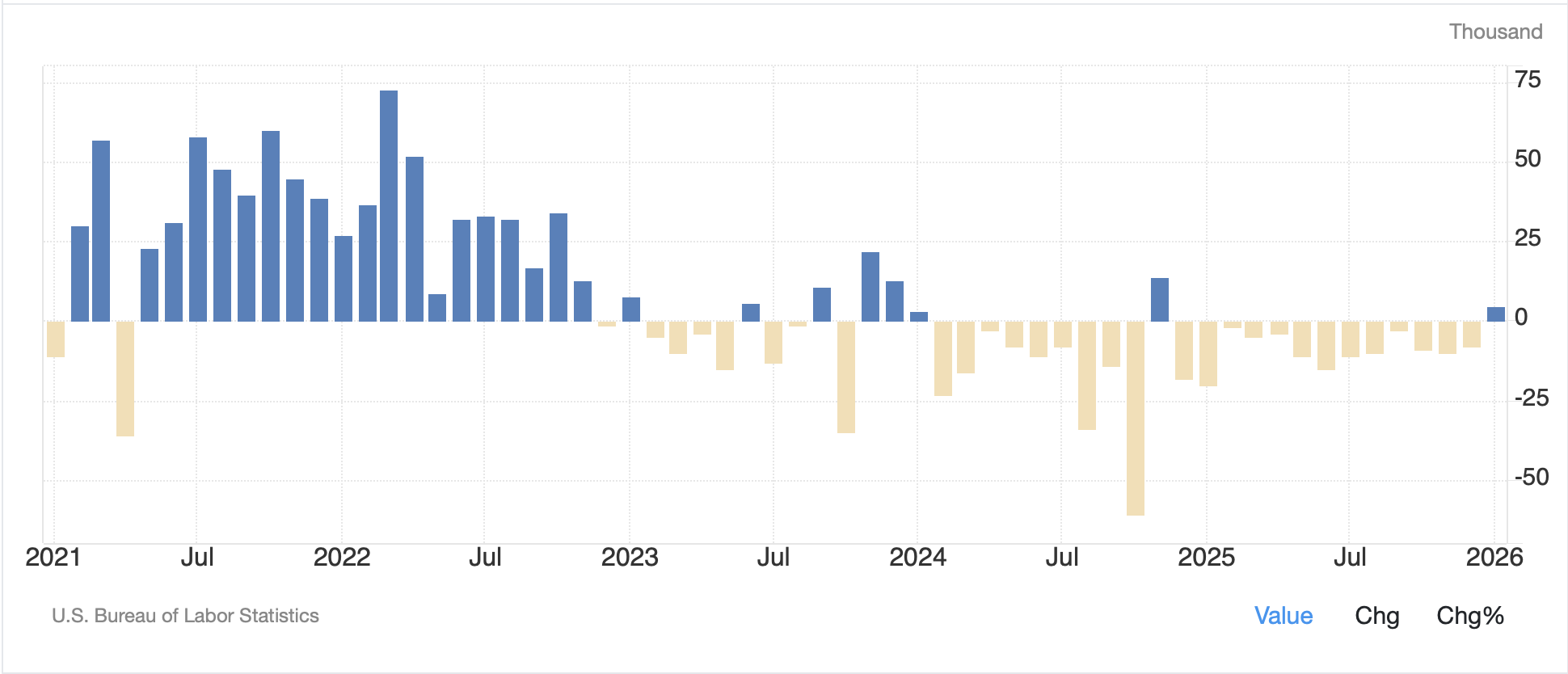
While 85K is much lower than the pre-Trump 2.0 level deemed necessary to maintain a strong labor market, it is abundantly clear that between the closure of the borders and the deportations, that is no longer the situation.  Estimates I have seen to achieve labor stability have been between 0 and 50K, and that includes comments from former Fed Chair Powell.  While an outturn at the forecast level would be lower than last month, it would still indicate the labor market is in decent condition.  Of course, one of the hardest things is to see through the revision noise as the BLS birth/death model describing new companies is clearly not representative of the current economy.  Below is a look at the past five years of monthly reports which is showing a clear trend lower, but as per the above, that may not be a problem.

Source: tradingeconomics.com

However, the other data we have seen lately, notably the strong ADP number, the solid employment subindices from the ISM data and the fact that claims data, although a touch higher yesterday, remains very contained, tells me that we are going to see a better number than forecast, something around 115K like last month.

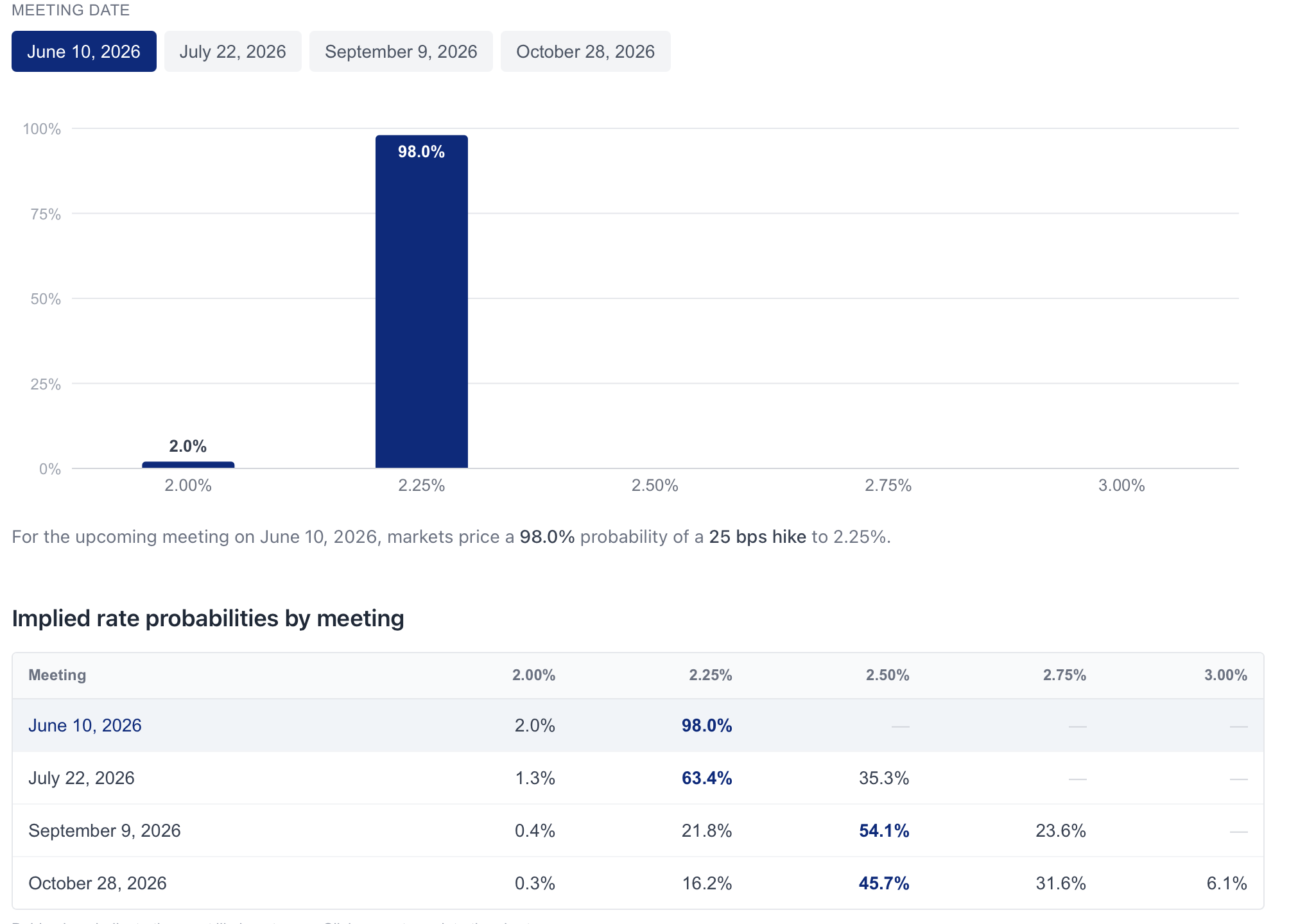
Perhaps the real question is why this matters now.  Well, as the war fades into the background, and remarkably that is what is happening, investors are back to looking for clues as to how the economy is performing and how the Fed is likely to behave going forward.  Several times this week I have highlighted the importance of capital flows, and a key part of that story is central bank liquidity being available to flow.  Thus, if the Fed sees this data and leans more toward tightening, that is likely to have a negative impact on those markets that require easy money like stocks, high-yield debt and private markets.  Interestingly, if bond traders sense that the Fed is going to pay closer attention to inflation, that should help the long end of the bond market, and we could see a bull flattener result.  Nothing has changed in the Fed funds futures market, but that is something that could really move on an outlier number here.  We will learn soon enough.

Away from that, though, the most interesting thing I have seen is the below tweet although the commentary was strongly of the opinion that this is fake news.  If it is real, that is a major breakthrough in leading to the end of the war, however, based on the fact that oil prices are essentially unchanged (-0.15%), the market does not appear to believe the story.

Ok, let’s see what else is happening in other markets.  Not surprisingly, gold (-0.25%) is also not doing much but both silver (-1.7%) and copper (-1.6%) are softer despite the fact oil’s little changed.  Metals appear to have lost some of their luster for now, but I do believe that their long-term prospects remain strong.

In the stock markets, yesterday saw the DJIA take the lead for a change, rallying to a new all-time high although the NASDAQ went nowhere as questions about the AI story are beginning to be raised.  Too, semiconductor stocks, which have been extraordinarily strong, are beginning to be questioned given the highly cyclical nature of that business.  Yesterday Harris Kupperman wrote a very interesting piece on semiconductors which I think is worth reading.

In the meantime, Asian markets followed the tech lead from NASDAQ and were virtually all lower, some extremely so.  The worst case was Korea (-5.5%) followed by Indonesia (-4.2%) but the major indices all fell as well (Tokyo -1.3%, HK -1.15%, China -1.8%).  Tech took a beating.  Of course, for Europe, since they basically have no tech, markets are having a much better day with Spain (+1.1%) leading the way followed by France (+0.5%), the UK (+0.4%) and Germany (+0.2%).  Perhaps the fact that Eurozone GDP for Q1 was revised down to -0.2% Q/Q and +0.3% Y/Y has some thinking the ECB may not (stupidly) raise rates due to the oil shock.  But if that’s the case, you cannot tell by the interest rate markets which show the current probabilities as per the ECB itself.

At this hour (7:40) US futures are mixed with the NASDAQ (-0.9%) still suffering while the DJIA (+0.2%) continues to smile.

Apparently, global bond markets are collectively holding their breath ahead of the data point as yields are essentially unchanged in the US, Europe and were unchanged last night in Asia.

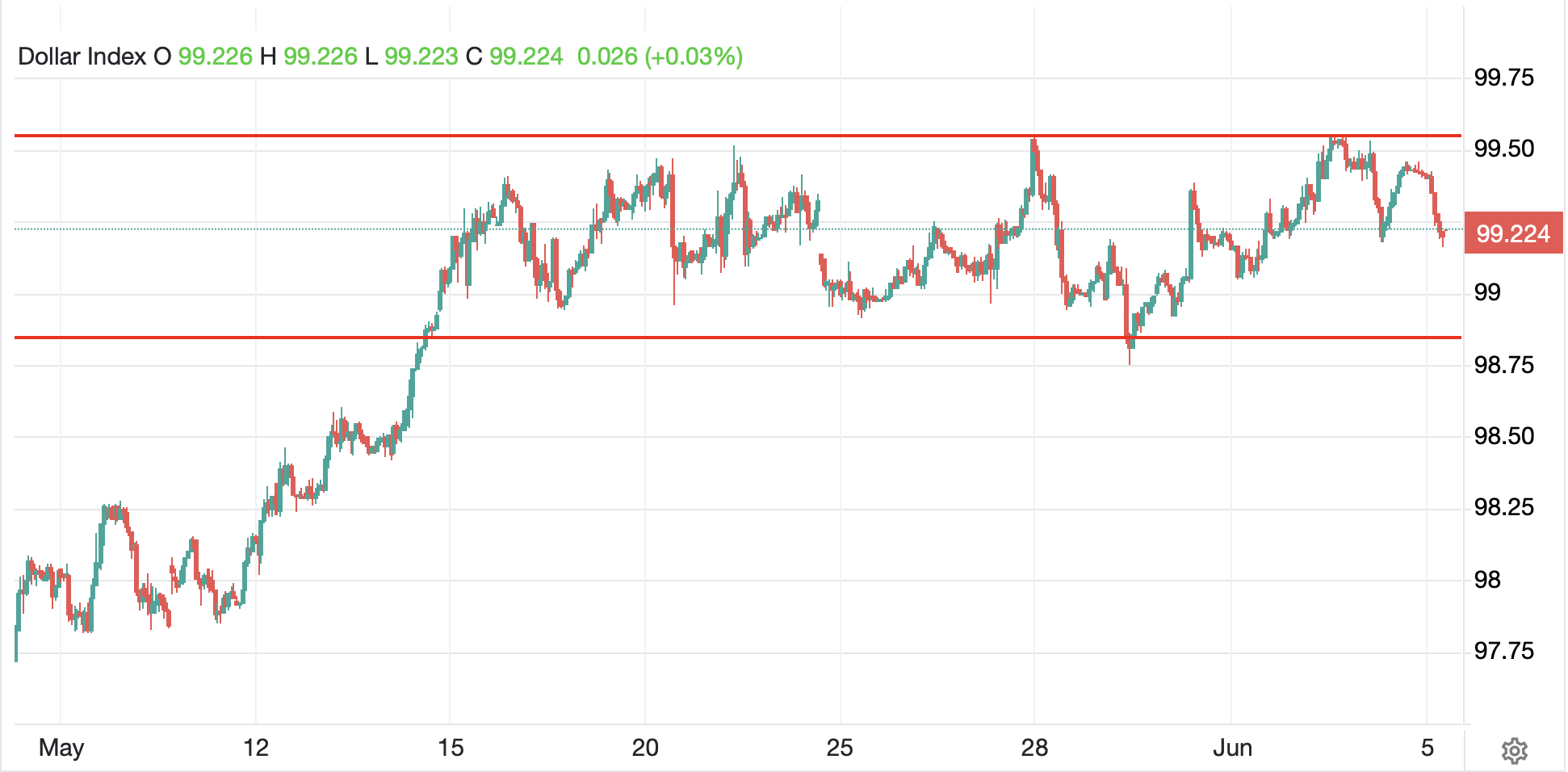
Finally, the dollar is slightly softer this morning, although remains above 99 on the DXY and is merely chopping back and forth within the extremely tight range of the past 3 weeks I show, once again, below.

Source: tradingeconomics.com

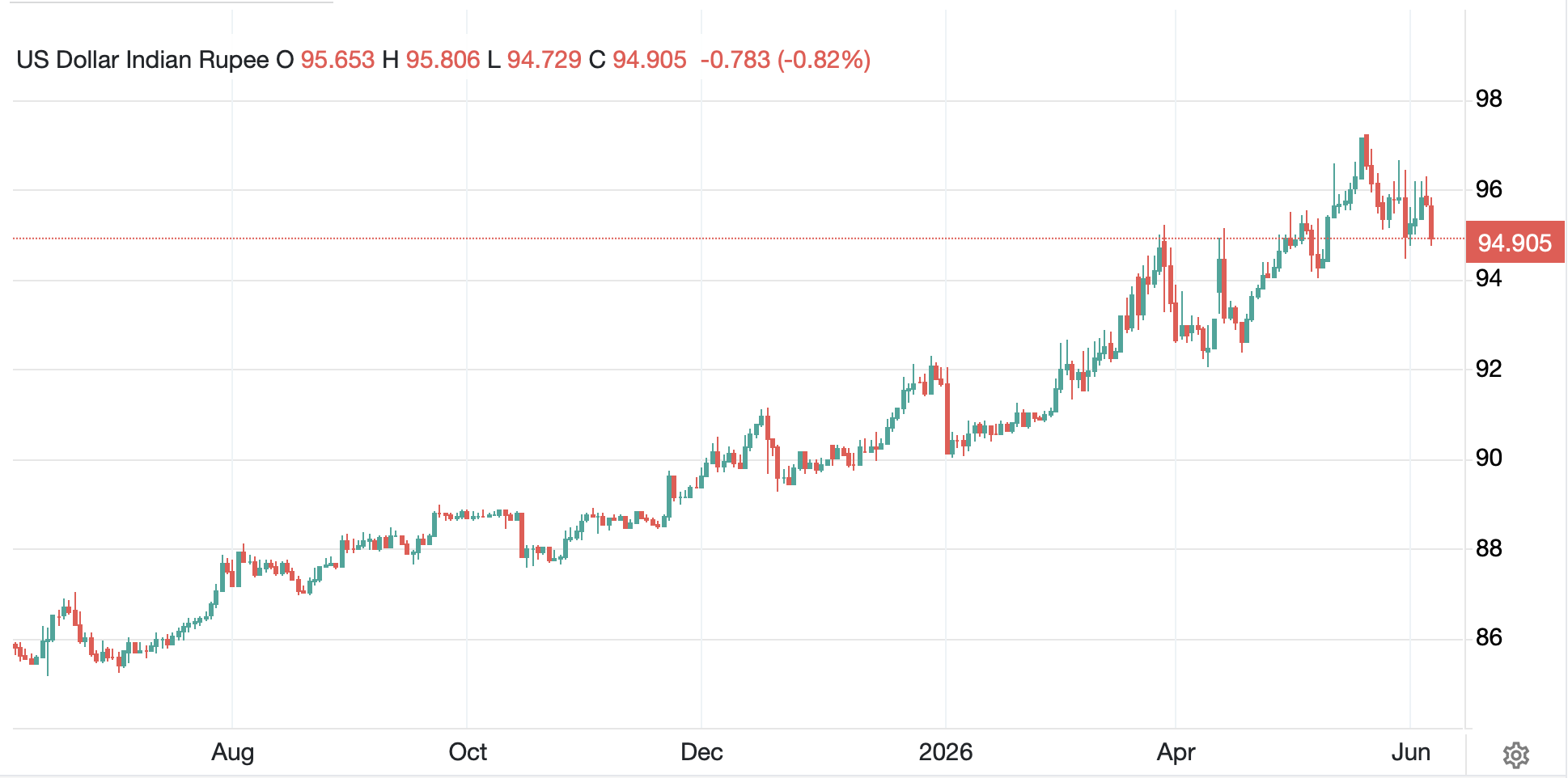
Most movement today across both the G10 and EMG blocs is +/-0.25% or less, hardly the sign of a trend.  The one exception is INR (+0.8%) after the RBI left rates on hold, as expected, but instituted several measures to try to attract foreign capital such as easing investment rules for foreigners.  We shall see if that has a long-term benefit, but at least the rupee has put a little space between the current level and the bottom (dollar top) seen two weeks ago.

Source: tradingeconomics.com

And that’s really all for today.  So, absent news about real movement toward the end of the Iran conflict, it’s payrolls then a summer Friday where many will be seeking to leave early.  If I am correct and we see a stronger number, I see the dollar benefitting which should hurt the metals, although oil is independent of this news.  Since this would imply more chance of a Fed rate hike, I expect stocks would not be pleased, nor will bonds.  We shall see.

Good luck and good weekend

Adf
Actively Chided

Ostensibly, talks are ongoing
However, some fighting is sowing
The seeds of more doubt
That they’ll work it out
Ere Tehran’s surroundings are glowing

But markets have clearly decided
An outcome will soon be provided
Thus, risk is embraced
And stocks, higher, chased
While bond bears are actively chided

I hope everyone had a nice Memorial Day weekend, although until Monday afternoon, I must admit the weather here in NJ was less than we might have hoped.  Of course, a few raindrops are nothing compared to the “defensive” attacks executed by US forces, sinking two Iranian boats while they were trying to lay mines in the Strait.  Apparently, Iran’s response, several volleys of surface-to-air missiles was met with the destruction of those launchers as well.  

There is nothing better, though, than the language Iran uses in situations like this.  According to the WSJ, the head of the national security committee of Iran’s parliament, Ebrahim Azizi, explained that any attacks on the country’s armed forces would be met with “a decisive, crushing and regrettable response.”  It certainly sounds impressive, but it is not clear they can back up those words that effectively.  I guess we shall see.

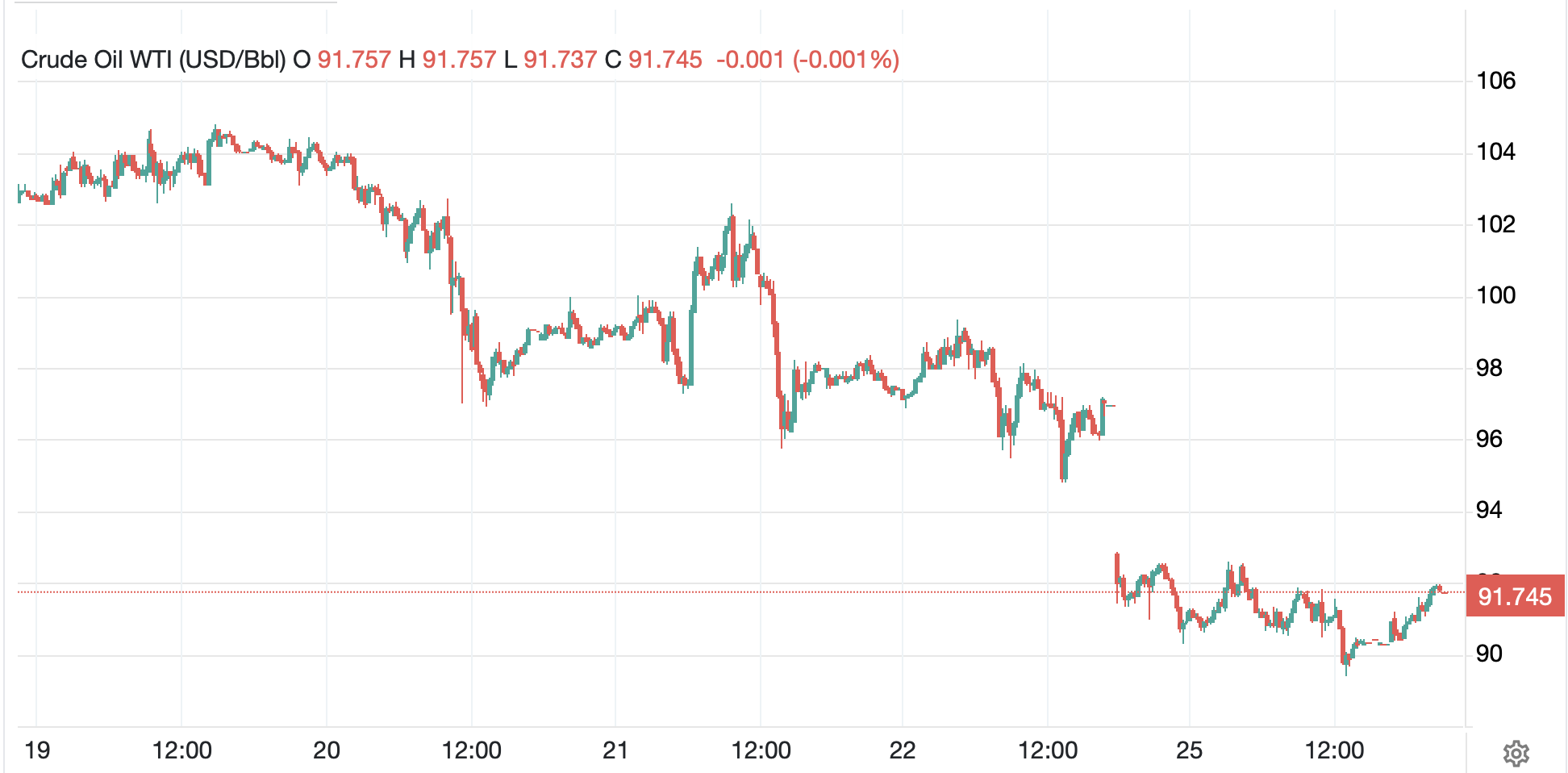
In the meantime, the other newsworthy item from the weekend was that the Supreme Leader, Mojtaba Hussein, was killed in a military strike and yet talks appear to be continuing.  President Trump explained that the framework for a deal was getting close and that was enough for traders to don their rose-colored glasses as oil gapped lower by more than $5/bbl when futures markets opened Sunday night and despite the recent “defensive” strikes mentioned above, remains far below levels seen last week.

Source: tradingecomomics.com

Not surprisingly, as Monday night trading in Asia gets underway, risk is back on with equities and metals higher, and bond yields lower.  

And as we awaken Tuesday morning, very little new has occurred.  The market continues to believe in the idea that the war is over in all but the details, at least the Iran war.  Ukraine continues, alas.  

On Friday, the latest Fed Chair
A man with a full head of hair
Was sworn to uphold
The idea that gold
To dollars, must never, compare

Before the weekend began, Kevin Warsh was sworn in as the new Fed Chair and the man has a tough job, that is for sure.  As another indication that the Fed is not an apolitical institution (as if any institution based in Washington DC could be apolitical), he hadn’t even gotten the keys to the office before two Fed governors were out opposing his very existence. The WSJ editorial page had a nice summation here which explained that Michael Barr, the erstwhile Vice Chair for Supervision who oversaw the collapse of Silicon Valley Bank (perhaps not the best credentials) was adamant that shrinking the balance sheet would lead to problems, as though he could foresee them!  Then Chris Waller, who was in the hunt for the Chairman’s seat, reversed his recent views on interest rates, explaining hikes were likely in order.  I’m sure there are no sour grapes there!

From this poet’s perspective, the financialization of the economy has been one of the biggest long-term problems we have seen and part and parcel of that financialization has been the Fed bloating expanding its balance sheet from <$1 trillion prior to the GFC to nearly $9 trillion at the height of the Covid madness and still well above $6 trillion today.  It is much harder to financialize things if there is less money around.  I fully support the idea that shrinking the Fed’s balance sheet would be a good thing.  Alas, that will be a tough road to hoe for Mr Warsh.  Good luck to him.

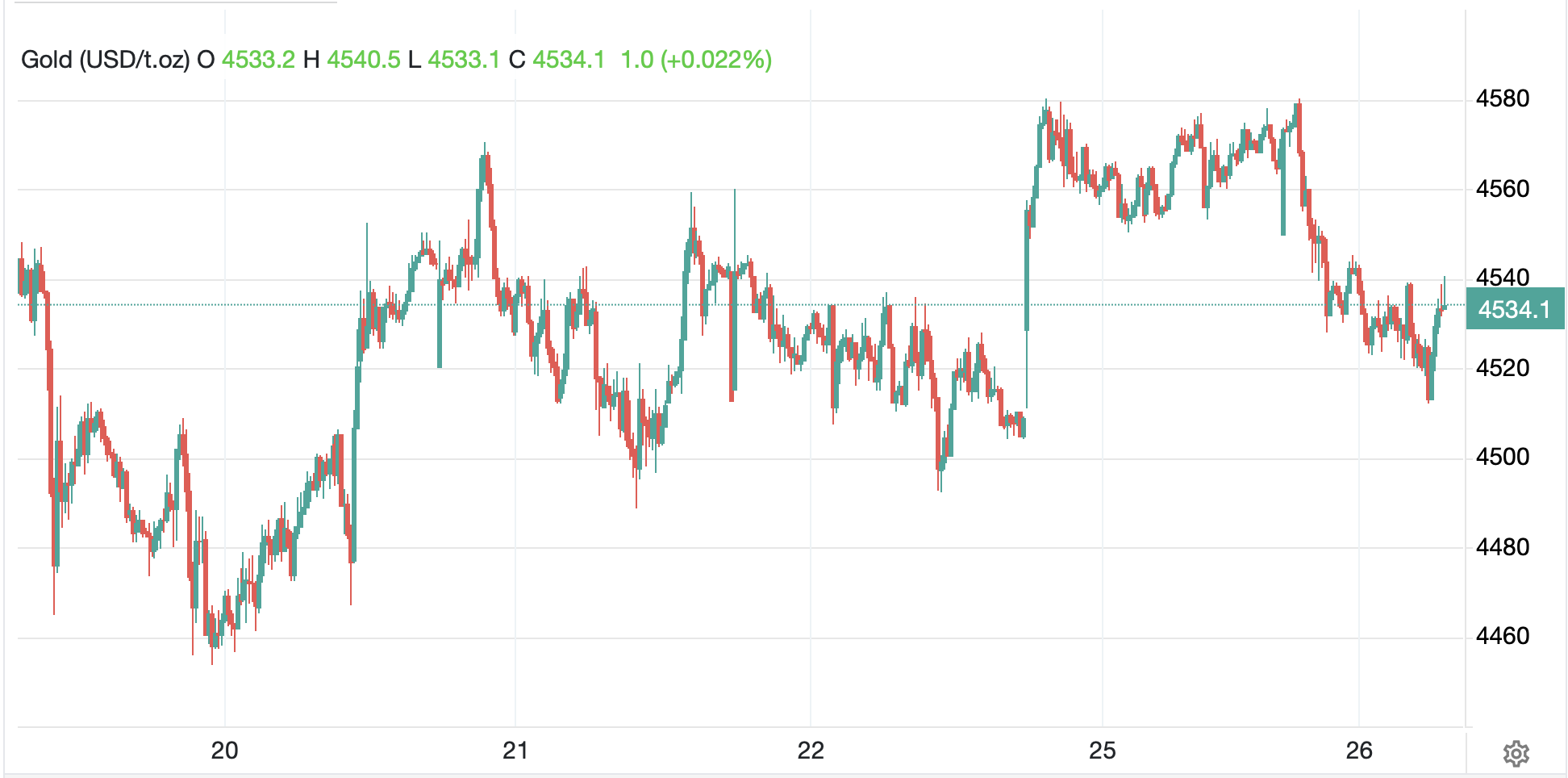
And with that, there are few other stories of note, so let’s look at the market response to the latest peace initiatives.  While we’ve already discussed oil above, gold saw the initial move you would have expected, jumping sharply, but has since given back much of those gains, as per the below chart, and is now about 0.5% higher than Friday’s close.

Source: tradingeconomics.com

Silver has seen similar price action as has copper.  Certainly, if a deal is signed, I believe we can expect oil to head back toward $75 – $80 per barrel and gold and silver to rebound sharply as well.  

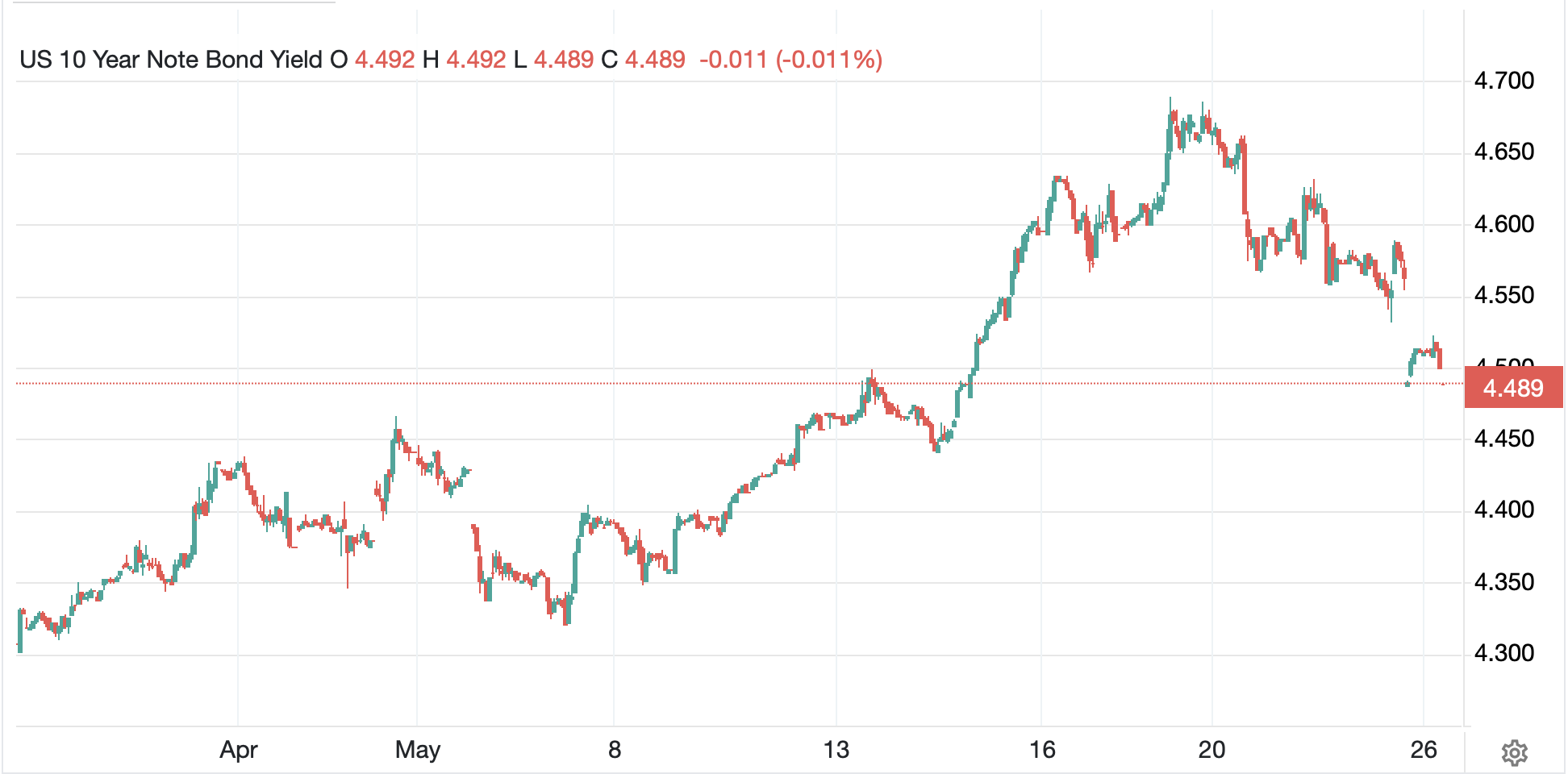
The other noteworthy mover was the bond market, which saw yields fall sharply on the news of the deal framework getting close.  You may recall the apocalyptic prognostications just last week when 10-year Treasury yields climbed near 4.70% with many discussions regarding the steepening of the yield curve and the trouble ahead for the economy.  But as I type this morning at 7:00am, the 10-year yield has dipped back below 4.50% in sync with the oil move lower as some of those inflation fears seem to be mitigating.

Source; tradingeconomics.com

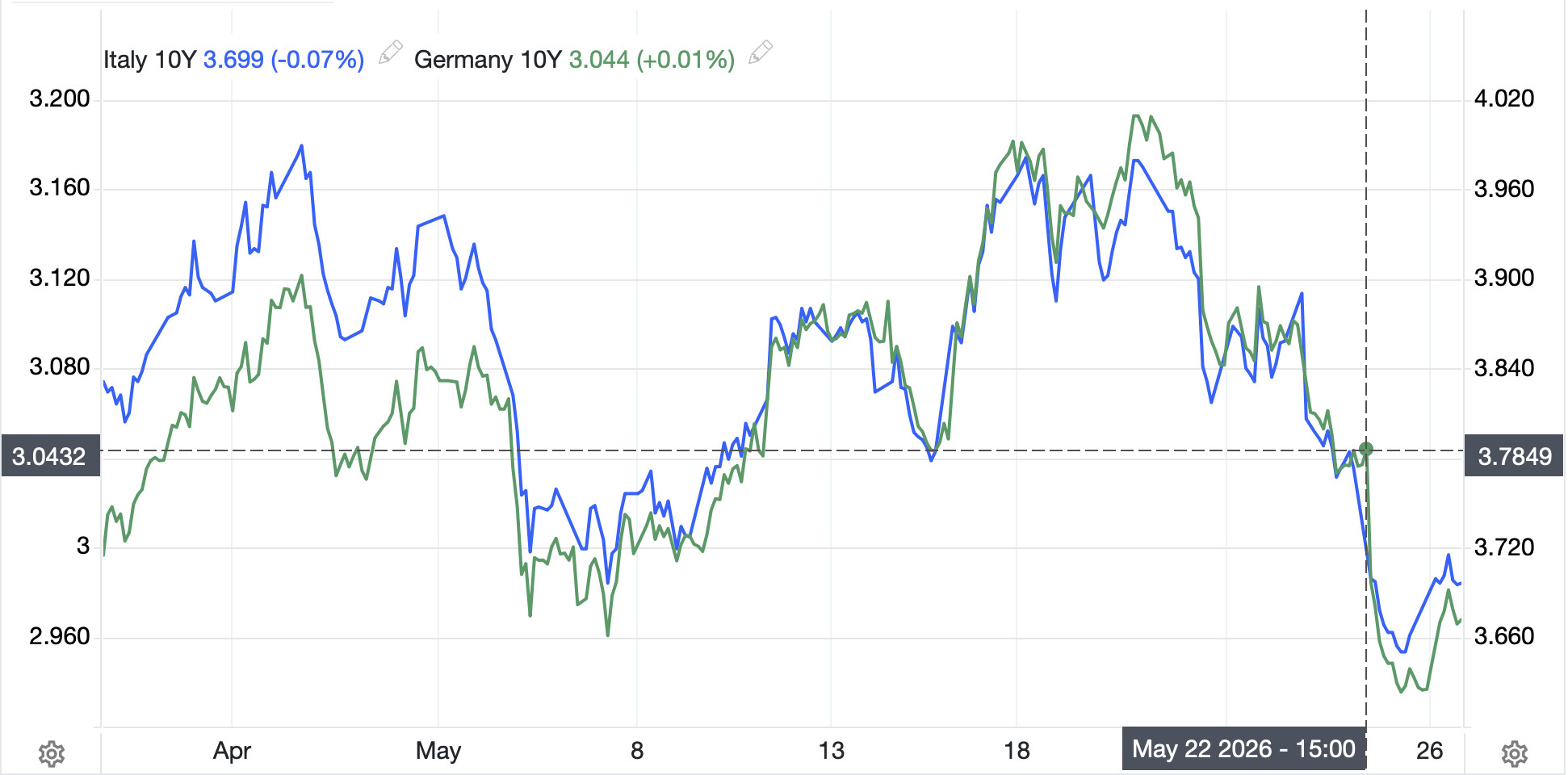
Now, as I look across European sovereign markets, they all show modest rises in yields this morning, but that is because yesterday, they fell so sharply.  Net, over the two days, yields are lower across the board.  As an example, the chart below shows both German and Italian 10-year yields and I highlighted Friday’s closing levels.  As you can see, both fell sharply yesterday and bounce a bit this morning but remain much lower.

Source: tradingeconomics.com

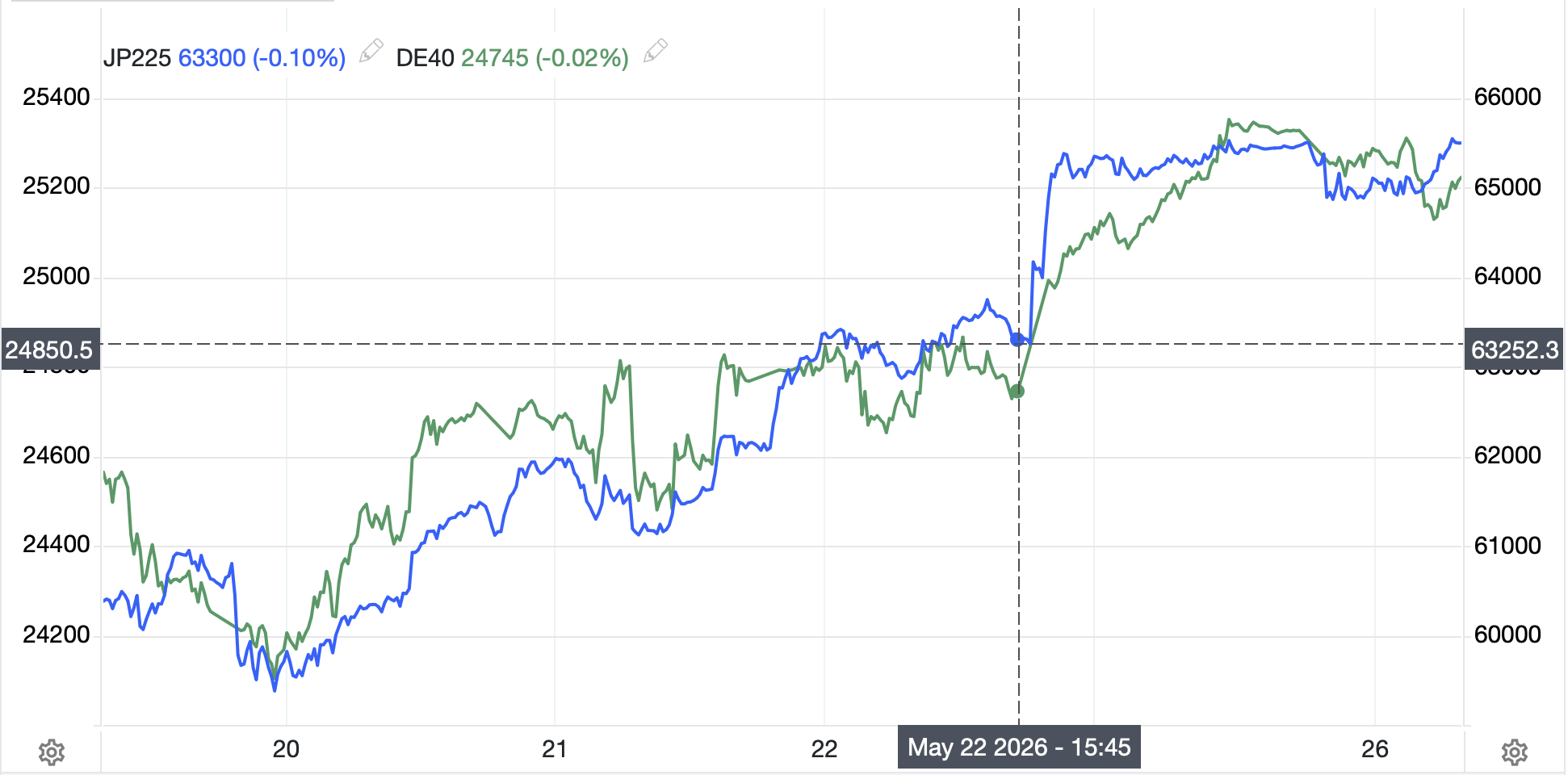
Moving on to equity markets, we have observed the same phenomena there, where there was a gap opening higher on Sunday night in futures markets which continued in cash markets while the US markets were closed for Memorial Day.  So, while last night, the Nikkei (-0.25%) slipped, that was after a more than 3% rally on Sunday night/Monday.  Ultimately, given the US holiday and the news cycle over the weekend, we need to look at the movement since Friday to get a sense of things.  So, below is a chart of both the Nikkei and the German DAX showing the rally from Friday’s late trading.  Again, risk is back baby!!

Source: tradingeconomics.com

Finally, the dollar is, well, it is all over the place this morning.  I look at tradingeconomics.com as my source for currency prices as they are all in one place.  One of the weird things this morning is that the EUR (-0.1%), GBP (-0.2%), JPY (-0.15%), CAD (0.0%), CHF (-0.2%) and SEK (-0.2%), the components of the DXY, are all flat to weaker this morning, the DXY itself is also weaker.  I have no explanation for that.  Generally, I would say the dollar is a bit firmer overall this morning with one notable exception, KRW (+0.7%) which saw demand alongside the sharp rally in the KOSPI overnight.  but otherwise, the dollar is modestly higher against most of its counterparts.  Lastly there has been a lot more noise than signal here.

On the data front, the short week does bring some important information.

TodayChicago Fed National Activity-0.3
 Case-Shiller Home Prices1.0%
 Consumer Confidence92.0
ThursdayInitial Claims211K
 Continuing Claims1780K
 Durable Goods3.5%
 -ex Transport0.5%
 Personal Income0.4%
 Personal Spending0.5%
 GDP Q12.0%
 PCE0.5% (3.8% Y/Y)
 Core PCE0.3% (3.3% Y/Y)
 New Home Sales670K
FridayGoods Trade Balance-$87.0B
 Chicago PMI49.7

Source: tradingeconmics.com

Now, with PCE coming, we are going to have to get a new line there as Chairman Warsh likes trimmed-mean PCE, which not surprisingly, has been lower of late, as the key metric for the Fed to follow.  I assume that will become the newest thing to watch.  Of course, it is far too early to have any sense of anything at the Fed now, other than the fact that there will be lots of politicking going on.

So, what have we learned?  Markets are still hopeful that the Iran conflict will end soon with a satisfactory (meaning no SOH problems) conclusion.  In that circumstance, risk will be the ongoing preferred stance, and I expect the dollar will come under pressure in that scenario, at least for a time.

Good luck

Adf
Venting Spleen

It used to be data was seen
As noncontroversial and clean
But politics, lately
Has damaged it greatly
With both D’s and R’s venting spleen
 
So, it ought not be a surprise
That yesterday’s NFP rise
Was claimed by the left
To lack any heft
While R’s crowed out loud to the skies

By now, you are well aware that the NFP number was released much higher than the forecasts, printing at 130K vs a consensus forecast of 70K.  The previous two months were revised lower by 17K, so still a huge number, and it was the main topic of conversation in the markets all day. 

To me, the big news was that private sector jobs rose 172K, while government jobs declined by 42K.  In fact, the Federal civilian workforce is back to its smallest count since 1966!  That is an unalloyed positive in my view.  Too, manufacturing jobs increased by 5K, which is the first time we have seen a rise since November 2024.  In fact, if you look at the chart below of manufacturing jobs for the past 5 years, it is easy to see what President Trump is trying to achieve.  One month does not indicate success, but it’s a start.

Source: tradingeconomics.com

The last positive was that the Unemployment Rate fell to 4.3%, so overall, this seems like a pretty good report.  But as with everything these days, it depends on the lens through which you view it.  As with most national data in an economy as large and varied as the US, there were real and perceived negatives.  The BLS made their annual benchmark revisions to the data which removed 403K jobs from 2025’s numbers.  These revisions come as they adjust their birth-death model as well as get updated population statistics.  But for those who seek bad news for this administration, that reduction of 403K jobs is proof that the president’s policies are failing.  Another complaint has been that the bulk of the increase in NFP was in the health care sector, although given the ongoing aging of the population, that cannot be very surprising.

Nonetheless, just like every other piece of data these days, NFP was a Rorschach test of your underlying political beliefs and not so much a description of the economy.  My question is, if the employed population is ~159 million, is an adjustment of 400K really meaningful?  After all. It’s about 0.25% of the working population in a measurement of a dynamic statistic amid people changing jobs and the economy growing.  Perhaps the politics are the signal, and the data is the noise.

Given that there were two very different takes on the data, it ought be no surprise that the S&P 500 finished the day exactly unchanged which is a pretty rare occurrence, happening less than 2% of the time in the past 10 years.  In fact, that lack of movement was the norm with both the NASDAQ and DJIA slipping -0.1%.  Net, I don’t think we learned much new and now markets and the algorithms will focus on tomorrow’s CPI data.

However, the narrative writers had their work cut out for them.  All those who were seeking to pan the government had to change their tune and now they are focused on the fact that there don’t need to be rate cuts if the employment situation is better.  Again, through a political lens this is good if you are anti-Trump because it prevents him getting the rate cuts he has been demanding.  I guess we cannot be surprised that Stephen Miran, in comments yesterday, continues to explain rate cuts make sense, which simply confirms the view that everything is political these days.

So, do we know anything new this morning?  Alas, I don’t think we learned anything to change the big picture yesterday, so let’s see how the data was received around the world.  Tokyo followed the S&P’s lead and was unchanged overnight with China (+0.1%) also doing little.  HK (-0.9%) lagged as traders prepare for the Chinese New Year holiday that runs all next week and took profits.  Korea (+3.1%) continues to perform well while India (-0.7%) continues to waver as the trade deal with the US impacts different parts of the economy very differently there.  Net, a mixed session.  In Europe, Germany (+1.3%) is the leader this morning on the strength of solid earnings reports by key companies as there has been no data released.  France (+0.75%) too is having a good day on earnings although Spain (-0.2%) is lagging.  The UK (+0.1%) is the only place where data made an appearance and it showed that GDP growth has fallen to 1.0% Y/Y there, another problem for the embattled PM Starmer.  It appears his time in office will be ending soon as literally every policy decision he has made has had a negative outcome.  As to US futures, at this hour (7:30) they are firmer by about 0.3%.

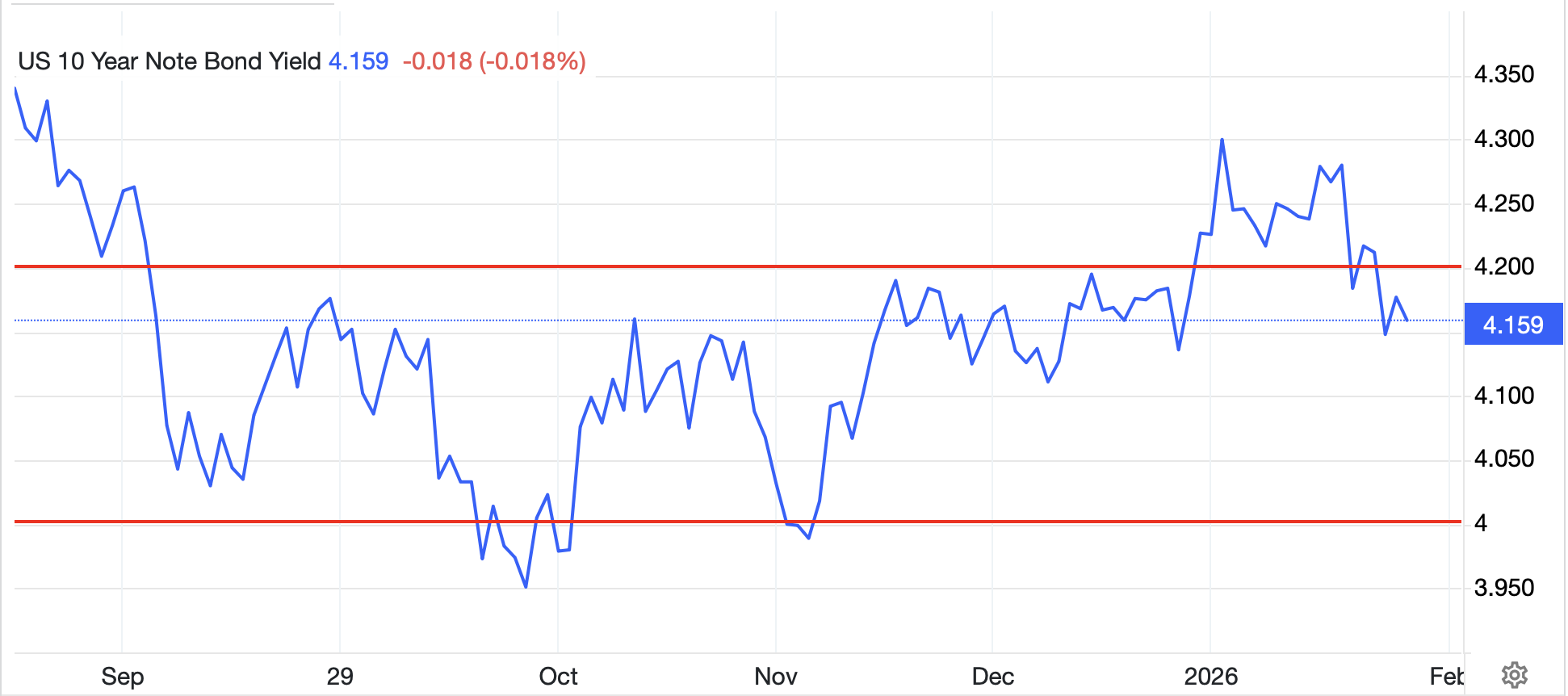
Bond markets saw the biggest move yesterday, with Treasury yields rising 4bps, although they have slipped back -1bp this morning and continue to trade in their range of 4.0% – 4.2%.  while we did spend some time above that range, it appears that fears of a bond market meltdown, or that China was going to sell their bonds or something else have faded somewhat.  In fact, globally, 10-year yields this morning are essentially unchanged.

Source: tradingeconomics.com

In the commodity space, the Iran situation continues to be top of mind for oil traders although WTI (-0.3%) is not really moving much this morning.  There was no announcement from the White House regarding the meeting between President Trump and Israeli PM Netanyahu which indicates, to me at least, that nothing was decided.  While a second US aircraft carrier steams toward the Persian Gulf, we are all on tenterhooks as to how this plays out.  Right now, it doesn’t appear that discussions between the US and Iran are leading anywhere.  Meanwhile, metals (Au -0.4%, Ag -1.6%, Pt -1.3%) are giving back some of yesterday’s strong gains with gold firmly back above the $5000/oz level again.  There is much talk of a major shortage on the COMEX for deliveries for March, but we shall see how that plays out.  Certainly, there has been no change in the demand structure for silver, but we just don’t know how much silverware has been sold for scrap to help alleviate the shortage at this point.  

Finally, the dollar is little changed vs most major counterparts with the two outliers KRW (+0.6%) on the back of strong equity market inflows and CHF (+0.4%) which appears to be the one haven that is behaving like one this morning.  JPY (-0.2%) has strengthened several percent over the past week, and comments from the latest Mr Yen, Atsushi Mimura, make clear they continue to watch the market closely, but for right now, there seems little concern, or likelihood, that intervention is coming soon.

One thing the NFP data did achieve was to alter the Fed funds futures market which now is pricing just a 6% probability of a rate cut at the March meeting with two cuts priced for the year.  I have to say that based on the comments from Logan and Hammack, as well as the NFP data, it certainly doesn’t appear likely that the Fed is going to cut again soon.  Tomorrow’s CPI data may change some opinions there, but we will have to wait to find out.

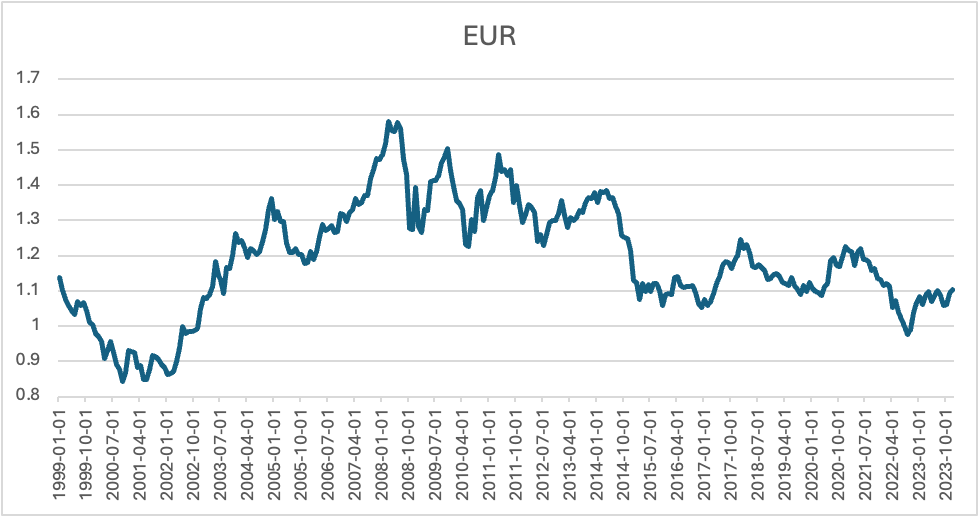
But riddle me this, if the Fed has finished its loosening cycle, and Kevin Warsh is seen as someone who is keen to reduce the size of the Fed’s balance sheet, why would we think the dollar is going to decline sharply from here?  For now, the buck remains rangebound, but as I watch what is going on elsewhere around the world regarding economic activity, the US continues to lead the way.  I still don’t see the dollar collapse theory making sense, although frankly, I think the administration would be fine with it.  Let me leave you with the entire history of the EURUSD exchange rate since its inception in 1999 and you tell me if you think the dollar is exceptionally weak or strong here.  Remember, a weak dollar is a strong euro, so higher numbers.  Frankly, it feels like we are close to the middle of the range, or if anything, stronger rather than weaker.

Source: data FRED, graph @fx_poet

Good luck

Adf
Dissension

It seems that there’s still quite some tension
As metals and stocks show dissension
Though Friday both puked
Of late, metals juked
Much higher, to stocks contravention
 
So, what can we learn from this split?
That tech stocks all now trade like sh*t
While silver and gold
Are what folks will hold
And bonds? No one just gives a whit

It seems the government shutdown has ended, just as quickly as it began and the only people impacted are traders who were looking forward to the NFP data on Friday.  Given the shutdown was only for a few days, and that apparently, all the data was already collected, it was the compilation that was being delayed, I presume we will get the numbers next week.  Of course, this is a government bureaucracy, so it may take a bit longer.  Nonetheless, this morning we see the ADP Employment number (exp 48K) and analysts will have to work from that, plus the reports like the ISM hiring data, to give their views of the economy.  It really all does seem like theater, I must admit.

Anyway, away from that, the only other news of note that is impacting markets has been an increase in tensions in Iran after the US shot down an Iranian drone heading toward the US aircraft carrier, Abraham Lincoln.  However, it appears that talks are still scheduled for Friday, so oil (+0.2% today, +1.4% since yesterday morning) is creeping back higher, although remains well below the levels seen last week when concerns over a US attack there were mounting.

Source: tradingeconomics.com

Which takes us to markets and what appear to be the key internal drivers.  Starting today with stocks, the narrative revolves around concern that AI is going to destroy software companies and SaaS models since their user base will no longer need those companies.  As well, there are the lingering concerns about the AI investment bubble and the circular dealing between Nvidia and its customers being an indication of the end of the era.  This is akin to what happened during the tech bubble in 2000-01 and has been highlighted by numerous analysts for several months, although is gaining more traction of late.  Finally, the Business Development Companies (BDC’s) and PE firms are under increasing pressure as their portfolio of loans and positions, many of which are being hurt by AI, are starting to hemorrhage cash.  This trifecta has been weighing on the NASDAQ, preventing any significant strength, although other sectors, notably energy and materials, have been doing pretty well.

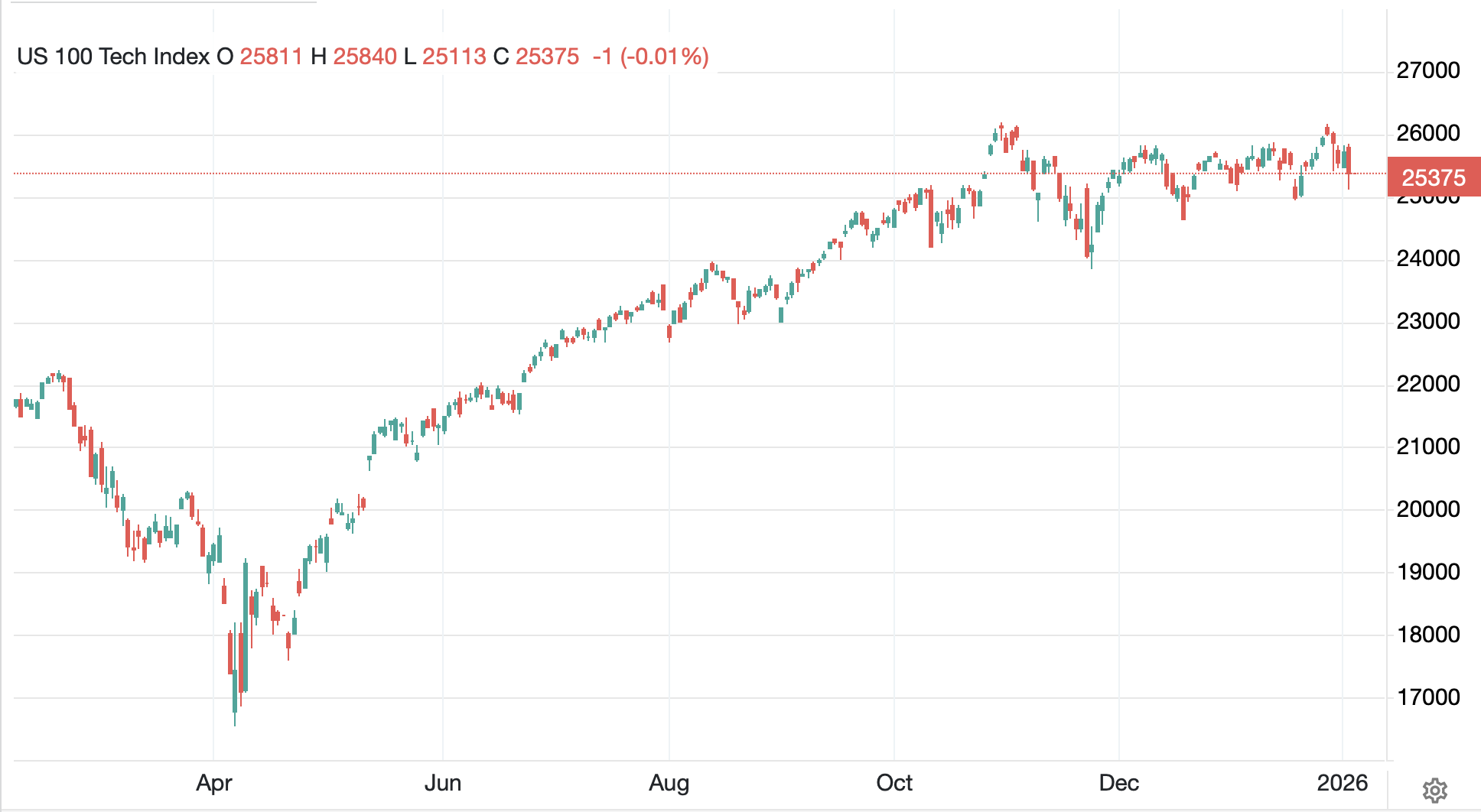
The funny thing is, while the NASDAQ (-1.4%) fell yesterday amid widespread US equity weakness, if I look at the chart (below from tradingeconomics.com) it doesn’t seem that negative, rather it seems to be consolidating ahead of another leg higher.  But then, I am no technician, so don’t pay attention to me.

However, the narrative is strong here that the world is about to end because Nvidia hasn’t made a new high in the past three months.  I am no tech stock expert, but my take from the cheap seats is that future equity market outcomes are going to continue to be reliant on the success of the Trump administration’s plans regarding reshoring and changing the nature of trade.  It is likely to be bumpy, especially if the Fed does not cut rates to support equity markets, especially since that has been the MO for the past 40 years.  But I remain positive overall.

Looking around the rest of the world, last night saw a mixed picture, although definitely more green than red.  While Tokyo (-0.8%) slid along with Malaysia and the Philippines, the rest of the region had a nice session led by Korea (+1.6%), China (+0.8%) and Australia (+0.8%).  It appears the tech fears were less concerning there, either that or PE and BDC companies aren’t yet so prevalent.  In Europe, meanwhile, despite mixed PMI Services data, there are more gainers than laggards led by the UK (+1.0%), which does have miners, benefitting from the rebound in metals prices.  But France (+0.9%) and Spain (+0.15%) are also higher although Germany (-0.2%) is lagging after a modest miss in the PMI data. As to US futures, at this hour (7:15), they are pointing higher by about 0.25%.

Back to metals, which continue to be THE story these days, gold (+2.0%) has reclaimed the $5000/oz level and while it is lower in the past week, remains nearly 17% higher YTD.  Silver (+6.0%) is also rebounding nicely along with platinum (+3.8%) as more and more discussions have ascribed last Friday’s rout to month end delivery and position issues amongst a few very large players who were able to prevent some major damage to their own balance sheets.  However, as I have maintained all along, the fundamentals are unchanged; there is a shortage of silver for industrial use and has been for several years.  As to gold, there is no indication that central banks have stopped buying.  These continue to be long-term plays and will likely drag the entire metals sector along for the ride.

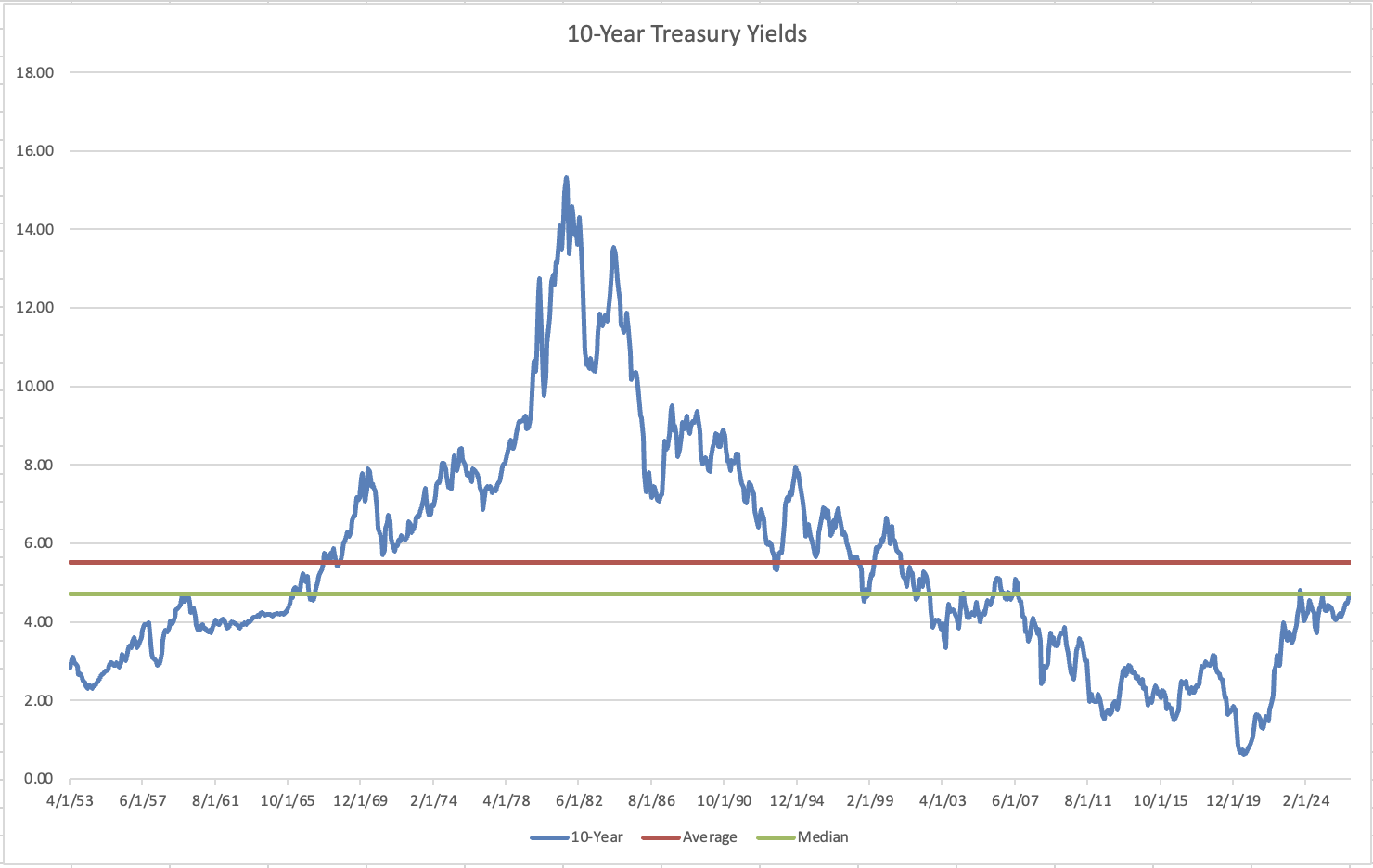
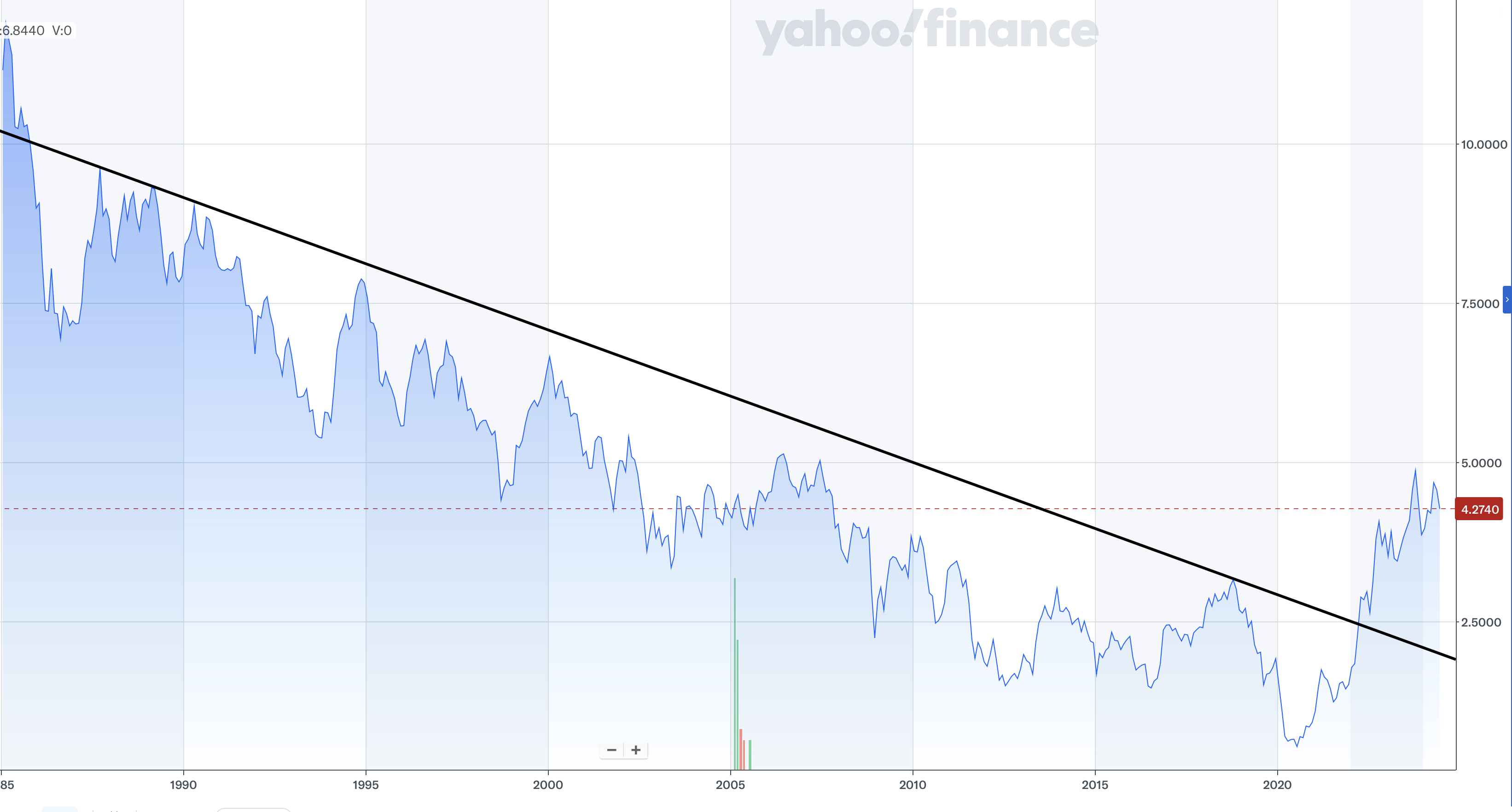
What about bonds, you may ask?  Well actually, nobody is asking about bonds!  They remain mired in a tight range with dueling narratives about the long-term view.  On the one hand, there are those who continue to look at the US debt load, and the expectation of fiscal deficits as far as the eye (or the CBO) can see, and expect supply issues to dominate, forcing the government to seek inflation to create the soft default necessary to pay back the debt.  They will point to the long-term trend, which saw yields decline for 40 years and then reverse back in 2020 (see chart below from finance.yahoo.com) as evidence that yields are going to trend higher for the next decades.

On the other side, you have those who believe the future is deflationary, with AI driving massive increases in productivity and driving down prices, while focusing on Truflation’s recent readings of 1.0% and claiming that is the way.  Personally, I have more sympathy for the former view than the latter, as it is increasingly difficult for me to understand the view that AI will be able to achieve all its currently stated desires without sufficient energy and materials, whose increasing prices are going to limit any downside in inflation.  As well, while a Warsh Fed chairmanship may strive to change the current central bank model of QE whenever needed, there is zero evidence any other central banks are going to follow suit.  

In the meantime, the tension between those two views has kept yields in a very tight range for a while, and we need an exogenous catalyst to break that range.  Peace in Ukraine?  War in Iran?  I’m not sure.

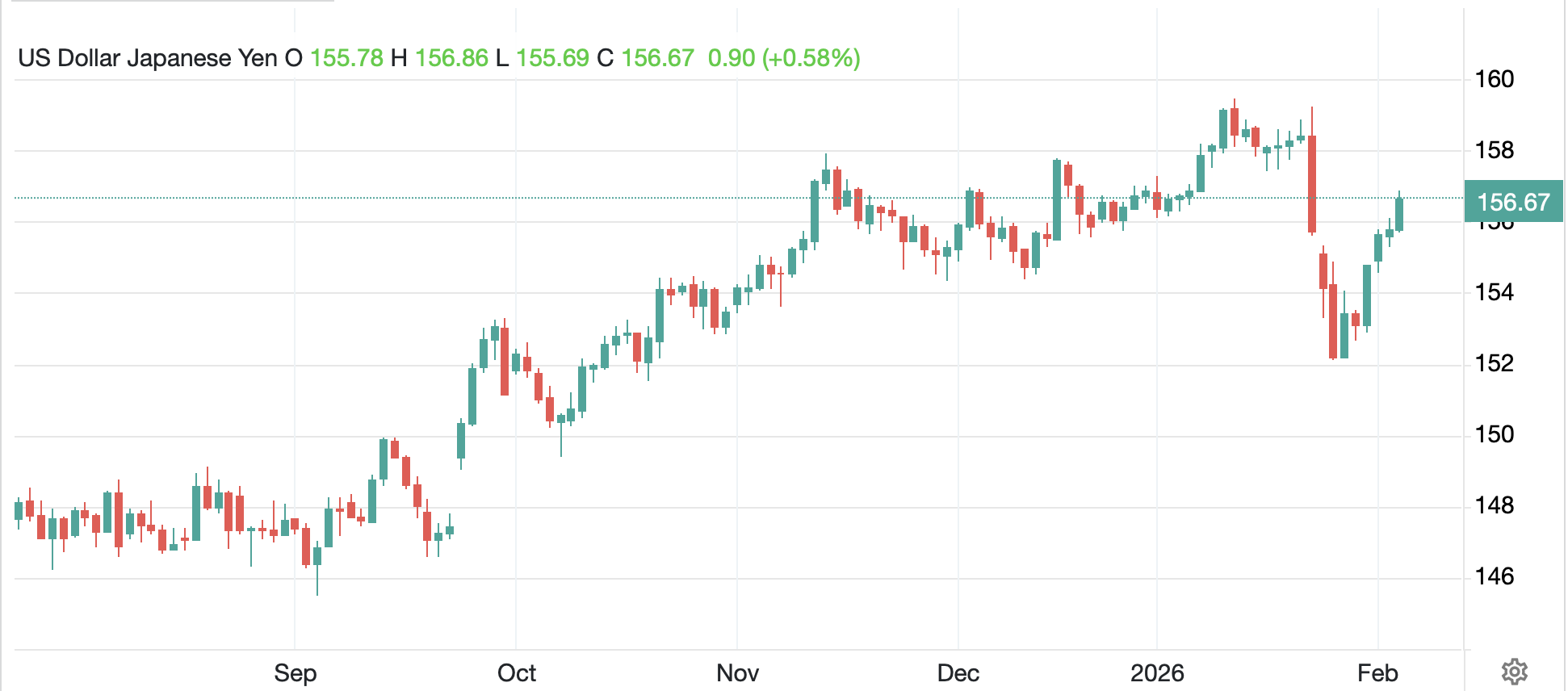
Finally, the dollar is a touch firmer this morning, notably against the yen (-0.6%), which continues to give back its gains from two Friday’s ago when the Fed ‘checked rates’ in the NY session as seen in the chart below.

Source: tradingeconomics.com

However, the point was made this morning, and it is a good one, that while Japanese 10-year yields are at 2.24%, 10-year yields, 10-years forward are about 4.10%, which would be a devastating yield for the Japanese government given its debt/GDP ratio remains above 230%.  It is difficult to get excited about owning the yen with that backdrop, especially given the demographic implosion of population that is ongoing there.  As to the rest of the currency market, Zzzzz.  Aside from the narrative of the dollar is dead, which gets recycled by somebody every day, it is very hard to look at recent price action and think something remarkable is going to happen.  We will need major monetary and fiscal policy changes, which while they may arrive, are going to take quite some time to get here.

And that’s really it this morning.  Aside from ADP, we get the ISM Services (exp 53.5) and we get the Quarterly Treasury refunding announcement, which will garner a great deal of attention only if Secretary Bessent explains he is going to issue more bonds and less bills, which seems unlikely.  Monday’s ISM data was quite strong.  Strength today could well portend that the US economy has a bright future ahead, in the near term, and that should support stocks and the dollar, while commodities will benefit from the increased demand.  Bonds?  Well, we’ll see which side of that argument is correct.  And what happens if the deficits are smaller than expected?  That is the question nobody is asking because the ‘smart’ folks don’t believe it is possible.  Remember, the dollar is still king.

Good luck

Adf
Tired

Though recently there’s been a ton
Of news, which has led to much fun
The markets today
Have little to say
Though recent trends ain’t been undone
 
Sometimes traders simply get tired
And find, in a rut, they’ve been mired
But you needn’t worry
‘Cause soon they will scurry
To come back with ideas inspired


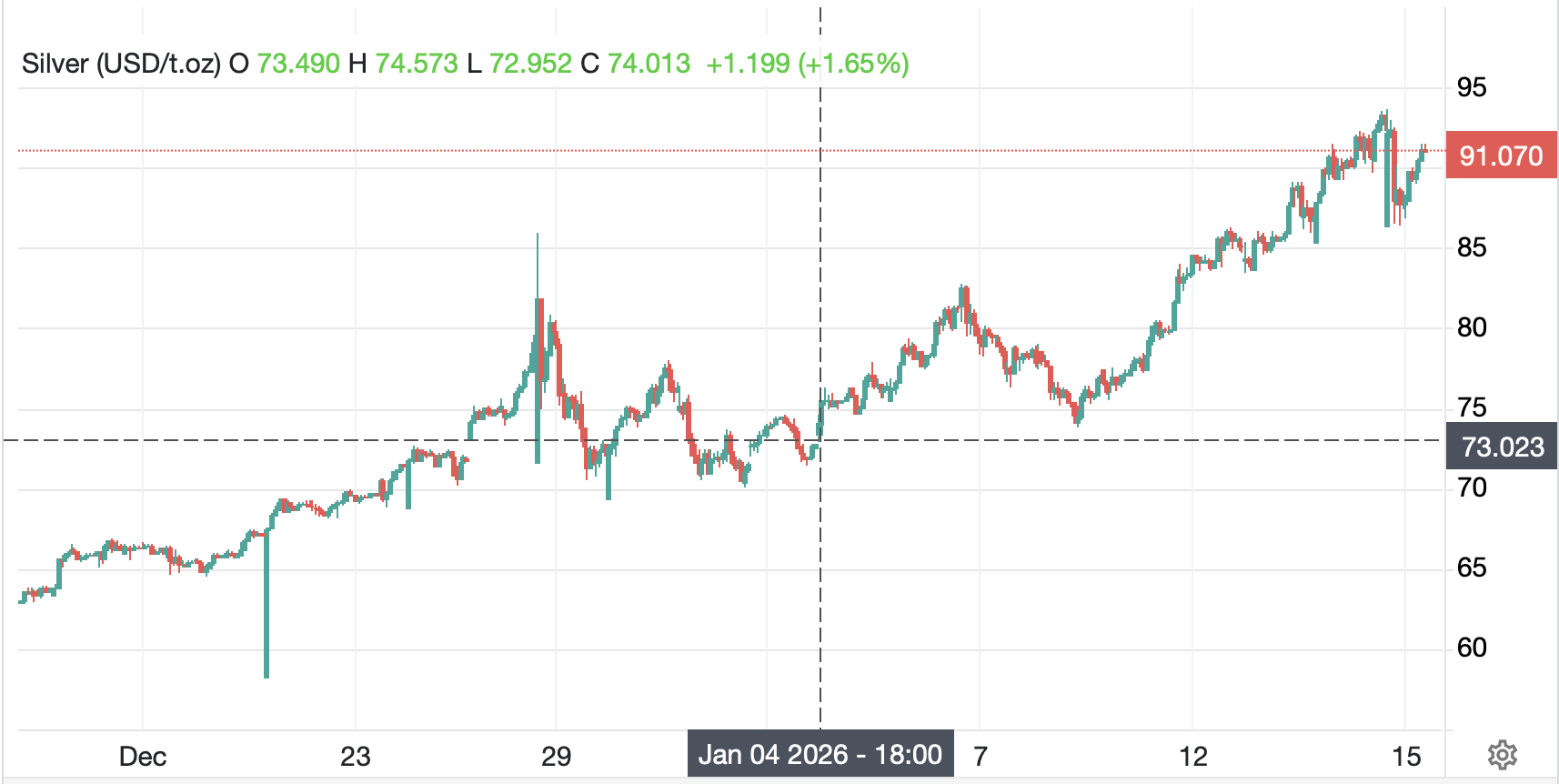
As much activity and new news that has been part of the process over the past several weeks, today is one of those days when it appears we may be able to step back and catch our collective breath.  One thing I have observed throughout my career on trading desks is that no matter the underlying news, narrative or data, traders, even algorithms, can only remain in a frenzy for so long.  Consider it has been nearly two weeks of nonstop news since the US exfiltration of former Venezuelan president Maduro, yet some markets have exploded.  Silver is probably the poster child for this price action and as you can see below, since markets reopened after that news, gold’s little brother has risen nearly 25%, including today’s modest -2.3% retracement.

Source: tradingeconomics.com

But all the precious metals, and base metals as well, have had massive runs and the narrative regarding supply constraints and increased strategic purchases by China along with the US labeling many as critical national defense requirements, has been enough to bring retail into the mix.  But a 25% move in less than two weeks is really exhausting for the folks who are in those markets every day.  

At the same time, the amount of energy that has been consumed regarding Greenland, Iran and Minneapolis (which even though it is not a market related issue, is so widespread in its reporting takes up space in one’s brain) seems to have reached a peak yesterday, at least a local maximum.  I don’t, for a minute, believe that these trends have ended.  But a few sessions of modest net movement as positions are adjusted is a normal response to dramatic movement.  We should welcome the rest!

Reading through as much as I could find this morning, there really is no new story on which to hang your hat, so without further ado, I will review overnight market activity and perhaps ponder how things may evolve going forward.

A key sign of the slower activity was yesterday’s US equity markets where modest declines were the order of the day.  That was followed by a mixed session in Asia with some gainers (China +0.2%, Australia +0.5%, Korea +1.6%) and some laggards (Tokyo -0.4%, HK -0.3%, Taiwan -0.4%, India -0.3%).  Other than Korea’s strong session, which was inspired by central bank and government efforts to get investment to come back home to support the won, it appears traders are now biding their time ahead of the next major event.

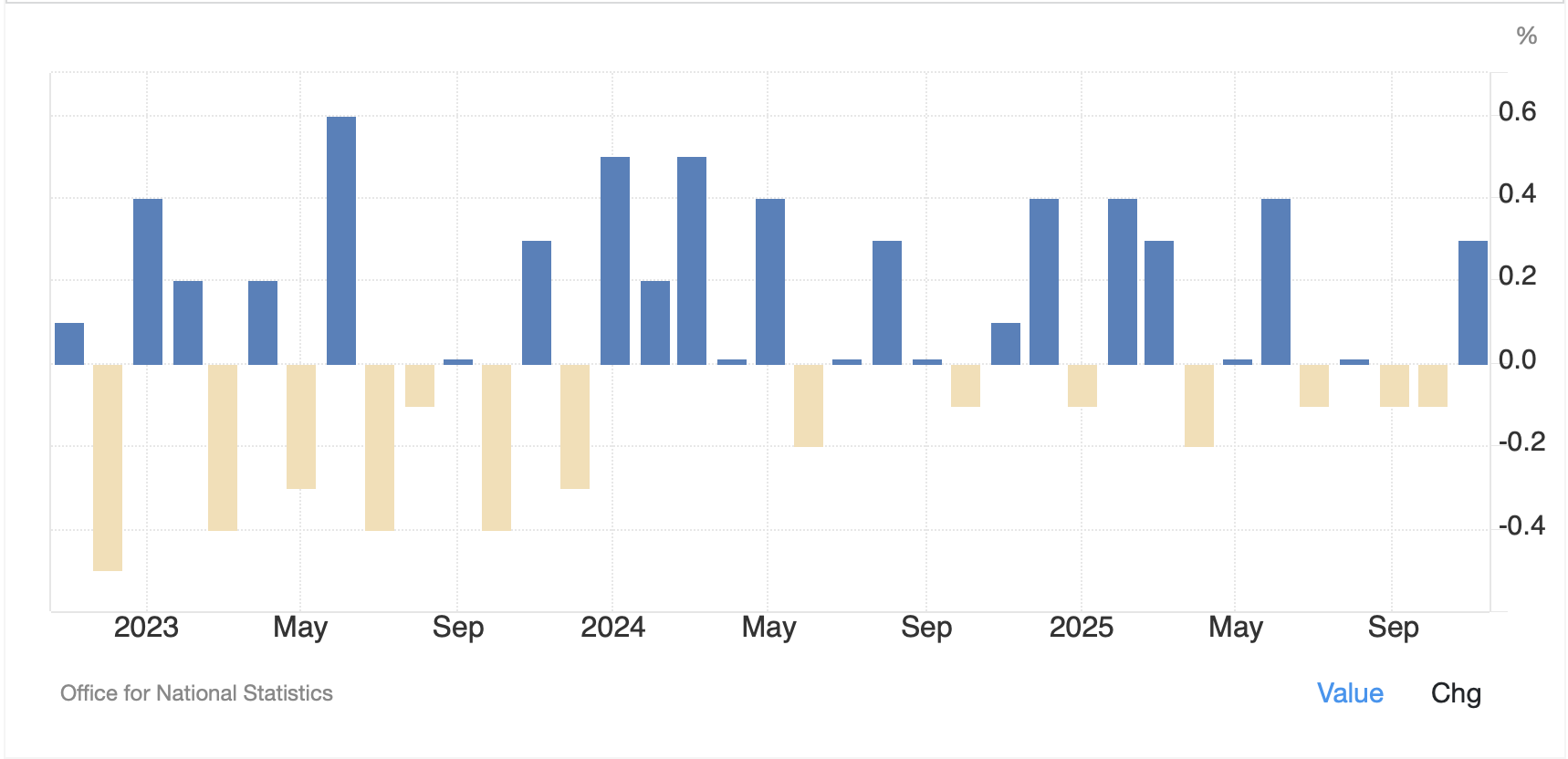
European bourses are also mixed (Germany -0.1%, France -0.3%, Spain -0.1%, UK +0.4%) with the UK benefitting from a stronger than expected GDP report where growth jumped to 0.3% on the month, well above expectations of a 0.1% increase.  But a look at the chart below indicates one ought not get too excited about the economic growth in the UK with 14 negative months in the past 3 years.

Source: tradingeconomics.com

As to US futures, at this hour (7:10) they are pointing higher, currently almost exactly offsetting yesterday’s declines.

In the bond market…ZZZZZZ is the story of the day week month past four months as evidenced by the chart below.

Source: tradingeconomics.com

There are a number of conflicting narratives here with one story that the economy is going into a tailspin as a look beneath the headline data shows weakness everywhere (housing, employment, manufacturing) and the result is rates will fall along with inflation because of the coming recession.  Another narrative is that the ongoing debt expansion to fund unending budget deficits in the US is going to lead to the collapse of the dollar and much higher long-term rates as investors require far more payment to hold this much riskier than previously assumed asset.

Right now, neither of these seem to be living up to their promises.  Yesterday’s Retail Sales print was much stronger than expected at +0.6%, which hardly portends a recession.  Now, the CPI data has been polluted by the missing October numbers and is biased downward based on the BLS methodology, but you can be confident that it will recoup those losses in a few months’ time.  Meanwhile, there is no indication the Fed is going to do anything in two weeks, and my take is there is significant uncertainty over the future direction of the economy, with both positive and negative pieces.  Until we get indications that growth is either truly cratering along with rises in unemployment, or that things are exploding higher, remaining in the range seems the most likely outcome.  Remember, too, the OBBB is going to goose economic activity right away and running it hot remains the mantra.  

As to European sovereign yields, they have edged higher by 1bp this morning with one outlier, Portugal (+13bps) which seems to be reacting to the prospect of a runoff in the presidential election this Sunday, in the race between a populist outsider and a Socialist party insider, with the populist seen a slight favorite.  As to JGB yields, they have slipped back -2bps as the market becomes accustomed to the idea of the snap election.

In the commodity space, oil (-3.6%) has ceded most of its recent gains after President Trump indicated that there would be no bombing by the US, and the Mullahs ostensibly promised no executions of protestors.  Added to that was a massive build in inventories reported yesterday and supply concerns have abated.  In the metals markets, we are seeing that breather across the board (Au -0.25%, Ag -2.3%, Cu -0.8%, Pt -0.6%) which is very clearly profit taking after we saw record highs in all metals yesterday.  Nothing has changed the fundamentals here, so higher is still the way, IMO, but a few days of chop ought not be surprising.

Finally, the dollar appears to have found a comfortable home at 99.00 in the DXY.  There has been limited movement across the board with even JPY unchanged on the day as traders wait before trying to push the currency lower again.  KRW (-0.3%) is the worst performer today as it has been weakening steadily for a year.  Adding to the discussion above, the Korean government is trying to internationalize the won to some extent in their effort to get Korea taken out of the emerging market bucket for markets.  This relaxing of restrictions has seen capital outflow, but my take is this will be temporary as the country remains in very good fiscal and economic condition and will attract investment in my view.  Otherwise, there is nothing of note.

On the data front today, we get the weekly Initial (exp 215K) and Continuing (1890K) Claims as well as Empire State Manufacturing (1.0) and Philly Fed (-2.0) all at 8:30.  We hear from 3 more Fed speakers and it seems the hymnal now contains a single talking point, Fed independence is crucial and the subpoenas to Powell are lawfare and inappropriate.  Only Steven Miran is not singing that tune, but given he is Trump’s appointee, that is no surprise.

As commodities, and really metals, have driven the entire narrative lately, if they are going to have a quiet day, look for quiet all over.  Longer term, nothing has changed, but nothing goes up in a straight line, and that is what we are witnessing today.

Good luck

Adf

A Vision For ‘Twenty-Six

(With apologies to Clement Clarke Moore)

Tis the first day of trading in Ought Twenty-Six
With too much attention on raw politics
At home, eyes have turned to the mid-term elections
To see if results will force mid-course corrections
In Europe, they’re going all-in on Ukraine
With more billions promised, though that seems insane
Meanwhile, Mr Xi is convinced he can fix
The problems at home with his policy mix
And this, my friends, just skims the surface of things
As pols everywhere suffer arrows and slings
Remember, though, markets are what I’m about
And while I could err, I am never in doubt.

Let’s start at the top with Growth here in the States
Which likely will show more than marginal rates
In fact, Four percent seems a viable goal
As inward investment and tax cuts take hold
Remember, for Trump, if there’s one thing he’s not
It’s timid, and so he’ll demand, “Run it hot!”
Thus, growth will expand, though inflation might gain
And for the elections, that could be a pain
The problem is Jay, and whoever comes next
Have come to believe two percent’s just subtext
The greatest unknown is on government spending
And whether it grows or, at last, starts descending

The punditry’s certain the government fisc
Is going to increase inflation’ry risk
If true, CPI of near Four percent’s apt
If not, then Inflation ‘neath Three, could be capped

And what about elsewhere, in Europe? Japan?
In markets, emerging, do they have a plan?
Will they grow their ‘conomies, drawing investment?
Or will we soon witness a large reassessment?

In Europe, they claim they’ll be building more guns
To help them defend all their daughters and sons
As well, they’re committed to helping Ukraine
Continue to fight, despite so many slain
They’re planning to borrow a cool 90 Bill
But energy costs, these grand plans could well kill
Meanwhile, M Lagarde claims that rates are just right
And given growth there’s One Percent, I won’t fight
So, weak growth and low rates and energy blues
Lead me to believe that come year-end, the news
Will be that the Euro is failing to thrive
Do not be surprised when it hits One oh-Five

In England and Scotland and all the UK
Just like in the EU, they can’t make much hay
The budget’s a wreck yet they want to raise taxes
Though history shows growth will wane ere it waxes
As well, they continue their crack down on speech
While crimping their energy industry’s reach
So, power is costly, and billionaires flee
From here, ‘cross the pond, this is what I foresee
A ‘conomy heading right into stagflation
As long as Kier Starmer is leading the nation
For markets, the Pound will lose all its allure
With One-Ten the Boxing Day screen price du jour

A turn to the East where the Sun Also Rises
Will teach us that, really, there are no surprises
To date you’ve heard much ‘bout the rise in yen rates
With pundits opining the Carry Trades’ fates
This year, so they say, look for much stronger yen
As local investors buy yen bonds again
Thus, all the hedge funds who’ve been funding their trades
By borrowing yen, and they’ve done so in spades,
Will need to buy back all that Japanese Money
The outcome, for yen shorts, will not be so sunny
But what if this idea of yen heading home
Is wrong?  This implies quite a different syndrome

At this point there’s no sign the government there
Is ready, more spending and debt, to forswear
Instead, what seems likely is more of the same
More government spending in all but its name
So, debt will continue to rise without end
And up to One-Eighty the buck will ascend

As well as Japan, in the continent vast
Of Asia, it’s China we come to at last
“Poor” President Xi has a problem at home
Consumption is not in the Chinese genome
For decades, the model’s been, build and export
Which helps explain why local usage falls short
But lately the rest of the world’s of a mind
That Chinese imports are a troublesome kind
So, Xi needs his people to learn how to spend
Else all that production may come to an end
But if they consume, what will that do to growth?
Its rate will decline, something for which Xi’s loath

Thus, GDP 5 means a weaker yuan
Well above Seven you can depend on
But if, against odds, Xi gets Chinese to spend
Six-Fifty is where yuan will be at year end.

Let’s shift our perspective to Treasury debt
A market of critical import, and yet
A market that’s been in a range for a while
So, what must occur for a change in profile?
The popular view is that deficit spending
Will drive an outcome of, high yields, never-ending
But Trump and his team are, quite hard, pushing back
Explaining that policy’s on the right track
Twixt tariffs and growth, tax receipts have been flying
While RIFs in the government are underlying
The idea that deficits soon will be shrinking
In truth, this is not what the punditry’s thinking
But one thing is clear that will keep yields from climbing
QE, which is back, is designed for pump-priming
So, Jay and his heir will keep buying and buying
And 10-Years at Four Percent seems satisfying

It’s not just the government, though, that’s in debt
Those corporates who borrowed at ZIRP, have not yet
Refinanced the trillions they owe, to this day
And now they’re competing with Bessent and Jay
While Scott will find buyers, if not least the Fed
For corporates that path may be flashing bright red
If credit spreads widen will companies fail?
And will that unravel the stock markets’ tale?
Right now, spreads for IG sit near one percent
And Junk’s above eight with investors content
However, the biggest risk this year could be
The absence of corporate debt liquidity
If IG spreads widen 200 bps more
The outcome could be a GFC encore

This takes us to stocks, both at home and abroad
Which last year saw rallies we all did applaud
But will this year bring us some more of the same?
Or have things been altered?  Is there a new game?
If my crystal ball is in any way clear
The outcome could well be a frightening year
Remember, the driver of last year’s returns
Was government spending which lacked all concerns
Thus, Cantillon nailed it with where cash would go
And stocks were the winner, of that much we know
But this year the mountain of debt coming due
Could well force decisions of what will ensue
And too, don’t forget if the deficit shrinks
It’s likely to be a great stock market jinx
So, don’t be surprised if December this year
A 10% fall ‘cross all stocks does appear

And what of that black, sticky stuff that they drill
Which powers the global economy still
When its price increases, it causes much pain
For most everyone, it can be quite the bane
Consumers, instead, like those prices to sink
But drillers, in that case, cause output to shrink
So, which will it be, will Trump’s mantra come true
Or will, new production, most drillers eschew
I think what is missed is technology’s traction
And how costs per barrel will tend toward contraction
As well, nations worldwide, at last understand
That Carbon Dioxide just cannot be banned
Come Christmas, next, we will see growth in supply
With Fifty per barrel the price we’ll espy

The last place to look is at bright things that shine
Which saw prices move in a vertical line
While gold was the starter, by year end t’was clear
That silver and platinum said, wait, hold my beer
The latter two rising thrice fifty percent
With neither responding to any event
Which brings us to this year, can these trends maintain?
Or are we now set up for infinite pain?
It seems to me that til the summer at least
All three will continue to rise, as with yeast
But when we reach solstice do not be surprised
If views on their future become bastardized
In other words, look for corrections in price
With early year gains given back in a trice
But still, by the end of the year I believe
Five Thousand in Gold is what we will perceive
For Silver, One Hundred could well be the spot
And Platinum, Three Grand, would not be too hot.

To all of my readers and friends, please forgive
My musings if they got too ruminative
This year will see change across many degrees
And some will be painful, while others will please

In sum, I think President Trump can succeed
In changing behavior, though not corporate greed
Reducing the number of government staff
As well as with regs, he can cut those in half
Inward investment will focus on stuff
Instead of on stocks, for the markets that’s rough
Dollars will still be in greater demand
While Treasury yields will be stuck in the sand
IG and Junk are unlikely to win
As rising expenses cut margins quite thin
And still, through it all, precious metals will gain
Though G7 central banks all will abstain
Come Christmas next, nothing will look quite the same
And maybe my views can help you build a frame.

Thank you all for tolerating my punditry and I hope that you all have a wonderful, healthy and successful year ahead.

Adf