
Is civilization now doomed
As bond yields, o’er 5%, bloomed?
Or are those who say
The end’s any day
Just hoping their clicks will have boomed?

I ask because it’s hard to square
The stock market with yields up there
The pundits explain
High yields are a bane
Investors, though, don’t seem to care
A PSA to start. For the next several weeks FX Poetry is going to be sporadic, if it shows up at all as I will be embarking on a road trip to the Doberman Pinscher Club of America National dog show in Topeka, Kansas and following that visiting family in Texas. We have been told that Marvel has a good chance to do well there, although the competition will be stiff. Nonetheless, here he is.

When I have time, I will try to write, but I am confident that the markets will continue to function while I am gone. And more importantly, I am confident that the world will not end, even if bond yields head a little higher from here.
Let’s start with bonds since that is the topic du jour. Below is the history of 10-year Treasury prices since 1953 from the FRED database. I have taken the month-end data and drawn both the average and median lines in as well.
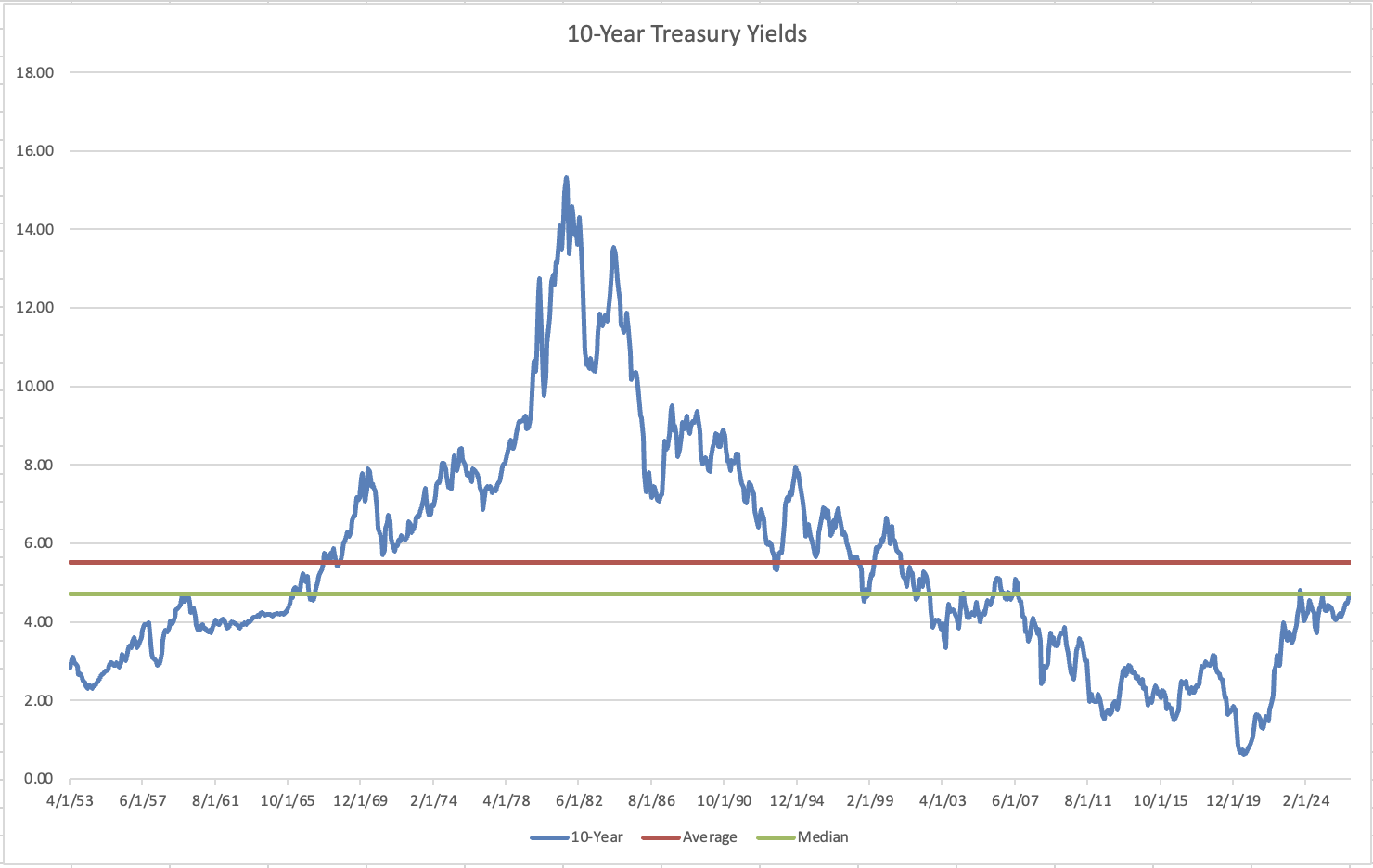
Once again, I ask you is 5% on the 10-year the anomaly? Or was 1% on the 10-year the anomaly? Throughout this entire time, the US economy managed to get by. Certainly, there were difficult times as rampant inflation in the 1970’s led to Paul Volcker’s dramatic efforts to withdraw liquidity from the system, thus driving rates higher which resulted in the twin recessions of the early 1980’s. Now, to my eye, the current level of 5.18% (-2bps on the day) does not look like it is unusual. In fact, it is firmly between the median (4.79%) and average (5.52%) levels on the chart.
And as I wrote yesterday, economic activity continues apace, in fact I would argue faster than apace. The Trump administration is all-in on the run it hot thesis and with inflation at 3.4% and real GDP at 5.1%, that implies nominal GDP is rising at 8.5% annualized. Even with the excessive government spending, and it is excessive, nominal GDP growth at that pace will result in a reduction in the debt/GDP ratio over time. Remember, the budget deficit is running at 6% or so, far lower than that GDP figure.
This is by no means an ideal situation, however, it is a sustainable one. And consider this as well, all that interest getting paid is part of the income streams for all the holders, many of whom are domestic. Recall, a major angst among the doomporn writers is that foreigners stopped buying Treasuries. That means domestic accounts own more and get paid more interest to recycle into the economy. Again, not ideal but certainly sustainable. The end is not nigh.
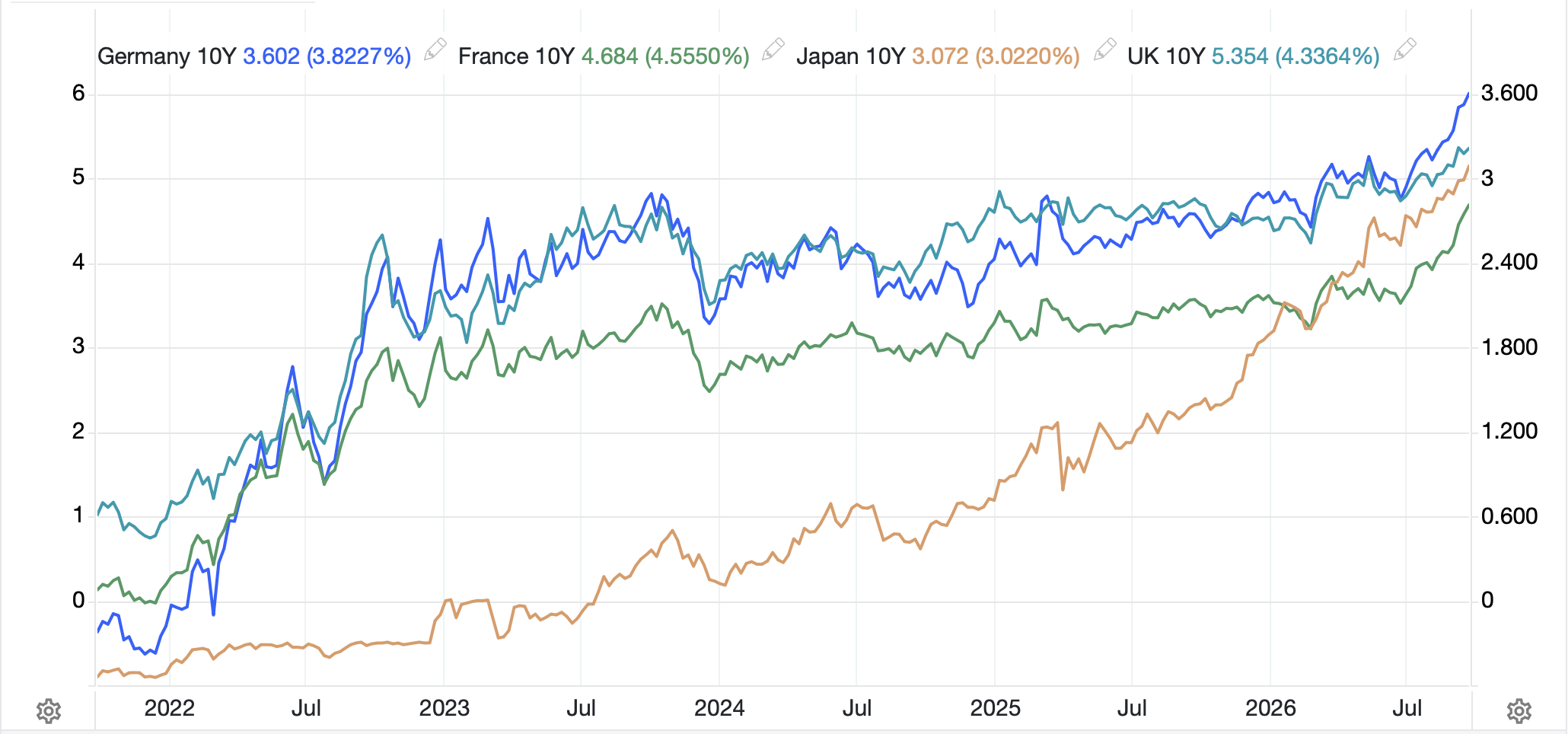
What about the rest of the world? Well, while their yields are rising as well as you can see in the below chart from tradingeconomics.com, their growth rates are not keeping pace with the US.
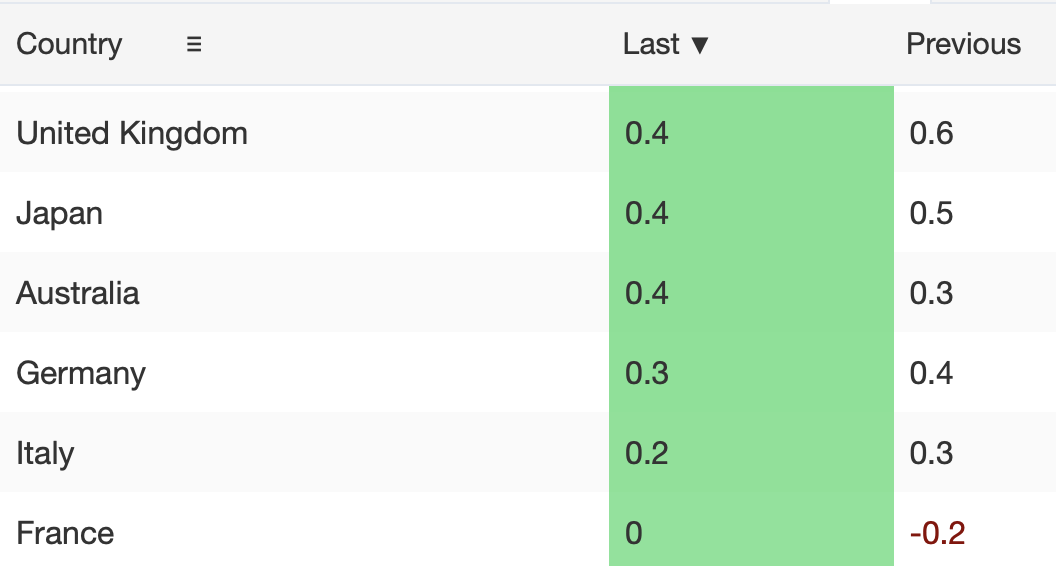
As you can see in the below table from tradingeconomics.com, the rest of the world has a much bigger problem with rising yields than does the US.
Our economy can clearly sustain them far better than any other economy which is one of the reasons that the equity markets in the US continue to perform so well and the primary reason that the dollar continues to perform so well. After all, the consistent drumbeat of announcements of new factories to be built in the US from Honda and Hyundai to TSMC and Samsung and every defense and pharma company in between, not to mention Nippon Steel’s expansion of the old US Steel facilities, is driving demand for dollars.
Again, doom may get clicks, but reality is far better than they make it out to be. And we know this because equity investors continue to be willing to hold US equities in record numbers. Earnings in the US continue to grow, in fact fast enough to reduce some of the overvalued multiples that we have seen over the past several years. So, while yesterday was a nonevent in US equity markets, the fact that was the outcome despite another sharp rise in yields tells you all you need to know. Overnight, China and Taiwan were closed, but we saw gains in Tokyo (+1.3%), Korea (+0.9%), India (+0.4%) and most of the region although HK (-1.0%) and Australia (-0.4%) lagged.
In Europe, though, the week is ending on a positive note with gains across the board (Spain +1.0%, Germany +0.7%, UK +0.3%, France +0.1%) and US futures are also higher at this hour, +0.4% or so. And Germany managed this despite a terrible reading from the GfK Consumer Confidence survey of -30.6, far worse than last month or forecasts.
In the commodity markets, oil (-2.4%) is sliding this morning as there appear to be ongoing talks to both reopen the Strait of Hormuz and end the US naval blockade, an outcome that would likely see oil prices, and the products as well, fall sharply. Meanwhile, gold (+0.7%) and silver (+1.6%) are bouncing a bit this morning as the chain of thought appears to be lower oil prices => lower interest rates => more attractive gold, or something like that. Nothing has changed my long-term view on the precious metals nor on copper, which if the US economy continues to grow like it has been will see significant demand going forward.
Finally, the dollar, after a two-week run is backing off this morning on two things. First, apparently when PM Takaichi and President Trump met, the yen was part of the discussion and last night we heard verbal intervention from FinMin Katayama taking the yen higher by 0.75%. As to the rest of the G10, smaller gains, on the order of 0.1% to 0.2% are the order of the day. In the EMG bloc, we are also seeing strength with KRW (+0.95%) the leader although ZAR (+0.8%) is also having a fine day as gold rebounds while the rest of the bloc, whether LATAM, CEE or APAC has seen much smaller gains, 0.3% or less. Again, the dollar is not going to disappear or be replaced. And frankly, I think we remain in the range of the past year for a while still.
On the data front, this morning brings Durable Goods (exp -0.4%, +0.6% -ex Transport) and then Michigan Sentiment (47.6). We also hear from a few more Fed speakers which will almost certainly serve to reinforce the idea that they are going to tighten policy further. Currently, the futures market is pricing a 2/3 probability of an October hike. Personally, I wish they would stop expanding the balance sheet before hiking again, but Keynesianism won’t allow them to think that way it seems.
Wrapping up, I see more good than bad on the horizon which should be positive for risk assets. At the same time, at 5.2%, 10-year yields are very attractive for a lot of people as an alternative to equities. After all, the hype about the highest yields in more than 20 years means that those on a fixed income have not been able to get these yields in more than 20 years. Historically, 5% was seen as a pretty fair return for bonds. Maybe this is the new equilibrium.
Good luck and good weekend
Adf


Good luck to you and Marvel
Thanks Rich