
The five-year sale went terrib-ly
So, doomsters are all filled with glee
There was a long tail
Though not quite a fail
They claim, now, the future they see

In fact, they claim, this is the end
That bonds will have nary a friend
And stocks will get smoked
As strong growth evoked
The specter of death for the trend
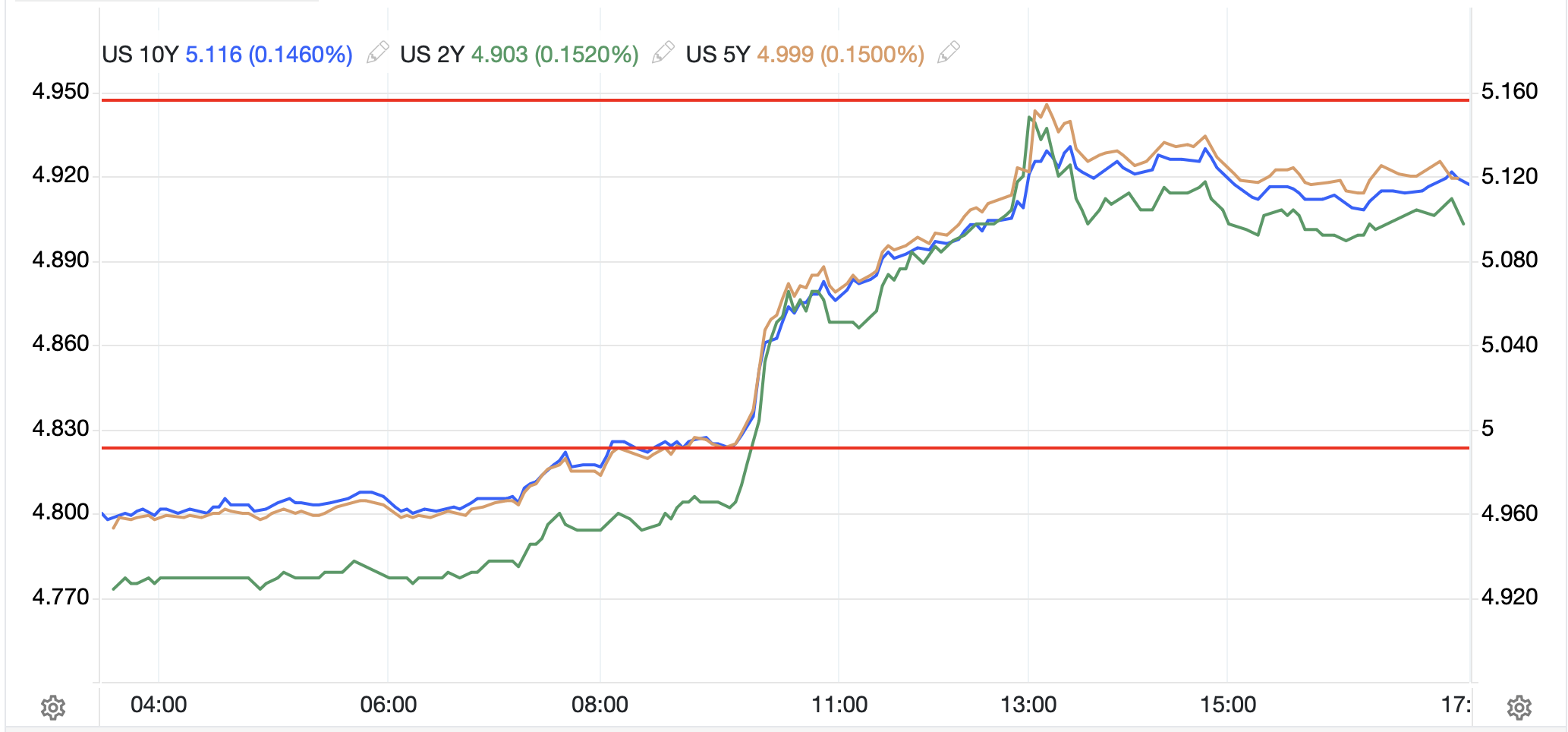
Well, everybody who has been crowing about the end of the US bond market is feeling their oats today, that’s for sure after yesterday’s terrible 5-year Treasury auction that wound up with a 3.1 basis point tail, extremely long for such a short duration instrument. (The tail is the difference between the actual outcome and the when-issued trading that takes place in the market prior to the auction. A long tail implies that demand was weaker than expected.) The upshot is that Treasuries sold off hard, with yields climbing upwards of 15bps in the 2-year and 11bps in the 10-year as you can see in the below chart.
Source: tradingeconomics.com
The starting point was the release of the much better than expected Flash PMI data where both Manufacturing and Services beat handily with 58.0 handles, but the price pressures indicated got the inflation story back as the key narrative. The yield peak came at 1:00 when the auction results were announced although they slipped a few bps before the close. And this morning, the 10-year yield is another 3bps higher along with European sovereign yields where we see France (+5bps) having the worst day but the rest of the continent, and the UK all showing yields climb 2bp to 3bps. Neither was Japan immune to this price action with 10yr JGBs jumping 9bps overnight.
It’s funny, for a very long time, the idea that good news was bad would have been ridiculous as a concept. Strong growth would indicate increased profit opportunities and higher equity values. But it started with Greenspan, when he first cut rates to, and left them at, 1.0%, for far too long and equity markets decided they liked low interest rates more than company fundamentals. The GFC and ZIRP increased the intensity of that reaction function, and we are still feeling that pain as higher rates, especially caused by strong economic growth, are now seen as a negative for stocks. The world is upside down. It is, however, the world in which we live.
On top of the markets’ hard beating
Both Xi and Trump soon will be meeting
The talks are on trade
While AI is weighed
It’s doubtful, though, deals are completing

In China the ‘conomy’s split
Twixt exports of plenty of sh*t
And people at home
Who live in the gloam
And can’t change their lives e’en one bit

While here in the US the sitch
Is talk of the poor and the rich
Election day’s nearing
And though some are cheering
For Trump it could be a real bitch
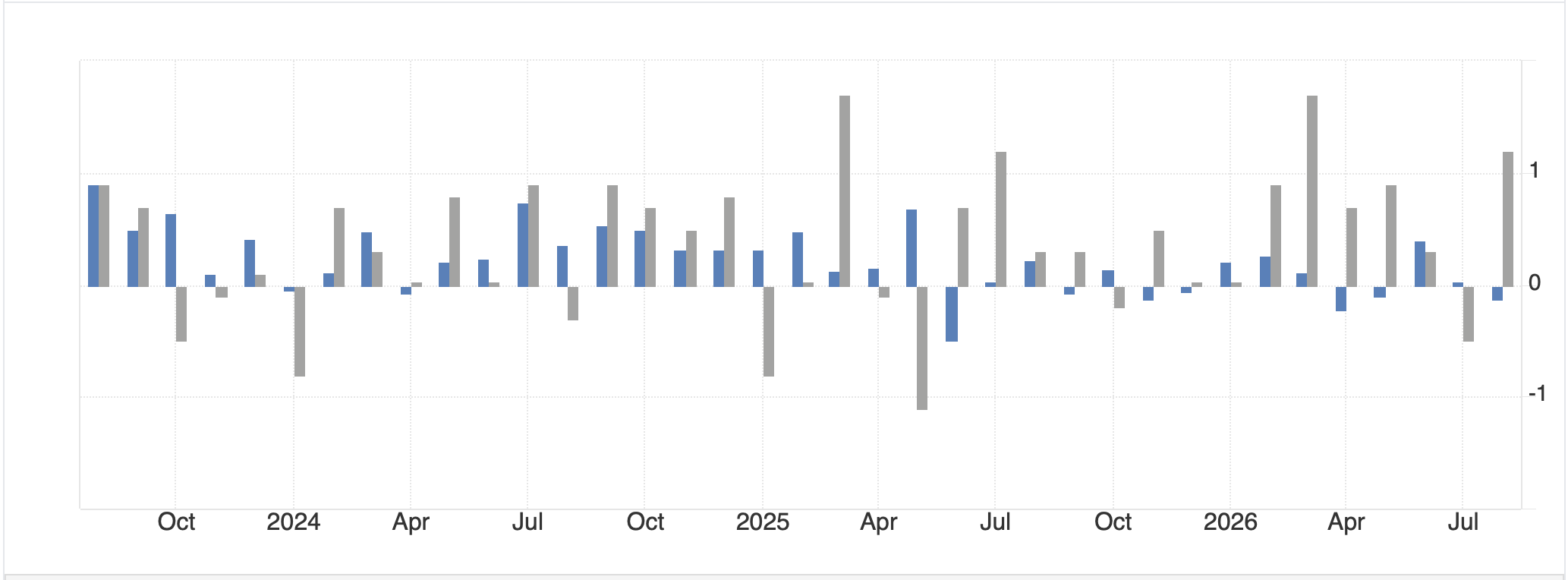
While the bond market has taken up most of the space of the financial market analysis, the meeting between Presidents Trump and Xi is clearly of great importance. Both nations have significant issues they are trying to address although in many ways they are mirror images of each other. On a macroeconomic scale, given the Chinese mercantilist model and the excess investment into productive capacity there, they build an enormous amount of stuff for export and starve the local economy of consumption. The result is extremely low inflation, if not deflation, while indicators like Retail Sales turn negative. Recall, consumption represents just over 50% of the Chinese economy compared to about 70% in the US.
For instance, the below chart shows a comparison between US (gray bars) and Chinese (blue bars) retail sales over the past 3 years. you can see just how soft Chinese activity has been domestically compared to the US.
Source: tradingeconomics.com
I have long maintained that the biggest weakness China has is that they rely on the US as the buyer of last resort and President Trump (and lately followed by many other nations) has been pushing back by imposing tariffs on much of what China sells, thus reducing those sales. If China lacks export growth, given the domestic weakness, that becomes a huge problem for Xi.
Meanwhile, the US spends far too much, at least the government does, and while there has been a dramatic increase in investment into the US, that has brought along significant demand for credit, hence higher yields, and demand for things that are scarce, like electricity, where power increases cannot keep up with industrial demand. The upshot here is that inflationary pressures are rising even without the impact of the large rise in oil prices since March and the Iran war began.
Of course, Xi’s greatest advantage is he doesn’t have to face the electorate, as there is none over there, while in six weeks, Election Day may prove monumental to President Trump’s plans. We need to watch more than markets right now as both the wars in Ukraine and Iran along with the politics are going to have major impacts for a while longer, I believe.
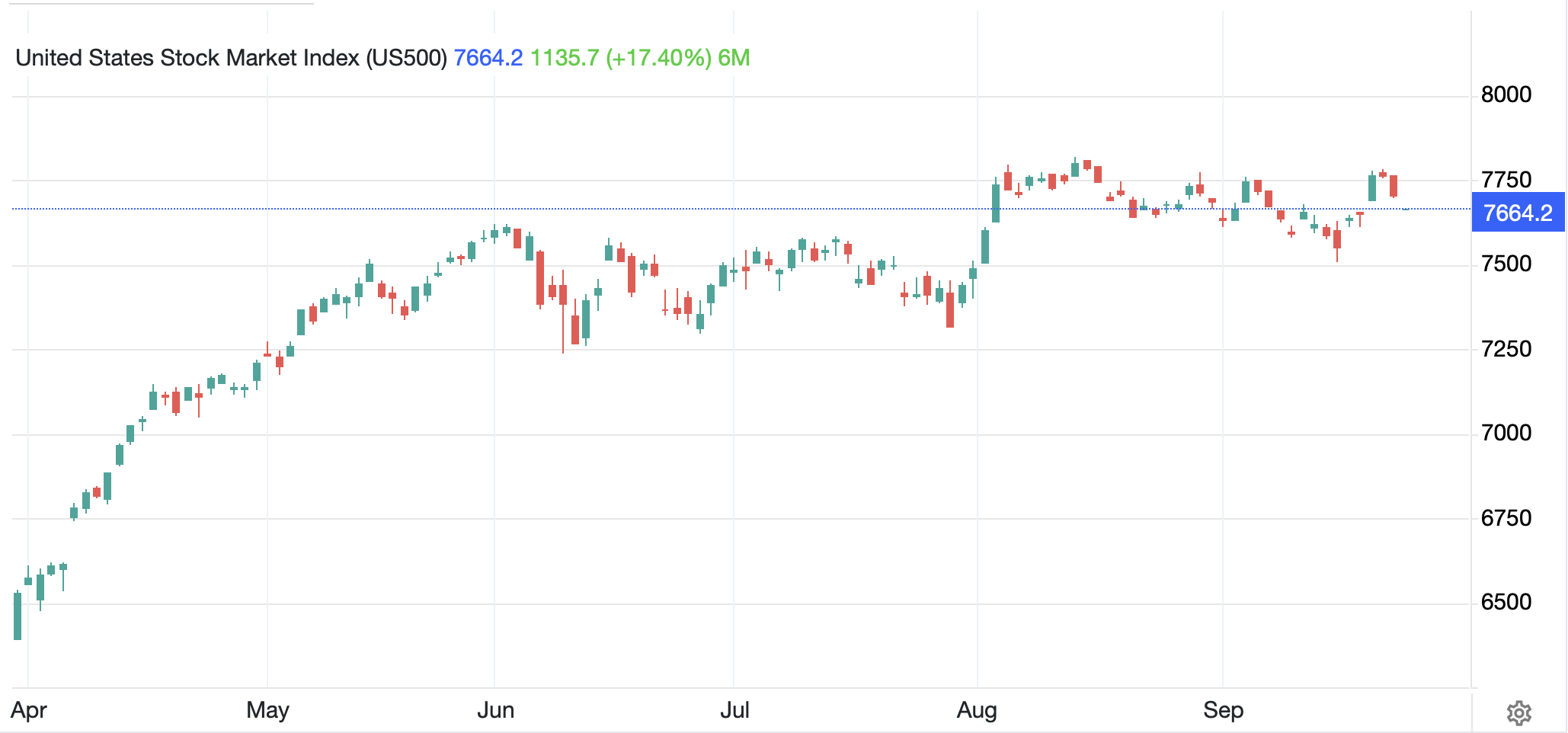
Turning to markets beyond the bonds, yesterday saw weakness in the US, although not quite as bad as might have been feared with losses of about -1.0%. To keep that in perspective, even with this morning’s pre-market futures lower by -0.5%, the S&P 500 is less than 2% from its all-time high set last month as you can see in the chart below. It’s not Armageddon quite yet!
Source: tradingeconomics.com
But the follow on in Asia was filled with red numbers as although the Nikkei (+0.8%) managed a gain, virtually every other index in the time zone fell including: China (-1.7%), HK (-0.3%), India (-1.7%), Australia (-0.7%) and all of the smaller exchanges as well. South Korea was on holiday, so no trading there. Meanwhile, in Europe, the picture is not so dour, although most markets there slid yesterday as well. This morning, the DAX (-0.5%) and CAC (-0.4%) are the laggards while the other major markets are flat to slightly higher, 0.1%. And as mentioned above, US futures are under pressure again this morning.
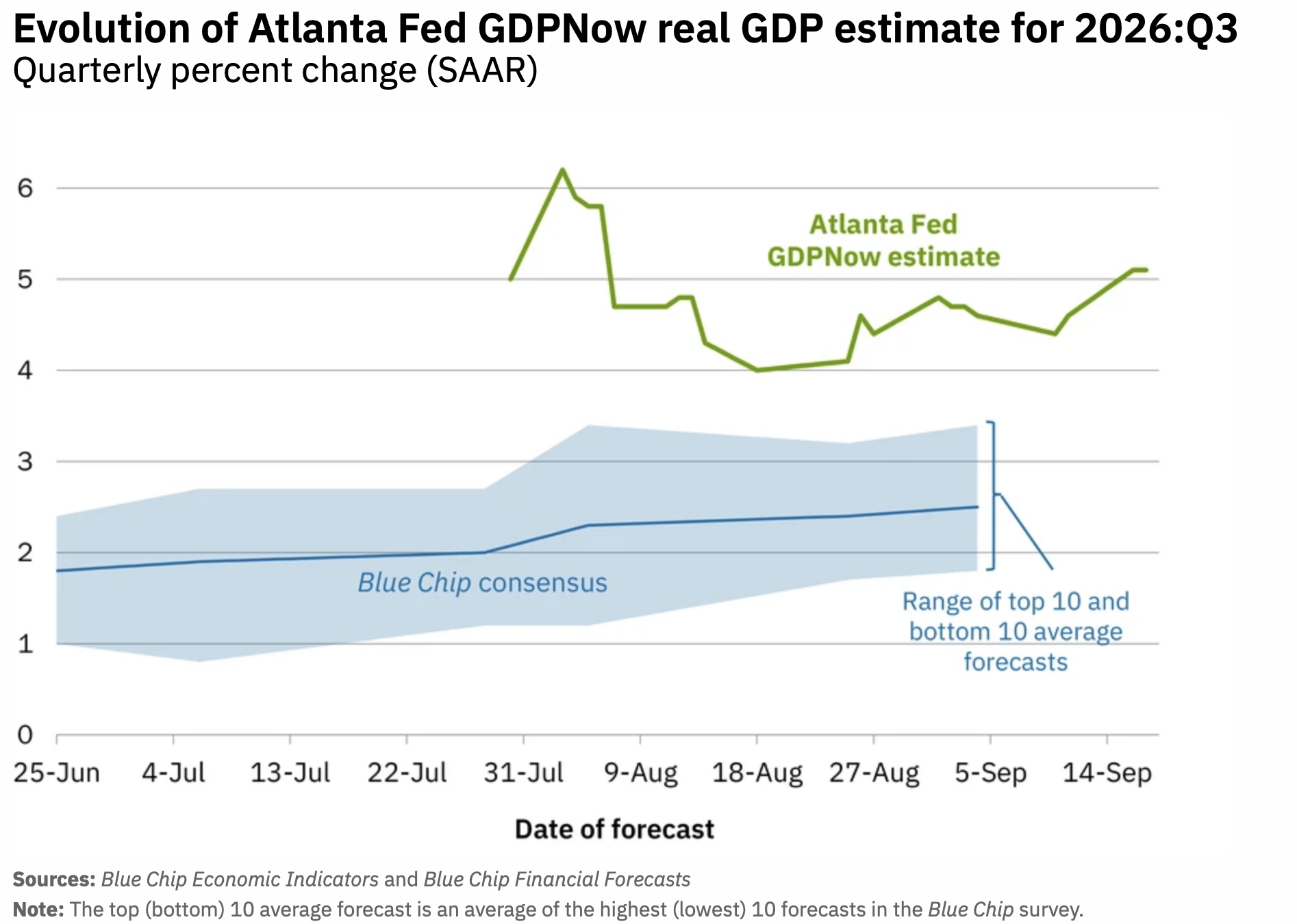
In the commodity markets, oil (+1.0%) is continuing its rebound off the lows from earlier this week as President Trump’s threats of annihilation of Iran has some on edge, although I have read that talks continue to find a way to end the conflict. But precious metals have no friends right now (gold -0.6%, silver -1.25%) as between higher yields and a rising dollar, fear over debasement has given way to greed for the last basis point of yield. Copper (+0.4%) though is starting to trade on its own terms as the strength in the US economy continues to underpin demand for the red metal. In fact, to highlight that economic strength, a look at the Atlanta Fed’s GDPNow estimate for Q3 shows that the data supports a positive view. It currently sits at 5.1%, far above analyst estimates as per the below chart.
Finally, turning to the dollar, as I mentioned earlier this week, a move to the top of the trading range was quite possible and we are on the way to getting there as you can see in the below chart. The peak is 101.80, so still 0.5% away from where we are, but the recent trend is strong.
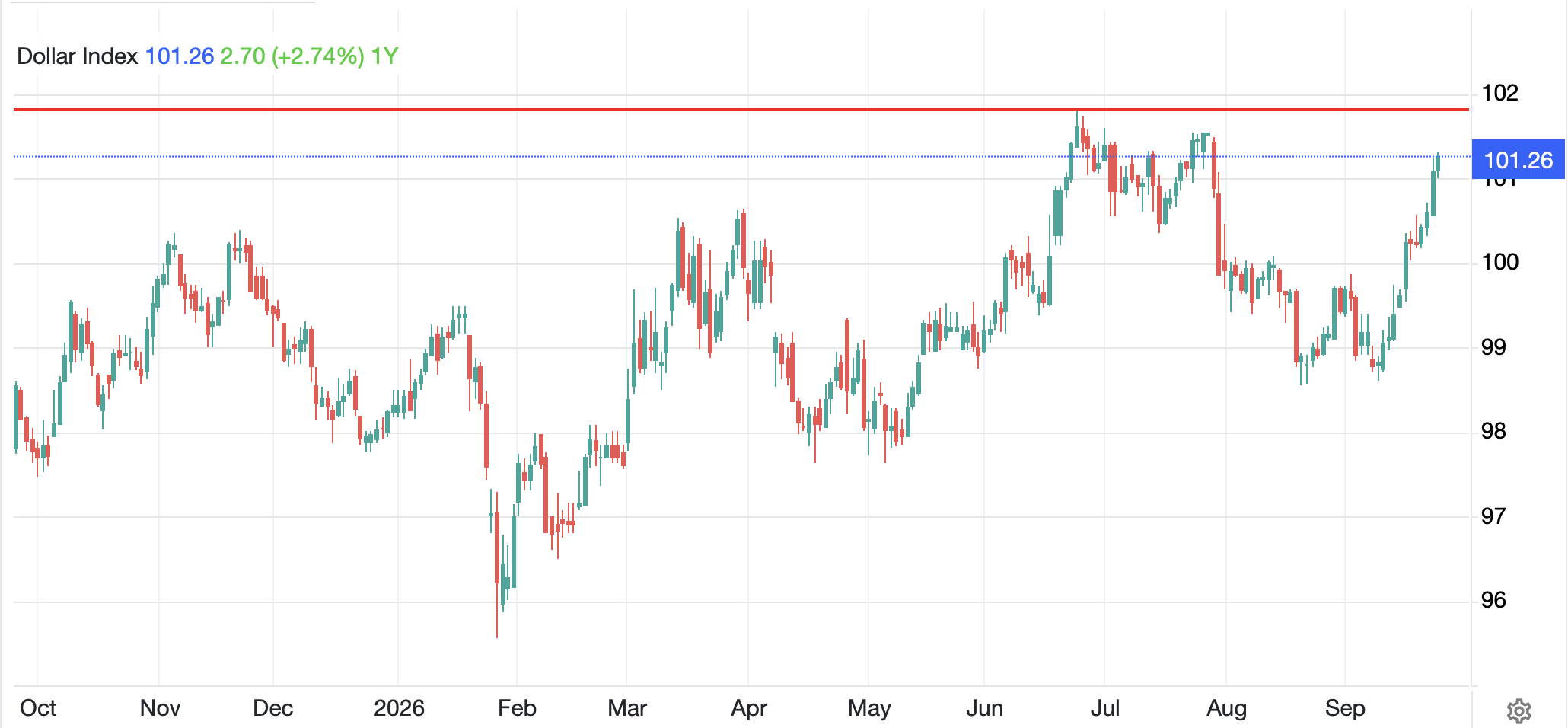
Source: tradingeconomics.com
This strength is broad based and entirely on the back of the US rate structure and growth story as markets price in a greater likelihood of a rate hike next month, now 70%, and an additional hike next year as you can see in the below cmegroup.com table.
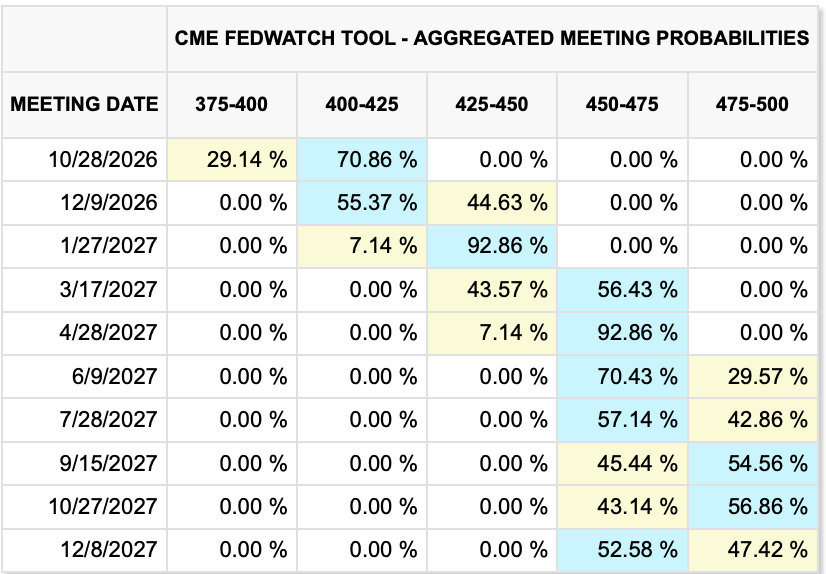
While the movement today has been pretty uniform across both G10 and EMG currencies, we do need to start to watch USDJPY again as it is heading back to the 160 level. Now, if the dollar is strong against all currencies, there is far less reason for intervention in the yen, but that doesn’t mean it won’t happen.
On the data front, this morning brings the weekly Initial (exp 201K) and Continuing (1750K) Claims data as well as New Home Sales (620K). Yesterday’s data also included oil inventories, which remain more than adequate. Something else to remember is that the SPR releases were all executed via swaps, so starting November 1, the SPR is going to get refilled over the ensuing several years and my guess is we will not hear a word about that in the future. The diesel export ban is a terrible idea, and hopefully cooler heads will prevail. Diesel prices are high because Ukraine continues to destroy Russian refining capacity, not because the US exports the excess over what we use.
It’s an odd thing this morning. I have seen many stories about the imminent collapse of the stock market now that bonds are under pressure and maybe that is exactly what will happen. But I am not getting the same level of fear from the current situation so while a correction is completely viable, I think we need a much bigger disruption to force a major downturn in risk assets.
Good luck
Adf

