
A key market story yesterday was that the Treasury buyback operations, you know the ones that would be “at least” doubled to $4 billion per event, could grow much larger as secretary Bessent would tap the Treasury General Account (TGA) for this purpose. Now the TGA is the federal government’s checking account. It is where your taxes get paid into, along with the receipts from bond sales and tariffs. It is also the account that pays all the federal government’s obligations like salaries and purchases of defense and other equipment. The current balance (a/o Aug 21st) is about $936 billion according to the Treasury website. Obviously, that is a huge amount of money, but then the federal government has a huge amount of payment obligations. I bet it is a hard checking account to balance!
Now, technically, I presume that all their operations are paid by the TGA. The mechanics would work that Treasury would issue T-bills, receive the cash in the TGA and use that cash to buy back bonds. But the implication was that he would just spend the money that was already there. Personally, I doubt that will be the outcome, and frankly, it almost sounded more like a threat than a future course of action. But it did get tongues wagging.
According to Grok, these comments came in an interview on CNBC at a bit after 9:00 yesterday morning. The chart below shows the bond market price action from that point onward, which tells me that while there was a modest initial response, it completely disappeared until another catalyst (lower oil prices I believe) helped push yields down early this morning.
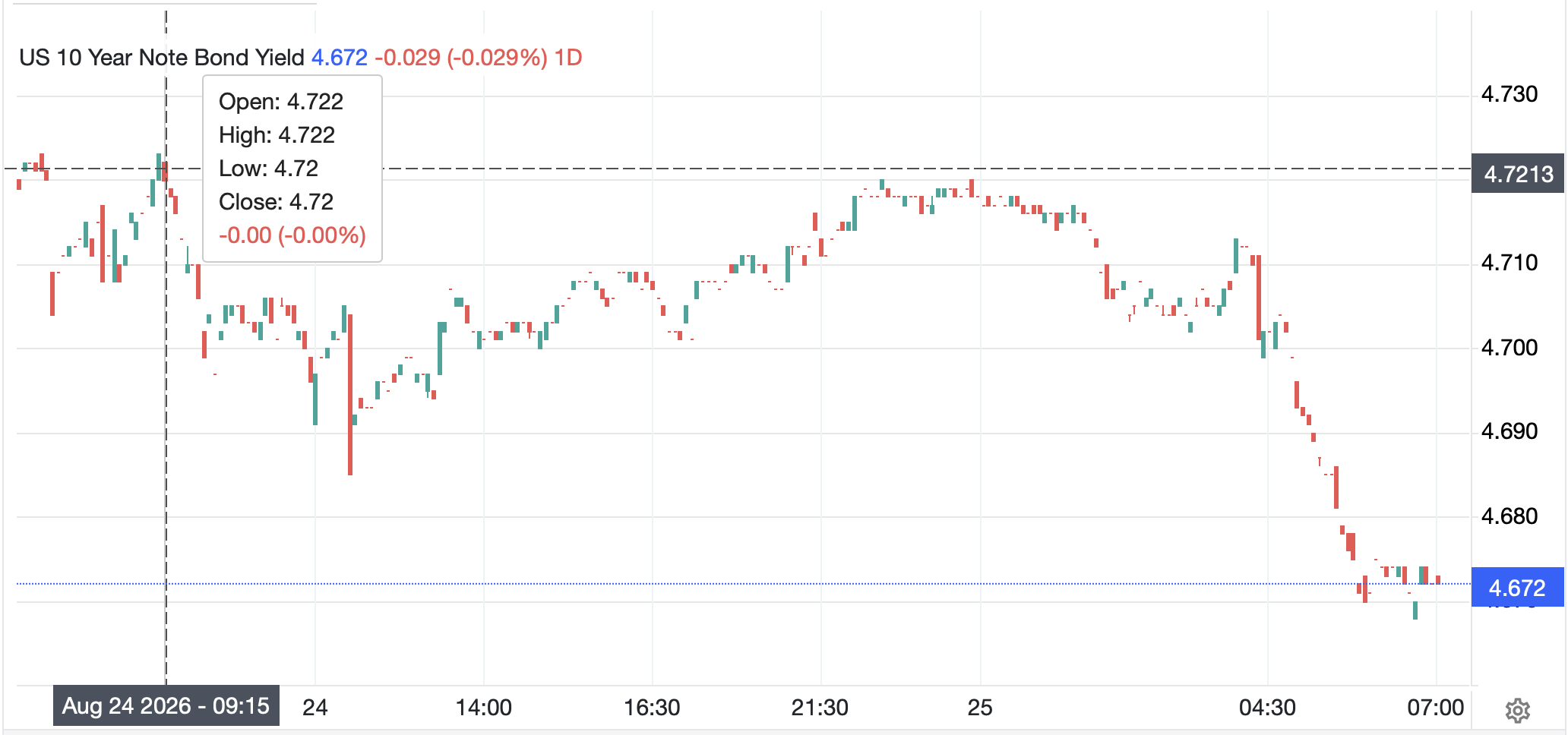
Source: tradingeconomics.com
But this clearly struck a nerve as in this morning’s WSJ, Stan Druckenmiller, Bessent’s mentor at the old Soros hedge fund, wrote an op/ed decrying the move. As I survey all that I have learned thus far, it seems clear that Bessent is looking to remove duration from the market in an effort to drive longer dated yields lower. But his tools are limited compared to the Fed’s abilities and, at least right now, it does not appear the Fed is going to cooperate. The first operations aren’t scheduled until September 7th, so until then, it is all just speculation, and I’m not even going to try.
The other thing that Secretary Bessent did yesterday, that may have a larger impact on things, was announce sweeping new sanctions on Iran and countries that do any residual business with Iran in an effort to add further pressure on the regime. It is possible, but not clear to me, that this is part of the rationale for this morning’s decline in the price of oil (-3.0%). However, if you look at the chart of oil for the past 24 hours, it is remarkably similar to that of the 10-year Treasury above.
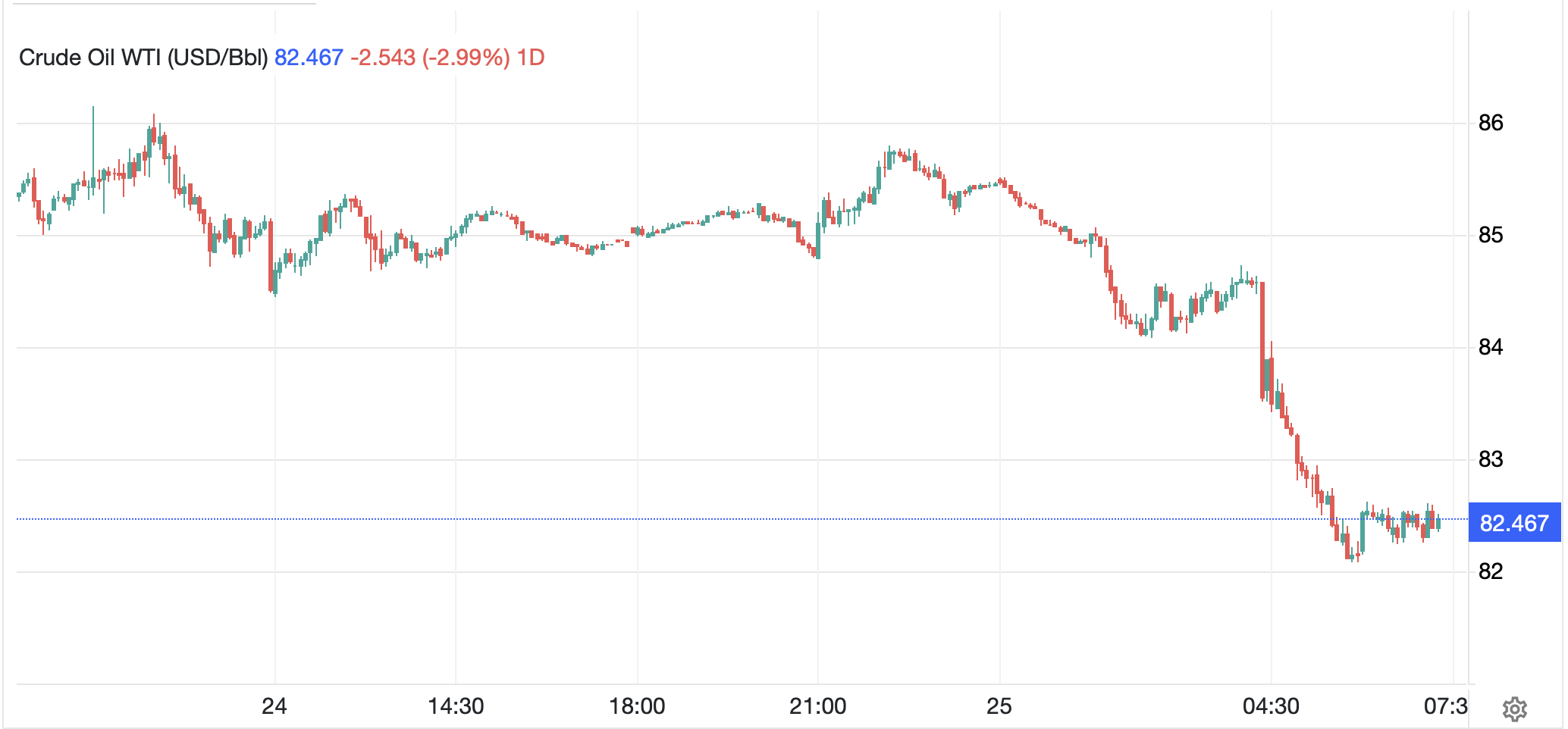
Source: tradingeconomics.com
Ostensibly, the news here, which of course would impact bond yields, is that the Pakistani army chief was intermediating between the US and Iran in an effort to find a solution and reduce tensions in the Gulf. That would certainly be a welcome outcome for all, but I’m not holding my breath. However, this price action has set the tone for risk markets this morning, so let’s take a look.
While Asia was mixed overnight (Tokyo +0.5%, China -0.3%, HK 0.0%) following the mixed US session, with pressure still evident on the tech sector, Europe is firmer this morning across the board (Germany +0.8%, Spain +0.4%, France +0.4%, UK +0.25%) with all those rallies timed almost exactly alongside the oil and bond moves. As you can see in the chart below, the same is true in the US where futures at this hour (7:25) are also higher and moved right alongside other equity markets. As to specific stories here, I think there is a great deal of breath holding for the Nvidia earnings report tomorrow after the close.
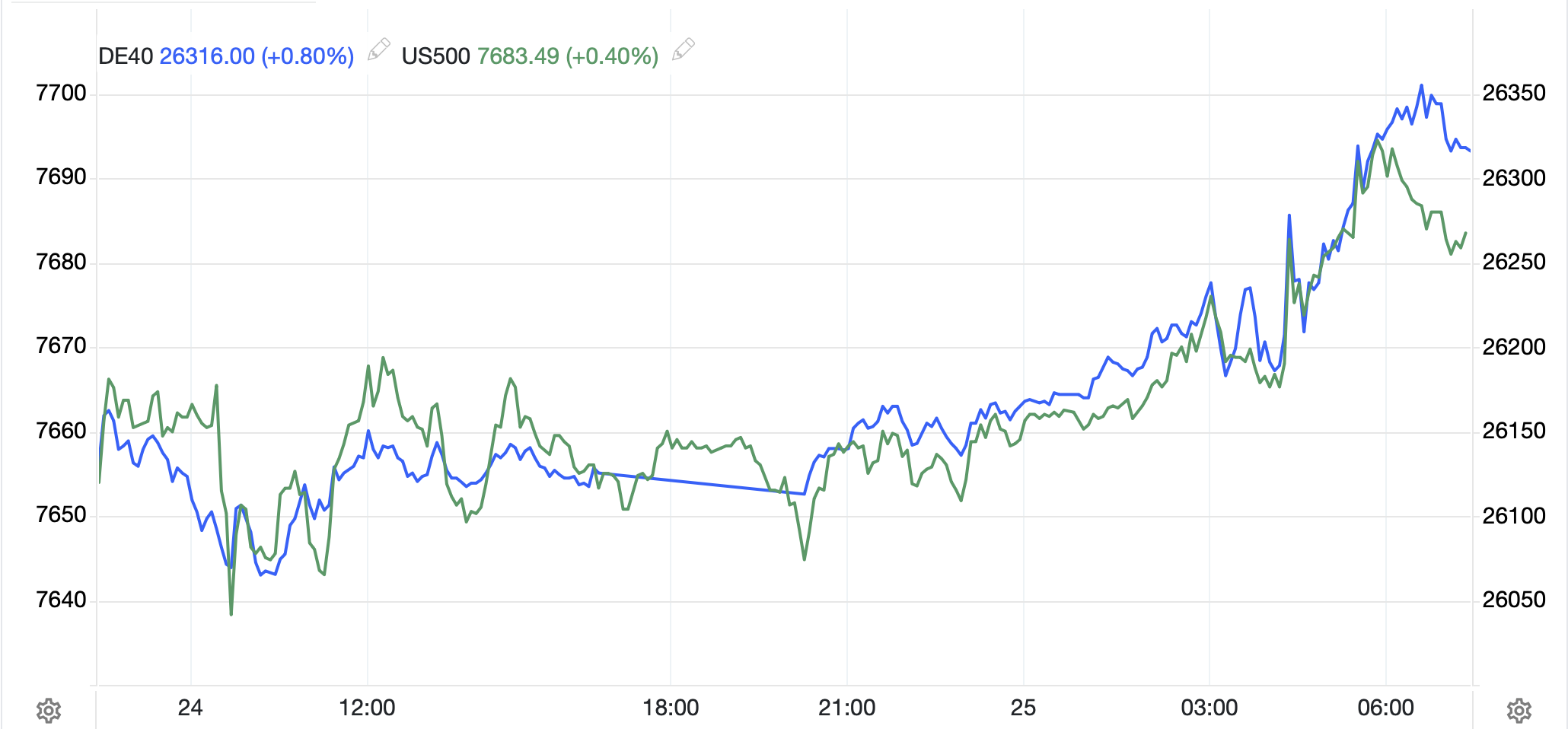
Source: tradingeconomics.com
In the bond market, as mentioned above, yields are lower across both Treasuries (-3bps) and all European sovereigns with the entire bloc seeing yields decline by between -3bps and -4bps. It appears this all revolves on the same story driving oil and equities.
In the metals markets, gold (-0.2%) is edging lower but basically consolidating another strong day yesterday. It is reasonable to conclude that market participants are growing cautious regarding US debt given there is no indication of spending restraint. But the reality is that markets are growing cautious of all G10 debt given that statement regarding spending restraint is universally true in that bloc. I continue to believe we are going to see governments around the world try to ‘run it hot’ with nominal GDP growth rising faster than government spending, thus reducing the real burden. However, running it hot generally means higher inflation, and that is something that is a political problem. As to the other metals, silver (-1.2%) is under pressure, although still far higher over the past week and month, while copper (+0.5%) is a bit firmer this morning.
Finally, the dollar is still sleeping this morning, virtually unchanged on the DXY at 99.00 and virtually unchanged vs. almost every major counterpart. The biggest mover is INR (+0.35%) a major beneficiary of lower oil prices and not surprisingly, NOK (-0.2%) is suffering on the same catalyst. But otherwise, everything is +/- 0.1% from yesterday’s close.
On the data front, there is not a ton this week, although PCE comes tomorrow, but really all eyes remain on Chairman Warsh’s speech Friday morning.
| Today | Case-Shiller Home Prices | 1.7% |
| New Home Sales | 620K | |
| Consumer Confidence | 90.2 | |
| Wednesday | PCE | 0.1% (3.7% Y/Y) |
| Core PCE | 0.2% )3.3% Y/Y) | |
| Q2 GDP | 1.5% | |
| Durable Goods | 0.7% | |
| -ex Transport | 0.5% | |
| Personal Income | 0.3% | |
| Personal Spending | 0.2% | |
| Thursday | Goods Trade Balance | -$99.0B |
| Initial Claims | 208K | |
| Continuing Claims | 1811K | |
| Friday | Chicago PMI | 57.0 |
| Warsh Speech | ||
| Michigan Sentiment | 51.0 |
Source: tradingeconomics.com
In addition, the EIA oil inventories are expected to see another build as there remains ample supply, at least so it seems. While PCE is important, I think it will be less so given the pending Warsh comments. To me, tomorrow’s Nvidia earnings and then Warsh are the keys for the rest of the week, absent a major change in Iran, and alas, I don’t see that.
The bond brouhaha is much ado about nothing I believe as it will not change the trajectory of Federal spending, and that is what is necessary to have a long-term impact. Unfortunately, that usually takes a crisis, and those are unpleasant. They also take a VERY long time to develop, after all Argentina imploded for nearly 100 years before electing Javier Milei who promised to do something about it. It has only been 25 years here since we last ran a budget surplus. I fear it could be much longer before things really change.
Good luck
Adf

