
Markets This Hated

No matter the nation you view
Its bondholders now see to rue
Their previous buys
And under that guise
Won't buy and bonds that are new

So, yields have been rising with haste
Though currencies have not debased
But markets this hated
Have often created
Reversals, which many then chased

Global Bond Yields Surge as Oil Prices Fuel Inflation Worries

The above article in the WSJ this morning captures the current zeitgeist in markets and seeks to explain why everything has turned bad.  Certainly, the rebound in oil prices (+2.5%) is putting pressure on economies around the world, but so, too, are the unrestricted spending plans seen throughout the G10, and frankly across most of the planet.  My take is that ‘run it hot’ (RIH) has become the economic strategy around the world.  Perhaps the only outlier here is China, but even that is not really true, they are just running it hot differently.  While most governments are responsive to their peoplevoters, Xi Jinping has demonstrated time and again he doesn’t really care about that.  Rather he has his strategic goals of global domination and is pushing his economy to achieve that.

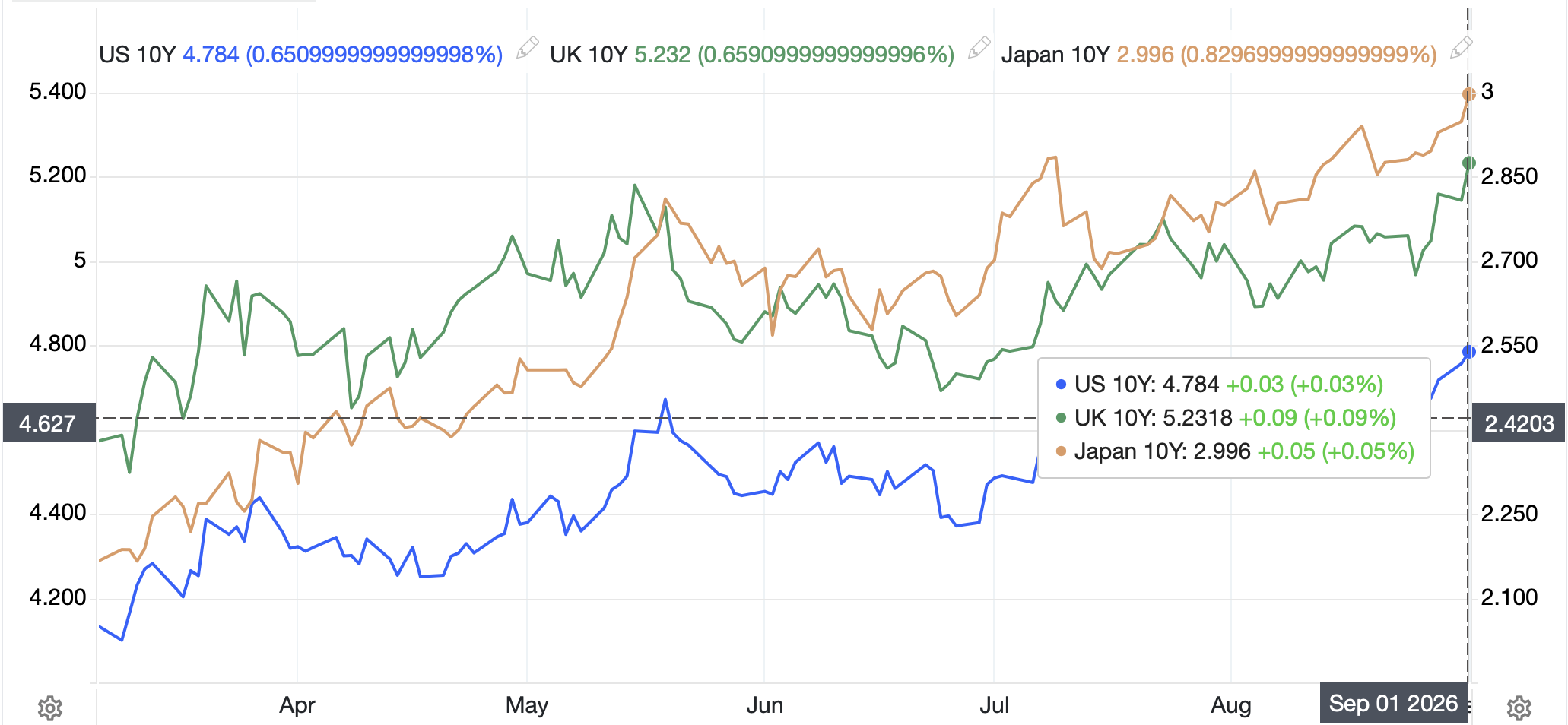
The upshot is that bond yields are rising and as you can see in the chart below, it is uniform, this is not just a US phenomenon.  In fact, much ink has spilled that 10-year JGB yields have traded to 3.0%, their highest level in 30 years.
Source: tradingeconomics.com

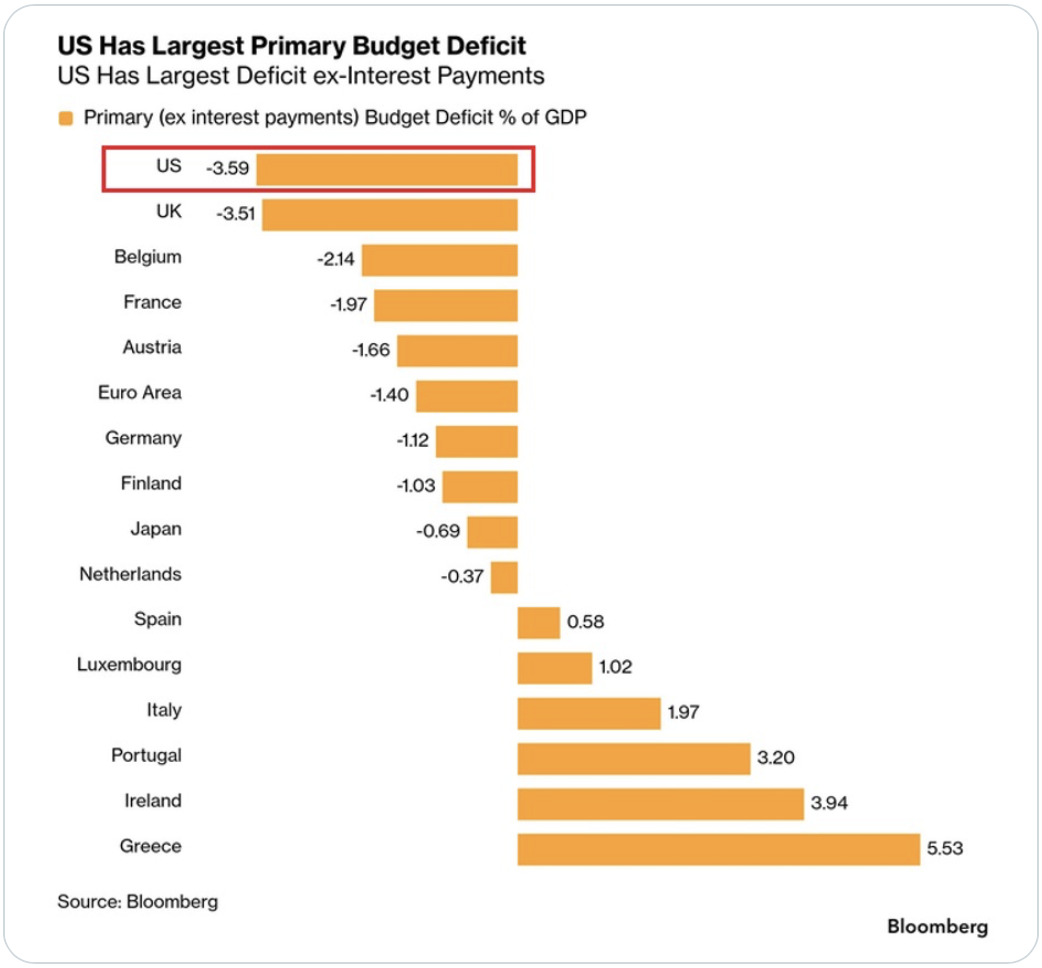
Now, as I said at the top, oil prices are clearly one of the pressure points as there are fears it will feed into higher inflation, thus investors are demanding higher yields.  And the other big story, which in my view is more concerning, is that governments are running increasingly larger budget deficits as the guns AND butter approach has become de rigueur in polite circles, or at least political ones.  In fact, the concern is that governments are increasingly running primary budget deficits (spending less interest payments) which is why debt loads are growing so rapidly.
Source: @KobeissiLetter

And this leads to the RIH theory.  If a country can grow its nominal GDP fast enough, then the denominator in the debt/GDP ratio will rise more quickly than the numerator thus reducing that ratio and implying a healthier fiscal outlook.  Now, nominal GDP is the sum of real GDP, the number that is reported, plus inflation and that sum can be any combination.  For instance, a nominal GDP growth of 7% could easily be 2% real GDP and 5% inflation, or vice versa.  In the RIH scenario the typical outcome is that wages rise, corporate earnings rise, stock market values rise…and prices rise.  The last point being the key political question.

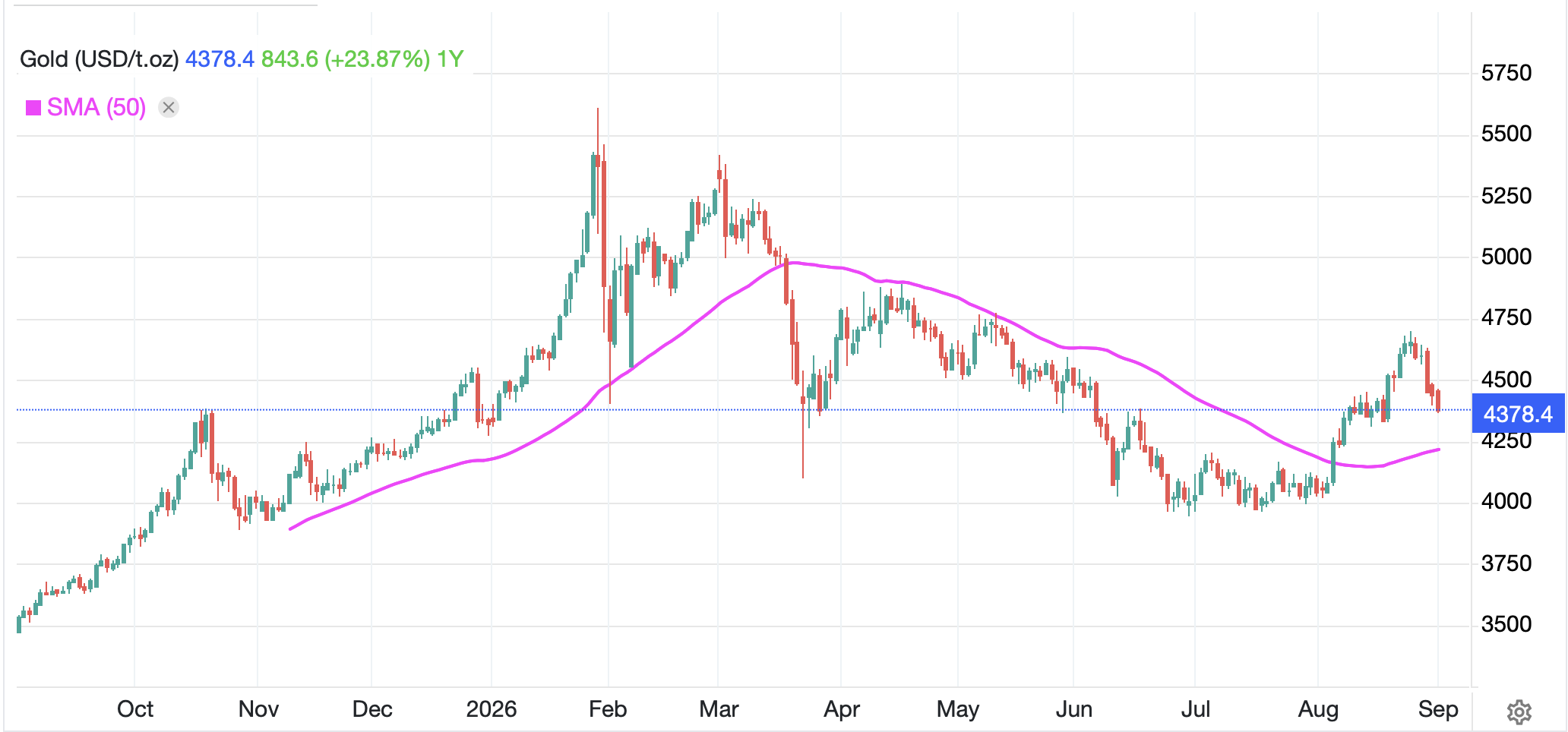
Which takes us back to the bond market and a few questions I have.  First an observation.  In the old days (Greenspan era) a rule of thumb in the bond market was the 10-year yield should approximate nominal GDP growth as a stable base.  I mention that because I am confused by the bond market reaction given the near universal view of Chairman Warsh’s speech on Friday was that he was hawkish and that rate hikes were coming.  But if that is the case, and the Fed is going to more aggressively address inflation, then why are bonds selling off?  Second, regarding the debasement trade, if bonds are selling off because of concerns over massive debt issuance and the assumed result that the dollar, and all currencies, are going to lose purchasing power, why is gold (-1.4%) selling off so aggressively?  It strikes me that gold should be flying higher on the view that inflation is going to rise, but then, I’m just a poet.  I guess one could make the technical argument that it is merely correcting its recent strong rally and it remains far above its 50-day moving average as per the below chart.
Source: tradingeconomics.com

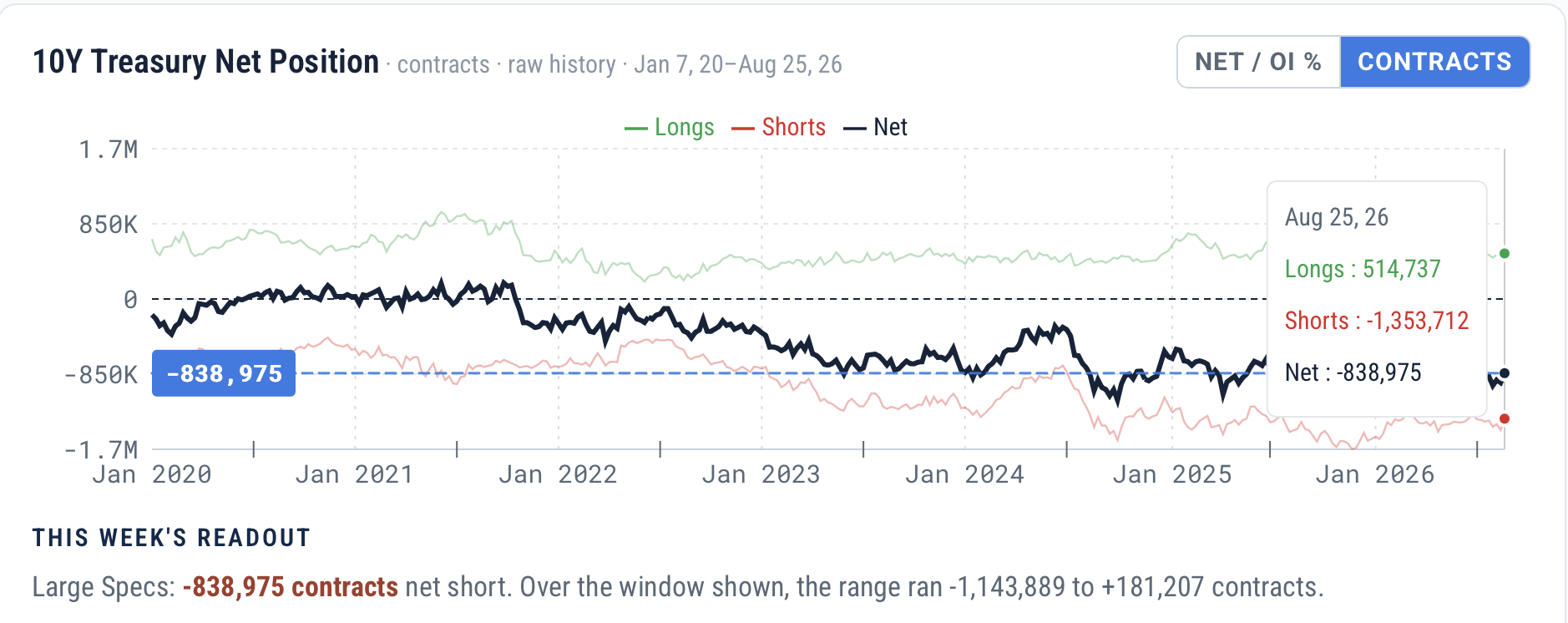
I wish I had the answers here, but I don’t.  However, something is amiss.  If the Fed was so hawkish, the bond market would not be aggressively selling off.  If the Fed was not hawkish, then the sell-off makes sense, but 90% of the punditry was wrong in their analysis of Warsh’s speech.  (My guess is they see that as a bigger problem.) One thing I do know, though, is that the bond market is quite bearish right now with nary a positive word to be found.  There is still a huge net short position in the bond futures market, as per the below chart.
Source: cotsignal.com

Here’s the thing about markets, at least in my experience.  Markets tend to seek out the ‘pain’ trade, the trade that will hurt the most participants most significantly.  As well, bull markets begin when all investors express uniform hatred of a product, like bonds right now.  Combining those two things leads me to believe that we could well be setting up for a significant bond market rally.  Just beware.

In the meantime, a quick tour of markets overnight shows negativity everywhere.  After yesterday’s declines in the US session, Asia saw mostly red numbers (Tokyo -0.15%, China -0.3%, HK -0.9%, Malaysia -1.5%, Singapore -0.8%) although Taiwan (+1.8%) and Korea (+0.25%) bucked the trend on some tech support which is also why the NASDAQ fell the least yesterday.  As to Europe, as you can see in the below screenshot from Bloomberg, it is universally red.
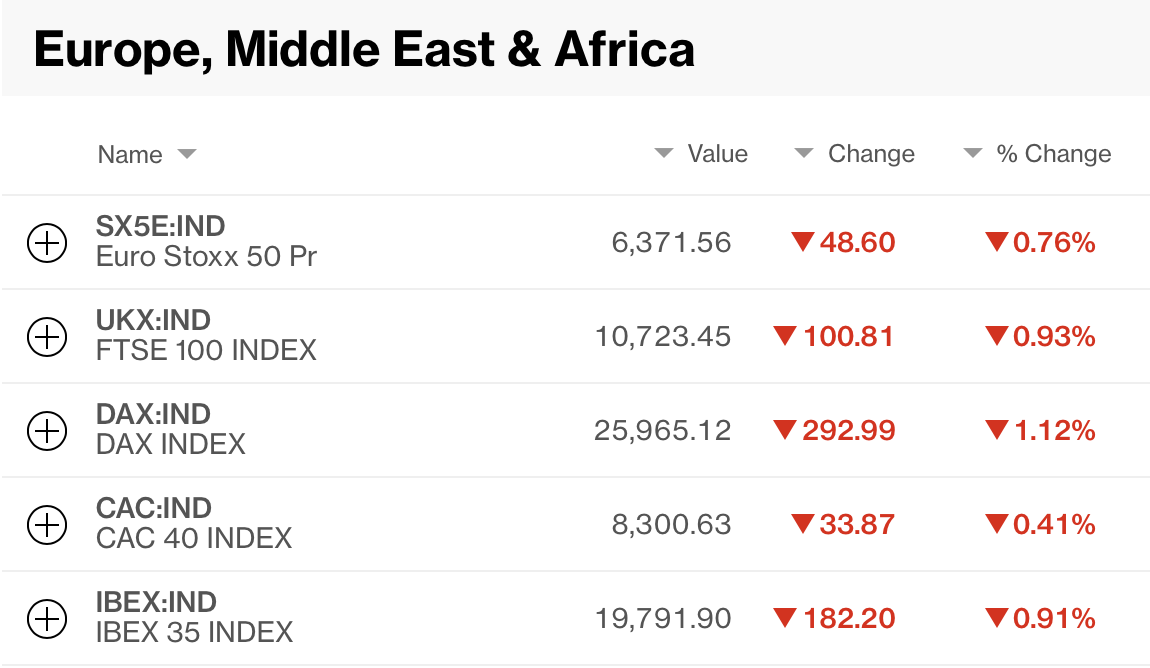
Lastly, US futures are under the gun this morning, down -0.5% except for the NASDAQ which is reversing yesterday’s outperformance and lower by -1.3% at this hour (7:20)

We’ve already discussed bonds, but this Bloomberg screenshot is worthwhile, I think.
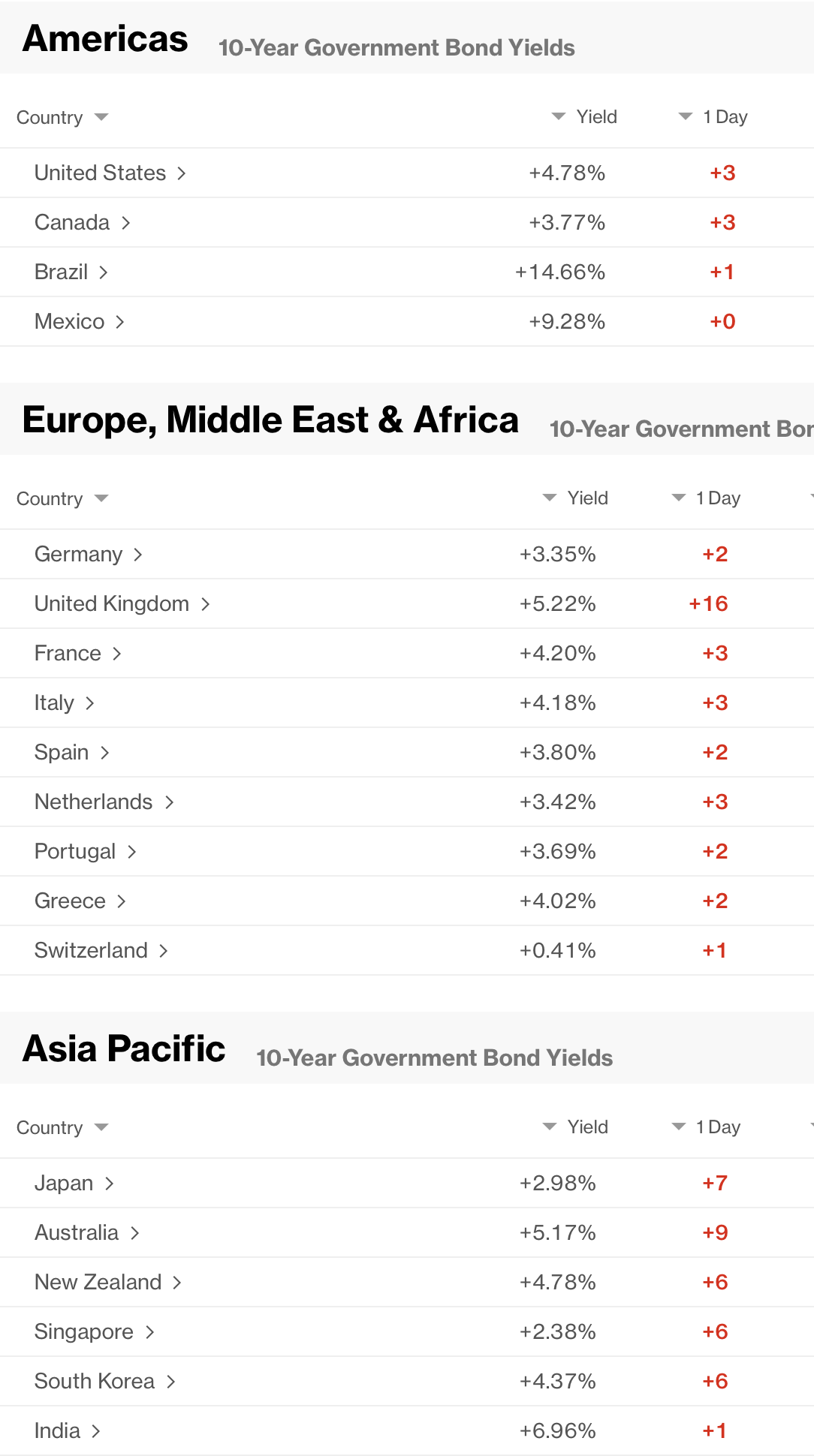
Of course, the outlier here is the UK, which was closed yesterday so had a lot of catching up (down?) to do.

We’ve already discussed commodities which brings us to the dollar, which is rising despite yields rising everywhere.  Now, the DXY is at 99.60, hardly new territory although the trend over the past year is marginally higher as per the below chart.
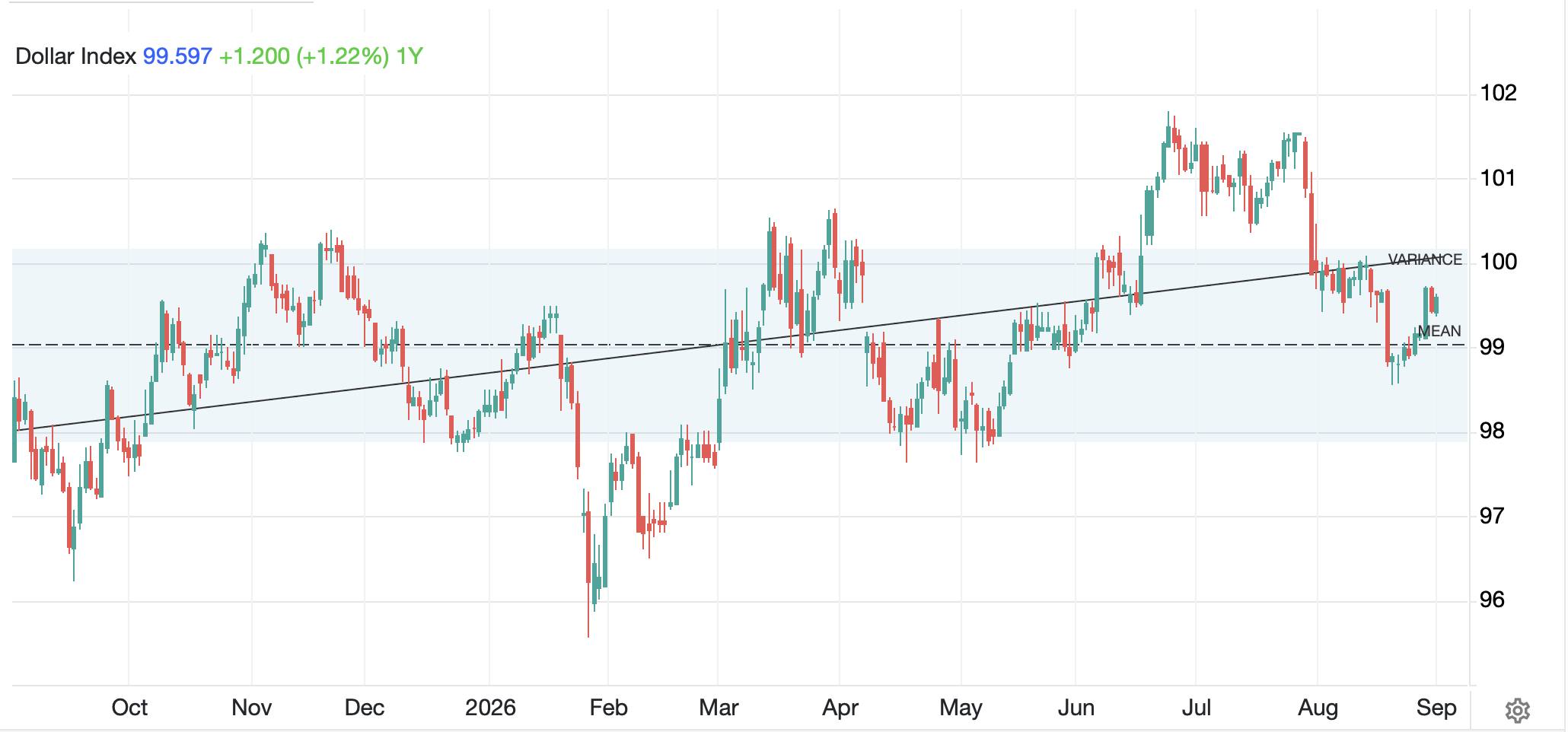
Source: tradingeconomics.com

If we look at individual currencies, JPY (-0.2%) has seen the dollar rise back above 160 as the post intervention price action remains consistent with every previous effort.  Perhaps the most surprising outcome today is ZAR (-0.1%) which is holding up quite well despite much higher oil prices and much weaker gold prices, the two key issues in that economy.  But net, as much as people worry about the debasement of the dollar, it appears they are more worried about the debasement of other currencies more rapidly.

On the data front, this morning brings ISM Manufacturing (exp 55.2) and Prices Paid (72.0) as well as the JOLTs Job Openings report (7.3M). Fed Governor Barr speaks before the data at 9:00 this morning so I wonder if he will reaffirm the hawkish vibe, and if he does, shouldn’t that help the bond market?  I am still focused on Friday’s NFP as the next truly important piece of news, but there is an awful lot that can happen between now and then, especially with this President.

Good luck

Adf

Fearmongers Now Say

A question that’s going around
Is where will the buyers be found
For all the new debt
That nations are set
To issue as budgets compound
 
As well, the fearmongers now say
A crisis is coming our way
If voters elect
The folks who reject
The status quo finance cliché


As markets return from yesterday’s US holiday, activity remains somewhere between muted and ordinary in most markets.  At times like these, it is interesting to take note of the tone of the articles in financial journals, whether the WSJ, Bloomberg or the New York Times, as they are the place where I find politics is inserted into the discussion.  

For instance, there have been several articles regarding the pending French election and the market’s concern about a victory by Marine Le Pen on the right.  The thesis seems to be if her RN party wins and takes over parliament, that her plans will result in a collapse in French finances based on the promises she has made throughout the campaign.  There are many analogies to what occurred in October 2022 in the UK, when the newly elected PM, Liz Truss, put forth a program of unfunded spending and the Gilt market fell sharply.  You may recall the result was that the BOE had to step in to buy Gilts even though at that time, they had just begun to sell them to reduce the size of their balance sheet. 

Of course, what gets far less press is the fact that UK insurance companies had levered up their balance sheets because of ZIRP as they tried to earn a sufficient return to match their pension liabilities and when the BOE started tightening policy, those companies were already in trouble.  Certainly, the market response accelerated the problem, but even without Truss, as the BOE kept raising rates, the outcome would likely have been the same.  However, it was politically expedient for the press to blame Truss and the Tories.

Now consider the US, where government profligacy is truly breathtaking as the current government is borrowing $1 trillion every 100 days or so.  Certainly, this topic has been reported, although it is difficult to find a discussion from the mainstream media that makes the leap that spending as much as is currently happening is the underlying cause.  (Yes, there are many stories of this from conservative media as well as on Twitter, but not on the CBS Nightly News.)  However, those same mainstream sources threaten everyone that in the event Donald Trump is elected, it will spell the end of the bond market and the US economy because of his policy proposals of tax cuts and supporting energy growth.

It is commentary of this nature that, in my opinion, has reduced the value of mainstream media via the constant politicization of every subject.  This is also why alternate media sources, like the numerous excellent articles on Substack, have become so popular and widely read.  Analysts who are not beholden to a corporate policy and politics are able to give much more accurate and politically unbiased views.

At any rate, there was much concern ahead of this morning’s French bond auctions (they issued €10.5 billion across various maturities from 3-8 years) as this was the first attempt to sell debt since President Macron called his snap election after his European Parliament electoral disaster.  However, happily for all involved (except the doom mongers) things went just fine with a solid bid-to-cover ratio and a modest decline in market spreads.  All told, while nobody knows the future, it is difficult to expect that a Le Pen government will be any worse financially than the current Macron led government.  After all, France has just been warned by the European Commission that it must reduce its budget deficit from the current 5.5% to 3.0% as per the Maastricht Treaty, and there is no “far-right” influence on the current government.

Enough politics, let’s recap the overnight markets.  Asian markets were mixed as the Nikkei edged higher (+0.15%) but the Hang Seng (-0.5%) gave back some of yesterday’s spectacular rally.  The laggard, though, was mainland China (-0.7%).  In Europe this morning, despite the fears of a Le Pen victory, the CAC (+1.0%) is the leading gainer as either we are seeing a trading bounce after a terrible week last week, or maybe the initial hysteria is being seen for what it was, unfounded hysteria.  Meanwhile, as the BOE just left rates on hold, as widely expected, the FTSE 100 has bounced about 0.3% in the first 15 minutes since the announcement and is up 0.5% on the day.  Overall, Europe is having a good day with the DAX and virtually all markets ahead.  US futures, too, are firmer this morning, with both the NASDAQ and S&P higher by 0.5% or more although the Dow continues to lag.

In the bond market, Treasury yields have backed up 2bps this morning but the picture in Europe is much more mixed.  German yields are higher by 3bps, but UK yields have slipped a similar amount.  In fact, looking at all the nations there, it appears that there is slightly less concern over Europe as a whole as French yields are only higher by 1bp and Italian yields have slipped 1bp, thus narrowing the spread with Germany overall.  Turning to Asia, JGB yields rose 2bps, following USDJPY higher, or perhaps anticipating a higher inflation reading tonight.

In the commodity markets, crude oil (+0.15%) is edging higher this morning, although it slipped in futures trading yesterday (the only market open).  This morning brings the inventory data which is anticipating a draw of 2M barrels.  Metals markets are solid again with gold (+0.4%), silver (+1.7
%) and copper (+0.2%) all continuing their rebound from the dramatic decline two weeks ago.

Finally, the dollar is stronger this morning against most of its counterparts, notably the JPY (-0.3%) and CNY (-0.1%).  I highlight these because the yen story remains critical to the global financial markets, and it appears that Japanese investors are beginning to turn back toward Treasuries and away from JGBs supporting the moves in those markets and USDJPY.  

Regarding China, last night the PBOC fixing was at 7.1192, its highest level since November 2023 and the largest move (33 pips) in weeks.  It appears that there are numerous changes being considered and ongoing in China regarding its domestic bond market (the PBOC is looking to become more involved to support liquidity) as well as the overall monetary structure (there is talk that they will be adjusting the framework of three different rates to something more akin to what Western central banks use with a single policy rate).  In the end, given the ongoing lackluster performance of the Chinese economy, a weaker CNY remains my base case and while it may be gradual, it seems it is the PBOC’s view as well.  The onshore market continues to trade at the edge of the 2% allowable band and the offshore market is a further 35bps higher (weaker CNY) than that.  

Elsewhere, ZAR (-0.85%) which has had a good run on the back of the ultimate electoral outcome, seems to be afflicted with some profit-taking and then most of the rest of the currencies are softer vs. the dollar by about 0.2%.  One last exception is CHF (-0.65%) which has slipped after the SNB cut their policy rate by 25bps, as expected, to 1.25%.

On the data calendar today, we see Initial (exp 235K) and Continuing (1810K) Claims, Philly Fed (5.0), Housing Starts (1.37M) and Building Permits (1.45M), all at 8:30.  Then, later this afternoon, Thomas Barkin of the Richmond Fed will undoubtedly remind us that things are moving in the right direction, but patience is required.

Summing it all up, while I didn’t specifically mention it, the key thing in financial markets continues to be Nvidia, which is much higher in pre-market trading again, and apparently is the driver of everything.  However, traditional relationships have been under strain as although it appears to be a risk-on day, both the dollar and precious metals are firmer.  Overall, nothing has changed my view that the Fed is going to remain firm for now, and that (too) much credence will be assigned to next Friday’s PCE data.  But such is the state of the world.

Good luck

Adf