Subterfuge

The narrative right now is run
By hawks who think Warsh is the one
To raise short-term rates
Right out of the gates
And so, they’re long bucks by the ton

Thus, futures positions are huge
With no effort at subterfuge
But if they are wrong
About being long
The hawks will have all been the stooge

In an otherwise quiet session, this morning I am going to borrow from Ole Sloth Hansen, the futures maven at Saxo Bank.  He publishes a Substack that is well worth reading if you are actively involved in the markets as he breaks down futures positions and offers context.  This morning I am going to juxtapose those positions with my views, which are diametrically opposed to the way the market is currently positioned.

Starting with the FX market, he has created a wonderful chart showing that the net non-commercial long USD position against eight major currencies has reached 10-year highs.  Interestingly, the DXY is not anywhere near those highs, although it appears that is the growing expectation of many traders.
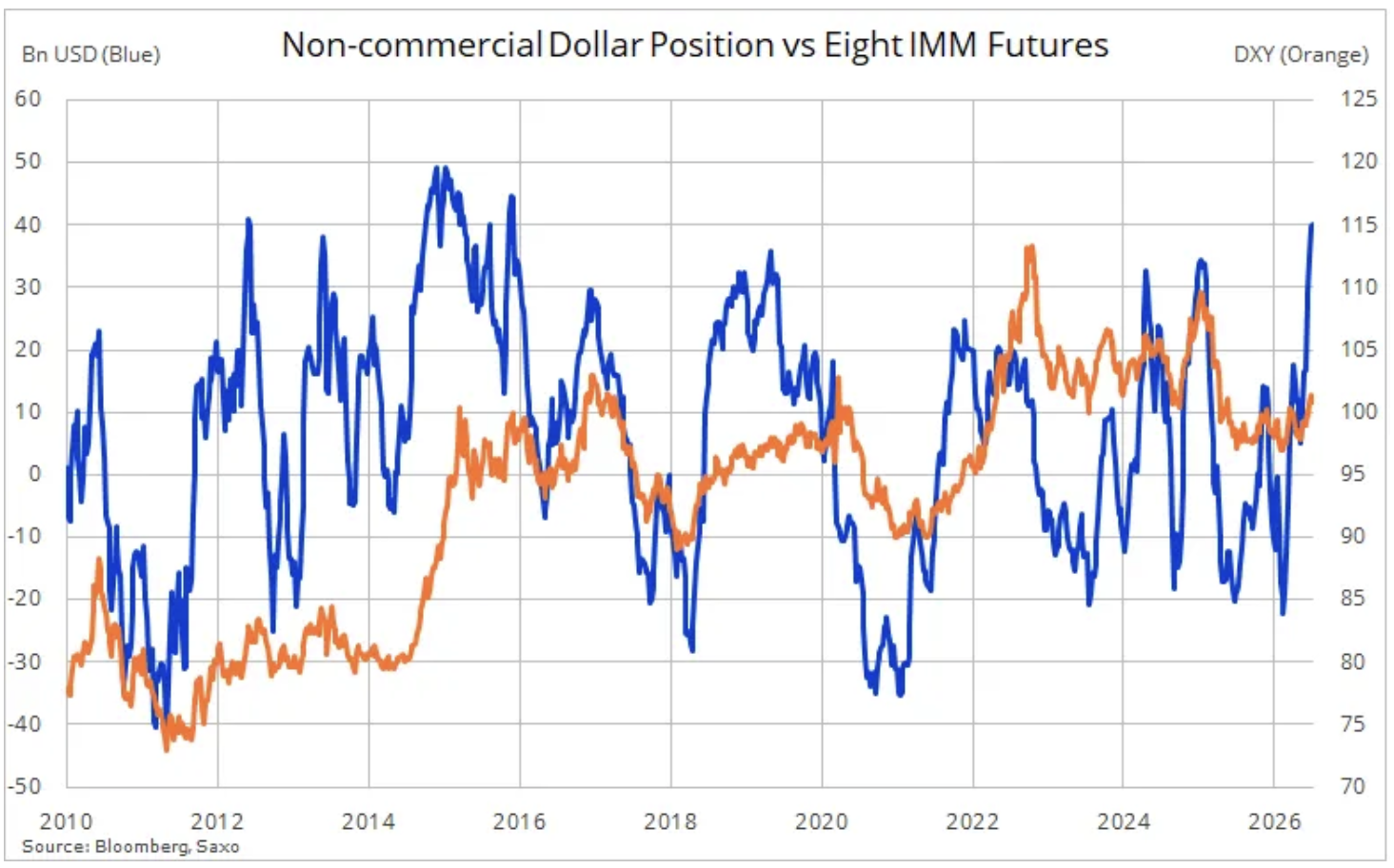
Arguably, this is based on the idea that Chairman Warsh is Paul Volcker redux and will be quite hawkish going forward.  Now, I cannot tell if this is the narrative because, absent forward guidance, narrative writers must now think on their own and are incapable of doing so, or if they truly believe that despite all the talk that rising oil prices were going to feed through to inflation readings, declining oil prices won’t have the same impact on the way down.

But it is not just the FX trading community that is on board with this story, so too is the short-term interest rate trading community.  While LIBOR has been forced out of existence, SOFR (Secured Overnight Funding Rate) is the new benchmark in interest rate markets and, naturally, there is an active futures market there as well.  As you can see from the below chart, also from Mr Hansen, the current positioning is strongly expecting higher short-term interest rates.

This is completely in accord with the Fed funds futures market where the market continues to price a 25% probability of a hike at the end of July and a virtual certainty of a hike by October.  By my calculations, as per the chart from cmegroup.com below, the market is pricing about 30bps of rate hikes by the December meeting.
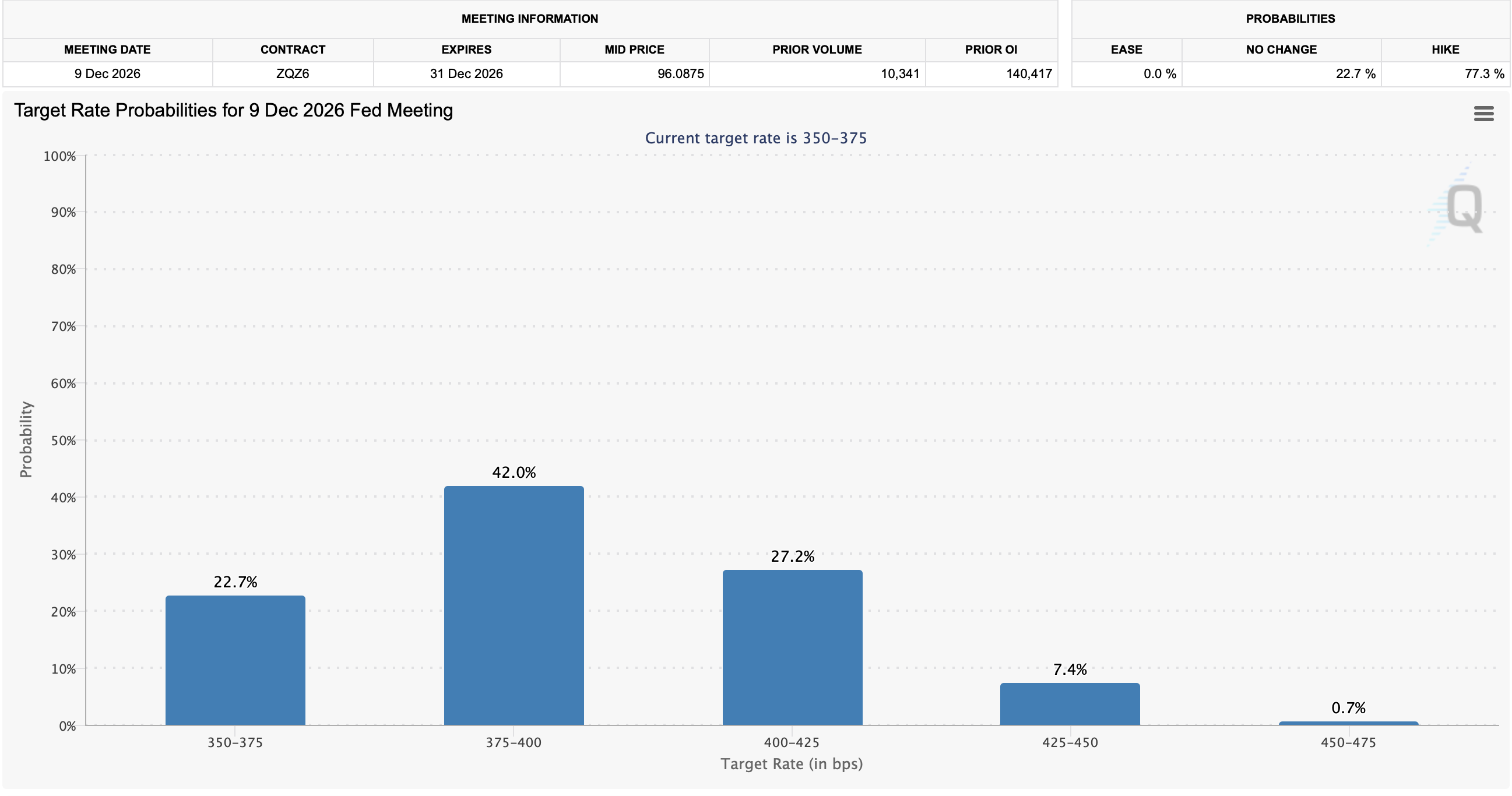
Or course, by now you know that my view is the Fed will not be hiking rates at all, and as measured inflation slides back (just look around the world and at oil prices) the narrative will belatedly shift to the need willingness to reduce rates on Warsh’s part and all these market positions will adjust.  

My longer-term positive view of the dollar is based on the ongoing investment inflows into the US, for real investment, not merely equity market participation, and nothing has happened to change that view.  In fact, the announcement yesterday by Toyota that they will be expanding their San Antonio truck and SUV plant with a $3.6 billion investment is just the latest in a series of these announcements.  But that is not the carry trade driving things.  In fact, ironically, we could easily see US rates slide a bit as the dollar rallies on natural investment demand rather than financial demand.  As well, if I am correct, the Fed funds futures market is going to head back to pricing no rate hikes, perhaps as soon as next week after the CPI data is released.

I think the lesson is that the narrative writers need to bone up on their understanding of macroeconomics and international finance as the central bank policy driver may not be the future.  Certainly, if Mr Warsh has anything to say about it, and he does, that will likely be the case.

Which takes us to the overnight session. The most excitement overnight was for Belgium as they completely outplayed the USMNT in a 4-1 victory in Seattle.  But otherwise, the story that Iran fired two missiles at ships heading through Hormuz helped support oil prices, but as I type, they are higher by just 0.7% (~50¢/bbl) so not really very much.  The interesting discussion in the oil market this morning is the fact that Iranian oil, which is no longer sanctioned, cannot seem to find any buyers with some 58 million barrels in floating storage and no takers.  Meanwhile, despite ongoing buying by central banks around the world, gold (-0.5%) continues to struggle, although appears to be putting in a base and silver (-1.4%) is suffering as well.  

In the bond market, yields are creeping higher with both Treasuries and European sovereigns all higher by 2bps this morning with a similar move by JGBs overnight.  My take is this is less of an inflation concern than a supply concern.  Certainly, there is no indication that the US, Europe or Japan are about to slow down their fiscal stimulus, with Europe now further ramping up its defense spending as the US pressures NATO further.  To me, this is where the rubber will meet the road as if Warsh really does seek to reduce the Fed’s balance sheet, it is not clear where buyers are going to be found to replace them.  I suspect we will see more regulatory freedom for banks and insurance companies to hold Treasuries without capital penalties, but that is a big hole to fill.  

In the equity markets, yesterday’s US rally was followed by a reversal in Asia with Korea (-4.9%) leading the way lower on the back of weakness in SK Hynix stock despite stellar earnings.  But that dragged down the entire region (Japan -2.1%, China -1.0%, HK -0.5%, Taiwan -2.3%) and various declines everywhere else except Singapore (+1.4%) although I can find no specific catalyst for that outlier move.  In Europe, things are more mixed with Germany (-0.7%) under pressure although there is modest strength in the UK (+0.3%), France (+0.2%) and Spain (+0.1%).  All the talk here is about defense spending, although one would have thought that would help Germany the most.  As to US futures, at this hour (7:55), NASDAQ futures are following Asia lower, -1.3%, but the other indices are little changed.

Finally, the dollar is generally a bit stronger this morning, at least against its G10 counterparts, although JPY (+0.1%) is holding up.  But the dollar’s gains are minimal, about 0.1% to 0.2%, so it is difficult to get too excited.  In the EMG bloc KRW (+1.0%) is the clear leader after the country expanded trading hours in the currency markets, and there has been modest strength in BRL (+0.4%) and INR (+0.4%) although neither has seen any major policy changes.

On the data front, yesterday’s ISM Services data was right on the button at 54.0.  This morning we see the Trade Balance (exp -$78.5B) and that’s it.  The hawkish Fed story continues to be the most popular, and until we see some data that can undermine that story, I expect it will remain in place.  Tomorrow’s FOMC Minutes should be interesting as there was obviously a lot of back and forth at the meeting, but since we have already heard further from Mr Warsh, and it is way too early to hear back from the task forces, I suspect we are in for more quiet markets for now.

Good luck

Adf
A Final Bronx Cheer

Though markets are desperate for Jay
To cut, there is fear that he’ll say
It’s not yet the time
In this paradigm
As tariffs have caused disarray
 
But truly, Chair Jay’s greatest fear
Is that ere October this year
The Prez will have chosen
A new Chair and frozen
Him out with a final Bronx cheer


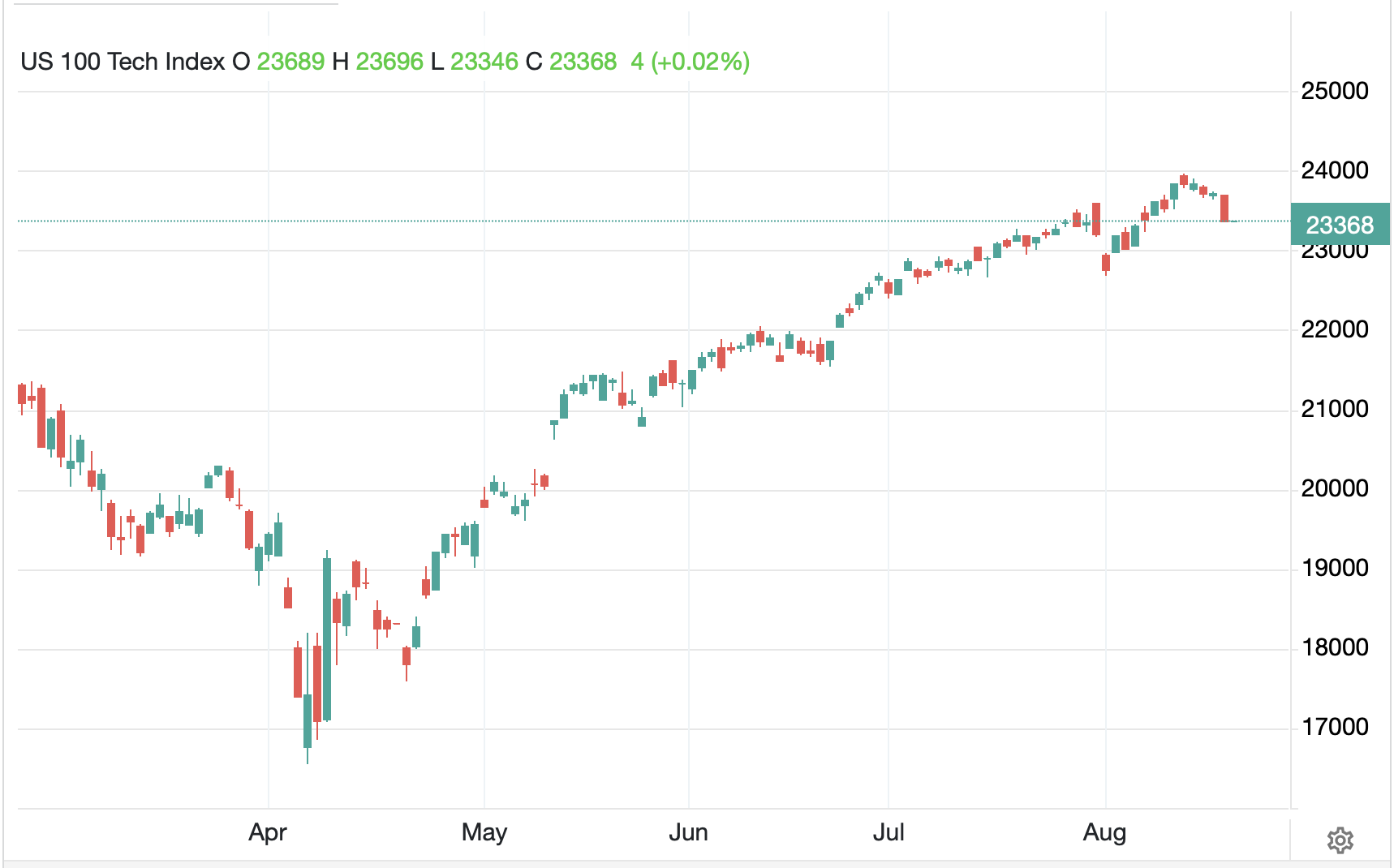
Yesterday saw the first substantial equity market move in nearly 3 weeks, with the NASDAQ declining 1.5% as concerns arose that the current extremely high valuations would have a more difficult time being maintained if the Fed does not ease policy as widely expected next month.  This resulted in all the Mag7 declining, which given they have been the driving force higher in the market, necessarily resulted in overall index declines.

Source: tradingeconomics.com

Of course, the question is, what made yesterday any different than previous sessions.  There were no earnings results of note, and arguably, the biggest tech news was the story about the US government taking a stake in Intel, something that seems likely to have been a positive.  However, there has been an increase in chatter about what Chair Powell is going to say on Friday at his Jackson Hole speech.  Notably, in the SOFR options market, there are a large, and still increasing, number of bets being placed that Powell will indicate 50bps is on the table in September.  But Wall St analysts continue to side with the patience crowd, explaining that while the current policy settings may be slightly restrictive, they are hardly suffocating for the economy.

While Powell has repeatedly blamed an uncertain impact of tariffs on his decision to maintain current policy settings, just like everything else, this is becoming extremely political.  Trump’s allies are lining up behind him and calling for immediate rate cuts to help support the economy.  At the same time, Trump’s political foes remain focused on preventing any Fed action that might help Trump, although they couch their arguments in terms of maintaining Fed ‘independence’.

However, last night was instructive in that two central banks, New Zealand and Indonesia, cut rates further while Sweden’s Riksbank, though standing pat, explained that more cuts are possible, if not likely, later this year.  While the PBOC did not cut rates, the pressure there is building as the economic situation is very clearly slowing down, as discussed last week after their data releases.  So, with most of the world cutting rates (Japan being the notable exception), pressure continues to mount on Powell and the Fed to pick up where they left off last December.

Hanging over both Powell’s speech and the September rate decision is the fact that Treasury Secretary Bessent explained yesterday that interviews for the next Fed chair would begin around Labor Day, just two weeks from now, and nearly eight months before Powell’s term ends.  This will almost certainly weaken Powell as other FOMC members and the market will look to whomever is selected for their views, with Powell serving out his term as a lame duck.  In fact, it is for this reason that my take is Powell’s speech at Jackson Hole will be less about policy and more an attempt to burnish his legacy.

And that’s where things stand.  With no data of note today, and yesterday’s housing data being mildly positive, but not enough to change macroeconomic opinions, the narrative writers are looking for something to say and Powell’s speech is where they have landed.  Absent a run of declining days, I put no stock in a change in the market temperature at this point.  So, let’s see how things behaved overnight.

In Asia, the Nikkei (-1.5%) had a rough night in a direct response to the US tech-led selloff.  Given that US markets have stabilized this morning, with futures unchanged at this hour (7:25), we need to see a continuation here before expecting a significant further decline there.  China (+1.1%), however, bucked that weaker trend, ostensibly on hopes that the ongoing trade talks with the US will prove fruitful.  Elsewhere in the region, Korea (-0.7%) and Taiwan (-3.0%) were both hit on the tech selloff blues but other markets, with less exposure to that sector were fine.  In Europe, it is a mixed picture with the DAX (-0.4%) the laggard after weaker than expected PPI indicated that current ECB policy needs to be more accommodative to help the country but may not be coming soon.  However, the rest of the continent is little changed.  surprisingly, UK stocks (+0.3%) are holding up well despite higher-than-expected CPI data which has adjusted analysts’ thoughts on whether the BOE will be able to cut again at their next meeting.

In the bond market, Treasury yields (-1bp) continue to trade in the middle of that band I showed yesterday, while European sovereign yields have also slipped between -1bp and -2bps this morning after the softer German price data.  The UK (-4bps) is a surprise as I would not have expected lower yields after a higher inflation reading.  Perhaps this is an indication that investors are expecting a much worse economic outcome from the UK going forward.

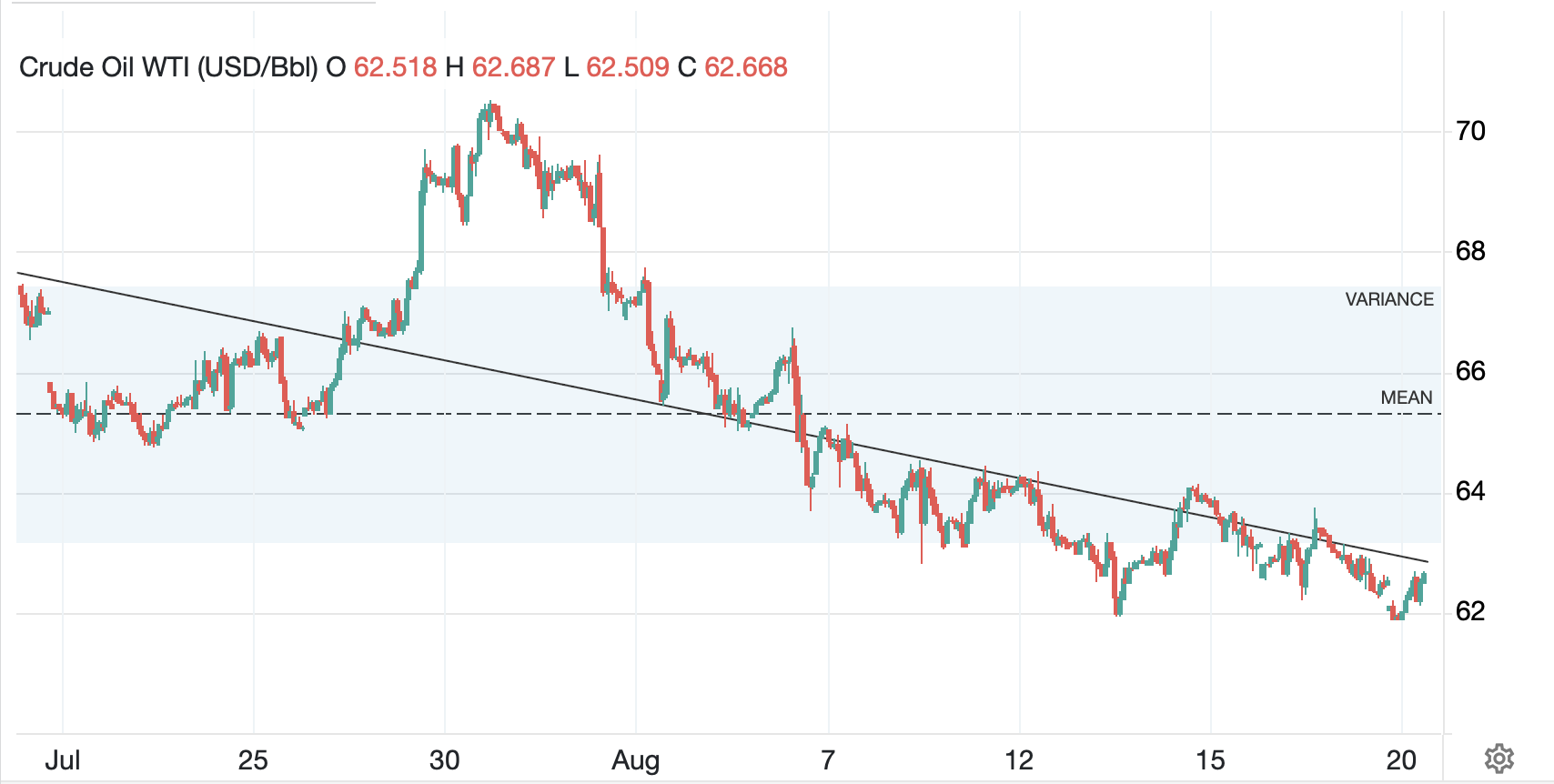
In the commodity markets, oil (+1.3%) is bouncing, but it remains in a well-defined downtrend for now as per the below chart.

Source: tradingeconomics.com

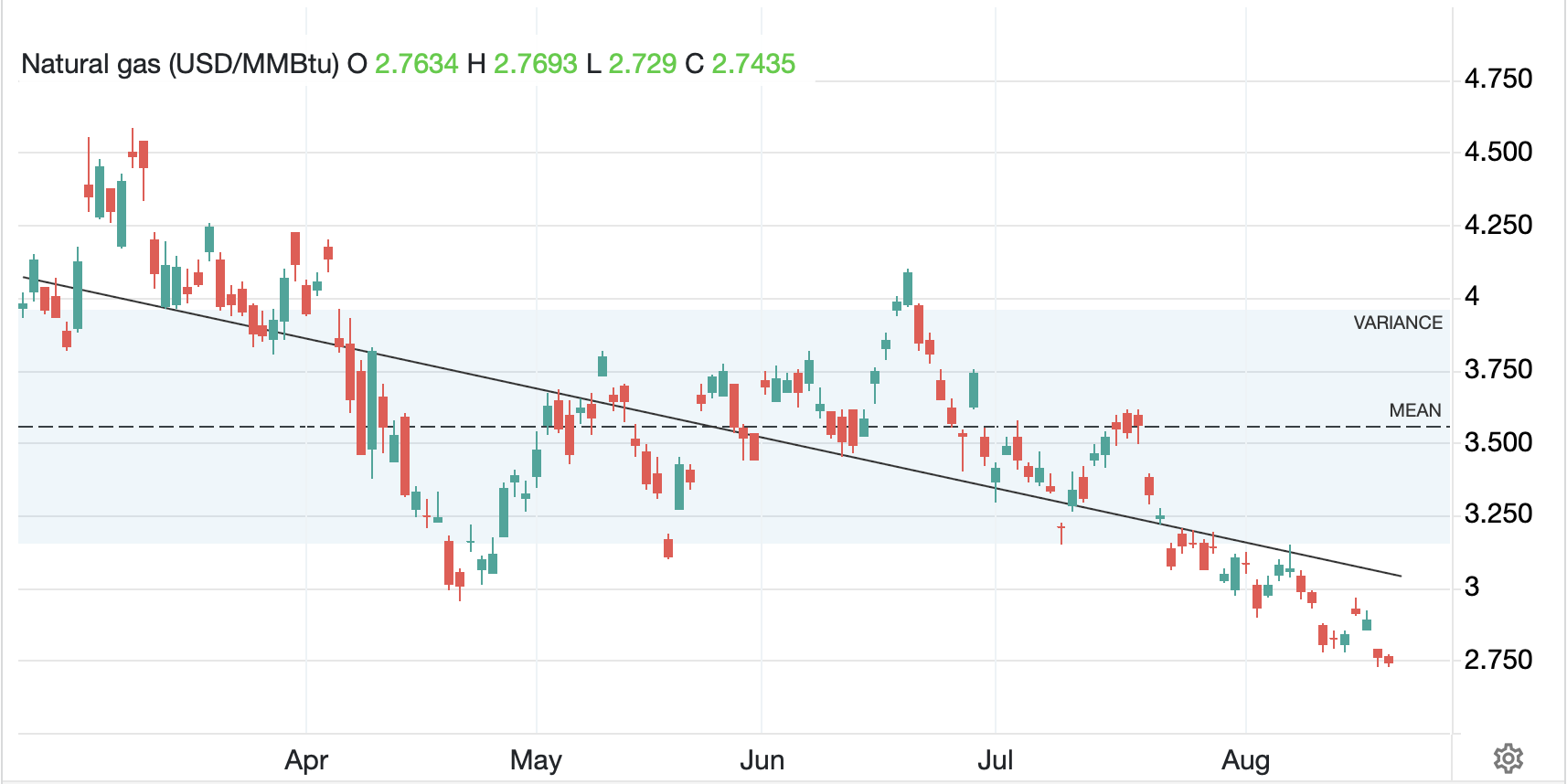
To change this trajectory, we will need to see something alter the production schedule, which with peace on the table in Ukraine seems likely to bring more oil to market not less, or we will need to see a significantly better economic outlook that drives a substantial increase in demand, something which right now seems unlikely as well.  I cannot get on board the higher oil price bandwagon at this time.  One other thing weighing on oil is the fact that NatGas has been trending lower for the past 6 months and is now at levels not seen since last November.  In fact, those two charts look remarkably similar!

Source: tradingeconomcis.com

There is a real substitution effect here and currently oil is trading at a price that is about 4X the energy price of NatGas.  Until that arbitrage closes, and it will eventually, oil will have difficulty rallying in my view. 

In the metals markets, gold (+0.4%) which sold off a few dollars yesterday is rebounding although both silver and copper are soft this morning.  These markets are just not that interesting right now.

Finally, the dollar is little changed this morning with one real outlier, NZD (-1.2%) which responded to the dovish tones of the RBNZ last night and is pricing in more interest rate cuts now.  KRW (-0.4%) also fell on concerns over trade and the semiconductor results but otherwise, there is very little ongoing here.

The only data this morning is EIA oil inventories with a small draw anticipated.  The FOMC Minutes come at 2:00 and there will be a lot of digging to see if other members seemed to agree with Bowman and Waller in their dissents at the last meeting.  Bowman spoke yesterday, but was focused on her role as chief regulator, not monetary policy, although we hear from Waller this morning.

A down day in equities is not the end of the world despite much gnashing of teeth.  It remains difficult to get excited about markets right now.  Perhaps Mr Powell will shake things up on Friday, but my sense is we will need to wait for the next NFP data to get some action.

Good luck

Adf

PS. A reader explained to me that in Australia, black swans are the norm, not the remarkable case as here in the US.  I guess we will need to find a new term to discuss an unexpected surprise.