
It turns out, inflation of late
Did not start to accelerate
Instead, it was mild
With doves now beguiled
But not yet declaring checkmate

The odds of a hike keep on sliding
But ere the Committee’s deciding
In two weeks, we’ll hear
Chair Warsh try to steer
The narrative with gentle (?) chiding
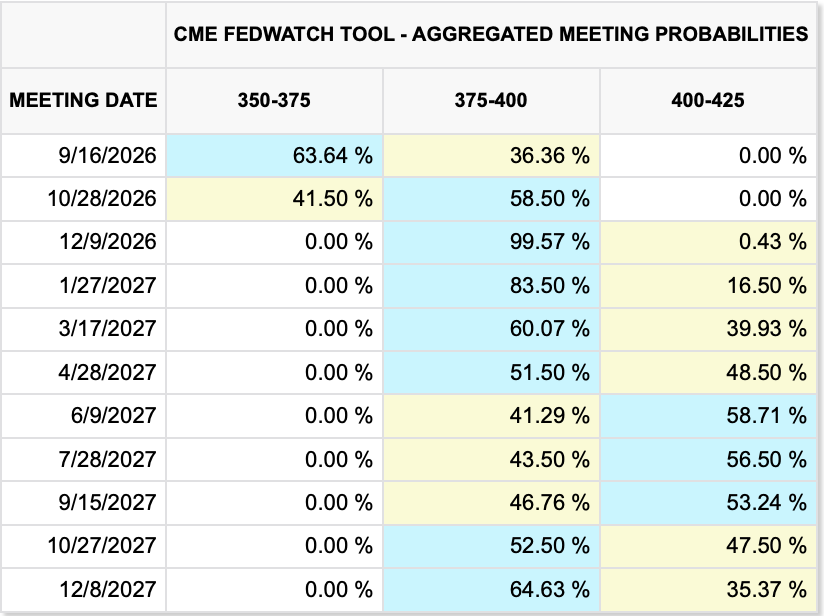
The fears over rising inflation have been allayed for the moment after yesterday’s CPI data was released right on expectations with monthly increases of 0.1% headline and 0.2% core and Y/Y results of 3.4% and 2.5% respectively. For all those who have been pining for that rate hike ASAP, this was unwelcome news. The below table from cmegroup.com shows how things have changed over the past month.

On July 13, markets were pricing a 75% probability of a hike in September with thoughts of a 50bp hike a reality. This morning, the probability of that September rate hike has fallen to just 36%. You may recall that I have been consistent in my views that there would be no rate hikes this year, and that continues to be my view. If we look at the entire Fed funds futures curve, as per the next table, we now have one hike priced for December only, compared with two plus hikes several months ago.
This is not to say I believe that inflation is dead, just that it is not accelerating away. As my friend The Inflation Guy points out in his piece on yesterday’s CPI, the data was boring, “Boring, right on expectations. The bad news is that it is boring and right on expectations…at 3%.” This is still a far cry from the Fed’s self-defined 2% target, but fears of “Amerizuela” type outcomes are vastly overblown. (However, you still want to protect you purchasing power and one effective way to do that is via USDi, the only inflation tracking cryptocurrency.)
Now, we still have a bunch more data before the next FOMC meeting, including today’s PPI, PCE at the end of the month and another NFP and CPI reading in September. As well, we cannot forget that Chairman Warsh will have the opportunity to clarify his thinking at the Jackson Hole soiree on Friday morning, August 28th.
So, has anything really changed that much after the CPI report? While the reality hasn’t shifted, it does appear that market participants are beginning to adjust their views a bit. One number does not a trend make, nor will it have bolstered Warsh’s credibility, assuming that is in question, either. This is a saga that will continue to play out over time. It seems to me that if the Fed really wanted to fight inflation effectively, they would be digging much deeper into why they continue to hold >$1.9 trillion in MBS on their balance sheet and run an ample reserves framework. Going back to scarce reserves allows the market to drive interest rates, something clearly on Chairman Warsh’s wish list. But that will have to wait for the task force reports.
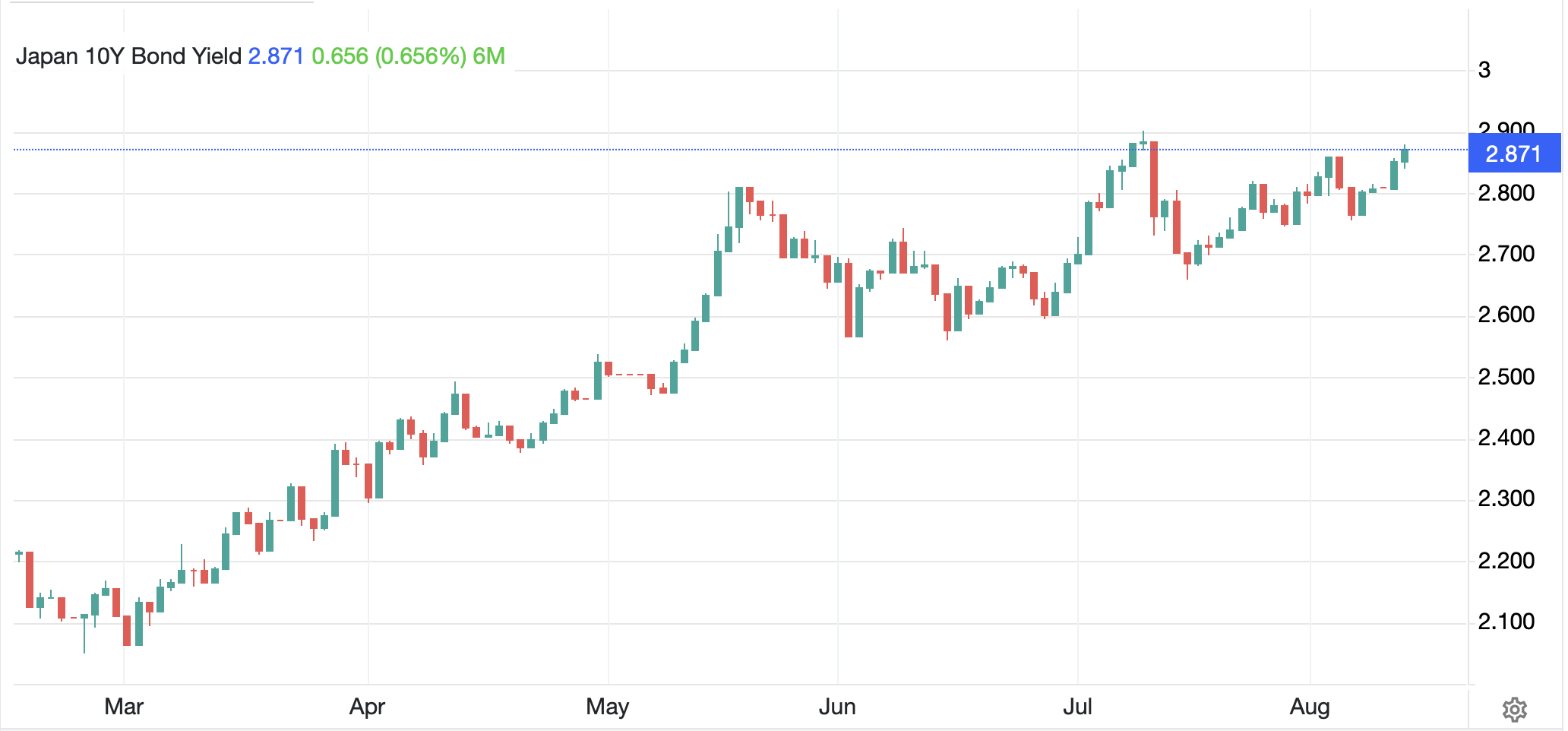
Ok, let’s see how markets other than Fed funds have responded to this news and data. Since we are on the rates subject, let’s start there this morning with bonds which have seen yields slip -2bps in Treasuries and between -1bp and -3bps in Europe. Oil prices (-2.1%) are slipping this morning so that appears to be the proximate cause of the yield move, a bit less concern over inflation. Yesterday, after the CPI data, we also saw Treasury yields drop -2bps, so for now, fears of an imminent test of 5.0% on 10-year Treasuries seem overblown. JGB yields, though, continue to creep higher, another 2bps overnight and are now just 3bps below their multi-decade high of 2.90% as per the chart below.
Source: tradingeconomics.com
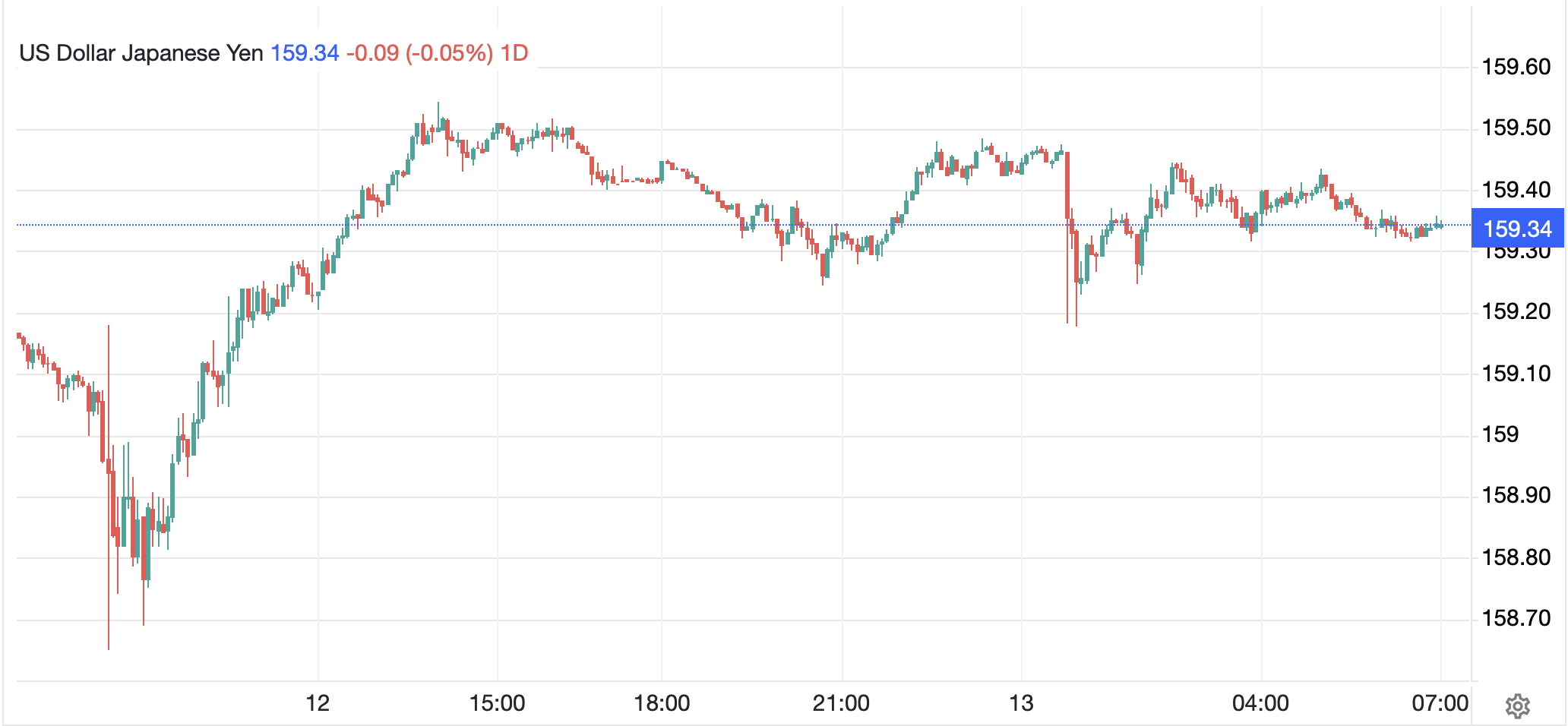
Speaking of Japanese rates, Bloomberg has an article this morning explaining that the Takaichi administration is ok with the BOJ raising rates sooner, a change in the market’s perspective if not an outright change of view there. Alas for those looking for a stronger yen and the end of the carry trade, the impact of the report was essentially nil as you can see in the chart below. The three large, red candles just to the right of center represent the immediate aftermath of the release of the report. Net, USDJPY is virtually unchanged on the day and the trend since the intervention remains for the dollar to move higher. My sense is perceptions of Fed rate activity is going to have a bigger impact than the BOJ for now.
Source: tradingeconomics.com
As to the rest of the FX market, +/- 0.2% covers the gamut for both G10 and EMG blocs. It wasn’t just the CPI report that was boring, so are FX markets overall.
Turning to equities, yesterday’s US market response was benign with only the NASDAQ showing much life, gaining 0.5%. In Asia, though we did see Tokyo (+1.1%) rise despite talk of the BOJ being more aggressive. Of course, the real price action remains in Korea (+3.6%), which is redefining what equity index volatility actually means. Otherwise, there were some gainers (Taiwan, New Zealand, India) and more laggards (China, HK, Australia, Malaysia, Indonesia) but none of these moves topped 1% in either direction.
European bourses, however, are feeling a bit better this morning led by Spain (+0.7%) and Germany (+0.5%) as earnings seem to be the driver here helping Spanish shares despite the tick higher in inflation there. UK shares (-0.2%) are lagging after GDP and production data was on the disappointing side while the Trade Deficit expanded further. And at this hour (7:30) US futures are little changed to slightly higher.
Finally, turning to commodities, oil’s decline seems to be attributable to the IEA reducing its global oil demand outlook (although they have been wrong about this for several years as they try to push a peak oil, transition to wind/solar narrative that is just not happening) as well as the fact that yesterday’s EIA data showed a 17+mm barrel build, a far cry from the slight draw expected and another blow to the tank bottoms story. As to the precious metals, the luster is gone (Au -0.5%, Ag -0.6%, Cu -0.5%) although copper remains quite close to its all-time highs, and both gold and silver remain in short-term uptrends after seemingly having bottomed back in July.
On the data front, this morning brings the weekly Initial (exp 202K) and Continuing (1800K) Claims data along with PPI (0.2%, 4.9% Y/Y) and core PPI (0.3%, 4.2% Y/Y). It strikes me that neither of these releases are going to be major market movers.
It is summer, and I assure you trading desk vacation schedules are far more important than secondary economic data releases. I suspect another boring day overall here. In fact, I suspect that until Warsh speaks in two weeks, we may see very little activity across most markets.
Good luck
Adf

