
The Minutes were pretty benign
As everyone toed the hike line
But this was old news
And Payrolls did bruise
The view Funds would soon rise and shine

As well, Bessent sold 10-year debt
And yields, buyers’ hunger, did whet
It seems there are some
Who think it’s not dumb
To grab these real yields they can get

And lastly, this morning’s ‘bout oil
Whose price is now up on the boil
The Strait of Hormuz
Is not safe to cruise
And this, major markets, did roil
Starting at the top, the FOMC Minutes were released yesterday and it’s not clear to me how much we learned. The unanimous vote to raise rates was accompanied by commentary that prices were an ongoing concern while the labor market seemed ‘balanced’. Of course, that was prior to the release of last week’s NFP report which showed that the balance may be tipping toward the downside, but that was just one report. The weekly claims data (exp today at 200K) hardly speaks to a serious problem there. As I type this morning, the probability of a hike at the end of this month is ~20% and has been so since last Friday’s release. Frankly, I don’t think we learned a great deal here.
Turning to yesterday’s 10-year Treasury auction, though, things were a bit more interesting. You may recall before my hiatus that there was a 5-year auction that had a relatively long tail, meaning that the final yield was 3.1 basis points higher than the when-issued price at the time of the release. That was seen as a very negative sign for the bond market. Well, yesterday, the 10-year auction saw a 1.7 basis point improvement on the when-issued price, a sign there was much more demand than anticipated. In fact, dealers took down only 2.5% of the auction with the rest going to investors of all kinds. That type of price action is quite positive and certainly puts paid to any discussion that investors don’t want to own Treasuries. It seems that at 5.3%, with a real yield of 2.5% or so, investors feel quite comfortable owning Treasuries, despite all the talk of too much debt leading to a calamity.
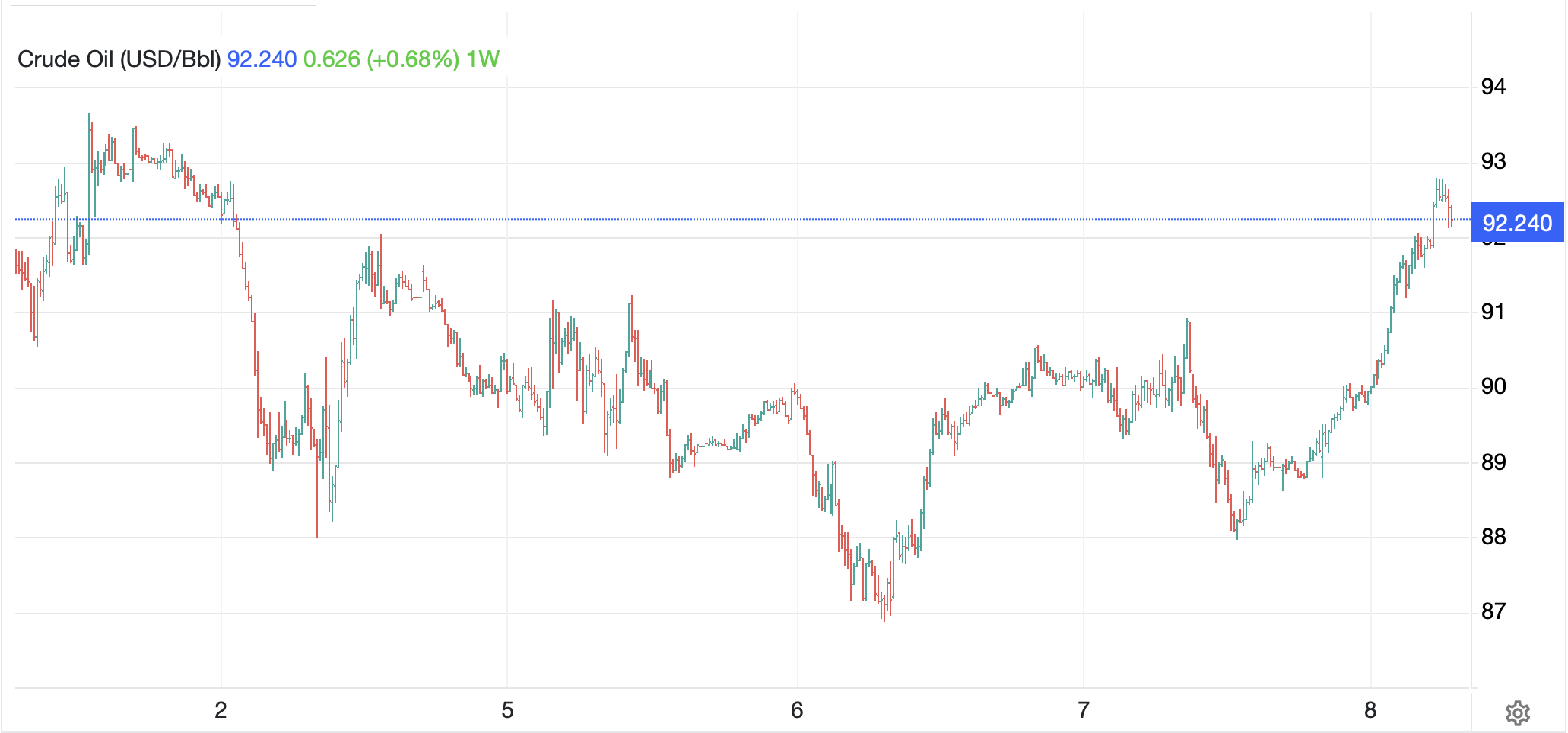
But today is all about oil (+4.5%) and the recent increase in attacks on ships through Hormuz. While last week, data showed that the flows had resumed to nearly pre-war levels, that has changed. Add to that the news that President Trump has ostensibly asked the Pentagon for updated plans for renewed military action soon, and nerves are jangling across markets. The below chart of WTI shows the reversal of price declines, but we are only back to levels seen last week. This is not extraordinary, especially given the volatility we have seen in this market. In fact, as you can see in the chart, the 1 week move shows oil higher by just 0.7%.
Source: tradingeconomics.com
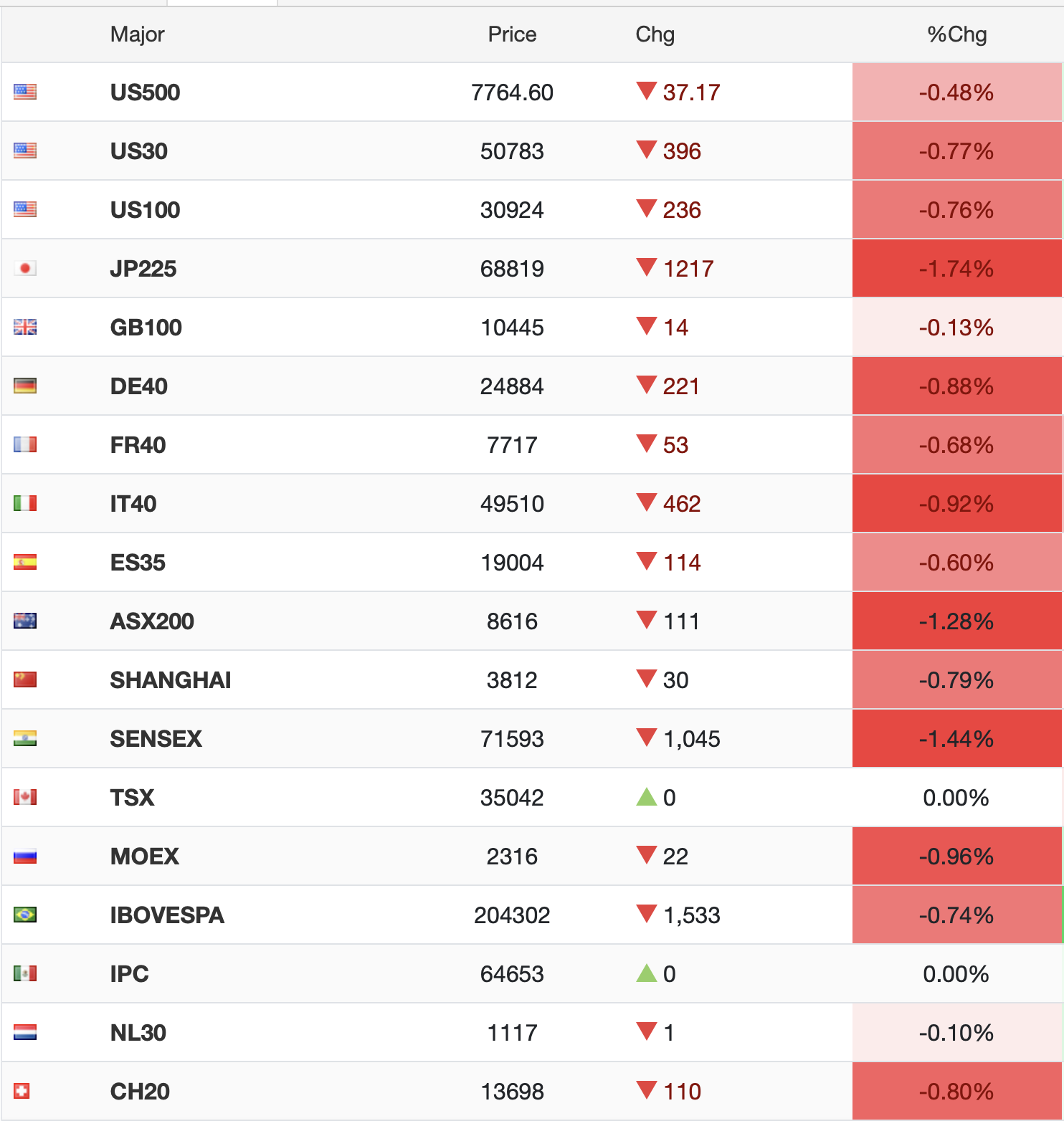
But every day is a new one, and today’s markets are being driven by the oil situation. You can see that clearly in the equity markets via the screenshot from tradingeconomics.com showing every market that is open (Toronto and Mexico are still closed) lower on the day by a pretty substantial amount.
Adding to the woes in the oil market is that the first hurricane of the season, Isaias, has formed in the Gulf of America and has forced the shut-in of about 25% of drilling activity there. Of course, that will be gone by Sunday and those rigs restarted, but for now, no bueno.
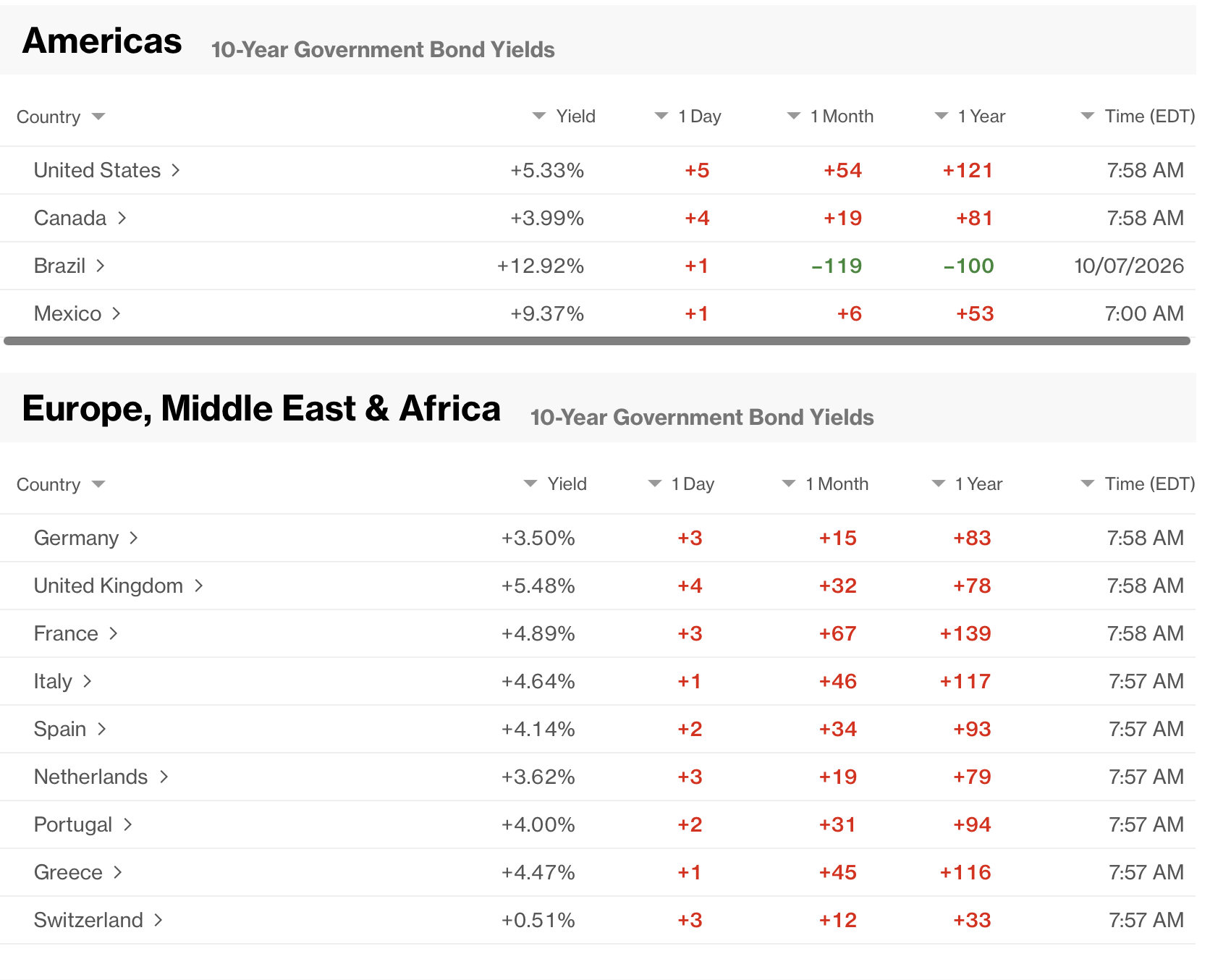
If we head back to the bond market, despite the strong auction results, this morning we are seeing yields rise everywhere in the world, albeit not as dramatically as yesterday.
Source: Bloomberg.com
One thing to note is that the spread between German and French debt has widened to its greatest gap since the Eurozone bond crisis in 2011 as concerns over French fiscal policies are really starting to bite. The protests in the street there are not helping, and investors are looking forward to the presidential election next spring where both the leading candidates are talking about lowering the retirement age to 60 from the current 62. I assure you, that will not help the fiscal situation either.
But let us consider this for a moment, why yields are rising. Is it entirely inflation concerns or is it something else? Earlier this week I discussed the fact that inflation breakevens remain pretty well anchored in the 2.3% to 2.5% range, indicating inflation is not the main concern. Rather, it appears to me that the factors driving yields higher are far more positive, namely stronger growth as currently symbolized by the hyperscalers borrowing massive amounts of money for their AI efforts, but arguably a reflection of the fact that the US economy is growing strongly. Izabella Kaminska (@izakaminska on X), former financial editor at the FT, made a very good point this morning on this subject.

In essence, running it hot means stronger private sector growth pushing demand for financing higher. However, it should also push up tax revenues reducing requirements for government borrowing. It can work out so they offset, but that will be tough, so there are going to be bumps. But, with Kevin Warsh not signaling great concern over the higher yields in the bond market, rather than financial repression (President Trump’s favored strategy), perhaps we just get back to a functioning economy and market with less interference from the government…well, one can always hope!
It should not be a surprise, then, that the dollar remains a major beneficiary of the current state of affairs. This morning it is higher yet again, albeit not dramatically so, only 0.1% against most major currencies. But let’s talk about the strength of the dollar. Is it really that strong? You all know how much I love to take a longer-term view on these things and this is no different. So, look at this chart of the DXY from barchart.com from its inception in 1974, and tell me if you think the dollar looks “strong”.
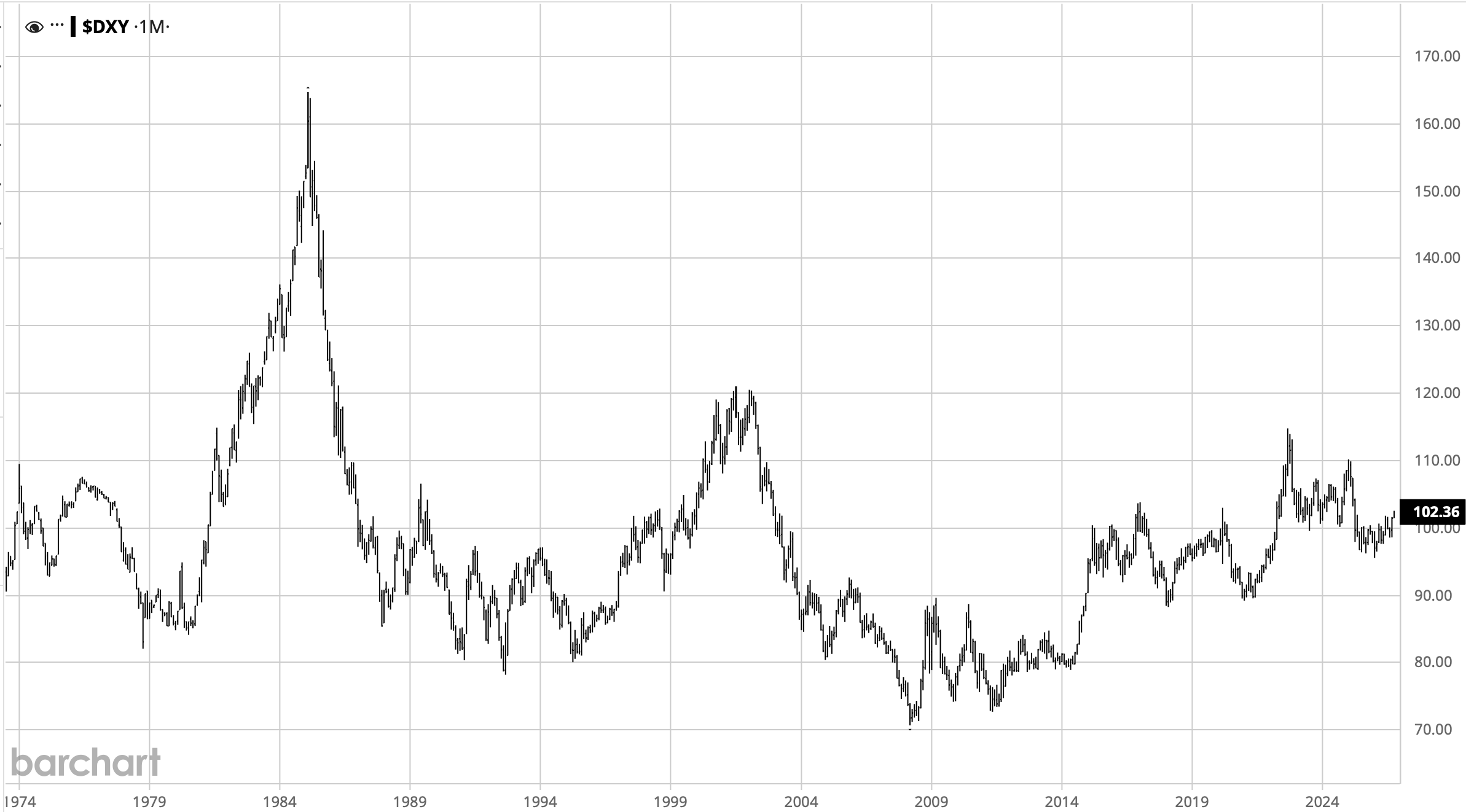
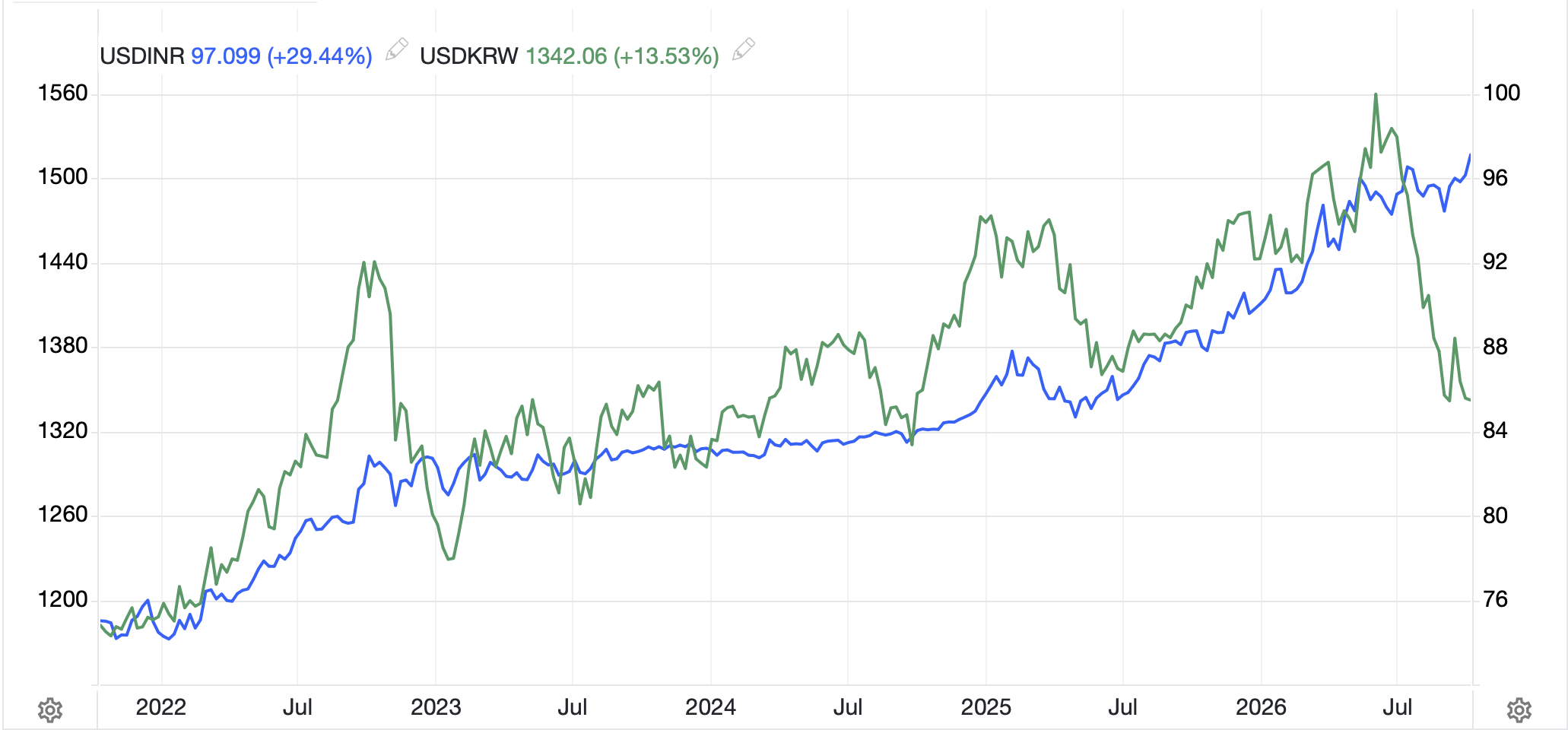
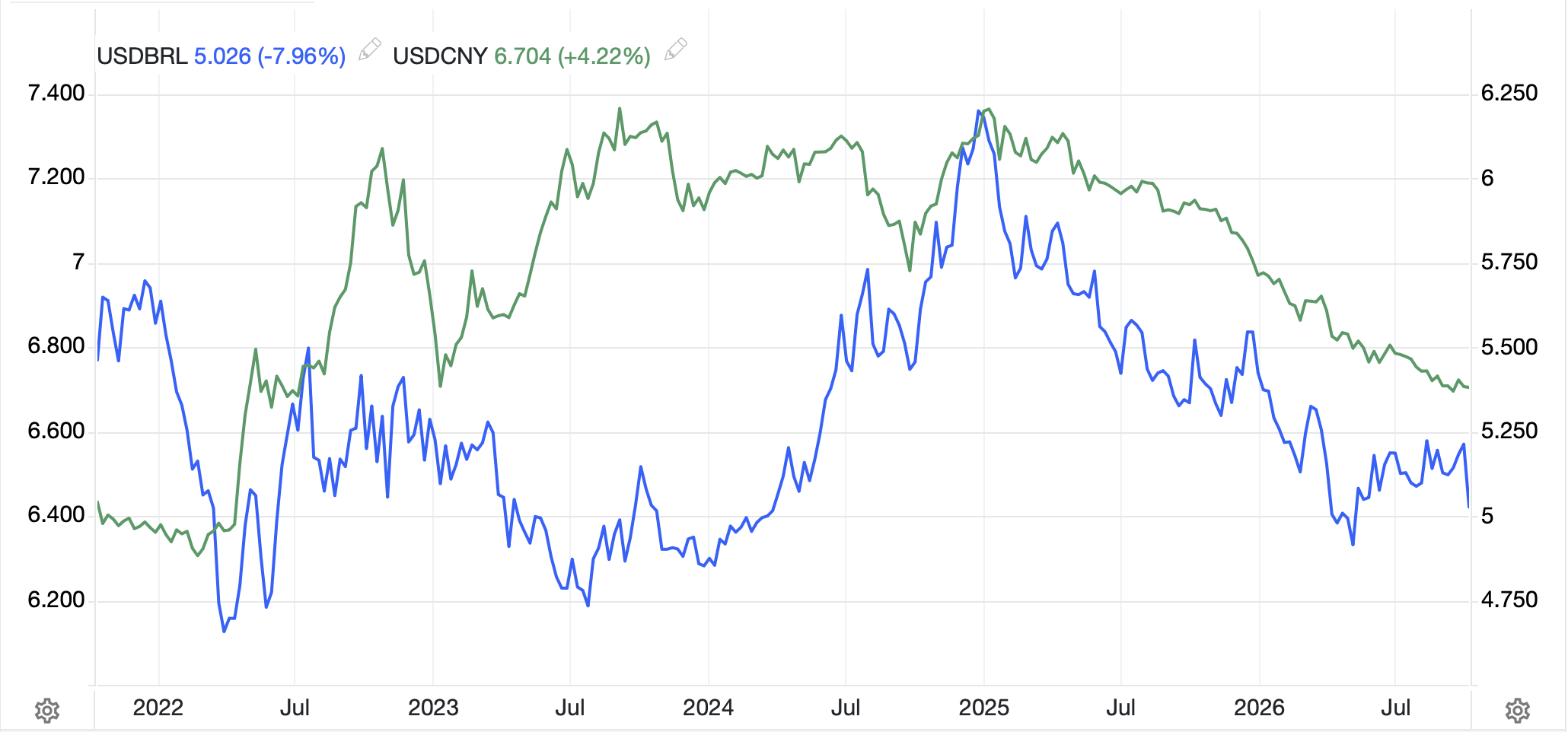
I remember getting the data and the average of the DXY is around 104.00, so we are not even there. In fact, the greenback is in a very ordinary place. Now, the DXY is representative of G10 currencies but not necessarily EMG currencies. However, that story has been quite divergent depending on the currency in question. For instance, if we look at the next two charts, we can see that movement across key currencies in this bloc have been very different.
Source: tradingeconomics.com
You can see INR and KRW, until very recently, have weakened substantially, while below, BRL and CNY have both shown real strength over the past 18 months, although had been more mixed prior to that.
Source: tradingeconomics.com
My point is, aside from the rupee, which is at long-term historic lows, we have seen all these prices before. There is no reason to panic about the dollar collapsing or becoming “too” strong.
We get our only real data of the week this morning with Initial (exp 200K) and Continuing (1710K) Claims and Wholesale Inventories (+0.7%), although nobody pays any attention to that. There is no doubt that market participants are nervous about a lot of things and that is why risk assets are under pressure. If the Iran conflict escalates, I expect we will see that play out for a longer time, but I have no opinion on whether that will be the case or not. To me, I take heart in the fact that economic activity appears to be moving along well, and ultimately, that is a huge positive for the country, and by extension, will support the dollar.
Good luck
Adf

