Far From Dead

Tomorrow we’ll hear from the Fed
With pundits not sure where they’ll tread
Some call for a hike
So, Warsh can out psych
Inflation that seems far from dead

But others claim hikes he will thwart
Awaiting the task force report
With oil retreating,
Though some call it fleeting,
The hawks he will likely abort

The one thing we cannot forget
Is all of the outstanding debt
A hike may create
A weaker growth rate
An outcome he’ll surely regret

Let us turn out attention to the FOMC meeting which begins today and culminates in tomorrow’s policy statement and then the press conference that ensues.  On the whole, I would say that Chairman Warsh has already achieved a key objective, market uncertainty about the outcome.  A point I have been making for a very long time is that uncertainty is what creates an anti-fragile market as positioning is inevitably reduced, and more importantly, so is leverage.  And this is true in every market.  While there may have been value in forward guidance at the onset of the GFC such that the Fed wanted to calm markets down, that time is long past.  

Interestingly, perhaps the one individual who is unhappiest is Nick Timiraos at the WSJ, the former Fed whisperer.  He exhibited great power in the market because he was seen as former Chairman Powell’s mouthpiece when Powell wanted to convey information without being directly attributed.  However, it appears that there will be no Fed whisperer in a Warsh Fed, although I suspect even if there is someone, it will not be Powell’s man to whom Warsh turns.  So Timiraos is on the outs anyway.  But you can tell how unhappy he is by the tone of his recent articles like the one last night trying to insinuate that Warsh will not get his way.

At the same time, Bloomberg has an article this morning explaining how Citadel Securities’ chief economist is expecting a hike.  In my opinion, this is how it should be.  Wall Street economists and analysts make enough money that they should be able to do the work themselves and have their own opinions, not merely regurgitate what they hear from the Fed speakers.  (After all, I make no money and have opinions!)

Reiterating my view quickly, I do not see a hike for the following reasons:

  1. Recent data releases point to cooling inflation offering a respite on concerns of runaway prices
  2. Delaying any action until the task forces complete their work and help reset the way the Fed approaches things feels like the goal
  3. The Federal government cannot afford a rate hike as they migrate more and more issuance to the short end of the curve that will directly be impacted.

The counter view basically revolves around the idea that Warsh can ‘earn’ market credibility by hiking now, whether or not it is a policy error.  I don’t think he is concerned about losing credibility at this stage and has set the table, via the task forces, to show he means business when it comes to changing the Fed.  We all find out tomorrow.

As traders await all the news
On earnings, it seems there are views
That AI is losing
Its luster and cruising
Toward outcomes where stocks sing the blues

In my discussion about parabolic markets yesterday, I mentioned the Korean KOSPI index but after last night’s price action, I think a picture is in order.  This from wolfstreet.com.
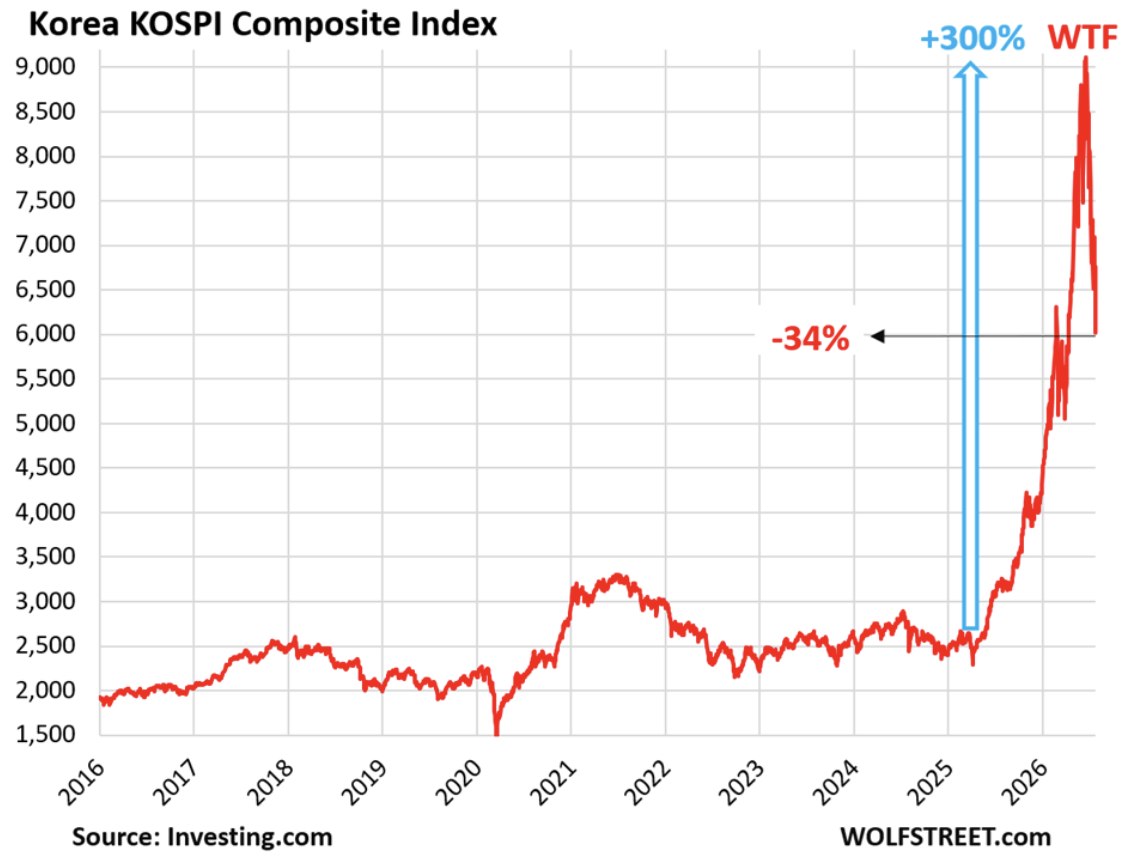
As I explained, parabolic moves do not end in a range, they fall like the chart above with pullbacks greater than 50% the norm.  This implies that the KOSPI is not done yet, and given the KOSPI is basically two stocks, Samsung and SK Hynix, both of which are major semiconductor manufacturers, it doesn’t speak well to the semiconductor space in the US either.  Tomorrow, we hear from MSFT and META and then Thursday we get AAPL and AMZN earnings reports.  My take is much is riding on these earnings reports as any indication that growth is starting to slip will feed into my discussion yesterday regarding the second derivative and how that is the driver.  In fact, we saw the announcement yesterday by Nvidia that they were guaranteeing $250 billion of debt for OpenAI to build a new datacenter in Ohio.  At cycle ends, the pace of activity tends to increase as the players want to get things done before the collapse.  I fear that is what we are watching.

Ok, let’s look at markets.  As I’ve already touched on the KOSPI, which fell -10.8% last night, it is not surprising that most of the rest of Asia had a rough go as well.  Tokyo (-4.0%), Taiwan (-4.65%) and China (-2.8%) were the biggest losers overnight although HK (+0.4%) managed to eke out some gains.  In fact, looking across the region, away from the big three mentioned above, it was a more mixed picture.  Indonesia (-0.9%) is having its own problems as the central bank governor resigned and there have been numerous scandals and other cabinet resignations lately undermining both the rupiah (-0.1% and back to multidecade lows) and the stock market there.

As to Europe, given they have no tech sector and the tech sector is the area under the most pressure, I guess we should not be surprised that bourses there are modestly higher this morning, mostly up around +0.3% across the board.  A very pleasant experience compared to the gyrations seen elsewhere.  And US futures at this hour (7:10) are mixed with NASDAQ (-1.1%) suffering while the DJIA (+0.5%) is fine and the SPX is caught in the middle, basically unchanged.

In the bond market, yields continue to edge lower, with Treasuries (-3bps) leading the way and European sovereign yields all lower between -1bp and -2bps. UK gilts (-3bps) are also performing well as the market awaits the BOE’s policy decision on Thursday.  Then JGB yields (-2bps) have slipped in concert as the market awaits the BOJ decision Friday.  At this point, consensus across the board is for no movement, although there has been a discussion regarding the BOJ with some analysts believing a hike is possible.

Turning to commodities, oil (-1.6%) is not the center of attention today for once, and is pushing back toward $80/bbl.  The ongoing decline appears to be based on comments that diplomacy is once again being tried to resolve the Iran situation and the Strait of Hormuz.  Perhaps more surprisingly the metals markets are also falling this morning (Au -1.3%, Ag -2.2%, Cu -1.1%) as their inverse relationship with oil is being tested.  

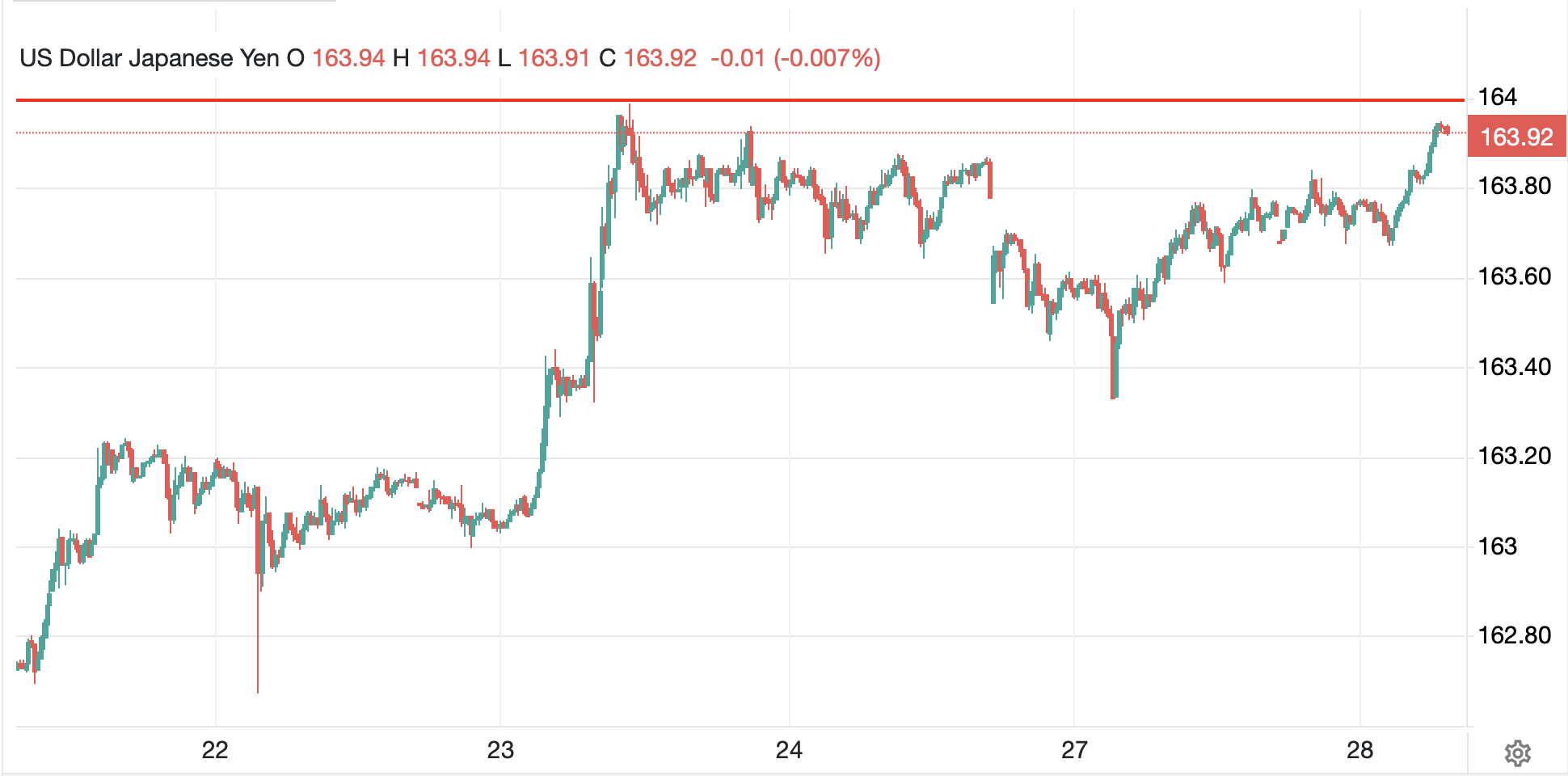
Finally, the dollar is ever so slightly firmer this morning, but mostly on the order of 0.1% or 0.2%.  AUD (-0.4%) is the worst performer in either G10 or EMG blocs as central bank comments led to a reduction in the probability of a rate hike there next month.  One other thing to note is USDJPY, where, as I type, the market is trading at 163.92, a scant 8 pips from the next big, round number at 164.00, a level almost touched last Thursday (163.99 was the high) but when it trades, it will almost certainly be hailed as an important milestone regarding potential intervention.  I don’t agree with that assessment.
Source: tradingeconomics.com

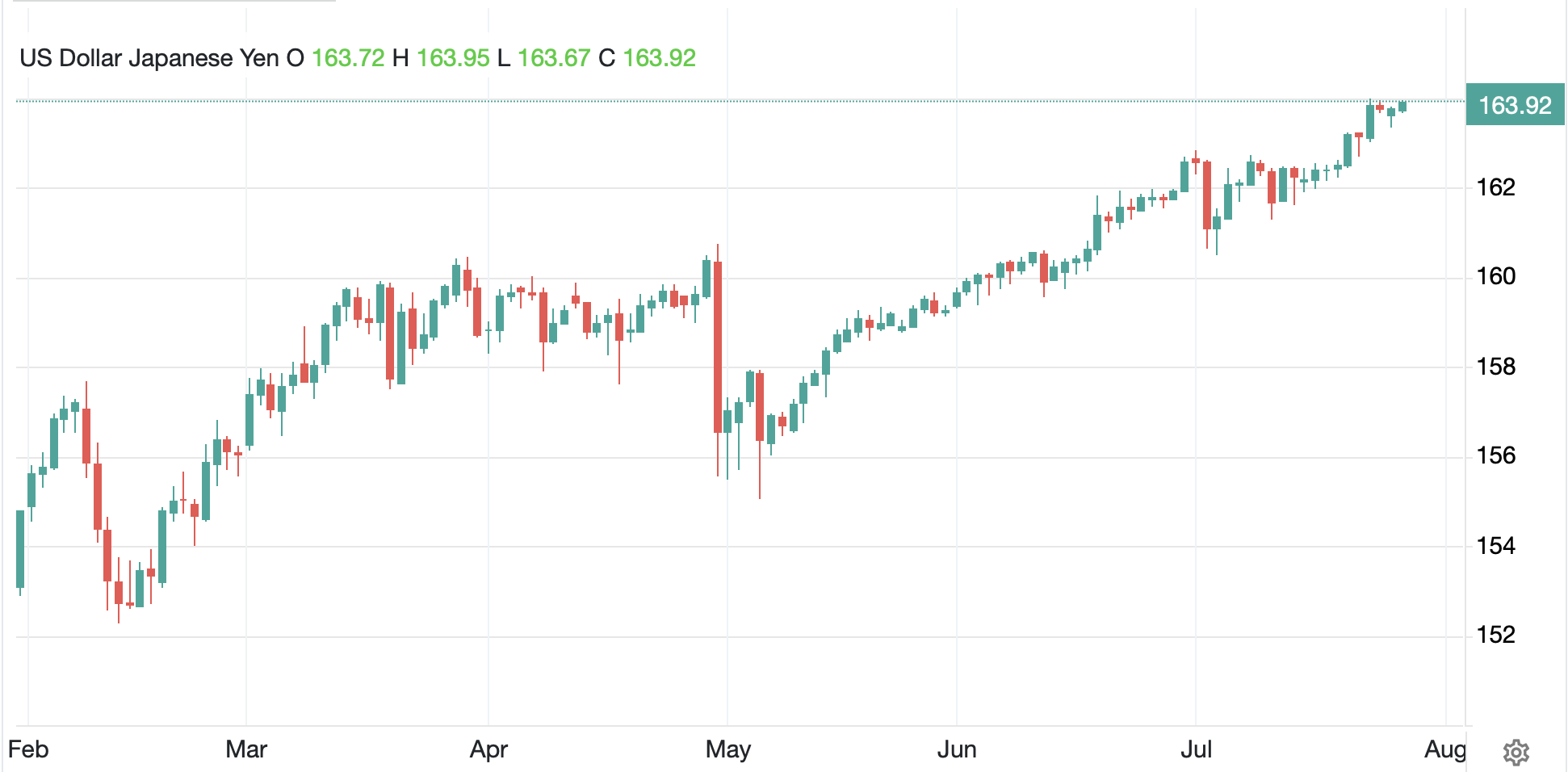
Again, a key feature of BOJ intervention has been an effort to address a volatile market, but as you can see below, while the direction of travel has been consistent, the only volatility has come from BOJ interventions.  Everything else is a slow, steady deterioration of the yen.
Source: tradingeconomics.com

On the data front, there is plenty upcoming this week in addition to the Fed, including PCE on Thursday.

TodayGoods Trade Balance-$100.0B
 Case-Shiller Home Prices1.3%
 Consumer Confidence92.3
WednesdayFOMC Decision3.75% (unchanged)
ThursdayBOE Rate Decision3.75% (unchanged)
 Initial Claims200K
 Continuing Claims1800K
 Q2 GDP2.1%
 Personal Income0.3%
 Personal Spending0.3%
 PCE-0.1% (3.7% Y/Y)
 Core PCE0.2% (3.3% Y/Y)
FridayBOJ Rate Decision1.0% (unchanged)
 Employment Cost Index0.8%
 Chicago PMI56.0
 Michigan Sentiment 54.0

Source: tradingeconomics.com

Obviously, the FOMC meeting will be the big story along with the earnings data, although I imagine that the PCE data may garner some interest for now, at least until we learn what measures of inflation the Fed is going to use going forward.  My fear is the equity market can crack, for now, and that will drive overall trading activity.  As to the dollar, I see no reason for a large move in either direction until we see new policies.

Good luck

Adf
Risk-Taking Cracks

The president told us elections
Were filled with some lethal infections
He’s unclassified
More docs to help guide
The courts to start making corrections

Meanwhile in Iran more attacks
Has led to some risk-taking cracks
Thus, oil is higher
While semis look dire
Have we seen the market climax?

A few words on the president’s speech last night as it was widely touted.  In it, he explained he declassified a trove of documents offering proof that there have been many election irregularities over the past six years, naming China as a major player in the process.  These documents are available online for all to see and ostensibly refute (I have not read them, nor am I likely to do so) that our elections have been secure in the US.  In fact, the same government analysts that have declared there to have been no issues are the ones who these documents purport to show were interfering.  My only observation, especially on this topic, is that no matter the proof available, minds have long been made up, and this will not change opinions, at least until arrests are made and trials are held.

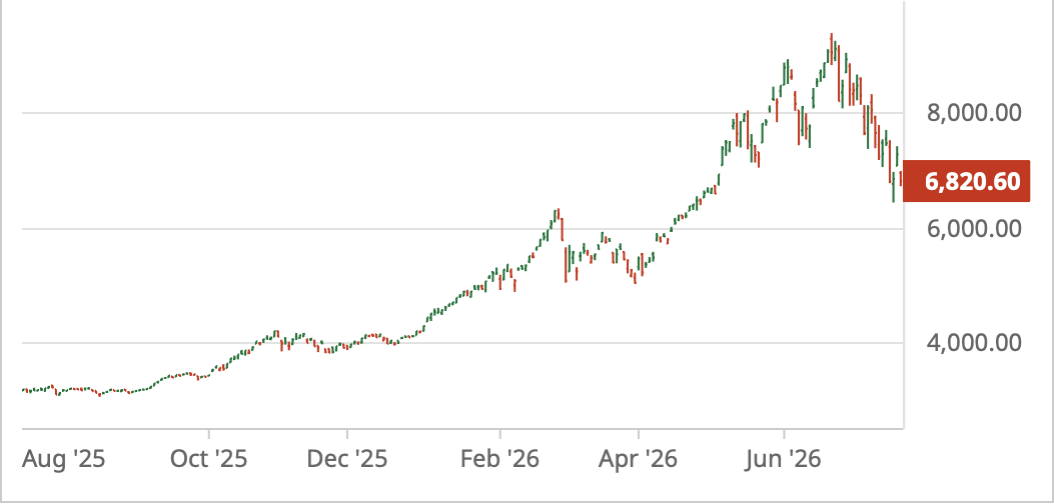
Which takes us to more relevant market issues.  Arguably, the poster child for semiconductor stocks is the Korean KOSPI (-6.4%), where just two companies, both major players, Samsung and SK Hynix, represent some 40% of the index value.  As you can see from the below chart, it has been tough sledding for the past month, with that market closing lower by nearly 28% from its highs on June 22nd.

Source: barchart.com

And while that may be extreme, if we look across major markets in Asia, there was some rough times last night almost everywhere.  Tokyo (-4.0%), HK (-1.8%), China (-3.6%) and Taiwan (-6.5%) all had serious dislocations downward.  And, of course, the thread running through them all is the tech exposure.  There has been much discussion of a rotation out of tech and AI stocks into other areas, with financials and energy amongst the beneficiaries, and certainly, last night’s price action supports that thesis.  Interestingly, India (+1.25%) completely bucked that trend, but then, India is perceived to be a major loser from the AI story, so if that is unwinding, I guess it’s no surprise that India benefits.  Elsewhere in the region, things were far less volatile.

As to Europe, despite a glaring dearth of technology companies, equity markets there are also under pressure this morning (DAX -0.9%, CAC -0.9%, IBEX -0.5%, FTSE 100 -0.1%) although that is more likely to be a response to the fact that oil prices have picked back up as the US resumes more aggressive military activities against Iran.  As to US futures, at this hour (6:45), they are all lower led by the NASDAQ (-1.8%) although both the SPX and DJIA are down by -0.7%.

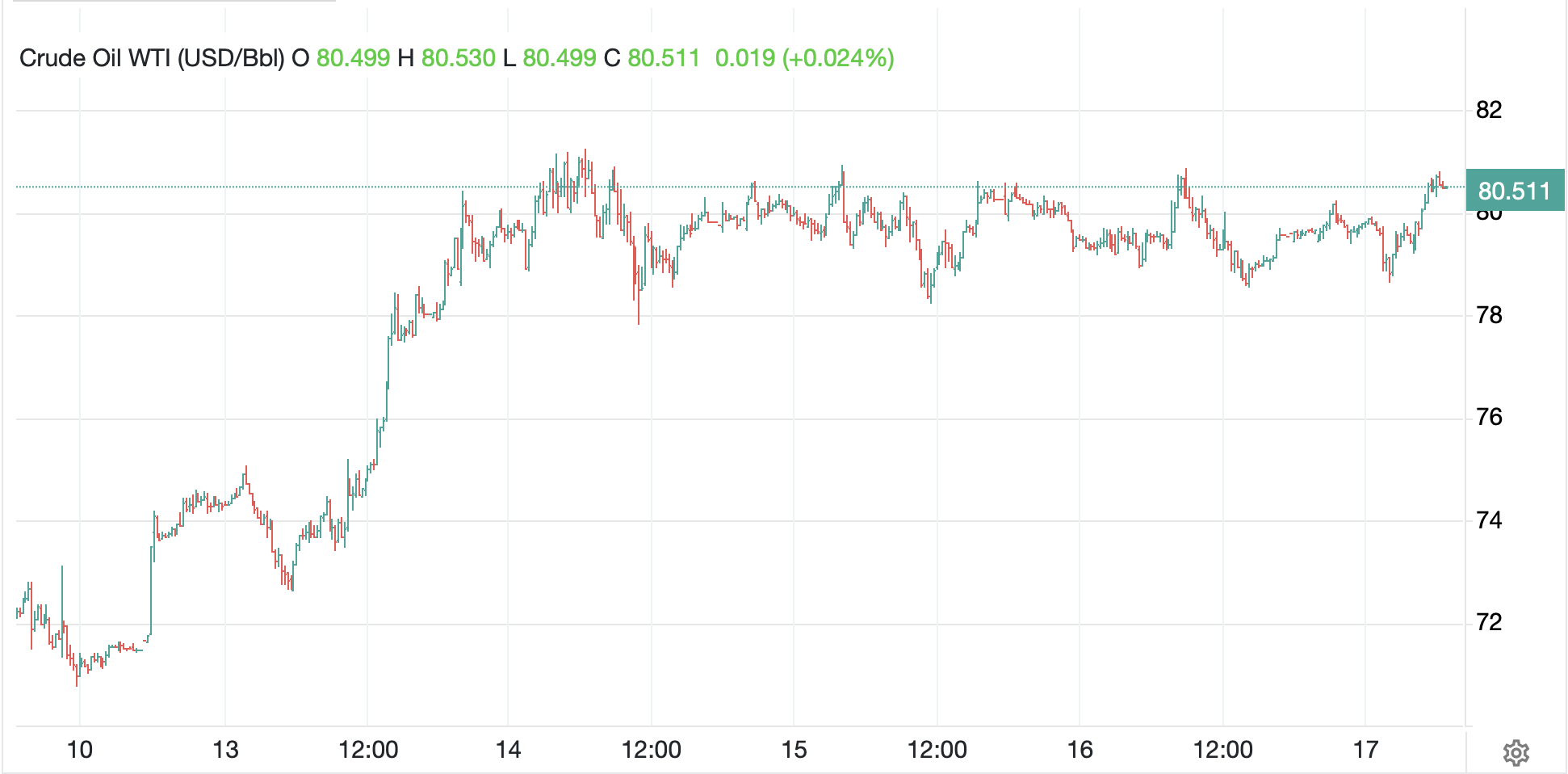
Which takes us to oil.  The black, sticky stuff is higher by 2.0% this morning, although, as you can see from the chart below, it is still hovering right around $80/bbl, the level I described as its new home earlier in the week.  

Source: tradingeconomics.com

The key question here remains just how much of an interruption in economic activity has been caused by the Iran conflict.  Not dissimilar to the election question at the top, it seems the two sides of this argument are dug in and will countenance no discussion that they are misreading the situation.  There are still analysts who discuss tank bottoms and the idea that now that so many reserve inventories have been released, we are quickly approaching a situation where their much mooted $200/bbl is right around the corner.  And yet, despite the tick higher overnight, the market continues to price a relative lack of concern over future supplies.  As always, I go with prices as the best arbiter, but that’s just me.  The massive production increases from the US and Canada, as well as Brazil and Guyana, increases from Venezuela and the workarounds by the Gulf nations to get their oil to market continue to demonstrate that supply is available.  

One wild card that is very difficult to completely understand is China, where things are always opaque, and where their imports have fallen sharply, thus reducing demand.  Was that demand “destroyed” in the sense that it will never return?  Seems unlikely.  Rather, my best guess, and it is just a guess, is that China tapped into their own SPR and has been using that, rather than importing.  Whatever the situation, there appears to be no shortage of oil available.  

One other thing weighing on the price has been Ukraine’s success in attacking Russian refining capacity.  If the Russians cannot refine their oil, they need to sell it as crude rather than products, and that is adding to the inventories available for sale.  It is also part of the explanation as to why products prices and the crack spread remain so high, more oil, less refining.

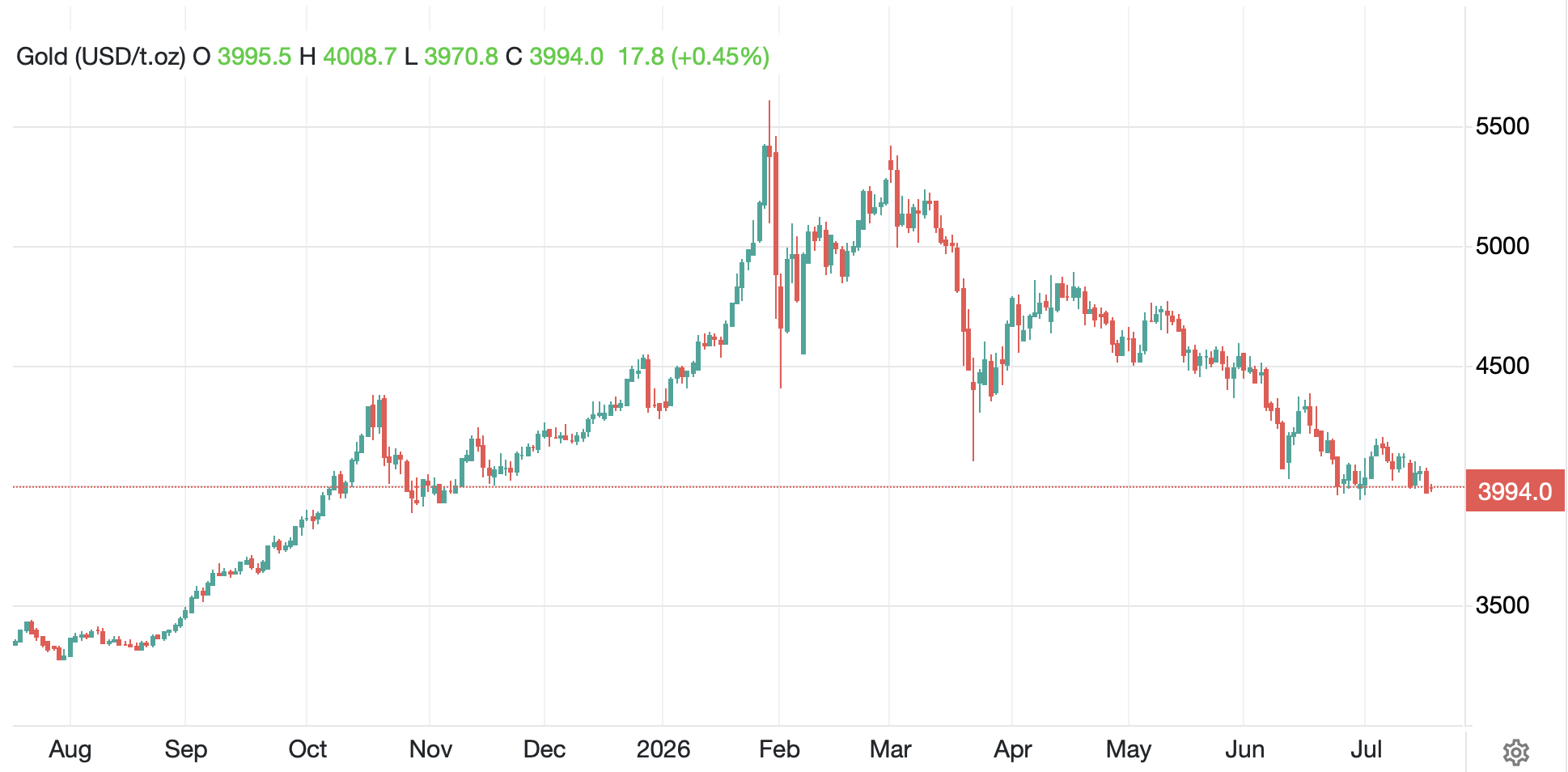
Looking at precious metals, gold (+0.4%) closed below $4000/oz yesterday for the first time since last November as per the below chart.

Source: tradingeconomics.com

Silver (-0.4%) also remains under pressure and this morning copper (-1.9%) is suffering alongside the precious space.  But perhaps a few words on what gold really represents are in order.

As J.P. Morgan said in 1912, before the Federal Reserve was created, “Gold is money, everything else is credit.” Certainly, the second part of the statement is correct as your bank deposits rely on your bank standing behind them, making you a creditor of your bank.  Federal Reserve Notes are paper obligations of the US government, so again, represent purchasing power, but as we have learned, a decreasing amount of it every day.  Meanwhile, gold has a 5000-year history of being accepted as a thing of inherent value.  Now, the widely accepted definition of money these days is it must have three characteristics; it serves as a medium of exchange, a store of value and a unit of account.  Gold historically has served as the first two, although rarely as a unit of account.  Rather, gold holdings were always converted into whatever the unit of account was at the time.

Which takes us to the present, why does gold continue to represent a part of the financial markets, and over the past several years, an increasingly important part.  I would contend this is all of a piece with the broader changes in the global community, notably the end of the Pax Americana, where the US no longer chooses to (or can) guarantee the peace of the post WWII and Cold War worlds.  Instead, we have seen a constant increase in debt by every nation as governments around the world seek to placate their own citizens and are unable to pay for all the goodies they offer, thus borrow the difference.  

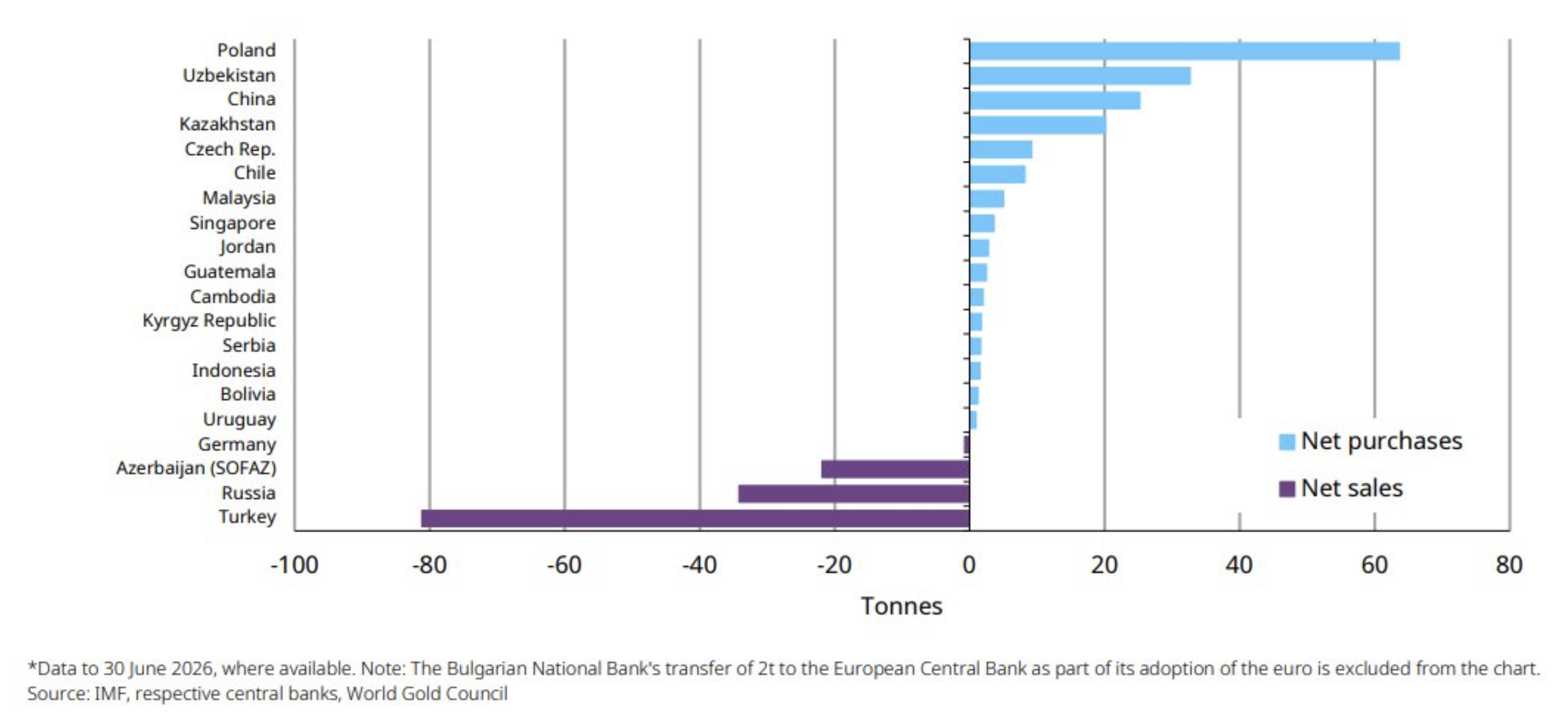
However, the freezing of Russian reserve assets by the West in the wake of the invasion of Ukraine has altered many views about what is safe and represents value, and what is paper and doesn’t represent value and central bankers, charged with maintaining a nation’s wealth, have gone back to gold as the one thing they know will retain value given it is nobody’s liability.  The chart below shows activity in May, which is similar to what has been happening virtually every month, that central banks are relatively price insensitive, buying the stuff as a strategic asset.  And the sellers, were selling because they needed the money!

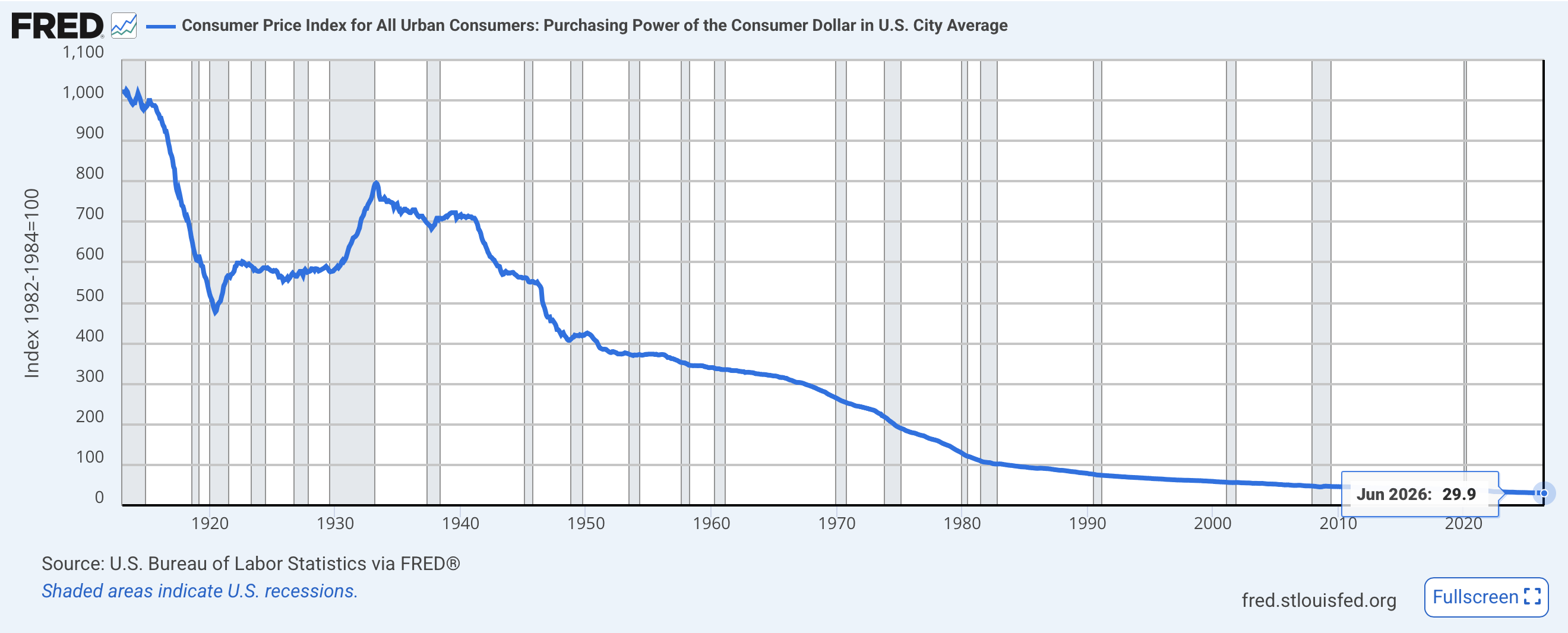
One last chart to make the point about gold and purchasing power.  The below chart from the FRED database demonstrates just how much purchasing power the dollar has lost since the Fed came into existence; i.e. just how much inflation has destroyed the real value of the dollar.  For reference, that opening level is 1021 compared to today’s 29.9, a 97.1% devaluation in 113 years of the Fed.  It can be argued that the Fed has failed catastrophically in their effort to maintain the value of the dollar.

Ok, quickly elsewhere bond yields have edged lower, with Treasuries (-3bps) leading the way and European sovereigns either unchanged or having slipped by -1bp.  JGBs overnight also slid -2bps, but overall, while there is a lot of discussion about yields, they are not moving very far.

Finally, the dollar is a bit firmer this morning with the pound (-0.3%), Aussie (-0.4%) and euro (-0.1%) all slipping although NOK (+0.2%) is benefitting from oil’s move.  In the EMG bloc, though, there is more trouble with KRW (-0.5%), ZAR (-0.6%) and MXN (-0.3%) representative of more anxiety there.  Ultimately, I still have a hard time getting too bearish the dollar in the current world.

On the data front this morning brings Housing Starts (exp 1.31M) and Building Permits (1.40M) as well as IP (0.2%) and Capacity utilization (76.2%).  Finally, at 10:00 we see Michigan Sentiment (51.0).  There are no Fed speakers scheduled, and they are entering their quiet period, so we won’t hear from them until the meeting on the 29th.  (Perhaps we won’t hear from them anymore after that too!). 

Summing up, Iran and oil are still key drivers, equity market rotation is happening, although given how far it has moved, we may be near the end of that process, and yields have no direction.  Regarding yields, we may have reached the point where the issue is not inflation concerns, per se, but rather the sheer volume of debt that is going to be issued going forward, and the fact that private investors want more yield to be persuaded to buy it.  As to the dollar?  Like I said, I just don’t see the bear case over any longer-term horizon.

Good luck and good weekend

Adf

At All Costs#

Ahead of the winter’s white frosts
The Chinese told firms, “at all costs”
Get oil and gas
And coal, so en masse
Our energy never exhausts

In Europe, as prices keep rising
For Nat Gas, most firms are revising
The prices they charge
Which has, by and large
Helped CPI keep on surprising

Ostensibly, the reason that the Fed, and any central bank, looks at prices on an -ex food & energy basis is because they realize that they have very little control over the prices of either one.  The only tool they have to control them is extremely blunt, that of interest rates.  After all, if they raise interest rates high enough to cause a recession, demand for food & energy is likely to decline, certainly that of energy, and so prices should fall.  Of course, precious few central bankers are willing to cause a recession as they know that their own job would be on the line.

And yet, central banks cannot ignore the impact of food & energy prices on the economy.  This is especially so for energy as it is used to make or provide everything else, so rising energy prices eventually feed into rising prices for non-energy products like computers and washing machines and haircuts.  As has become abundantly clear over the past months, energy prices continue to rise sharply and alongside them, we are seeing sharp rises in consumer prices as well.

Protestations by Lagarde and Powell that inflation is transitory do not detract from the fact that energy prices are exploding higher and that those charged with securing energy for their country or company are willing to continue to pay over the odds to do so.  Yesterday, an edict from the Chinese government to all its major companies exhorted them to get energy supplies for the winter “at all costs.”  This morning, they followed up by telling their coal mining companies to produce at maximum levels and ignore quotas.  Clearly, there is concern in Beijing that with winter coming, there will not be enough energy to heat homes and run factories, an unmitigated disaster.  But this price insensitive buying simply drives the price higher.  (see Federal Reserve impact on bonds via QE for an example.)

And higher these prices continue to go.  Nat Gas, which is the preferred form of fossil fuel, continues to rise dramatically in both Europe and Asia.  In both geographies, it has risen to nearly $35.00/mmBTU, almost 6x as expensive as US Nat Gas.  On an energy equivalent basis, that comes out to $190/bbl of oil.  And you wonder why the Chinese want to dig as much coal as possible.  The problem they are already having, which is adding to their overall economic concerns, is that they have run into an energy shortage and have been restricting power availability to the industrial sector in order to ensure that households have enough.  Of course, starving industry is going to have a pretty negative impact on the economy, hence the call for obtaining energy at all costs.  But that has its own problems, as driving prices higher will divert spending to energy from both investment and consumption.  In other words, as is often the case, there is no good answer to this problem.

If you are wondering how this impacts foreign exchange, let me explain.  First, energy is priced in dollars almost everywhere in the world, at least at a wholesale level.  So, buying energy requires having dollars to spend to do so.  I would contend one reason we have seen the dollar maintain its strength recently, and break out of a medium-term range, is because countries are panicking over their winter energy needs and need dollars to secure supplies.  Second, as energy prices rise, so too does inflation.  And while Mr Powell continues to refuse to accept that is the case, the market is not so stubborn on the issue.  We have seen the yield curve steepen sharply over the past several weeks, something which is historically a dollar positive, and with expectations for the taper firmly implanted into the market’s collective conscience, the strong view is interest rates in the US are going higher.  This, too, is very dollar supportive.  While I remain unconvinced that the Fed will ultimately be willing to tighten policy in any significant manner, that remains the current market narrative.  We shall see how things evolve, but for now, the dollar has legs alongside interest rates and energy prices.

Ok, to today’s price action.  The notable thing is the reduction in risk appetite that has been evident for the past several sessions.  For instance, yesterday we finally achieved a 5% correction in the S&P 500 for the first time in more than 200 sessions.  While prices remain extremely overvalued on traditional measures, it is not yet clear if the ‘buy the dip’ mentality will prevail as we enter a new fiscal quarter.  We shall see.

Overnight, Asia was mostly lower (Nikkei -2.3%, Hang Seng -0.4%) but Shanghai (+0.9%) managed to rally.  Of course, remember, Shanghai has been massively underperforming for quite a while.  Other than China, though, the rest of Asia was all red.  Europe, too, is bright red this morning (DAX -0.8%, CAC -0.8%, FTSE 100 -1.0%) as the broad risk-off sentiment combines with modestly weaker than expected PMI data and higher than expected Eurozone CPI data.  As to the latter, the 3.4% headline print is the highest since Sept 2008, right at the beginning of the GFC.  Yesterday, German CPI printed at 4.1%, which is the highest level since the wake of the reunification in 1993.  For a culture that still recalls the Weimar hyperinflation, things must be pretty uncomfortable there.  It is a good thing this inflation is transitory!

Not surprisingly, with risk being jettisoned, bonds are in demand this morning and although Treasuries are unchanged in this session, they did rally all day yesterday with yields declining nearly 5bps.  As to Europe, Bunds (-3.2bps) and OATs (-3.2bps) are firmly higher with the rest of the continent while Gilts (-1.5bps) are not seeing quite as much love despite an underperforming stock market.  I think one reason is that UK PMI data was actually better than expected and higher than last month, an outlier versus the continent.

Commodity prices are mixed this morning as despite my opening monologue, oil (WTI -0.9%) and Nat Gas (-0.7%) are both under pressure.  Of course, both have been rallying sharply for months, so nothing goes up in a straight line.  Precious metals are little changed on the day, but industrial metals are strong (Cu +1.6%, Al +0.5%, Sn +1.2%).  Ags, on the other hand, are mixed with no pattern whatsoever.

As to the dollar, it is under modest pressure this morning in what appears to be a consolidation at the end of the week.  The one noteworthy mover in the G10 is NOK (+0.75%) which is rallying despite oil’s decline as the market reacted to a surprisingly large decline in the Unemployment rate there to 2.4%.  But otherwise, GBP (+0.3%) is the next best performer and the rest of the bloc is +/-0.2%, with CAD (-0.2%) the laggard on weak oil prices.

EMG currencies have many more gainers than losers this morning with only RUB (-0.6%) on oil weakness, and KRW (-0.35%) on a smaller than expected trade surplus, declining of note, while THB (+0.6%), PLN (+0.6%) and HUF (+0.4%) all have shown some strength.  In Bangkok, the central bank vowed to monitor the baht, which has been falling steadily over the past 9 months to its weakest point in more than 4 years.  PLN saw higher than expected CPI data (5.8%) which has the market looking for higher rates from the central bank, while HUF was the beneficiary of central bank comments that the monetary tightening campaign was “far from the end.”

There is a veritable trove of data to be released this morning starting with Personal Income (exp 0.2%), Personal Spending (0.7%) and the Core PCE (3.5%) at 8:30.  Then at 10:00 we see ISM Manufacturing (59.5) and Prices Paid (78.5) as well as Michigan Sentiment (71.0).  If the PCE number prints on plan, the Fed will be crowing about how it, too, is falling and has peaked.  However, that is crow they will ultimately have to eat, as the peak is not nearly in.

The underlying picture for the dollar remains quite positive on both a technical and fundamental basis, but it appears today is a consolidation day.  Perhaps, a good time to buy dollars still needed to hedge.

Good luck, good weekend and stay safe
Adf