
The Great Denouement

While talks in Qatar carry on
No outcome, as yet, is foregone
Thus, traders are waiting
Before speculating
As all seek the great denouement

Range trading remains the norm, except for the S&P 500 which continues to make new highs almost every day.  At least that is true in US markets.  The KOSPI in Korea is also rocketing higher.  In fact, when comparing the percentage movement over the past 5 years, the S&P looks quite ordinary, but that is because the KOSPI has been insane!
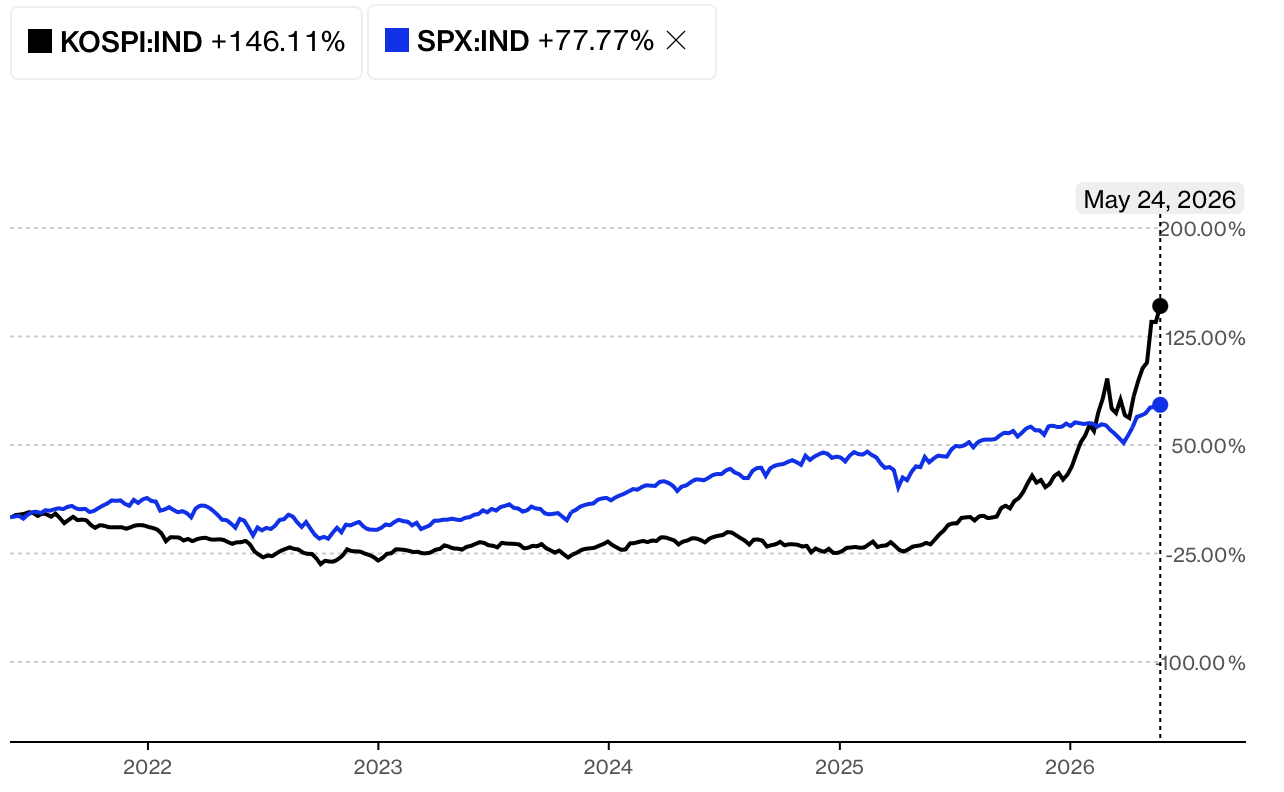
Source: Bloomberg.com

But away from a few select equity markets, it is getting increasingly difficult to find markets that are doing much more than chopping back and forth.  This is especially true if we take a step back and look at movement over the past several years.  

For instance, if we look at the 10-year Treasury, where we saw all sorts of angst last week when it traded to its highest level, near 4.70%, in a year, realistically, we have been rangebound for more than two years as per the chart below.  And prior to that we were in the massive abnormality of ZIRP.  So, if we go back over a longer time frame, the current 10-year yield is right around the long-term average as per the second chart.  It is really hard to get excited about this movement.
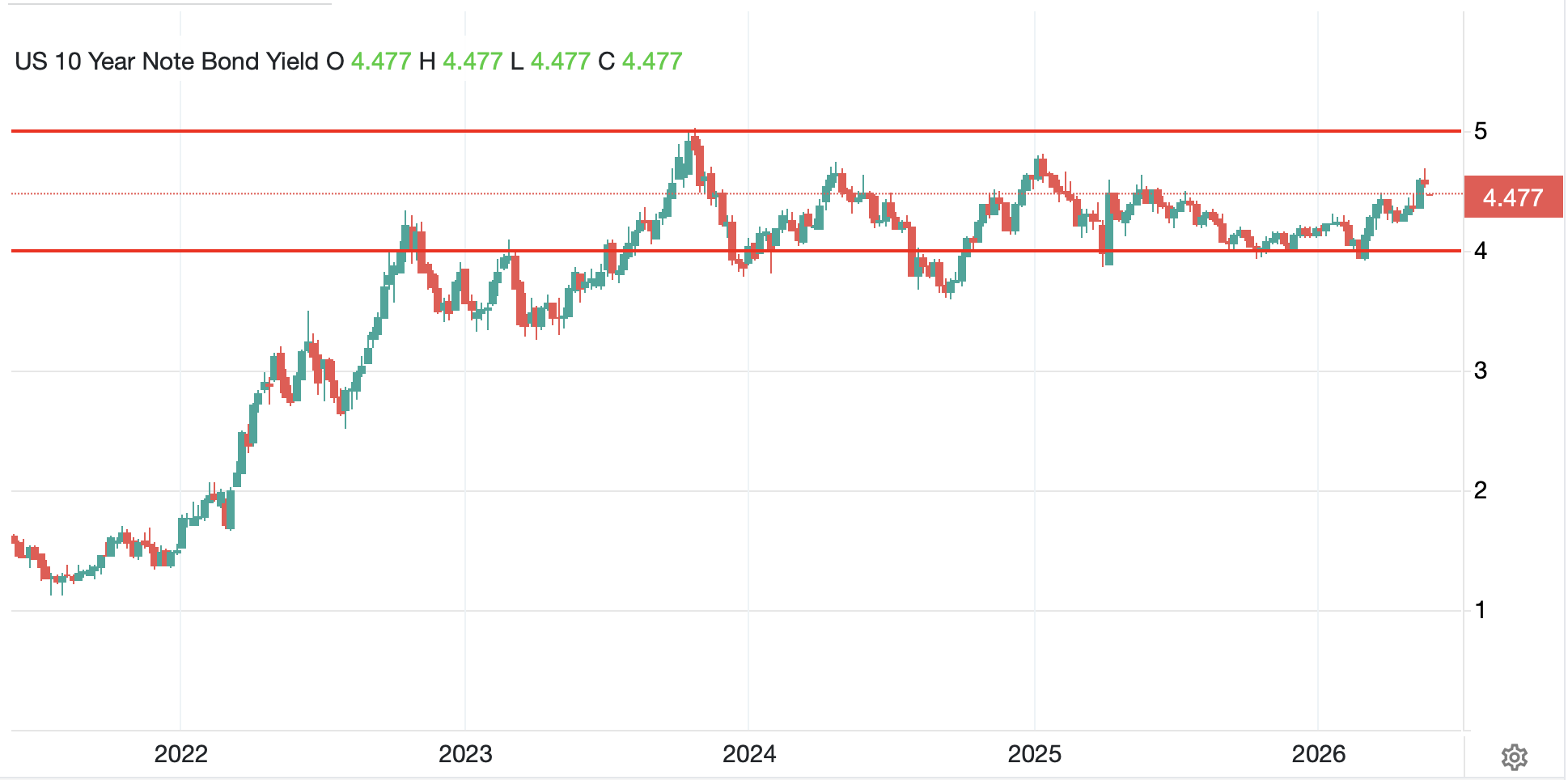
Source: tradingeconomics.com
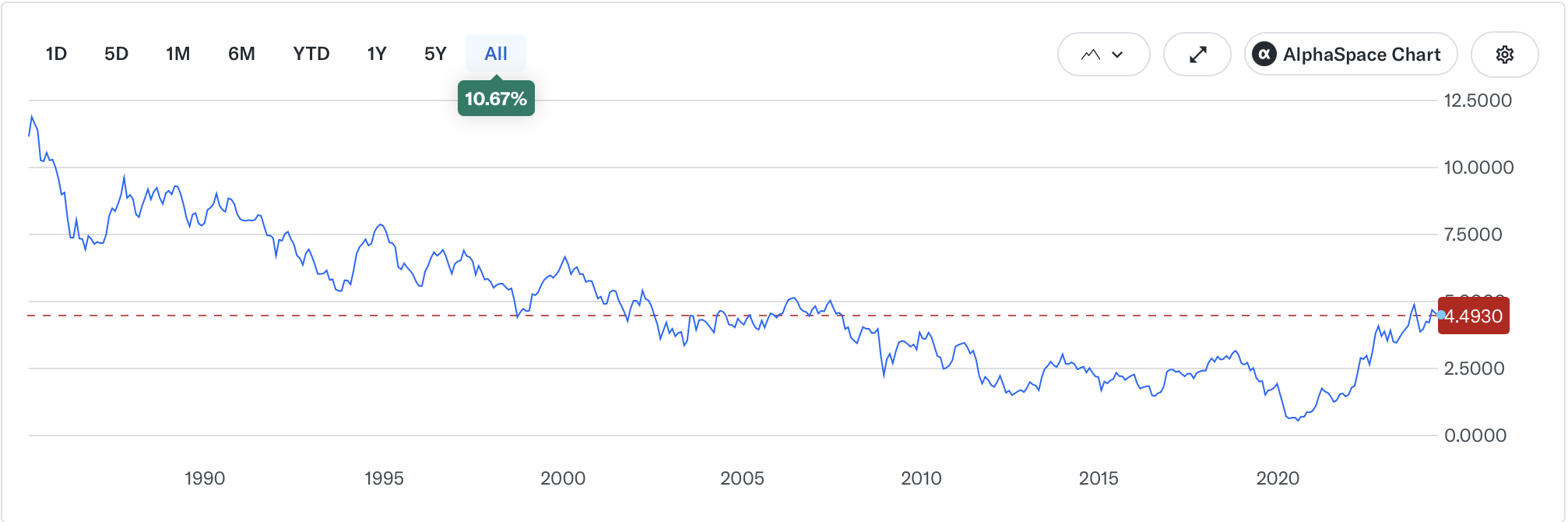
Source: finance.yahoo.com

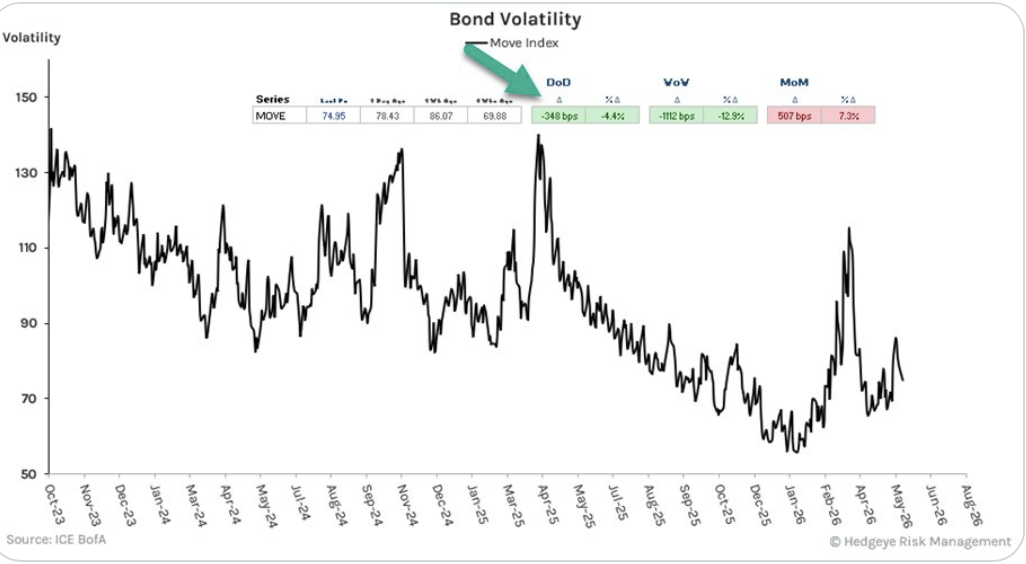
Perhaps we ought not be surprised that bond market volatility is heading lower again as per the below chart of the MOVE Index from Hedgeye
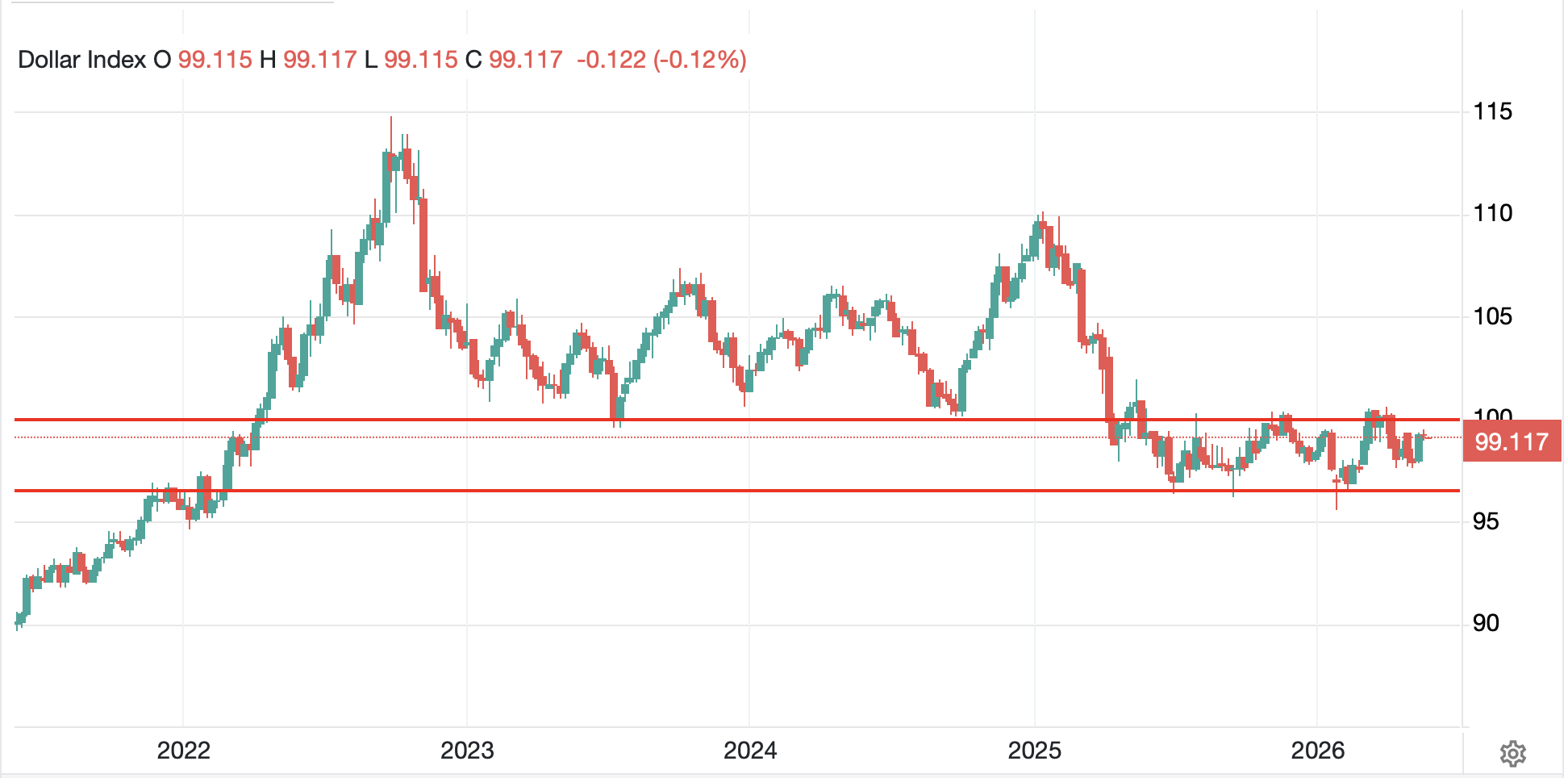
The same story exists in currencies, where major currencies have been in a range for more than a year as per the below chart of the DXY from tradingeconomics.com.
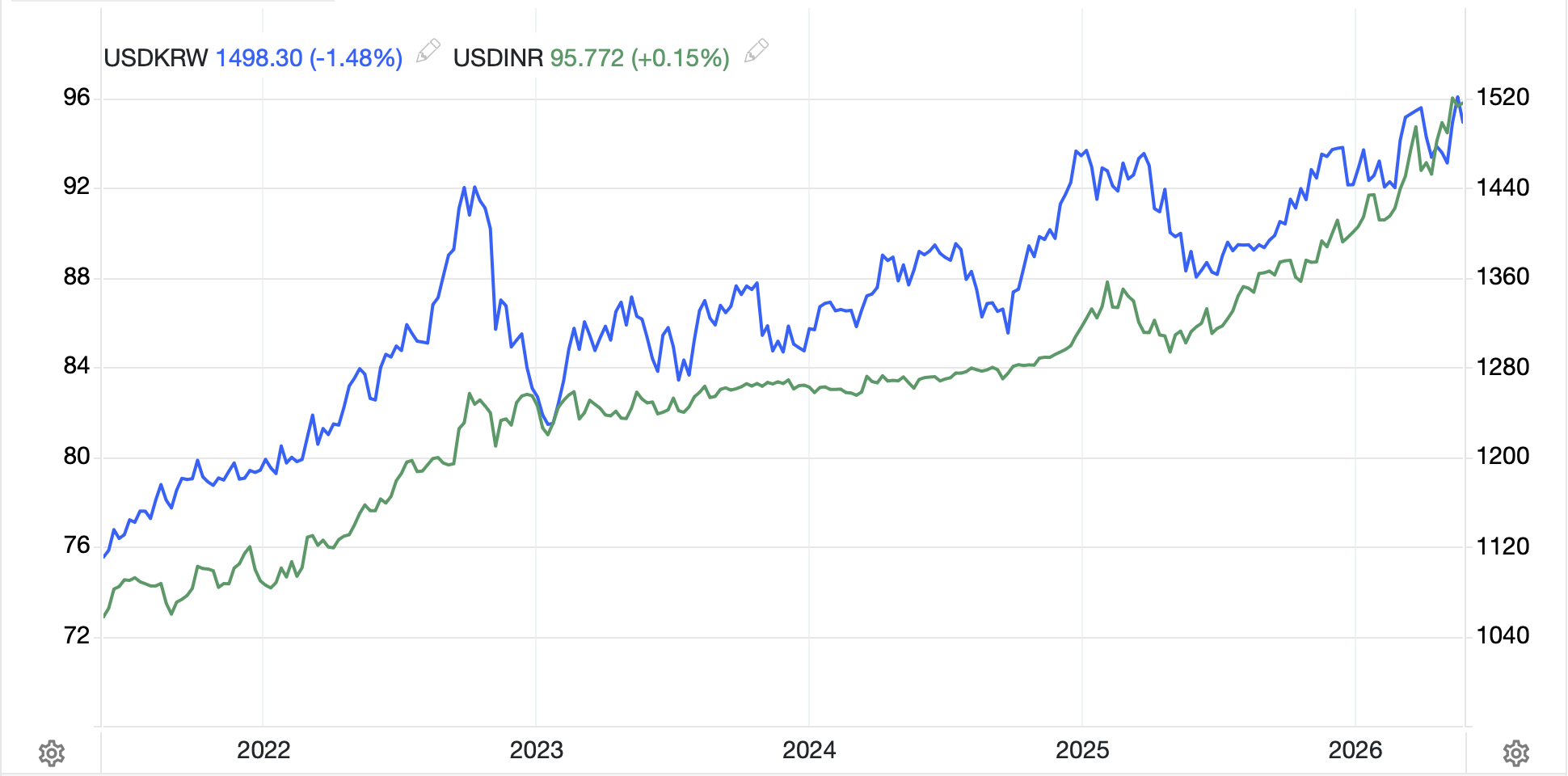
Now, there are currencies that have seen substantial movement over the past year, in both directions.  For instance, both KRW and INR have been weakening consistently for the past five years, and this is despite a massive equity rally in both nations, although, in fairness, India’s market has not kept up over the past few months.
Source: tradingecoomics.com

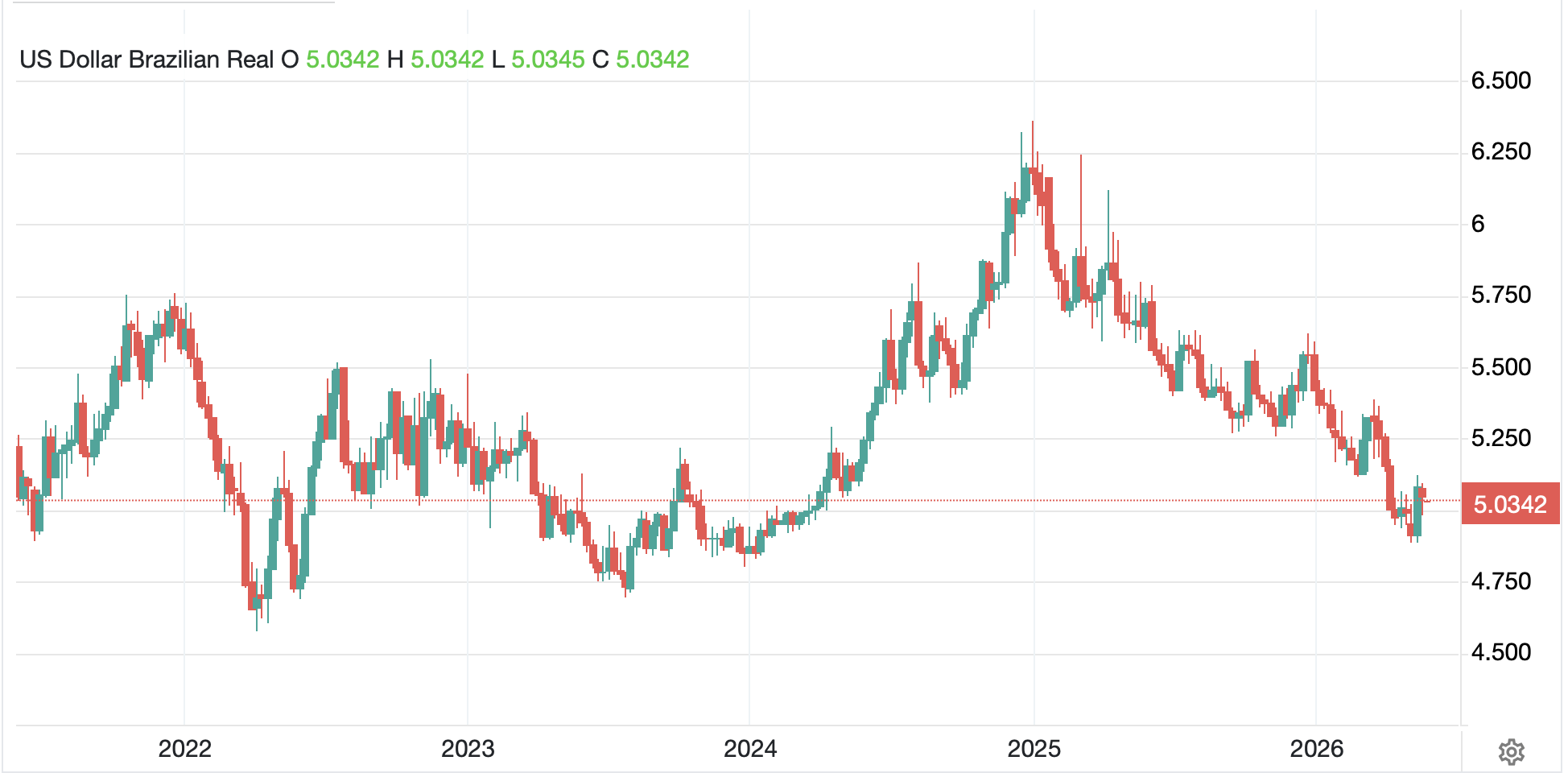
At the same time, BRL has been broadly rallying vs. the dollar for almost 18 months, as per the below chart, as it remains a favorite in the hedge fund community for its high interest rates.  And the fact that they continue to find more oil offshore is only helping things.
Source: tradingeconomics.com

But these currencies are secondary in the FX market, which has generally been dull.

Meanwhile, the oil story appears to be one of increasing belief that a deal is going to be done soon.  This morning, WTI (-3.7%) is falling again and back to $90/bbl.  Obviously, this is higher than where things were before this all started, but if there really was a shortage of the stuff, I expect prices would be much higher.  From what I have read this morning, the two sides continue to talk with Iran looking for a release of frozen financial assets while the US still wants the nuclear material.  

To me, the interesting thing is the tone of the comments from both sides.  President Trump continues to highlight the positive view of a deal coming, although assuring us he won’t make a bad deal.  Iran, though, continues with its apocalyptic rhetoric, threatening extremely painful revenge for every US action, although not really doing much at this point.  It appears to me that both sides are speaking to the domestic audience, not each other.  Trump needs to show progress and a victory, however defined, is near.  Iran needs to show they are strong and will not be beaten by their sworn enemies.  But at this point, I think both sides really need this to end.  The fact that Iran is now talking about money is the tell.  They know they are just about broke, and if there is no money to pay their armies, will their armies fight for the leadership?  I maintain my July 4th deal timeline. 

And that’s really today’s market story; oil’s slide is supporting other markets as we all await the end game.  Elsewhere in the news, there is far more excitement over the NY Knicks winning the NBA’s Eastern Conference than there is over the political stories of primary elections which are ongoing around the country.  While the mid-term elections are coming up in less than six months, the fields are not yet set, so it is difficult to handicap.  

On the data front, there is little of note today in the US although we do hear from several more Fed speakers.  But I maintain that their comments, today it is Governors Cook and Jefferson, are largely irrelevant and that can best be seen by the fact that the WSJ barely mentions any of their speeches anymore.  They are no longer newsworthy.  These two, though, will be an interesting case as both are avowed doves, but also hate President Trump, so will they vote with their belief set (rates should always go lower) or with their politics (Trump wants lower rates so they cannot vote that way)?  I guess we’ll find out in a few weeks at the next FOMC meeting.

One aside on central banking was last night the RBNZ met, left rates on hold at 2.25%, but were more hawkish than anticipated in their comments indicating rate hikes were coming.  This did help NZD to rally nearly 1%, an outlier in today’s market.

And that’s really it, I think.  Until the next headline on Iran, I cannot see a reason to trade in anything.

Good luck

Adf

Reason to Fear

In Europe, the price of Nat Gas
Has risen to new highs, alas
As winter comes near
There’s reason to fear
A rebound will not come to pass

As well the impact on inflation
Is likely to add to frustration
Of Madame Lagarde
As she tries so hard
To hide the debt monetization

Some days are simply less interesting than others, and thus far, today falls into the fairly dull category.  There has been limited new news in financial markets overall.  While the ongoing concerns over the imminent failure of China Evergrande continue to weigh on Asian stocks (Nikkei -0.6%, Hang Seng -1.5%, Shanghai -1.3%), the story that is beginning to see some light in Europe is focused on the extraordinary rise in Natural Gas prices.  As a point of reference, in the US, Nat Gas closed yesterday at $5.34/MMBtu, itself a significant rise in price over the past six months, nearly doubling in that time.  Europeans, however, would give their eye teeth for such a low price as the price in the Netherlands for TTF (a contract standard) is $22.61/MMBtu!  This price has risen nearly fourfold during the past six months and now stands more thar four times as costly as in the US.  Whatever concerns you may have had about your personal energy costs rising in the US, they are dwarfed by the situation in Europe.

This matters for a number of reasons beyond the economic (for instance, how will people in Europe afford to heat their homes in the fast approaching winter and continue to feed their families as well?)  but our focus here is on markets and economics.  Thus, consider the following:  Europe remains a manufacturing and exporting powerhouse and is reliant on stable supply and pricing of natural gas to power their factories.  Obviously, recent price action has been anything but stable, and given the European dependence on Russian gas supplies, there is a geopolitical element overhanging the market as well.  LNG can be a substitute, but Asian buyers have been paying up to purchase most of those cargoes, so Europe is finding itself with reduced supply and correspondingly rising prices.

The first big industrial impact came yesterday when a major manufacturer of fertilizer shut down two UK plants because the cost of Nat Gas had risen too far to allow them to be competitive.  Consider the chain of events here: first, closure of the plant means reduced overall output, as well as furloughed, if not fired, workers. Second, reduction in the supply of fertilizer means that the price for farmers will almost certainly rise higher, thus forcing farmers to either raise their prices or reduce production (or go out of business).  Higher food prices, which have already risen dramatically, will result in reduced non-food consumption and strain family budgets as it feeds into inflation.  Net, slower growth and higher prices are the exact wrong combination for any economy and one to be avoided at all costs.  Alas, this is very likely the type of future that awaits many, if not most, European countries, the dreaded stagflation.  The ECB has its work cut out to combat this issue effectively while the Eurozone economy sits on more than €11.3 trillion in debt.  I don’t envy Madame Lagarde’s current position.

Beyond the macroeconomic issues, what are the potential market impacts?  Here things, as always, are less clear, but thus far, we have seen one impact, and that is a declining euro (-0.4%).  In fact, all European currencies are falling today as it becomes clearer that economic activity across the pond is going to be further impaired by this situation.  It has been sufficient to offset perceived benefits of European economies reopening in the wake of the spread of the delta variant of Covid.  However, the upshot of this currency weakness has been equity market strength.  It seems that any concerns of the ECB considering tighter policy have been pushed even further into the future thus encouraging investors to continue to add risk to their portfolios.  Hence, this morning, in the wake of the ongoing rise in Nat Gas prices, we see European equities all in the green (DAX +0.5%, CAC +1.0%, FTSE 100 +0.45%).  Under the guise of TINA, weaker growth leads to continued low rates and higher stock prices.  What could possibly go wrong?

US markets are biding their time at this hour, with futures essentially unchanged and really, so are bond markets.  Of the major sovereigns, only Gilts (+1.8bps) have moved more than a fraction of a basis point this morning.  While risk may be on, it is not aggressively so.  Either that, or European banks are back to buying more and more of their national bonds tightening the doom loop that ultimately led to the Eurozone crisis in 2012.

Commodities?  Well, as it happens, after a multi-day rally, oil prices are consolidating with WTI (-0.25%) basically holding the bulk of the $10 in gains it has made in the past month.  Nat Gas, too, is consolidating this morning, down $0.16/MMBtu, although that represents 3% (Natty is very, very volatile!)  With the dollar rocking, we are also seeing weakness across the metals’ markets, both precious (gold -0.75%) and industrial (Cu -2.0%, Al -0.6%, Pb -1.6%).  In fact, the only commodity that is performing well today is Uranium, which is higher by a further 8.1%.

Finally, the dollar is king today, rising against 9 of its G10 counterparts with CHF (-0.5%) the laggard and only NZD (+0.1%) able to show any strength today.  The Kiwi story has been a much better than expected GDP print (2.8% vs 1.1% expected) leading to growing expectations of a 0.50% rate hike next month.  Meanwhile, the rest of the bloc is suffering from the aforementioned cracks in the rebound theory as well as broad-based dollar strength.  This strength has been universal in EMG markets, with every currency sliding against the greenback.  Thus far, the worst performer has been PLN (-0.6%) followed by THB (-0.5%) and HUF (-0.5%).  Beyond that, most currencies are down in the 0.2% range.  Interestingly, for both PLN and HUF, the market discussion is about raising interest rates with Hungary looking at 50bps while Poland has called for a “gentle” rise, assumed to be 0.25%.  As to THB, it seems the market has been reacting to a rise in the number of Covid cases which is perpetuating the Asian risk-off theme.

We have a full slate of data today at 8:30 with Initial (exp 323K) and Continuing (2740K) Claims; Philly Fed (19.0) and the biggest of the day, Retail Sales (-0.7%, 0.0% ex autos).  Tuesday’s Empire Manufacturing data was MUCH stronger than expected, so there will be some hope for Philly to beat.  But the Retail Sales data is the key.  Remember, this number started to slide once the stimulus checks stopped, and last month we saw a much worse than expected -1.1% outcome.  Given the uncertainty over the near-term trajectory of the economy, this will be seen as an important number.

Well, the dollar managed to strengthen despite lacking support from yields, certainly a blow to the dollar bears out there.  The thing is, against the G10, I continue to see the dollar in a range (1.17/1.19) and will need to see a break of either side to change views.  If forced to opine, I would say the medium-term trend for the dollar is gradually higher, but would need to see the euro below 1.17, or the DXY above 93.50 before getting too excited.

I will be out of the office tomorrow so no poetry until Monday.

Good luck, good weekend and stay safe
Adf

QE’s Paradigm

Said Daly, this “pop” was expected
But basically, we have projected
This only will last
A few months, then pass
Thus, higher rates we have rejected

Said Bullard, it may well be time
To alter QE’s paradigm
By end of this year
It ought to be clear
That tapering is not a crime

And finally, today Chairman Jay
Is like to have something to say
‘Bout why rising prices
Do not mean a crisis
Is brewing and soon on the way

The one thing about writing this note on a daily basis is that you really get to see the topic du jour.  In fact, arguably, that is the purpose of the note.  When Brexit happened in 2016, it was likely the topic of 75% of my output.  Covid dominated last year for at least 3 months, where virtually every discussion referenced its impact.  And now we are onto the next topic which just will not go away.  In fact, if anything it is growing in importance.  Of course, I mean inflation.

By now you are all aware that June’s CPI reading was 5.4% on a headline basis and 4.5% ex food & energy with both readings substantially higher than forecasted by the punditry.  The monthly gains in both series was 0.9%.  Now my rudimentary math skills tell me that if I annualized 0.9%, I would wind up with an inflation rate of 11.4%.  I don’t know about you, but to me that number represents some real problems.  Of course, despite the reality on the ground, the FOMC cannot possibly admit that their policies are driving the economy into a ditch, so they continue to spin a tale of transitory price gains that are entirely due to short-term impacts on supply chains and gains relative to last year’s extremely depressed prices on the back of Covid inspired lockdowns.  And while, last year’s Covid-inspired lockdowns did have a major negative impact on prices, the idea that supply chain disruptions are short-term are more an article of faith, based on economic textbook theories, than a description of reality.

In addition, the other key leg of the Fed thinking is that inflation expectations remain ‘well-anchored.’  Alas, I fear that anchor may have come loose and is starting to drift with the current of inflation prints to a higher level.  This was made evident in the NY Fed’s survey of inflation expectations released on Monday showing that people expected inflation to be 4.8% in one year’s time.  The Fed also likes to point to inflation breakevens in the market (the difference between nominal Treasury yields and their TIPS counterparts) and how those have fallen.  It is true, they are lower than we saw at the peak in mid-May (2.56%), but in the past week, they have risen 15 basis points, to 2.37%, and appear to be headed yet higher.

And this is not merely a US phenomenon.  For instance, just this morning CPI in the UK printed at 2.5%, rising a more than expected 0.4% from last month, and we have seen this occur around the world, as both developed countries (e.g. Germany, Canada and Spain) and developing nations (e.g. Brazil, India and Mexico) have all been suffering from prices rising faster than expected.  Now, there are some nations that are addressing the issue with monetary policy by tightening (Brazil, Mexico and Hungary being the latest).  But there are others that continue to whistle pass this particular graveyard and remain adamant there is no problem (US, UK Europe).

Chairman Powell testifies to the House today (my apologies for mistakenly explaining it would be yesterday) and it has the opportunity to be quite interesting.  While there will not doubt be a certain amount of fawning by some members of the committee, at least a few members have a more conservative bent and may ask uncomfortable questions.  I keep waiting to hear someone ask, ‘Chairman Powell, can you please explain why you believe my constituents are better off when paying higher prices for the items they regularly purchase?  After all, isn’t that what Fed policy to raise inflation is all about?’  Alas, I don’t expect anyone to be so bold.

In the end, based on a lot of history, Powell will never directly answer a question on inflation other than to say that it is transitory and that the current monetary policy settings are appropriate.  If pressed further, he will explain the Fed “has the tools” necessary to combat inflation, but it is not yet time to use them.  While it is possible he has a Freudian slip and reveals his true thinking, he has become pretty polished in these affairs and the audience is generally not sharp enough to throw him off his game.

To sum it all up, inflation is screaming higher rising rapidly and the Fed remains sanguine and unlikely to adjust their policies in the near future.  While Daly and Bullard, two doves who spoke yesterday, indicated that tapering QE would likely be appropriate at some point, there was no evident hurry in their views.  Consumer prices are going higher from here, count on it.

There are some nations, however, that are willing to address inflation.  We already see several raising rates and last night, the RBNZ explained they would be ending QE by next week.  This was quite a surprise to the market and so we saw 10-year yields in New Zealand jump 7.3 basis points while NZD (+1.0%) has been the best performing currency in the world as expectations are now that the RBNZ will begin raising rates by the end of the summer.  But that the Fed had this type of common sense.

Ok, enough ranting on inflation.  Let’s see how this string of higher CPI prints has been impacting markets.  On the equity front, it has not been a happy period.  Yesterday saw US markets sell off, albeit only in the 0.3%-0.4% range. But Asia was far worse (Nikkei -0.4%, Hang Seng -0.6%, Shanghai -1.1%) and Europe is entirely in the red as well (DAX -0.2%, CAC -0.25%, FTSE 100 -0.6%) with the UK leading the way lower after that CPI print.  US futures, though, have had enough of the selling and are very modestly higher at this time.  Perhaps they think Powell will save the day.

Did I mention the 30-year bond auction was a disaster yesterday?  Apparently, with inflation running at 5.4%, locking in a yield of 1.975% for 30-years does not seem very attractive to investors.  Hence, the abrupt move to 2.05% after the auction announcement, with a long tail.  While yields are a touch lower this morning (10-year -2.0bps, 30-year -2.6bps) that has more to do with the jettisoning of equity risk than a desire to earn large negative real returns.  In Europe, it should be no surprise that Gilt yields are higher, +3.6bps, after the CPI print, but the continent is largely unchanged on the day.

Oil prices have backed off a bit, falling 0.8% this morning, but WTI remains just below $75/bbl and the trend is still firmly higher.  Gold is perking up a bit as declining real yields always helps the barbarous relic and is higher by 0.5% with silver +0.8%.  Base metals, however, are in a different place with Cu (-0.75%) and Al (-0.5%) leading the way lower.  Foodstuffs are generally higher, which of course explains the ongoing unrest in a growing list of developing countries.

As to the dollar, it is broadly weaker vs. its G10 counterparts, with kiwi far and away the leader while the rest of the bloc is firmer by between 0.1%-0.3%.  That feels much more like a dollar consolidation than any other stories beyond NZD and GBP’s inflation print.  In the EMG bloc, the picture is more mixed with PHP (-0.6%) the laggard as capital continues to flow out of the country amid foreign reserve levels sinking.  The rest of the APAC bloc was also soft, but much of that came yesterday in NY’s session with little adjustment from those levels.  On the plus side, MXN (+0.3%) is the leading gainer and the CE4 are all higher by about 0.2%, but this remains dollar consolidation after a run higher.

Somewhat anticlimactically we are going to see PPI this morning (exp 6.7%, 5.1% ex food & energy), but given the CPI has already been released, it will have to be really special to have an impact.  The Fed’s Beige Book is released at 2:00 but the highlight will be the Chairman at noon.  Frankly, until then, I don’t expect very much at all, but the market will be hanging on every word he speaks.

Broadly, the dollar remains well bid.  Yesterday saw the market anticipate the Fed being forced to tighten sooner than previously expected.  Powell has the opportunity to squelch that view or encourage it.  While I believe he will lean toward the former, that is the key market risk right now.  If I were a hedger, I would think about getting things done this morning, not this afternoon.

Good luck and stay safe
Adf