
Much ink has been spilled
Describing intervention
But does it matter?
It is still early days since the joint intervention in USDJPY by the US and Japan, and we know they spent a lot of money, but the question at this point is, has it really changed anything? It is pretty easy to look at the chart below and see the pattern following previous interventions repeating already. Major dollar decline followed by very gradual dollar strength.
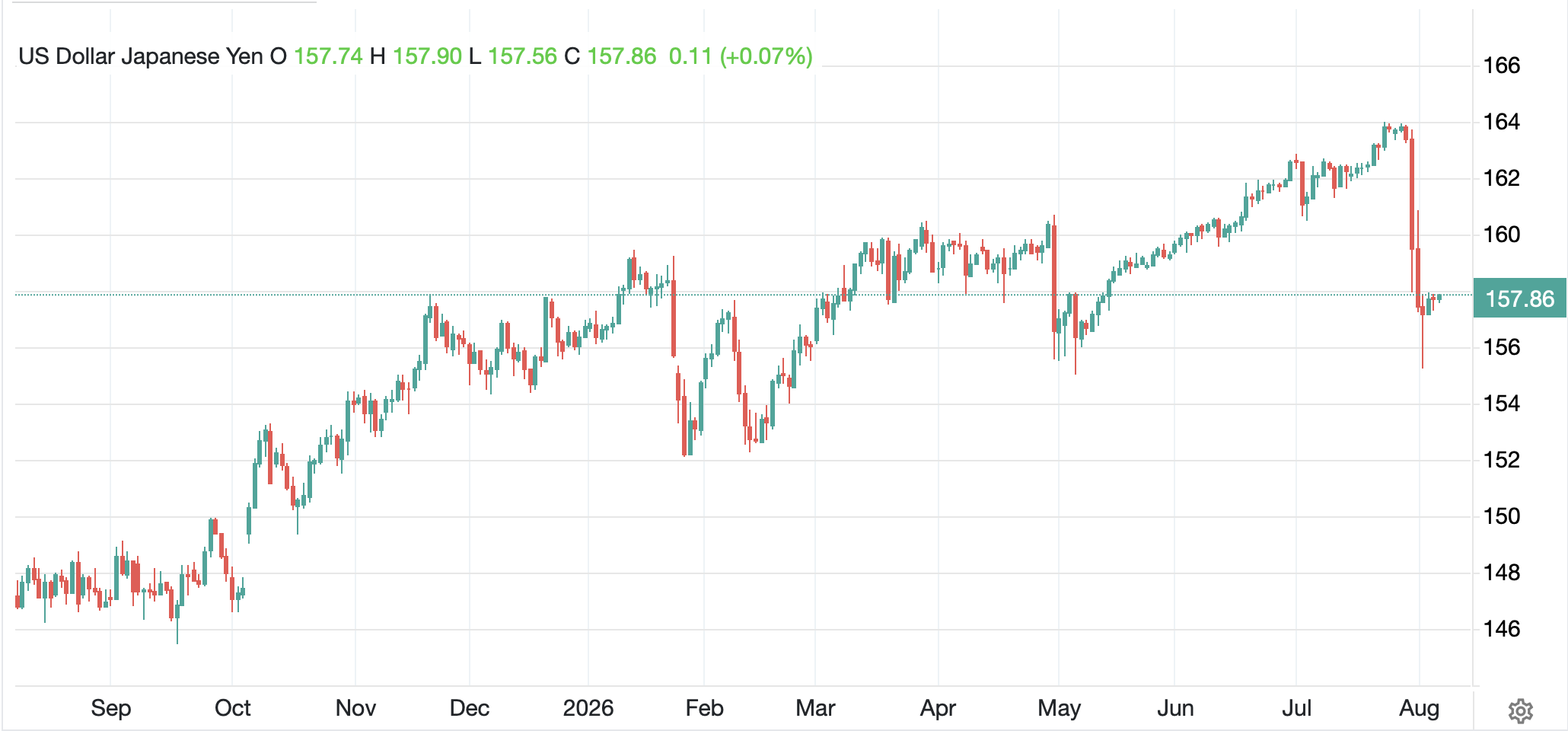
Source: tradingeconomics.com
But as I said it is early days. Now, I have made the point that unless more fundamental changes are made in Japan, whether that is reining in spending (which seems highly unlikely) to reduce the budget deficit and ongoing increases in debt issuance, or tightening monetary policy by raising interest rates more aggressively, it strikes me that despite all the headlines, this won’t change the situation that much.
If we use CME JPY futures positions as a proxy for the carry trade, as you can see in the below chart from cotsignal.com, that while we are not at record short positions in the large spec community, we are awfully close.
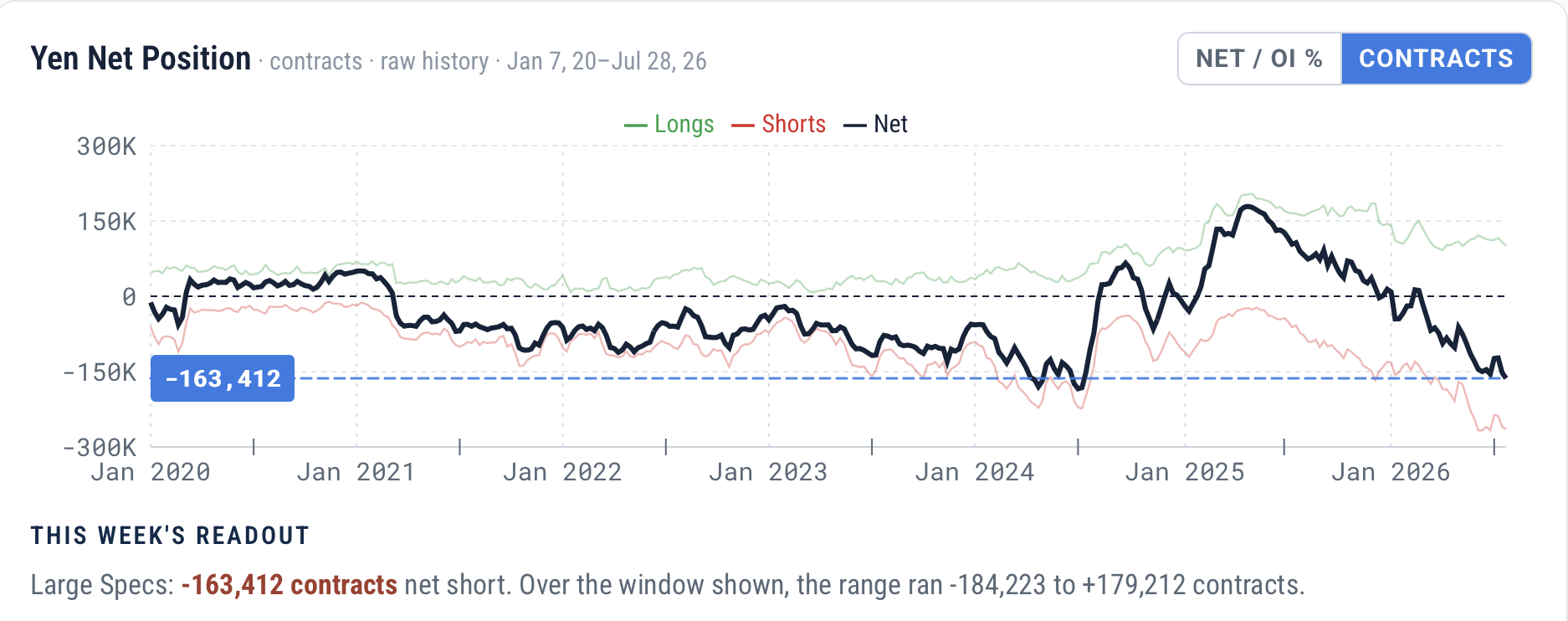
In fact, it is difficult to see at this point, although the data to be released tomorrow could well show it, much change in the short JPY positioning amongst the speculative set. In fact, I would expect that would be the case to some extent. And yet, as in the first chart, the yen appears to have begun to grind lower again.
Much has been made of the potential ramifications of the fact that the Foreign and International Monetary Authority (FIMA) swap lines were used to fund this intervention rather than Japan simply selling some of its Treasury holdings (remember, it holds some $1.13 trillion), and what it means. Some analysts are claiming Secretary Bessent is concerned over the reaction in the Treasury market if the Japanese sell their bonds and so was trying to prevent any additional pressure there. And perhaps that is correct. We will never really know as Bessent will certainly never admit that.
But let me offer a different, simpler explanation. The BOJ didn’t want to take the losses on their bonds which are probably quite large given where US yields have been. Remember Silicon Valley Bank? So, if the BOJ used a repo facility, they get the cash and don’t take the loss. After all, that is not really a new idea. Yet I haven’t heard a single analyst mention it. I guess it’s not sexy enough. Time will tell if things have really changed, but to my eyes, not yet.
Let’s turn now to Friday’s release
Of Payrolls, where there’s an increase
Expected and if
It comes, folks will sniff
A hike ere the summer does cease
On a subject that has not gotten a lot of press so far this week, tomorrow brings the NFP report where a solid growth in NFP is expected (80K) although yesterday’s ADP Employment number disappointed at just 44K. Remember, since the change in immigration policy and the deportation of several million foreigners, it is becoming dogma that a stable Unemployment Rate can be achieved by simply not losing jobs as opposed to having to keep creating new ones.
In this light, 80K indicates a still solid labor situation. Now, the question at hand is how the market will absorb the data. We continue to see equity market participants focused entirely on the earnings data being released, with macro concerns a distant third place on their worry list. (I imagine oil is second). But for the fixed income market and the newly created Fed watchers, this is a critical piece of information.
The few Fed speakers we have heard this week have all discussed how they are now very focused on inflation (where were they in 2022?) and may need to raise rates if it continues to rise although a look at the Fed funds futures market shows that the probability of a rate hike next month has declined to 55% from two-thirds earlier this week. And while a second hike is still priced in the curve, it has been delayed until next spring from the earlier January expectations.
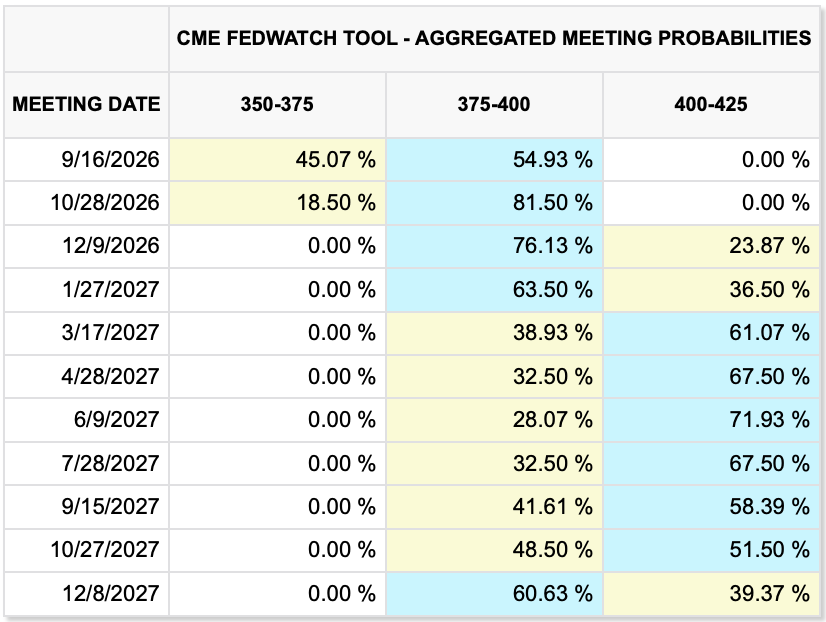
I find this quite interesting as all the Fed commentary has been hawkish and the data we have seen, notably ISM, continues to show economic strength. So, too, does the corporate earnings data and forecasts, with strength as far as the eye can see. I have no explanation for this change, and, in fairness, it is a bit subtle, but the futures market appears to be pricing in a different outcome than the punditry or at least starting to. We will need to watch this carefully as it may be a harbinger for more substantive changes in the narrative and future price action.
Ok, let’s quickly look at markets. The outstanding performer yesterday was clearly the precious metals space with gold (+4.1% yesterday, +0.3% this morning) having its largest gain since the late March bounce. Whether I draw a trend line or look at the 50-day moving average, it seems like a clear break higher after six weeks of consolidation around the $4000/oz level.
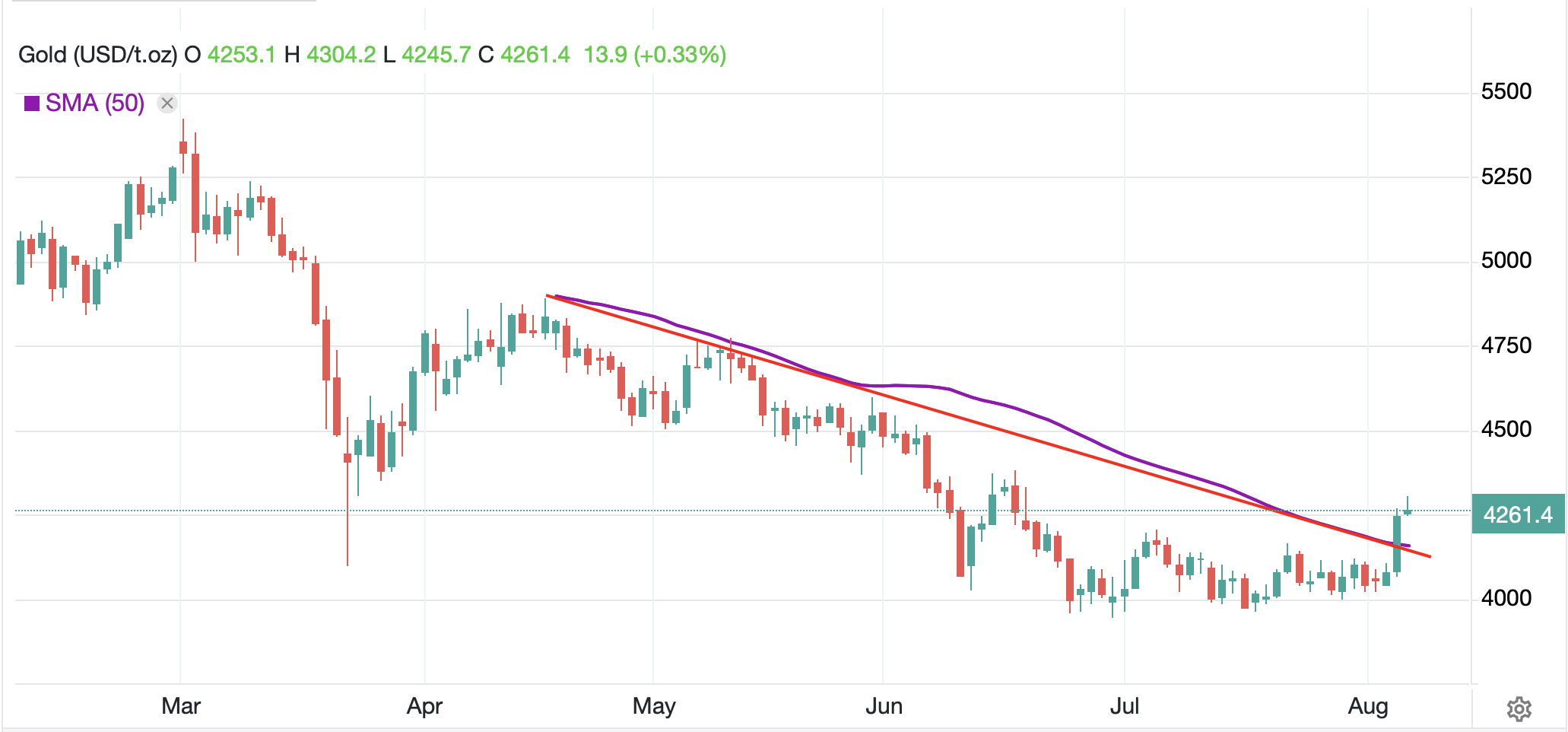
Source: tradingeconomics.com
Silver (-0.5%) had a similar move yesterday while copper (+0.9%) is in the process of making yet more new highs this morning although this move has been far steadier. I’ve seen explanations about how yesterday, the market suddenly realized that inflation was a problem or other such nonsense, but my experience tells me this is more likely a positioning event with new money entering after the markets demonstrated a more certain bottom. In other words, since it couldn’t go down despite bad news, the only direction left was up.
Oil (+1.0%) is almost an afterthought these days, remarkably. There is a lot of discussion about an imminent deal between Oman and Iran on the Strait of Hormuz, but my impression is that the market has pretty much moved beyond that story. EIA inventories rose, inventories at Cushing rose and there is no evidence of shortages anywhere in the West.
In the equity markets, yesterday’s mixed US session was followed by a generally weaker one in Asia (Japan -0.9%, China -0.2%, HK -1.5%, Korea -4.6%) although there were some gainers as well (India +0.5%, Australia +0.5%, Singapore +1.0%, Thailand +0.7%). The tech story continues to be the driver and yesterday was a clear demonstration of tech concerns compared to basic materials bullishness. Europe, though, is firmer this morning led by Spain (+1.1%) and France (+0.6%) after some positive data was released (Spanish IP, French Construction PMI, German Factory Orders) although the DAX (+0.25%) is lagging the group. As to US futures, at this hour (7:40) while the NASDAQ (-0.4%) is lower, the other two indices are firmer by 0.2%.
In the bond market, yields are edging higher this morning with Treasuries (+2bps) leading the way and most European sovereign yields higher by 1bp. While yields across the board are at the high end of their recent ranges (see chart below), they do not appear to be breaking out Although for now, the trend across the board does seem to be modestly higher.
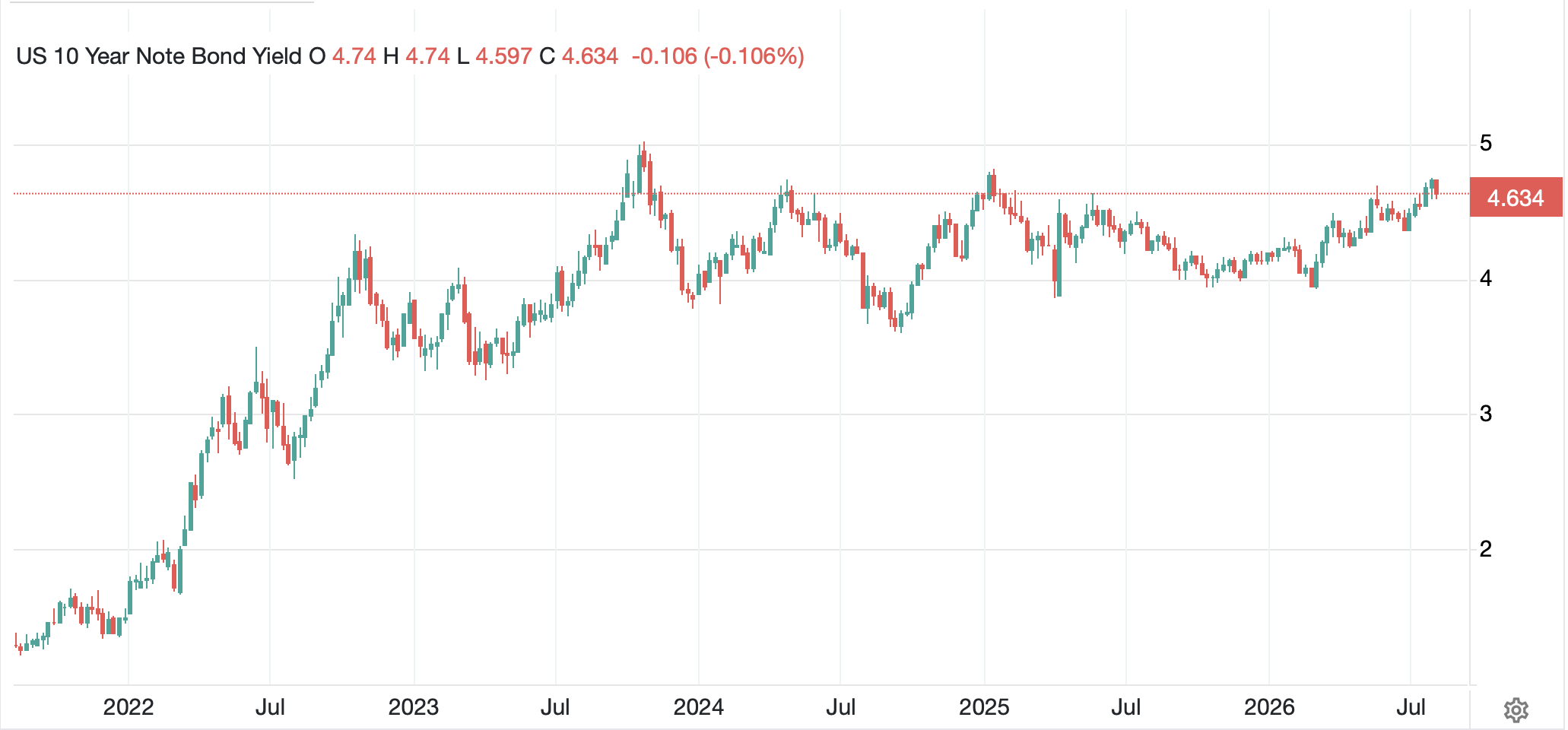
Source: tradingeconmics.com
Finally, the dollar is a bit firmer this morning, but only just. In fact, there is really no currency movement of note to discuss. Brazil cut its SELIC rate to 14.0% as expected and the BRL (+0.3%) is a touch firmer, but really, other than that, 0.1% is today’s story and that is not much of a story.
Today’s data releases include Initial (exp 202K) and Continuing (1790K) Claims as well as Nonfarm Productivity (0.6%) and Unit Labor Costs (2.1%) and that’s really it. There is another speech by St Louis Fed president Alberto Musalem, but we already know he is a hawk, so there will be nothing new there.
While we need to keep our eye on how things play out in the yen, there seem to be fewer stories of interest right now, at least marketwise. Perhaps we are finally in the summer doldrums.
Good luck
Adf

