
Somewhat Decreased

The OECD has released
Its forecasts for West and for East
Alas what they’ve said
Is looking ahead
The growth story’s somewhat decreased

It’s another extremely dull day in markets as the passing of the debt ceiling crisis has left traders and investors looking for anything new at all to help catalyze trading ideas.  Granted, all market participants are anxiously awaiting next Wednesday’s FOMC meeting, but there is a lot of time between now and then to fill.  As there was a dearth of new data of importance overnight, the talk of the market is the OECD’s release of their June 2023 Report on global GDP growth as per the below:
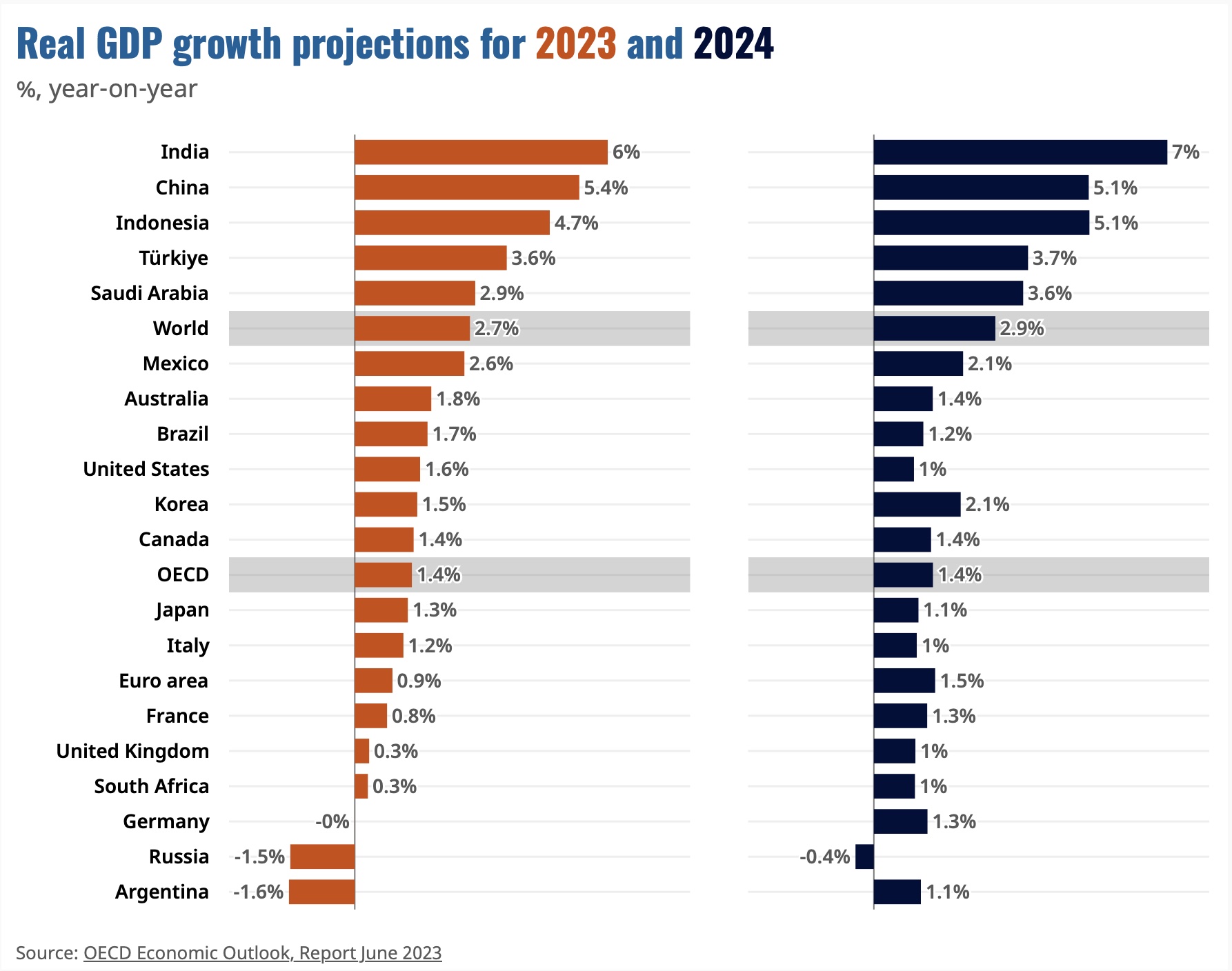
In truth, it does not make for great reading as the estimates point to continued subdued growth, well below the pre-pandemic average of 3.4% globally.  As well, they highlight that this slower growth trajectory will be matched with higher inflation (exp 6.6% in 2023 and 4.3% in 2024), a truly unenviable situation.  Of course, just like every forecast, these must be taken with a grain of salt as the one thing we know about forecasting is…it’s really hard, especially about the future.  It is not clear that anybody altered their views on anything after the release of the report, but it has been the talk of the town.


Aside from that, I must follow up on a comment from yesterday’s note regarding the interest rate adjustments made in China, as it seems there is even more nuance involved.  The big 4 Chinese banks have reduced their onshore deposit rates for USD by about 30bps to try to discourage dollar hoarding and incremental additions to the carry trade.  With US rates now above 5%, the carry opportunity to hold dollars relative to renminbi has been quite significant and has been a key driver of the renminbi’s weakness this year.  In fact, from the renminbi’s high point this year in mid-January, it has weakened nearly 6.6%, which is quite far for a currency that traditionally runs with about a 4% annualized volatility.


One other thing to consider here is that the fact that Chinese banks had to lower their USD deposit rates in order to discourage the owning of dollars seems at odds with the idea that the Chinese are getting out of their dollar holdings.  Rather, it might be a signal that the Chinese people, regardless of what their government may want, seem pretty comfortable holding the greenback. 


And, my goodness, there is virtually nothing else marketwise to discuss from the overnight session.  Equity markets have been generally quiet overall, with modest gains or losses following yesterday’s very modest US rally.  Major European bourses are +/- 0.1% on the day although we did see the Nikkei fall -1.8% overnight, arguably on the back of the latest Policy proposal by PM Kishida which calls for more spending and debt.


Bond markets are also quite subdued with yields edging slightly higher in most places, but just on the order of 1bp-2bps, hardly a worry.  The one noteworthy thing here is now that the debt ceiling has been suspended, the Treasury issued just under $400 billion in T-bills yesterday and is likely to continue on that pace for the rest of the month as they refill the TGA.  The market impact is that the curve’s inversion is increasing with 2yr-10yr now back to -83bps and seemingly heading far lower again.  A test of -100bps seems entirely likely here.  Meanwhile, the 3m-10yr spread is -163bps, which is far below the levels seen even in the 1970’s and 1980’s during Volcker’s time in office.  Given the amount of issuance likely still forthcoming, I suspect this can fall further still.  It is not clear to me that this is a positive for the market.


Turning to commodities, oil (+1.1%) is rebounding slightly as it retraces yesterday’s losses while metals markets are a bit more positive today with copper (+0.5%) and aluminum (+0.75%) both rebounding although gold is little changed on the day.  I sense that part of this is related to the dollar softening a bit, as the growth story just does not seem that positive.


Speaking of the dollar, other than vs. the Turkish lira, which has collapsed nearly 7% this morning after President Erdogan’s new government took office, it is generally a bit softer on the day.  With oil’s rebound, NOK (+0.8%) is leading the G10 higher followed by SEK (+0.6%) and AUD (+0.4%) on broader commodity strength, but the whole bloc is firmer.  In the EMG bloc, ZAR (+1.0%) is the leader, also on better commodity pricing as well as an increasingly positive outlook on the power situation there, followed by the rest of the bloc (save TRY) edging up between 0.1% and 0.3%.  There really aren’t any other good stories there.


And that’s all she wrote.  This morning we see the Trade Balance (exp -$75.8B) and this afternoon, Consumer Credit ($22.0B), but these days, neither of those is likely to matter to the trading community.  I expect another dull day, and potentially a whole week of dull until the CPI data next Tuesday and then the FOMC meeting on Wednesday.  At this stage, the medium-term trend is for modest dollar strength, but on a given day, there doesn’t seem to be much directional impetus in either direction.


Good luck

Adf

Flames of Concern

In Turkey, the president canned
The central bank chief, and has fanned
The flames of concern
As traders now spurn
The lira in lieu of the rand

The top FX story this morning clearly revolves around the abrupt firing of the Turkish central bank’s governor, Naci Agbal, after he had the audacity to raise rates a surprising 2.0% last week in his effort to combat rising inflation.  The market had applauded the rate move and TRY had risen sharply, more than 4%, in the aftermath.  Unfortunately for him, Turkish president Erdogan is strongly of the opinion that rising inflation is caused by higher interest rates and is adamantly against the idea of raising rates.  (It appears that Erdogan is an MMTer at heart).  Arguably this is because it costs his government more to borrow for his spending plans, but whatever the rationale, this is at least the second central bank governor he has fired after a rate hike.  It cannot be a surprise that the lira has fallen dramatically in markets this morning and is down more than 10% as I type.  I highlight this to remind readers that abrupt and very large movements remain quite feasible in the FX markets.

Meanwhile, it’s the Treasury bond
About which most markets respond
Two camps have emerged
Where one side has urged
A cap, while the other side’s yawned

But really, the story that matters the most in markets right now continues to be the future price action in US Treasury markets.  The battle lines have been drawn with the inflationistas convinced that the combination of massive money printing by the Fed (M2 +25.8% Y/Y as of January 31) combined with the recently passed $1.9 trillion Covid bill is going to lead to significant price rises and much higher yields in the bond market.  In this camp, many expect the Fed to be forced to cap yields, either tacitly, by extending the maturity of QE purchases, or explicitly by telling us so, thus driving real yields lower and the dollar down as well.

In the other camp are the deflationists, a shrinking group, who nevertheless believe that the underlying drivers of declining inflation over the past 40 years; namely globalization, technology and demographics, remain firmly in place and will reassert themselves in the medium term.  This camp will also point to the fact that the ratio of interest payments to GDP, a key metric determining the affordability of government debt loads, continues to decline in the US and so a short-term rise in Treasury yields is no cause for concern.   Arguably, Treasury Secretary Yellen lives in this camp as she has consistently expressed her belief that the risks to the economy now are not doing enough to support growth and has been completely unconcerned with the rapid growth of Treasury debt to fund the serial government programs that have been enacted.  In this telling, the current price action in bonds is temporary and will soon be corrected as it becomes clear inflation is not a significant problem.

Ultimately, what this means is that the rest of us are beholden to the outcome of this situation and need to remain vigilant for clues as to how the situation will evolve.  Perhaps this week we will get some clues, if not from the data, then from the twenty-two different Fed speeches that are on the calendar.  Almost every FOMC member will be regaling us with their views following last week’s FOMC meeting.  In fact, the first, Richmond Fed president Barkin, has already spoken overnight and dismissed concerns over rising yields as an issue, rather explaining they were a vote of confidence in the economy and no problem at all.  We shall see!

Ok, on to markets, where the overriding theme is… there is no theme.   Equity markets were mixed overnight (Nikkei -2.1%, Hang Seng -0.4%, Shanghai +1.1%) and European bourses are showing a similar spread (DAX +0.25%, CAC -0.25%, FTSE 100 0.0%). US futures?  Same thing here with NASDAQ up 0.8% while DOW futures are slightly softer, -0.1% and SPUs are +0.1%.

Bond markets, however, are rallying somewhat after last week’s gyrations with the 10-year Treasury yield down 4.6bps and back below 1.70%.  The yield declines in Europe are far more muted (Bunds -1.5bps, OATs -1.0bps, Gilts -1.5bps) although we did see JGB’s (-2.9bps) rally last night.  If pressed, I would say that investors, given the lack of theme are taking advantage of the recent rise in yields to earn a bit more.

In the commodity space, earlier price action saw much deeper declines, but as New York is walking in, oil (-0.2%) is just marginally lower; gold (-0.4%) has retraced some early losses and the base metals are mixed at this time with copper (+0.6%) higher while aluminum (-0.2%) is lagging.

Finally, looking at the dollar, aside from TRY’s collapse, the rest of the EMG space is far less dramatic with MXN (-0.75%) the laggard on a combination of weaker oil and the ongoing border crisis being seen as a negative for the economy there.  On the positive side, the gains are de minimis (PLN +0.3%, KRW +0.25%, PLN +0.2%) with CE4 currencies tracking the euros modest gains and Korea benefitting from comments about a faster than previously expected recovery.

G10 currencies, which had been mixed earlier, have started to gain a bit, led by CHF (+0.3%) and SEK (+0.3%) although the rest of the bunch have seen much smaller movement overall.  The interesting CHF story was that the SNB executed $118 billion of FX intervention last year, which may come under further scrutiny by the US Treasury given the fact that Switzerland was named a currency manipulator last year.  In the end, though, given the remarkably small size of the Swiss economy, it is hard to believe that there has been any real impact on the US economy by their actions.  The SNB meets this week and will almost certainly defend their activities as a requirement to prevent further strength in the currency which could drive a significant deflationary spiral, at least so they believe.

On the data front, there is a good deal coming up as follows:

Today Existing Home Sales 6.49M
Tuesday Current Account Balance -$188.3B
New Home Sales 873K
Wednesday Durable Goods 0.7%
-ex transport 0.6%
PMI Manufacturing (prelim) 59.5
Thursday Initial Claims 730K
Continuing Claims 4.0M
GDP Q4 4.1%
Friday Personal Income -7.2%
Personal Spending -0.8%
Core PCE Deflator 1.5%
Michigan Sentiment 83.6

Source: Bloomberg

In truth, the Friday data seems the most important, as the Personal Spending and PCE are keys being watched most closely.  We all know that the housing market is hot, and that PMI is likely to be strong as the economy reopens.  But what will happen with the Fed’s key measure of inflation?

And then, amidst all the Fed speak, we have Chair Powell in two joint appearances with Treasury Secretary Yellen, first before the House tomorrow and then the Senate on Wednesday, but given the sheer breadth of commentary we are going to hear, it will be important to see if a theme regarding the bond market’s recent declines with ensuing yield increases becomes a key topic.  Certainly, market participants are highly focused on the subject.

So, adding it all up, we have a decent amount of data and a lot of Fed speakers coming our way.  As I strongly believe the dollar’s direction will be driven by the bond market for the near-term, at least, listen carefully to those comments.  Powell actually starts the commentary this morning at 9:00.  The more unconcerned the Fed speakers are with rising yields, the more likely, in my estimation, the dollar is to rise.

Good luck and stay safe
Adf