
While waiting to hear more from Jay
Investors keep socking away
More assets that need
Low rates to succeed
With clues, now, inflation’s at bay

In Europe, the money supply
Although really still very high
Is starting to fall
As well, there’s a call
To start waving PEPP bonds bye-bye
Overall, it has been an uneventful session in the markets with risk assets generally performing well amid clues that all the central bank efforts to tame inflation may be starting to work. The first sign was the release of lower-than-expected Italian CPI data at 6.7%, down sharply from last month’s 8.0% reading. As well, Italian PPI continues its recent negative trend, printing at -6.8% Y/Y, widely seen as a harbinger of future CPI activity. In addition, money supply data has continued to fall rapidly as per the below chart from the ECB, with M1 growth falling to -6.4%, its lowest reading ever.

Yesterday I mentioned the idea that the ECB was turning into a closet monetarist institution as they continue to see their balance sheet shrink and today’s data helps bolster that view. In addition, there is increasing discussion at Sintra that the ECB should consider actually selling some of the bonds from their QE programs, APP and PEPP, rather than simply let them roll off without reinvesting. Recall, that while the Fed is allowing $95 billion / month to mature without reinvestment, the ECB’s pace is a mere €15 billion / month. Granted, the ECB also has the benefit of having a large slug of TLTRO loans maturing this week (approximately €500 billion) which has been the driving force behind their balance sheet’s decline, but whatever is driving the process, it seems like the ECB is tightening monetary policy more aggressively than the Fed.
The big difference between the US and Europe, though, is that Europe is already clearly in a recession while the US, despite a widely anticipated slowdown, continues to perform quite well. For instance, yesterday’s data releases were uniformly better than expected. Durable Goods, Home Prices, New Home Sales, Consumer Confidence and the Richmond Fed Manufacturing Index all printed at better levels than expected. This goes back to the Citi Surprise Index, which jumped nearly 17 points yesterday after the releases and sits firmly in positive territory in an uptrend. Meanwhile, the same measure in the Eurozone is collapsing, deep in negative territory. The below Bloomberg chart is normalized at 100 from one year ago. It is quite easy to see the remarkable gap between the US (blue line) and Eurozone (white line) with respect to relative economic performance.
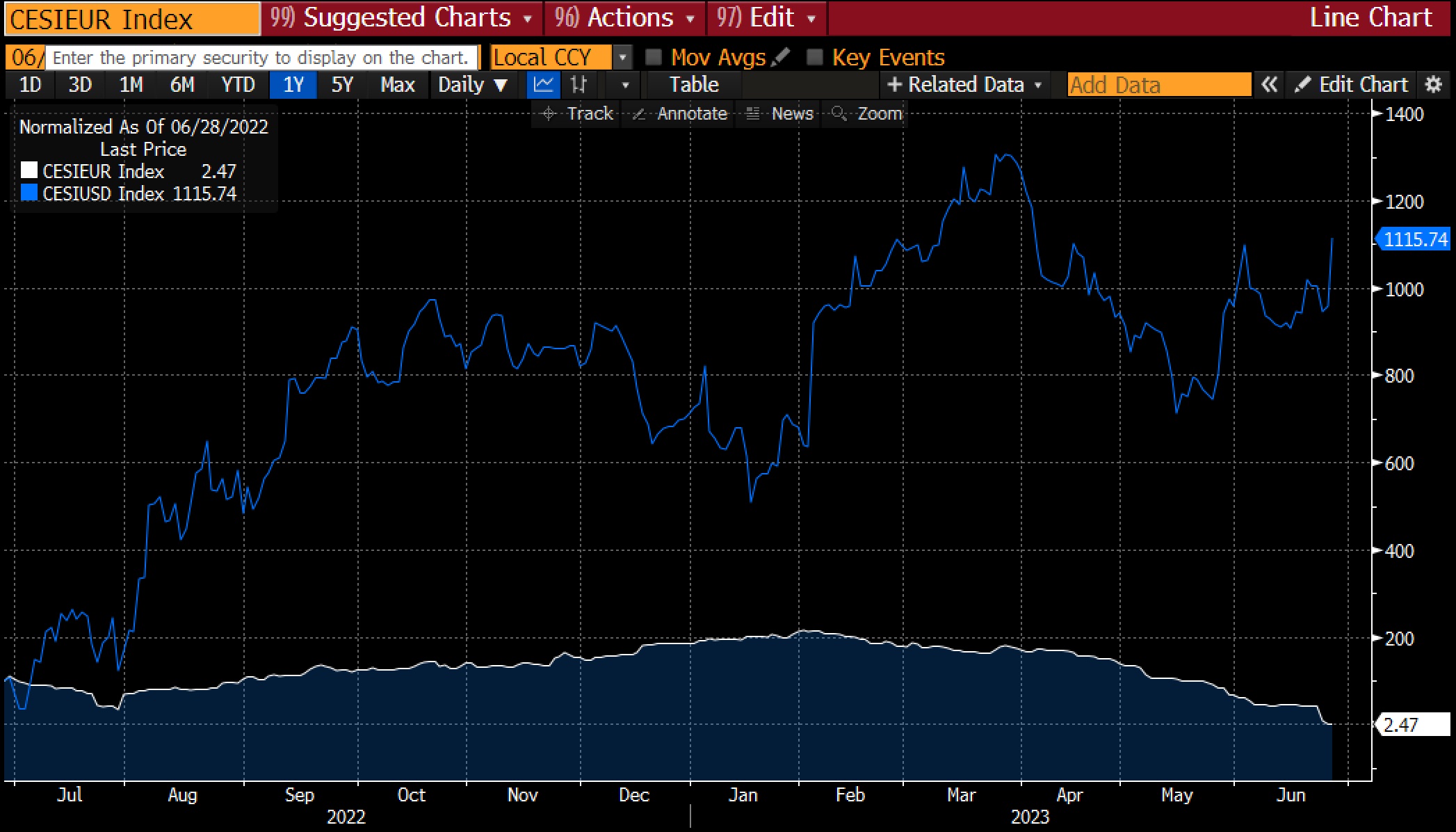
Arguably, one would expect that given the US economy’s seeming resilience, the Fed would be the more aggressive of the two central banks, but that is just not the case, at least based on the behavior of their respective balance sheets.
The big question is, can this dichotomy continue? With the Eurozone already in a recession and showing no signs of coming out of it, can the ECB continue to tighten policy in the same manner they have to date? As well, can the US equity market continue to perform well despite no indication that the Fed has any reason to pivot to easier money in the near future? Logically, at least based on previous logic, one would have thought these conditions could not continue very long. And yet, here we are with no obvious end in sight.
My sense, and my fear, is that the ‘long and variable lags’ with which monetary policy impacts economic activity have not yet been felt in the US economy and that much more stress is still in the not-too-distant future. If I had to select a particular weak spot it would be commercial real estate, especially the office sector, as already we have seen a number of high-profile mortgage defaults, and given the change in working conditions for so many people and companies, are likely to see many more. The GFC was driven by the retail mortgage sector imploding. It is not hard to imagine the next financial downturn being driven by the inability of commercial mortgage holders to refinance over the next year or two as they are currently upside down on their properties and cash flows are suffering dramatically to boot. If this sector is the genesis of the problems, then given local and community banks are quite exposed to the sector all over the country, we are likely to be in for a rough ride, both in the economy and the stock market. Be wary.
As to the overnight session, generally speaking, equity markets followed yesterday’s US rally with gains. Japan was the leader with the Nikkei rallying 2% and only mainland China suffered as there was less clarity that the Chinese government was going to support the economy, and the currency. European bourses are all nicely higher although US futures, especially the NASDAQ, are a bit softer after the Biden administration indicated further restrictions on semiconductor sales to China.
Bond yields are sliding a bit this morning but not too much, 2bp-3bp and quite frankly, all remain in a fairly narrow trading range. Despite the Treasury issuance onslaught that has been proceeding since the debt ceiling was eliminated, yields have not moved very far at all. It would seem that as issuance is pushed further out the maturity ladder, we would see higher yields, but that has not been evident yet. Meanwhile, the yield curve remains massively inverted, right at -100bps this morning.
Oil prices are stabilizing this morning but have fallen more than 6% in the past week as this is the one market that truly believes the recession story. Gold is also under pressure, falling further and pushing toward $1900/oz. Higher yields continue to undermine the barbarous relic. As to base metals, copper is under pressure, but aluminum is holding in reasonably well.
Finally, the dollar is rebounding from a few days of softness with strength virtually across the board this morning. Every G10 currency is weaker led by NZD (-1.3%) and AUD (-0.95%) as concerns over Chinese economic activity weigh on the antipodeans. But the whole bloc is under pressure. Meanwhile, in the EMG space, the picture is the same, virtual unanimity in currency weakness led by ZAR (-1.0%) and THB (-0.95%) with CNY (-0.3%) reversing course after the PBOC was absent from the market last night. Despite hawkish comments from the SARB, the rand continues to suffer over concerns about the broader economy while the baht is suffering from political concerns. This is an interesting story as Pita Limjaroenat was the surprise victor in recent elections but was not backed by the military. Not surprisingly they are not happy, and he is having trouble putting a government together.
There is no major data today, so we are all awaiting Chairman Powell’s comments at 9:30 to see if he has any further nuance to impart. At this point, I have to believe he will continue to push the higher for longer mantra as the data has certainly done nothing to dissuade him. As such, I still like the dollar over time.
Good luck
Adf
 fxpoetry