
The talk of the town has been gold
Whose rally, by some, was foretold
While Christine and Jay
Would give it away
Elsewhere it’s what folks want to hold
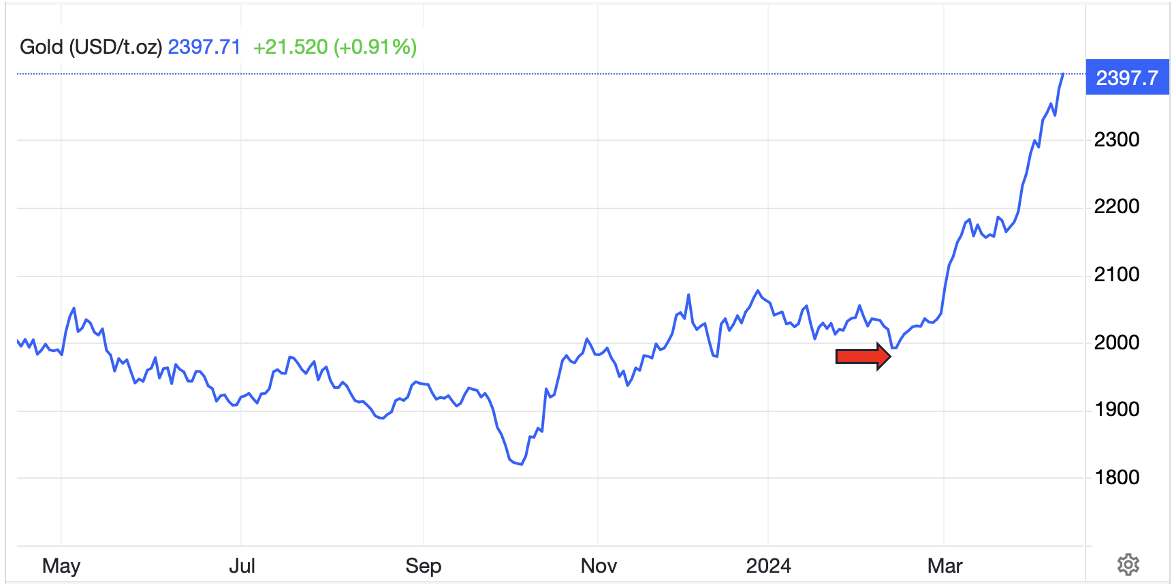
Under the rubric, a picture is worth a thousand words, have a look at the chart of the price of gold over the past twelve months below:
Source: tradingeconomics.com
That red arrow is pointing to the closing price on February 13, at $1988/oz, more than $400 lower than this morning’s market price. There are many theories as to what is happening to drive this remarkable move in a commodity that has had a very limited role in the macroeconomic discussion for the past 53 years, ever since Nixon closed the gold window in 1971. But the rally has been so strong it has fostered a host of theories as to what is driving it. The latest is that there is a large, price-insensitive buyer acquiring large amounts outside the NY/London trading axis, with many people of the belief it is China and/or Russia preparing for a more complete break from the USD-based global monetary system.
Perhaps that is the case as we know from official reports that China has continued to acquire large amounts of gold over the past year. But that has too much of a whiff of conspiracy theory in it for my taste. My strong belief is that conspiracies are extremely difficult to maintain because people simply talk too much. Rather, four decades of experience in financial markets, specifically FX and precious metals markets, has taught me that sometimes, markets move a long way on the basis of underlying fundamentals that have heretofore been ignored. A simpler explanation could be that given its millennia-long history of being an able store of value and the fact that inflation remains rampant around most of the world while central bankers remain keen to cut interest rates and stop any efforts to fight it, many folks have decided it is a good idea to hold some portion of their personal wealth in the barbarous relic. I know I do and have done so for quite a while. I do not believe I am alone in that mindset. Speaking of central bankers…
Said Christine, it’s still premature
To cut rates cause we’re not yet sure
Inflation is dying
Though we’re falsifying
It’s death from the Po to the Ruhr
At yesterday’s ECB meeting, as expected, there were no policy changes. Madame Lagarde commented as follows: “If the Governing Council’s updated assessment of the inflation outlook, the dynamics of underlying inflation and the strength of monetary policy transmission were to further increase its confidence that inflation is converging to the target in a sustained manner, it would be appropriate to reduce the current level of monetary policy restriction.“
That represents a lot of ten-dollar words to say, we want to cut rates, but we’re afraid if we do inflation might return so we are going to wait longer. However, what was clear was that there is a wide range of views on the council. For instance, this morning, Yannis Stournaris, the Greek central banker, said he thought that 4 cuts this year made sense. At the same time, the last we heard from Robert Holtzmann of Austria, one cut was probably enough.
Once again, Lagarde explained they are not waiting for the Fed, which is a good thing given the Fed seems less and less likely to cut this year at all, and Europe is in a recession already and needs lower rates. This morning, the euro has fallen even further, down another -0.7%, and is back to levels last seen in early November. It is becoming increasingly clear that monetary policies in the US and Europe are going to diverge further than currently priced and that does not bode well for the single currency going forward.
And those are really the big stories. Yesterday’s PPI was a tick softer than expected, but the explanation was that in the calculation, the BLS seasonally adjusts the price of gasoline, so it showed a reduction despite the fact that gasoline prices, as we all know, have been rising steadily of late. In any event, the market shook it off as we saw US equity markets perform well with both the S&P and NASDAQ reversing Thursday’s declines. In Asia, however, while the Nikkei (+0.2%) managed a small gain, Chinese shares, and especially those in HK (-2.2%) had a lot more difficulty. Chinese trade data was quite disappointing with the Trade balance shrinking dramatically (granted it is still >$50B) but both imports and exports declining. And truthfully, all the other regional markets were lower to close the week.
European bourses, though, are all in the green, and nicely so, as investors and traders listen to the ECB doves and see more rate cuts, not less, coming. This was confirmed with final pricing data showing the trend lower in inflation remains intact. As to the US futures market, at this hour (7:50), they are lower by about -0.25% after weaker than expected earnings from JPM were released this morning.
In the bond market, after a week that has seen yields climb dramatically around the world, this morning Treasury yields are lower by 6bps, although still above 4.50%. European sovereigns have seen yields decline even more, between 9bps and 11bps as the hope for rate cuts springs eternal. Arguably, this is why the euro is under such pressure, the market narrative is gelling around the idea that the Fed won’t cut, and the ECB will be more aggressive. One last thing, JGB yields are lower by 2bps this morning, but that is after a sharp rise seen in the wake of the US inflation report. In fact, like many markets, with 10-year yields back at 0.84%, we are seeing levels not seen since November.
Turning to commodities, we have already discussed gold, and ignored silver (+2.0%) which is rallying even more aggressively, and copper (+1.80%) which is gaining on a combination of concerns over supply and a growing belief that China is going to add more stimulus to their economy. Oil (+1.4%), too, is on the move, rebounding on growing concerns that the Middle East situation is getting even more dangerous with all eyes on Iran and any potential retaliation for Israel’s actions in Syria last week that resulted in the death of a key Iranian commander. Historically, commodity rallies of this nature were accompanied by a weaker dollar, but not this time. If this price action continues, there are going to be a lot of problems in nations all around the world that need to acquire commodities while their respective currencies are weakening. Do not be surprised to see more market intervention in many places.
Finally, the dollar is back on top, rallying vs. virtually every currency this morning in a substantial manner. In the G10, SEK (-1.3%) is the laggard, but the euro, pound, Aussie, Kiwi and Nokkie are all weaker by -0.6% or more. In fact, only the yen (0.0%) is holding up, but that is after it blew through the previous ‘line-in-the-sand’ at 152.00 and is now above 153.00. emerging market currencies are also uniformly weaker, although some are holding in better than others. ZAR (-0.1%) is clearly benefitting from the metals rally, but not quite enough to rally on its own. But KRW (-1.0%), MXN (-0.5%), BRL (-0.45%) and PLN (-0.65%) give a flavor of the overall price action. Frankly, this is likely to continue until/unless we see a significant change in the data flow with US economic activity slowing, or at the very least, we get a consensus from all the Fed speakers that they are going to cut regardless of the data.
Speaking of the data, today we see only Michigan Sentiment (exp 79.0) and hear from two more Fed speakers, Bostic and Daly. it doesn’t strike me that the data will matter that much, but market participants are quite keen to get more clarity from Fed speakers. There is still a mix of views, although the one consistency is they have no confidence that inflation is falling toward their target sustainably. However, some see a reversal higher as quite possible while others are holding out hope that this is a temporary bump in the road. We will still see a significant amount of data before the FOMC meeting on May 1st including Retail Sales next week and the PCE data at the end of the month. We will also hear much more from Fed speakers, so as of now, while there is no consensus, perhaps one will coalesce.
Yesterday’s data did result in futures markets very slightly increasing the rate cut probabilities, with June now a 25% chance and 45bps priced for the rest of 2024. I remain in the no-cut camp and so expect the dollar will continue to perform well vs. its brethren. However, I see no reason for the commodity markets to back off either. Bonds, however, are likely to see more pain going forward.
Good luck and good weekend
Adf
 fxpoetry