
The interest rate doves are excited
That job growth in August was blighted
If that was the case
The Fed may embrace
Enough cuts to leave them delighted
But if they’re correct, what of stocks?
Will weak data be a new pox
On earnings and growth
And undermine both
With stocks falling onto the rocks?
As far as anyone can tell, there is only one thing that matters today, the payroll report. Let’s set the table with the latest median forecasts:
| Nonfarm Payrolls | 160K |
| Private Payrolls | 139K |
| Manufacturing Payrolls | 0K |
| Unemployment Rate | 4.2% |
| Average Hourly Earnings | 0.3% (3.7% Y/Y) |
| Average Weekly Hours | 34.3 |
| Participation Rate | 62.6% |
Source: tradingeconomics.com
I’m sure you all remember that last month we got a surprising, and disappointing, reading of 114K for the headline number and then we subsequently got those massive revisions from the BLS which indicated that they had overstated job growth by more than 800K over the year from April 2023 through March 2024. As well, yesterday’s ADP Employment data showed private job growth of a below expectations 99K with a revision lower to the previous month’s number. Certainly, some of the data we have seen is pointing in the direction of a weaker outcome. However, if one looks at the Initial and Continuing Claims data, neither of those series are pointing to a significant weakening in the labor market, although it has cooled somewhat since last year.
Since the last NFP report, 10-year Treasury yields have declined by 28bps and now sit at 3.70% this morning. If you compare that to the current Fed funds rate of 5.375%, the implication is that rates are going to fall by at least 160 basis points over the next two years. In fact, we are starting to see some analysts (Citi) call for nearly that many cuts by the end of 2024! It strikes me that 150bps of cuts by December 2024 would only occur in response to a significant slowing of US economic activity, in other words, the long-awaited recession. Now, if the Fed were to cut that aggressively without a clear decline in the economy, it would certainly open the door to much higher inflation ahead. After all, why add liquidity and ease policy if the economy continues to cruise along at a decent clip?
The upshot is that it appears, at least to this poet’s eyes, that the bond market is way ahead of itself with respect to potential Fed rate cuts. Either that or the stock market is completely mispriced for the potential future earnings results of its components. The one consistent outcome from all recessions is that corporate earnings growth slows dramatically. Given that current equity prices embody P/E multiples near historically high levels (see chart below of Cyclically Adjusted Price Earnings for the S&P 500), if the E in that fraction declines, you better believe that so will the P.
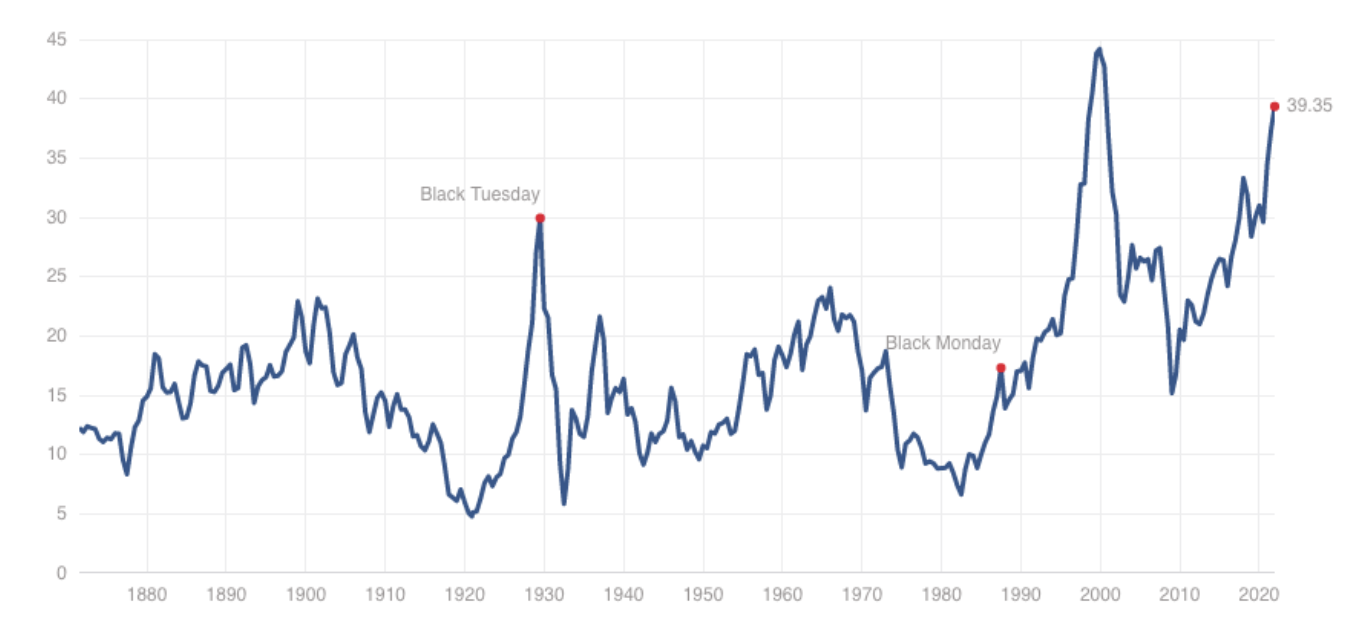
Source: lesswrong.com
What will this mean for other asset classes, notably commodities and the dollar? Here we need to consider the driver of the potential rate cuts in question. If the US economy is clearly slowing dramatically and the Fed is responding by cutting rates aggressively, I would expect that the dollar will come under real pressure, at least initially, as the Fed is likely to be more aggressive than other central banks. However, remember that the market is already pricing in significant rate cuts, so given the reality that if the US enters recession, most of the rest of the world is going to see much slower economic growth with their central banks easing policy as well, I would not look for a dollar decline of historic proportions. Another 5%-8% seems viable but looking for the euro at 1.50 or the pound at 1.75 or the renminbi at 6.00 seems unrealistic. The one outlier here is the yen, of course, where a situation with declining US equity prices, and correspondingly declining risk asset prices all over the world, could easily see Japanese investors run home with their money and USDJPY could well fall back to the 120 level or even lower in that scenario.
As to commodity prices, I expect the initial move would be lower as concerns about growth would imply falling demand for the key commodities oil and copper. Gold, however, is a different animal and I imagine that we could see more uptake here as a weaker dollar and growing fear drive more retail buying of the barbarous relic.
Of course, if the data this morning is firmer than expected, all these bets are off. In fact, that appears to be the biggest risk in markets today, a strong NFP number with a decline in the Unemployment Rate. Market participants seem quite confident that the slowdown is coming and that the Fed is going to stick the soft landing. That is the only explanation for the fact that equity markets, despite yesterday’s modest declines, continue to trade near all-time highs regardless of the indications that US economic activity is slowing somewhat. The belief seems to be that the Fed will be able to cut rates the appropriate amount to prevent a collapse without triggering a renewed burst in inflation. And maybe they will. But given the fact that equity ownership is at record high levels already, the question becomes who is going to buy from here. Any misstep by the Fed, where it becomes clear that the outcome will be worse than a soft landing (either a recession or higher inflation or both) is going to weigh heavily on equity and other risk markets.
So, as we await the big news, a quick review of the overnight session shows that most equity markets in Asia (Nikkei -0.7%, CSI 300 -0.8%) and Europe (DAX -0.4%, FTSE 100 -0.3%) are lower, following the US session.
In the bond markets, yields everywhere continue to decline with Treasury yields (-3bps) continuing their fall while European sovereign yields are all softer by between -4bps and -5bps this morning. Even JGB yields (-3bps) are continuing lower as the global bond markets seem to be implying that economic activity is waning everywhere.
In the commodity markets, oil (+0.5%) is a touch firmer but remains below $70/bbl and has not shown any real strength despite a dramatic inventory drawdown reported by the EIA yesterday. OPEC+ has explained they are not going to restart production next month and will wait until at least December before doing so, but based on the price action of oil, I will wager they will delay it again then. Metals markets are little changed this morning after rallying yesterday during the US session, but like almost every market, all eyes are on the tape at 8:30 when NFP is released.
Finally, the dollar is a touch softer net, with traders seemingly preparing for a weak number. But the movements are so small that the largest is JPY (+0.25%) which is the result of a combination of fear and the broader dollar weakness I think. Here, too, we will learn much based on the data, so not much to do until then.
In addition to the payroll report we will hear from NY Fed President Williams and Governor Waller this morning as they will be the last to speak ahead of the Fed’s quiet period. Williams is due at 8:45, so his speech is prepared, but Waller will have time to alter things if the data is a significant surprise given he doesn’t speak until 11:00.
And that’s really it for today. It’s all NFP all the time. While it is very easy to believe that a weak number is coming, it is also clear to me that the pain trade would be a strong number. As such, I have a sneaking suspicion we could see something much firmer than forecast, maybe 200K with the Unemployment Rate ticking back down to 4.1%. That would be the real surprise.
Good luck and good weekend
Adf
 fxpoetry