Like Goldilocks?

For assets so safe and secure
It seems bonds have lost their allure
Yields worldwide are rising
And it’s not surprising
Since ‘flation, we all must endure

The question is, what about stocks?
Are they set to soon hit the rocks?
Or will they remain
Resistant to pain
If growth behaves like goldilocks?

Certainly, yesterday was a pretty bad day for risk assets as equity markets in the US sold off aggressively along with commodities.  The thing is it was a pretty bad day for haven assets as well with Treasury yields rising sharply.  And right now, just before 7:00am in NY, those trends remain intact.  In fact, the only thing that seemed to perform well yesterday was the dollar.

So, what gives?  Many will point to the downgrading of the US credit rating by Fitch as the proximate cause of things, and it may well have been an excuse for some selling, but despite the logic I detailed yesterday, the impact on markets should be di minimis.  After all, Treasuries are used for two things largely, either as investments in their own right, or as collateral for other financial transactions.  Regarding the first point, nobody is actually concerned that the US will not repay their debt, so if the yield is attractive, investors will still buy them.  As to the second point, this could have been an issue but since the S&P downgrade in 2011, collateral agreements have been rewritten to accept not only AAA securities, but also US government securities, with no mention of their rating.  So, there is no change in the collateral situation.

If it was not the downgrade, then what has driven the recent upheaval in markets?  Arguably, this has been building for quite some time and was looking for a catalyst to get things started.  I think there are two ways to consider the situation.  For the bears out there, watching equities rally daily despite what appeared to be softening margins along with tightening monetary conditions didn’t make sense.  But the rally has been so relentless that the bears have largely capitulated on their views.  It seems the key lesson is that the timing of monetary policy transmission is much slower than it had been in the past, or at least that’s what it feels like, and so despite the Fed’s aggressiveness, it hasn’t had nearly the impact anticipated.  

To this point, remember, while the Federal government didn’t take advantage of ZIRP to term out its debt, homeowners and corporations did just that.  This has resulted in a lot of borrowers with a long runway before needing to refinance their debt and left them somewhat impervious to the Fed’s recent moves.  We have all heard that > 50% of mortgages outstanding are at rates < 4.0%.  This has resulted in an unwillingness to move and reduced existing home inventories and sales.  But all those people have not been impacted by the rate hikes, at least not on their largest single interest payment.  And the same has been true for many corporations who termed out their debt in 2020-2021 and even the first half of 2022.  While much of that debt will eventually be refinanced, it may be another 5-7 years before we start to see companies feel any stress there.  Consider, too, how this has helped lower rated companies, who, if forced to refinance today would see yields in the 8%-12% range but were able to borrow at 5% or less.  Of course, that debt was likely 5-year tenor, so that comeuppance is likely to arrive in 2025 or 2026.  And maybe that is when we should be looking for the first real problems.

The Fed’s Loan officer survey showed that conditions are continuing to tighten in the bank market, which means that smaller companies are going to be stressed, but the large cap companies that issue debt directly are sitting pretty.

Therefore, if it is not the downgrade, what other reasons could there be?  The first thing to remember is that there doesn’t have to be a specific reason for markets to sell off.  Markets that are overbought (or oversold) can reverse without any particular driver.  Historically, August has been a more volatile and weaker month for equities, often attributed to vacation schedules, with investors and traders both taking their summer trips and leaving skeleton staffs of junior people on the desk.  This will result in reduced liquidity and any outside selling impetus can have an overly large impact.  Remember, though, a rational look at equity markets indicates that on a historic basis they remain quite richly valued with the Shiller Cyclically adjusted P/E ratio at 31.1, well above its long-term median of 15.93.  However, what is typically true is that when an overvalued market starts to correct, it can continue doing so for quite some time until it reaches a more rational valuation.  If the bears have all given up, and the bulls are all on vacation, who is left to buy things?

All this is to say that, while the recent equity market weakness may not make sense specifically, there is nothing to say that it cannot continue for a while yet.  Turning to bonds, though, that is a different story.  Yields around the world are rising and, in many cases, rising sharply.  While the BOE just raised rates 25bps this morning, as largely expected, they are simply catching up to the rest of the G10.  However, 10-year Treasury yields are +6.7bps as I type (7:20) and now trading at 4.14%, their highest level since last October.  My sense is that this move is all about two things, concerns that inflation has seen a local bottom and the dramatic increase in supply just announced by the Treasury.  As discussed yesterday, yields above 4% have led to things breaking, so the question is what is set to break now?  Perhaps, the stock market selling off will be this breakage, or perhaps there will be some other crisis that flares up.  Maybe another large bank going to the wall, or a large corporate bankruptcy in a key sector.

We have discussed rising oil prices and you are all aware of rising gasoline prices every time you go to fill the tank.  Headline CPI, when it is released next week, will be well above last month’s 3.0%.  Too, yesterday’s ADP Employment number was much stronger than expected for a second consecutive month.  If the no landing scenario is correct, then inflation is likely to remain far more stubborn than currently expected and Chairman Powell will not be thinking about thinking about cutting rates any time soon.  In fact, at this point, if the Fed starts to think about cutting rates, that likely means that the economy has reversed course and is clearly headed into a recession.  Be careful what you wish for.

Summing up, I would be wary of reverting to the buy the dip mentality that has prevailed for more than a decade.  The underlying economic and financial situation is changing pretty quickly and that implies previous strategies may not perform that well.  Do not forget last year’s market performance.

I would be remiss if I didn’t mention that the BOJ was back in the market again last night, buying an unlimited amount of JGBs as they try to smooth the rise in JGB yields, which are now up to 0.65%.  This did help the yen a bit, which has rallied slightly on the day, but overall, the dollar remains much stronger.  My take is that we are seeing investors who are uncertain about the medium and long term, buying dollars to buy T-bills, earn a nice piece of interest and reconsider their next move.  One thing to note is that the yield curve’s inversion is lessening quite quickly.  Last Monday, the inversion was -104bps.  This morning it is -75bps.  That is a remarkably fast move in a short time.  It also implies that the demand for 10-year Treasuries is a little soft right now.  As I have written, this inversion could resolve with higher long rates, not lower short rates, and that is not something for which the market is prepared.  I believe that would be a clear equity negative.

There is a lot of data this morning starting with Initial (exp 225K) and Continuing (1708K) Claims, Nonfarm Productivity (2.3%), Unit Labor Costs (2.5%), Factory Orders (2.3%) and then ISM Services (53.0) at 10:00.  But this is all a lead-up to tomorrow’s NFP data.  Fed speakers have been fewer than usual, but we do hear from Richmond’s Thomas Barkin this morning.  I see no reason to believe that there will be any new dovishness upcoming.

To my mind, yields are going to continue to rise, equities are going to remain under pressure and the dollar, overall, is going to remain stronger rather than weaker.  We will need to see big changes in the data to change that view.

Good luck

Adf

Never-Ending

A landing that’s soft’s now the bet
By many who poo-poo the debt
But deficit spending
Which seems never-ending
Means prices ain’t coming down yet

So, nominal growth may still rise
Inflation, though, will not downsize
And yields on the bond
Are like to respond
By soaring right up to the skies

Fitch downgraded US government debt one notch to AA+ from its previous AAA.  Now, only Moody’s rates the US a AAA credit.  As per their announcement, their rationale was threefold: “The rating downgrade of the United States reflects the 1) expected fiscal deterioration over the next three years, 2) a high and growing general government debt burden, and 3) the erosion of governance relative to ‘AA’ and ‘AAA’ rated peers over the last two decades that has manifested in repeated debt limit standoffs and last-minute resolutions.”   

Let’s forget the political implications and the commentary from the government as it is completely expected.  And I am not here to defend or attack the outcome, but rather hope to try to make sense of what they were thinking and how markets are likely to behave.

Regarding the first issue, expected fiscal deterioration over the next three years, that seems a pretty fair point.  After all, fiscal deterioration has been consistently getting worse since the turn of the century, the last time we had a budget surplus.  In fact, as per the below Bloomberg chart, absent the Covid drama, the current budget deficit, at -8.5% of GDP, is larger than any time other than the GFC.  And this is occurring when, not only is there no recession, but GDP seems to be accelerating.  In fact, the Atlanta Fed’s GDPNow forecast has jumped up to 3.86%.  It seems fair to ask if part of that ‘growth’ is a direct result of deficit spending.

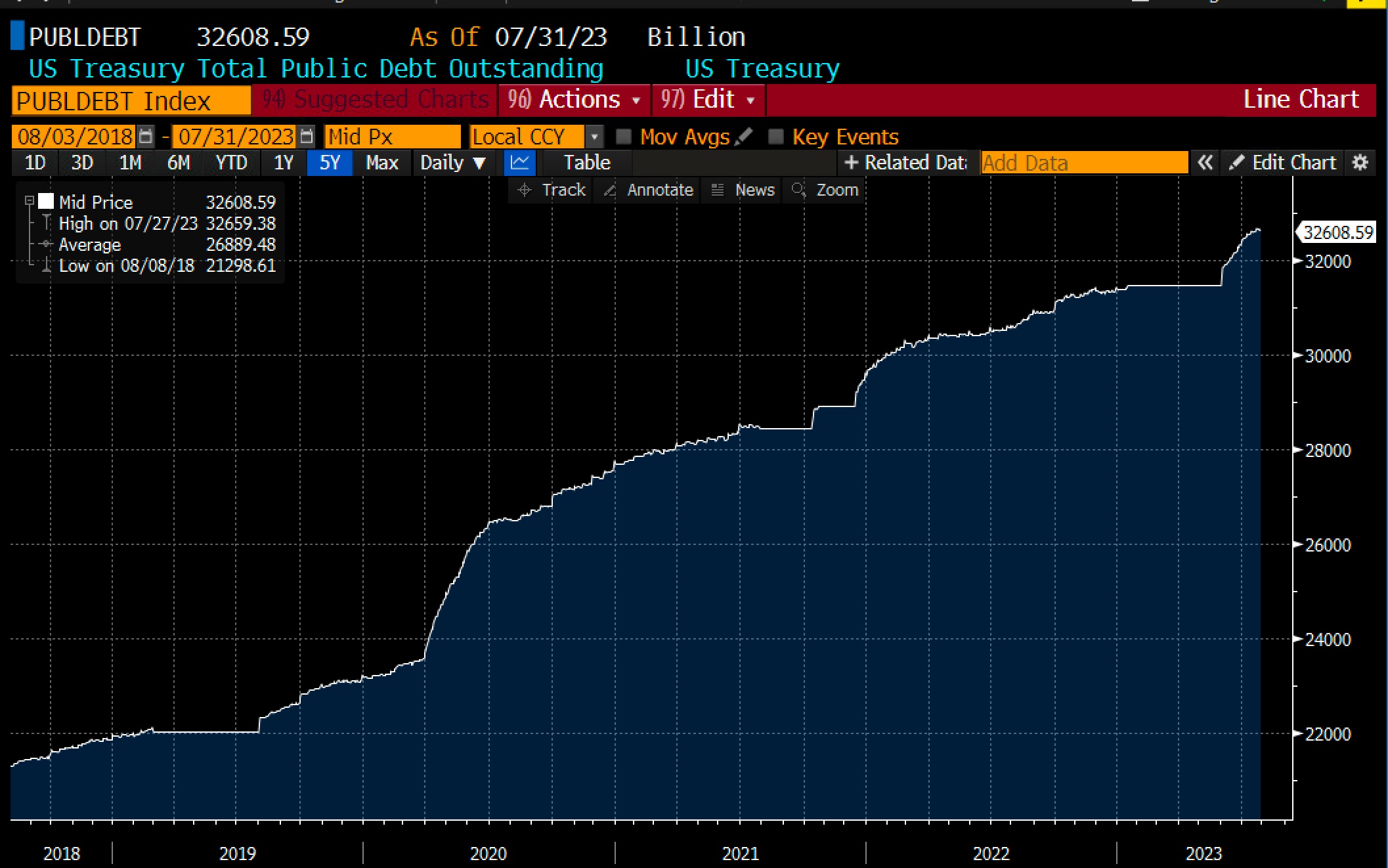
As to point number two, a high and growing government debt burden, that also seems like a fair point.  Since the debt ceiling was removed, government debt has grown by ~$1.2 trillion in exactly 2 months’ time (see Bloomberg chart below).  At the same time, the Treasury just announced they would be issuing $1.9 trillion in new debt during the rest of 2023.  Those are pretty big numbers and based on the legislation that was passed last year, the IRA and CHIPS act, as well as the fact that recent tax revenues have been declining, it is reasonable to expect the government debt burden to continue to grow.  

Finally, this poet is in no position to judge the relative erosion of governance compared to other nations, but on an absolute basis, it is not hard to argue that governance in the US has diminished, at least fiscal governance, given the political split between the House of Representatives and the Senate/White House.

Of course, this all begs the question, does it matter for markets?  Well, we have seen this movie before in 2011 when S&P downgraded the US government credit rating after the last standoff in Congress regarding the debt ceiling.  While it was a big deal politically, it actually had limited impact on the markets.  In fact, it may fairly be said that it marked the bottom in the equity market and ignited a massive multi-year rally.  Can we expect the same thing this time?  I would contend the situation now is quite different than back then, with a much higher debt/GDP ratio as well as a much higher level of interest rates.  The point is that the government’s fiscal stance is more tenuous now as interest payments on existing debt either start to crowd out other spending or drive deficits even higher, as per Fitch’s point.

Back then, 10-year yields were also much lower, ~2.5%, and the debt/GDP ratio was ~90% as compared to today’s ~120%.  In other words, there was a little more flexibility for the government.  In fact, following the move, bond yields fell another 100bps over the ensuing year, bottoming at 1.39%, the pre-Covid low.  An optimistic reading of that outcome is that investors looked around the world and decided that despite the flaws in the US, it was still the safest place to be.  Of course, that low interest rate coincided with the Eurozone debt crisis, so perhaps investors were simply fleeing the euro (the dollar did rally) given those problems.

So far, the reaction has been a downtick in equity markets and little movement in the bond market.  But it is not clear to me that either of those moves are directly related to this news.  Rather, it is entirely possible that we are starting to see the effects of what Fitch is describing, rather than the effects of Fitch’s move.

For instance, there is a growing perception that a soft landing is going to be the result of the Fed’s policy moves.  While inflation has obviously fallen from its highs of last year, the two things that have been driving that, lower commodity prices and base effects in the calculation, are reversing going forward.  For instance, oil prices are higher by nearly 17% in the past month while the monthly comparison for CPI in July is just 0.0%, so any inflation at all is going to result in a rise in the Y/Y figure.  

Instead, I would contend that the massive fiscal stimulus from the IRA and CHIPS Act are going to continue to drive demand, as well as debt issuance, and continue to pressure inflation higher.   While nominal growth may remain firm, inflation will too, so real growth will decline.  Arguably, the government needs this outcome in order to devalue their massive debt pile.  However, whether this will be a positive for risk assets is a much tougher question.  Certainly, bond yields are likely to rise in this scenario, and if that is the case, I suspect equity markets may start to revalue as well.  Government spending is not organic economic growth. Instead, it is far less efficient and debt driven, thus underpinning the Fitch viewpoint.  I fear that this time, the ratings downgrade may result in a different result than last time, with risk assets suffering as we go forward.

And that was certainly the case last night as equity markets throughout Asia were all in the red, as are European equities this morning.  Notable declines were seen in Japan (-2.3%), Hong Kong (-2.5%) and Spain (-1.2%), but it is universal.  As to US futures, they are all in the red as well this morning.

As to the bond market, 10-year Treasury yields are back above 4.0%, although they are little changed this morning.  Remember, the last several times the 10-year yield has gone above 4%, there have been problems somewhere in the market, with the UK bond meltdown and Silicon Valley Bank’s implosion the most widely remembered.  The curve is steepening (really getting less inverted) because long rates are rising, not because the Fed is cutting.  If the yield curve heads back to normal with 10-year yields at 5.5%, consider how that will impact equities.  It won’t be pretty.

Away from oil prices, base metals are under pressure this morning as well, potentially because China has yet to offer real support to its economy, or potentially because yields continue to rise thus hurting the investment case.

Finally, the dollar is broadly stronger this morning, certainly against the EMG bloc with KRW (-1.1%) and PHP (-0.75%) the laggards, but weakness widespread.  Both of those currencies are reacting to fading data and concerns over China’s actions going forward.  Meanwhile, in the G10, NOK (+0.45%) and JPY (+0.4%) are the outliers on the high side, with the former following oil while the yen’s move looks to be a trading bounce given the lack of news or rate activity.    However, the rest of the bloc is under pressure led by NZD (-0.6%) and AUD (-0.5%) with both sliding alongside the metals markets.

On the data front, ADP Employment (exp 190K) is coming shortly *Flash, ADP +324K* with most analysts anxiously awaiting not only the headline print, but any revision to last month’s extraordinary 497K rise.  As to Fed speakers, there are none on the calendar today.  All in all, the market will be keenly focused on the ADP especially after mildly softer than expected JOLTS Jobs data yesterday as well as a soft ISM Employment print.  There are certainly still hints of an impending recession, but the situation remains very uncertain.  Remember this, though, prior to the GFC, the consensus view was that a soft landing was going to be achieved.  The same was true in 2001 and as far back as 1980.  The only time the Fed successfully engineered that soft landing was in 1994 and I am not of the mind that they are going to be successful this time.  It’s just not clear what is going to break first.

Good luck

Adf

Walk the Walk

The Chinese are starting to feel
Recession could really be real
With PMI falling
Most pundits are calling
For policy help with more zeal

But so far, despite lots of talk
The Chinese will not walk the walk
One wonders how long
That they’ll sing this song
And when they’ll stop acting the hawk

Right now, the face of ‘all talk, no action’ is Chinese President Xi Jinping.  China’s economy has been slowing, or perhaps a better description is that the post-covid performance has been much less dynamic than had been widely anticipated.  Amongst the more concerning lowlights is the incredibly high youth unemployment rate there, with >21% of the population aged 18-24 unable to find work.  That is not the sign of economic dynamism.  You may recall the enthusiasm that greeted the news that the Covid lockdowns had ended suddenly in January and there was a widespread call for a rally in commodity prices in anticipation of the great reopening.  It never really happened.  Since then, things have been lackluster at best and the Chinese government has grown increasingly concerned.  However, they have not yet grown concerned enough to act in any significant way with fiscal policy support extremely narrow and inconsistent.

Last night simply reinforced these themes as the Caixin PMI Manufacturing data was released at 49.2, a full point below expectations and, of course, below the key 50 level indicating growth.  This was the lowest print since December, but a quick look at the numbers since then shows a very limited growth impulse in China.  The average reading in 2023 has been 50.1, hardly a sign of a rebound.  Now, the Chinese government did come out and say they are going to increase credit to private companies, focusing on small firms and the central government called on cities and provinces to do more to support the property markets.  But talk is cheap and until we see real money getting spent, it is hard to get excited about the Chinese economy.  Ultimately, while the PBOC is very concerned that the renminbi could fall sharply if they loosened their grip on the currency, I expect that a weaker CNY is going to be a theme for the rest of this year, and probably most of next year, as it offers the one release valve that they have available.  7.50 is still in the cards.

Away from the China story, the market’s focus on central banks intensified as the RBA left rates on hold at 4.10% despite market expectations of a 25bp rate hike.  The first casualty of this surprise was the AUD (-1.3%) which is the worst performing currency across the board today.  Apparently, their concern is that growth is faltering, and given the lack of growth in their largest export market, China, they believe that inflation pressures are ebbing and they have achieved their objectives.  Like all central banks these days, they claim to be data dependent and right now the data are telling them not to worry.  I guess that means when if inflation starts to reaccelerate, they will be back at the hiking game.  But for now, like central bankers all over the world, they are eager to claim victory over inflation.  

We heard this from the ECB last week, and it is quite possible that the BOE hints at that on Thursday as well, although inflation is much stickier in the UK than elsewhere.  My point is that the one central bank that is not satisfied is the Fed, where there is still a very wide consensus that the job is not done.  As long as US economic activity remains the best around, and that seems highly likely for another few months at least, it is hard to see any other central bank maintaining a more hawkish stance than the Fed.  Again, the underlying thesis of dollar strength is the Fed will be the most hawkish of all, and nothing we have seen today would contradict that theory.

How have markets responded to this news?  Well, yesterday saw a very late rally to take the US indices higher on the day, but only just, and while the Nikkei (+0.9%) had a good session, continuing its recent run, Chinese stocks, not surprisingly, were weighed down by the baggage of the PMI data.  Europe is also feeling the brunt of weak PMI data as the Manufacturing prints there were all in the low 40’s, except for Germany which managed to remain unchanged at 38.8!  Virtually all the markets on the continent are down by around 1% this morning in response to the data.  In fact, it is data like this that helped inform Madame Lagarde’s belief that the ECB is done, and who can blame her.  While inflation may be a problem, and the ECB’s only mandate, given she is a politician first and central banker second, the optics of tightening policy into a rapidly declining economy would be very difficult to explain.  Again, this bodes well for the dollar overall.  As to the US futures market, they are a bit softer this morning, not dramatically so, but it seems that there is some response to a generally softer tone in the earnings numbers released to date.

Interestingly, despite equity weakness, bond yields are higher in the US and across Europe by a few basis points.  For some reason, the bond market does not seem to agree with stocks, nor it seems, with most central bankers.  Inflation concerns remain top of the list for bond investors, and other than Down Under, where AGBs fell 8.6bps after the RBA left rates on hold, there seems to be a growing worry that the central banks are ending their fight too soon.  As to the US, once again the 10-year yield is approaching 4.0%, clearly a level of great import to the market.  I would also note that JGB yields edged ever so slightly lower overnight and remain below 0.60%.  However, it is still early days with respect to the policy changes there, so the eventual outcomes are still unclear.

Oil prices are very little changed today, consolidating their recent gains.  This must be a concern for the central banks as evidence of slowing economic activity is not leading to slowing demand for oil.  That is a key tenet of their policy structure.  The belief is weaker growth and recession will reduce demand for energy first, and then other things thus reducing inflationary pressures.  But if growth weakens and oil stays firm or rallies, they have a big problem.  Now, the metals complex is all softer this morning, behaving as would be expected in a weakening growth scenario, so it is oil that is the current outlier.

As to the dollar, it is king of the hill this morning.  While Aussie is the weak link, all the commodity currencies are under pressure, down between -0.6% and -0.9%.  But the yen (-0.5%) is also failing to find support on a risk-off day, which comes as a bit of a surprise to all those who continue to believe the BOJ is going to alter policy further.  Here, too, I see further weakness vs. the dollar as time progresses.  Just wait until the Fed hikes again and sounds hawkish as CPI data rebounds.

In the emerging markets, ZAR (-1.4%) has now edged ahead of the Aussie for title of worst of the day, as a response to the Chinese data, its own weak PMI reading and declining metals prices.  But virtually the entire bloc is weaker today with all three geographic areas feeling the pain.  

Yesterday’s US data was definitely soft with Chicago PMI at 42.8 and Dallas Fed at -20.0.  As well, the Senior Loan Officer Opinion Survey indicated that credit conditions for commercial and industrial loans had tightened further with reduced demand to boot.  In fact, the tightening is reaching levels last seen during the covid recession and the GFC.  This is not indicative of a soft landing, rather of a much harder one.  This morning we see Construction Spending (exp 0.6%), JOLTS Job Openings (9600K) and ISM Manufacturing (46.9) all at 10:00am.

And yet, despite the data and SLOOS, we heard from Goolsbee and Kashkari that they continue to believe a recession will be avoided.  This morning, Goolsbee is back on the tape, but we already know his view.  However, I do not believe he is in the majority at this point, though he is a voter, so come September, if they hike, perhaps we will have a dissent.

If the data is terrible, perhaps we will see the dollar cede some of this morning’s gains, but absent that outcome, let alone surprising strength, it feels like the dollar has further to rally.

Good luck

Adf