Like Love Unrequited

Said Trump, we can all use $5K
To help with our life’s day-to-day
So, vote for the R’s
And your cookie jars
Will fill up with this bonus pay

The pundits are clearly united
That this idea’s crazy and blighted
But of more concern
Is buyers will spurn
The 10-year like love unrequited

I guess we cannot be but so surprised that populist President Donald Trump has said he will hand out $5000 to every adult US citizen if the Republicans retain both the House and the Senate during the mid-term elections.  He is, after all, a populist.  And that is what populists do; they promise things to the people to get elected.  While this may be abhorrent to the alleged ‘hard’ money analysts on Wall Street, it strikes me that this is a brilliant way to get those leaning Socialist to vote for the Republicans.  After all, their entire MO is to get money for no work, and that’s exactly what this is.  It is laughable to me that there is now concern that if this were to go forward, it would cost ~$1 trillion and ‘where would the money come from?’ is now the big question.  The money would come from where all the money for government spending comes from, more Treasury issuance.  

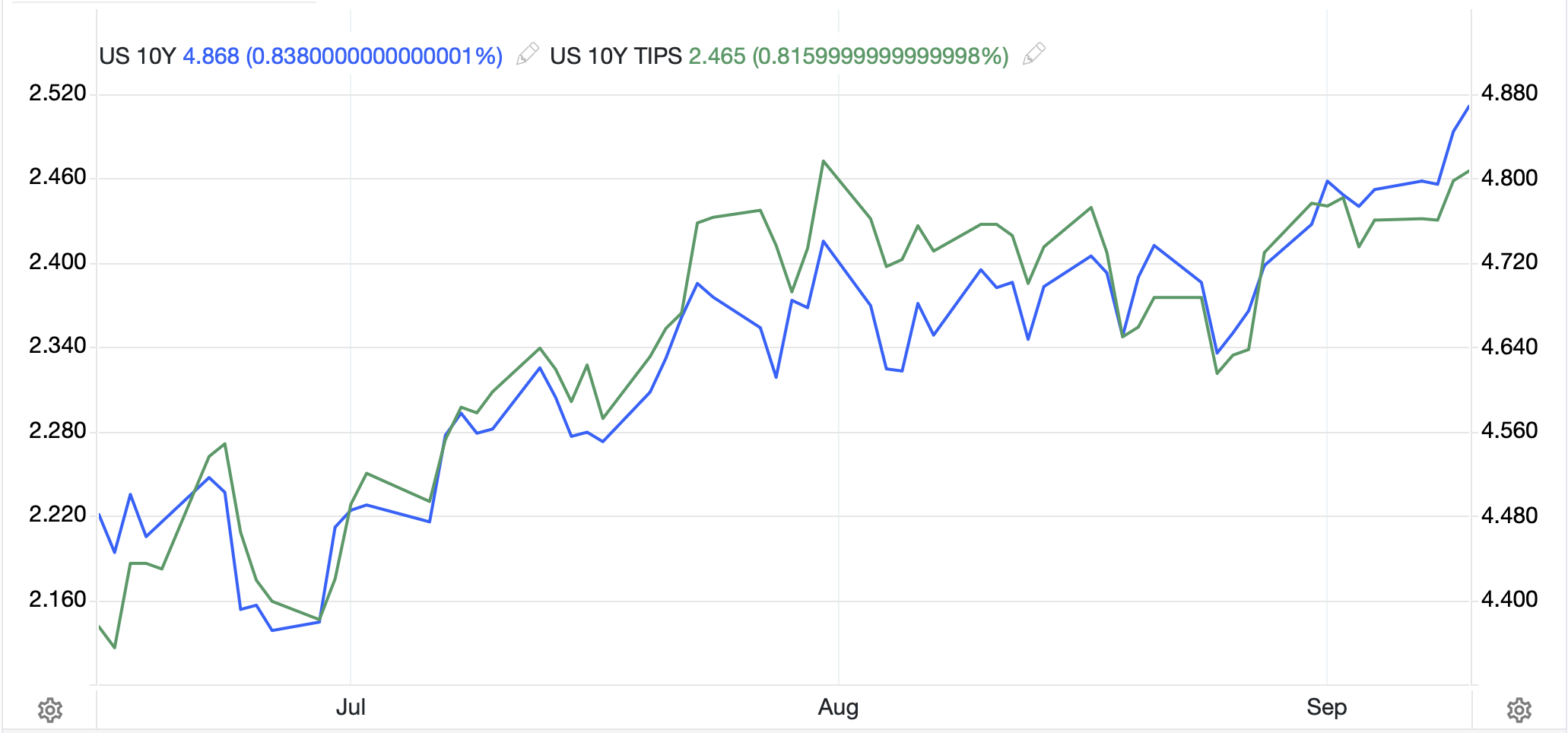
Which brings us to a more important question regarding markets, if there is a new line item in the 2027 budget, $5000 bonuses, how will the bond market respond?  Here the situation is very clear, yields continue to rise.  If you look at the chart below comparing 10-year yields with their counterpart TIPS yields, you can see that inflation is edging higher as a concern (nominal yields are rising more quickly than real yields).
Source: tradingeconomics.com

While I don’t believe this is a direct response to the Trump bonus plan, rather to the ongoing climb in oil and related energy prices, I’m confident the bonus plan is not helping the situation.  

This dovetails nicely with the other key topic of discussion in the market; how the Fed will respond to this information as well as the PPI/CPI data to be released later today and tomorrow.  I chuckled at the WSJ headline, A Tiny Shift in the Inflation Rate Could Decide the Fed’s Next Move as the implication is that if the M/M reading for core CPI is 0.2%, the Fed will stand pat but if it is 0.3% it will hike.  And maybe that is the way things will work out.  But if that is the case, it sure seems to me like they would be missing the forest for the trees.  This is especially so since Chairman Warsh was explicit in that he wanted to see the underlying trend, and as we all know, a single data point does not a trend make.

Currently, the Fed funds futures market is back to pricing a 64% probability of a rate hike next week, although as per the below chart from rateprobability.com, you can see that the Fed appears to be one of the most dovish central banks around.
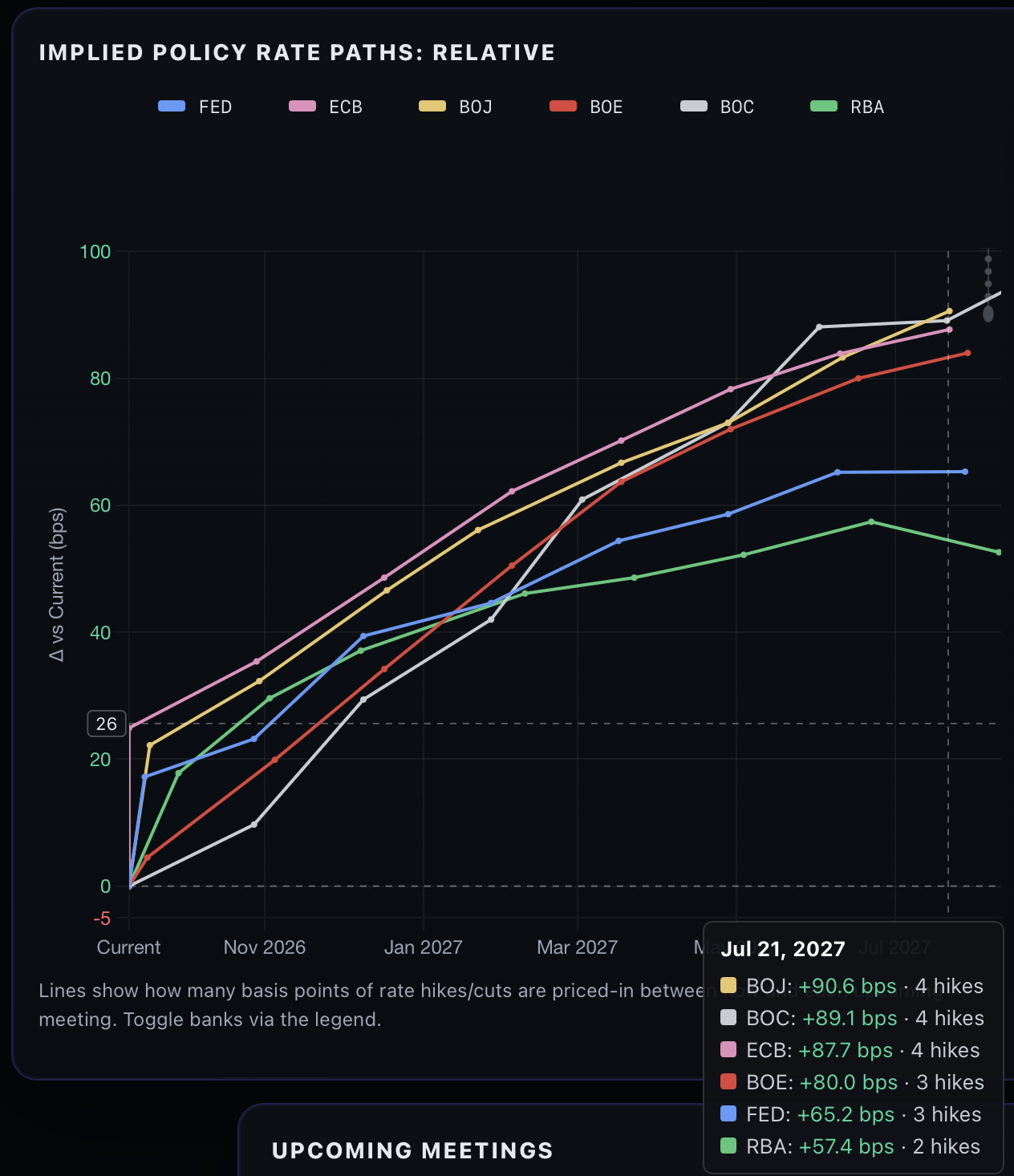
The ECB is virtually guaranteed to hike 25bps this morning and are priced to hike 3 more times during the next 10 months.  I keep wondering how they reconcile a Eurozone economy that is barely growing with hiking rates to reduce demand, and by extension, inflation.  This is where Keynesianism has a really hard time.  In fact, one of the big benefits of Kevin Warsh not having a PhD in economics is that he has never been indoctrinated into that school of thought.

In fact, if you recall Warsh’s first press conference, he lauded the bond market for doing the Fed’s job, raising the cost of funding so the Fed didn’t need to move.  Well, after a lull, the bond market is doing the hard work again.

As an aside, Secretary Bessent’s bond buybacks will take place today and, certainly in no surprise to me, the amount has been increased to $6 billion.  (Remember the ‘at least double’?). In truth, I expect that this program will increase in size each week going forward and ultimately become meaningful with respect to the size of the bond market.  Of course, looking at the bond market’s pricing today, with yields rising another 2bps, the punditry is once again calling out Bessent for not being able to do what he explained.  Funnily, though, they have stopped talking about the yen continuing to decline even though they were quick to dismiss Bessent’s activities there as well.  Personally, I’m going to wait a little longer before I declare the program a success or failure!

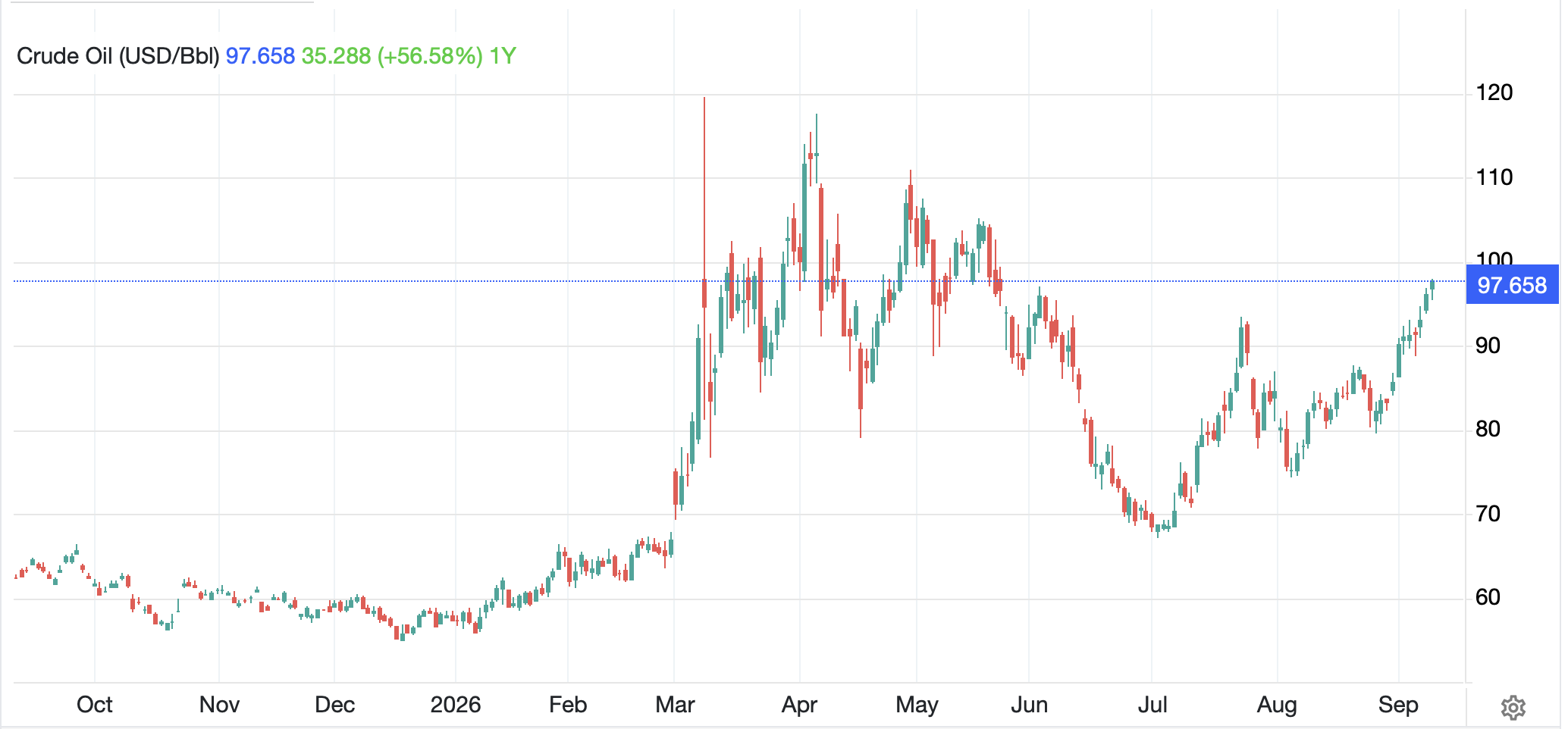
Ok, let’s turn to markets this morning.  Oil (+1.7%) continues to climb as the Iran conflict is showing no signs of cooling off.  It is not hard to see the trend in the chart below, and it is not clear what will alter this trend absent a major change in Iran.
Source: tradingeconomics.com

At the same time, the metals markets are under pressure this morning, with copper (-4.75%) leading the way lower and taking gold (-0.3%) and silver (-2.2%) down as well.  I don’t believe anything has changed with respect to the long-term prospects of metals, but they are quite volatile and always have been.  Copper has been subject to tariffs and the LME – COMEX spread and arbitrage is a key part of the price action there, dwarfing fundamentals right now.

But higher energy prices have weighed on risk appetite everywhere with equity markets struggling in most places around the world.  Yesterday’s US weakness was followed by a general decline throughout Asia (China -0.5%, HK -1.3%, Australia -1.0%, Taiwan -0.5%, Indonesia -1.3%) with only Tokyo (+0.2%) bucking the trend.  The only real news came from Down Under where two RBA members were explicitly hawkish, essentially promising a rate hike at the end of this month and the market has priced in two more going forward, a tightening of expectations.

In Europe, though, despite (because of?) the imminent rate action by the ECB today, equity markets are mixed with some gainers (Italy +0.4%, Spain +0.3%) and some laggards, (UK -0.4%) with Germany essentially unchanged.  There has been no data to alter any views, but I guess we will need to hear what Madame Lagarde has to say later this morning.

Quickly, European sovereign yields are little changed this morning but broadly continue to follow Treasury yields higher and JGB yields (+3bps) bounced after their recent dip.  Recall, I mentioned this pattern yesterday.

Finally, the dollar remains generally quiet, although in the last few hours, we have started to see a bit of dollar strength.  JPY (-0.4%) is edging lower as are NOK (-0.7%) despite rising oil prices and ZAR (-0.45%) because of declining metals prices.  However, most other currencies remain +/-0.1% from yesterday’s closing levels.

On the data front, we get a bunch today.

Initial Claims205K
Continuing Claims1780K
PPI0.4% (5.3% Y/Y)
Core PPI0.3% (4.6% Y/Y)
Existing Home Sales3.98M

Source: tradingeconomics.com

We also see the EIA oil inventory data with a slight draw expected.  I suspect that the ECB is likely to be a nonevent and that PPI, unless it is dramatically different than forecasts, will also have a limited impact.  Oil prices are back in the driver’s seat so we will have to see if this rally continues, or it is, like we have seen in both bonds and yen, speculative driven.

Good luck

Adf
All-Knowing

The war in Iran’s getting hotter
With tankers now under the water
So, oil is climbing
Which right now is priming
A stock market starting to totter

Meanwhile, Scotty Bessent is crowing
Take care ‘bout the shade that you’re throwing
Now, I am the house
And while you may grouse
In markets, I now am all-knowing

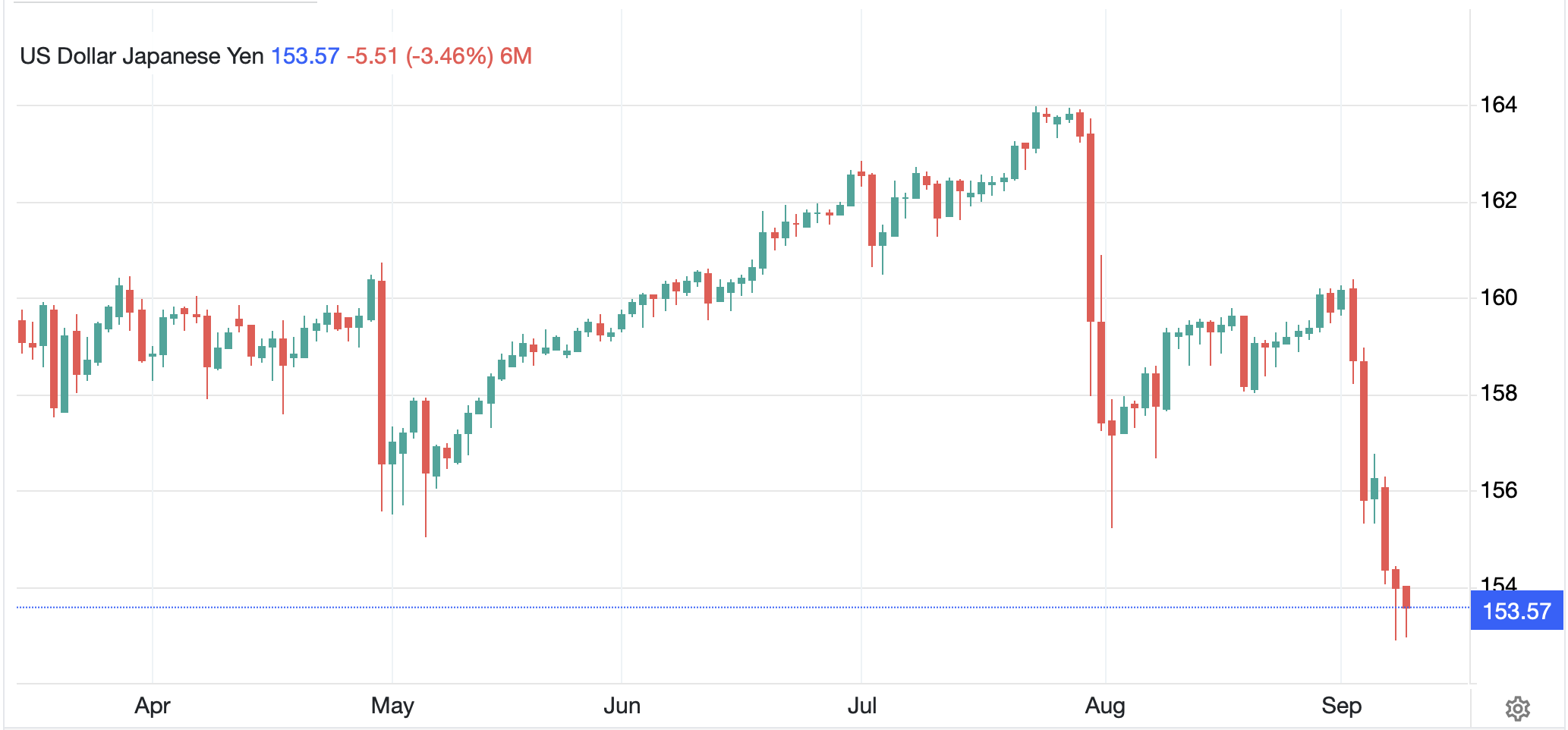
Remember back at the end of July when the MOF/BOJ intervened in the FX markets and the US Treasury was ostensibly right alongside them, selling €13 billion vs. yen, give or take a nickel.  And then, for the next month, the yen behaved as it ordinarily does after an intervention, it slowly crawled lower (dollar higher) as per the chart below.

Source: tradingeconomics.com

So far, so normal.  But something changed a week ago as there has been another significant leg lower in the dollar with no sign of official activity.  The story at the time, which has been neither confirmed nor denied, was that the GPIF was moving funds back into Japan to the tune of several billion dollars’ worth, and that certainly fit the price action.  But that was a one-day event.  And yet, here we are this morning with USDJPY plumbing new lows for the move, more than 2% below levels reached last week.  Something else is happening.

Which brings us to Secretary Bessent.  Yesterday, speaking at an event at SMU in Dallas, he made the following comments, “I am the house now, so when we intervene with the Japanese yen, I have pretty good insight into what the Japanese, what the Bank of Japan is going to do, what Japanese policymakers are going to do.  And you can bet against me if you want.”   On the one hand, those are pretty arrogant comments to come from any politician, especially one who knows exactly the limits of power governments have when it comes to markets.  (Remember, he was instrumental in the trade that broke the pound back in 1992 and forced it out of the Exchange Rate Mechanism).  On the other hand, not only does he understand markets extremely well, he also has a setup where one of the key drivers of the market he is pushing against has been increasing leverage, and leverage is very fragile.  

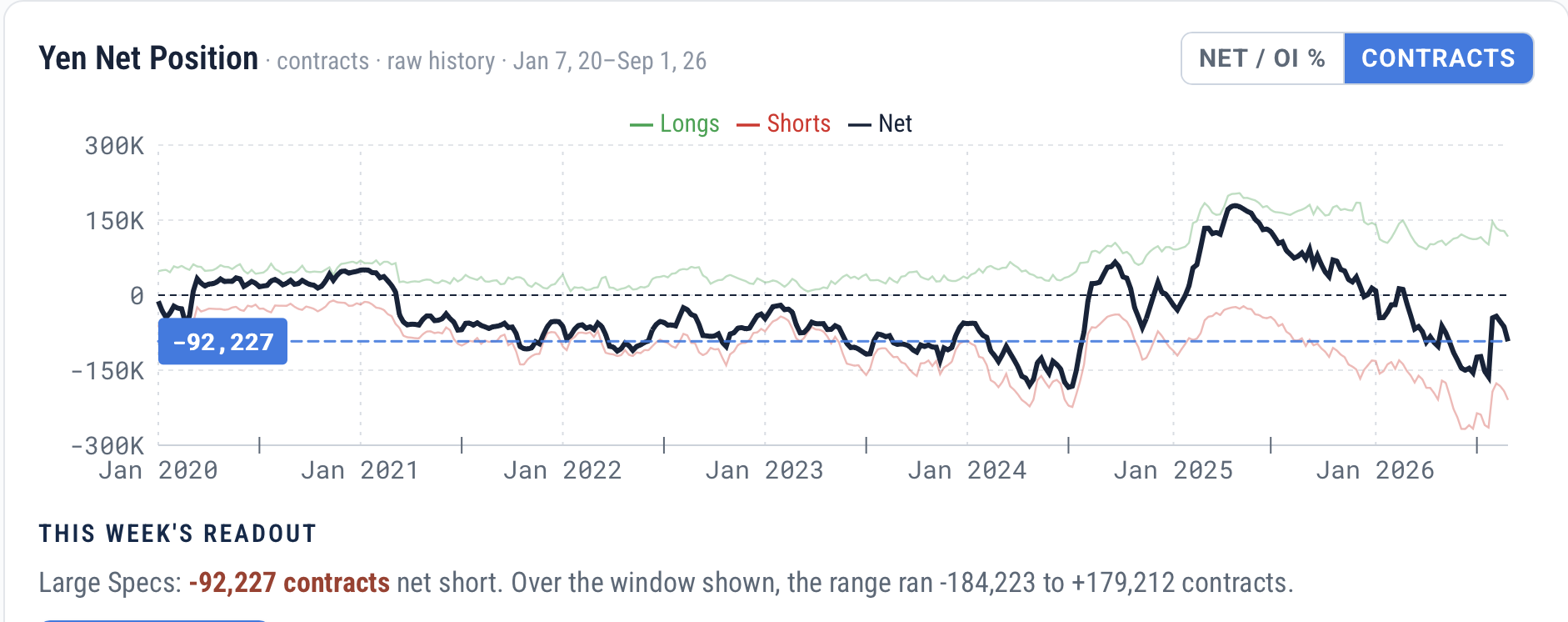
If we look at futures positioning as our proxy, you can see in the below chart from cotsignal.com that there are still quite a few net short JPY futures positions, although those positions have been reduced over the past month.

Remember, too, when looking at currency futures positions, they represent a tiny fraction of the market, <1%, but they do offer directional views.  The point is that the net short JPY trade remains quite large, and if Japanese investors are truly starting to bring their money home, the yen can strengthen quite a bit further.  As an aside, while this may correlate with a sell-off in risk assets, it is important to understand that the causality in this case would be reversed, so yen strength would be the driver, not the risk-off response.  As I wrote yesterday, my take is 140-145 is a viable target, a level that would offer a solid adjustment without necessarily resulting in a major negative response in other risk assets.  We shall see.

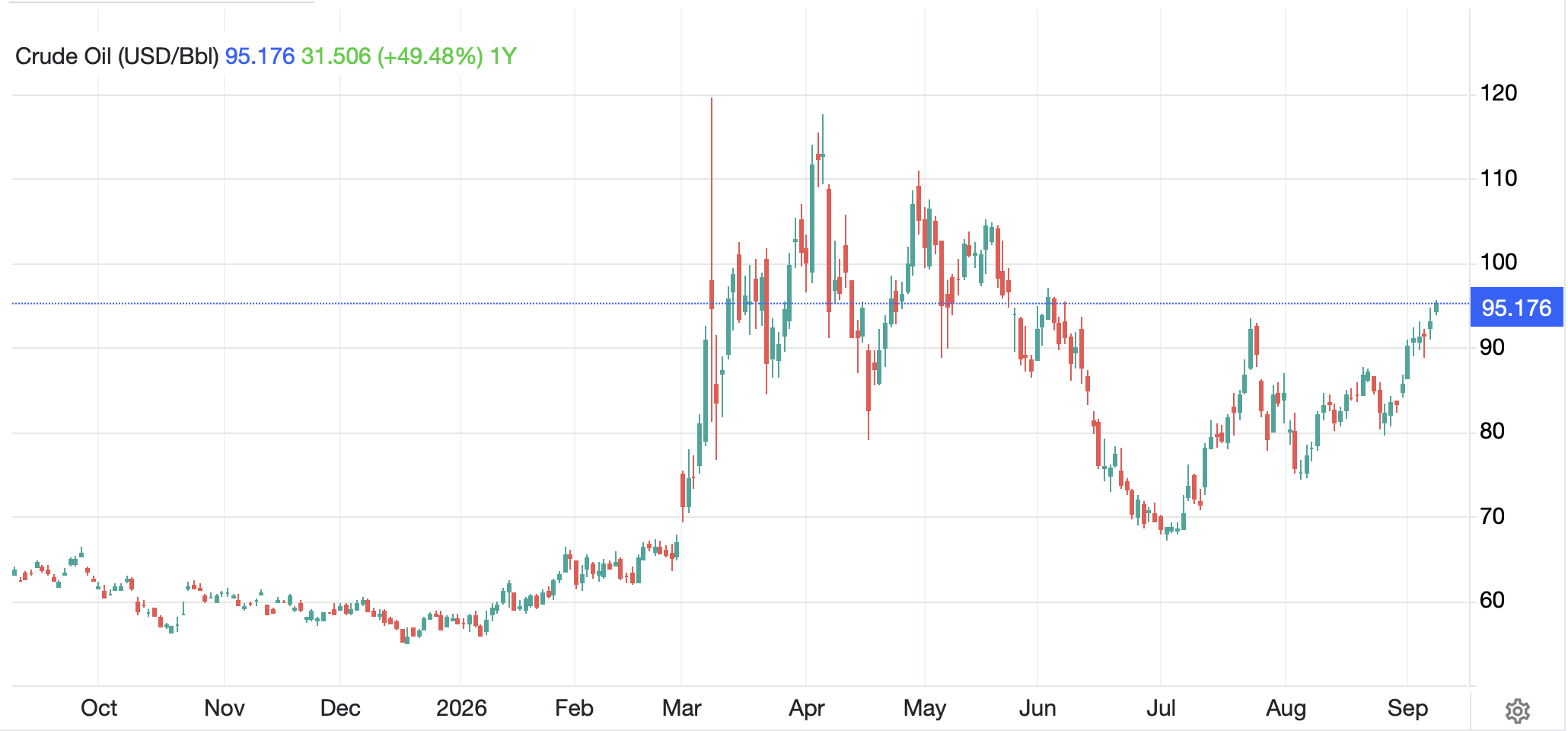
Turning to oil (+2.3%), over the past two months, we have seen WTI rally from a low of $67.0/bbl to today’s price of $95.17/bbl, a 42% climb as per the below chart.

Source: tradingeconomics.com

Clearly things are not getting better in Iran, or Russia/Ukraine, but the former appears to be the proximate cause for this move.  Ostensibly, the US sank three Iranian oil tankers near Kharg Island after the Iranians fired ballistic missiles at two US warships.  The Iranians claimed they hit the ships, the US claimed they didn’t and that is what you would expect to hear.  I have no idea what is true, although it appears to be true that those tankers are sunk.

My two cents, if they are worth even that, is that Iran has decided that if it can force gasoline and diesel prices high enough ahead of the midterm elections, that can serve to weaken President Trump and his resolve in this war if the Republicans lose power.  Maybe yes, maybe no.  Today is the beginning of the Republican mid-term convention in Dallas, a new idea designed to excite the Republican base to get out and vote.  From what I have read, polls remain close in several key states where senatorial elections are going to take place, and both the House and Senate are up for grabs.  This will certainly be the main story for the next two months.

Which takes us to action in other markets.  Equities remain under pressure almost universally.  After yesterday’s weak US performance, Asia had a more subtle performance with only a few markets showing substantial strength (Korea +1.4%) or weakness (India -1.1%, Singapore -0.7%) while the rest of the region saw movement of just +/-0.2% or so.  However, the same cannot be said for Europe, where substantial declines are the order of the day (Spain -2.3%, France -1.7%, Germany -1.5%, UK -0.8%) as rising oil prices, Brent is over $100/bbl, have weighed heavily on profit prospects there.  Too, US futures at this hour (7:10) are pointing lower with declines on the order of -0.5% or so.

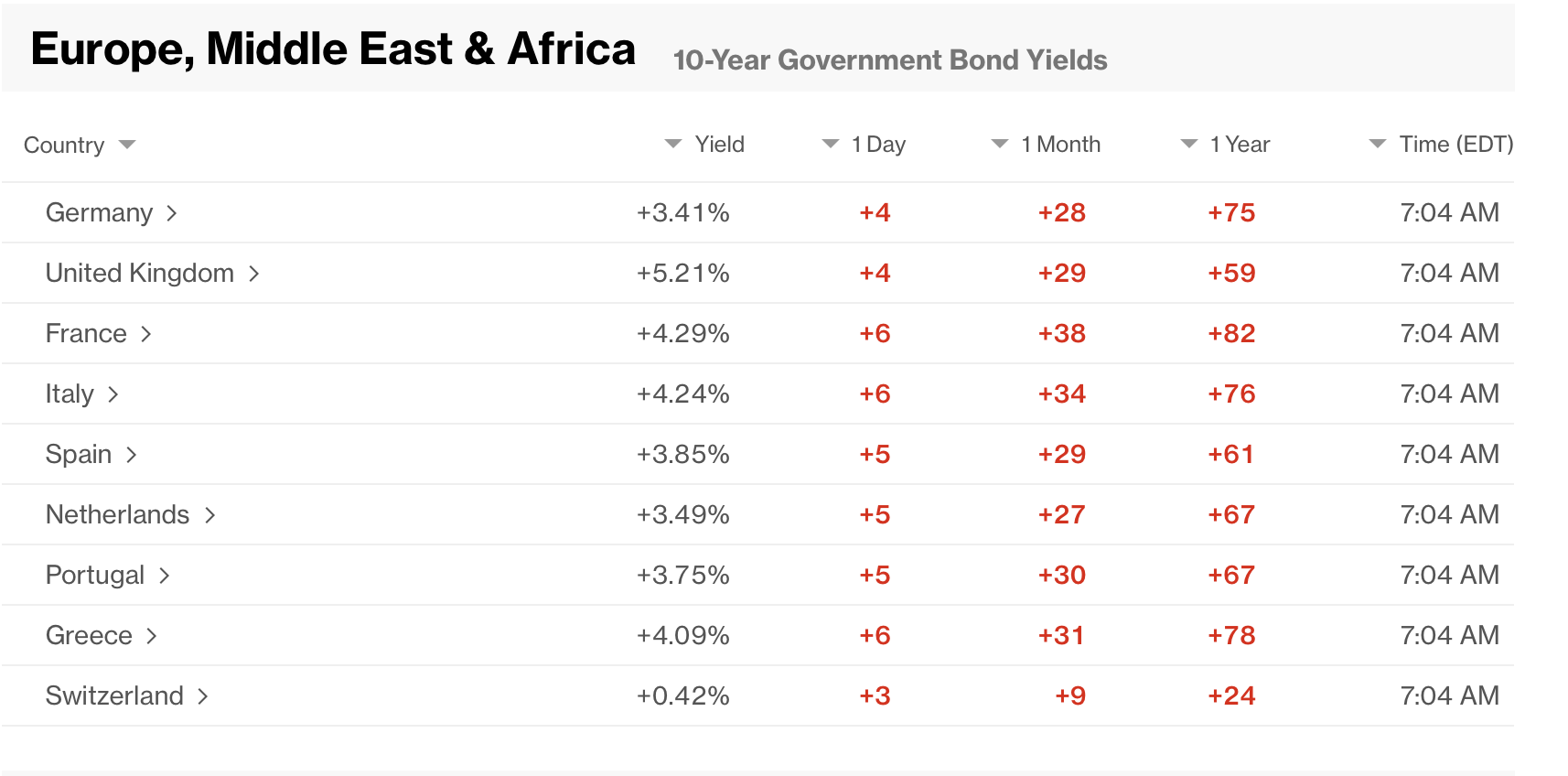
In fact, Europe is having a rough day overall as bond markets there are all under pressure as you can see in the below Bloomberg screenshot.

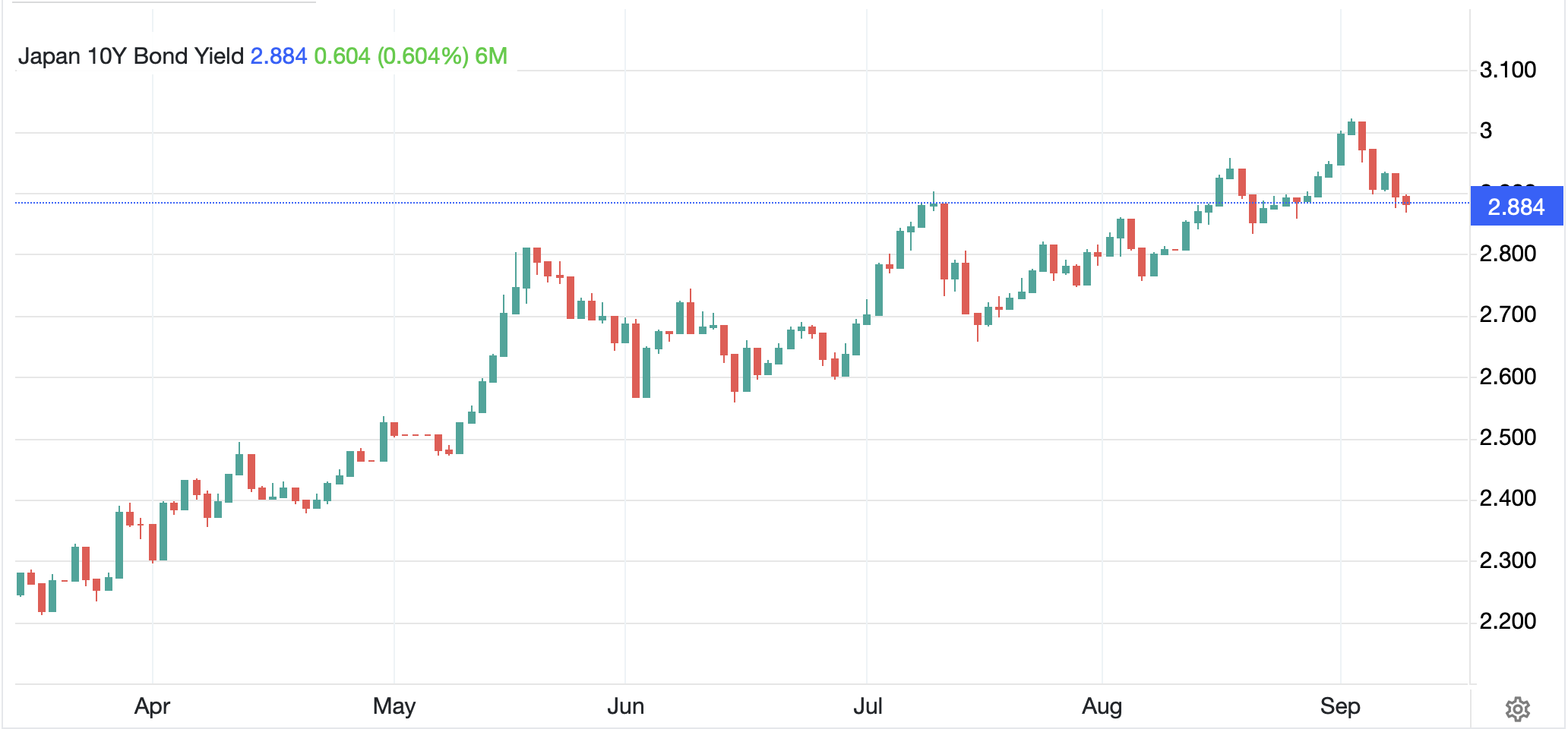
While the ECB is almost certain to hike rates tomorrow by 25bps, it appears bond investors in Europe are seeking a greater commitment to fight inflation.  Alas for Madame Lagarde, the fact that Eurozone growth is hovering just below 1% per annum makes it hard for the Keynesian view of how to fight inflation (raise rates) to help the economies there.  As to Treasury yields, they continue to creep higher, up 2bp this morning at 4.81% and the recent winner continues to be JGB markets, with the 10yr yield there slipping -1bp.  However, before we get too enamored of the JGB price action, a quick look at the chart for the past 6 months shows that we have seen this type of movement, a move higher with a several session retracement, at least eight times during this period.  It could be nothing more than ordinary trading here.

Source: tradingeconomics.com

Looking briefly at the metals markets, gold (+1.1%) is rallying this morning despite the rise in oil, a break from that recent negative correlation, and it is dragging silver (+0.9%) along for the ride.  Copper (-0.8%) however, is not playing the same game.

Finally, the dollar…well away from the yen, the dollar is doing nothing.  The DXY is still hovering either side of 99.0 and other than the yen’s move today, +0.3%, there are really no currencies that have moved more than 10 basis points in either direction.  Right now, FX is secondary except USDJPY.

On the data front, there are no releases and as we are in the Fed’s quiet period, there are no Fed comments on the calendar.  For now, markets are going to maintain their focus on Iran and oil prices and on the yen story.  Absent more headlines in either of those, I see no reason for major excitement today.  But remember, we do get CPI on Friday, so there is still something critical on the near horizon.

Good luck

Adf

Waters, Uncharted

Last quarter, chair Jay set the stage
For yields to go on a rampage
Now, Q4 has started
And, waters, uncharted
Seem dead ahead in this new age

Both oil and dollars are rising
And bond yields worldwide keep surprising
By rising as well
With efforts to quell
Those hikes what CB’s are devising

As we begin the fourth quarter it appears the trends that had been quite clear for most of Q3, rising oil prices, rising bond yields and a stronger dollar, all remain intact. Historically, when this condition has prevailed, it has been a negative, and frequently a very large negative, for risk assets.  This begs the question, is something going to change or is it different this time?  Now, we all know that it is ‘never’ different this time, the cycles of financial markets have repeated constantly throughout history with pretty clear causes and effects.  In the current circumstance, the combination of these three indicators rising simultaneously is going to reduce the ability of non-USD economies to access necessary commodities as their prices are rising even more in local terms than in dollar terms, and the rise in interest rates is forcing them to pay more interest on their outstanding debt.  And every developing country has lots of outstanding debt, so this is a universal issue.

If we work under the assumption that this time is NOT different, then the question is, what is going to change and when might that occur?  This goes back to the idea that the Fed will raise rates until something breaks.  As of now, while a few things have broken (UK insurance companies, some regional US banks, Credit Suisse) it appears the economy continues to perform at a higher level than virtually everybody had anticipated it could.  As of yet, the most highly anticipated recession in history has still not occurred.  In fact, the soft-landing narrative, where the Fed manages to reduce inflation without pushing the economy into recession, has become the consensus view (alas this poet disagrees with that view and fears a much deeper recession is coming our way.)

So, what might change?  Well, last night the BOJ indicated that they are going to be performing an extra round of JGB buying in Q4 as they are growing increasingly concerned about the rise in JGB yields.  Last night, 10yr JGB’s moved up to 0.76%, after touching 0.775%, the highest level in more than a decade.  So, more QE is a clear possibility.  Now, we all know that the Fed is continuing its QT process, having reduced its balance sheet by a shade under $1 trillion so far and claiming they will continue to allow bonds to roll off without replacing them for quite a while yet.  The ECB is also engaged in this process and the BOE actually increased its target, now planning to sell £100 of gilts in 2024, up from the previous amount of £80 billion.  Will the central banks be able to continue these policies if the economy does tip into recession?  I think not, but they have maintained that the balance sheet issue is separate from their policy framework.

A direct impact of the QT programs is that bond yields are rising because of the absence of demand from what had been price insensitive buyers (aka central banks) which forces the private sector to absorb all the new issuance and they are requiring higher yields to take the paper.  Given the extraordinarily high levels of debt that exist, both on government and private balance sheets, it certainly seems like we might soon reach a breaking point here.  However, until that point is reached forcing a reversal in central bank views regarding their balance sheets, I anticipate yields will continue to rise.

The direct corollary to rising yields, especially rising Treasury yields as they are leading the way, is that the dollar is following along for the ride.  If you are looking for the dollar to reverse course, you are, almost by definition, looking for the Fed to reverse course.  Yet, there is no indication that is the case.  In fact, the only central bank that has demonstrated they are willing to end the tightening cycle is the BOJ, and let’s face it, they haven’t really started a tightening cycle, the market is simply anticipating that one is coming soon.

Oil, meanwhile, remains exogenous to the central bank story and is an OPEC story.  The poohbahs there meet this week in Vienna but there is no expectation of a change in their current production policy.  This means that the supply of oil is unlikely to rise anytime soon while demand, given the more robust than expected economic activity, continues apace.  Nothing has changed this story that a decade of misguided ESG policies has created a structural supply deficit of oil and the price is destined to continue to rise going forward.

Alas, the upshot of this set of conditions as we enter Q4 remains risk assets are likely to remain under pressure until whatever that something is finally breaks and the central banking community, notably the Fed, changes their tune.  Keep your ears peeled for that change in tune.

Now to today’s markets, where equity markets in Asia that were open, notably Japan, were a bit softer while China is on their Golden Week holiday so markets are basically closed all week.  That said, we did see their PMI data released on Friday night and Saturday and it was slightly stronger than expected, and for the first time since March, all the readings were above 50.0, albeit just barely.  Nonetheless, a positive sign.  As to Europe, weakness across the board is the description of the day, with the major bourses lower by between -0.3% and-0.6%.  US futures, which had been barely positive earlier in the evening session, are now slightly softer as well, -0.3% or so at 8:30.

Bond yields are rising again with Treasuries higher by 6bps and back above 4.60% while the bear steepening continues with the 2yr-10yr spread now “just” -47bps.  As well, throughout Europe we are seeing sovereign yields rise about 3bp-4bp across the board as this trend of still high inflation, rising oil prices and ongoing QT is working its ‘magic’.

Speaking of oil, it is back on the rise with WTI up 0.5% and above $91/bbl this morning as we have seen consistent drawdowns in inventory for the past several months as the OPEC supply cuts have really started to bite.  One thing that we need to keep an eye on going forward is NatGas, which as we come into winter and the colder weather, could well see a lot of upward pressure, especially in Europe.  Looking at the metals markets, the combination of rising prices in oil, yields and the dollar is really starting to weigh on this sector with gold down another -0.75% and getting closer to $1800/0z, down more than 5% in the past month.  Copper (-1.6%) and aluminum (-0.3%) are also under pressure today and both are feeling the weight of developing downtrends.

Finally, the dollar, which sold off slightly on Friday into month-end, has reversed course and is stronger across the board this morning with the DXY up 0.35% while some outliers are ZAR (-1.1%) and MXN (-0.7%), both suffering from the strong dollar disease.

On the data front, the PMI data from Europe was still awful, with Germany still sub 40.0 and the Eurozone at 43.4.  As to the rest of the week, we get important things culminating in Fridays NFP report.

TodayISM Manufacturing47.7
 Construction Spending0.5%
TuesdayJOLTS Job Openings8.83M
WednesdayADP Employment160K
 ISM Services53.6
 Factory Orders0.3%
ThursdayInitial Claims210K
 Continuing Claims1678K
 Trade Balance-$64.6B
FridayNonFarm Payrolls163K
 Private Payrolls160K
 Manufacturing Payrolls5K
 Unemployment Rate3.7%
 Average Hourly Earnings0.3% (4.3% Y/Y)
 Average Weekly Hours34.4
 Participation Rate62.9%
 Consumer Credit$12.5B

Source: Tradingeconomics.com

As well as all this, we hear from nine different Fed speakers across eleven events including Chairman Powell this morning at 11:00am.  And that is just what is on the schedule, I expect we will hear some BBG interviews or things like that as well.  

The question remains, is something going to change, either because of the data or the tone of Fed speeches?  There is no indication the Fed is changing their attitude and I expect that will remain the case until the data changes.  I have maintained for more than a year that the NFP report is critical to Powell and friends as it is their CYA document.  As long as the Unemployment rate remains lower than 4.2% or so, and NFP is positive, nothing will deter them on their mission against inflation.  And that means the dollar will remain underpinned.

Good luck

Adf

Like Goldilocks?

For assets so safe and secure
It seems bonds have lost their allure
Yields worldwide are rising
And it’s not surprising
Since ‘flation, we all must endure

The question is, what about stocks?
Are they set to soon hit the rocks?
Or will they remain
Resistant to pain
If growth behaves like goldilocks?

Certainly, yesterday was a pretty bad day for risk assets as equity markets in the US sold off aggressively along with commodities.  The thing is it was a pretty bad day for haven assets as well with Treasury yields rising sharply.  And right now, just before 7:00am in NY, those trends remain intact.  In fact, the only thing that seemed to perform well yesterday was the dollar.

So, what gives?  Many will point to the downgrading of the US credit rating by Fitch as the proximate cause of things, and it may well have been an excuse for some selling, but despite the logic I detailed yesterday, the impact on markets should be di minimis.  After all, Treasuries are used for two things largely, either as investments in their own right, or as collateral for other financial transactions.  Regarding the first point, nobody is actually concerned that the US will not repay their debt, so if the yield is attractive, investors will still buy them.  As to the second point, this could have been an issue but since the S&P downgrade in 2011, collateral agreements have been rewritten to accept not only AAA securities, but also US government securities, with no mention of their rating.  So, there is no change in the collateral situation.

If it was not the downgrade, then what has driven the recent upheaval in markets?  Arguably, this has been building for quite some time and was looking for a catalyst to get things started.  I think there are two ways to consider the situation.  For the bears out there, watching equities rally daily despite what appeared to be softening margins along with tightening monetary conditions didn’t make sense.  But the rally has been so relentless that the bears have largely capitulated on their views.  It seems the key lesson is that the timing of monetary policy transmission is much slower than it had been in the past, or at least that’s what it feels like, and so despite the Fed’s aggressiveness, it hasn’t had nearly the impact anticipated.  

To this point, remember, while the Federal government didn’t take advantage of ZIRP to term out its debt, homeowners and corporations did just that.  This has resulted in a lot of borrowers with a long runway before needing to refinance their debt and left them somewhat impervious to the Fed’s recent moves.  We have all heard that > 50% of mortgages outstanding are at rates < 4.0%.  This has resulted in an unwillingness to move and reduced existing home inventories and sales.  But all those people have not been impacted by the rate hikes, at least not on their largest single interest payment.  And the same has been true for many corporations who termed out their debt in 2020-2021 and even the first half of 2022.  While much of that debt will eventually be refinanced, it may be another 5-7 years before we start to see companies feel any stress there.  Consider, too, how this has helped lower rated companies, who, if forced to refinance today would see yields in the 8%-12% range but were able to borrow at 5% or less.  Of course, that debt was likely 5-year tenor, so that comeuppance is likely to arrive in 2025 or 2026.  And maybe that is when we should be looking for the first real problems.

The Fed’s Loan officer survey showed that conditions are continuing to tighten in the bank market, which means that smaller companies are going to be stressed, but the large cap companies that issue debt directly are sitting pretty.

Therefore, if it is not the downgrade, what other reasons could there be?  The first thing to remember is that there doesn’t have to be a specific reason for markets to sell off.  Markets that are overbought (or oversold) can reverse without any particular driver.  Historically, August has been a more volatile and weaker month for equities, often attributed to vacation schedules, with investors and traders both taking their summer trips and leaving skeleton staffs of junior people on the desk.  This will result in reduced liquidity and any outside selling impetus can have an overly large impact.  Remember, though, a rational look at equity markets indicates that on a historic basis they remain quite richly valued with the Shiller Cyclically adjusted P/E ratio at 31.1, well above its long-term median of 15.93.  However, what is typically true is that when an overvalued market starts to correct, it can continue doing so for quite some time until it reaches a more rational valuation.  If the bears have all given up, and the bulls are all on vacation, who is left to buy things?

All this is to say that, while the recent equity market weakness may not make sense specifically, there is nothing to say that it cannot continue for a while yet.  Turning to bonds, though, that is a different story.  Yields around the world are rising and, in many cases, rising sharply.  While the BOE just raised rates 25bps this morning, as largely expected, they are simply catching up to the rest of the G10.  However, 10-year Treasury yields are +6.7bps as I type (7:20) and now trading at 4.14%, their highest level since last October.  My sense is that this move is all about two things, concerns that inflation has seen a local bottom and the dramatic increase in supply just announced by the Treasury.  As discussed yesterday, yields above 4% have led to things breaking, so the question is what is set to break now?  Perhaps, the stock market selling off will be this breakage, or perhaps there will be some other crisis that flares up.  Maybe another large bank going to the wall, or a large corporate bankruptcy in a key sector.

We have discussed rising oil prices and you are all aware of rising gasoline prices every time you go to fill the tank.  Headline CPI, when it is released next week, will be well above last month’s 3.0%.  Too, yesterday’s ADP Employment number was much stronger than expected for a second consecutive month.  If the no landing scenario is correct, then inflation is likely to remain far more stubborn than currently expected and Chairman Powell will not be thinking about thinking about cutting rates any time soon.  In fact, at this point, if the Fed starts to think about cutting rates, that likely means that the economy has reversed course and is clearly headed into a recession.  Be careful what you wish for.

Summing up, I would be wary of reverting to the buy the dip mentality that has prevailed for more than a decade.  The underlying economic and financial situation is changing pretty quickly and that implies previous strategies may not perform that well.  Do not forget last year’s market performance.

I would be remiss if I didn’t mention that the BOJ was back in the market again last night, buying an unlimited amount of JGBs as they try to smooth the rise in JGB yields, which are now up to 0.65%.  This did help the yen a bit, which has rallied slightly on the day, but overall, the dollar remains much stronger.  My take is that we are seeing investors who are uncertain about the medium and long term, buying dollars to buy T-bills, earn a nice piece of interest and reconsider their next move.  One thing to note is that the yield curve’s inversion is lessening quite quickly.  Last Monday, the inversion was -104bps.  This morning it is -75bps.  That is a remarkably fast move in a short time.  It also implies that the demand for 10-year Treasuries is a little soft right now.  As I have written, this inversion could resolve with higher long rates, not lower short rates, and that is not something for which the market is prepared.  I believe that would be a clear equity negative.

There is a lot of data this morning starting with Initial (exp 225K) and Continuing (1708K) Claims, Nonfarm Productivity (2.3%), Unit Labor Costs (2.5%), Factory Orders (2.3%) and then ISM Services (53.0) at 10:00.  But this is all a lead-up to tomorrow’s NFP data.  Fed speakers have been fewer than usual, but we do hear from Richmond’s Thomas Barkin this morning.  I see no reason to believe that there will be any new dovishness upcoming.

To my mind, yields are going to continue to rise, equities are going to remain under pressure and the dollar, overall, is going to remain stronger rather than weaker.  We will need to see big changes in the data to change that view.

Good luck

Adf

Nowhere Near

Charles Evans, on Tuesday, explained
Inflation can well be contained
In fact, his concern
Is prices could turn
Back lower ere targets are gained

“I’m going to be very regretful if we sort of claim victory on averaging 2% and then we find ourselves in 2023 with about a 1.8% inflation rate, sustainable, going forward. That would be a challenge for our long-run framework,” he [Evans] said. “We ought to be willing to average inflation above 2%—frankly, well above 2%. [author’s emphasis]”

One cannot overstate the hubris associated with the above quote from Chicago Fed President Charles Evans.  The fact that he legitimately believes the Fed’s powers are such that they can fine-tune a $24 trillion economy to the point that measured estimates of particular features of that economy are able to be managed to a decimal place of an annualized percentage outcome is extraordinary.  It is the perfect illustration of the fact that the Fed is completely out of touch with the economy in which you and I live and completely ensconced in a model driven framework where data represents reality.  But it is exactly this hubris that has resulted in the policy decisions that have brought the world negative interest rates and a defense of debt monetization.  As long as central bankers, notably the Fed, continue to believe that their models are the economy, rather than a simplified representation of the economy, they are likely to continue to make decisions with significant unintended consequences from which we all will suffer.

This morning the market awaits
The latest inflation updates
What’s patently clear
Is they’re nowhere near
An outcome to end the debates

Speaking of inflation, this morning brings the latest CPI data with expectations running as follows: Headline (0.5%, 5.3% Y/Y) and ex food & energy (0.4%, 4.3% Y/Y).  Both of those forecasts are slightly lower than the prints seen in July, and if realized, you can be sure that we will hear a chorus of FOMC members highlighting the transitory nature of inflation.  Of course, if the outcomes are higher than forecast, something we have seen in each of the past twelve reports, we will also hear a chorus of FOMC members explaining that this remains a temporary phenomenon and that inflation is transitory.  [Perhaps when Ralph Waldo Emerson wrote in 1841, “a foolish consistency is the hobgoblin of little minds, adored by little statesmen and philosophers and divines,” he was anticipating the Fed.]  However, financial markets may not be quite as sanguine over the results, especially if they continue their year-long streak of outperforming the median estimate.

Markets, of late, have been starting to discern between those products that will benefit from altered policy and those products that will suffer.  Nowhere is this clearer than in the US equity markets where we have seen the NASDAQ underperform its brethren indices.  Recall, given the NASDAQ’s strong bias toward high growth (and low profit) companies that benefit greatly from extremely low interest rates, the index behaves very much like a very long-duration bond.  So, in a scenario where inflation is rising and market expectations are for tapering of asset purchases to begin soon(ish), it should be no surprise that the NASDAQ falls alongside the price of bonds.  At the same time, if the implication is that rising inflation is being caused by rebounding growth, rather than supply-chain blockages, there is an opportunity for more mundane, value-type companies to outperform.  Hence, the differing performance of the DOW vs. the NASDAQ.
Of course, the place where inflation is likely to have the most direct effect is the bond market, where long-term yields are theoretically supposed to reflect inflation expectations.  And while we have certainly seen yields rise over the past week, there is no way they currently reflect those expectations.  They cannot do so as long the Fed continues to buy all the new issuance, and then some, thus artificially driving up prices and driving down yields.  Ask yourself this, does it make sense that US 10-year yields are at 1.36% if inflation is at 5.4%?  Of course, the answer to that is a resounding ‘No!’  Yet, that is the current situation.  To observe the bond market and believe it is not artificially inflated (everywhere in the world, mind you) is akin to believing that the moon is made of green cheese.  It just ain’t so!

At any rate, ahead of this morning’s CPI release, investors have generally been biding their time as they wait to determine if they need to adjust their world view.  Equity markets are generally a bit firmer as Asia mostly eked out some gains (Nikkei +0.6%, Hang Seng +0.2%, Shanghai 0.0%) with Europe following suit (DAX 0.0%, CAC +0.3%, FTSE 100 +0.5%).  US futures are split with the NASDAQ (-0.2%) slipping following yesterday’s losses, while the other two main indices are essentially unchanged.  All in all, it appears that there is some hope that CPI prints on the low side to allow the Fed narrative to continue apace, and therefore to allow rates to remain lower for longer.

Bond markets, though, are starting to get a bit antsy these days with Treasury yields edging higher again (+1.7bps) with similar type gains seen throughout Europe (Gilts +1.4bps, OATs +1.8bps, Bunds +0.8bps).  At this point, 10-year Treasury yields have risen 0.25% in the space of a week, which is a very substantial move, especially when considering that the base at the beginning was just 1.12%.  One has to believe the Fed is watching extremely closely as they do not want to see the market run too far ahead of their mooted tapering and create Taper tantrum #2 inadvertently.  It is here where a higher than forecast CPI print could have quite an impact and which may force the Fed to reconsider the idea of tapering.  After all, they cannot afford for 10-year yields to rise to 2.0% while they are still purchasing $120 billion per month of paper.

Commodity prices are mixed today with oil (-1.1%) feeling the pressure of higher yields while gold (+0.5%) seems to be ignoring that same pressure.  Of course, gold was just subject to a significant sell-off, so this could easily be a simple trading bounce.  As it happens, both agricultural and base metal prices are showing a mixture of gainers and losers and no real underlying theme.

Finally, the dollar is definitely stronger again this morning.  While the movement vs. its G10 brethren has not been large, it is unanimous, with all currencies in the red today.  A particular shout-out goes to the euro, which is trading just pips from the key support level of 1.1704.  Watch that carefully as a break there is likely to open up much lower levels.  In the emerging markets, KRW (-0.6%) has been the laggard, followed by TRY (-0.5%) and HUF (-0.4%).  The won has been suffering from a combination of rising covid cases, with a record high 2200 reported yesterday, which has been encouraging the liquidation by foreign investors of Korean equities.  Meanwhile, TRY is under pressure as traders are concerned the President Erdogan will once again interfere in the central bank’s business and prevent them from raising rates at tomorrow’s meeting.  Finally, the forint seems to be suffering for the sins of its neighbors as concerns over German growth, a key market, and Polish politics, a close neighbor, have encouraged selling.

And that’s really it for today.  All eyes will be on the CPI at 8:30. More than just watching the tape, I always pay attention to @inflation_guy on Twitter as he does an excellent job breaking down the drivers of the number and offering insight into how things may evolve.  I highly recommend following him.

As to the dollar, the slow grind higher continues and as long as US rates are rising, I think so will the dollar.  If we break the 1.1704 level in the euro, look for a bit of an acceleration.  But don’t be surprised if we reject the move given it is the first test of the support level since it was established back in March.

Good luck and stay safe
Adf