
Depths We May Plumb

The PMI data was soft
Which helped keep stock prices aloft
As many now think
That yields will soon sink
And, therefore, stock prices have troughed
 
But really, the data to come
Is much more important to some
‘Cause if PCE
Is still on a spree
Then many more depths we may plumb


First two mea culpas on yesterday’s note.  Clearly, the ECB is considering a cut, not a hike as I mentioned inadvertently at one point and my info on the timing of Alphabet’s earnings release was incorrect, it was not yesterday but is due tomorrow.

Markets remain generally comfortable with the current situation as all eyes continue to be on Friday’s activity.  Remember, not only do we get the PCE data in the US, but before NY walks in, the BOJ will have met and announced any potential policy changes (unlikely) but hinted at future moves (more possible).  However, until then, quarterly earnings and secondary data are all we have.

This brings us to yesterday’s activity where the US Flash PMI data was weaker than expected in both Manufacturing (49.9) and Services (50.9) while both were anticipated to print at 52.0.  Of course, in a world of rising rates and concerns that the Fed is going to become yet more hawkish when they meet next week, weak data is seen as a potential cure.  The result was a rally in stocks and bond prices (yields fell), albeit not a very dramatic one.  After the equity market close, Tesla reported their earnings and while they were softer than the median analyst expectations, it appears they beat the whisper numbers and Elon said enough things to encourage a rebound in the company’s share price.

Now, you know that if I am discussing Tesla earnings, there is absolutely nothing going on in the markets.  So, let’s turn our attention to something a bit longer term, and quite speculative, but important if it comes about.  I am referring to the story that is getting more traction regarding Robert Lighthizer, who was President Trump’s trade advisor for the entire term, and who recently has discussed the goal of weakening the dollar if Trump is re-elected.  

One of the things that annoys me is that so many political hacks players believe that they can drive market prices without making major underlying policy changes.  And, generally speaking, they recognize that changing the underlying policies is either out of their hands or would cause other, more serious problems even if they were achieved.  This is a perfect example of that type of thinking.

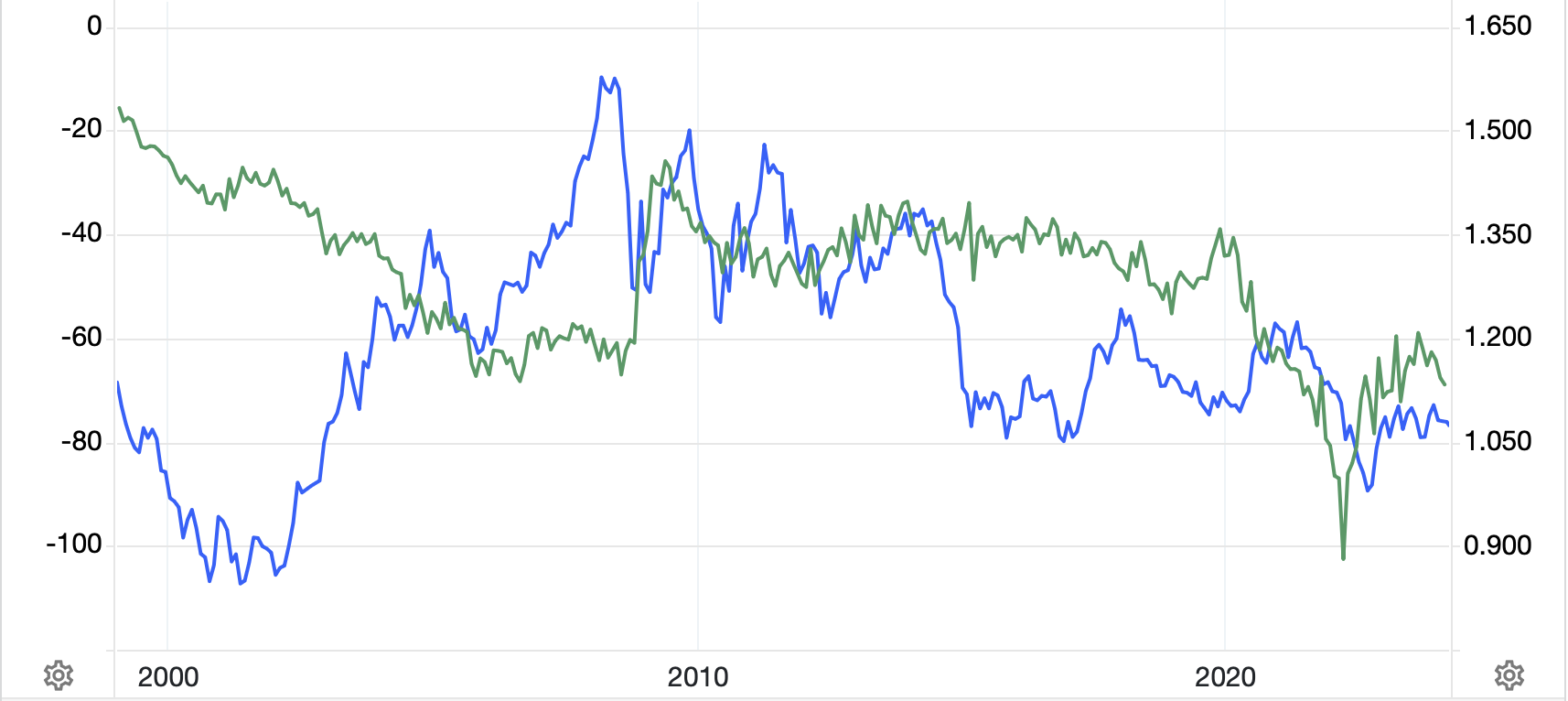
The underlying issue, I believe, is the Trump focus on the trade deficit as being a crucial indicator and something about which the US should be overly concerned.  Let’s start by looking at a history of the dollar’s value (as measured by the EURUSD) compared to the monthly trade balance.
Source: tradingeconomics.com

The green line, based on the left-hand axis, is the trade balance while the blue line, on the right-hand axis, tracks the EURUSD exchange rate.  The first thing to see is that there is not a very strong relationship.  In fact, the R2 is just 0.07, so virtually no relationship.  However, in your old finance textbooks, there is a theory that a weaker exchange rate improves the trade balance at the expense of increasing inflation.  And that certainly makes sense, but I believe that relationship is more representative of countries whose currency is not the global reserve currency.  In the current situation, the dollar’s movement is dependent on many other things, and the trade balance is more frequently an indicator of the strength of the US economy.  After all, when things are going well, we are importing much more stuff than we can produce and so the trade balance turns more negative.  Looking at the chart, the periods when the trade deficit shrank (rising green line) are the same periods when the US was in a recession.

The other problem for a Trump administration that is seeking to weaken the dollar is that the other consequences of the policy actions that would likely lead to a weaker dollar will not be welcomed.  First, and foremost, we will see inflation rise pretty rapidly as not only import prices, but also commodity prices would all move much higher.  The other likely outcome would be an increased reticence for foreigners to hold US assets overall, as a declining dollar will reduce their value in local currency terms.  Right now, the US equity markets represent nearly 70% of global equity market assets in value.  That has been a virtuous circle of foreign buyers of US assets driving prices higher and the dollar higher as US deficit spending drives growth.  But that can certainly turn into a vicious cycle of a weakened dollar driving sales of US assets by foreigners, leading to falling equity prices and a reduction in that percentage of global market cap.  And one thing we know is that Mr Trump is very concerned with the value of the stock market, so a falling one would be seen as a big problem.

I raise this issue because it is getting more press and will impact the narrative, especially as we get closer to the election.  While I don’t believe that the US has the ability to unilaterally weaken the dollar ceteris paribus, I would not be surprised to see this topic gain in mindshare and have an impact for a while.

The reason I focused on this is there has still been very little else to consider.   Right now, everybody is happy as equity markets have rebounded around the world following yesterday’s US rally while bond yields, which dipped yesterday, are rebounding this morning by between 4bps and 6bps.  Both of these are indicators of economic strength.

In the commodity markets, yesterday’s oil rally on the back of a much bigger inventory draw than expected, according to the API, is moderating this morning while metals prices, seem to be finding a bottom after their recent correction.  Given how far and how fast metals prices rose over the past several weeks, a correction was overdue, and welcome to markets as things are now set for the next leg higher, I believe.  Nothing has changed my view on this story.

Finally, the dollar is firmer this morning after a modest decline yesterday on the back of the rates selloff.  In fact, some currencies are under more substantial pressure like SEK (-0.75%) and NOK (-0.75%) although those are the largest movers on the day.  Perhaps the biggest news is that USDJPY finally breached the 155.00 level and now has its sights set on 160.  I expect that we will hear much more talk tonight from MOF speakers regarding the yen, but I see no reason to believe the BOJ will act because of this move.  However, as I mentioned last week, for all you JPY asset and revenue hedgers, I would be using JPY puts here, either purchased or in collars, because I suspect we will see a sharp decline on any intervention, and that day is drawing closer, I fear.

On the data front, Durable Goods (exp 2.5%, 0.3% ex transport) is this morning’s release and then the EIA oil inventory data comes later this morning.  And that’s really it.  Tomorrow, we have more data, Initial Claims, and Q1 GDP, and then, of course the PCE on Friday.  But for now, it’s still an earnings driven market I think.  So macro is on the back burner till Friday.

Good luck

Adf

Worse Than Just Sloth

With payrolls on everyone’s mind
The overnight range was confined
The bulls live in fear
That job growth’s still clear
While bears worry payrolls declined

But, looking beyond NFP
There’s something the bulls fail to see
Liquidity’s growth
Is worse than just sloth
It’s shrinking to quite a degree

Before I start this morning, please know I will be on vacation next week so there will be no poetry again until the 16th.

Now, to start this morning, all eyes are on the payroll report where the market is definitely in the ‘bad is good’ frame of mind.  Median analyst expectations are as follows:

Nonfarm Payrolls170K
Private Payrolls160K
Manufacturing Payrolls5K
Unemployment Rate3.7%
Average Hourly Earnings0.3% (4.3% Y/Y)
Average Weekly Hours34.4
Participation Rate62.9%

Source: tradingeconomics.com

We know that Wednesday’s ADP number was quite weak, and we know that Tuesday’s JOLTS number was quite strong.  Yesterday’s Initial Claims data was also a harbinger of strength with the weekly number falling to 207K.  If we look at the ISM employment sub-indices, both showed relative strength with the Manufacturing number rising above 50 for the first time in 5 months while the Services employment index remains at a healthy 53.4 level.  Much of what I have read over the past several weeks has focused on the idea that companies are still reluctant to lose employees as they remember how difficult it was to hire post the Covid fiasco.   I have a funny feeling we are going to see a better than expected number this morning, as between the JOLTS and Claims data it feels like we’re due for a pop.  However, I believe we need to see a print above 200K to have a meaningful impact on the markets.

To be clear, if I am correct, I would look for bond yields to retest their recent highs, equities to fall and the dollar to rebound from its recent consolidation/correction.

But let’s discuss the dollar for a moment and a data point that gets short shrift these days, the Trade Balance.  A brief history lesson shows that once upon a time, the Trade Balance was the most important monthly release for the FX market.  This was during the Reagan years when US policy was highly focused on the trade deficit with Japan and concerns over whether Japan was going to replace the US as the preeminent global economy.  (We know how that worked out!). But the point is trade data used to matter.  One of the things that gets little attention these days but is directly impacted by the trade data is the amount of global USD liquidity that exists. Despite all the hyperventilation over the concept of dedollarization, the reality is that the dollar has never been a more integral part of the global financial system than now.  The reason for this is the fact that there is somewhere north of $275 trillion of USD debt outstanding around the world, according to the IMF, and the US portion is only on the order of $95 trillion.  This means the rest of the world needs to service $180 trillion of debt, paying USD interest.   

How, you may ask, does everybody get those dollars to pay the interest on that debt?  Well, one of the keys had been the US running a massive trade deficit, buying stuff and sending dollars all over the world.  Those dollars were used to service the debt.  But lately, the US trade deficit has been declining pretty steadily, with yesterday’s better than expected reading of -$58.3 billion a continuation of the last two years’ trend from the worst print of -$105B in March 2022.   The thing is, if the US trade deficit is shrinking, we are not sending as many dollars out into the world for everyone else to use.  There has also been a great deal of discussion lately about how M2 money supply has been shrinking at an unprecedentedly fast rate, yet another sign that liquidity is drying up.  One consequence of these two factors, shrinking M2 and a shrinking trade deficit, is that foreigners need to bid more aggressively for the dollars they need to service and repay their USD notional debt.  This has been a key driver in the dollar’s recent strength and there is no sign this is going to change in the near future.

But shrinking liquidity also weighs on other things, notably risk assets.  Again, think about the post GFC era when QE’s 1 through infinity were ongoing and all the calls for inflation to ramp up never materialized.  Well, as I wrote during that time and is becoming clearer today, there was plenty of inflation, it was just concentrated in asset prices like stocks, bonds and real estate, as opposed to everyday items like groceries, clothing and dining out.  At this point, we realize that the Covid fiscal stimulus around the world is what unleashed the recent bout of inflation, and that central banks are working feverishly to halt this trend.  Combine the Fed leading the way, having raised rates the furthest of the major central banks, and the fact that there are less dollars around due to shrinking money supply and trade deficits, and you come up with a good understanding of why the dollar remains well bid.  Regardless of the short-term impact of numbers like today’s NFP, the underlying structural effects continue to point to dollar strength.

With that structural backdrop in mind, a look at today’s price activity shows modest net activity ahead of the data.  Asian equity markets that were open had a mixed session with the Nikkei sliding while the Hang Seng managed some solid gains (+1.6%) and mainland Chinese markets remained closed, set to reopen on Monday.  European bourses, though, are having an ok day, with gains on the order of 0.5% or so after better than expected Factory Orders data from Germany.  As to US futures, they are currently (7:30) higher by 0.1% and trading in a tight range.

Bond yields are backing up again with Treasuries and most of Europe higher by 3bps or so.  One move that has been growing lately is the Bund-BTP spread, which is now 202bps, right at the level where the ECB has historically started to get a bit nervous.  If this spread continues to widen look for more ECB talk about, first, how the market is wrong, and then second, how the TPI, their program to buy BTPs and sell Bunds, is likely to be appropriate.  At 250bps, their hair will be on fire, but that still feels pretty far off.

Oil prices, which are unchanged today, appear to be consolidating after a hellacious week where they fell >$10/bbl.  The thing is demand data continues to point to growth and supply data continues to point to limits.  The recent price action has all the earmarks of Russian disinformation a trading response to the massive run higher through the summer where a lot of trend followers got into the market too late.  Longer term, the direction here remains higher in my view.  As to the metals markets, they also are consolidating after a rough period with gold unchanged though silver, copper and aluminum are all higher between 0.3% and 0.9% this morning.  Again, we have seen a pretty sharp decline here, so this feels like a trading reaction, not a fundamental thing.

Finally, the dollar is a bit firmer this morning as we await the data.  USDJPY continues to hold the 149 level and it looks to be merely a matter of time before we test 150 again.  According to the flow data from the BOJ, there was no indication that they intervened earlier this week which implies there was some rate checking.  However, it is very clear they remain quite concerned over the movement.  One currency that has really seen some movement lately is MXN, which after a long period of strength on the back of a very stout monetary policy by Banxico, has given back 10% in the past 5 weeks.  Interestingly, the US is running a growing trade deficit with Mexico, which should help alleviate some pressure on the peso, but right now, the difference in tone between the Fed’s higher for longer and Banxico’s we are done is the driver.

Aside from payrolls this morning we see consumer Credit (exp $11.7B) and hear from Governor Waller at noon.  Yesterday’s Fed speak was much of a muchness with no changes in tone overall.  At this point, all we can do is wait.

Good luck, good weekend and until Monday October 16th

Adf