
Towel Throwing

Did they sell?  Or not?
The new Mr Yen, Kanda
Explained, “No comment”

As is clear from the chart below (source tradingeconomics.com), there was a bit of movement in the USDJPY market yesterday morning.  The price action certainly had the feel of intervention, with a nearly 2% decline that occurred in seconds, but there has been neither confirmation nor denial of any BOJ trading activity.  Kanda-san, who is vice minister of international affairs which is the MOF role that deals with the currency, is the current Mr Yen.  His comments were certainly cryptic and as such, not very informative.  “We will continue with the existing stance on our response to excessive currency moves,” said Kanda. “While we are basically like a Gulliver in the market, we’re also coming and going as a market player, so usually we won’t say whether or not we’ve intervened each time,” Kanda said.  
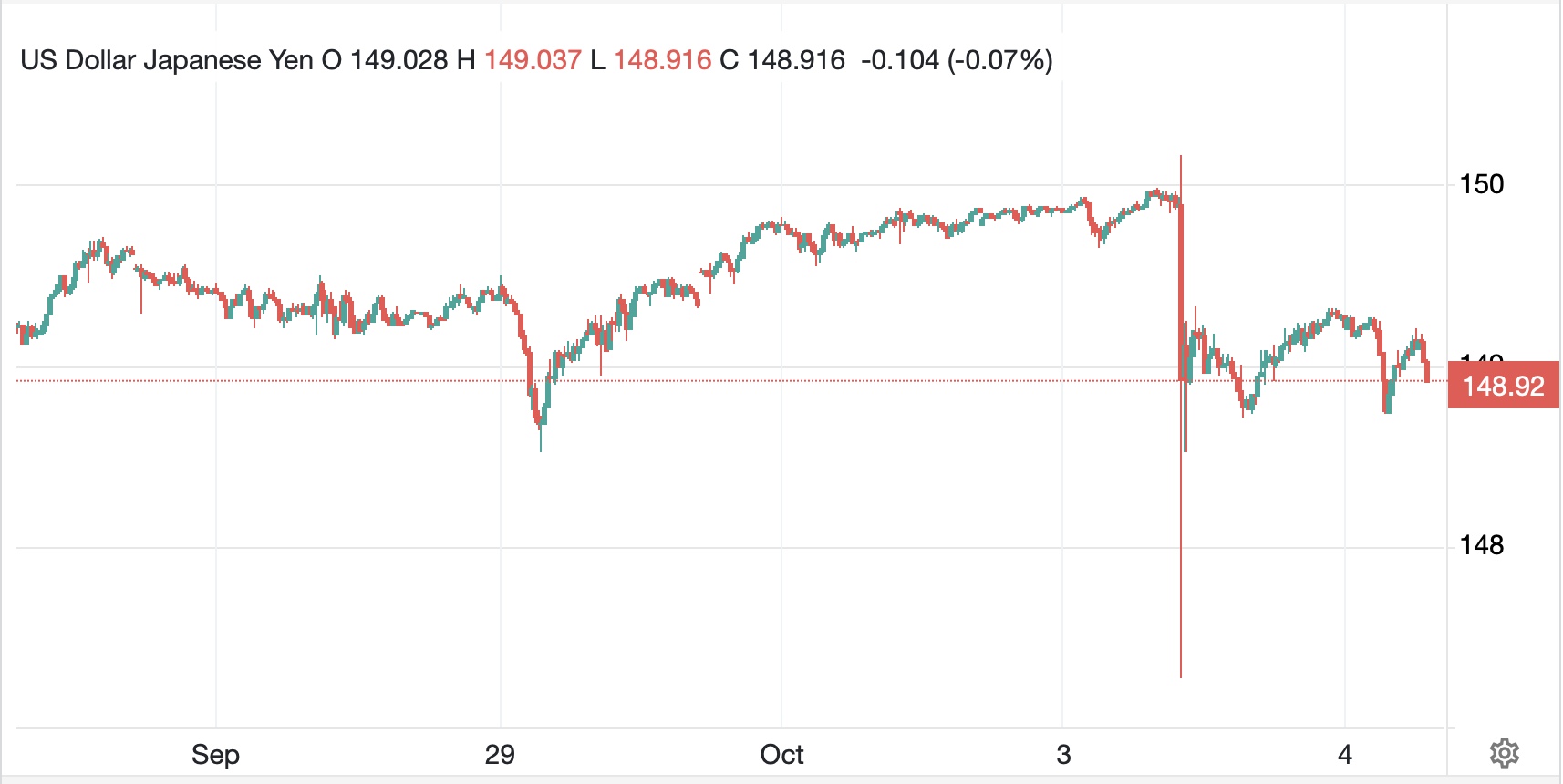
The story that makes the most sense is that the BOJ reached out to the major Japanese banks in NY and London and checked rates.  The fact that the move happened minutes after the spot rate finally breeched the 150 level certainly was suspicious and indicated that contrary to yesterday’s comments by Watanabe-san, a former Mr Yen, the level really does matter, not just the speed of the move.  Others have tried to explain that breeching 150 triggered selling levels, but if there were exotic option barriers at 150, and I’m sure there were, the more typical move would be an acceleration higher as stop-loss orders by dealers were triggered.  The spike down, at least in my experience, is a sign of exogenous activity, not market internals.

Looking ahead, are we likely to see more of this type of activity?  You can never rule out currency support from any nation whose currency is weakening sharply, but there are G7 and G20 constructs that are supposed to limit these, and are designed to focus on volatility of movement, not levels.  This appeared contrary to those concepts, so we have much yet to learn.  At the end of the month, the BOJ will publish any intervention activity as part of their transparency initiative, but that might as well be next year for all the information it will provide.  Be wary of further movements like this, but the fundamentals continue to point to a higher USDJPY, especially given the accelerating rise in US Treasury yields.

The bond market rout keeps on going
As we see more folks towel throwing
The question at hand
Is can Powell stand
The pressure that’s certainly growing

Thus far, there’s no sign that the Fed
Is worried when looking ahead
More speakers were heard
To follow the word
That higher for longer’s not dead

Of course, away from the FX market, where the dollar has continued to show remarkable strength overall, the big story is the Treasury market.  After yesterday’s sharp move, the 10-year yield is higher by 23bps so far in October and it is only the morning of the third session of the month!  The yield curve inversion is down to -32bps and 30-year Treasury yields are pressing 5% now, a level not seen since summer 2007.  This sharp move has been the true driver of almost all markets and as long as it continues, there is going to be more pain for risk assets.  There has been no change in the fundamentals and yesterday’s move was ascribed to a much higher than expected JOLTS Job Openings number, which printed at 9.61M, far above the forecast 8.8M and a huge jump from last month’s outcome.  This seemed to encourage the Fed speakers to maintain their higher for longer attitude with a number still looking for one more rate hike this year.  Once again, I will point to Friday’s NFP number and its importance as a key driver of Fed policy.  If that number remains strong, and Unemployment remains low, the Fed can maintain this policy stance with limited fallout politically.

The rise in Treasury yields is being copied elsewhere around the world with yields following the US higher.  While today is seeing a bit of consolidation, with European sovereign and Treasury yields currently softer by 1bp-2bps, this is a trading effect, not a change of heart.  Interestingly, even JGB yields are getting dragged along higher as they closed last night at 0.80%, their highest level since 2012, the beginning of Abenomics.  But in the end, this is all about US yields with the rest of the world continuing to follow their lead.  I heard some analysts claiming this was a blow-off top in yields and we have seen the end.  Alas, I don’t believe that as history shows the yield curve will move back to a normal stance and with the Fed firmly in the higher for longer camp, 10-year yields have further to rise.  Yes, something is likely to break at some point, but so far, the few hiccups have been contained.

Not surprisingly, risk assets had a tough time in yesterday’s session with US indices all falling sharply, by -1.3% or more.  Yesterday’s European bourses were also under significant pressure and the Asian markets open overnight got hit hard as well with the Nikkei (-2.3%) and Hang Seng (-0.8%) the biggest movers.  However, this morning, Europe has a touch of green on the screen, with small gains on the order of 0.3% and US futures are also edging higher, +0.15% at this hour (7:45).  I wouldn’t read too much into this modest bounce and fear that there is further, and potentially much further, to go.  One of the remarkable things about the equity market is that earnings estimates for 2024 are for a rise of 12% on 2023 earnings.  Given the ongoing rise in energy costs and the increasing probability of a recession, those seem quite optimistic.  As they are revised lower, that, too, will weigh on equities, and by extension all risk assets.

Lastly, in the energy space, oil (-1.7%) is under further pressure this morning, although the fundamentals wouldn’t indicate that is the right move.  Not only did we see a further draw in inventories in the US, notably at the key Cushing, OK storage depot, but we heard from Russia that they are going to continue to restrict production by 300K bbl/day through the end of the year.  Meanwhile, the law in the US is set that the government cannot sell oil from the SPR when the inventory level falls below 330 million barrels.  Currently, it sits at 327 million, so that supply has ended.  Nothing has changed my view that oil has much higher to go, albeit not in a straight line.

Metals prices remain generally under pressure although gold (+0.2%) seems to be bouncing with other risk assets this morning on a technical trading basis.  However, both copper and aluminum are still sliding, typically a harbinger of weaker economic activity to come.

As to the dollar broadly, it, too, is a touch softer this morning, pulling back from highs seen yesterday in sync with all the markets.  But the same fundamentals driving the bond and stock markets are in play here, higher yields leading to more demand and a higher dollar.  Yes, this will end at some point, but we need to see a change in policy for that to happen.  The next real chance we have for something like that is on Friday with the payroll report.  A weak report, which seems unlikely at this time given the other employment indicators, would almost certainly change the market’s tone.  However, until then, look for positioning to continue to favor a stronger dollar, and for more and more dollar short sellers to get stopped out.

On the data front, this morning brings ADP Employment (exp 153K) as well as Factory Orders (-2.1%) and ISM Services (54.5).  the PMI Services data from Europe indicated that the worst may be over, but that there is, as yet, no real rebound.  We hear from a few more Fed speakers, but thus far they remain consistent, higher for longer is appropriate.

Today could see more consolidation of the recent moves across the board, but I do not believe that we have come to the end.  Calling a top or bottom is always impossible but remembering that the trend is your friend is likely to keep your activities in good shape.

Good luck

Adf
Much More Afraid

Watanabe-san,
A previous Mr Yen,
“No intervention”

As USD/JPY approaches the psychological level of 150.00, there is a growing belief in the market that the BOJ is soon going to intervene.  Recall, last week we heard about the urgency with which the MOF is watching the exchange rate.  Historically, the next step would be for the BOJ to ‘check rates’.  This is when they call around to the big Tokyo bank FX trading desks and ask for levels.  The implication is they are ready to sell dollars and defend the yen.

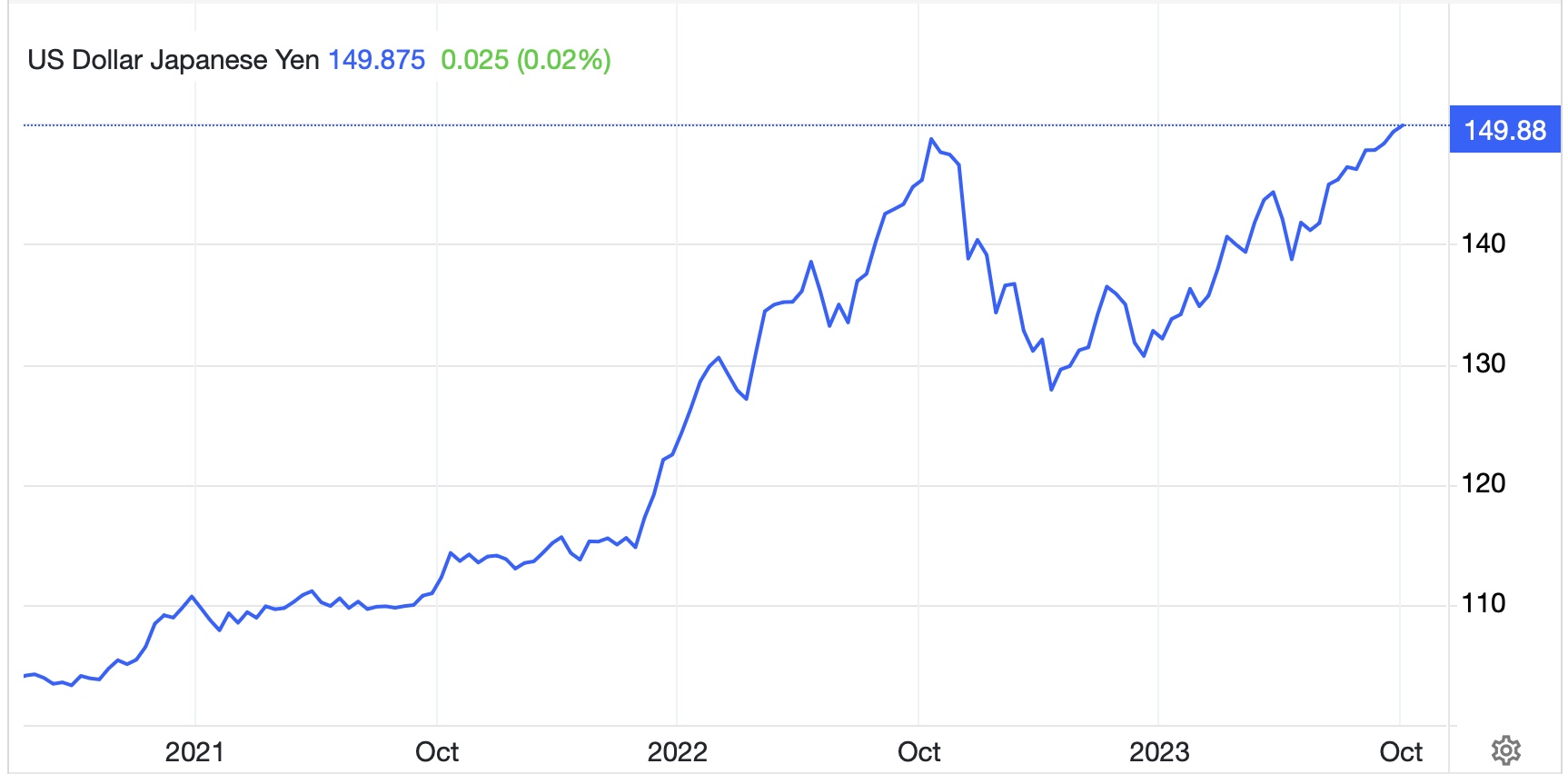
However, unlike the previous decline in the yen almost exactly a year ago, the recent movement has been somewhat more gradual as can be seen in the chart below (source tradingeconomics.com)

This was highlighted last night by Hiroshi Watanabe, the deputy FinMin in charge of currency policy from 2004 through 2007.  He explained that after seeing the dollar remain in a 145-150 range for much of the past year, “I don’t think authorities are worried about the outlook as much as they were last year.  There’s no sense of imminence because the dollar/yen level hasn’t changed much from a year ago, and it doesn’t seem like the yen will start to plunge even if it breaches the 150 mark.

As is often the case when it comes to concerns about a currency’s value, the pace of its decline is far more important than the actual level.  Most countries, or at least most finance ministries, feel they can handle slow and steady.  It is the abrupt collapses that scare them.  This move has been quite steady, and as long as both the Fed and BOJ maintain their current monetary policies, a continuation seems likely.  Hedgers, keep that in mind.

Now, turning to yesterday’s trade
A message was clearly conveyed
As interest rates rise
Risk appetite dies
And people are much more afraid

The most pressing story in markets continues to be the US Treasury market where sellers outnumber buyers on a daily basis.  Yields on the 10-year rose 10bps yesterday, touching 4.70% and are continuing higher by another 2bps so far this morning.  The bear steepener continues to be the story with the 2yr-10yr spread falling to -40bps and looking for all the world like it is going to go positive before the end of the year, if not the end of the month.  And it makes sense.  There is still substantial demand for short-term paper yielding more than 5% (yesterday’s 3mo T-Bill auction cleared at 5.35%).  Meanwhile, we are seeing money flee those assets with long duration over fears that inflation has not yet been quelled and that the structural issues (ongoing massive supply meeting limited demand) has investors pulling back quickly.  Not only are Treasury bonds being sold aggressively driving yields higher, but yesterday saw utility stocks, often seen as a duration proxy given the high amount of debt on their balance sheets, fall nearly 5%.  

This activity is having the knock-on effects that one would expect as well.  Yields around the world continue to get dragged higher by Treasuries, the dollar continues to benefit, and commodity prices are suffering.  In fact, yesterday saw a sharp decline in the price of oil and it has now retraced more than 6% from the peak last week.  I had written about the simultaneous rise in yields, the dollar and oil as being a HUGE problem for global markets.  Well, it seems that oil is starting to feel the pain of higher yields and a stronger dollar.  As well, tomorrow OPEC meets in Vienna and there is some talk that the Saudis may increase their production, unwinding those unilateral cuts made back in June and continued since then.   

But make no mistake, ongoing rises in Treasury yields will continue to underpin the dollar and that will be enough of a problem for economies elsewhere even if oil prices slide some more.  And right now, there is no indication things are going to change.  Yesterday we heard from two Fed speakers, Governor Bowman and Cleveland Fed President Mester with both maintaining the hawkish views.  In fact, Bowman expressed the need for several more rate hikes in order to get inflation under control and both were clear that higher for longer was crucial.  As long as that remains the Fed attitude, until we see a substantial change in the data stream, yields are going to continue to rise.

Now, this week brings the all-important NFP report on Friday, which has been a key driver of Fed policy.  With inflation readings continuing far above the Fed’s target, as long as NFP remains positive and the Unemployment Rate remains either side of 4%, the Fed will have no reason to reconsider the current policy mix.  In their minds, they have not yet broken anything, at least not so badly that it couldn’t be fixed.  I’m sure they are straining their arms as they pat themselves on the back for the effectiveness of the Bank Term Funding Program (BTFP) which was created after the bank failures in March.  In fairness, it seems to be working for now.  However, I will warn that cans can only be kicked down the road for so long, and I fear the end of that road is nearing.

As to the rest of the session today, risk is decidedly on the back foot.  Those equity markets in Asia that were open all fell pretty sharply with the Nikkei (-1.6%) and Hang Seng (-2.7%) leading the way lower.  The story is similar in Europe with the major indices all lower by about -0.75% or so as they respond to the ongoing increase in interest rates around the world.  Finally, US futures are lower by -0.45% at this hour (7:30) with concerns growing that yields will not stop rising.

Looking at European sovereign bonds, yields there are rising alongside Treasury yields with most of them higher by 3bps-4bps and Italy higher by 9bps.  That Bund-BTP spread, currently at 193bps, is something we need to watch as 200bps is likely to be the first place the ECB really shows concern and if it heads higher than that, expect more direct actions.  As to JGB yields, they remain static at 0.76%.

We already discussed oil prices and we are seeing serious weakness across the entire metals complex lately, although today’s declines are relatively muted, on the order of -0.2%, as the moves have already been pretty large.  The lesson from the recent price activity is that yields continue to drive the market.

Finally, the dollar remains king with the euro below 1.05, USDJPY just below 150 and the pound making a run at 1.20.  Last night, the RBA met and left rates on hold, as widely expected, but the tone of new governor Michele Bullock’s first meeting was seen as somewhat dovish leading to a nearly 1% decline in the Aussie.  At the same time, the EMG bloc of currencies is also coming under pressure with declines today on the order of -0.5% across all three regions.  There is a term, the dollar wrecking ball, which is quite apt.  As it continues to rise it puts intense pressure on countries around the world as they scramble to get dollars to service the trillions upon trillions of dollars of debt outstanding.  Nothing has changed my view that this has further to run.

On the data front today, the only release is JOLTS Job Openings (exp 8.8M) a number that remains significantly larger than the number of unemployed.  We also hear from Atlanta Fed president Bostic this morning so it will be interesting if he is willing to push back against the ongoing hawkishness.

I see no catalysts to change the current trend in the dollar, so for all you receivables hedgers out there, keep that in mind.

Good luck

Adf

Just Kidding

Remember Friday
When one percent was declared
The top?  Just kidding

Much has been written about the BOJ’s surprising change in policy at their meeting last Friday, when they ostensibly widened the cap on their Yield Curve Control to 1.00% while explaining that flexibility in operations was the watchword.  They did not touch their overnight rate, which remains at -0.10% and there is no apparent belief that they are going to adjust that anytime soon. 

Neither market pricing in the OIS market nor any commentary from any BOJ official has hinted at such a move.  So, the question is, did they really change their policy?

This matters a great deal for those amongst us who care about USDJPY and its potential future direction.  The prevailing narrative has been that once the BOJ altered policy and allowed Japanese interest rates to rise to a more normal setting, investment would flow into JGBs, and the yen would strengthen rapidly.  Remember, a big part of this process is that since the yen is the last remaining currency with negative interest rates in the front end of the curve, it remains the financing currency of choice amongst the speculative and hedge fund set.  Adding to this discussion was the fact that back in December of last year, when Kuroda-san truly surprised the market by raising the YCC cap from 0.25% to 0.50%, it took less than one day for the 10-year JGB yield to test the new cap.  Expectations recently had been that a similar move was likely to be seen this time around as well.

Alas, it is Monday, so some thirty-six market hours into the new policy and already the BOJ has stepped into the market to prevent a further rise in the 10-year yield once it touched 0.60%.  Last night they stepped in with a ¥300 billion program of additional QE.  One cannot be surprised that USDJPY (+0.9%) is higher on this news as it undermines the entire thesis about imminent JPY strength once they changed policy.  And if they didn’t really change policy, as evidenced by the fact that they have already stepped into the market, then THE key pillar of the stronger yen thesis has just been removed.  The other problem for the yen bulls is that the US data last week, especially the GDP and IP data, indicate that the Fed will be under no duress if they continue to tighten policy beyond current levels.  Despite all the arguments about the Fed making another policy error, and there are sound arguments there, in Jay Powell’s eyes, until NFP starts to fall sharply, or Unemployment starts to rise sharply, or both, there are no impediments to a continuation of the current tightening policy.

It is with this in mind that I foresee continued strength in USDJPY, and while it seems likely that a very rapid move higher will see further intervention by the BOJ/MOF like we saw last autumn, another test of 150 is in the cards.  A quick look at the chart below (from tradingeconomics.com) shows that the trend higher in the dollar remains intact with the decline in the first part of July already mostly undone.  For those of you who were looking for a reversion to the 120 or 130 level, I fear that is just not in the cards for a long time to come.

Last Thursday the ECB said
That policy, looking ahead
Need not be so tight
And so, they just might
Stop raising rates, pausing instead

Though their only mandate is prices
They’ve come to a bit of a crisis
Seems growth’s really weak
And so, they will seek
A policy, sans sacrifices

The good news in Europe is that Q2 GDP was positive, which followed a negative Q4 and a flat Q1.  Hooray! The bad news about the data, which showed a 0.3% rise, is that fully half that number comes from Ireland! Now, Ireland’s weight in the Eurozone economy is tiny, about 4%, so the fact that growth there represented half the entire EZ’s growth is remarkable.  However, if you consider that this growth is more illusion than economic activity, it is easier to understand.  The growth is a result of the large profitability of US tech companies that generate their profits, from an accounting perspective, in Ireland to take advantage of the extremely low Irish corporate tax rate of 12.5%.  So, US tech companies had a good quarter driving Irish GDP higher, and by extension Eurozone GDP higher.  But they didn’t really produce that much stuff.

At the same time, Core CPI in the Eurozone printed at 5.5% this morning in July’s preliminary reading, hardly indicative of a collapse and calling into question Lagarde’s seeming dovishness last week.  In the end, the dichotomy between the US economy, where the latest data continues to show a robust outcome, and Europe, where the only thing rising is prices with economic activity lackluster at best, remains the key reason why the dollar’s demise is still a theory and not reality.  

To summarize the information that we have received from around the world in the past several days, Japan is unwilling to allow interest rates to rise very far, European growth is staggering, US growth is accelerating, the ECB is inclined to stop hiking rates and the Fed continues with ‘higher for longer’.  All of this points to the dollar maintaining its value and likely rising further.  I have yet to see anything persuasive in the dollar bear case to address all these issues. 

Now, those are the big picture views, but let’s take a quick tour of the overnight session.  Equities rallied in Asia following the US performance on Friday, but Europe has been a bit more circumspect with a couple of markets showing gains, notably France and Italy, but the rest doing nothing at all.  At the same time, US futures are little changed at this hour (7:30).

Arguably, though, it is the bond market where things are really interesting as yields continue to rebound.  US Treasuries are higher by 1.5bps and pushing back to that all important 4.00% level this morning.  There is a growing belief that if 10-year yields push above 4.10%, that may signal a new framework, a breakout in technical terms, and we could see much higher yields from there.  The Fed is likely to welcome such an event as it will help tighten financial conditions, something that they have been unable to achieve thus far.  However, I do not believe the equity markets would take kindly to that type of movement, so beware.  As to European sovereigns, they are mostly higher by about 1bp-2bps this morning and of course, JGBs saw yields finish higher by 6bps, just below 0.60%.

Oil prices (+1.0%) continue to rise on an organic basis.  By this I mean there have been no announcements, no disruptions and no news of any sort that might indicate a change in the current situation.  In other words, there is just a lot of buying going on.  WTI is well above $81/bbl and we have seen a gain of more than 16% in the past month.  Headline inflation will not be sinking on this news.  We are also seeing a little strength in the metals space this morning with gold, copper and aluminum all firmer as the week begins.  The base metals are responding to continued indications that China is going to support their economy, although direct fiscal payments don’t yet seem likely.  Just wait a few months.

Finally, the dollar is net, little changed, although we have a wide array of gainers and losers today.  In the G10, AUD (+0.9%) and NZD (+0.75%) are the leaders, rallying alongside the commodity rally, while JPY (-0.8% now), is the laggard based on the discussion above.  As to the rest of the bloc, there are more gainers than losers, but the movement has been far less impactful.  In the EMG space, MYR (+1.1%) has been the leading gainer on significant (for Malaysia) equity market inflows of ~$40mm -$50mm last night.  After that, though, the gainers have mostly been EEMEA currencies, and they have not moved that much.  On the downside, ZAR (-0.7%) is the laggard on limited news, implying more of a trading action rather than a fundamental shift.  But on this side of the ledger as well, things haven’t moved that far and net, the space is little changed.

It is an important week for data in the US culminating in the payroll report on Friday.

TodayChicago PMI43.4
 Dallas Fed Mfg-22.5
TuesdayJOLTS Job Openings9600K
 ISM Manufacturing46.9
WednesdayADP Employment183K
ThursdayInitial Claims227K
 Continuing Claims1723K
 Unit Labor Costs2.5%
 Nonfarm Productivity2.2%
 Factory Orders2.1%
 ISM Services53.0
FridayNonfarm Payrolls200K
 Private Payrolls175K
 Manufacturing Payrolls5K
 Unemployment Rate3.6%
 Average Hourly Earnings0.3% (4.2% Y/Y)
 Average Weekly Hours34.4
 Participation Rate62.6%
Source: Bloomberg

In addition to this, we get the first post-FOMC Fedspeak with just two speakers, Goolsbee and Barkin, on the calendar this week although the pace picks up next week.  As long as the data remains strong, I see no reason for the Fed to change its tune nor any reason for the dollar to back off its recent net strength.

Good luck

Adf