
Like an Avalanche

Like an avalanche
The Nikkei collapsed last night
Is there more to come?


The thing about markets is that they have an extraordinary ability to confound everyone.  For instance, last night, the Nikkei (-5.8%) essentially collapsed, falling more than 3% on the opening and continuing lower from there.  This takes the “correction” in this index to more than -16% in the past three weeks as you can see from the chart below.
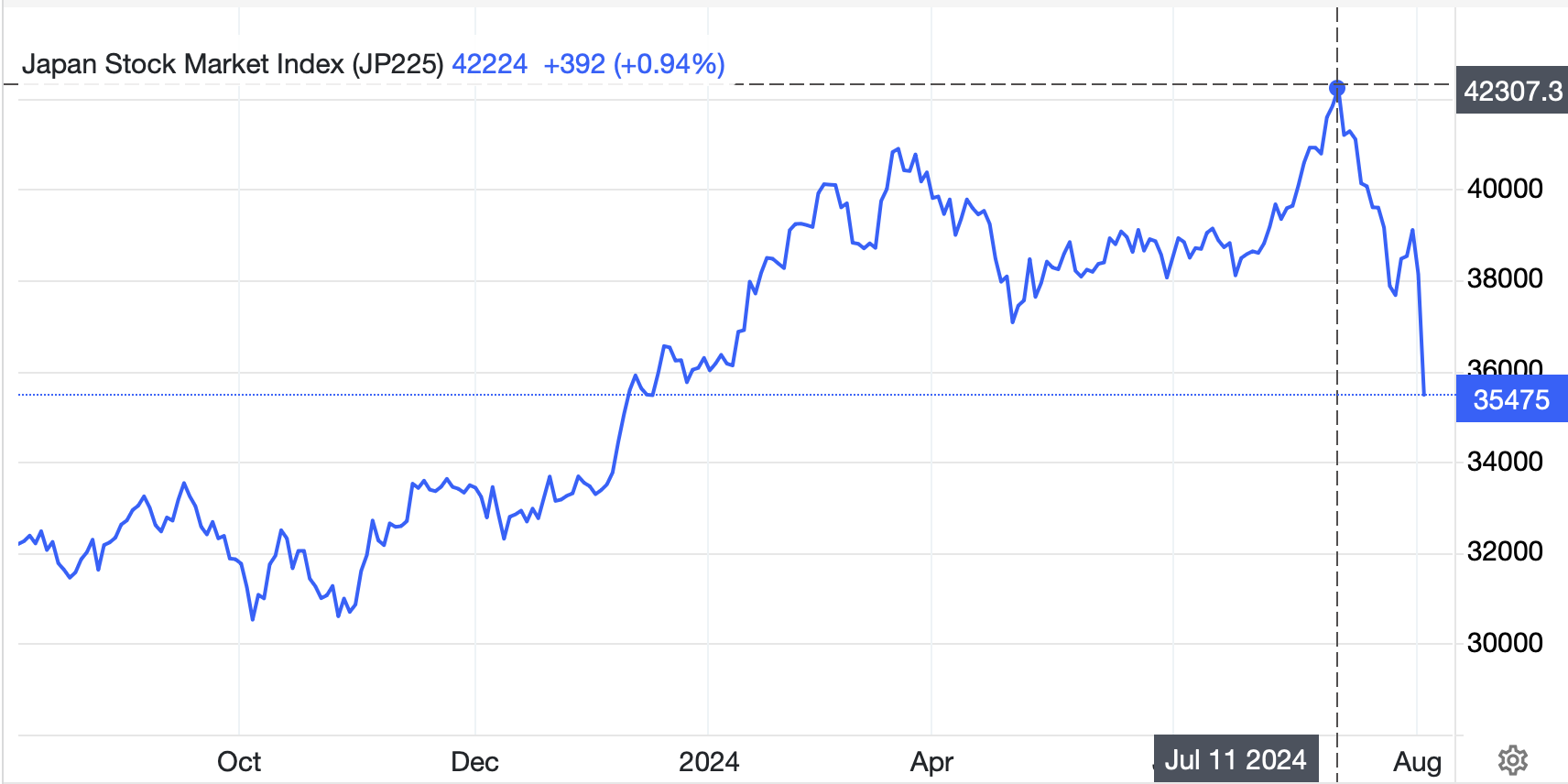
Source: tradingeconomics.com

I have seen several explanations for the move but the one thing I have learned over time is that the biggest moves often lack a specific catalyst.  Rather, an accurate post-mortem of the situation would indicate that prior to the collapse, the market was in a ‘critical state’, a state where there are many inherent flaws beneath the surface that can combine to drive a single significant move. (If you have not already read Ubiquity by Mark Buchanan, I cannot recommend it highly enough as it is both extremely well written and discusses this exact situation and how it plays out across all systems, including financial ones.) At any rate, the essence of the idea is that systems develop ‘fingers of instability’ within their structure over time.  These can be things like the extreme concentration in the Mag 7 stocks compared to the rest of the S&P 500, or the fact that earnings for a majority of the S&P have been declining despite the index making new highs.

I will be the first to admit I do not know the inner workings of the Nikkei at all.  However, I am confident that there were numerous fingers of instability beneath the surface that led to this move.  Arguably, some of those were the recent appreciation in the yen, which has rallied ~8% in the past month with a negative impact on Japanese exporter earnings.  And of course, just Wednesday night the BOJ tightened policy in a surprising move, but as importantly, explained they would be reducing their QQE, and that further tightening was likely going forward.  Finally, the US market, especially the tech sector, has been under some pressure as well given some lackluster earnings reports by key Mag 7 players.  Combine all that and you have a situation ripe for a major correction.  It’s just that it is rare to put it all together ahead of time. 

With payrolls the topic today
The pundits don’t know what to say
Is good news still bad?
Or will bears be glad
If payrolls, real weakness, betray?
 
Cause yesterday’s markets were rough
For holders of risk-laden stuff
The data was weak
And havens were chic
Investors have had ‘bout enough

Which takes us to this morning’s payroll report.  Before that discussion though, it is important to touch on what yesterday’s data revealed.  It started with the highest Initial Claims data in almost a year, far higher than forecast and as you can see in the chart below, there certainly seems to be a developing trend.

Source: tradingeconomics.com

Continuing Claims were also much higher, their highest in nearly three years, and an indication that getting jobs is a lot harder these days.  While the Productivity data was solid, the ISM data was anything but, printing at 46.8, the 22nd time in the past 23 months that it has printed below the 50.0 level of growth/contraction.  And Construction Spending was also weak.  The point is that yesterday had the feel of a much weaker economy than what we have been seeing previously.  And more importantly, the market response seems to have changed from bad news = good, to bad news = bad.  Previously, weak economic data encouraged the idea that the Fed would cut, and risk assets rallied.  But now that the Fed passed on their opportunity to cut this week and will not meet again until September, bad news implies the Fed is falling further behind the curve, and risk assets are suffering accordingly.  Now, with that is intro, here are today’s expectations:

Nonfarm Payrolls175K
Private Payurolls148K
Manufacturing Payrolls-1K
Unemployment Rate4.1%
Average Hourly Earnings0.3% (3.7% y/Y)
Average Weekly Hours34.3
Participation Rate62.5%
Factory Orders-2.9%

Source: tradingeconomics.com

Certainly, the tone of the recent data has been soft, and the ADP Employment number was much lower than expected at 122K.  This might lead one to believe that today’s number will be soft as well, with a headline print of 125K – 150K.  If that happened, I don’t think anyone would be surprised.  But here’s the thing about markets, they seem to exist to cause the most pain possible before heading where they are supposed to go.  As such, there is a small part of me that believes we could see a better-than-expected outcome, perhaps over 200K again, just to confuse people.

However, if the report is soft, I expect that will weigh further on risk assets, and based on the US futures market at this hour (7:00), that is the general expectation with all three major US indices having fallen by more than -1.0% following yesterday’s rout.  So, let’s look at how the rest of the world is handling this collapse in Japan.  Every major market in Asia fell, mostly by more than -2% with notable declines in Taiwan (-4.4%), Korea (-3.6%) and Hong Kong (-2.1%) although the CSI 300 on the mainland fell only -1.0%.  In Europe, the picture is all red, but the magnitude of the declines is not nearly so dramatic, DAX (-1.5%), CAC (-0.7%), FTSE 100 (-0.3%).  Of course, given this seems to be related to a tech stock decline, this should be no surprise as there is no real tech in Europe.

Bond yields are lower everywhere after a sharp decline yesterday as well.  Treasury yields are below 4.0% for the first time since their brief foray below that line at the beginning of the year, back when markets were pricing in 6 rate cuts this year.  Net, 10-year Treasury yields have decline 13bps since yesterday morning.  European sovereign yields are also declining in a similar manner, down between 8bps and 10bps from yesterday morning but the real surprise is in Japan where 10yr JGB yields have tumbled 9bps.  It seems that there is more to the decline in USDJPY than simply unwinding the carry trade and covering JPY shorts.  It looks as though some institutional money is heading home.

In the commodity markets, traders don’t know what to think.  Will a war in the Middle East cause significant supply disruptions?  Or is the evidence of a weak economy now too great to overcome and set to drive oil prices lower again.  This morning, WTI is slightly softer (-0.2%) but I would come in on the side of weaker growth being a drag.  Remember, there is much spare capacity in Saudi Arabia if supplies tighten.  But the real story is gold (+0.5%) which has rallied to yet another new all-time high this morning and is dragging the rest of the metals complex along with it.  In the end, I think in many eyes around the world, if not in the US, gold remains the ultimate safe haven, and when the fan gets hit, people want it in their portfolios.

Lastly, the dollar is under real pressure this morning, opposite its haven characteristics but for a good reason.  A quick look at the CME futures shows the market is now pricing a 24% chance of a 50bp cut in September, and if the data continues to weaken, especially this morning’s NFP, I expect there will be pressure growing for an inter-meeting cut.  So, the euro (+0.4%) looks healthy by comparison and USDJPY continues to trickle lower, but the big surprise is CNY (+0.55%) which has had its largest daily rally since early May.  I maintain that the PBOC will be happy to allow the renminbi to strength as long as it lags the yen.  And lately, every currency has been lagging the yen with the big carry trades amongst the worst performers.  But the chart of CNYJPY below demonstrates that the PBOC is likely not that concerned about a little strength vs. the dollar right now.
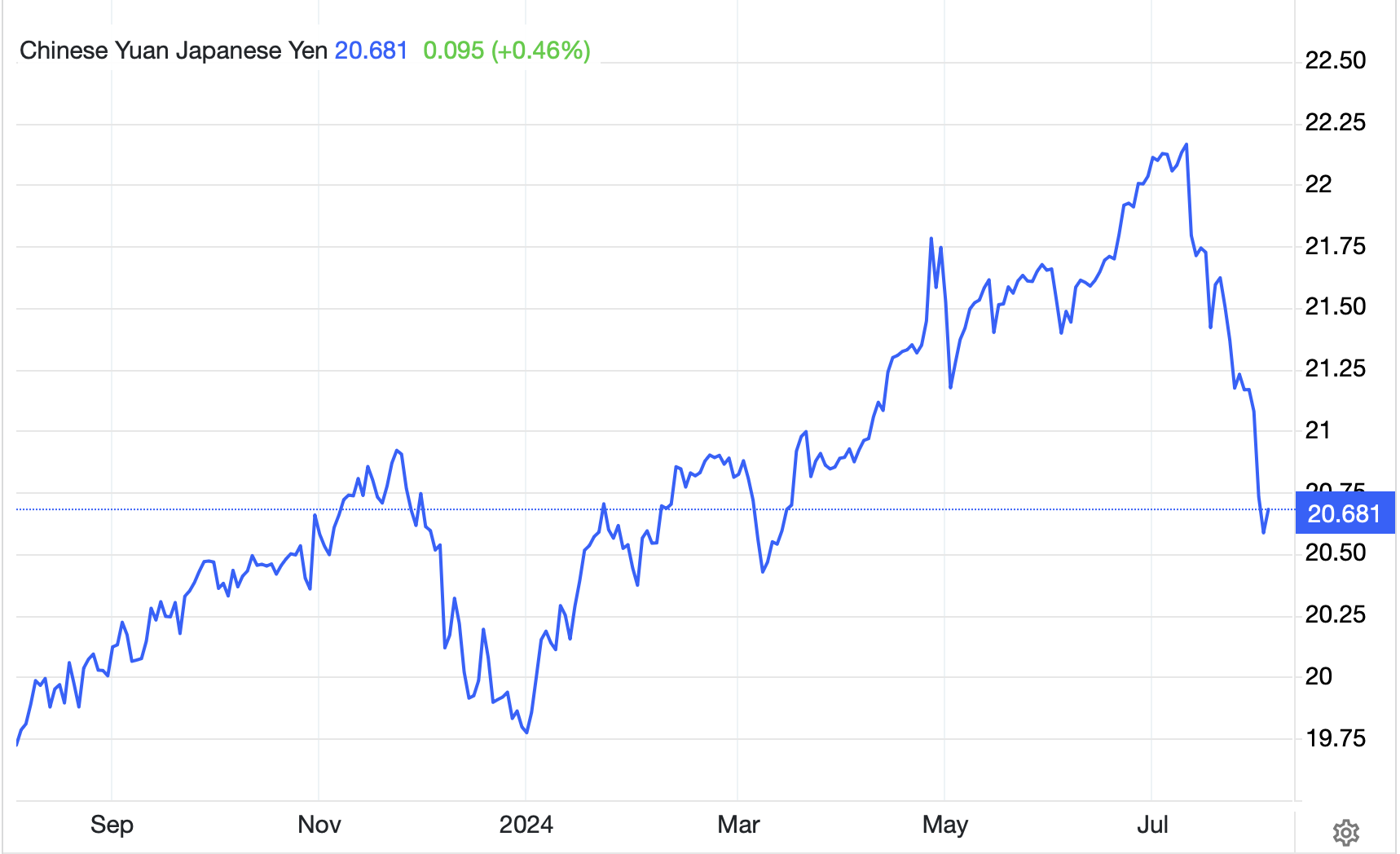
Source: tradingeconomics.com

And that’s really all for the day.  I don’t see any Fed speakers on the calendar, but given the market movements lately, I expect we will hear from at least one FOMC member.  Ahead of the NFP, things will remain quiet, but that will set the tone.  To my eye, this correction has further to go, and if all those analysts who have been digging into the data and claiming we are already in a recession prove to be correct, watch for the Fed to be far more aggressive than currently priced.  That means the dollar has a lot of room to decline in that situation.

Good luck and good weekend

Adf

A Stock Jamboree

Said Jay, there are two goals we seek
Strong job growth while prices are weak
And as I sit here
The way things appear
Come autumn, Fed funds we may tweak

The market responded with glee
Twas truly a stock jamboree
Plus, bonds joined the fun
And went on a run
The dollar, though, sank in the sea

At this point, the only question in market participants’ minds is whether the Fed will cut 25bps or 50bps in the September meeting.  Yesterday afternoon, as widely expected, the FOMC left rates unchanged and tried to offer a balanced view of the future, explaining that both of their dual mandate goals were normalizing.  Obviously, inflation, which has been their primary focus for the past two years, has been moving in the right direction and Chairman Powell reiterated that they are gaining ‘confidence’ that they will achieve their 2% target.  But this time, Powell spent more time describing the job market and how it was now coming into balance.  In other words, what had previously been a significant inflationary pressure in the Fed’s collective view, was now having less of an impact on prices.

At the press conference, Powell would not be pinned down on a September cut, although based on pricing in the Fed funds futures market, you would be hard pressed to believe that.  This morning, the market is pricing more than 28bps of rate cuts (a 13.5% probability of a 50bp cut) into the September meeting, so the key will be to watch how that probability of a 50bp cut evolves.  If we start to see hard data, like tomorrow’s NFP or CPI, in two weeks’ time, decline, I’m confident that the market will be calling for a 50bp cut before long.

In the end, the recent correction seen in risk asset markets seems to have been just that, a correction, and now the narrative is that there are blue skies ahead with lower rates to support things and the Fed is going to stick the soft landing.  This poet is less certain that the best case will obtain, but that’s what makes markets.

So, even though we have not yet heard from the third major central bank as I write (the BOE is due to announce in a few hours’ time), I don’t think that is going to impact the global narrative.  Let me start by saying that I believe they will cut rates in the UK as yesterday’s activities in the US make it all but certain a cut is coming here, and given the ECB, BOC and Riksbank have all cut already, they have plenty of company.  However, let’s recap where things are now and what the market narrative is now explaining to us all.

Policy normalization is the new watchword as we hear that the BOJ is normalizing policy by raising interest rates and tightening while the rest of the G10 are normalizing policy by cutting rates and ending activities like QT.  I guess the definition that the punditry ascribes to normal policy is, every country has the same interest rate!  In fact, I say that only half tongue in cheek, as there is some merit to the discussion.  While it is certainly true that global economies have evolved in greater synchronicity over the past decades, interest rate policy has always been based on the idiosyncrasies of each economic area.  For instance, money supplies and productive capacities differ widely amongst countries, so why should we believe that the “proper” monetary policy is the same level of interest rates across the board.  Of course, we shouldn’t, but for market participants, it is much easier if they have one target for everything rather than being forced to understand each economy in its own right.

But with that in mind, let’s recap where things currently stand around the major economies.

1.     US – economic activity is slowing, but the pace of that slowdown is very modest, at least based on the recent GDP reading.  Inflation is slowly receding but has not yet achieved the Fed’s target and the jobs market has, to date, held up reasonably well.  Of course, we will know more about that tomorrow.  On the flip side, the manufacturing portion of the economy has been the laggard, with PMI and regional Fed surveys pointing to subpar activity.  There seems to be a disconnect between the slowing economy and the roaring equity market, but markets have a life of their own.
2.     Europe – economic activity overall is modest with a reversal in the weak vs. strong players as Germany is the sick man of Europe and the PIGS economies are all faring far better.  Inflation here is a bit stickier than it seems in the US as evidenced by yesterday’s higher than expected readings and remains well above the 2% target here.  Most nations are seeing more substantial weakness in their manufacturing sectors, although for some (I’m looking at you Germany) it is self-inflicted based on insane energy policies driving energy costs much higher.
3.     Japan – recent growth signs have been quite poor with a negative GDP release just last week indicating things are not going well.  This has been accompanied by above target inflation, which while seeming to slow, is slowing very gradually.  In fact, this is the one place where the FX rate seems to really have had an impact, with the yen’s previous weakness adding to inflationary pressures and offsetting their very modest monetary policy tightening.  However, the combination of the BOJ hiking and the Fed seeming to promise a cut has led the yen to recoup nearly 8% over the past several weeks and now that USDJPY is below 150, I expect to see this move continue.  That should help ameliorate some of the inflation pressures, although it is not clear to me it will help economic growth.
4.     China – last night’s Caixin Manufacturing PMI was a disappointing 49.8, down two points and below expectations.  The indication is that economic activity in China remains hampered by the lack of consumer activity.  China’s long-term policy of mercantilism is running into its limits as nations around the world are unwilling to take their excess production freely, and the domestic economy remains in the doldrums, still suffering from the ongoing deflation of the property bubble.  While the PBOC did reduce interest rates recently, the fact that neither the Third Plenum nor the Politburo were willing to inject real stimulus into the economy indicates that things are going to remain lackluster going forward.

Arguably, the lesson from this recap is that economic activity is in a downtrend and that inflation is also in a downtrend, just a shallower one.  Policy makers around the world are struggling to find the right mix because oftentimes, the right mix means something politically difficult.  Net, I expect this process will continue and that we will see more and more efforts to turn around the economic trend while ignoring the inflation trend.

Ok, this has turned into more than I expected, so let’s be quick on markets today.  Yesterday’s Fed led to a huge tech sector rally in the US but that was not enough to help the rest of the world.  Despite that optimism, Japanese shares (-2.5%) were down sharply on the continued strength of the yen, while Chinese shares, in both Hong Kong (-0.25%) and the mainland (-0.7%) saw no love either.  In fact, the whole region was under water.  The same is true in Europe this morning with all the continental bourses lower on average by -0.65% or so after continued weak PMI data was released this morning.  The only exception here is the UK, where the FTSE 100 is now higher by 0.3% after the BOE, as I expected, cut rates by 25bps at 7:00am.  As to US futures, euphoria is still alive and they are all higher at this hour, just past 7:00.

In the bond market, yields are declining around the world led by Treasury yields which fell 10bps yesterday, although they have rebounded by 2bps this morning.  2yr yields also fell a similar amount so the yield curve’s inversion remains at -23bps this morning.  In Europe, yields also slid yesterday, albeit not as much as in the US and are a further 2bps lower this morning as they try to catch up.  The exception here is the UK, again, as 10yr Gilt yields are lower by 5bps this morning in the wake of the BOE cut.  JGB yields overnight fell 1bp, although given the move in Treasury yields, that gap has still narrowed substantially.

In the commodity markets, oil (+0.9%) continues to rally as fears over an Iranian retaliation against Israel grow with no clear idea where this will stop.  Consider, though, WTI remains below $80/bbl still, so right in the middle of its longer term range.  I imagine we could see a bump higher, but remember, OPEC has a lot of spare capacity, so if some countries are forced to stop producing, the Saudis can turn on the taps.  Gold (-0.4%) is backing off the new all-time highs it reached yesterday, but remains far above $2400/oz.  In fact, all the metals markets saw gains yesterday and this morning they are ceding some of those gains, but I don’t think this story has changed; if the Fed gets more aggressive, I expect these commodity prices to rise further.

Finally, the dollar is on fire this morning, rallying against everything but the Swiss franc right now.  The pound (-0.7%) is under the most pressure in the G10 after the rate cut, but we are seeing weakness everywhere else but Norway and Switzerland.  Even the yen, which had broken through the 150 level earlier this morning is now back below (dollar above) that level, although I expect there are further declines to come here in the dollar.  One other surprisingly large mover is CNY (-0.4%) which has given back more than half its gains from the activities last week involving the PBOC rate cuts and intervention.  Remember, if the yen continues to strengthen, the renminbi will be able to do so at a very gradual rate and maintain increased competitiveness vs. Japanese exports.

On the data front, this morning brings Initial (exp 236K) and Continuing (1860K) Claims, Nonfarm Productivity (1.7%), Unit Labor Costs (1.8%) and ISM Manufacturing (48.8).  Remarkably, there are no Fed speakers on the schedule, but I imagine they will not be able to keep quiet for long.  However, while there is a definite glow amongst investors, all eyes will turn to tomorrow’s NFP data, where a hot number will not be taken well, at least not at first, but if we print below NFP expectations, look for stocks to rock on a growing expectation of 50bps in September.  That will also hurt the dollar, which should retrace some of today’s gains.

Good luck
Adf