That Trade Again

Remember when everyone knew
That BOJ hikes would come through
The Fed would cut rates
And all the debates
Were focused on what next to do?
 
It turns out the very next thing
For those getting back in the swing
Was selling the yen
(Yes, that trade again)
And buying stuff that has more zing


We all know that the carry trade died two weeks ago.  After all, the BOJ hiked rates in a surprise to the markets which was followed by Chairman Powell essentially promising to cut rates.  Those actions spooked traders, and arguably algorithms as well, and we saw a dramatic decline in equity markets around the world, led by Japanese stocks.  The premise was that much of the market activity was driven by borrowing yen at near 0.0% and then converting those yen into other currencies and buying other assets, or just depositing the dollars, or Mexican pesos or Brazilian reals and earning the interest rate differential.

Now, don’t get me wrong, that was an active trade and clearly a part of the ongoing risk asset rally that was evident throughout most of the world.  But that trade took several years to build up, and the idea that it was unwound in a week is laughable.  But, that sharp move two weeks ago succeeded in doing one thing, it scared the 💩 out of the central bankers around the world.  Within days, the BOJ walked back all their tough talk about normalizing monetary policy and ending QQE.  As well, despite desperate calls from some of the punditry for an emergency rate cut, or at the very least, a guarantee of a 50bp cut in September by the Fed, the few Fed speakers we have heard continue with their mantra that while some things are looking encouraging, the time is not yet right to cut rates.

And, you know what that means?  It means that the interest rate differentials between Japan and the rest of the world remain plenty wide enough to reinvigorate that self-same carry trade that was declared dead just two weeks ago.  The obvious proof is in the equity markets which, while not quite back to the highs of July 16th, have rebounded between 6.8% (S&P500) and 8.8% (NASDAQ) from the bottoms seen at the beginning of the month.  (see chart below)

A graph of a line graph

Description automatically generated with medium confidence

Source: tradingeconomics.com

But equally important to this story is the fact that the yen has declined more than 4% from its highs at the peak of the fear as investors are far less concerned about much tighter BOJ policy.  This is also evident in the JGB market, where 10-year yields, while climbing 3bps overnight, remain well below the 1.0% level that was seen as a harbinger of the new monetary framework in Japan.

A graph showing the price of a stock market

Description automatically generated

Source: tradingeconomics.com

Of course, there has been other news that has abetted this price action, namely the recent US data which showed that the employment situation may not be as dire as the NFP report at the beginning of the month.  This was demonstrated yet again yesterday when Initial Claims fell to 227K, its lowest point in 5 weeks and the second consecutive decline in the result.  As well, Retail Sales were a much stronger than expected 1.0% (although the autos component seemed a bit funky), indicating that real economic activity was still growing.  Granted, the IP (-0.6%) and Capacity Utilization (77.8%) data were soft as were both the Philly Fed (-7.0) and Empire State Manufacturing (-4.7) surveys, but none of that matters when the markets get on a roll.

If I had to describe the narrative this morning it would be, everything’s fine.  The economy is still doing well, the jobs market is not collapsing, and the Fed is still on track to cut rates next month.  Goldilocks has come out of hiding and is back headlining the show.  While there are still some doubters out there, their voices are being drowned out by all the shouting to buy more stocks.

So, as we head into the weekend, let’s see how things have performed overnight.  In Asia, markets everywhere rallied following the strength in the US yesterday.  The Nikkei (+3.6%) led the way and has now rebounded more than 20% from its nadir at the height of the fear.  But the Hang Seng (+1.9%) showed strength and we saw strength throughout the region (Australia +1.3%, Korea +2.0%, India +1.7%) with one notable exception, mainland China, where shares edged up just 0.1%.  It seems that President Xi has, at the very least, a marketing problem with respect to getting investors to put money into China. In Europe, most markets are higher between 0.25% (CAC) and 0.6% (DAX) although the FTSE 100 (-0.4%) is struggling this morning after Retail Sales data there were seen as less than stellar.  As to the US, ahead of the opening futures markets are little changed at this hour (7:15).

In the bond market, yesterday’s stock euphoria played out as a sale of bonds with the corresponding rise in yields of 7bps in the US Treasuries.  However, this morning, those yields have backed off by 5bps and we have seen similar price action throughout Europe with sovereigns there showing yield declines of between 3bps and 5bps after following Treasury yields higher yesterday.  For now, bonds are certainly behaving like a haven asset.  Also, it is worth noting that the yield curve inversion is back to -17bps, edging slowing away from normalization.

In the commodity markets, after a solid performance yesterday, oil (-2.6%) is under real pressure this morning as market participants look to the lackluster Chinese economic activity and are worried that demand is not going to pick up anytime soon.  Certainly, yesterday’s Chinese data was nothing to write home about, and this morning they released their Foreign Direct Investment data showing it had decline -29.6% YTD in July.  This does not inspire confidence.  In fact, under the rubric a picture is worth 1000 words, here is a chart of that Chinese FDI.  It seems clear that something has changed in the way the world views China.

A graph of blue and orange lines

Description automatically generated

Source: tradingeconomics.com

As to the metals markets, gold (+0.4%) continues to find support as despite the equity rally, there remains a steady interest to hold something other than USD and fiat currencies.  However, the rest of the complex is softer this morning as weaker industrial activity would indicate less demand.

Finally, the dollar is ceding some of its gains from yesterday with some pretty substantial moves in both G10 and EMG blocs.   Versus the G10, the yen, which fell sharply yesterday, has rebounded 0.75% this morning, although remains above 148.  But we have seen strength in AUD (+0.3%), NZD (+0.7%) and GBP (+0.35%) as virtually all the G10 is firmer.  The pound is a bit odd given the equity market’s response to the UK data, but the other currencies seem to be simply retracing yesterday’s weakness.  In the EMG bloc, ZAR (+0.4%) is firmer on the back of gold and the generally weak dollar, but we are seeing MXN (-0.2%) lag the move.  CNY (+0.2%) is also benefitting today as broad dollar weakness plays out far more aggressively here than it has historically.  While the dollar’s long-awaited demise is still far in the future, today it is under some pressure.

On the data front, this morning brings Housing Starts (exp 1.33M), Building Permits (1.43M) and Michigan Consumer Sentiment (66.9).  As well, this afternoon we hear from Chicago Fed president Goolsbee.  He has been one of the more dovish FOMC members so look for him to talk up the chances of a more aggressive rate cut next month.  However, there is still a lot to learn between now and then with PCE next week, then another NFP and CPI report as well as the Jackson Hole conference.  As it stands this morning, the Fed funds futures market is pricing a 27% chance of a 50bp cut, with 25bps a lock.  But if the data continues to shine, please explain why they need to cut.  I think we are in a ‘good news is good’ scenario, so strength in this morning’s data should support the dollar and weakness impair it.  We shall see.

Good luck and good weekend

Adf
The World is Ending

The world is ending
At least, that’s the way it feels
Owning equities
 
The narrative writers are caught
‘Cause stories those writers had wrought
No longer apply
And folks now decry
The idea that dips should be bought


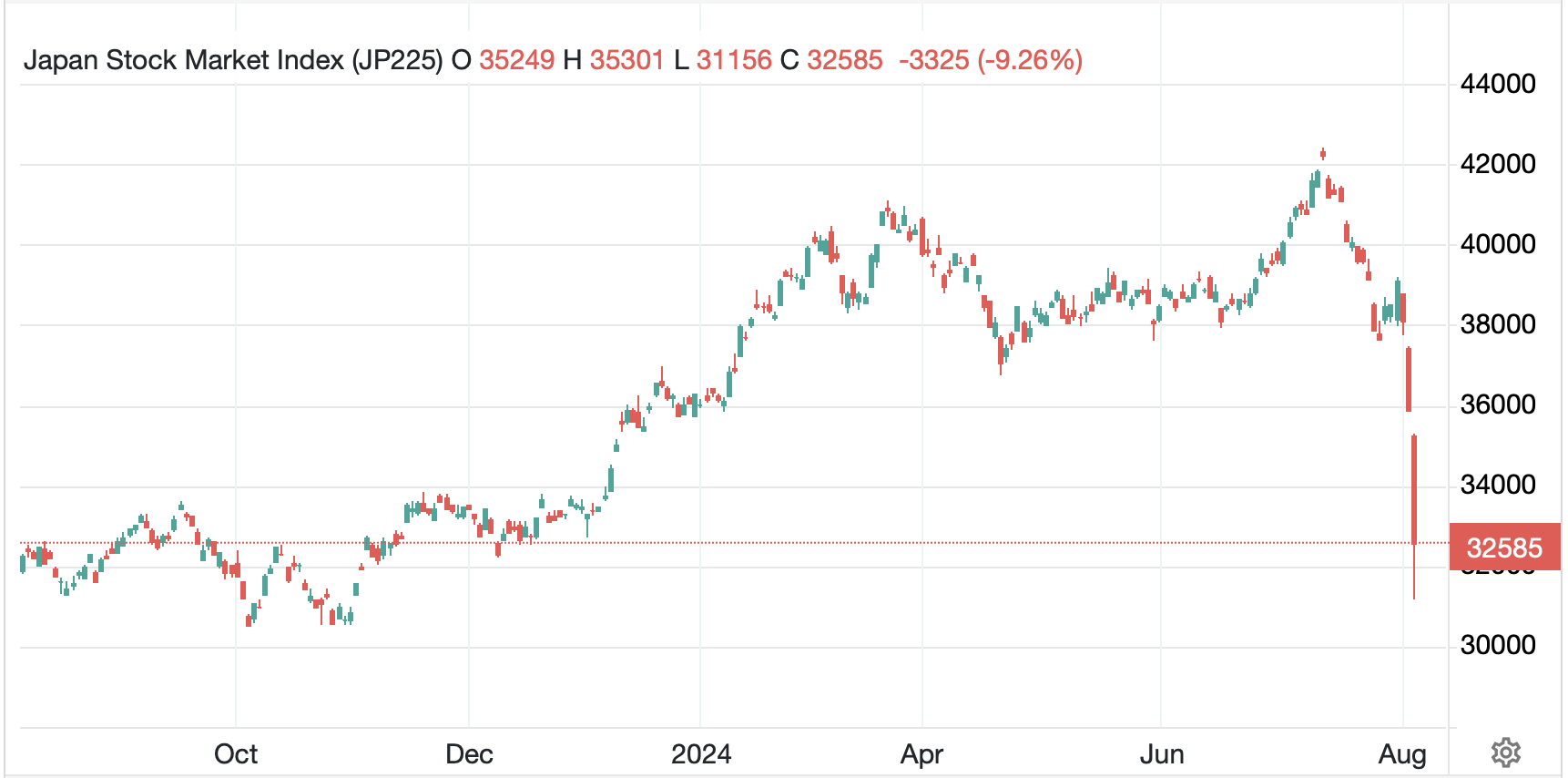
Remember the idea of the summer doldrums where everybody is on vacation, so markets move very little? Yeah, neither do I!  Here’s a different idea though, when risk is under pressure, all correlations go to 1.0.  Look at the following three charts (source: tradingeconomics.com) and explain to me how they behave independently:

There is rioting in the streets today, perhaps not in your neighborhood directly, but in many places around the world (the UK, Bangladesh, Kenya, others), as the global order that we have known for the past X years gets tested.  How big is X?  There will be many different answers to that question, but in this poet’s mind, what we are witnessing in its full glory today is the beginning of the unwinding of the market excesses that began when global interest rates headed to 0.00% in the wake of the GFC in 2009, so X=15 years.  

It is easy to wax philosophical on this subject, discussing the merits of moderating the business cycle and why interest rate policy is a net benefit, and you can be sure that before this week is over, we will get policy interventions.  But ultimately, markets need to clear to function effectively, and I would argue that the last time markets actually cleared was in 1974.  The next big opportunity to allow markets to clear was in October 1987 and the Maestro, although he had not yet earned that moniker, stepped in after that Black Monday and promised unlimited liquidity to prevent too much damage. 

Ever since then, central bankers around the world, led by the Federal Reserve, but do not forget actions like Mario Draghi’s “whatever it takes” moment, have decided that they need to manage the global economy, and market responses, and that markets were only effective if they were going higher.  (It’s ironic that TradFi people scoffed at the crypto maxim ‘number go up’, yet they believed exactly the same thing, only in a different wrapper.) As well, we all know that the concept of political will does not exist anymore, at least not in the West, as no elected politician will ever choose to fight for a policy that has short-term pain and long-term gain.  The result of this constant intervention and guidance from policymakers is that things get overdone, and bubbles inflate.  And it is much easier to inflate a bubble when you maintain policy rates at 0.00% (or negative rates in some cases).  

At this point, you will read many stories about which particular catalyst drove this market reaction, whether it was last week’s BOJ meeting where Ueda-san surprised the market and hiked rates as well as promised to reduce QQE, or whether it was the fact that Chairman Powell did not cut rates, or if it was the weak payroll report.  Others will point to the escalation in hostilities in Ukraine and the Middle East as flashpoints getting people to exit risk positions.  But in the end, the catalyst is not important.  As I wrote on Friday, and is so well explained in Mark Buchanan’s book, Ubiquity, the market was rife with ‘fingers of instability’ and an avalanche has begun.

To this poet’s eye, there needs to be more excess wrung from the market.  After all, given the underlying trade of virtually the entire bull market has been the JPY carry trade, where traders and investors borrowed JPY at 0.00%, converted it to another currency and either held that currency to earn the interest rate differential, or for the truly aggressive, used the currency to buy other risky assets (NVDA anyone?), and that trade has been building for years.  Deutsche Bank has estimated that it grew to $20 trillion in size.  I assure you it is not completely unwound!

However, as I mentioned above, I am confident that central bankers are already getting intense pressure from their respective governments to ‘do something’ to stop the rout.  But central bankers are already (save Japan) in cutting mode.  And the Fed just passed on cutting rates last week.  If they were to cut today, no matter what they said, it would remove any doubt that the only thing they care about is the stock market.  It would destroy whatever credibility they still retain.  But do not count out that response, at this stage, it’s probably 50:50 they cut this week if things continue.  After all, the Fed funds futures market is now pricing in a 95% probability of a 50bp cut in September and a total of 125bps of cuts by December!

I will be the first to say I have no idea where things are going to head from here because while market internals point to further unwinding of risky assets, policy responses have not yet been seen.  So, the best advice I can offer if you are not leveraged is do not panic.  If you are, you have probably been stopped out already anyway.  In the meantime, let’s take a look at the damage overnight.

Equity Markets in Asia:

  • Nikkei 225       -12.4%
  • Hang Seng       -1.5%
  • CSI 300            -1.2%
  • ASX 300           -3.7%   
  • KOSPI               -8.8%
  • TAIEX               -8.3%
  • Nifty 50           -2.7%

In other words, it was quite the rout, with tech shares getting hammered everywhere.  Perhaps the most surprising thing to me as that the CSI 300 didn’t fall further, although I suspect that there was significant intervention by the government to prevent that from happening.  (After all, you don’t need to be a western government to want the number to go up!)

Equity Markets in Europe:

  • DAX                 -2.6%   
  • CAC                 -2.4%
  • FTSE 100         -2.4%
  • IBEX                 -2.8%’
  • FTSE MIB         -3.0%

This tells me that these markets were not nearly as leveraged as Asian markets, likely because prospects throughout Europe have been relatively less interesting to many investors.  After all, if you are leveraging up via borrowing yen, you want to buy growth, not value, stocks, and there aren’t that many growth names in Europe.

Finally, US futures, at this hour (7:00) are lower by:

  • S&P 500          -3.0%
  • NASDQ            -4.5%
  • DJIA                 -2.1%

Bond markets are also seeing very significant movement, in the opposite direction as they are performing their safe haven role brilliantly today.  While the movements today are solid, with Treasury and European sovereign yields all lower by between 5bps and 7bps, to see the real story, you need to see the move since Friday’s opening (these are all 10-year yields).

  • US                    -20bps
  • Germany         -10bps
  • UK                   -9bps
  • Japan               -20bps
  • Australia          -17bps

The US yield curve, at least the 2yr-10yr measurement, is virtually flat today and 30yr yields are now higher than both of those maturities.  Also, look at JGB yields, down to 0.77%, as Japanese investors take their toys and go home.  The thing about this move, and the reason I don’t believe the unwinding is over yet, is that once the Japanese investment community starts to move, it takes a long time for them to get to be where they want given the amount of the assets involved.  And despite all the clutching of pearls about the US ability to sell the amount of debt they need to fund themselves; it won’t be a problem for right now.  Many people around the world will be all too happy to buy Treasury bonds regardless of some political foibles in the US.

Commodity markets are under pressure this morning, but not seeing the same type of pain as equity markets. The story here is that commodities are not directly impacted by the current movements (if anything declining interest rates should help them) but when margin calls come, people sell whatever they can that is liquid.  So, gold (-1.6%) is being liquidated to cover margin calls, not because people don’t want it.  Oil (-1.6%) is likely feeling pressure because these equity moves presage potential economic weakness and a reduction in demand, and we are seeing the same response from the industrial metals.  My take is gold is the one thing, besides bonds, that people are going to be willing to hold, and will rebound first.

Finally, the dollar is under pressure, net, but we are seeing massive movements in both directions.

  • JPY       +2.5%
  • EUR     +0.4%
  • GBP     -0.3%   
  • AUD     -0.9%
  • MXN    -3.3%
  • NOK     -1.0%
  • ZAR      -2.0%
  • CNY     +0.8%  
  • CHF      +0.8%
  • KRW    -0.5%

See if you can determine which were the favorite currencies to hold long against short JPY (AUD, MXN, ZAR). Meanwhile, the renminbi is able to gain as it continues to weaken, net against the yen, its most important competitor.  Remember, currencies are the outlet valves for economies when other markets cannot move enough.  The thing to keep in mind, especially as a hedger, is that volatility is going to be very high for a while yet.  This will not all quiet down and go away in a week’s time. 

At this point, it’s fair to ask, does data matter anymore?  Probably not today, but it will be key for the central banks if for no other reason than to cloak their actions in some fundamental story.  Alas for the Fed, there is virtually nothing to be released this week.  All we see is:

TodayISM Services51.0
TuesdayTrade Balance-$72.4B
ThursdayInitial Claims250K
 Continuing Claims1880K

Source: tradingeconomics.com

As well, and perhaps remarkably, so far on the calendar we only have three Fed speakers, Goolsbee, Daly and Barkin.  However, it seems almost certain we will hear from others, especially if the rout continues.

Right now, fundamentals do not matter.  My sense is we will see a bounce of some sort after the first wave ends, perhaps as soon as tomorrow, but the narrative of the soft landing has been discarded.  Look for more political pressure on the Fed to act, and to act soon.  Also, do not be surprised if the rest of the week ultimately sees a slower, but steady, decline in risk assets as those who haven’t panicked react to the situation and reevaluate just how much they love their positions.  Consider, Warren Buffet sold some of his favorite positions last week and is loaded with cash to act.  But there is nobody who is more patient than he.  

Good luck

Adf

Destined for Sloth

The Chinese are starting to worry
That if they don’t act in a hurry
Their ‘conomy’s growth
Is destined for slowth
Explaining their rate cutting flurry


Sunday night, the PBOC surprised markets by cutting both their 1-year and 5-year Loan Prime Rates by 10 basis points each.  As well, they cut the rate on their newly developed 7-day repo rate by 10bps as they endeavor to shorten the maturity of their money market operations. At the time, it was taken as a response to the Third Plenum and the only concrete action seen as new support for the economy.  As its name suggests, those rates represent the cost to borrow for credit worthy companies.  A quick look at the history of this rate (the blue line), which was first tracked toward the end of 2013, shows that over time, it has done nothing but decline.  I have overlayed a chart of USDCNY in the chart (the grey line) to help appreciate the long-term trend in that as well which, not surprisingly, shows a steady weakening of the renminbi (rise in the dollar).

Source: tradingeconomics.com

But the reason I bring this up is that last night, the PBOC surprised markets yet again by cutting its One-Year Medium-Term Lending Facility by 20 basis points, to 2.30%.  Not only was this the largest cut since the pandemic, but it was also done at an extraordinary meeting and combined with an injection of CNY235 billion (~$32B) into the economy.  Arguably, this is the most aggressive monetary policy stance that has been effected by the PBOC since the summer of 2015 when they surprisingly devalued the renminbi 2%.  Apparently, the PBOC is trying to adjust its policy actions to be more in line with the G7 where central banks use short term rates as their tools.  One other thing this implies is that President Xi remains steadfastly against any fiscal stimulus of substance at this point.  On the one hand, you must admire that effort, but I fear that the domestic Chinese economy remains so weighed down by the ongoing property sector problems, achieving their 5.0% GDP growth target is going to become that much more difficult as the year progresses.

For our purposes, though, the story is all about the CNY (+0.7%), which rallied sharply after the announcement, continuing its movement from the Monday rate cuts which totals 1.1%.  Now, ordinarily one might think that a country cutting its rates would lead to a weaker currency, ceteris paribus, However, given the market outcome, there is much discussion about how the PBOC “requested” Chinese banks to more aggressively buy CNY to support the currency.  Interestingly, the fixing rate on shore overnight (7.1321) continues to weaken ever so slightly overall, but now the spread between the fix and the market has fallen to just over 1%, well within the +/- 2% band and an indication there is less pressure on the currency.  My take is this is just window dressing, but I would not fight it.  I expect that we will see USDCNY slowly return to higher levels over time, with the key being it will take lots of time.

The ongoing rout
In tech stocks has another
Victim, dollar-yen

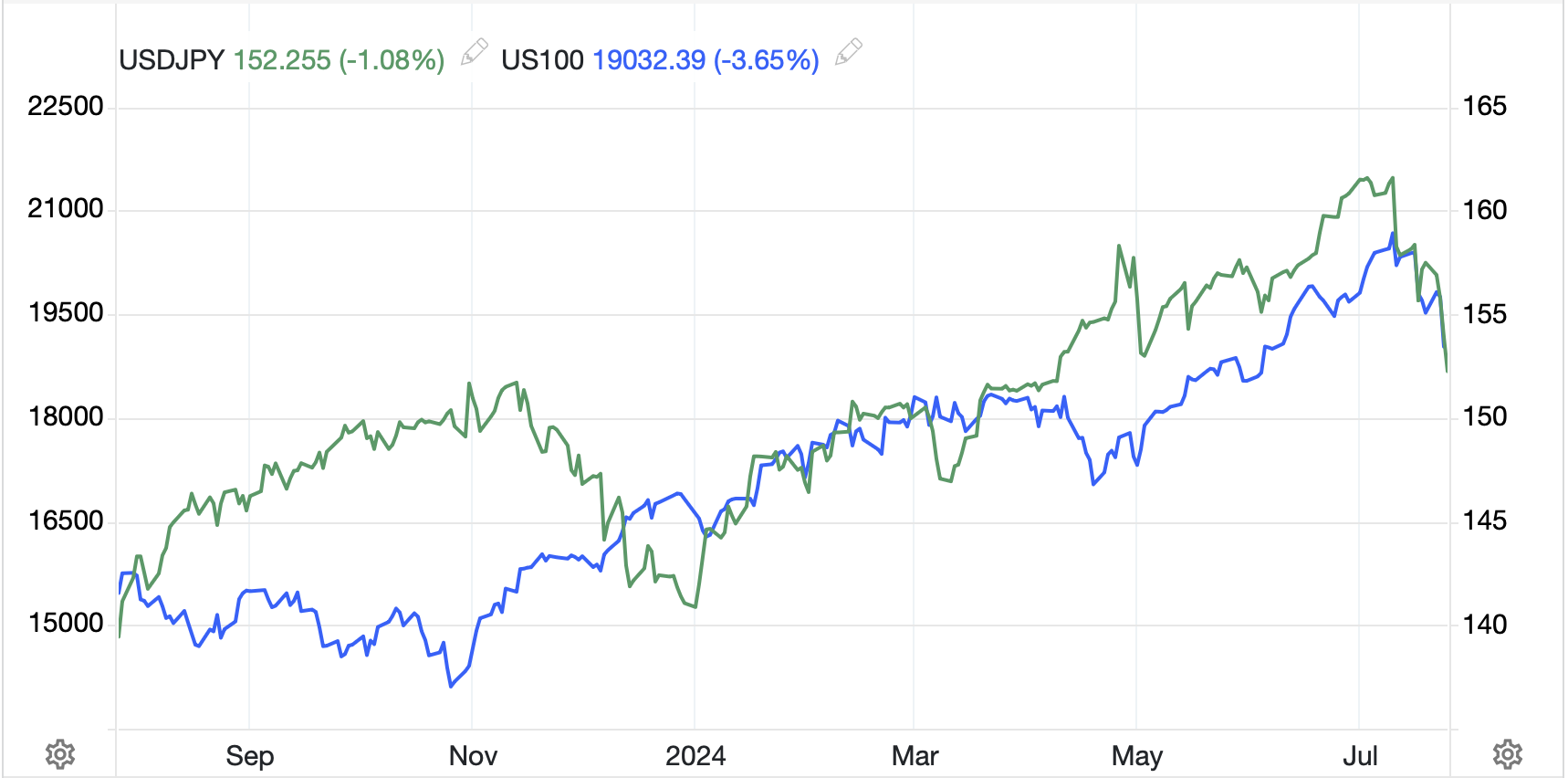
Under the guise, a picture is worth a thousand words, the below chart showing the NASDAQ 100 (blue line) and USDJPY (green line) overlaid is quite interesting.

Source: Tradingeconomics.com

While there is an ongoing argument amongst market practitioners as to whether it is the decline in the tech sector that is driving USDJPY’s decline or the other way round, what is clear is that there is a strong correlation between the two.  If you think about what the USDJPY trade represents, it is the purest form of a carry trade, shorting the cheapest currency and using the funds to buy a much higher yielding currency with maximum liquidity.  But another thing to do with those funds obtained from borrowing yen and buying dollars was to use the dollars to jump on the tech stock bandwagon.  After all, that added another 30% to the trade since the beginning of the year.  

However, over the past two weeks, nearly one-third of the NASDAQ gains have been erased and that has been made worse by the >6% rise in the yen.  At this stage, it no longer matters which is driving which, the reality is that we are seeing significant short covering in the yen with sales in other assets required to unwind the trade.  Arguably, this is why we are seeing virtually every risk asset lower this morning, although bonds are holding up as havens, as all have been funded with short yen.  Given that relationship, I am coming down on the side of the yen being the driver, but as I said, I don’t think it matters.  

The real question is can it continue?  It is important to understand that when markets achieve excessive levels like we saw in USDJPY, they rarely simply unwind to some concept of fair value.  Rather they typically overshoot dramatically in the other direction.  As such, if we assume PPP is fair value, and PPP for USDJPY is currently around 110.00, it appears there is ample room for USDJPY to decline much further.  Consider, this movement has happened, and the Fed has not even started to cut rates.  If we do, indeed, fall into recession, the Fed will respond, and I expect that we could see a very sharp decline in USDJPY.  Something to consider looking ahead.

While that was a lot about the currency markets, they seem to be the current drivers, so are quite important.  But let’s look at everything else.

Equity market pain has been universal with Japan (-3.3%), Hong Kong (-1.8%) and China (-0.6%) all following the US lower overnight and in Europe, this morning, it is no better with the CAC (-2.2%) the worst performer, but all the major indices falling sharply.  US futures are little changed at this hour (7:00), but remember, we are awaiting key GDP data and more earnings numbers, which have been the driver.

As mentioned above, bond markets are rallying with Treasury yields lower by 5bps and most European sovereigns seeing declines of -3bps or -4bps.  Credit is an issue as Italian BTPs are the laggard this morning, with yields there only lower by 1bp.  Equally of interest is the fact that the US yield curve inversion has been reduced to just 14bps and has been normalizing dramatically for the past several sessions.  One thing to remember about the yield curve is that when it inverts, it indicates a recession is coming, but when it uninverts, it indicates the recession has arrived!  This is all of a piece with softer economic data and expectations of Fed policy ease coming soon to a screen near you.

In the commodity markets, nobody wants to own anything.  Oil (-1.3%) is continuing its recent poor performance despite EIA data showing significant inventory reductions.  This is not a sign of strong demand.  But we are also seeing weakness across the entire metals space with gold (-1.0%) breaking back below $2400/oz and silver and copper under severe pressure.  Right now, nobody wants to hold these, although I suspect that the long-term supply/demand situation remains bullish.

Finally, the dollar is mixed overall.  While we have seen strength in JPY and CNY, as discussed above, and CHF (+0.8%) is also showing its haven status and use as a funding currency, there are numerous currencies under pressure, notably AUD (-0.8%), NOK (-0.8%), MXN (-0.8%), ZAR (-0.7% and SEK (-0.6%) all of which are commodity linked to some extent.  Yesterday, the BOC cut rates by 25bps, as expected, but the Loonie has been steadily weakening for the past two weeks, so yesterday’s decline and today’s is just of a piece with that.  Ultimately, we are watching a serious risk-off event, and I expect the dollar will hold its own vs. most currencies, although JPY and CHF seem to have room to run yet.

On the data front, once again yesterday’s data was on the soft side with the Flash Manufacturing PMI falling to 49.5, well below expectations and New Home Sales slipping to 617K.  In fact, it is difficult to find the last strong piece of data, perhaps the ex-autos Retail Sales number from last week.  This morning, we see Initial (exp 238K) and Continuing (1860K) Claims, Q2 GDP (2.0%), and Durable Goods (0.3%, 0.2% ex transport).  The Atlanta Fed’s GDPNow tool is indicating GDP in Q2 was 2.6%, well above the forecasts.  However, I think of much more interest will be to see how it starts out for Q3.  We have had a spate of weak data, and those recession calls are growing louder.

This is a tough market, but I expect we have not yet seen the last of the risk-off trade (just consider how long the risk-on trade has been going on) so further dollar strength against most currencies, except for JPY and CHF, and further weakness in commodities and equities seem the most likely direction.

Good luck

Adf