Feelings of Doubt

Two candidates took to the stage
But neither of them could assuage
The feelings of doubt
‘bout how things turn out
And how we can all turn the page
 
Meanwhile there’s news south of the border
Where AMLO, the courts, did reorder
This has raised some fears
That in coming years
The nation will lack law & order


Before I start, please take a moment to remember those 2,977 nnocent lives lost on this horrible day 23 years ago, this generation’s day of infamy.

Now, on to the market discussion.  I don’t know about you, if you watched the debate, but frankly I was pretty bored and disappointed by the whole thing.  I heard many platitudes from both sides, many accusations from both sides, and couldn’t help but notice how the moderators interjected themselves consistently in favor of Vice-president Harris via their “fact-checking”.  All in all, I don’t think we learned that much, although Harris is certainly more coherent than Biden was.  My guess is that very few undecided voters changed their minds.  As to the market’s reaction, perhaps the only notable result was that gold rallied slightly as no matter who wins the election, the idea that fiscal prudence is on the agenda remains anathema to both sides.  Equity futures were slightly lower when the debate started, and still slightly lower when it ended, as well as this morning.  It ought not be surprising as the impact of politics on equity markets has always been unclear in the short run.

The other political story of note was that in Mexico, AMLO, who remains president for a few more weeks, was able to finally get the change to the constitution he has been seeking his entire term, which now allows for judges, including supreme court justices there, to be elected rather than appointed.  The concern is that this will politicize the judicial system.  An independent judiciary is a key ingredient for international investors as they seek some comfort that business decisions can be fairly considered.  However, judicial elections may call that into question and that is likely to have a longer-term negative impact on the Mexican economy.  As you can see from the chart below, the peso has been massively underperforming since April, falling more than 22% and breaching the 20.00 peso level for the first time in more than 2 years, as concerns over this issue have grown.  Add to this the fact that inflation in Mexico has drifted slowly lower and expectations are rising for more aggressive rate cuts by Banxico, and you have the recipe for a weaker currency.  While the peso has bounced 0.9% this morning, this trend lower remains clear for now.

Source: tradingeconomics.com

With all that out of the way, it is time to turn to this morning’s big news, the August CPI report.  Current median expectations are for a 0.2% M/M, 2.6% Y/Y rise in the headline number and a 0.2% M/M, 3.2% Y/Y rise in the ex-food & energy reading.  However, I have seen estimates ranging from 0.0% M/M to 0.3% M/M based on various subcomponents like used cars, apparel and shelter.  Ahead of the release, I have no further information than that, but let’s consider what can happen in either situation.

First, we know that the Fed is going to cut rates next week, regardless of the number today.  Currently, the Fed funds futures market is pricing a 29% probability of a 50bp cut.  A quick look at the below table from the CME shows this is close to the lower end of the range of expectations over the past month, which back in August were at 51%.

source: cmegroup.com

The current working assumption seems to be that a soft number will virtually assure a 50bp cut regardless of any other economic data, while a 0.3% print will lock in a 25bp cut.  Once again, given the apparent resilience of the economy, the rationale for cutting rates aggressively remains elusive.  The cynic in me might point to the fact that Chairman Powell is a private equity guy, someone who made his fortune in that space, and he has been receiving pressure from all his old friends and colleagues to cut rates to help resurrect the sales activity in that market.   While that may seem glib, given the way things work in the corridors of power in Washington, it cannot be ruled out.  However, history has shown that when the Fed begins a cutting cycle with 50 bps, it is generally because they are behind the curve and recession is already here.  If that is the situation, while next week a 50bp cut may be well received by equity investors, the medium-term outlook is not nearly as bright.  At this point, the question is, how will markets respond to the data.

Let’s start with looking at how things behaved overnight.  Yesterday’s mixed US session, with the DJIA slipping while both the S&P and NASDAQ rallied was followed by uniform weakness in Asia.  Perhaps nobody there was enamored of the debate, which was taking place while those markets were open, but we saw the Nikkei (-1.5%) fall sharply with weakness also in the Hang Seng (-0.75%) and CSI 300 (-0.3%). In fact, only Singapore (+0.5%) managed any gains during the session with every other regional market declining.  But that is not the story in Europe, where all markets are higher, albeit not that much higher.  Spain’s IBEX (+0.65%) is the leader with other markets showing gains of between 0.1% (FTSE 100) to 0.3% (DAX).  For those who are concerned that a Trump victory may isolate Europe more than a Harris victory, perhaps there was more encouragement she could win after the debate.

In the bond market, after some significant declines in yields yesterday, where Treasury yields fell nearly 10bps, this morning they have fallen a further 2bps and are now back to their lowest level since June 2023.  At 3.6%, nearly 200bps below Fed funds, the bond market seems to be pricing in a recession.  Interestingly, neither stocks nor credit spreads are pricing that same outcome.  European sovereign yields also fell sharply yesterday, although not as much as Treasury yields, more like 5bps, and this morning they are a bit lower again, somewhere between -1bp and -3bps.  Perhaps the most interesting outcome is that JGB yields have slipped 4bps, once again delaying the idea that the BOJ is going to tighten policy soon.

In the commodity markets, oil (+2.6%) has rebounded sharply this morning as concerns over Hurricane Francine shutting in Gulf of Mexico production rise ahead of expected landfall later today.  However, the trend here remains lower as demand concerns remain front and center and supply continues to grow.  My sense is that the declining demand is a signal that economic activity is slowing, but it will return with a return to more robust global growth.  In the metals markets, everything is back in the green with gold (+0.2%) once again pushing toward its recent all-time highs, while both silver and copper show strength this morning.  I believe those moves are related to the anticipation of larger cuts by the Fed and other central banks coming soon.

Finally, the dollar is under pressure across the board this morning, also playing along with the theme of the Fed cutting rates more aggressively going forward.  In fact, literally every currency in both the G10 and EMG blocs are stronger today with most modestly so, on the order of 0.2%, although we have seen MXN (+0.85%) rebounding from its recent declines discussed above, and ZAR (+0.45%) benefitting from the strength in metals markets.

Aside from the CPI data, the only other news is the EIA oil inventories, where last week saw a large draw overall, and the only forecast I see is for a modest build of <1mm barrels.  However, CPI will determine today’s price action.  I think we are in a ‘good news is good’ scenario so a soft number should see a rally in stocks, bonds and commodities while the dollar suffers further.  On the flip side, a high print should see the opposite reaction.

As I reread my note, it appears to be an accurate description of the fact that there are features in the data pointing to further economic strength and other pointing to weakness.  Truly, nobody knows what lies ahead.

Good luck

Adf
Source of Despair

There once was a US VP
Who pined for the presidency
Her views were well-known
But many had shown
The voters could well disagree
 
So last night, amidst great fanfare
She finally took to the air
Disclaimed all her views
And thought to accuse
The Right as the source of despair
 
The reason for pointing this out
Is many are starting to doubt
If she wins the race
That she won’t debase
The buck, which could head for a rout


While this poet is always reluctant to discuss politics in the morning, sometimes that is the story that is driving the discussion.  Today, that is the case in the wake of VP Harris’s first interview of her presidential campaign.  One of the major complaints about her campaign was she had ostensibly changed many long-held views by 180° without explanation.  This was supposed to be rectified in the interview.  It should be no surprise that her supporters claim she did just that swimmingly while her detractors feel they know nothing more this morning than they did before the interview aired.

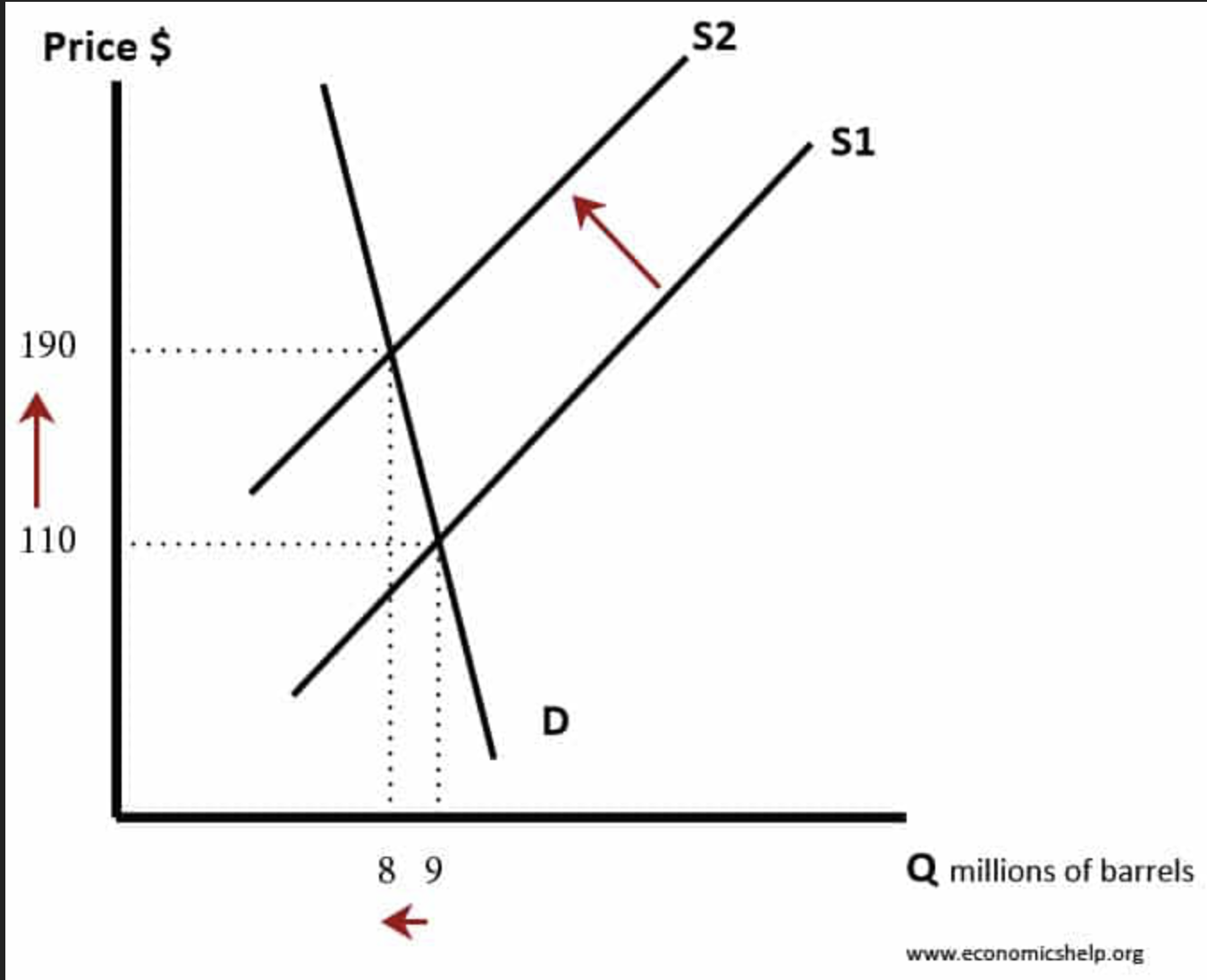
For instance, a key question is about energy markets, specifically fracking.  From a market perspective, if a President Harris were indeed to ban fracking, her long-standing view, oil prices would surge dramatically given that somewhere around 6mm-7mm barrels per day are pumped using this method.  At the margin, removing 6% of supply in the oil market could easily double the price given the relative inelasticity of demand as per the chart below.

My take is that would be quite destructive to the economy, dramatically reducing growth while raising inflation substantially.  My point is these policy pronouncements matter, and market participants know that.  Now, based on the price behavior of oil (unchanged today) and still trading in the middle of its recent year-long trading range, it is clear the market is not too concerned about that outcome.  Whether that is because the market is betting on a Trump victory or the market is betting that she will not be able to withstand the political pain of higher gasoline prices that would come with a dramatic reduction in US oil production, I have no idea.  

I am merely highlighting that the consequences for the economy and markets are very large depending on the outcome of the upcoming presidential election here.  And those consequences will be felt worldwide.  Were the US to decide to cede its energy status, it would be quite easy to see the dollar fall substantially in value as capital seeks a safer home elsewhere or simply because there would be less demand for dollars to pay for oil.  It would be quite easy to see bond yields rise as investors seek alternatives or demand higher yields to hold US paper.  These outcomes are not guaranteed, they are merely one direction in which things could turn.  

Remarkably, away from that story, there is precious little else of note ongoing as we await this morning’s PCE release.  It’s not that there wasn’t other data, there was, but the outcomes were close enough to expectations to result in limited movement.

For instance, last night Japanese data showed a modest rise in the Unemployment Rate to 2.7% as well as a rise in Tokyo CPI (2.6%, 2.4% core, 1.6% super core) with all three readings higher than last month.  Meanwhile, both Korean and Japanese IP were soft.  But none of that fazed markets as we saw gains in both the Nikkei (+0.75%) and KOSPI (+0.45%) while the yen (-0.25%) and won (0.0%) really did very little nor did JGB yields move.

Meanwhile, this morning there was a raft of European data with inflation readings from both France (1.9%) and Italy (1.1%) helping to complete the Eurozone composite rate (2.2%).  These readings follow Germany’s lower than expected 1.9% yesterday and seem to cement a 25bp cut by the ECB next month.  Alas for the French, GDP continues to underperform with Q2 printing at 0.2% M/M, 1.0% Y/Y, helping to boost the case for a rate cut.  The market response here has been more focused on the potential for cuts than the lackluster economic performance as equity markets are higher throughout Europe (DAX +0.2%, CAC +0.4%, IBEX +0.6%) and the UK (+0.3%).

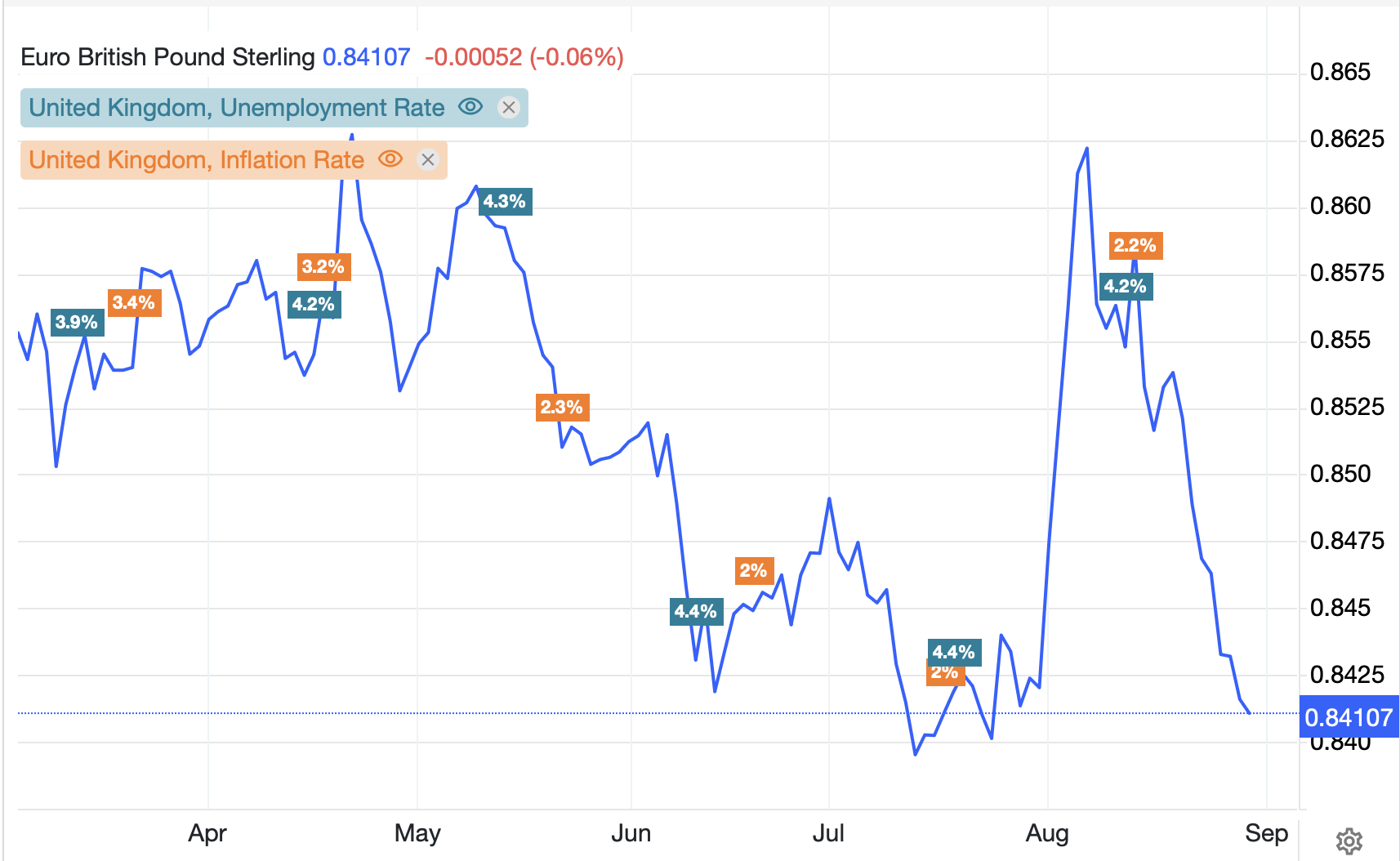
Perhaps more interesting is the fact that UK economic data continues to outperform the continent with the most recent data showing the housing market there remains solid, at least based on new mortgage approvals and mortgage lending data.  This dichotomy is most evident in the EURGBP exchange rate which has moved sharply in the favor of the pound, more than 2.5%, over the past three weeks, after the BOE cut rates at their last meeting but in a very close 5/4 vote indicating that concerns over inflation remain, and future cuts are not baked in.

Source: tradingeconomics.com

And I feel that really sums up the overnight discussions.  In other markets of note, Chinese shares (CSI 300 + 1.3%) finally got off the schneid and had their first up day in a week.  Too, the Hang Seng (+1.1%) rallied alongside.  As to US futures, ahead of the PCE all three major indices are seeing futures higher following yesterday’s gains.

In the bond market, Treasuries are unchanged this morning and European sovereign yields are lower by 1bp across the board.  Clearly, there is little concern of either a collapse in Europe, nor a runaway higher in activity.  And that 25bp cut is baked in at this point.

In the commodity markets, as mentioned above, oil prices are unchanged awaiting the next shoe to drop, which in the metals markets, gold (0.0%) is unchanged, holding its recent gains while both silver (+0.5%) and copper (+1.0%) rebound further from some weakness earlier in the week.  

Finally, the dollar continues its mixed performance, with a number of the high yielding EMG currencies showing strength this morning (MXN +0.9%, ZAR +0.7%, BRL +0.6%) as the belief in the market is that the Fed will not only cut in September but will continue to do so going forward.  However, in the G10 bloc, the movement has been far less significant with only the yen moving more than 0.2%.  in my opinion, this is due to a combination of curiousity about the data this morning and the fact that it is the Friday of a holiday weekend in the US, hence most desks are lightly staffed.

As to that data, we see Personal Income (exp 0.2%), Personal Spending (0.5%) and PCE (0.2%, 2.6% Y/Y) along with Core PCE (0.2%, 2.7% Y/Y).  Later this morning we get Chicago PMI (45.5) and Michigan Consumer Sentiment (68.0).  Yesterday’s Claims data was on the button and the GDP data was actually revised higher to 3.0% in a surprise.  Once again, it remains difficult for me to understand the idea that the Fed needs to cut rates aggressively given the economy seems to be working well, at least based on the data the Fed discusses with us.  And yet, the market is still pricing in a one-third probability of a 50bp cut next month.

Putting it all together, while I believe the Fed is more focused on unemployment than inflation, as they have basically claimed victory over the latter, if we see a soft reading this morning, I suspect the market will price a greater probability of a 50bp cut and the dollar will suffer while stocks and bonds rally.  But a strong reading will not have the opposite effect as the focus will be on next week’s unemployment data.

Good luck and good weekend

Adf

No Quid

We have now a President Joe
Whose allies had asked him to go
Reject them, he did
For there was no quid
To pay him if he gave the quo
 
But Sunday, the news was revealed
That his campaign, he would now yield
It’s, therefore, not clear
Who’s running this year
‘Gainst Trump, it’s a wide-open field


Of course, you are all aware by now that President Biden has decided to abandon his re-election campaign and “to focus solely on fulfilling my duties as president for the remainder of my term.”  While he has endorsed Vice-president Kamala Harris, and since the announcment, there have been more endorsements for the VP, nothing is clear yet.  If nothing else, there has been no clarity whatsoever regrading who VP Harris would select as her running mate should she be the presidential nominee.

In the end, this adds uncertainty to the political situation and is likely to add some volatility to financial markets as well.  However, remember that political impact on financial markets tends to be relatively rare and if it is going to be significant, must be a genuine surprise.  Given the drumbeat from an increasing number of Democrat politicians and donors, this cannot be considered a real surprise.  I suspect that recent volatility will continue, but it is unlikely to increase substantially because of this.  However, if, say, the Fed were to cut rates next week, that would be a genuine surprise with a major market reaction.  (That is a hypothetical, I am not forecasting that.)  All told, the circus that is the US presidential campaign seems likely to simply continue for the next four months.

In China, the Plenum has ended
And rate cuts last night were extended
But is that enough
To help Xi rebuff
The weakness with which he’s contended

In the meantime, while all eyes around the world remain on the US as both allies and enemies try to determine what is happening, and likely to happen going forward, in the US regarding its presidential politics, China’s Third Plenum has ended, and the decisions have been made public.  Reuters has given an excellent, and succinct, description of what this meeting represents and why it is seen as so important.  The link above is a worthwhile, and quick read, but the money lines are [emphasis added]: “China’s ruling Communist Party commenced its so-called third plenum on Monday, a major meeting held roughly once every five years to map out the general direction of the country’s long-term social and economic policies,” and “This week’s third plenum, described by Chinese state media as “epoch-making”, is expected to deliver major initiatives to address the risks and obstacles related to China’s long-term social and economic progress.”  

So, in essence, this is the annual meeting where Xi and his fellow senior policymakers focus on the economy for the next decade.  This is quite timely given the economy in China has been consistently disappointing over the past several years with the most recent data releases showing that GDP growth declined to 4.7%, far below expectations as well as Xi’s target, in the second quarter.  Now, the law of large numbers would indicate it will be increasingly difficult for China, a $17 trillion economy, to continue to grow at previous rates, especially since its population is shrinking.  But that will not stop Xi from trying, or at least from having the government publish numbers that indicate he is succeeding.  

Ultimately, the problem in China remains that domestic consumer demand remains lackluster, largely because of the sharp decline in the Chinese property market.  In China, property had been a key store of personal wealth as there were limited vehicles in which citizens could invest.  But with that bubble having burst, and continuing to deflate, ordinary people do not feel the confidence to continue previous consumption patterns.  This is the underlying reason why China continues to focus on industry, and the genesis of the international angst over China’s manufacturing exports.  It is also the genesis of why tariffs are so prominent in discussions around Western policy circles.  The perception that China is dumping product offshore at a loss, undermining Western companies, and therefore Western job markets, is a powerful political motive to find some way to restrict said exports.  Tariffs are the most obvious first solution.

But China knows there are problems internally and that led to last night’s surprise cuts in the Loan Prime Rates for both 1-year and 5-year, with each being cut by 10 basis points.  I would look for further rate cuts shortly after the Fed starts to cut rates here (assuming they do so) whether that is next week or in September. Ultimately, I continue to believe that the PBOC will need to allow the renminbi to weaken, but it will be a long, drawn-out process as Xi remains steadfast in his view that the currency must be seen as a stable store of value.  Ironically, I believe we are entering a timeline when pretty much every nation will seek to weaken their currency to gain a trading advantage, but of course, if that is the case, then the only thing that will change is inflation will rise.  Oh well, policymakers around the world all have the same blind spots.

And those are really the only stories of note, although naturally, the first one is massive and will be the talk of the world for at least the next month until the Democratic convention produces a presidential ticket.  So, with all that in mind, let’s look at the market responses overnight.

Friday’s continued weakness in the US equity markets was mostly followed in Asia with the Nikkei (-1.2%) continuing its recent retracement from the highs made a week and a half ago.  And that red ink was seen throughout the region with one exception, the Hang Seng (+1.25%) as it responded to the PBOC’s rate cuts.  Interestingly, the onshore markets (CSI 300 -0.7%) did not.  However, in Europe, this morning, equities are having a great day with strong gains across the board.  While part of this is certainly simply a rebound from last week’s declines, it seems that there is a thesis brewing regarding Europeans now gaining confidence that Mr Trump will not be re-elected and so attracting some bullish views.  I don’t necessarily agree with that, but that seems to be the take.  As to US futures, they are firmer this morning as well, although given the sharp declines at the end of last week, this seems a reflexive bounce

In the bond markets, Treasury yields, which backed up despite the equity market declines on Friday, are softening a bit this morning, down 2bps, while European sovereign yields are mostly little changed from Friday’s levels, down about 1bp in most nations.  Right now, there is very little excitement in this space.

In the commodity space, oil prices are continuing their decline from last week with WTI back below $80/bbl as this market seems to believe that Mr Trump will win in November and that he is very serious about ‘drill baby, drill’.  Certainly, I would anticipate a Trump administration will be quite focused on increasing energy output and that should undermine prices.  As to the metals markets, gold (+0.5%) continues to find buyers although it did sell off sharply on Friday, but the rest of the space is under pressure, notably copper (-1.25%) as that Third Plenum did not encourage anyone that China would be subsidizing further economic activity and driving up demand for the red metal.

Finally, in the FX markets, the dollar is under modest pressure overall, although not universally so.  JPY (+0.4%) is the leading gainer in the G10 space as hopes for a Fed cut continue to impact views on the carry trade here.  However, the euro (+0.1%) and pound (+0.25%) are also edging higher, albeit on much less information.  Perhaps, the idea that Trump has been vocally calling for a weaker dollar is part of this movement, but that seems awfully early in the process.  On the flip side, AUD (-0.3%) is being weighed down by the decline in commodity prices.  In the EMG bloc, MXN (+0.35%) is the biggest gainer on the day although the CE4 currencies are all demonstrating their high beta with the euro as they have gained about 0.25% across the board.  Lacking new information, it appears that the peso is acting as a broad EMG proxy for traders wanting to short the dollar.

On the data front, the important stuff all comes at the end of the week with GDP on Thursday and PCE on Friday.

TodayChicago Fed National Activity0.3
TuesdayExisting Home Sales3.99M
WednesdayGoods Trade Balance-$98.0B
 Flash Mfg PMI51.7
 Flash Services PMI54.4
 New Home Sales640K
ThursdayInitial Claims239K
 Continuing Claims1869K
 GDP Q21.9%
 Durable Goods0.4%
 -ex Transport0.2%
FridayPersonal Income0.4%
 Personal Spending0.3%
 PCE0.1% (2.4% Y/Y)
 Core PCE0.1% (2.5% y/Y)
 Michigan Sentiment66.5
Source: tradingeconomics.com

Mercifully, there will be no Fedspeak at all this week as they remain in the quiet period.  The expected declines in PCE inflation will continue to support the September rate cut expectation which remains at a virtual 100% probability according to the CME Fed funds futures pricing.  That would be in concert with everything we heard from Fed speakers in the past several weeks, although the stronger than expected Retail Sales data has some claiming the Fed will remain on hold.  My read is there are fewer people discussing an impending recession, although that may be more about the cacophony of political discussion drowning things out, than a real change in sentiment.  Alas, I find myself far more concerned about an economic slowdown, although not necessarily with a corresponding decline in inflation.  Meanwhile, the dollar, while under some modest pressure, remains pretty solid and I wouldn’t look for a significant change, at least not until Friday’s data.

Good luck

Adf