
Finding a Cure

Apparently President Xi
Is keen to continue to be
The story du jour
While finding a cure
For China and its ‘conomy

But elsewhere, the market’s fixation
Is central bank communication
Tomorrow, Chair Jay
Seems likely to say
They’ve not yet defeated inflation

The story in China continues to be one of weakening economic activity and a government that is increasingly desperate to address the situation while maintaining their iron grip on everything that occurs in the country.  Of course, the problem with this thesis is that economic activity works far better without government interference, but that is the bed they have made.  At any rate, the word out of the CCP’s Politburo is that more support is coming with expectations now for lower interest rates as well as still looser property investment policies.  While it seems they don’t want to make direct cash injections into the economy yet, that appears to be the next step.

However, the announcements last night were sufficient for a bullish slant on everything China along with positive knock-on effects for those nations that are heavily reliant on a strong China for their own economic progress.  The result is that we saw dramatic strength in Chinese equity markets with the Hang Seng (+4.1%) and CSI (+2.9%) both having their best days in months.  Even with these moves, though, the Hang Seng remains more than 37% below its 2021 highs while the CSI is about 34% off those levels.  The point is that while last night’s session was quite positive, belief in the Chinese economic story remains a bit suspect yet.

Elsewhere, however, the PBOC is doing its level best to prevent the renminbi from declining sharply as they set the fix nearly 1% stronger than expected based on analysts’ models, and ultimately, the currency closed 0.6% stronger on the session.  Now, it remains well above the 7.00 level, but it seems quite clear that Pan Gongsheng, the freshly appointed PBOC governor, is making a statement that the renminbi should not fall dramatically.  I suspect that if the Chinese economy continues to flounder, that attitude may change, but for now, that is the party line.  As such, it should be no surprise that the rest of the APAC currency bloc performed well last night, along with AUD (+0.3%) the best G10 performer.

But away from that story, the market’s attention is turning almost entirely to the trio of central bank meetings that are starting with announcements due tomorrow afternoon (Fed), Thursday morning (ECB), and Thursday night late (BOJ).  Let us begin with the Fed, where the meeting commences shortly, and they are set to discuss the current situation in the economy as well as how things have changed since their June meeting and what their forecasts for the future look like.  

One area that is worth discussing is the Fed’s Reverse Repurchase Program (RRP or reverse repo) which serves as a low-risk investment outlet for excess funds in the system.  Prior to the debt ceiling crisis, there was a great deal of concern that when the Treasury started to issue T-bills to refill the Treasury General Account, the government’s checking account, the liquidity to buy those bills might come out of the stock market and undermine the stock market rally.  But there was another potential source, the RRP program, which prior to the debt deal had more than $2.3 trillion parked, mostly cash held by Money market funds.  However, since the TGA bottomed at the end of May, and the Treasury has been issuing T-bills at a record rate, it turns out that the entire TGA balance has been filled by a reduction in RRP.  In other words, there has been no liquidity drain from the markets, writ large, hence the equity markets continued ability to rally.  That amount has been approximately $500 Billion.  (See chart below with data from Bloomberg and the poet’s calculations)
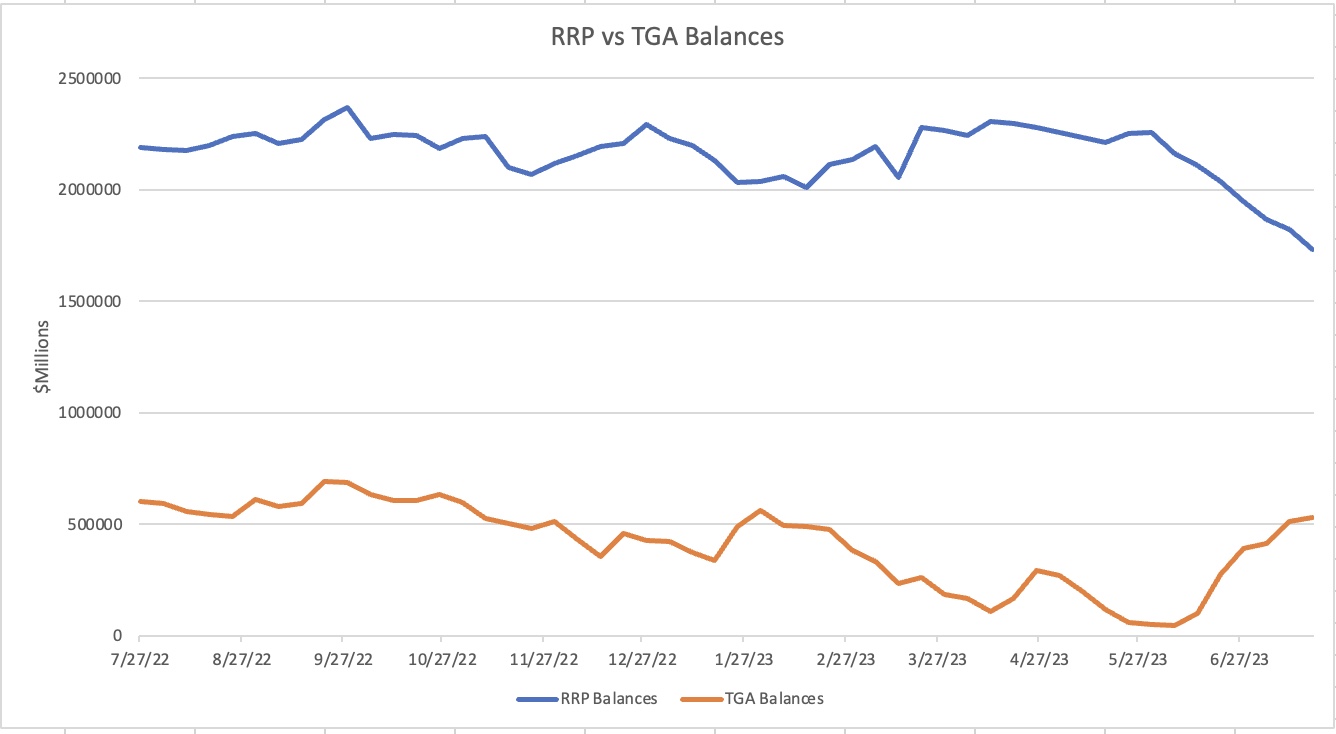
Of course, there is a cost to this, and that is that the Treasury has been paying a higher yield on T-bills than those money market funds could get in the RRP market, and that, my friends, is adding to the already gargantuan budget deficit.  Since the start of this process, 3mo T-bill yields have risen 50bps, right alongside the Fed funds rate.  In essence, the Treasury is paying to keep the stock market higher.  

There is another short-dated money issue and that is Interest on Reserves, the rate the Fed pays banks for excess reserves that are held at the Fed.  That is currently set at 5.15%, between the Fed’s 5.00% to 5.25% band for Fed funds.  One subtle tweak the Fed could make is to alter that relative level when they raise rates tomorrow in an attempt to adjust the amount that is held there.  After all, other uses for those funds could be satisfying loan demand assuming that existed.  Arguably, a lowering of that rate would imply the Fed is seeking fewer excess reserves in the system, somewhat of a tightening exercise.  

At this stage, the 25bp rate hike is baked in the cake and is assumed by virtually every analyst with just 5 of the 108 analysts surveyed by Bloomberg calling for no hike.  Futures markets are pricing a 97% probability as well, so the reality is that all the action will be in the press conference as well as any new tweaks to the statement.  In my view, there has not yet been enough evidence of a considered slowing in inflation for the Fed to change its tune, but by the September meeting, we will have seen a lot more data and depending on how that plays out, things could be different.  But not this month.

Heading into this morning’s session, that Chinese stock rally was not really widely followed elsewhere as the Nikkei was unchanged and most of Europe is higher by just basis points.  That minimal movement is true in US futures as well.

Bond yields are a touch firmer, about 2bps across Treasuries and virtually the entire European space with only Italy (+4bps) an outlier.  The only data of note was the German IFO report, which was on the soft side, but not dramatically so.  I suspect that the yield move is in anticipation of the coming central bank activities.

In the commodity space, after another rally yesterday, oil is essentially unchanged and consolidating its recent gains.  However, the base metals have rallied sharply on the back of the China news with copper higher by almost 2% and aluminum by 1%.  Meanwhile, gold continues to trade in a very narrow range just below $2000/oz.

Finally, the dollar is slightly firmer this morning overall as the China story did not bleed over into any other areas and traders seem to be adjusting positions ahead of the Fed meeting.  Surprisingly, NOK (-0.6%) is the worst performer despite oil’s recent gains, but elsewhere, in both the G10 and EMG, it is modest dollar strength around.

This morning we see Case Shiller Home Prices (exp -2.35%) and then the Consumer Confidence reading (112.0) although typically, these do not move markets.  With no Fed speakers, the ongoing earnings calendar is likely to be the key driver of markets, although it is not until later this week when we hear from some of the Megacap names that people are getting excited.  I suspect there will be little net movement today ahead of tomorrow’s FOMC announcements.

Good luck

Adf

Tempt the Fates

For everyone, here’s a hot flash
The Treasury’s bagful of cash
May soon start to shrink
And analysts think
That could lead to quite the backlash

The Fed might be forced to raise rates
A prospect that could tempt the fates
How might stocks respond
If the 10-year bond
Sees yields rise as growth now reflates?

You cannot scan the financial headlines these days without seeing a story about either, the extraordinarily low interest rates that non-investment grade credits are paying for money (the average junk bond yield is now below 4.0%, a record low) or about the remarkable bullishness exhibited by investors regarding the future of the stock market given the ongoing reflation story and expected future growth once the pandemic subsides.  In other words, risk is on baby!

But is it really that simple?  There are those, present company included, who believe that the current situation is untenable, and that the future (for markets anyway) may not be as rosy as currently believed.

Consider the following: last summer, as Treasury bond yields were making new all-time lows, we saw a spectacular amount of investment in the stock market, with a particular concentration in companies that were deemed to be beneficiaries of the lockdowns and evolution toward working from home.  These (mostly) tech names have carried the broad indices to record after record and, quite frankly, don’t seem to be slowing down.  Essentially, it could be argued that the tech mega-cap stocks were acting as a substitute for Treasuries, and that the relationship between the stock and bond markets had evolved.  After all, if interest rates were going to remain permanently low, courtesy of the central banks, then it was far better to seek yield in the stock market.  and the situation was that the yield from the S&P 500, at 1.57%, was substantially higher than the yield on 10-year Treasuries, which traded between 0.6%-0.85% for months.  One could define this ‘equity risk premium’ as ~0.80%, give or take, and when combined with the growth prospects it was deemed more than sufficient.

But that was then.  Lately, as the reflation story has really started to pick up, we have seen the Treasury steepener trade come to the fore.  The spread between 2y and 10y Treasuries has risen to 1.13%, its highest level since early 2017 and up from the ~0.50% level seen last summer.  Not only that, but the strong consensus view is that there is further room for 10-yr and longer yields to rise.  After all, expectations are that the Treasury will be issuing another $1.9 trillion of bonds to pay for the mooted stimulus package, and all that supply will simply add pressure to the bond market, driving yields higher.

However, if the bond market story is correct, what does that say about the future of the equity market?  From a positioning perspective, it can be argued that being long the stock market, especially the NASDAQ, is akin to being short a put on the Treasury market (h/t Julian Brigden for the analogy).  In other words, if the premium required to own stocks over bonds is 0.8% of yield, and if the 10-year yield continues to rise to 1.50% (it is higher by 4 more basis points this morning), that means the dividend yield on stocks needs to rise to 2.3% to restore the relationship.  Doing the math shows that stock prices would need to decline by…33% to drive yields that much higher!  I’m pretty sure, that is not in the reflation story playbook, but then I’m just an FX salesman.

Which brings us back to the Treasury and the Fed.  The Treasury, during the pandemic, has maintained an extraordinarily high level of cash balances at the Fed, roughly $1.6 trillion, far above its more normal $500-$600 billion.  It seems that Secretary Yellen is looking to draw down those balances (arguably to spend money), which means that the likely market response will be much lower front-end yields, with the possibility of negative rates in the T-bill market quite realistic.  This outcome is something which the Fed would deeply like to avoid, and so they may find themselves in a situation where they need to raise IOER and the reverse repo rates in order to encourage banks to maintain the cash as reserves, like they currently are, instead of having them flow to the T-Bill market driving rates lower.  But how will the markets respond if the Fed raises rates, even if it is IOER and even though it will surely be described as a technical adjustment?  It could be completely benign.  But given that this is truly ‘inside baseball’ with respect to the markets functioning, it could also easily be misinterpreted as the Fed starting to remove liquidity from the markets.  And that, my friends, would not be taken lightly.

Summing all this up leaves us with the following: Treasury yields continue to rise on the reflation trade and pressure is coming to the front end of the curve which could result in the Fed acting to make technical adjustments to raise rates there.  The combination of these two events could easily result in a repricing of equity markets of some substance.  It would also result in a tightening of financial conditions, something the Fed is very keen to prevent, which means the story would not end here.

And how would this impact the dollar?  Well, the combination of higher rates and risk reduction would likely see a strong, initial bid in the buck.  But this is where the idea of the Fed capping yields comes into play.  A reflating (inflating) economy with rising yields will be quite problematic for the US government and with the justification of tighter financial conditions, the Fed will smoothly pivot to extending QE tenors if not outright YCC.  And that will halt the dollar’s rise, although not inflation’s, and the much-vaunted dollar weakness is likely to be a result.  But as I have said consistently, that is a H2 event for this year.

So, has that impacted markets negatively today?  Not even close.  Risk remains in favor as we saw the Nikkei (+1.3%) and Hang Seng (+1.9%) both rise sharply.  Shanghai remains closed until Thursday.  Europe, however, has been a bit more circumspect with very modest equity gains there (CAC +0.1%, DAX 0.0%, FTSE 100 +0.15%) although US futures are higher by roughly 0.5% across the board.

Bond markets are continuing to sell off, even after yesterday’s sharp declines.  Treasuries, this morning, are higher by 5bps now, while bunds (+2.1bps), OATs (+2.5bps) and Gilts (+3.7bps) are following yesterday’s moves further.  In fact, bund yields are now pushing toward their post-pandemic highs.

On the commodity front, oil continues to perform well, although WTI is benefitting from the ongoing problems in the Midwest where production is being shut in because of the bitter cold and ice thus reducing supply further.  Meanwhile, base metals are modestly higher, but precious metals are unchanged.

Finally, the dollar remains under pressure and for those who thought that the correction had further to run, it is becoming clear that this gradual depreciation is back.  Of course, with risk in demand, the dollar typically suffers.  In the G10, NZD (+0.5%) is the leading gainer although the entire bloc of European currencies is higher by about 0.3%.  The kiwi story seems to be expectations for eased pandemic restrictions to enable further growth, and hence reflation.  But given the dollar’s broad-based weakness, I don’t ascribe too much to any particular story here.

In the EMG bloc, there are more winners than losers, but the gains are not that substantial.  TRY (+0.6%) continues to benefit from the tighter monetary stance of the new central bank governor, while CLP (+0.6%) seems to be the beneficiary of higher copper prices.  On the downside, PHP (-0.6%) is the laggard, falling after both a sharp rise yesterday and news that foreign remittances and foreign reserves both declined in January.  But the rest of the movement here is much smaller in either direction and the main story remains broad dollar weakness

On the data front, this morning we saw that the German ZEW Expectations Survey was much better than expected despite the ongoing lockdowns across the continent.  Here, at home, we get Empire Manufacturing (exp 6.0), which seems unlikely to move things, but then we hear from three Fed speakers, ranging from the erstwhile hawkish Esther George to the unrequited dove Mary Daly.  But any change of message would be shocking.

And that’s it for the day.  With risk continuing to be embraced, the dollar is likely to remain under pressure.

Good luck and stay safe
Adf