
Dripping Lower

Like rain off a roof
The yen keeps dripping lower
Can it fall further?


On a quiet morning after a welcome rebound in equity markets around the world, there has been an uptick in discussion regarding the yen, BOJ Governor Ueda and the upcoming BOJ meeting this Friday.  One of the things that seems to have Ueda-san and the rest of the BOJ confused is that after their last meeting on March 18, where they raised interest rates for the first time in forever, the yen has continued to weaken.  A quick look at the chart below shows the relatively steady decline in the currency since that date.
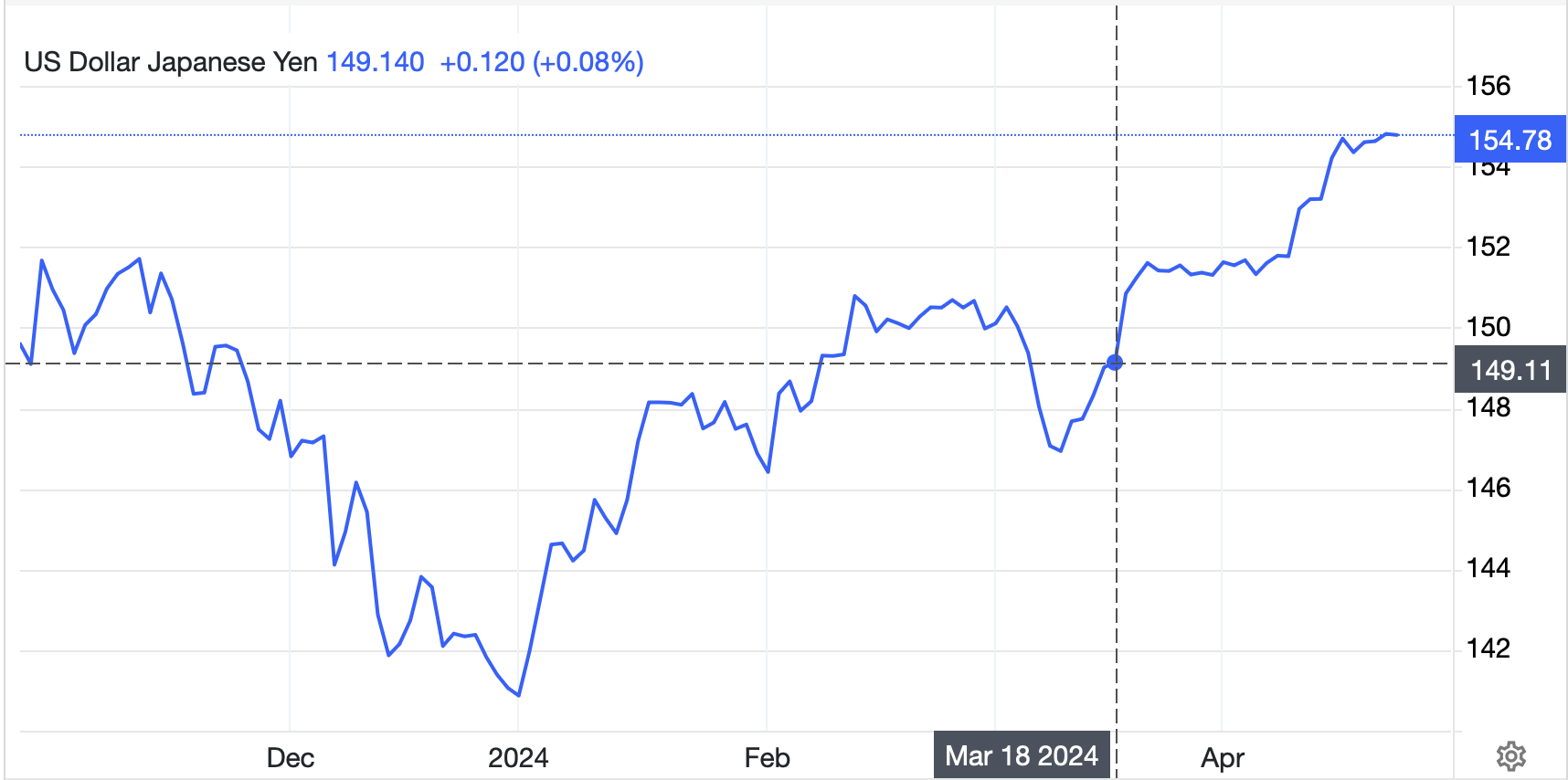
Source: tradingeconomics.com

Perhaps this is a sign that Japan’s monetary policy, at least given the enormous interest rate differentials with the US, just doesn’t really matter to the traders in the FX market.  A look at relative interest rate movements in the respective 10-year bonds shows that Treasury yields have rallied about 30bps while JGB yields have risen just half that amount since that BOJ meeting.  One thing that is becoming clearer is that the pressure on Ueda-san and FinMin Suzuki to do something about the weakening yen is growing.  It seems they have finally figured out that a weak yen has a direct link to rising yen prices of energy for both home and autos, and that the people in Japan are running out of patience with those rises.

Perhaps this explains the increase in the comments by these two critical players, with both threatening action if things get out of hand.  For instance, Suzuki explained, “I think it’s fair to assume that the environment for taking appropriate action on forex is in place, though I won’t say what the action is,” when speaking to Parliament last night.  His problem is he knows that intervention by Japan only will have no long-term impact and merely allow traders a better entry point to continue to pressure the yen lower. 

Meanwhile, Ueda-san was absolutely loquacious in his comments to Parliament, explaining, “we will set our short-term interest rate target at a level deemed appropriate to sustainably and stably achieve our 2% inflation target.  If underlying inflation rises toward 2% in line with our projections, we will adjust a degree of monetary easing. In that case, we will likely raise short-term interest rates.”  

Now, does this mean that they are going to do something at their meeting this week?  I think the probability of a policy change is vanishingly small.  Quite frankly, they are very aware that their current toolkit is not fit for the purpose of strengthening the yen and so jawboning is pretty much all they have.  In fact, to the extent that they would like to see the yen strengthen, their best bet is to call Chairman Powell and plead their case that the US should cut rates, and by a lot, or the world will end.  I don’t see that happening either.

Something worth noting is that Powell is facing pressure from multiple directions as foreign central bankers are desperate for the Fed to cut so they can too, and from the administration which believes that lower rates will help them in their quest to be reelected.  But, in the end, there is no evidence that the Fed is going to reverse their recent comments and turn dovish.  As long as that is the case, the trend higher in USDJPY remains quite clear and I see no reason to expect anything other than minor pullbacks in the near future.  However, if the Fed does cut rates despite the ongoing inflation pressures in the US, look for the dollar to fall sharply while risk assets explode higher.

So, while we all await both the BOJ and the PCE data on Friday, let’s recap the overnight session.  While green was the predominant color on screens overnight with Japan (+0.3%) and Hong Kong (+1.9%) leading the way, mainland Chinese stocks continue to suffer (-0.7%) dragging down Korean shares (-0.25%).  But otherwise, India, Taiwan, Australia, Singapore, etc., were all in the green.  In Europe, there is no question that things are looking up as every market is higher, most by 1% or more after the Flash PMI data was released showing that economic activity was picking up across the continent.  While manufacturing remains in contraction, and is hardly improving, the services sector is definitely stronger.  Meanwhile, at this hour (7:30) US futures are firmer by about 0.25%.

In the bond markets, price activity has been far more muted with Treasury yields recouping the 2bps they lost yesterday, while European sovereigns are higher by 1bp across the board.  The ECB commentary continue to highlight a June hike with the most dovish acolytes calling for 100bps of cuts this year (Portugal’s Centeno) while Spain’s de Guindos reminded everyone that the Fed was still driving the bus and they need to think about the whole world, not just the US.  As you can see, Powell faces pressure from all over.

On the commodity front, the retracement from the massive bull rally in metals prices is continuing apace with gold (-1.4%), silver (-1.4%) and copper (-1.1%) all under more pressure today after having fallen sharply for the past two sessions already.  My take is that this is an overdue correction from a remarkable move higher, but that the underlying story remains intact.  Certainly, the apparent lessening of tensions in the Israel-Iran issue has helped this movement as well as its impact on the price of oil (-0.75% today, -4.65% in past week).  However, the inflation story remains front and center when it comes to pricing commodities and there is no evidence whatsoever that prices are slipping back.  As we head toward summer, I do anticipate that metals demand will return, especially if the economy continues to perform at its current levels.

Finally, the dollar is slightly softer this morning but remains above 106 on the DXY.  We have already discussed the yen, which cannot find a bid anywhere, but the pound (+0.25%) is rebounding after PMI data in the UK was also a bit better.  However, overall, there are gainers and losers in both the G10 and EMG blocs, the largest of which is the ZAR (-0.3%) which is clearly suffering alongside the slide in metals prices.  Not surprisingly, NOK (-0.2%) is feeling pressure from oil’s decline.  But the euro has edged higher, and it has taken its CE4 counterparts higher while LATAM currencies seem to be taking the day off entirely.  We need real news to change the story here.

On the data front, we see the Flash PMI data (exp Manufacturing 52.0, Services 52.0) and New Home Sales (662K) and that’s really it.  With no Fed speakers, once again the market will take its cues from earnings releases with today’s biggest likely to be Google Alphabet and Tesla.  The dollar has been on a roll lately, so it would be no surprise to see a bit of a pullback, but as long as the Fed is seen as maintaining its current tightness, it will be hard-pressed to decline very much.

Good luck

Adf

Good…or Bad

FinMin Suzuki
Noted that a weaker yen
Might be good…or bad

One of the great things about finance and central bank officials is their ability to twist language into pretzels while trying to make their case in any given situation.  Last night offered another great example from Japanese FinMin Shun’ichi Suzuki with this being the money quote, “From that standpoint, I’m closely watching market moves with a strong sense of urgency.”  It is not clear how you watch something with urgency, but if you are the MOF official in charge of explaining why your currency has been declining so rapidly, I guess you have to say something.  (As an aside, I might simply point out that the interest rate differential between the US and Japan is now 5.5%, having risen from 0.35% over the past two years and that might have something to do with the FX move.)

As previously mentioned, the MOF is moving up its ladder of pre-intervention activities as detailed on Wednesday, arguably now somewhere between numbers 2 and 3.  The biggest problem Japan has is that there is a quickly declining probability that the US is going to be easing policy as soon as had been previously thought, and so the incentive to own yen remains diminished.  The second biggest problem they have is their economy has slipped into recession and so the urgency for Ueda-san to tighten policy is also diminished.  While USDJPY has been hovering just above 150 for a few days, I expect that it is going to grind higher still and force Suzuki-san to continue to climb that numeric ladder.  The one saving grace for Suzuki is that as we approach fiscal year-end in Japan, there is likely to be a seasonal flow of funds back home for dressing up balance sheets.  That could well keep things in check until sometime in April, but all signs are that the market is going to test him again before too long.

On Tuesday, the data was hot
On Thursday, it really was not
So, which one describes
The ‘conomy’s vibes?
Or have, now, stagflation, they wrought?

The CPI data on Tuesday certainly opened a rift between the narrative of smoothly declining inflation leading to numerous Fed rate cuts this year and what appears to be a more realistic situation where any further decline in inflation comes in fits and starts if it comes at all.  The narrative explanation for the sticky inflation was that economic activity was so strong that it should be expected.  But if the economy is truly that strong, someone needs to explain how Retail Sales can decline -0.8% in January, why Industrial Production would decline -0.1% and why Capacity Utilization would fall back to 78.5% despite all the government support for reshoring activity.  In an ironic twist, the other two releases yesterday, Philly Fed and Empire State Manufacturing, were both better than forecast.  This is a complete reversal of the pattern we have seen for the past 2 years where survey data is lousy but hard numbers remained strong.

In the end, it appears that market participants have given up on the macro data and are back to buying any dip with abandon.  I will be the first to explain that the economic outlook remains very cloudy.  To date, it appears that the excessive deficit spending has been successful in maintaining steady GDP growth.  Of course, excessive deficit spending is not something that can continue forever.  As Herbert Stein explained in 1985, “if something can’t go on forever, it will stop.”

This leads to the question; how long until forever?  If we have learned nothing else in the past decades it is that when governments involve themselves directly in economic activity and financial markets, forever is delayed. Things take MUCH more time than we expect for them to play out.  Simply consider how long Japan has been running massive budget deficits, NIRP and QE without destroying their economy.  (30 years.)

Of course, forever in the economy and forever in the markets are two very different things and while the government may be able to delay a reckoning in economic activity, we must be very careful around how markets behave with the same catalysts and inputs.  My point is any risk-off outcome will be important for your investing and hedging decisions, but not necessarily change the trajectory of GDP.  After all, there is always more money to be printed.  In fact, it is this issue that drives my longer-term inflation thesis.  Every government will do whatever they think they need to prevent a serious economic contraction and high on the list of actions will be much easier monetary policy.  Watch closely for things like QT to end or another BTFP-like program to continue to force liquidity into markets.

Ok, let’s look at how things finished the week.  As I said, the market no longer cares about bad data and simply continued to add to risk assets.  Yesterday saw gains in the major indices in the US which was followed by gains throughout Asia and most of Europe, all of them pretty substantial.  In fact, the only red numbers on my screen are in Spain’s IBEX which is suffering on the back of Spanish central banker Pablo Hernandez de Cos explained that several Spanish banks may suffer due to the ongoing drought in Spain and its negative impact on the economy there.  US futures are basically pointing higher again this morning as well.

In the bond market, though, yields are edging higher around the world.  Treasury yields are up 4bps today and pushing back to that peak seen immediately following the CPI print on Tuesday.  European sovereign yields are all higher by between 3bps and 4bps although JGB yields are unchanged on the day.  Ultimately, I continue to see the case for yields to climb from these levels as there is no indication that inflation is truly ending.

Oil markets powered higher yesterday, rising nearly 2% despite the huge build in inventories as concerns over supply being unable to keep up with ever growing demand have reemerged.  As well, the fact that any cease fire in the Israel-Hamas war seems to be a distant memory has some on edge that things can get worse in the Middle East overall.  As to the metals markets, gold managed to regain the $2000/oz level yesterday and is hanging right there this morning.  On a brighter note, both copper (+1.5%) and aluminum (+0.5%) are firmer this morning, perhaps in anticipation of China’s reopening next week, or perhaps because the dollar has stopped rising.

Speaking of the dollar, it is mixed this morning with the yen (-0.3%) and KRW (-0.3%) the laggards while ZAR (+0.3%) seems to be benefitting from the metals price action.  Broadly speaking, I still like the greenback for as long as the US maintains the tightest policy around.

On the data front, to finish the week we see PPI (exp 0.6% headline, 1.6% ex food & energy) as well as housing data with Starts (1.46M) and Building Permits (1.509M).  Finally, at 10:00 we see Michigan Sentiment (80.0).  We also hear from two more Fed speakers, Governor Michael Barr and SF President Mary Daly.  Yesterday, Atlanta Fed president Bostic explained he was not worried by Tuesday’s CPI print, but not yet convinced they had beaten inflation.  I have a feeling we will hear a lot of that sentiment for the time being.

Heading into the weekend, despite Tuesday’s shocking data, risk assets have performed well overall, with the S&P 500 making its 11th new all-time high this year yesterday.  I don’t know what will derail this train, and for now, there is nothing obvious to do so.  As such, I would keep with the trend overall, that means modestly higher stocks, yields grinding higher and the dollar edging higher as well.  I know that doesn’t seem to make much sense, but that’s what we’ve got.

Good luck and good weekend
Adf