
Not Well Understood

The ISM data was weak
And traders, more bonds, did soon seek
The oil price fell
The dollar, as well
But stocks ended close to their peak
 
So, is now bad news really good?
‘Cause Jay will cut rates, or he should
Or is it the case
That growth’s slowing pace
Means risk is not well understood


The narrative had a little hiccup yesterday as the ISM data was released far weaker than expected.  The headline number, 48.7, fell vs. last month and was a full point below market expectations.  The real problem was that while the Employment sub-index was solid, New Orders tanked, and Prices remained high.  If you add this to the Chicago PMI data from Friday, which at 35.4, was the lowest print since the pandemic in May 2020 and back at levels seen in the recessions of 2001 and 2008, it is fair to question just how strong the US economy is right now.

Adding to this gloom is the news that the Atlanta Fed’s GDPNow estimate slipped to 1.8% for Q2, down from 2.7% last Friday, and the trend, as per the below chart, is not very pretty.

Given the data, it can be no surprise that the Treasury market rallied sharply, with yields declining 8 basis points on the session, although they are little changed this morning.  After all, if the economy is slowing, the theory is that inflationary pressures will decline, and the Fed will be able to cut rates sooner rather than later.   And maybe that is true.  But when we last heard from the FOMC membership, most were pretty convinced they needed to see more proof that inflation was actually lower, rather than simply that slowing growth should help their cause.  And I might argue that a weak ISM print, especially with the prices portion remaining high, is hardly the proof they require.

But yesterday’s markets were a bit confusing overall.  While the initial response to the weak data led to immediate selling across all equity markets, by the end of the day, those losses were reversed such that the NASDAQ had a fine day, rising 0.5%.  Ask yourself the question, why would stocks rebound despite further evidence that the economy is slowing down.  The obvious answer is that a slower economy will lead to slowing inflation and allow the Fed to reduce interest rates before long.  Of course, the flip side of that story is that a slower economy implies companies will lose pricing power as demand slides, thus reducing available profit margins and overall profits.  It seems hard to believe that stock prices will rally amid declining earnings, although these days, anything is possible.

While the Fed’s quiet period has many advantages (in truth I wish the entire time between meetings was the quiet period) one of its key attributes is that the narrative can run wild in whatever direction it likes.  As we will be receiving quite a bit of data this week, I suspect the narrative will have a few more twists and turns yet to come, although there is no question that the bulls remain in control of the conversation.  

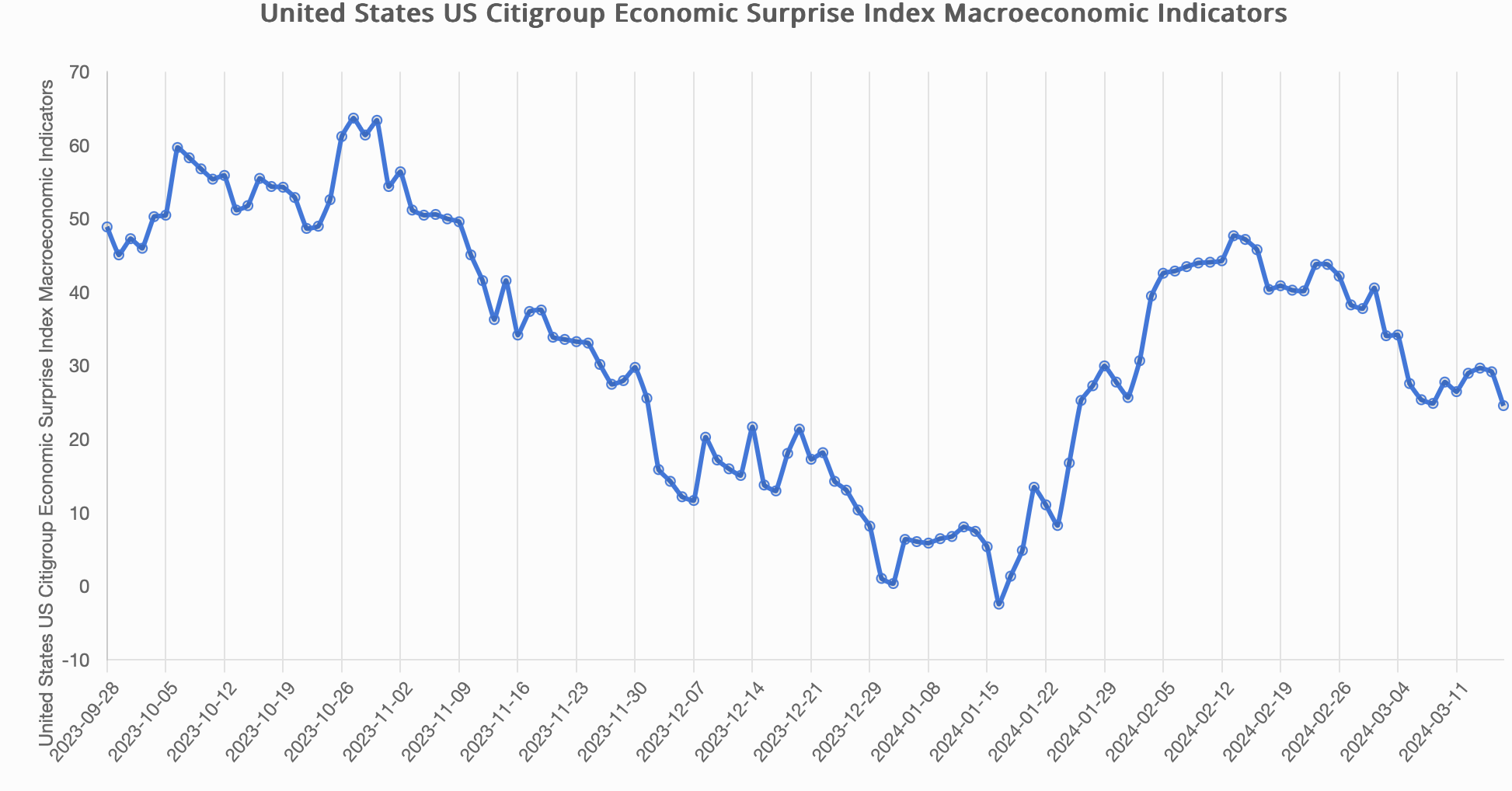
One other thing to keep in mind about that ISM data is that while the US data was weak, the PMI data elsewhere in the world indicated that the worst had been seen elsewhere.  While it is not full speed ahead yet in Europe or the UK or China, the trend is far better than in the US.  Remember, a key part of the narrative is that the US is the ‘cleanest shirt in the dirty laundry’ and so funds continue to flow into US equities and the dollar by extension supporting both.  But what if other nations are starting to see an uptick in their growth stories while the US is starting to slide a bit?  Perhaps the non-stop bullishness for the NASDAQ will find a limit after all.  Perhaps another way to consider this is to look at the Citi Economic Surprise Index, which is designed to compare actual data releases with the forecasts before the release.  As such, a high number shows better than expected data and vice versa.  As you can see from the below chart, the trend here is lower.
Source: macrovar.com

One interesting aspect of this chart is that you can see during Q1, when the equity markets rallied and bullishness was rife, this index was rallying as well.  But remember what we learned last week regarding Q1’s GDP, it was revised lower to just 1.3% annualized.  So, if better than expected data still led to weak growth, what will declining data do?  

In the end, at least in my view, the economy is struggling overall, although not collapsing.  If I am correct, then it leads to several potential, if not likely, outcomes.  While the Fed has continuously claimed they remain focused on inflation, if growth starts to decline more sharply, and unemployment starts to rise more rapidly, they will cut rates regardless of CPI or PCE, and they may well end QT if not start QE again.  The clear loser here will be the dollar.  Equity markets are likely to initially react to the rate cuts and rise, but if earnings suffer, I think that will reverse.  Bond markets, too, will rally initially, but if inflation rebounds, which seems highly likely if the Fed eases policy, I don’t think the long end of the yield curve will be very happy, and we could easily see 5.0% or higher in 10-year yields.  Finally, commodities will see a lot of love and rally across the board.

Ok, let’s look at what happened overnight, as other markets responded to the surprisingly weak US data.  Asia wound up mixed, similar to the US indices, as Japan (-0.25%) slipped while China (+0.75%) rallied along with Hong Kong (+0.25%).  But the big mover overnight was India (-5.75
%) which fell sharply as the election results there indicated that PM Narendra Modi, while winning a third term, saw a decline in his support that left him somewhat weakened.  The rupee (-0.5%) also slipped, although nothing like what we saw yesterday in Mexico.  As to the rest of the region, we saw winners (Indonesia, Malaysia) and laggards (Taiwan, Korea, Australia) so no real trend.  In Europe, this morning, there is a trend, and it is all red, with losses ranging from -0.4% in the UK to -1.1% in Spain.  The only data here was employment in both Spain and Germany, and while both numbers were a touch soft, neither seemed dramatic.  And, as I type (8:00), US futures are all lower by -0.3%.

In the bond markets, yesterday’s Treasury rally was mimicked by European sovereigns, with yields there falling as well, albeit not quite as much as in the US.  This morning, the European market is extremely quiet, with yields +/-1bp from yesterday’s closes.  However, overnight, we did see Asian government bond yields fall, with JGB’s -3bps and greater declines elsewhere in the space.

Oil prices (-1.85%) are under severe pressure this morning, following on yesterday’s $3/bbl decline, falling another $1.50/bbl.  It seems the combination of the weak ISM data and the OPEC+ discussion of an eventual return of more production to market next year was enough to convince a lot of long positioning to throw in the towel.  As is its wont, the oil market can move very sharply and overshoot in either direction.  It feels to me this could be one of those cases.  But commodity prices are getting killed everywhere this morning as although metals held up well yesterday, this morning we are seeing blood in the water.  Both precious (Au -0.9%, AG -3.4% and back below $30/oz) and industrial (Cu -2.3%, Al -0.5%) are falling as slowing growth and the belief that it will reduce inflationary pressures is today’s story.

Finally, the dollar, which sold off sharply yesterday in the wake of the ISM data, is bouncing a bit this morning, at least against most of its counterparts.  While most of the G10 is softer, led by NOK (-1.2%), the outlier is JPY (+0.85%) which is suddenly behaving like a safe haven amid troubled times.  I think that the increased uncertainty amid Japanese investors as to the state of the global economy may have them bringing home their funds, especially now that 10yr JGB yields are above 1.0% with no hedging costs.  As to the EMG bloc, MXN (-1.7%) remains under severe pressure but today they are not alone with all EEMEA currencies and other LATAM currencies declining as well.

The two data points this morning are the JOLTS Jobs Openings (exp 8.34M) and Factory Orders (0.6%), both released at 10:00.  Obviously, there is no Fedspeak, so I expect that equities will be the driver, and if fear starts to grow, we could get an old-fashioned risk off day with stocks falling, bonds rallying and the dollar gaining as well.

Good luck

Adf

A Modest Decrease

On Friday, the latest release
For some, showed a modest decrease
In pace of inflation
Although observation
By others was not of that piece


As an indication of just how confusing everything is in the macroeconomic world, and how earnestly different pundits try to make their individual cases, the following two headlines were in the same email roundup of market and economic articles that I receive daily.

The Fed’s Favored Inflation Gauge Reinforces The Disinflationary Trend

Federal Reserve Watch: Inflation Not Dropping

Parsing a specific data point that is subject to so much revision is always a fraught activity, and this time is no different.  Did the PCE data Friday indicate the inflation trend is starting to head back down or not?  Beats me. Below are the forecasts and actual results as released Friday morning by the Bureau of Economic Analysis (BEA).  While the M/M Core PCE print was a tick lower than the consensus forecast, everything else was right there.  If anything, the fact that Personal Spending fell ought to be a bigger concern.

Source: tradingeconomics.com

So, ask yourself this question, based on the information above, is the disinflationary trend being reinforced?  Or is inflation still sticky and rising?  Personally, I don’t think we have enough information to have changed our views from whatever they were ahead of the release, but that’s just me.  If nothing else, perhaps this will help you understand just how little anybody really knows about the situation.  One other seeming anomaly is that the M/M Core PCE number was lower than expected, yet the Y/Y number was right on target.  Whatever your null hypothesis, it doesn’t seem as though there is enough new information in this report to reject it.  Of course, that didn’t stop the punditry!

In Mexico, voters have spoken
And Claudia Sheinbaum’s awoken
This morning as prez
From Roo to Juarez
Alas, now the peso’s been broken

In a historic, although completely expected outcome, Claudia Sheinbaum has been elected president of Mexico, the first woman to hold the office.  She is current president Lopez Obrador’s protégé as well as the former mayor of Mexico City.  Now, she will be ruling from Quintana Roo in the south to Ciudad Juarez in the north of the country.  However, perhaps the bigger news, at least from the market’s perspective, is that her party, Morena, looks like it will win a supermajority in both the House and Senate there.  This matters because it will allow congress to alter the constitution as they see fit with no checks against it.  Given that Morena is a left-wing party, markets have suddenly become concerned that there could be serious impacts to the nature of business in Mexico which might impact both strategic and operational questions.
 
Consider, part of Mexico’s attractiveness as a manufacturing base was its relatively low wages.  However, with this type of political control, it is not hard to believe that a much higher minimum wage would be imposed, perhaps only on companies that export goods, but one that would substantially reduce the profitability of those operations.  As well, changes in the constitution would now be achievable with no recourse.  Reduction of judicial independence and the removal of the presidential term limit are two key domestic issues that may be addressed and are garnering concern.  After all, the one thing we all know is that when one political party can change the rules without the opposition having a say, those rule changes are generally designed to maintain power in perpetuity.  History has shown that is not typically a great situation.
 
As to the market impact, under the rubric, a picture is worth 1000 words, behold the chart of the peso as of this morning.

Source: tradingeconomics.com

FX traders and investors have determined there is a great deal of risk attached to the overall election outcome, and the peso has suffered accordingly.  This morning it has fallen -2.6% and is showing no sign of slowing down.  Remember, the peso has been a favorite currency in the hedge fund world as the carry trade has been a huge winner since last October.  Not only did traders benefit from Mexico’s higher interest rates, but the currency appreciated nearly 10% as well from October through late May.  But as of this morning, MXN has weakened nearly one full peso from its level just two weeks ago.  I sense that many risk managers are forcing a lot of position unwinding as the broader concerns over the future direction of the country increase as per the above issues.  For those of you with MXN revenues or assets, this will be a tricky time as hedging remains very expensive.  For those with MXN expenses, flexibility will be key with option structures likely to be very effective right now.

However, beyond those stories, the overnight session was relatively muted.  PMI data was largely in line with expectations around the world, confirming that economies are not seeing either significant growth or weakness, but rather muddling through.  So, let’s see how markets behaved overall.

Friday’s late US rally was followed throughout Asia with the Nikkei (+1.1%), Hang Seng (+1.8%) and ASX 200 (+0.8%) all having solid sessions but pretty much all markets rallying overall.  European bourses are also having a good day led by the DAX (+0.85%) and Spain’s IBEX (+0.8%) with green being the dominant color on screens here as well.  US futures at this hour (6:45) are pointing higher, except for the Dow which is down ever so slightly.

In the bond market, yields are continuing their recent slide with Treasuries down 2bps this morning and 15bps from the levels seen just last Wednesday.  European sovereign yields are also lower this morning, but between 4bps and 6bps as it appears traders remain highly confident the ECB, which meets Thursday, will cut rates by 25bps despite last week’s firmer than expected CPI data there.  The fact that the PMI data was lackluster has probably helped this mindset.

In the commodity markets, oil prices have edged higher by 0.1% after OPEC+ laid out that they will maintain production cuts through 2025, but also created a process by which they would eventually grow production again.  Given the fact that there is no indication demand for oil has peaked, I expect that all that production and more will ultimately be needed.  In the metals markets, both precious and industrial metals are continuing their modest rebound after the recent selloff.  Of course, given the strength of the rally since March across the board here, more consolidation seems quite likely for a while.  However, I believe the direction of travel remains higher for all metals going forward.

Finally, in the FX markets, while the peso is the outlier, (now -3.4% just 45 minutes later than the earlier update), the dollar is mixed otherwise.  ZAR (+0.6%) is benefitting from the news that a coalition government is forming, and Cyril Ramaphosa is likely to remain president.   Meanwhile, KRW (+0.5%) rallied on the back of stronger PMI data.  However, the euro (-0.1%) and its CE4 acolytes are all softer this morning as there has been more saber rattling over Ukraine’s use of recently acquired long-range missiles and ammunition from the West to attack deeper into Russia.  Threats are now being made about an escalation of this conflict in terms of the sphere (i.e. Eastern Europe) and the tools (i.e. nukes), so the euro is feeling a little heat.

On the data calendar this week, there is a decent amount of new information culminating in the payroll report on Friday.  As well, we hear from both the Bank of Canada and the ECB this week.

TodayISM Manufacturing49.6
 ISM Prices Paid60.0
TuesdayJOLTS Job Openings8.34M
 Factory Orders0.6%
WednesdayADP Employment173K
 BOC Rate Decision4.75% (5.00% current)
 ISM Services50.5
ThursdayECB Rate Decision4.25% (4.50% current)
 Initial Claims220K
 Continuing Claims1798K
 Trade Balance-$76.0B
 Nonfarm Productivity0.3%
 Unit Labor Costs4.7%
FridayNonfarm Payrolls190K
 Private Payrolls170K
 Manufacturing Payrolls5K
 Unemployment Rate3.9%
 Average Hourly Earnings03% (3.9% Y/Y)
 Average Weekly Hours34.3
 Participation Rate62.7%
 Consumer Credit$10.5B
Source: tradingeconomics.com

So, lots to look forward to all week with two key central bank rate decisions and rate cuts seen as the most likely outcome.  As well, the payrolls will be a critical piece of the Fed discussion.  But mercifully, the Fed is in its quiet period so there will be no actual Fed discussion.

Last week, investors and traders got excited over the prospect that inflation was heading back toward target which would allow the Fed to finally cut rates.  However, that interpretation seems tenuous to me, as I do not see the data as pointing strongly in that direction.  Given it seems likely that both the BOC and ECB will be cutting rates, Friday’s data will be extremely important in helping us determine the tone of the FOMC meeting.  I believe we are seeing a growing split between the Fed governors and regional presidents with the former anxious to start easing policy while the latter see that as quite risky.  My take is that split will prevent any actions for quite a while as both sides argue their case and so any rate cuts will not be coming until next year at the earliest.  That is, of course, unless we see a significant economic downturn, which seems highly unlikely right now.  In the end, I think the dollar will maintain its value overall as the Fed remains the most hawkish central bank around.

Good luck

Adf