
The Fed PhD’s have constructed
Their models, from which they’ve deducted
The future will be
Like post-GFC
In which case, we all will be fucted
Instead, perhaps what’s really needed
And for which Steve Miran has pleaded
Is changing impressions
In future Fed sessions
Accepting the past has receded
While we all know that things change over time, human nature tends to drive most of us, when facing a new situation, to call on our experience and analogize the new situation to what we have experienced in the past. But sometimes, the differences are so great that there are no viable analogies. For the past several years I have made the point in this commentary that the Fed’s models are broken. Consider, as an example, how wrong they were regarding the alleged transitory nature of inflation in 2022 which led to policy adjustments that not only were far too late to address the issue, but in reality, only had a marginal impact anyway.
On a different, and topical subject, consider the issue with tariffs. Economists explained that the imposition of tariffs would be devastating to the US consumer, raise prices dramatically and strengthen the dollar as FX markets adjusted to reflect the new trade policy. But none of that happened, at least not yet. In fact, the dollar continued to fall in the wake of the Liberation Day tariff announcements, while CPI since then has, granted, edged higher, but remains in its recent range for now and well below the 2022 levels (see below chart from tradingeconomics.com).

And a more important question regarding inflation is, have the tariffs been the driver, or has it been other parts of the price index, housing and core services for instance, that have been the key issue, neither of which would be directly impacted by tariffs.
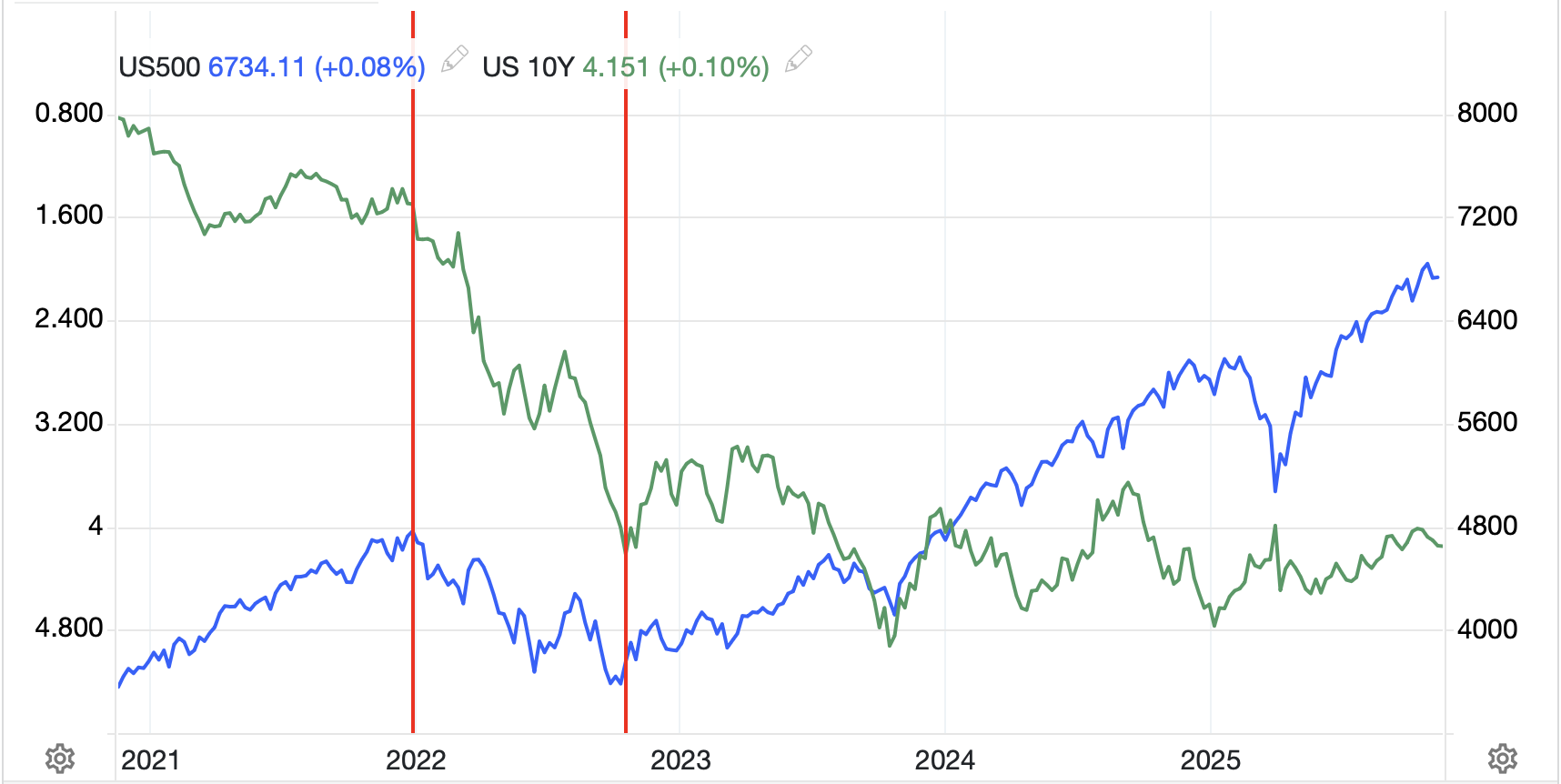
All of this is to highlight the fact that the world has changed and that the evidence of the past several years, at least, is that the Fed’s econometric models are no longer fit for purpose. I raise this issue because a look at so many previous market relationships show that many are breaking down. We have seen gold rise alongside rising real interest rates and the dollar rise alongside gold, two things that are 180o from previous history. Too, think back to 2022 when both stocks and bonds fell sharply at the same time, breaking the decades-long history of bonds behaving in a manner to offset declines in equity markets.
Source: tradingeconomics.com
This contemplation was brought on by a tweet which led me to a very interesting article (just a 5 minute read) by DL Jacobs of the Platypus Affiliated Society, regarding Fed Governor Miran and his recognition that the world has changed and that the Fed needs to change too. Here is the second paragraph, and I think it explains the issue beautifully [emphasis added]:
He [Miran] used the moment to challenge the foundations of United States monetary policy. “I think it’s important to take these models seriously, not literally,” he said. He warned that models do not take into account the scale and speed of policy changes in light of the Trump administration’s re-election. The problem with the Fed isn’t wrong technique or bad data, he suggested, but rather that the very structure of its models is embedded in the economic and political assumptions of a bygone era. The world the forecasts are trying to measure no longer exists.
(At this point, I have to explain that the Platypus Society is a left-wing organization trying to explain why Marxism failed and recreate it, but that doesn’t make this article any less worthwhile. I believe they see it as a step in the destruction of capitalism, which appears to be their goal.)
To me, this is just another point indicating that we’re not in Kansas anymore. Policies need to change, and the Trump administration is working hard to do so. One of the key points Miran makes is that the Fed and Treasury ought to be considered as a single entity, with the idea of Fed independence an anachronism from a bygone age. The upshot is the Trump administration is going to continue to run things hot, or as macro analyst Lynn Alden has been saying, “Nothing stops this train”.

This means that the Fed is going to run relatively easy monetary policy while the government, via the Treasury, is going to ensure there is ample liquidity available for everything, real economic activity and market activity. The downside of these policies, alas, is that the idea inflation is going to decline in any meaningful way is simply wrong. It’s not. Keep this in mind as we go forward.
As it happens, there was very little news of note overnight, at least market news, so let’s see how things behaved. Friday’s mixed session in the US was followed by Chinese weakness with HK (-0.7%) and China (-0.7%) both under pressure. Tokyo (-0.1%) was not nearly as impacted and the regional exchanges were actually broadly higher (Korea, India, Taiwan, Indonesia, Thailand). The big news in Asia is the increasing verbal jousting by China and Japan at each other after PM Takaichi said, out loud, that if China attacked Taiwan, it would impact Japan. Given the proximity, that is, of course, true, but apparently it was a taboo item in the diplomatic dance in the past. I don’t see this having a long-term impact on anything.
In Europe, though, bourses are lower this morning led by Spain (-0.8%) although weakness is widespread (Germany -0.5%, France -0.4%. UK -0.1%). There has been no data of note to drive this movement and it seems as though we are seeing the beginning of some longer-term profit taking after strong YTD gains by most bourses on the continent. US futures at this hour (6:45) are pointing a bit higher, 0.43% or so.
In the bond market, Treasury yields have slipped -3bps this morning despite (because of?) the market pricing a December rate cut as a virtual coin toss. This is a huge change over the past month as can be seen at the bottom of the chart below from cmegroup.com

Recent Fedspeak has highlighted the Fed’s uncertainty, especially absent data, and the belief that waiting is a better choice than acting incorrectly (what if waiting is the incorrect move?). At any rate, we are going to be inundated with both Fedspeak (14 speeches this week!) as well as the beginnings of the delayed data so there will be lots of headlines. Right now, I think it is fair to say that nobody is confident in the current direction of travel in the economy. But perhaps, a more hawkish tone at the front of the curve has investors believing that inflation will, once again, become the Fed’s focus. Alas, I don’t think so. Looking elsewhere, European sovereign yields have followed Treasury yields lower, slipping between -2bps and -3bps this morning. Perhaps more interesting is Japan, where JGB yields (+3bps) have risen to a new 17-year high as a prominent LDP member put forth a massive new spending bill to be passed.
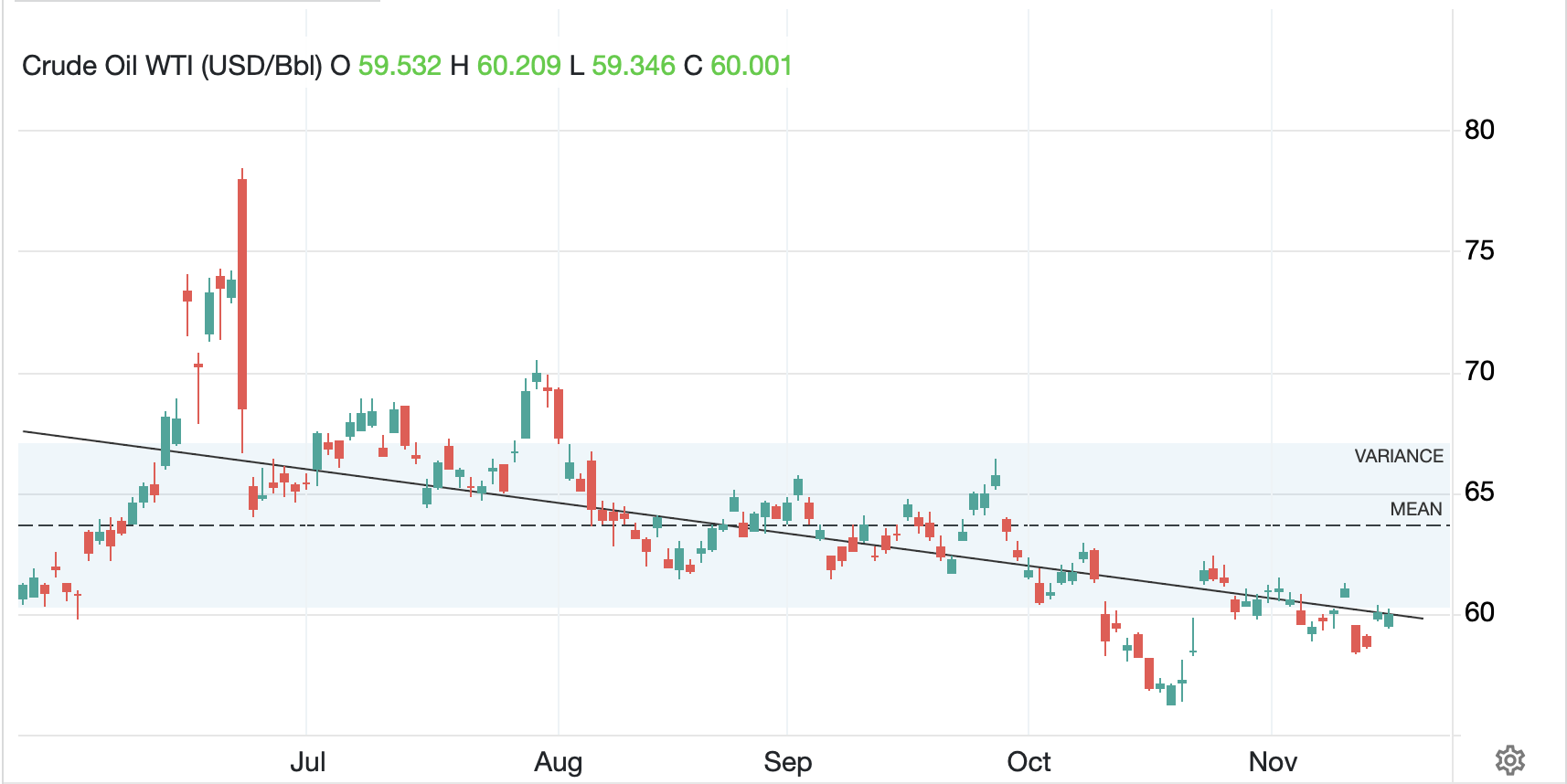
In the commodity space, oil remains pinned to the $60/bbl level with lots of huffing and puffing about Russian sanctions and oil gluts and IEA changes of opinion but in the end, WTI has been either side of $60 for the past month+ and continues to trend slowly lower.
Source: tradingeconomics.com
Metals remain the most volatile segment of the entire market complex although this morning, movement has not been so dramatic (Au -0.1%, Ag +0.9%, Cu -0.4%, Pt -0.1%). All the metals remain substantially higher than where they began the year and all have seemingly run into levels at which more consolidation is needed before any further substantial gains can be made. I don’t think the supply/demand story has changed here, just the price action.
Finally, the dollar is a touch firmer this morning, with the DXY (+0.1%) a good representation of the entire space. The only two currencies that have moved more than 0.2% today are KRW (-0.9%) which reversed Friday’s price action and is explained as continued capital outflows to the US for investment. On the flip side, CLP (+1.1%) is benefitting from the first round of Presidential elections in Chile, where the right-wing candidate came out ahead and is expected to consolidate the vote and win an absolute majority in the second round. Jose Antonio Kast, if he wins, is expected to proffer more market-friendly policies than the current socialist president, Gabriel Boric. It seems the people in Chile have had enough of socialism for now. But other than those two currencies, this market remains quiet.
On the data front, there is so much data to be released, but the calendar for much of it has not yet been finalized. One thing that is finalized is the September employment situation which is due for release Thursday morning at 8:30. This morning we see Empire State Manufacturing (exp 6.0) and Construction Spending (-0.1%) and hopefully, the calendar will fill in as the week passes.
While equity markets remain very near their all-time highs, the Fear and Greed Index is firmly in Fear territory as per the below from cnn.com.

Historically, this has been seen as an inverse indicator for stock markets although it has been down here for more than a month. Uncertainty breeds fear and the lack of data has many people uncertain about the current state of the US economy since the only information they get is either from the cacophony of social media, the bias of mainstream media or their own two eyes. But even if you trust your own eyes, they just don’t see that much, likely not enough to come to a broad conclusion.
FWIW, which is probably not much, my take is things are slower than they have been earlier in the year, but nowhere near recession. I think it is the correct decision for the Fed to hold next month rather than cut because the drivers of inflation remain extant. But Jay doesn’t ask me. Whether Miran is correct in his prescriptions for the economy, I am gratified that he is questioning the underlying structure. In the meantime, run it hot remains the name of the game and that means any risk-off period is likely to be short.
Good luck
Adf
 fxpoetry