
The Mayhem-ber

Five years ago, some will remember
George Floyd was the riotous ember
But while cities burned
What some of us learned
Was markets ignored the mayhem-ber
 
Of late, as the headlines are filled
With riots, no one’s been red-pilled
While some may disdain
Risk assets, it’s plain
That most buying stocks are still thrilled


The tragic goings on in LA remain the top story as we have now passed the fourth day of rioting.  It strikes me that ultimately, the constitutional question that may be addressed is how much power the federal government has in a situation where a state government seemingly allows rampant destruction of private property.  Of course, we saw this happen just over five years ago in the wake of George Floyd’s death in May 2020 and the ensuing riots in Minneapolis which ultimately spread to Portland, Oregon and Seattle.  

With this as a backdrop, I thought I would take a look at market behavior during that period, if for no other reason to be used as a baseline.  Of course, there are major caveats here as that was during Covid and the government had recently passed a massive stimulus bill while the Fed began to monetize that debt.  Now, we cannot ignore the BBB which looks a lot like a massive stimulus bill as well, so perhaps things are closer in kind than I originally considered.  At any rate, the chart below shows the S&P 500 leading up to and through the 2020 riots.
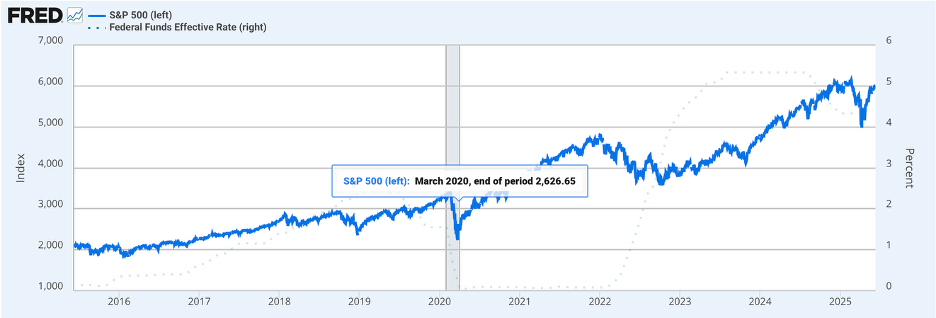
The huge dip before the riots began was the Covid dip, and the faint dotted line is the Fed Funds rate, so you can see things were clearly different.  However, the point I am trying to make is that despite the violence and disagreements over President Trump’s authority, I would contend the market doesn’t care at all about the situation there.  Investors remain far more concerned about the ongoing trade talks with China that are taking place in London and are “going well” according to Commerce Secretary Lutnick.  From what I read on X, it seems there is a growing expectation that a China deal of some sort will be announced soon and that will be the latest buy signal for stocks.  My larger point is that just because something dominates the headlines, it doesn’t mean that something is relevant in the financial world.

Funnily enough, because the LA riots are sucking the oxygen from every other story, there is relatively little to drive market activity, hence the relatively benign market activity we have been seeing for the past few days.  Yesterday was a perfect example with US equity markets trading either side of unchanged all day and closing pretty much in the same place as Friday.  In Asia overnight, the picture was mixed with the Nikkei (+0.3%) edging higher while both the Hang Seng (-0.1%) and CSI 300 (-0.5%) finished slightly in the red.  The one big outlier there was Taiwan (+2.1%) with other markets showing less overall interest.  I suspect this movement was on the back of the positive vibe the market is taking from the US-China trade talks.

As to Europe, the continent has a negative flavor this morning with the DAX (-0.5%) the laggard and other major indices edging lower by just -0.1% or so.  However, the FTSE 100 (+0.4%) has managed a gain after softer than expected employment data has increased discussion that the BOE will be cutting rates a bit more aggressively.  US futures are still twiddling their proverbial thumbs with no movement at this hour (7:10).

In the bond market, Treasury yields have slipped -3bps and we are seeing similar yield declines throughout the continent.  However, UK gilts (-7bps) are really embracing the slowing labor market and story of a more aggressive BOE rate cut trajectory.

In the commodity markets, oil (+0.5%) continues to climb higher despite the alleged increases in supply and is close to filling the first gap seen back in April (see chart below from tradingeconomics.com)
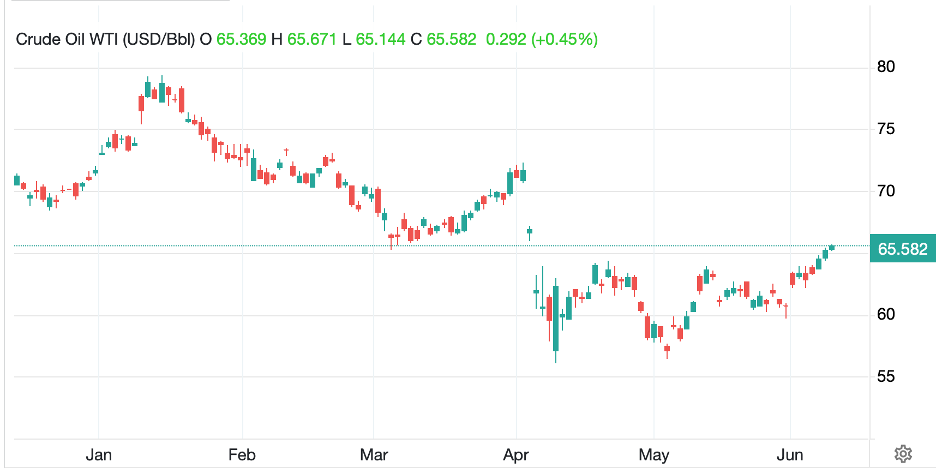
Given OPEC+ and their production increases, this is a pretty impressive move, especially as the recession narrative remains largely in place.  One tidbit of information, though, is that the Baker Hughes oil rig count is down 37 rigs since the 1st of May, a sign that US production, despite President Trump’s desires for more energy, may be slipping a bit.  As to the metals markets, gold (+0.45%) keeps on trucking, with a steady grind higher although both silver and copper are little changed this morning.  I must mention platinum as well, given I discussed it yesterday, and we cannot be surprised that after a remarkable run, it is softer by -1.3% this morning taking a breather.

Finally, the dollar, like equities, is directionless overall with the pound (-0.3%) slipping on the weak labor data but the rest of the G10 within 0.1% of Monday’s closing levels.  In the EMG bloc, KRW (-0.9%) is the outlier, apparently responding to the positive signals from the US-China trade talks.  However, I question that narrative as no other APAC currency moved more than 0.1% on the session in either direction.  And truthfully, that pretty well describes the rest of the bloc in LATAM and EEMEA.

On the data front, the NFIB Small Business Optimism Index was released this morning at a better than expected 98.8, which as you can see below, is a solid reading overall, certainly compared to most of 2022-2024.

Source: tradingeconomics.com

And here is the rest of what we get this week:

WednesdayCPI0.2% (2.5% Y/Y)
 -ex food & energy0.3% (2.9% Y/Y)
ThursdayPPI0.2% (2.6% Y/Y)
 -ex food & energy0.3% (3.1% Y/Y)
 Initial Claims240K
 Continuing Claims1908K
FridayMichigan Sentiment53.5
 Michigan Inflation Expected6.6%

Source: tradingeconomics.com

However, we must take that Inflation expectation number with at least a few grains of salt (even assuming it has value as an indicator at all), as yesterday, the NY Fed released their own survey of Inflation expectations which fell to 3.2%.  A quick look at the two indicators overlaid on one another shows that the Michigan indicator, if nothing else, has much greater volatility which reduces its value as an indicator.

Source: tradingeconomics.com

It is difficult to get excited about movement in either direction right now.  At some point, the mayhem in LA will end and news sources will look for the next story.  I suspect that trade deals are going to grow in importance as Mr Trump will need to sign some more before long.  As well, the BBB, which I continue to believe will be passed in some form, is going to add some measure of certainty and stimulus to the economy, which, ceteris paribus, implies that the long-awaited reckoning in the stock market may be awaited even longer.  If that is the case, then the weak dollar story, one I understand, is likely to fade for a while as well.

Good luck

Adf

Depression’s Price In

As cities continue to burn
The stock market bears never learn
Depression’s priced in
And to bears’ chagrin
Investors have shown no concern

Once again risk is on fire this morning as every piece of bad news is seen as ancient history, riots across the US are seen as irrelevant and the future is deemed fantastic based on ongoing (permanent?) government economic support and the continued belief that Covid-19 has had its day in the sun and will soon retreat to the back pages. And while the optimistic views on government largesse and the virus’s retreat may be well founded, the evidence still appears to point to an extremely long and slow recovery to the global economy. Just yesterday, the Congressional Budget Office, released a report indicating it will take nearly ten years before GDP in the US will return to its previous trend growth levels. That hardly sounds like they type of economy that warrants ever increasing multiples in the stock market. But hey, I’m just an FX guy.

A look around the world allows us to highlight what seem to be the driving forces in different regions. There are two key assumptions underpinning European asset performance these days; the fact that the EU has finally agreed to joint financing of a budget and mutualized debt issuance and the virtual certainty that the ECB is going to increase the PEPP in their step tomorrow. The flaws in these theories are manifest, although, in fairness, despite themselves the Europeans have generally found a way to get to the goal. However, the EU financing program requires unanimous approval of all 27 members, something that will require a great deal of negotiation given the expressed adamancy of the frugal four (Austria, the Netherlands, Sweden and Denmark) who are not yet convinced that they should be paying for the spendthrift habits of their southern neighbors. And the problem with this is the amount of time it will take to finally agree. Given the urgent need for funding now, a delay may be nearly as bad as no support at all.

At the same time, the ECB, despite having spent only €250 billion of the original €750 billion PEPP monies are now assumed to be ready to announce a significant increase to the size of the program. Not surprisingly, members of the governing council who hail from the frugal four have expressed reluctance on this matter as well. However, after Madame Lagarde’s gaffe in March, when she declared it wasn’t the ECB’s job to protect peripheral nation bond markets (that’s their only job!) I expect that she will steamroll any objections and look for a €500 billion increase.

Clearly, traders and investors are on the same page here as the euro continues to rally, trading higher by 0.3% this morning (+4.2% since mid-May) and back above 1.12 for the first time since March. European equity markets are rocking as well, with the DAX once again leading the way, up 2.4%, despite a breakdown in talks between Chancellor Merkel’s CDU and its coalition partner SPD over the nature of the mooted €100 billion German support program. But the rest of Europe is flying as well, with the CAC up 2.0% and both Italy’s and Spain’s main indices higher by about 2.0%. European government bonds are sliding as haven assets are simply no longer required, at least so it seems.

Meanwhile, in Asia, we have seen substantial gains across most markets with China actually the laggard, essentially flat on the day. But, for example, Indonesia’s rupiah has rallied another 2.2% this morning after a record amount of bidding for a government bond auction showed that investors are clearly comfortable heading back to the EMG bloc again. The stock market there jumped 2.0% as well, and a quick look shows the rupiah has regained almost the entirety of the 22% it lost during the crisis and is now down just 1.6% on the year. What a reversal. But it is not just Indonesia that is seeing gains. KRW (+0.7%, -5.0% YTD), PHP (+0.5%, +1.1% YTD) and MYR (+0.35%, -4.0% YTD) are all gaining today as are their stock markets. And while both KRW and MYR remain lower on the year, each has recouped more than half of the losses seen at the height of the crisis.

So, the story seems great here as well, but can these nations continue to support their economies to help offset the destruction of the shutdowns? That seems to vary depending on the nation. South Korea is well prepared as they announced yet another extra budget to add stimulus, and given the country’s underlying finances, they can afford to do so. But the Philippines is a different story, with far less resources to support themselves, although they have availed themselves of IMF support. And Indonesia? Well, clearly, they have no problem selling bonds to investors, so for the short term, things are great. The risk to all this is that the timeline to recovery is extended far longer than currently perceived, and all of that support needs to be repaid before economic activity is back.

The point of all this is that while there is clearly a bullish story to be made for these markets, there are also numerous risks that the bullish case will not come to fruition, even with the best of intentions.

And what about the US? Looking at the stock market one would think that the economy is going gangbusters and things are great. But reading the news, with every headline focused on the ongoing riots across the nation and the destruction of property and businesses, it is hard to see how the latter will help the economy return to a strong pace of growth in the short run. If anything, it promises to delay the reopening of many small businesses and restaurants, which will only exacerbate the current economic malaise.

The other thing that seems out of step with the politics is the underlying belief that there will be another stimulus bill passed by Congress soon. While the House passed a bill several weeks ago, there has been no action in the Senate, nor does there seem to be appetite in the White House for such a bill at this time with both seeming to believe that enough has been done and ending the lockdowns and reopening businesses will be sufficient. But if there are riots in the streets, will ordinary folks really be willing to resume normal activities like shopping and eating out? That seems a hard case to make. While the cause of the riots was a tragedy, the riots themselves have created their own type of tragedy as well, the delay and destruction of an economic rebound. And that will not help anybody.

So, on a day where the dollar is under pressure across the board, along with all haven assets, we have a bit of data to absorb starting with the ADP Employment number (exp -9.0M) and then ISM Non-Manufacturing (44.4) and Factory Orders (-13.4%). The Services and Composite PMI data from Europe that was released earlier showed still awful levels but marginally better results than the preliminary reports. However, it is hard to look at Eurozone PMI at 31.9 and feel like the economy there is set to rebound sharply. Those levels still imply a deep, deep recession.

However, today is clearly all about adding risk to the portfolio, and that means that equities seem likely to continue their rally while the dollar is set to continue to decline. For receivables hedgers, I think we are getting to pretty interesting levels. If nothing else, leave some orders a bit above the market to take advantage.

Good luck
Adf