
Angina

This week all the problems in China
Have given the markets angina
Last night, we are told
Stocks oughtn’t be sold
While Xi tries to hold a hard line-a

For the third day in a row, China is the story du jour.  Two stories from last night illustrate the problems in the Chinese economy are either spreading more widely or simply becoming more widely known outside China.  The litany of issues are as follows: Chinese authorities requested that investment funds not be net sellers of equities this week; the PBOC added the most cash to the economy via reverse repos in six months; investors who have not been repaid by Zhongrong International Trust were seen outside the company’s Beijing HQ protesting openly; and the yuan continues to slide despite PBOC efforts to moderate the currency’s decline.

A brief recap of the process in the onshore CNY market shows that each morning the PBOC sets a central rate for the day (the CFETS rate), ostensibly based on a basket of currencies they follow, and when the market starts trading, it must remain within a +/- 2% band around that central rate.  Historically, when the PBOC wanted to signal that the currency was getting too strong or too weak, that CFETS rate would be set further in their desired direction than the model implied to help guide the market.  Well, lately, the PBOC has been setting the CFETS rate for a much stronger than expected CNY, but the market has largely been ignoring that. Bloomberg has an excellent chart showing the rising discrepancy that I have reprinted below.
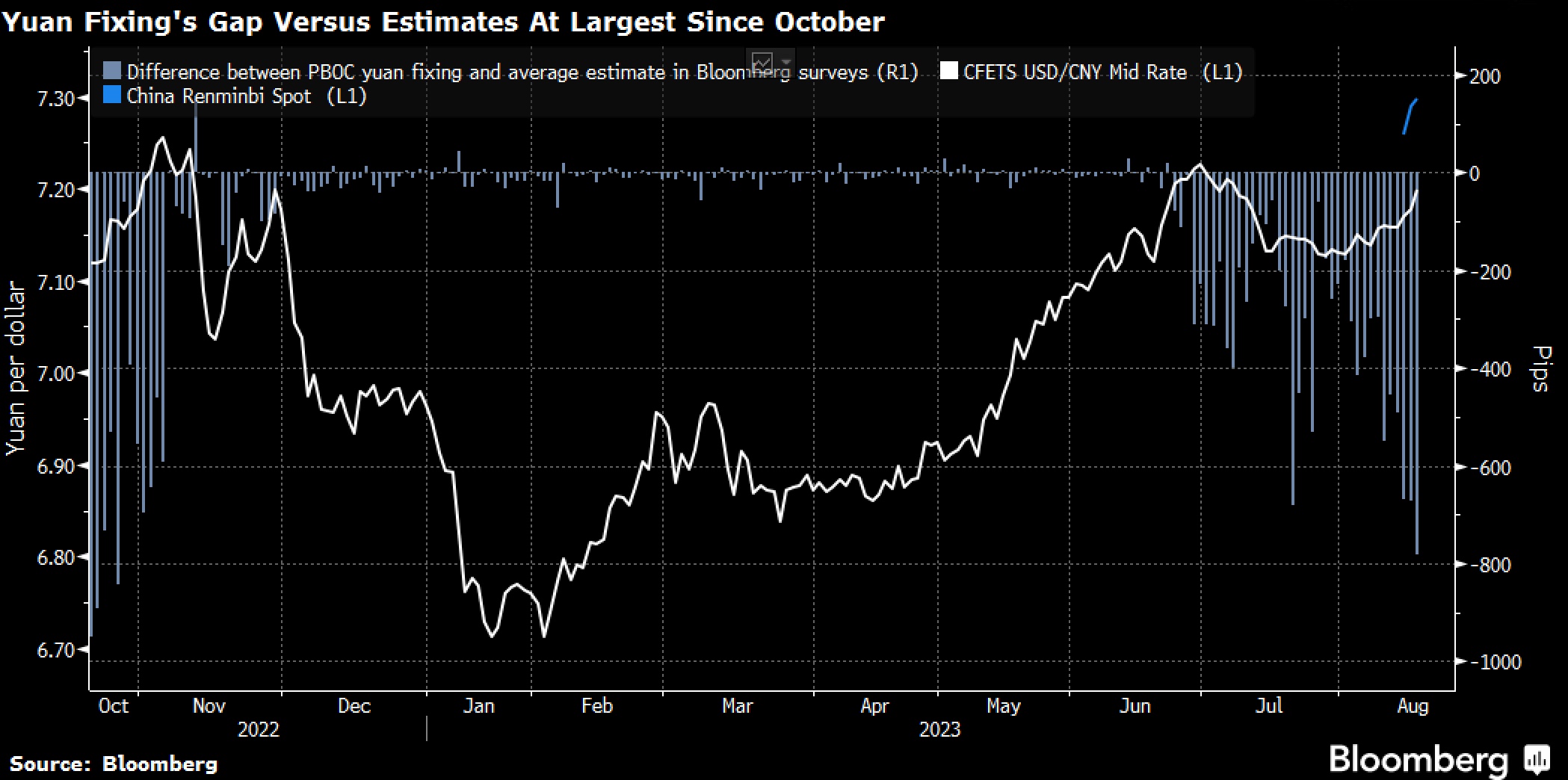
The bars on the chart represent the difference, in pips on the RHS axis, between the actual CFETS fix and the estimates from analysts’ models.  Notice that from November 2022 through the beginning of July, that difference was virtually nil.  The point is the models have proven themselves over time to be accurate, so these big discrepancies are policy choices.

As the PBOC watches the currency of its closest ally, Russia, collapse in slow-motion, it is clearly concerned about its own situation.  The added pressure of slowing growth and the problems in the investment sector are making things more difficult.  The fact that China is on a monetary easing path while the rest of the world is still tightening is naturally going to undermine the value of the renminbi, but the great fear in China is a rapid devaluation.  

The biggest problem the PBOC has is that unlike the situation with youth unemployment, where they simply decided to stop publishing the data, they don’t really have that choice in this situation.  They cannot hide what they are doing and expect that the FX market will be able to function realistically.  And China needs an FX market because of the huge portion of their economy that is reliant on international trade.  

There is no easy answer for the Chinese here.  If they seek to support the domestic economy with easier monetary policy, the renminbi is very likely to continue to fall as locals seek to get their money out of the country and invest in higher yielding assets.  The fact that the Chinese equity markets have been slumping simply adds more pressure to the situation.  There is a well-known idea in international finance called the impossible trilemma which states that no country can have the following three things simultaneously:

  1. A fixed foreign exchange rate 
  2. Free capital movement
  3. Independent monetary policy

China’s situation is that while the FX rate is not actually fixed, it is carefully and closely managed; while there are significant capital controls, there is still a steady flow of funds leaving the country, often via international real estate investments, so there is some freedom of flows; although of course, there is no attempt at independence by the central bank.  However, what we can readily observe is that even maintaining control of the currency while there is any ability to move capital offshore is virtually impossible these days.  Nothing has changed my view that we are headed to 7.50 and beyond over time.  And, to think, I didn’t even have to discuss weak earnings from Tencent or further concerns about Country Garden going bankrupt.

With that as our backdrop, it cannot be surprising that risk is under some pressure.  After all, the Chinese economy remains the second largest in the world.  The big change for markets is that after two decades of China being the fastest growing major economy in the world, now it is much slower than both Japan and the US (Europe is still in the dumps) and portfolio adjustments are still being made.

Looking at the overnight session, after a weak US market, with all three major indices lower by more than -1.0%, Asia followed suit completely, with markets there also under significant pressure, falling by -1.0% or more pretty much throughout the time zone.  European bourses, though, have edged higher after a weak performance yesterday, but the gains are di minimis, and in the UK, after inflation data showed the BOE’s job is not nearly done, the FTSE is a bit softer.  US futures are little changed this morning as the market awaits the FOMC Minutes this afternoon.

Treasury yields have backed off a bit, down about 2bps, and we are seeing similar movements in Europe. However, 10yr Treasury yields remain well above 4.0% and certainly seem like they are trending higher.  In the wake of the much stronger than expected Retail Sales data yesterday morning, 10yr yields spiked to 4.26%, their highest level since last October, and tantalizingly close to the highest levels seen in more than 15 years.

Oil prices (+0.3%) which have been sliding for the past week, consolidating their strong move over the past two months, seem to be stabilizing above $80/bbl for now.  We are also seeing modest strength in the metals complex today, although the movement has been very tiny.  Gold has managed to hold the $1900/oz level, but its future performance will depend on the dollar writ large I think.

And finally, the dollar, which has been quite strong overall lately, is softening a touch this morning, with only two weaker currencies in the EMG bloc, KRW (-0.5%) and CNY (-0.1%) as both respond to the problems mentioned above.  But elsewhere, this seems to be a bit of a relief rally with the dollar sagging broadly.  The G10 space is seeing similar price action with only CHF (-0.2%) and JPY (-0.1%) lagging slightly, while the rest of the bloc edges higher.  But movement of this tiny magnitude tends to mean very little.

On the data front, Housing Starts (exp 1450K) and Building Permits (1463K) come first thing with IP (0.3%) and Capacity Utilization (79.1%) at 9:15.  Finally, at 2:00 the Minutes from the July FOMC meeting will be released and given the change in tone we have heard from several members lately, with cuts now on the table for next year, it will be interesting to see how that plays out.

Today feels like a consolidation day, without any significant catalysts, so I expect a quiet session overall.  Unless the Minutes change everyone’s views regarding the next steps by the Fed, I maintain my view of dollar strength over time.  At least until the Fed actually turns things around.

Good luck

Adf

Opening Move

Forty trillion yen
Kishida’s opening move?
Or his legacy?

While it has been quite a week in the FX markets, and in truth, markets in general, it appears that both traders and investors are now tired and price volatility has ebbed.  While inflation remains topic #1 in most discussions, that poor horse has been beaten into submission at this point.  We already know that it is running hotter than most forecasts and that its composition is broadening.  This means the idea that Covid related issues, like used car prices or lumber prices, which have spiked (and in the case of lumber receded somewhat) due to supply chain issues is clearly no longer the only factor.  In fact, wages are beginning to rise substantially and with higher commodity prices, input costs continue to climb (see PPI) which is rapidly feeding into retail costs.  And it doesn’t appear this is set to slow anytime soon, despite the wishful comments by every central banker and finance minister around.  So, what’s a country to do?

Well, if you’re Japan, this is the perfect time to…spend more money!  And so, last night it was reported that new PM, Fumio Kishida, will be proposing a ¥40 trillion stimulus package in order to help support growth.  The rationale is that GDP is forecast to have contracted in Q3, rather than following in the footsteps of other major nations which all saw varying levels of growth.  Meanwhile, this being Japan, the home of the permanent deflationary impulse, one ought not be surprised at the fact that the BOJ and the government completely dismiss the recent PPI data (8.0% in October, a full point above expectations) as transitory given the decision that this will shore up the government’s approval rating.  And anyway, all the forecasts point to a still subdued 0.1% Y/Y CPI reading next week so there should be nothing to worry about.  After all, economic forecasts for inflation have been spot on around the world lately!

Since the last week of September, when USDJPY broke out of a six-month long trading range, the yen has fallen nearly 5%.  I believe that the BOJ is extremely encouraging of this movement as it has been a tacit policy goal since the initiation of Abenomimcs in 2012, when the BOJ really went all-in on its QE initiative in an effort to defeat deflation.  One thing for the Japanese to consider, though, is that history shows getting a little inflation is a very hard thing to do.  Once that genie is out of the bottle, it tends to be far more unruly than anticipated.  For Japan’s sake, I certainly hope that the PPI data is the outlier, but the risk of a policy mistake seems to be growing.  And after all, central bank policy mistakes are all the rage now (see Federal Reserve), so perhaps Kuroda-san just wants to feel like a member of the club.  At any rate, this morning the yen appears to be readying for the next leg lower and I would not be surprised at a move toward 116.75 before it’s all over.

But truthfully, there is not much to tell beyond that.  As mentioned, there is still a lot of discussion regarding inflation and its various causes and effects.  One thing to keep in mind is that history has shown the currencies of nations with high inflation tend to fall over time.  And this does not have to be hyperinflation, merely inflation running hotter than its peers.  Consider Italy, pre euro, where inflation averaged 5.4% and the currency regularly depreciated to offset the growth in prices.  In fact, the entire economic model was based on a depreciating currency to maintain the country’s industrial competitiveness.  The same can be seen in Turkey today, where each higher than expected CPI print leads to further lira weakness.

The point is, while Japan may not be able to create inflation, it is abundantly clear that we have done so in the US.  And when push comes to shove, if/when the Fed has to implement policy to support financial stability, they will be faced with the “impossible trinity” where of the three markets in question, stocks, bonds and the dollar, they will support the first two and allow the dollar as the outlet valve.  This means that eventually, a much weaker dollar is likely on the cards, not in the next several months, but very possibly within the next 2 years.  For payables hedgers, especially with the dollar showing short term strength, it may be an excellent time to consider longer term protection.  USD puts are very cheap these days.  Let’s talk.

Ok, so what do I mean by dull markets?  Well, equities are mostly higher, but generally not by very much.  In Asia, the Nikkei (+1.1%) was the big winner on the stimulus news, but both the Hang Seng (+0.3%) and Shanghai (+0.2%) were only modestly better on the night.  In Europe too, the movement has been relatively modest with the UK (FTSE 100 -0.4%) even falling on the day although the other major markets (DAX +0.1%, CAC +0.4%) are a bit firmer.  US futures are also pointing higher, with gains on the order of 0.2% across the board.

Bond markets are mixed as Treasuries (+2.2bps) are softer after yesterday’s holiday, but European sovereigns are all seeing modest yield declines (Bunds -0.9bps, OATs -0.6bps, Gilts -0.9bps).  That said, the peripheral markets also selling off a bit with Italian BTPs (+2.8bps) and Greek GGBs (+3.1bps) leading the way lower.

Commodities are actually the one market where there is still some real volatility as oil (-2.1%) leads the way lower alongside NatGas (-2.8%), although there is weakness in gold (-0.6%) and copper (-0.4%), all of which have had strong weeks.  Frankly, this feels like some position closing after a positive outcome rather than the beginning of a new trend.  In fact, if anything, what we have seen this week is commodity prices breaking out of consolidations and starting higher again.  Agriculturals are little changed and the other industrial metals like Al (+1.1
%) and Sn (+0.6%) are actually a bit better bid.  In other words, there doesn’t appear to be a cogent theme today.

As to the dollar, mixed is the best adjective today.  In the G10, we have several gainers led by the pound (+0.2%) as well as several laggards led by SEK (-0.4%).  The thing is, there is very little to hang your hat on with respect to stories driving the activity.  Neither nation published any data and there haven’t been any comments of note either.  In the EMG space, PHP (+0.6%) is the leading gainer on the strength of equity market inflows as well as central bank comments indicating they will seek to allow the market to determine the exchange rate.  On the downside, RUB (-1.0%) is falling sharply on the back of oil’s sell-off and rising geopolitical tensions with Russia complaining about NATO activity near its borders.  Between those two extremes, however, the movement is limited and pretty equal on both sides in terms of the number of currencies rising or falling.  Last night, Banxico raised rates by 25bps, as widely expected and the peso is weaker this morning by -0.25% alongside oil’s decline.

Data-wise, JOLTS Jobs (exp 10.3M) and Michigan Sentiment (72.5) are both 10:00 numbers, but neither seems likely to move markets.  NY Fed president Williams speaks at noon, so perhaps there will be something there, but I doubt that too.

For now, the dollar’s trend is clearly higher in the short term, especially if we continue to see Treasury yields climb.  However, as mentioned above, I think the medium-term story can be far more negative for the greenback, so consider that as you plan your hedging for 2022 and beyond.

Good luck, good weekend and stay safe
Adf