
Around the world, chaos is spreading
As government norms get a shredding
Korea’s the latest
But not near the greatest
Seems to the Fourth Turning we’re heading
While Russia/Ukraine knows no end
And Israel seeks to defend
The French are about
To toss Michel out
And all this ere Trump does ascend
If you view markets through a macro lens, the current environment can only be described as insane. Niel Howe and William Strauss wrote a book back in 1997 called The Fourth Turning (which I cannot recommend highly enough) that described a generational cycle structure that has played out for hundreds of years. If you have ever heard the saying
- Hard times make strong men (1st Turning)
- Strong men make good times (2nd Turning)
- Good times make soft men (3rd Turning)
- Soft men make hard times (4th Turning)
Or anything in the same vein, this book basically describes the process and how it evolves. The essence is that about every 20-25 years, a new generation, raised by its parents whose formative years were in the previous Turning, falls into one of these scenarios. Howe and Strauss explained that at the time they wrote the book, we were in the middle of the 3rd Turning, and that the 4th Turning would be upon us through the 2020’s. One of the features they highlighted was that every 4th Turning was highlighted by major conflict (WWII, Civil War, Revolutionary War, etc.) with the implication that we could well be heading toward one now.
Of course, we already have a few minor wars with Russia/Ukraine (although that seems to have the potential to be more problematic) and Israel/Hezbollah/Hamas, with Iran hanging around the edges there. In a funny way, we have to hope this is the worst we get, but there are still more than 5 years left in the decade for things to deteriorate, so we are not nearly out of the woods yet.
But turmoil comes in many forms and political turmoil is also rampant these days. This is evident by the number of sitting governments that have been ejected in the most recent elections as well as the increasingly strident blaming of others for a nation’s current problems. In this vein, the latest situation will happen shortly when the French parliament votes on a no-confidence motion against the current PM, Michel Barnier. As it is, he is merely a caretaker PM put in place by President Macron after Macron’s election gamble in June failed miserably. Adding to France’s problems, and one way this comes back to the markets, is that the French fiscal situation is dire, with a current budget deficit exceeding 6% of GDP and no good way to shrink it. In fact, Barnier’s efforts to do so are what led to the current vote. I have already discussed French yields rising relative to their European peers and the underperformance of the CAC as well.
On the one hand, today’s vote, which is tipped to eject Barnier, may well be the peak (or nadir) of the situation and things will only improve from the current worst case. However, it strikes me this is not likely to be the case. Rather, there are such a multitude of problems regarding immigration, culture, economic activity and government responsiveness, that we have not nearly found the end. My fear is we will need to see things deteriorate far more than they have before populations come together and agree that ending the mess is the most important outcome. Right now, there are two sides dug in on most issues and the split feels pretty even. As such, neither side is going to give up what they believe for the greater good, at least not yet.
And before I move on to the markets, I cannot ignore the remarkable events in South Korea yesterday, where President Yoon Suk Yeol declared martial law in the early hours on the basis of the opposition’s efforts to paralyze the government (I guess that means they didn’t agree with him). In the end, the Korean Parliament voted to rescind the order, and the military has since stood down with all eyes on the next steps including likely impeachment hearings for the President. Not surprisingly, Korean assets suffered during this situation with the won tumbling briefly, more than 2.6%, before retracing the bulk of those losses once the order was rescinded.
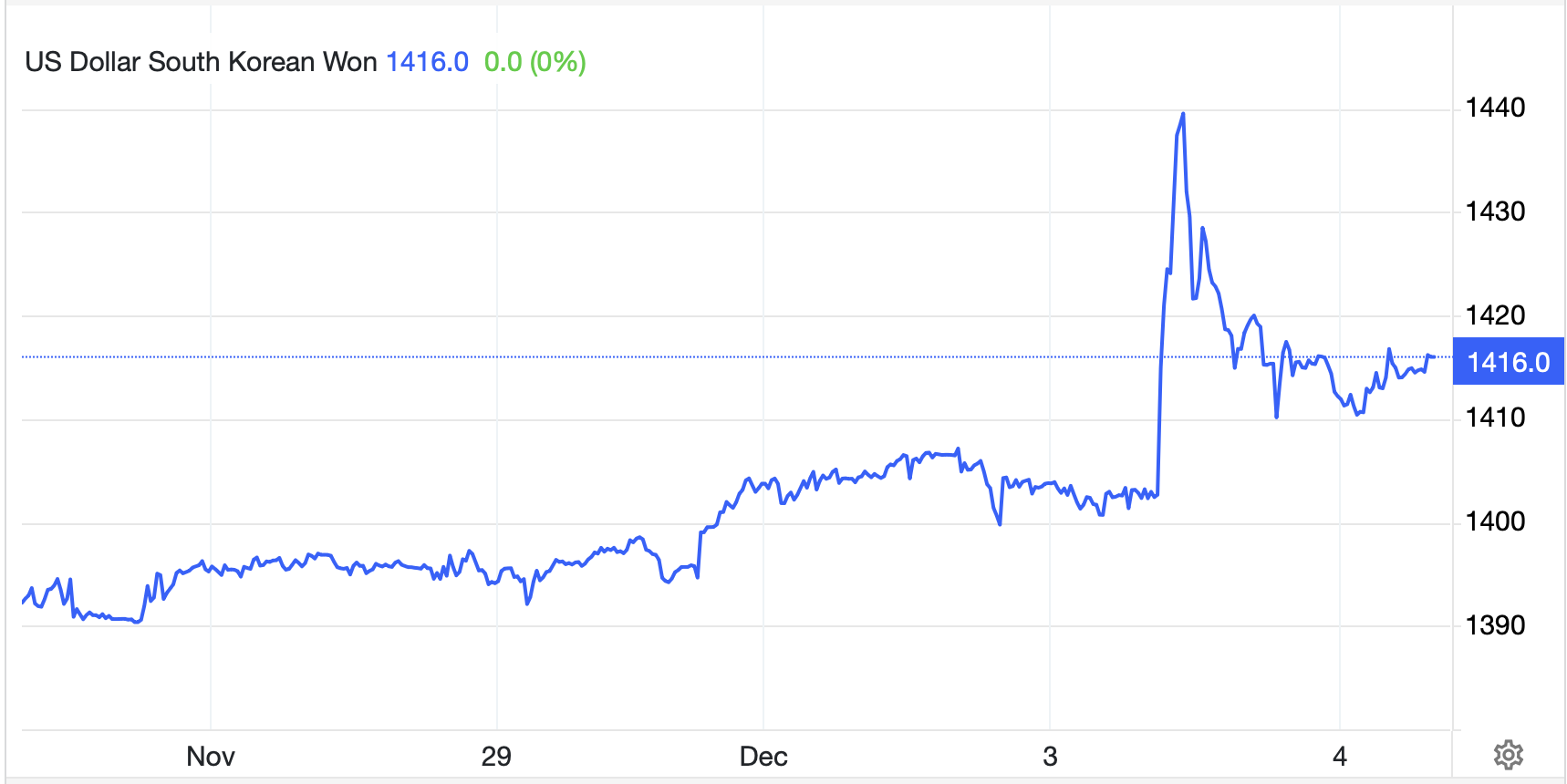
Source: tradingeconomics.com
Too, the KOSPI (-1.5%) suffered although that was off the worst levels of the day after things settled down. The point to keep in mind here is that markets are subsidiaries of economies. They may give indications of expectations for the future, or sentiments of the current situation, but if we continue to see geopolitical flare ups, markets are going to respond as investors seek havens. In this case, the dollar, despite all its flaws, remains the safest choice in many investors’ eyes, so should remain well bid overall.
Ok, let’s look at how markets have been behaving through this current turmoil. In Asia, given the events in Korea, it ought not be surprising that equities had little traction. Japanese shares were unchanged as were Hong Kong although mainland Chinese (-0.5%) and Australian (-0.4%) shares were under some pressure. That said, Australia suffered on weaker than forecast GDP data which puts more pressure on the RBA to cut rates despite inflation remaining sticky. Australia dragged down New Zealand (-1.5%) shares as well with really the only notable winner overnight being Taiwan (+1.0%). In Europe, investors seem to be betting on a more aggressive ECB as somewhat weaker than expected PMI Services data has led to gains on the continent (DAX +0.85%, CAC +0.5%, IBEX +0.7%) although UK shares (-0.2%) are not enjoying the same boost. I guess the French market has already priced in the lack of a working government, hence the market’s underperformance all year. US futures, at this hour (8:00) are pointing higher by between 0.3% and 0.6%.
In the bond market, yields are rising, with Treasuries (+4bps) leading the way although most of Europe are higher by between 3bps and 4bps. It has the feel that bond markets are starting to decouple from central banks as they see inflationary pressures building and central banks still in active cutting mode. I fear this will get messier as time goes on.
In the commodity markets, oil is unchanged this morning, right at $70/bbl, having continued its rally for the week on news that OPEC+ will maintain its production cuts through March 2025. NatGas (-2.0%) has been sliding since the spike seen 2 weeks ago ahead of the current cold spell as warmer weather is forecast for next week. In the metals market, gold (-0.2%) seems stuck in the mud right now while silver (-1.3%) and copper (-0.6%) appear to be victims of the dollar’s strength.
Turning to the dollar, it is stronger across the board with AUD (-1.3%) the laggard after that GDP data and it dragged NZD (-1.0%) down with it. JPY (-1.1%) is also under pressure as hopes for that BOJ rate hike dissipate. Away from those, the euro (-0.2%) and pound (-0.1%) are softer, but much less so. In the EMG bloc, ZAR (-0.5%) is feeling the weight of the weaker metals prices and we are seeing BRL (-0.3%) and CLP (-0.1%) also sliding slightly although both are stabilizing after more pronounced weakness earlier in the week.
On the data front, this morning brings ADP Employment. (exp 150K) along with ISM Services (55.5) and then the Fed’s Beige Book. Perhaps of more importance, at 12:45, Chairman Powell will be speaking and taking questions, so all eyes will be there looking for clues as to how the Fed will be viewing things going forward. Fed funds futures have been increasing the probability of that rate cut, now up to 74%, which implies we are going to see one, regardless of the inflation story.
Central banks around the world are in a bind as inflation refuses to fall like they want but many nations are seeing slowing economic activity. In the end, I expect that the rate cutting cycle has not ended, but the dollar is likely to remain well bid given both its haven status and the fact that the US economy is outperforming everywhere else.
Good luck
Adf
 fxpoetry