
The calendar’s not e’en turned twice
Since Trump, with JD as his Vice
Have taken the reins
And beat up on Keynes
While weeding out waste in a trice
For markets, the problem, it seems
Is rallies are now merely dreams
So, equity buyers
Are putting out fires
While thinking up pump and dump schemes
For bondholders, it’s not so clear
If salvation truly is near
But one thing seems sure
The buck will endure
Much weakness throughout this whole year
We have not even reached 50 days of a Trump presidency as of this morning and nobody would fault you if you estimated we had three years of policies enacted to date. The pace of changes has been blistering and clearly most politicians, let alone investors, have not been prepared for all that has occurred.
One of the things that I read regularly is that Trump is destroying the Rules Based Order (RBO) which was underpinned by the Pax Americana of the US essentially being the world’s policeman. This is cast as a distinct negative under the premise that things were going great and now, he is upsetting the applecart for his own personal reasons. Of course, market participants had grown quite accustomed to this framework, had built all sorts of models to profit from it and with the Fed’s help of monetization of debt, were able to gain significantly at the expense of those without market linked assets. Hence, the K-shaped recovery.
But while that is a lovely narrative, is it really an accurate representation of the way of the world? If the US was truly the world’s policeman, and we certainly spend enough on defense to earn that title, perhaps it was time for the US to be fired from that role anyway. After all, there is currently raging military conflict in Ukraine, Lebanon, Syria, Congo, Sudan and the ongoing tensions in Gaza. That’s a pretty long list of wars to claim that things were going great.
Secondly, the question of financing all this conflagration, as well as other economic goals, notably the alleged transition to net zero carbon energy production, appears to be reaching the end of the line. While the US can still borrow as needed, (assuming the debt ceiling is raised), the reality is that the US gross national debt outstanding is greater than $36,000,000,000,000 relative to GDP that is a touch under $28,000,000,000,000. On a global basis, total (not just government) debt is in excess of $300,000,000,000,000 while global GDP clocks in somewhere just north of $100,000,000,000,000. Arguably, on a credit metric basis, the world is BB- or B+, a clear indication that all that debt is unlikely to be repaid.
If we consider things considering this information, perhaps the RBO had outlived its usefulness. Arguably, the loudest complaints are coming from those who benefitted most greatly and are quite unhappy to see things change against them. But as evidenced by the polls taken after President Trump’s speech last Tuesday evening, the bulk of the American public is still strongly supporting this agenda. The idea that the president and his Treasury secretary are seeking to engineer a short-term recession early, blame it on fixing Biden’s mess, and having things revert to stronger growth in time for the 2026 mid-term elections is not crazy. In fact, there have been several comments from both men that short-term pain would be necessary to achieve a stabler, long-term gain.
So, what does this mean for the markets? You have no doubt already recognized that volatility is the main event in every market, and I don’t see that changing anytime soon. But some of the themes that follow this agenda would be for US equities to suffer relative to other markets, as the last decade plus of American exceptionalism, led by massive deficit spending and borrowing, would reverse under this new thesis. Add to this the sudden realization that other nations are going to be investing significantly more in their own defense, and money will be flowing out of the US into Europe, Japan and emerging markets around the world.
Bonds are a tougher call as a weaker economy would ordinarily mean lower yields, but the question of tariff impacts on prices, as well as reshoring, which, by definition, will raise prices, could mean we see the yield curve steepen with the Fed cutting rates more aggressively than currently priced, but 10-year and 30-year yields staying right where they are now.
I believe this will be a strong period for commodities as all that foreign capex will be a driver, as will the fact that, as I will discuss shortly, the dollar is likely to underperform significantly. Gold will retain its haven characteristics as well as remain in demand for foreign central banks, while industrial metals should hold their own. As to oil, my take is lower initially, as OPEC returns its production and slowing GDP weighs on demand, at least for a while, although eventually, I suspect it will rebound along with economic activity.
Finally, the dollar will remain under significant pressure across the board. Clearly, Trump is seeking a weaker dollar to help the export industries, as well as discourage imports. Add to this the potential for lower yields, lower short-term rates, and an exit of equity investors as US stocks underperform, and you have the making of at least another 15% decline in the greenback this year.
With this as backdrop, we need to touch on three key stories this morning. First, Friday’s NFP report was pretty much in line with expectations at the headline level but seemed a bit weaker in some of the underlying bits, specifically in the Household Survey where a total of 588K jobs were lost and there was a large increase in the number of part-time workers doing so for economic reasons. Basically, that means they wanted full-time work but couldn’t find a job. Markets gyrated after the release, with yields initially sliding but then rebounding to close higher on the day. Equities, too, closed higher on the day although that had the earmarks of a relief rally after a lousy week overall. The thing about this report is that it did not include any of the government changes that have been in the press, so next month may offer more information regarding the impact of DOGE and their cuts.
The second story comes from north of the border where Mark Carney, former BOC and BOE head, was elected to lead the Labour Party in Canada and replace Justin Trudeau. As is always the case, when there is new leadership, there is excitement and he said he will call for a general election in the next several weeks, ostensibly to take advantage of this new momentum. It seems that President Trump’s derision of not only Trudeau, but Canada as well in many Canadian’s eyes, will play a large role with the two lead candidates, Carney and Poilievre, fighting to explain that they are each better placed to go toe-to-toe with Trump on critical issues.
Here’s the thing, though. Despite much angst about the US-Canada relationship on the Canadian side of the border, the market viewpoint is nothing has really changed. a look at the chart below shows that after a bout of weakness for the Loonie in the wake of the US election and leading up to Trump’s tariff announcements, USDCAD is basically unchanged since mid-December, with one day showing a spike and reversal in early February. My point is that the market has not, at least not yet, determined that the Canadian PM matters very much.
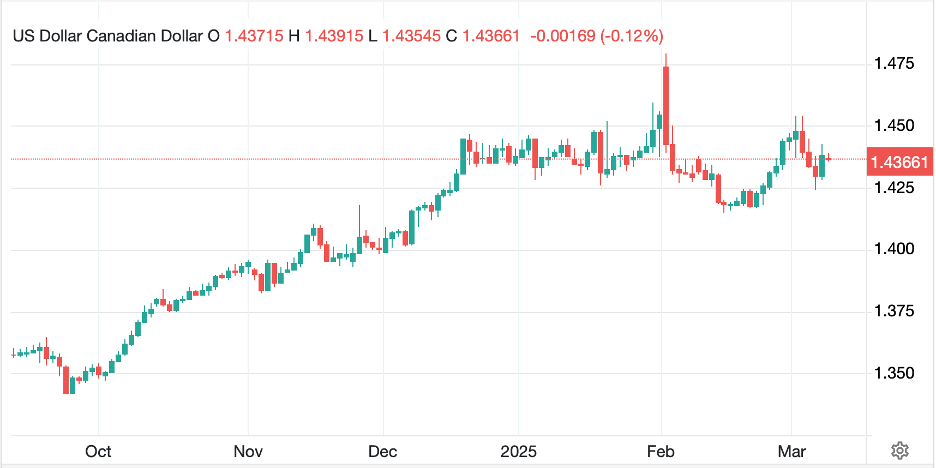
Source: tradingecoomics.com
The last story to discuss is Chinese inflation data which was released Saturday evening in the US and showed deflation in February (-0.7% Y/Y) for CPI and continuing deflation in PPI (-2.2%). In fact, as you can see from the below chart, PPI in China has been in deflation for several years now. Recently there have been several articles explaining this offers President Xi a great opportunity for significant stimulus because no matter how much the government spends and how much debt they monetize, inflation won’t be a problem for a long time to come. I would counter that given deflation has been the norm for several years, they have had this opportunity for quite a while and done nothing with it. Why will this time be different? Ultimately, the default result in China is when things are not looking like they will achieve the targeted growth of “about 5%”, you can be sure there will be more investment to build things up adding still more downward pressure on prices as production facilities increase.

Source: tradingeconomics.com
The renminbi’s response to this news has been modest, at best, with a tiny decline overnight of -0.25%. And a look at the chart there shows it is remarkably similar to the CAD, with steady weakness through December and then no real movement since then. Given the dollar’s recent weakness overall, this seems unusual. Although, we also know that China prefers a weaker currency to help support their export industries, so perhaps this in not unusual at all.

Source: tradingeconomics.com
Ok, this note is already overly long, so will end it here. We do have important data later this week with both CPI and Retail Sales coming. As well, the consensus from the Fedspeak is that they are pretty happy right here and not planning to do anything for a while.
The big picture is best summarized, I believe, by the idea that we are at the beginnings of a regime change in markets as discussed above. Volatility continues to be the driving force, so hedging remains crucial for those with natural exposures.
Good luckAdf
 fxpoetry