
The pundits have now all declared
That everyone should be quite scared
It will be a bummer
When shelves, come this summer
Are empty, so please be prepared
As well, a recession’s in view
Although, that seems like déjà vu
For three years at least
The pundits increased
The odds that this bill would come due
Apparently, the only thing you need to know this morning is that by summertime, shelves across the country will be barren as imports from China halt. The upshot, at least according to the sources that I have read, is that you should blame President Trump and join the media chorus in hating the man and his policies.
Now, I am no logistics expert, but the concern stems from the significant decline in shipping as evidenced by port activity in both China and the US. As you can see from the chart below, there has certainly been a significant decline in the number of ships leaving China on their way to the US.
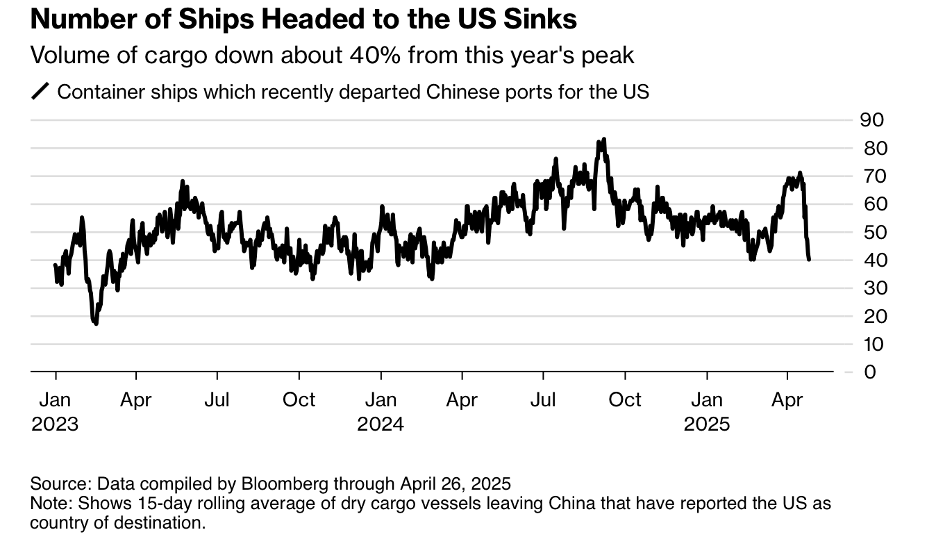
I guess the question is just how much of what is on store shelves comes from China? Much will depend on what kind of store one considers. Certainly, toy stores seem likely to have less inventory, as will Best Buy with electronics potentially suffering, although as I recall President Trump exempted electronics initially. Arguably, clothing shelves and racks may be sparser as well. But based on official data, Chinese imports (~$463B) accounted for approximately 1.7% of the US’s $26.9T GDP in 2024. This may be an overreaction.
Potentially a bigger issue will be the impact on intermediate goods that are imported from China and elsewhere and incorporated into products finalized in the US. However, I cannot calculate that, nor have I seen any data of this issue, although I have read many stories about the end of this particular world as well.
One of the things to remember about the punditry is that they make their living describing the worst possible outcome because that gets them recognition. However, I’m confident we all remember that a recession was forecast for 2022, 2023 and 2024 by much of the punditry and yet one was never officially declared by the NBER. In fact, you may recall that in Q1 and Q2 of 2022, US Real GDP growth was -0.2% for both quarters, thus two consecutive quarters of negative growth. Historically, that has defined a recession. However, subsequent data revisions did remove that as you can see below with Q2 revised higher.

Source: tradingeconomics.com
The one thing I do know is that there is a group of analysts/economists who have been forecasting the next recession consistently for several years. They point to data like changes in the housing market, the JOLTs Quits rate shrinking and various other secondary and tertiary data points and sources, all of which have been pointing in that direction for several years. And I grant, reading that ~40% of GenZ is using BNPL to buy their groceries, and then run late on payments, is a frightening statistic (although perhaps one that highlights financial illiteracy more than economic reality).
In the end, what you need to know is you should be terrified because the punditry is almost certain that this time, they have it right. But our concern is how will this scenario impact markets.
Basically, despite all this huffing and puffing, it appears markets are whistling past this particular graveyard. Friday’s US equity rally was followed by general strength in Asia and strength this morning in Europe. Last night, Tokyo (+0.4%), Mumbai (+1.3%), Taiwan (+0.8%) and Australia (+0.4%) all had solid performances although neither Hong Kong (-0.1%) nor China (-0.15%) could find any real buying support. A less reported story is that China is exempting a number of US imports from its 125% tariffs on the US as clearly, this trading relationship is deep and complex.
As to Europe, all markets are ahead this morning, with the UK (+0.4%) the laggard and most of the continent higher by between 0.7% and 0.8%. There are headlines around as to how the ECB is preparing to cut rates further on the assumption that global economic activity is going to slow and thus hurt Europe, while the consistent message is that US tariffs will be deflationary in Europe, so less concerns about their inflation mandate. Finally, US futures are pointing slightly softer (-0.2%) at this hour (6:45).
In the bond market, 10-year Treasury yields have fallen 30bps in the past two and one-half weeks, sliding 5bps on Friday before bouncing 3bps overnight. However, the recent trend does seem lower.

Source: tradingeconomics.com
But yields are climbing in Europe as well today, higher by 5bps across the board on the continent, although UK Gilts have only edged higher by 2bps. It’s funny, despite all the doom and gloom regarding the economy because of US tariffs, as well as growing expectations of an ECB rate cut at the early June meeting, investors appear to be growing concerned about something. Perhaps they have pivoted back to the promised fiscal spending increases as their driver today.
In the commodity markets, oil (-0.35%) continues to trade in its recent $60 – $63/bbl range with limited signs that this will soon change. Peace in Ukraine does not seem at hand yet and reports are that the initial discussions between the US and Iran, while constructive, still have a ways to go before completion. Both of those seem likely to weigh on oil prices if completed. However, the more unusual thing to me is that with the rising chorus of recession calls, oil’s price has not fallen further. To date, markets have not yet agreed with the economists’ view that recession is imminent. In the metals markets, gold (-1.0%) is continuing its rough week, although remains nicely higher on the month. You may recall my view a week ago Friday that the move seemed parabolic and due for a correction. Recent price action is exactly that, corrective, as I believe the underlying thesis to own the barbarous relic remains intact. The other main metals are a touch softer this morning, but really nothing to discuss.
Finally, the dollar is mixed this morning with modest strength against the euro (-0.15%) but softness vs. the pound (+0.15%) and those size moves are representative of most of the price action across both G10 and EMG currencies this morning. The outlier is KRW (-0.4%), which seems to be suffering from comments that no trade deal will be completed before June’s election there.
Overall, despite ongoing doom and gloom by much of the punditry, it is not obvious to me that investors are anticipating major changes. Perhaps they are wrong, and the pundits are correct. But as yet, there is no evidence to support that conclusion.
Ok, let’s turn to the data this week, which starts slowly but ends on NFP.
| Tuesday | Goods Trade Balance | -$146.0B |
| Case-Shiller Home Prices | 4.8% | |
| JOLTs Job Openings | 7.5M | |
| Wednesday | ADP Employment | 108K |
| Q1 GDP | 0.4% | |
| Q1 Employment Cost Index | 0.9% | |
| Chicago PMI | 45.5 | |
| Personal Income | 0.4% | |
| Personal Spending | 0.6% | |
| PCE | 0.0% (2.2% Y/Y) | |
| Core PCE | 0.1% (2.6% Y/Y) | |
| Thursday | Initial Claims | 225K |
| Continuing Claims | 1860K | |
| ISM Manufacturing | 48.0 | |
| ISM Prices Paid | 70.2 | |
| Friday | Nonfarm Payrolls | 135K |
| Private Payrolls | 127K | |
| Manufacturing Payrolls | -5K | |
| Unemployment Rate | 4.2% | |
| Average Hourly Earnings | 0.3% (3.9% Y/Y) | |
| Average Weekly Hours | 34.2 | |
| Participation Rate | 62.5% | |
| Factory Orders | 4.5% |
Source: tradingeconomics.com
As well as NFP, we get the PCE data, which looks like it has changed to a 10:00am release from its traditional 8:30am time. The Fed is in its quiet period, but nobody has been listening to them anyway. Secretary Bessent, along with President Trump, has been the most important voice lately. Again, for now, the data has not indicated recession, although Q1 GDP is slated to be soft. Markets, too, have been unwilling to get behind the recession call completely.
Ultimately, the one thing we know is that the nature of the global economy has changed since President Trump’s election. Globalization is in retreat and mercantilism is the new normal. It is not clear to me that existing econometric models will accurately portray how that works, so I need to see more data before recognizing the end of times. In the meantime, these myriad views are a sign that hedging for risk managers remains the only path forward.
Good luck
Adf
 fxpoetry