
Attention right now’s being paid
To Congress on taxes and trade
The One BBB
Is seen as the key
To growth in the coming decade
Meanwhile, Sintra right now’s the host
To Powell, Lagarde and almost
All central bankers
Each one of whom hankers
To nurture the perfect riposte
The headlines this morning highlight that Congress put in an all-nighter last night as they try to get the BBB over the line and on the president’s desk by Friday. My take is they were seeking sympathy for all the hard work they must do and trying to make it seem like they are slaving away on their constituents’ behalf. Yet it appears that since the president’s inauguration on January 20, 161 days ago, Congress has been in session for somewhere between 40 and 50 days (according to Grok), about one-quarter of the time. I have seen these estimates elsewhere as well, and quite frankly, it doesn’t speak well of Congressional leadership.
In the end, though, I continue to expect the BBB to get passed by both houses and sent to the president. I’m certain there are still a lot of things in the bill that many fiscal conservatives will not like, but I’m also confident that the fact that not a single Democratic representative or senator is going to vote for the bill is likely a sign that it does more good than harm. I am completely aware of the debt and deficit issues and questions of their long-term sustainability, and I am not ignoring that. But politics is the art of the possible, not the perfect, and my take is this is possible. Consider for a moment the Orwellian-named Inflation Reduction Act from 2022, which passed the Senate on a tiebreaker vote by VP Harris. That was a much more harmful piece of legislation from a fiscal perspective than this. In fact, I would say this is the very definition of politics.
Through a market lens, if (when) this is passed, while there may be an initial ‘sell the news’ move, I suspect that the stimulus it entails will be a net benefit for risk assets overall. And the only reason there would be a sell the news event is that the market is already pricing in a great future as evidenced by yesterday’s quarterly close at new all-time highs for the S&P 500, above 6200.
Turning to the other noteworthy news, the ECB is holding their faux Jackson Hole event this week in Sintra, Portugal where all the heads of major central banks are currently gathered along with academics and journalists who are there to spread the good word. Chairman Powell speaks today, but this is the Powell story of the day. Apparently, President Trump had this hand-written note delivered to the Fed Chair. Are we not entertained?

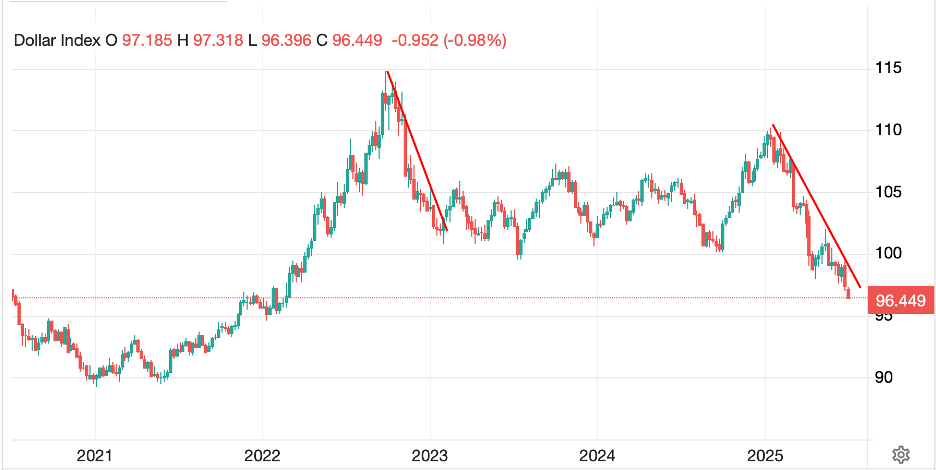
But ignoring for a moment the president’s desires, let us consider the dollar and its potential future direction. The predominant current thinking is that it has further to slide as the trend is clearly lower and the rising anticipation of a recession in the US forcing the Fed to cut rates further will undermine the greenback. Let’s break that down for a moment. There is no question the dollar is currently in a downtrend as evidenced by the chart below. A look at the red line on the right shows the slope of the decline thus far this year, which totals about 11%.
Source: tradingeconomics.com
In fact, much has been made of the decline thus far this year as to its speed and how it is a harbinger of both a recession and the end of the dollar’s hegemony. Yet, we don’t have to go very far back in time, late 2022-early 2023 to see a virtually identical decline in the dollar over a slightly shorter period, hence the steeper slope of the line in the center of the chart, and I cannot find a single descrying of the end of the dollar at that time. Too, I remember being certain a recession was on the way then, when it never arrived. According to JPMorgan, it seems the recession probability for 2025 is now 40%. I have seen estimates ranging from 25% to 80% over the past few months which mostly tells me nobody has any idea.
We also don’t have to go very far back in time to see when the dollar was substantially weaker than its current levels. I’m not sure why this time the dollar’s recent trend means the world is ending when that was not the case back in 2023 or any of the myriad times we have seen movement like this in the past.
But one other thing to consider regarding the dollar is that the BBB is going to provide significant stimulus to the economy. Combining this with President Trump’s trade policies which are designed to draw investment into the US, and seemingly are working, and I think that despite his desire for lower interest rates, the Fed will have little reason to cut amid stronger growth in the economy. I do not believe you can rule out a turn in the dollar higher once the legislation is passed as it is going to matter a great deal. While spending priorities are going to change, it appears that investment is going to rise and that will help the buck. Be wary of the dollar is dying thesis.
Ok, yesterday’s market activity, while reaching record highs in the equity markets, was actually incredibly slow with volumes shrinking. My sense is folks are on holiday this week and those who aren’t are waiting for Thursday’s NFP data, so they can then run out of the office and go for their long weekend. But the rest of the world doesn’t have the holiday Friday and are all trying to solve their trade situation with the US. That led the Nikkei (-1.25%) lower yesterday as there appears to be a timing mismatch from a political perspective. Ishiba doesn’t want to agree to open Japan’s market to US rice ahead of the election on July 20th as that will be a major political problem, but July 9th is approaching quickly, and Trump has said that is the date. But aside from Japan and Hong Kong (-0.9%) the rest of the region had a pretty solid session led by Thailand (+2.1%) and Taiwan (+1.3%). In Europe, though, PMI data was less than stellar, and bourses are modestly softer (DAX -0.5%, CAC -0.4%, FTSE 100 -0.3%) although Spain’s IBEX (+0.2%) has managed a gain as they had the best PMI outcome of the lot.
In the bond market, yields continue to slide everywhere with Treasuries (-4bps) actually lagging the Eurozone which has seen declines of -6bps virtually across the board. Madame Lagarde, in her Sintra opening speech, explained that the ECB would be altering their communication strategy to try to take account of the uncertainty in their forecasts, so not promise as much, but I have a feeling the movement is more a result of the softer PMI data as well as the Eurozone inflation release at 2.0% which has ECB members explaining things are under control. Japan is a bit more confusing as JGB yields (-4bps) slipped despite what I would consider a strong Tankan report and a rise in their PMI data. However, the newest BOJ board member did explain there was no reason to raise rates anytime soon, so perhaps that is the driver.
In the commodity markets, oil (+0.8%) continues to creep higher, perhaps a harbinger of stronger future economic activity around the world, or perhaps more short covering. Gold (+1.4%) has completely erased the dip at the end of last week and is back at its recent pivot point of $3350 or so. This has brought silver (+1.1%) and copper (+0.7%) along for the ride.
Finally, the dollar is clearly softer this morning with JPY (+0.6%) the leader in the G10 while ZAR (+0.9%) is the leading gainer in the EMG bloc as it follows precious metals prices higher. Net, I would suggest that the average move here is about 0.25% strength in currencies.
On the data front, we get ISM Manufacturing (exp 48.8) and Prices Paid (69.0) and we get the JOLTs Job openings (7.3M) this morning. Too, at 9:30, Chairman Powell speaks so it will be interesting to see if there is any change in his tune.
I see no reason for the dollar to turn higher right now but watch for the BBB. Its passage could well change the dollar’s direction.
Good luck
Adf
 fxpoetry