
Some nations have gained a reprieve
About a month left to achieve
A deal to prevent
The extra percent
Of tariffs that Trump can conceive
The news cycle continues to be bereft of new stories regarding finance and markets as there is continued focus on the tragedy in Texas after the flash floods that were responsible for over 100 deaths. But in our little corner of the world, tariff redux is all we have. So, to rehash, today marks 90 days since President Trump delayed the imposition of his Liberation Day tariffs back in April with the idea of negotiating many new trade deals. Thus far, only two have been agreed, the UK and Vietnam, while there has clearly been progress made on several key deals including Japan, South Korea, the EU, India and Australia. As such, the president has delayed the imposition of these tariffs now to August 1st, but we shall see what happens then.
It is worth noting that trade negotiations historically have taken a very long time, years if not decades, as evidenced by the fact that any time an agreement is reached, it is met with dramatic fanfare on both sides of the deal. Consider, for a moment, that the EU and MERCOSUR finally agreed terms in 2024, after 25 years of negotiations, although the deal has not yet been ratified by both sides. With this in mind, it is remarkable that as much ground has been covered in this short period of time as it has.
However, if I understand correctly, many other nations will be subject to tariffs starting today. Of course, along with these tariffs are the resumed calls for a catastrophic outcome for the US with inflation now set to advance sharply while growth stagnates. At least the naysayers are consistent.
Away from this story, though, the market is the very picture of the summer doldrums. After all, nothing else has really changed. The BBB solved the debt ceiling issue, with another $5 trillion added to the mix, so funding the government should not be a problem for several years at least. Of course, this means the monetary hawks will re-emerge and complain that the government is spending too much (which it clearly is) and that the economy will collapse under the weight of all that debt. After all, one needs a calamity to get one’s views aired these days, and doomporn is all the rage with President Trump in office.
So, I won’t waste any more time before heading into the market recap. Yesterday’s US equity decline, catalyzed by the display of letters written to Japan and South Korea about the imposition of 25% tariffs, was halted after the delay was announced, but the markets still closed lower. Overnight, Asian markets managed to rally a bit with the Nikkei (+0.3%) the laggard while Korea (+1.8%) really benefitted from that delay. Meanwhile, China (+0.8%) and Hong Kong (+1.1%) were also solid as was most of the region although Thailand (-0.7%) which did not receive a reprieve, did suffer.
In Europe, the picture is somewhat mixed with the DAX (+0.45%) rising after a slightly wider than expected trade surplus was reported this morning while the CAC (-0.1%) has been under modest pressure after the French trade deficit rose slightly. But the bulk of the market here is modestly higher on the reprieve concept, although only about 0.2%. As to US futures, at this hour (7:05), they are basically unchanged to slightly higher.
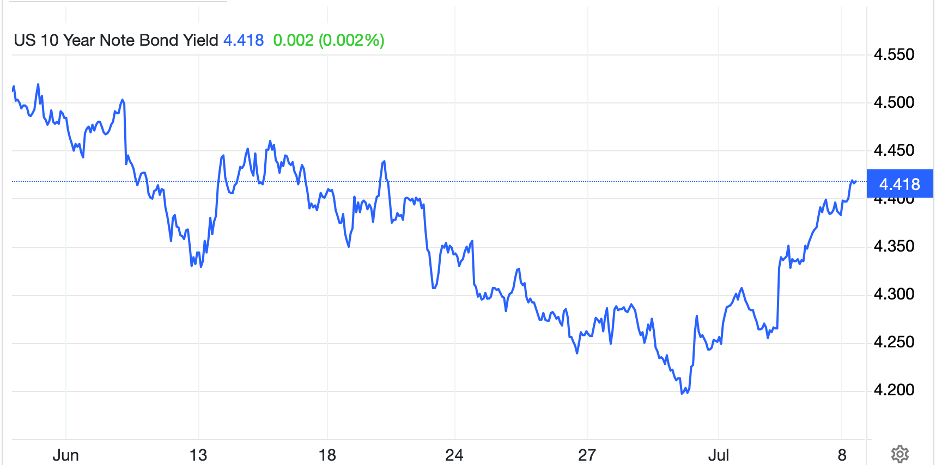
In the bond market, though, yields continue to rise around the world this morning as it appears investors are growing somewhat concerned that all the government spending that is being enacted around the world is becoming a concern. Treasury yields have risen 3bps and European sovereigns are higher by between 4bps and 5bps. JGB yields, too, are higher by 4bps and in Australia, an 8bp rise was seen after the RBA failed to cut their base rate last night as widely expected. Since the beginning of the month, 10-year Treasury yields have risen by more than 20 basis points (as per the chart below) a sign that there may be concern over excess supply…or that the BBB is going to encourage faster growth. I’m not willing to opine yet.
Source: tradingeconomics.com
In the commodity markets, oil (-0.3%) has been trading in a $4/bbl range since the end of the 12-Day War and the US destruction of Iranian nuclear facilities removed the war premium from the market. In truth, this is surprising given the ongoing increases in production from OPEC+ and the widespread belief that the economy is suffering and heading into a recession. But it is difficult to look at the below chart and be confident of the next move in either direction.

Source: tradingeconomics.com
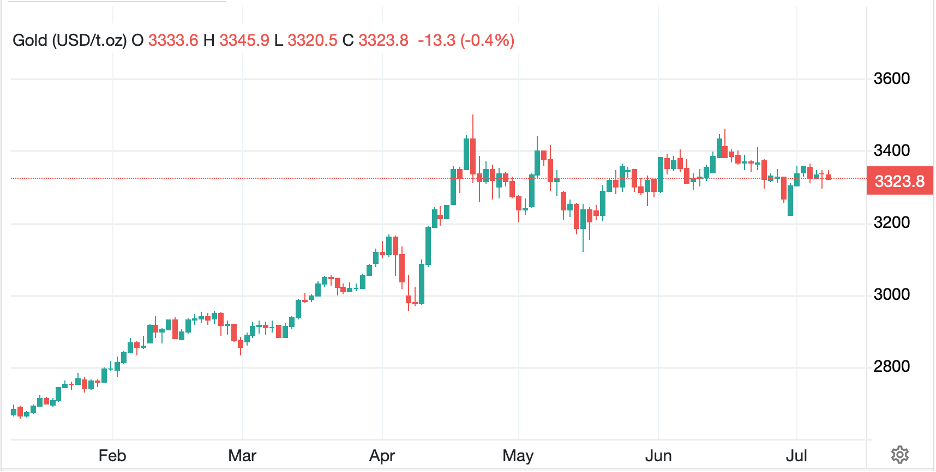
Meanwhile, metals markets this morning show gold (-0.35%) giving back some of its late day gains yesterday while silver and copper remain little changed. Again, range trading defines the price action as gold has basically gone nowhere since late April.
Source: tradingeconomics.com
Finally, the dollar is mixed this morning with AUD (+0.6%) the leading gainer after the RBA no-action outcome, although ZAR (+0.6%) has gained a similar amount which appears to have been driven by Trump rescinding his threat to add a 10% additional tariff on all BRICS nations (the S is South Africa) that seek to avoid using the dollar for trade. On the other side of the coin, the pound (-0.3%) and yen (-0.4%) are both slipping this morning with the former suffering from domestic finance problems as the Starmer government continues to flail in its efforts to pay for its promised spending. In Japan, the Upper House elections, which are to be held July 20th, are a problem for PM Ishiba and his minority government. One of the key issues is despite the fact that rice prices there have risen more than 100% in the past year, and the US is keen to export rice to Japan to help mitigate the problem, the farmers bloc in Japanese politics has outsized influence and is vehemently against the proposal. If the government falls due to election losses, agreeing a trade deal will be impossible. Perhaps this time, the yen will weaken in the wake of tariffs. (As an aside, are any of you old enough to remember the death of the carry trade and how the yen was going to explode higher? I seem to recall that was a strong narrative just a few months ago, but it is certainly not evident now.)
On the data front, the NFIB Survey was released this morning at 98.6, a tick lower than expected and 2 ticks lower than last month, but basically little changed. I don’t think it provides much new information. Later this afternoon we see Consumer Credit (exp $11.0B), potentially a harbinger of future spending outcomes. But really, that’s it.
Headline bingo continues to drive markets with the narratives locked in place. The dollar’s trend is clearly lower, but it remains to be seen if the oft-predicted collapse is on the cards. Personally, while a bit further weakness seems reasonable, getting short here, with the market already significantly positioned that way, does not feel like the right trade.
Good luck
Adf
 fxpoetry