
The vibe in the market is fear
As equities get a Bronx cheer
Commodities, too
Most traders eschew
The dollar, though’s, getting in gear
So, what has the catalyst been
To drive such a change in the spin
No story stands out
But there is no doubt
Investors are filled with chagrin
Ladies and gentlemen, boys and girls, this morning things just feel bad. As I peruse the headlines around the major publications, there is no obvious story that is driving today’s weakness in risk assets, but there is no mistaking the vibe. Certainly, there are several issues outstanding that might be seen as a negative, but none of them are new.
- The government has been shut down for 35 days as of today, and it doesn’t sound like the Senate Democrats are ready to vote to reopen it. Granted, the problems of the shutdown increase with time, but there has been no apparent change in tone for at least the past two weeks, so why is today the day when things look bad?
- The war in Ukraine continues apace with no obvious timeline to ending, but this has been ongoing for nearly 4 years, so what is it about today that may have changed?
- Concerns over fraud have increased after the recent bankruptcy filings by First Brands and Tricolor, as well as accusations by banks of other situations, but again, no new story broke overnight.
- Perhaps it is the fact that today is Election Day in the US, and there is concern that Zoran Mamdani, a self-described Democratic Socialist, could become the next mayor of NYC, which given it is still home to so many financial markets, has those market participants unnerved.
Some days, it’s just not clear why markets move in the direction they do, and there can be far less dramatic drivers. For instance, we have seen a major rally in equity markets, and risk assets in general, over the past 5 years, with an acceleration over the past 6 months and they are simply taking a breather. Whatever the driver, the movement is clear.
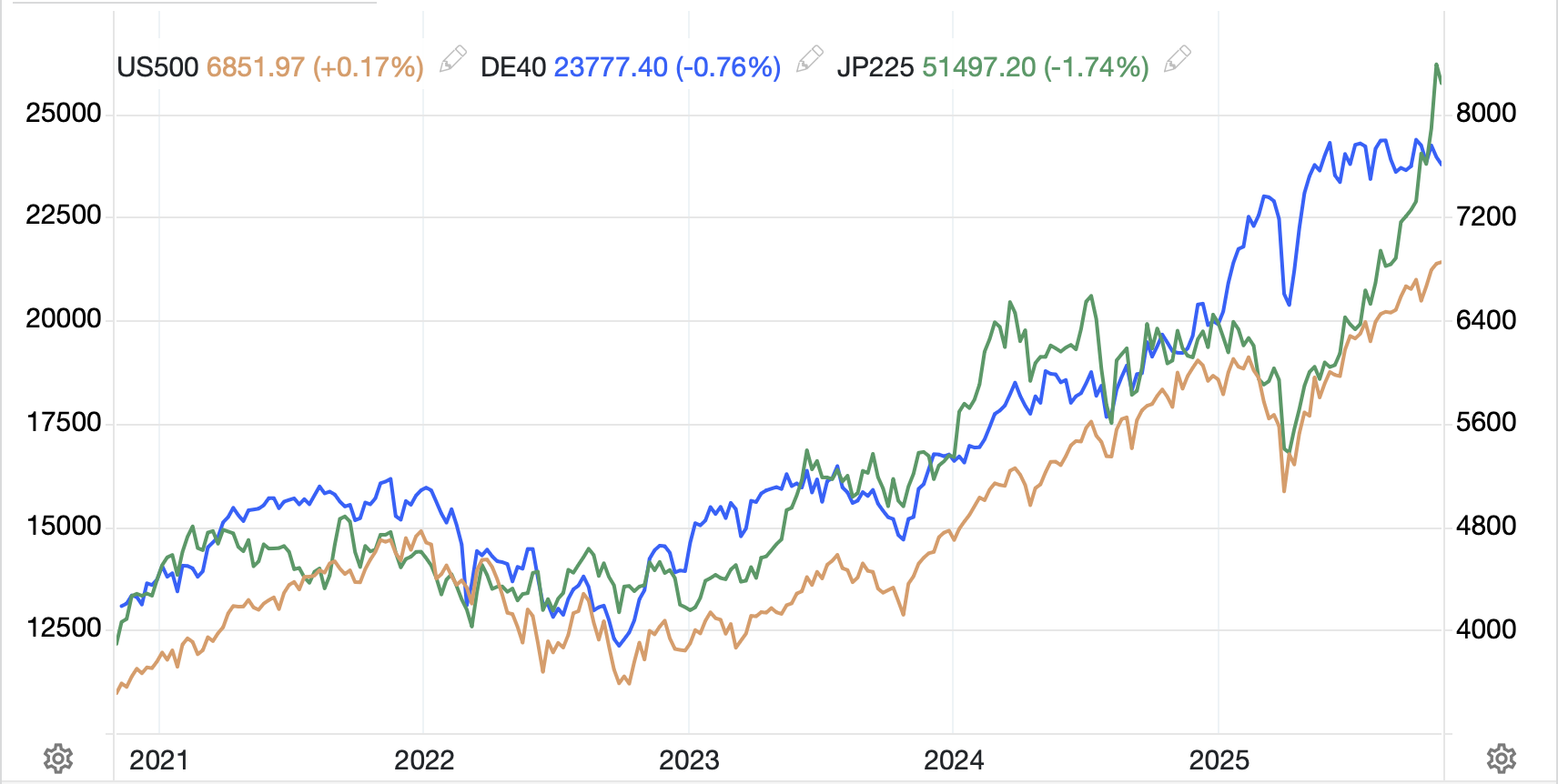
Source: tradingeconomics.com
So, given the absence of obvious drivers to discuss, let’s simply recap the damage. After yesterday’s mixed session in the US, Asia was under significant pressure led by Tokyo (-1.75%) with HK (-0.8%) and China (-0.75%) slipping as well. But Australia (-0.9%) fell after the RBA left rates on hold, as expected, although Governor Bullock sounded a touch more hawkish than expected, and the rest of the region saw almost universal weakness with Korea (-2.4%) the worst of the bunch, but declines everywhere (India, Taiwan, Indonesia, Singapore, Thailand) except New Zealand, which managed a small gain, to reach yet another record high, on solid earnings numbers from key companies.
Meanwhile, European bourses are all sharply lower as well (DAX -1.3%, CAC -1.2%, IBEX -1.1%) as the overall market vibe weighs on these markets, all of which recently traded at new all-time highs. Ironically, the UK (-0.6%) is about the best performer despite a speech from Chancellor of the Exchequer, Rachel Reeves, which explained…well, it is not clear what it explained. The UK has major budget problems and has discussed raising taxes, but given growth is lagging, there is a lot of pushback, even within the Starmer government, on that subject. As with virtually every G10 economy, the government is spending far more than they take in and they don’t know how to address the deficit. Unfortunately for the UK, the pound is not the global reserve currency and so they are subject to market discipline, unlike the US…so far. But, in this space, US futures are all lower this morning, down -1.0% or so as I type at 7:10am.
Now, your first thought might be that bonds have rallied nicely on all this risk aversion, but while they have, indeed, moved higher (yields lower) I don’t know that nicely would describe the movement. Rather, barely is a better description as 10-year yields are lower by -2bps in the Treasury market and between -1bp and -2bps in all European sovereign markets. In fact, despite the weakness in Japanese stocks overnight, JGB yields are unchanged. The message is, bonds are not that appealing, even if stocks aren’t either.
Turning to commodities, oil (-1.4%) is having a hard time this morning alongside the equity markets, with virtually all energy prices lower across the board. Given there has been no announcement of a major energy breakthrough, this has the feel of growing concern over economic activity going forward. With that in mind, though, WTI is still trading right around $60/bbl, which seems to be its “home” lately.
In the metals markets, gold (-0.15%) continues to trade around the $4000/oz level, which seems to be its new “home” as traders await the next catalyst in this space. Silver (-0.3%) is similarly fixated on its level of $48/oz and seems likely to follow gold’s lead going forward. However, copper (-2.3%) seems like it is more in sync with oil lately, as the two are both so intimately linked with economic activity and changes thereto. It’s funny, despite the risk asset weakness, I have not seen anything new on a pending recession in the US, nor globally, although there continues to be a steady stream of analysts who have been explaining we are already in one.
Finally, the dollar is today’s winner, rising against every one of its counterparts except the yen (+.45%) which responded to a second round of verbal intervention from FinMin Katayama, who once again drew from the MOF seven-step playbook with a half-step overnight: “I’m seeing one-sided and rapid moves in the currency market. There’s no change in our stance of assessing developments with a high sense of urgency.”
But away from the yen, it is merely a question of which currency looks worst. The pound (-0.65%) has traded down to levels not seen since Liberation Day, as it appears the FX market did not take Chancellor Reeves’ comments that well.

Source: tradingeconomics.com
For those who view the DXY as the key indicator, it has traded above 100 for the first time since August, and I know many technicians are looking for a breakout here. The fact remains that the Fed’s recent seeming mildly hawkish turn is out of sync with most of the rest of the world and will support the dollar for now. Of course, the futures market is still pricing a 72% probability of a rate cut in December, so traders are taking the ‘hawkish’ comments by Chair Powell at the press conference last week with a grain or two of salt. In fact, one of the things weighing on the pound is the idea that the BOE may cut this week despite still high inflation.
But wherever you look in this space, the dollar is sharply higher. ZAR (-1.0%), NOK (-0.9%), MXN (-0.85%) and SEK (-0.9%) lead the way, but declines of -0.5% are rampant across all three regional blocs. Today is a straight up dollar story.
And that’s all we have today. Yesterday’s ISM data was a touch weaker than forecast, and last month, slipping to 48.7 with Prices Paid (58.0) slipping as well. Weirdly, the S&P PMI was a better than expected 52.5, rising from last month and beating expectations. It seems a mixed message. Yesterday’s Fed speakers didn’t tell us anything new, with Governor Cook explaining that December is a “live” meeting. I’m not sure what that means. Is the implication they may not cut there? That would not go down well in either markets or the White House.
Given how far equity prices have come in the past 6 months, it would not be a surprise to see a more substantial pullback. In fact, it would be healthy for the market to remove some of the excesses that abound. The fraud stories are concerning as they tend to flourish at the end of bull markets, and while they are not yet flourishing, they are starting to become more common. In the end, while I expect the Fed will cut in December, and then again in January, I don’t see a reason for the dollar to decline sharply.
Good luck
Adf
 fxpoetry