So Mind-Blowing

On one hand, the chorus is growing
That US debt is so mind-blowing
The ‘conomy will
Slow down, then stand still
As ‘flation continues its slowing
 
But others remind us the data
Does not show a slowing growth rate-a
And their main concerns
Are Powell still yearns
For rate cuts to help market beta


As many of us enjoyed the long weekend, it appears it is time to put our noses back to the proverbial grindstone.  I know that as I age, I find the meaning of the Memorial Day holiday to grow in importance, although I have personally been very fortunate having never lost a loved one in service of the nation.  However, as the ructions in the nation are so evident each day, I remain quite thankful for all those that “…gave the(ir) last full measure of devotion” as President Lincoln so eloquently remarked all those years ago.

But on to less important, but more topical things.  A week ago, an X account I follow, The Kobeissi Letter, posted the following which I think is such an excellent description of why we are all so confused by the current market gyrations.  

Prior to President Trump’s second term, I would contend that the broad narrative had some internal consistency to it, so risk-on days saw equity markets rally along with commodities while bond prices would fall (yields rise) and the dollar would sink as well.  Similarly, risk-off days would see pretty much the opposite.  And it was not hard to understand the logic attached to the process.  

But here we are, some four plus months into President Trump’s term and pretty much every old narrative has broken into pieces.  I think part of that stems from the fact that the mainstream media, who were purveyors of that narrative, have been shown to be less than trustworthy in much of what they reported during the Biden Administration, and so there is a great deal of skepticism now regarding all that they say, whether political or financial.

However, I think a bigger part of the problem is that different markets have seen participants focusing on different idiosyncratic issues rather than on the bigger picture, and so there are many mini narratives that are frequently at odds.  Add to this the fact that there continues to be a significant dichotomy between the soft, survey data and the hard, calculated data, with the former pointing toward recession or stagflation while the latter seems to be pointing to stronger economic activity, and the fact that if you ask twenty market participants about the impact of President Trump’s tariff policies, you will receive twenty-five different explanations for why markets are behaving in a given manner and what those policies will mean for the economy going forward.

It is at times like these, when there are persuasive short-term arguments on both sides that I step back and try to look at bigger picture events.  In this category I place two things, energy and debt.  Energy is life.  Economic activity is simply energy transformed and the more energy a nation has and the cheaper it is, the better off that economy will be.  President Trump has made no bones about his desire to cement the US as the number one energy producer on the planet and to allow affordable energy to power the economy forward.  As that occurs, that is a medium- and long-term bullish backdrop.

On the other hand, we cannot forget the debt situation, which is an undeniable drag on economic activity.  Forgetting the numbers per se, the fact that the US debt/GDP ratio is at wartime levels during peacetime (well, US peacetime) with no obvious end to the spending is a key concern.  But it is not just the US with a growing debt/GDP ratio.  Here is a listing from tradingeconomics.com of the G20’s ratios.  (Russia is the bottom of the list but not relevant for this discussion.)
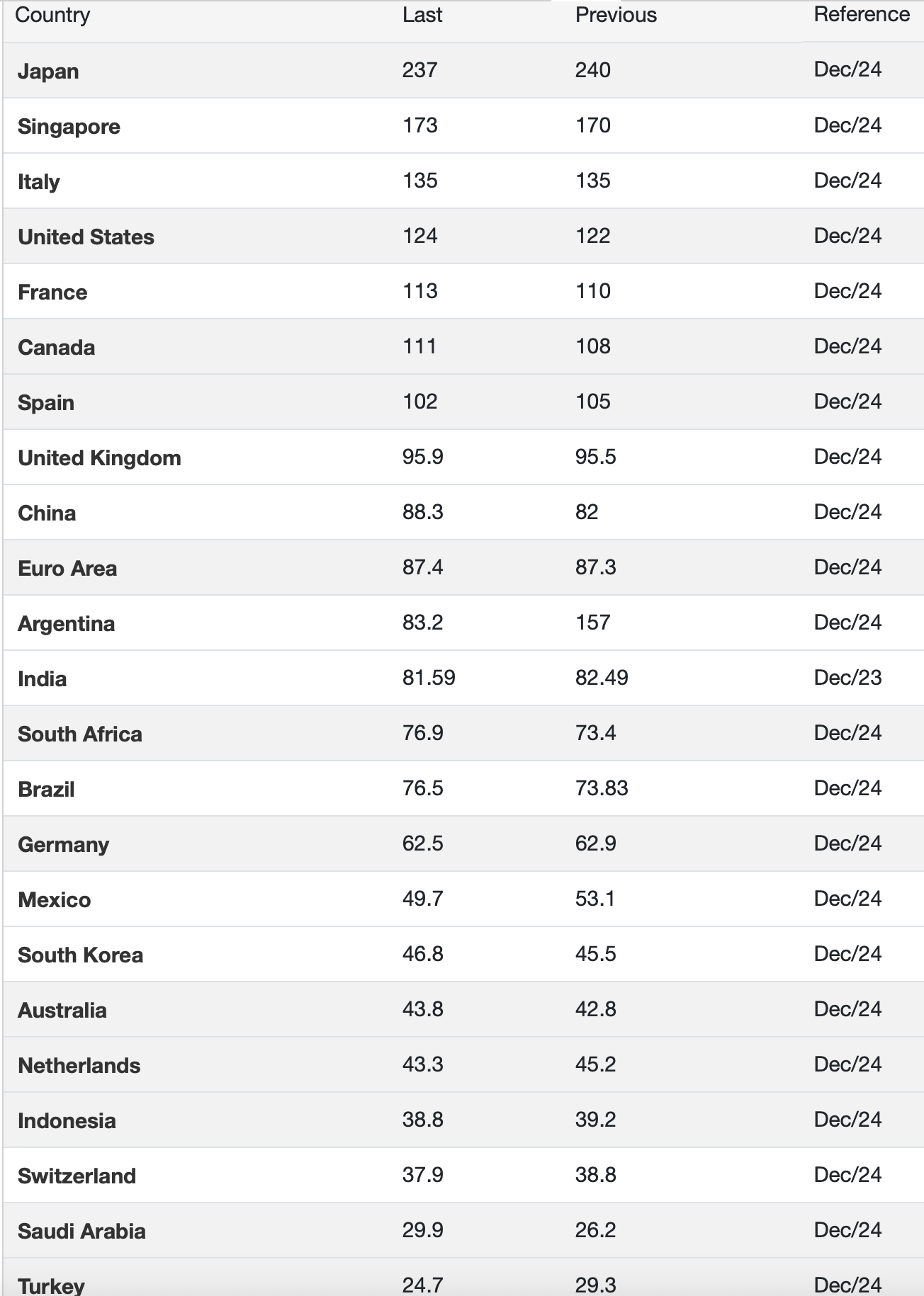
And remember what has been promised by Germany and the Eurozone with respect to defense spending? More than €1 trillion for Germany and it sounds, if my addition is correct, like upwards of €1.7 trillion across the continent.  And all of that will be borrowed, so that is another 22% in Germany alone.  The point is the global debt/GDP ratio remains above 300% for public and private debt.  As government debt grows above 100%, at some point, we are going to see central banks, in sync, clamp down on longer-term yields.  

However they couch it, and however they do it, whether actual yield curve control, through regulations requiring banks and insurance companies to hold more government bonds on their balance sheets with no capital charges, or through adjustments to tax driven accounts like IRA’s and 401K’s, requiring a certain amount of government debt in the portfolio to maintain the tax deferred status, I expect that is what we are going to see.  And even with oil prices declining, which I think remains the trend, inflation is going to be with us for a long time to come as debt will be monetized.  It is the only solution absent a depression.  And every central bank will be in on the joke.  Which takes us to this morning…

As yields were soaring
The BOJ kept quiet
Until yesterday

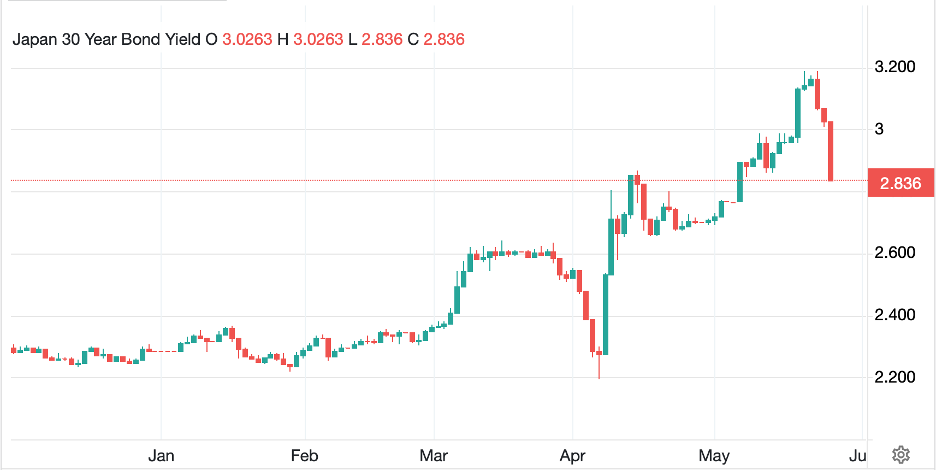
Apparently, the bond vigilantes have spent the past decades learning Japanese.  At least that is what I conclude from the price action, and more importantly, the BOJ’s recent response in the JGB market. As you can see in the chart below, there has been a significant reversal in 30-year JGB yields with similar price action in both the 20-year and 40-year varieties.
Source: tradingeconomics.com

You may recall that last week, the Japanese government issued 20-year bonds, and the auction went quite poorly, with yields rising sharply (that was the large green candle six sessions ago). Well, it seems that the BOJ (along with the Ministry of Finance) have figured out that the bond situation in Japan is reaching its limits. After all, in less than two months, 30-year JGB yields rose 100 basis points from a starting point of about 2.2%.  That is an enormous move.  Now, if we look at the table above, we are reminded that Japan’s debt/GDP ratio is the highest in the developed world at well over 200%.  In addition, the BOJ owns more than 53% of all JGBs outstanding.  Quite frankly, it is easy to make the case that the BOJ has been monetizing Japanese debt for years.  

As it happens, last week the BOJ held one of their periodic (actually, the 22nd) “Bond Market Group” meetings in which they discuss with various groups of market participants the situation in the JGB market regarding liquidity and trading capabilities and the general functioning of the market.  The two charts below, taken from the BOJ’s website (H/T Weston Nakamura) demonstrate that there is growing concern in the market as to its ability to continue along its current path.
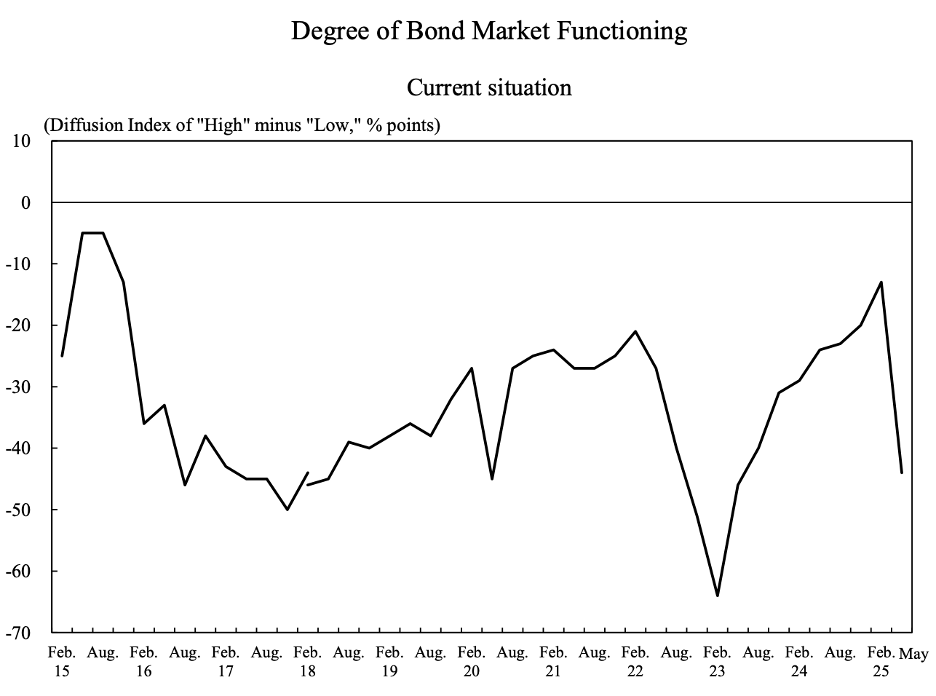
The concern demonstrated by market participants is a clear signal, at least to me, that we are entering the end game.  For all the angst about the situation in the US, with excessive fiscal expenditures and too much debt, Japan has that on steroids.  And while Japan has the benefit of being a net creditor country, the US has the advantage of having both the strongest military in the world and issuing the world’s reserve currency.  As well, the US neighborhood is far less troublesome than Japan’s in East Asia with two potential protagonists, China and North Korea.  All I’m saying is that after decades of kicking the can down the road, it appears that the road may be ending for Japan and difficult policy decisions regarding spending, deficits and by extension JGB issuance are coming soon.

It’s funny, many economists have, in the past, described the US situation as Japanification, with rising debt and slowing growth.  But perhaps Japanification will really be the road map for how to respond to the first true limits on the issuance of government debt for a major economy.  Last night, JGB yields fell across the board, dragging global yields down with them.  The yen (-0.8%) weakened sharply, reversing its trend of the past two weeks, while the Nikkei (+0.5%) rallied.  Perhaps market participants are feeling comforted by the fact the Japanese government seems finally ready to recognize that things must change.  But this is the beginning of that process, not the end, and there will be many twists and turns along the way.  Stay tuned.

Ok, I really ran on, but I feel it is critical for us all to recognize the debt situation and that there are going to be changes coming.  As to other markets overnight, this is what we’ve seen.  Asia was mixed with gainers (Hong Kong, Australia, Singapore) and laggards (China, Korea, India, Taiwan) but nothing moving more than 0.5% in either direction.  Europe, on the other hand, has been the beneficiary of President Trump delaying the tariffs on the EU until July 9th, with all the major indices higher led by the DAX (+0.8%) which also rallied more than 1% yesterday.  Say what you will about President Trump, he has gotten trade discussions moving FAR faster than ever before in history.  US futures, at this hour (6:15) are also pointing nicely higher, more than 1.3% across the board.

We’ve already discussed bond yields where 10yr Treasury yields have backed off by 5bps this morning although European sovereign yields have not benefitted quite the same way with declines of only 2bps on average.  But the trend in all cases is for lower yields right now.  Hope springs eternal, I guess.

In the commodity space, with the new view on tariffs, risk is abating and gold (-1.5%) is being sold off aggressively.  Not surprisingly, this has taken the whole metals complex with it.  As to oil (+0.1%) it continues to trade in its recent $60 – $65 range and while the trend remains lower, it is a very slow trend.

Source: tradingeconomics.com

Finally, the dollar is perking up this morning, not only against the yen, but across the board.  On the haven front, CHF (-0.6%) is sinking and the commodity currencies (AUD -0.6%, NZD -0.8%, SEK -0.6%) are also under pressure.  But the euro (-0.4%) is lower and taking the CE4 with it.  In fact, every major counterpart currency is lower vs. the dollar this morning.

On the data front, this morning brings Durable Goods (exp -7.8%, -0.1% ex-transport), Case Shiller Home Prices (4.5%), and Consumer Confidence (87.0). We also hear from NY Fed President Williams this evening.  Chairman Powell spoke at the Princeton graduation ceremony but said nothing about policy.  I will review the rest of the week’s data tomorrow.

Bonds are the thing to watch for now, especially if we are going to see more active policy adjustments to address what has long been considered an unsustainable path.  The question is, will there be fiscal adjustments that help?  Or will central banks simply soak up the bonds?  While I hope it is the former, I fear it is the latter.  Be prepared.

Good luck

Adf

Never-Ending

A landing that’s soft’s now the bet
By many who poo-poo the debt
But deficit spending
Which seems never-ending
Means prices ain’t coming down yet

So, nominal growth may still rise
Inflation, though, will not downsize
And yields on the bond
Are like to respond
By soaring right up to the skies

Fitch downgraded US government debt one notch to AA+ from its previous AAA.  Now, only Moody’s rates the US a AAA credit.  As per their announcement, their rationale was threefold: “The rating downgrade of the United States reflects the 1) expected fiscal deterioration over the next three years, 2) a high and growing general government debt burden, and 3) the erosion of governance relative to ‘AA’ and ‘AAA’ rated peers over the last two decades that has manifested in repeated debt limit standoffs and last-minute resolutions.”   

Let’s forget the political implications and the commentary from the government as it is completely expected.  And I am not here to defend or attack the outcome, but rather hope to try to make sense of what they were thinking and how markets are likely to behave.

Regarding the first issue, expected fiscal deterioration over the next three years, that seems a pretty fair point.  After all, fiscal deterioration has been consistently getting worse since the turn of the century, the last time we had a budget surplus.  In fact, as per the below Bloomberg chart, absent the Covid drama, the current budget deficit, at -8.5% of GDP, is larger than any time other than the GFC.  And this is occurring when, not only is there no recession, but GDP seems to be accelerating.  In fact, the Atlanta Fed’s GDPNow forecast has jumped up to 3.86%.  It seems fair to ask if part of that ‘growth’ is a direct result of deficit spending.

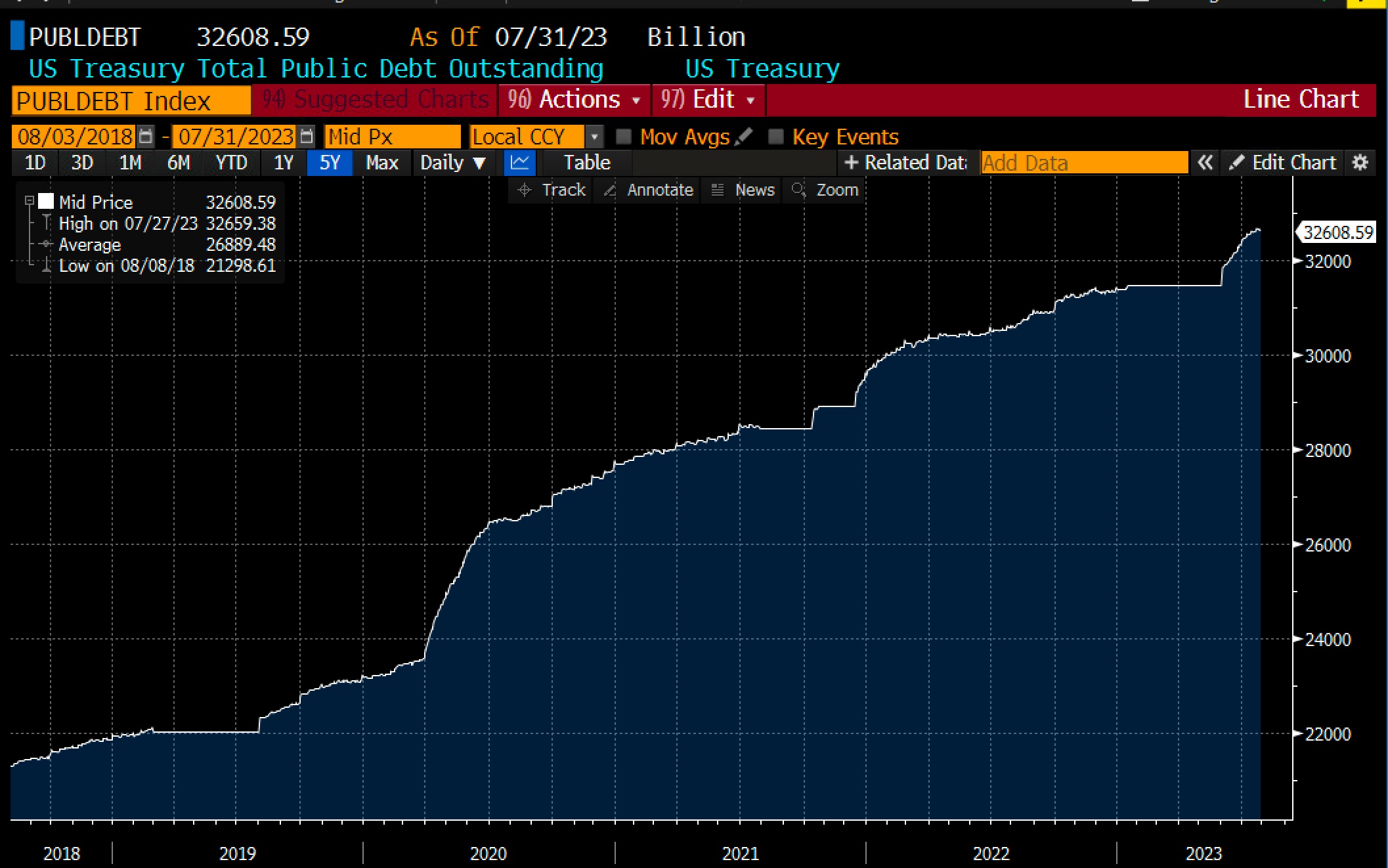
As to point number two, a high and growing government debt burden, that also seems like a fair point.  Since the debt ceiling was removed, government debt has grown by ~$1.2 trillion in exactly 2 months’ time (see Bloomberg chart below).  At the same time, the Treasury just announced they would be issuing $1.9 trillion in new debt during the rest of 2023.  Those are pretty big numbers and based on the legislation that was passed last year, the IRA and CHIPS act, as well as the fact that recent tax revenues have been declining, it is reasonable to expect the government debt burden to continue to grow.  

Finally, this poet is in no position to judge the relative erosion of governance compared to other nations, but on an absolute basis, it is not hard to argue that governance in the US has diminished, at least fiscal governance, given the political split between the House of Representatives and the Senate/White House.

Of course, this all begs the question, does it matter for markets?  Well, we have seen this movie before in 2011 when S&P downgraded the US government credit rating after the last standoff in Congress regarding the debt ceiling.  While it was a big deal politically, it actually had limited impact on the markets.  In fact, it may fairly be said that it marked the bottom in the equity market and ignited a massive multi-year rally.  Can we expect the same thing this time?  I would contend the situation now is quite different than back then, with a much higher debt/GDP ratio as well as a much higher level of interest rates.  The point is that the government’s fiscal stance is more tenuous now as interest payments on existing debt either start to crowd out other spending or drive deficits even higher, as per Fitch’s point.

Back then, 10-year yields were also much lower, ~2.5%, and the debt/GDP ratio was ~90% as compared to today’s ~120%.  In other words, there was a little more flexibility for the government.  In fact, following the move, bond yields fell another 100bps over the ensuing year, bottoming at 1.39%, the pre-Covid low.  An optimistic reading of that outcome is that investors looked around the world and decided that despite the flaws in the US, it was still the safest place to be.  Of course, that low interest rate coincided with the Eurozone debt crisis, so perhaps investors were simply fleeing the euro (the dollar did rally) given those problems.

So far, the reaction has been a downtick in equity markets and little movement in the bond market.  But it is not clear to me that either of those moves are directly related to this news.  Rather, it is entirely possible that we are starting to see the effects of what Fitch is describing, rather than the effects of Fitch’s move.

For instance, there is a growing perception that a soft landing is going to be the result of the Fed’s policy moves.  While inflation has obviously fallen from its highs of last year, the two things that have been driving that, lower commodity prices and base effects in the calculation, are reversing going forward.  For instance, oil prices are higher by nearly 17% in the past month while the monthly comparison for CPI in July is just 0.0%, so any inflation at all is going to result in a rise in the Y/Y figure.  

Instead, I would contend that the massive fiscal stimulus from the IRA and CHIPS Act are going to continue to drive demand, as well as debt issuance, and continue to pressure inflation higher.   While nominal growth may remain firm, inflation will too, so real growth will decline.  Arguably, the government needs this outcome in order to devalue their massive debt pile.  However, whether this will be a positive for risk assets is a much tougher question.  Certainly, bond yields are likely to rise in this scenario, and if that is the case, I suspect equity markets may start to revalue as well.  Government spending is not organic economic growth. Instead, it is far less efficient and debt driven, thus underpinning the Fitch viewpoint.  I fear that this time, the ratings downgrade may result in a different result than last time, with risk assets suffering as we go forward.

And that was certainly the case last night as equity markets throughout Asia were all in the red, as are European equities this morning.  Notable declines were seen in Japan (-2.3%), Hong Kong (-2.5%) and Spain (-1.2%), but it is universal.  As to US futures, they are all in the red as well this morning.

As to the bond market, 10-year Treasury yields are back above 4.0%, although they are little changed this morning.  Remember, the last several times the 10-year yield has gone above 4%, there have been problems somewhere in the market, with the UK bond meltdown and Silicon Valley Bank’s implosion the most widely remembered.  The curve is steepening (really getting less inverted) because long rates are rising, not because the Fed is cutting.  If the yield curve heads back to normal with 10-year yields at 5.5%, consider how that will impact equities.  It won’t be pretty.

Away from oil prices, base metals are under pressure this morning as well, potentially because China has yet to offer real support to its economy, or potentially because yields continue to rise thus hurting the investment case.

Finally, the dollar is broadly stronger this morning, certainly against the EMG bloc with KRW (-1.1%) and PHP (-0.75%) the laggards, but weakness widespread.  Both of those currencies are reacting to fading data and concerns over China’s actions going forward.  Meanwhile, in the G10, NOK (+0.45%) and JPY (+0.4%) are the outliers on the high side, with the former following oil while the yen’s move looks to be a trading bounce given the lack of news or rate activity.    However, the rest of the bloc is under pressure led by NZD (-0.6%) and AUD (-0.5%) with both sliding alongside the metals markets.

On the data front, ADP Employment (exp 190K) is coming shortly *Flash, ADP +324K* with most analysts anxiously awaiting not only the headline print, but any revision to last month’s extraordinary 497K rise.  As to Fed speakers, there are none on the calendar today.  All in all, the market will be keenly focused on the ADP especially after mildly softer than expected JOLTS Jobs data yesterday as well as a soft ISM Employment print.  There are certainly still hints of an impending recession, but the situation remains very uncertain.  Remember this, though, prior to the GFC, the consensus view was that a soft landing was going to be achieved.  The same was true in 2001 and as far back as 1980.  The only time the Fed successfully engineered that soft landing was in 1994 and I am not of the mind that they are going to be successful this time.  It’s just not clear what is going to break first.

Good luck

Adf

No line in the Sand

The story from Janet and Jay
Continues to point to a day
In two years, nay three
That both can foresee
A rate hike could be on the way

Until then, while growth should expand
No policy changes are planned
If prices should rise
Though, we’ll recognize
There’s simply no line in the sand

With a dearth of new news overnight, the market appears to be consolidating at current levels awaiting the next big thing.  With that in mind, market participants continue to parse the words of the numerous central bank and financial officials who have been speaking lately.  Atop this list sits the second day of testimony by Fed Chair Powell and Treasury Secretary Yellen, who yesterday were in front of the Senate Banking Committee.  While several senators tried to get a clearer picture of potential future activities from both Powell and Yellen, they have become quite practiced at not saying anything of note in these settings.

Perhaps the most interesting thing to be learned was, when Yellen was being questioned about her change of heart on the growth of the Federal debt load (in 2017 she publicly worried over a debt/GDP ratio of 75% vs. today’s level of 127%), she repeated her new belief that the Federal government has room to borrow trillions of more dollars to fund their wish list.  “My views on the amount of fiscal space that the United States [has], I would say, have changed somewhat since 2017.  Interest payments on that debt relative to GDP have not gone up at all, and so I think that’s a more meaningful metric of the burden of the debt on society and on the federal finances.” She explained.  It is remarkable what a change of venue will do to one’s opinions.  Now that she is Treasury Secretary, and wants to spend more money, it appears much easier for her to justify the new borrowing required.

At the same time, Chair Powell explained that the rise in bond yields was of no concern and that it represented a vote of confidence in the growth of the economy.  We heard this, too, from Atlanta Fed President Bostic yesterday, and this is clearly the new mantra.  So, while 10-year yields have backed off their recent highs by a few basis points, be prepared for further movement higher as positive data gets released.  The bond market has a history of testing the Fed in times like this, and remember, history also shows that when the 2yr-10-yr spread starts to steepen, it doesn’t stop until it reaches 250-275 basis points, which is more than one full percent higher than its current level.  I expect to see that test sometime this summer, as inflation rises.  Beware the impact on risk assets in that scenario.

But other than that, and of course the fact that the Ever Given remains wedged side-to-side in the Suez Canal, there is very little happening in markets today. (Apparently, the economic cost to the global economy of this incident is $400 million per HOUR!  And consider what it is doing to the concept of just-in-time delivery for supply chains.  We have not yet felt the full impact of this event.)

A quick tour of markets shows that Asian equity markets were mixed, with the Nikkei (+1.1%), by far the best performer, while the Hang Seng (0.0%) and Shanghai (-0.1%) essentially tread water.  European markets are mostly red, but the movement has been minimal.  The DAX (-0.2%), CAC (-0.2%) and FTSE 100 (-0.3%) are perfectly representative of pretty much the entire European equity space.  Meanwhile, US futures are edging higher (NASDAQ +0.4%, SPX +0.25%, DOW +0.2%) after yesterday’s late day sell-off.  Anecdotally, one of the things I have noticed lately is that the US equity markets tend to close nearer their trading lows than highs, which is a far cry from their behavior up through January, where late day price action almost always pushed prices higher.  The other thing that is changing is that the huge retail push into single stock options has been fading lately.  Perhaps it’s not as easy to make money in the stock market as it was claimed several weeks ago.

As to the bond market, we continue to see modest strength in the European sovereign market, where the ECB’s impact is clear to all.  This morning, in contrast to Treasury yields edging slightly higher (+0.5bps), we are looking at yield declines of between 1.3bps (OATs) and 2.5bps (Gilts) with Bunds in between.  There is no question that the ECB’s purchase numbers this week will be close to last week’s rather than near their longer-term average.  As an aside, we heard from BOE chief economist Haldane this morning and he explained that the UK economy could be set for a “rip roaring” move higher in Q2 given the amount of savings available to spend as long as the vaccine roll-out continues apace.

On the commodity front, despite the ongoing disruption in the Suez, oil prices have slipped back by 1.3%, although continue to hold above the psychologically important $60/bbl level.  As to metals prices, they have drifted down as well, along with most agricultural products.  Again, the movements here are not substantial and are indicative of modest position adjustments rather than a new trend of any sort.

Lastly, turning to the dollar, it too has had a mixed session, with both gains and losses across the spectrum.  In the G10, AUD (+0.4%) is the leader, followed by the GBP (+0.3%) and then lesser gains amongst most of the rest.  Meanwhile, JPY (-0.35%) has been the laggard in the group.  Aussie was the beneficiary of short covering as well as exporter interest taking advantage of its recent declines, while the pound seems to have been responding to the Haldane comments of potential strong growth.  As to the yen, while there are some concerns the BOJ may cut back on its JGB purchases, it appears the yen was a victim of some importer selling ahead of the Fiscal year end next week.

EMG currencies are also mixed, with gainers led by RUB (+1.0%), ZAR (+0.7%) and MXN (+0.45%) while the laggards have a distinctly Asian flavor (THB -0.35%, MYR -0.35%, TWD -0.3%).  The ruble appears to be benefitting from a trading bounce after a 3-day losing streak, while the rand is gaining ahead of a central bank meeting today, although expectations are for no policy change given the still low inflation readings in the country.  On the downside, the Bank of Thailand left policy on hold, as expected, but forecast a narrowing of the current account surplus, thus weakening the baht.  Meanwhile, both the ringgit and the Taiwan dollar are suffering from concerns over continued USD strength in combination with some technical moves.  Overall, the bloc remains beholden to the dollar, so should the buck start to gain vs. the G10, look for these currencies to suffer more acutely.

As it is Thursday, we start the day with Initial Claims (exp 730K) and Continuing Claims (4.0M), but also see a Q4 GDP revision (4.1%, unchanged) along with some of the ancillary GDP readings that tend to be ignored.  In addition, we hear from five more Fed speakers, but it is hard to believe that any of them is going to have something truly new to tell us.  We already know they are not going to raise rates until 2023 at the earliest and that they are comfortable with higher inflation and higher bond yields.  What else is there?

With all this in mind, I keep coming back to the Treasury market as the single key driver of markets overall.  If yields resume their rising trend, look for the dollar to rally and equities to fade.  If yields edge back lower, there is room for modest dollar weakness.

Good luck and stay safe
Adf